Feeds:
Posts
Comments

Posts Tagged ‘History’

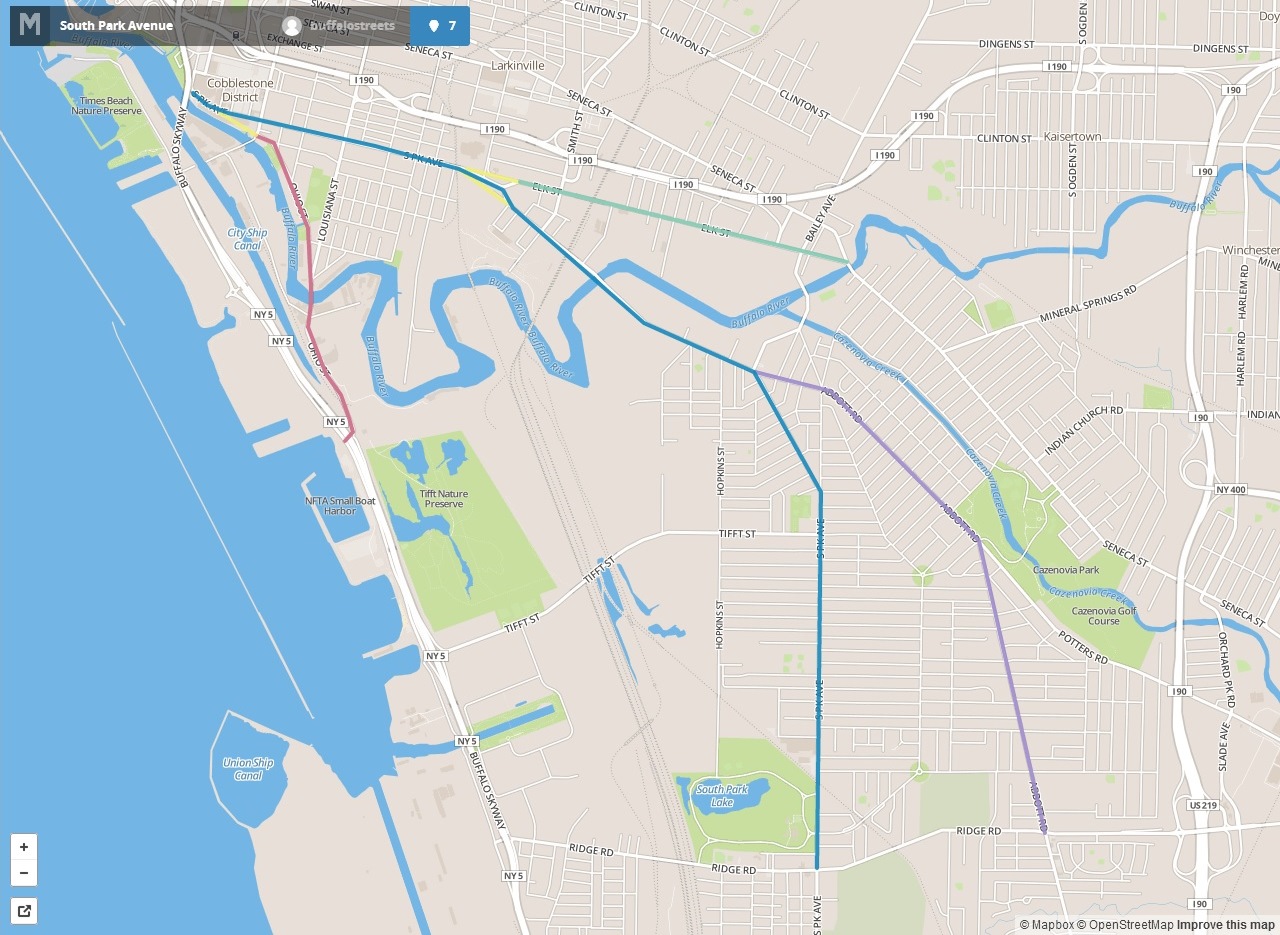
South Park Avenue shown in Blue.  Ohio Street shown in Pink.  Elk Street shown in Teal.  Abbott Road shown in Purple.  Yellow lines show connections that are no longer extant.

South Park Avenue shown in Blue. Ohio Street shown in Pink. Elk Street shown in Teal. Abbott Road shown in Purple. Yellow lines show connections that are no longer extant. (click map to zoom in)

South Park Avenue runs from Downtown Buffalo to the Buffalo-Lackawanna City Line (and beyond down into Hamburg where the road changes to Buffalo Street).  Ever wonder why South Park Avenue has some weird intersections?  It’s because the street was originally a bunch of different streets!  Not all street names are changed to honor famous or influential people.  In 1939, a proposal was presented to change the name of four streets to allow motorists to travel from the Lackawanna city line all the way to Main Street in Downtown Buffalo along one continuous road.

1899 View of Triangle Neighborhood

1899 View of Triangle Neighborhood

The proposal began thanks to efforts of the Tri-Abbott-South Park Businessmen’s Association.  They proposed that portions of Ohio, Elk, Triangle and Abbott Road  be named South Park Avenue.   Yes, there was a Triangle Road in the Triangle Neighborhood!  Triangle Road ran from Abbott Road to what is now Southside Parkway.  Southside Parkway was originally part of South Park Avenue, which ran from Ridge Road to Abbot Road).  Southside Parkway was renamed McKinley Parkway and a portion of South Park Avenue was renamed Southside Parkway.

The intent of the name change for South Park Avenue was to allow those entering the City of Buffalo from the Southtowns to be better able to find the downtown district.  At the time, when you were entering the City from Lackawanna, you would take South Park Avenue to Triangle Street, to Abbott Road, to Elk Street and to Ohio Street before you arrived at Main Street.  You saw five different street names, even though the roads were essentially a continuous thoroughfare.

Buffalo Memorial Auditorium

Buffalo Memorial Auditorium

The proposal to change the name was made around the time of construction of the new convention hall (Buffalo Memorial Auditorium) so it was anticipated that more people would be travelling into Downtown Buffalo for events.  Additionally, many people were expected to stop in Buffalo on their way to the 1939 World’s Fair in New York City.

The proposal was approved by the City Council on May 26, 1939.  At the time, the Council kicked around the idea of renaming the road “South Main Street”; however, they decided upon South Park.  Of the 38 organizations who comprised the South Park Taxpayers Improvement Association, 35 of them voted in favor of calling the “new” road South Park.  Representatives from near the Elk Street business district wanted the route to be called Elk street.

 Learn about the origins of other street names by checking out the street index.

Sources:

  1. “South Park Ave name chosen for proposed continuous thoroughfare.” Courier express April 29, 1939, p 7
  2. “South Park – Triangle – Abbott- Elk- Ohio route -what shall it be called” Courier Express Apr 21, 1939, p 7
  3. “South Park Avenue Lengthening Urged” Courier Express March 3, 1939.  Buffalo Streets Scrapbook Vol 2, 159

Read Full Post »

Often a group of streets will be named after a theme.  This is often seen when a developer may name a bunch of streets after his family members or friends.  Many people know that Washington, DC has streets named after all 50 states to form the City’s grid (crossed by alphabetic and numbered streets).   The City of Buffalo has streets named after 32 of the 50 states.  Many of these state street names originated in one of Buffalo’s original street grids.

Map of Village of Black Rock, 1816 Source:  New York State Archives

Map of Village of Black Rock, 1816
Source: New York State Archives

Many of the streets named after streets are located in what was the original development of the Village of Black Rock.  The Black Rock streets were originally laid out  two years before Joseph Ellicott came to Buffalo!  New York State purchased a one mile strip of land along the Niagara River known as the New York State Reservation in 1802.  The State laid out the streets of the Village of Black Rock.  For 20 years, Black Rock would serve as Buffalo’s rival.  In 1825, Buffalo won its fight to be the terminus of the Erie Canal, became a booming city, and annexed the Village of Black Rock in 1854.

State named streets in Black Rock include Georgia, Carolina, Virginia, Maryland, Pennsylvania, Jersey, York, Connecticut, Rhode Island, Massachusetts, Hampshire.  All of the original 13 colonies are represented by these streets, other than Delaware, which was originally located where Hudson Street is today.  When Buffalo and Black Rock merged, duplicate street names were changed to prevent confusion.  These streets all lay parallel to each other in what is now the West Side of the City of Buffalo, but was originally known as the South Village of Black Rock or Upper Black Rock.  When originally laid out, these streets formed a grid with numbered streets.  The streets were laid out by Lemuel Forester, a Surveyor for New York State.  You can read about the numbered streets in Buffalo by clicking here.  These streets form what was known as Upper Black Rock.  Peter Porter was an important person in the early days of Black Rock.

It is important to note that it is difficult to differentiate between states such as North and South Carolina or Virginia and West Virginia, as the cardinal directions (north, south, east, west) are used in street naming conventions.  Early maps of Black Rock show Jersey, York and Hampshire as New Jersey, New York and New Hampshire, but as time elapsed, the convention to name streets “New” to differentiate between different alignments of a street which changed over time, of which the alignment’s name may be “New _____ Street” or “Old ______ Street”.

Streets in Buffalo Named After States

Streets in Buffalo Named After States  (click to view larger image)

The City also has streets named after the following states:

  • Alabama
  • Arkansas
  • California
  • Colorado
  • North and South Dakota (as Dakota Street)
  • Delaware
  • Florida
  • Illinois
  • Kentucky
  • Louisiana
  • Michigan
  • Minnesota
  • Mississippi
  • Montana
  • Nevada
  • Ohio
  • Oregon
  • Tennessee
  • Texas
  • Vermont
  • Washington
  • Wisconsin
  • Wyoming

There are several streets named after states that used to be located in Buffalo.  These streets names have been removed for various reasons:

Portion of 1900 Sanborn Map depicting locations of Idaho and Arizona Streets.

Idaho Street and Arizona Streets– were located in North Buffalo off Military Road, north of Sayre Street.  The Buffalo Foundry was located here, and industrial facilities eventually absorbed the streets.

1951 Sanborn Map showing the former location of Indiana Street


Indiana Street was located near the foot of Main Street.  The street was eliminated when Crossroads Arena (aka Marine Midland, aka HSBC, aka First Niagara Center) was built.  The street is currently buried under First Niagara Center.

1925 Sanborn Map Showing Alaska Alley

1925 Sanborn Map Showing Alaska Alley

Alaska Alley  – was closed on February 24, 1960.  This was a small alley off of Chippewa near Genesee and Washington.   The block where Alaska and Seward Alleys were located is now parking for the Electric Tower building.

Iowa – used to be the part of LaSalle Avenue from Bailey to Eggert (near Minnesota Avenue).  However, they changed the name when they wanted to rename Perry Street to Iowa Street.  They then decided that Perry was too important to change the name of the street.  At this time, they also tried to change the name of Fulton Street to Oklahoma, but also decided that Fulton was too important of a person to change the name of the street.

In 1901, the City wanted to rename Indian Church, Hudson or South Division Street to Missouri.  Residents complained because it sounded like “Misery” to them, and they did not want to live on “Misery Street”.

There is no Maine Street, because it would be confusing because it sounds like Main Street.

I was unable to find evidence of streets in Buffalo named after the following five states:

  • Kansas
  • Nebraska
  • New Mexico
  • Utah
  • Hawaii

Buffalo Ex-Pats living in the Washington, DC area will be happy to know that Columbia Street, in the Cobblestone District near the arena, is named after the District of Columbia.

To answer the “which street named after a state is your favorite?” question – mine is York Street.  My dad moved to Buffalo (from Central New York….and after time spent in the Navy) in 1978 and his first apartment here was on York Street.  My parents lived there when the first got married.  This is where my branch of the Keppel family started in Buffalo.  🙂

To read about other streets, click the Street Index.

Sources:

  1. “Many Changes Made in Names of Streets Here” Courier Express, August 26, 1928
  2. “New Names for Streets” Buffalo Express Oct 7, 1901
  3. “Council Closes Alaska Alley” Buffalo Courier Express, February 24, 1960.

Read Full Post »

rohrstreetRohr Street is a street in the Martin Luther King, Jr., Park neighborhood on the East Side of Buffalo.  The street runs between Walden Avenue and Northampton Street, a few blocks from the park.

Rohr Street is named for Mathias Rohr, president of the Volksfreund German Newspaper.  Mr. Rohr was editor of the Volksfreund for 14 years.  Although he wrote his editorials for the paper in his native German, Rohr was 100% proud to be an American.

rohr2Mr. Rohr was born in Germany in 1840.  At the age of 16, he became a teacher in his village of Zemmer. During his school days, Mr. Rohr had heard of a man from his village who had gone to America as a poor teacher and returned to Germany as a rich man.  Mr. Rohr longed for the freedom in America, so he dedicated himself to learn the English language.  At the time, studies outside of the traditional curriculum were forbidden at his school.  He also studied French and German literature, which was helpful in his later job as a journalist.  At the age of 28, he came to America.  A representative of the Central Zeitung, a German newspaper in Buffalo, met him at the dock and offered him a position as editor.  Two years later, he joined the editorial staff of the Buffalo Volksfreund.  Starting in 1883, he also served as a representative for the New York Life Insurance Company of Germania.  In 1904 he became president of the Buffalo Volksfreund.  Under his leadership, the Buffalo Volksfreund became one of the most important German-American newspapers in the country.   In 1913, he sold his interest in the paper.

Ad for the Buffalo Volksfreund from 1891.   The daily newspaper cost 25 cents every 2 weeks, or $6 per year if prepaid.  For this price, the paper would be mailed to readers in the local area in both the United States and Canada.  The weekly version could be sent to Europe or other regions for $2.60 per year.

Ad for the Buffalo Volksfreund from 1891.
The daily newspaper cost 25 cents every 2 weeks, or $6 per year if prepaid. For this price, the paper would be mailed to readers in the local area in both the United States and Canada. The weekly version could be sent to Europe or other regions for $2.60 per year.  The Volksfreund offices were at 14-16 Broadway.

He was a member of the first board of the Buffalo Public library and was an original subscriber to the former Buffalo Orchestra and a contributor to the original music hall.  He was considered a gifted writer and in addition to his journalistic writing, he wrote numerous poems, essays and novellas that were published in newspapers and periodicals.  He published a book of poems in German written about Niagara Falls “On Niagara” in 1900 (which can be read here in German).  He also published a book titled Oreola, the Pearl of the Iroquois and Other Stories of Indian Life.  He served as President of the Broadway Brewing & Malting Company.

rohr

Mr. Rohr married Miss Sophie C. Reichert in 1869.  The couple had 11 children.  Mr. Rohr owned property on Rohr Street, but he never lived there.  His home was at 186 Edward Street, near Virginia.  The house on Edward Street is still standing.  Mr. Rohr was also an active member of the Catholic Church.  In 1874, he was selected as a delegate of the Catholic Union of Buffalo to Rome and Lourdes.  He was also a member of Orpheus, the German Literary Society, and the Knights of Columbus.

rohrgraveMr. Rohr passed away in 1920 and is buried in the United German and French Cemetery in Cheektowaga.

Mr. Rohr’s son Frank was the founder and president of the Broadway Businessmen’s Association.  This group was the organization that abolished the fenced park that was once Lafayette Square.  Under their leadership, Broadway cut through the Square to Main Street.  Since the Holland Land Company had deeded the Lafayette Square property to the City on condition that it be maintained as a park, surrounded by a fence, when traffic congestion had dictated that the road cut through the park, public condemnation notices had to be published in the newspapers of the Netherlands to be read by any surviving persons interested in the Holland Land Company.  Mr.  Frank Rohr also worked with the association to bring the Broadway Auditorium to open.

Sources:

  1. “Rohr Street Memorial of Volksfreund Editor” Courier Express Feb 19, 1939, sec 5
  2.  White, Truman C, ed.  Our County and its People:  A Descriptive Work on Erie County, New York.  The Boston History Company:  1898.
  3. The History of the Germans in Buffalo and Erie County. Published by Reinecke & Zesch.  Buffalo, NY: 1898.
  4. Mueller, Jacob.  Buffalo and Its German Community.  German American Historical Society:  1911-12.

Read Full Post »

Often, streets are named after a developer’s family. This is the case for a bunch of streets in the Kensington-Bailey neighborhood on the East Side of Buffalo.  In particular, the streets between Bailey Avenue and Eggert Road, north of the Kensington Expressway are mostly named after the Bickford Family’s first and middle names:

Streets in the Kensington-Bailey neighborhood named by Bickford

Streets in the Kensington-Bailey neighborhood named by Bickford

The following streets were named for Bickford and his family:

  • Alice Ave
  • Bickford Ave
  • Davidson Ave
  • Hastings Ave
  • Phyllis Ave
  • Martha Ave
  • Gail Ave
  • Millicent Ave
  • Edith Ave
  • Godfrey St
  • Leonard St
  • Kay St
  • Janet St
General Bickford and Mary Davidson Wedding, 1904

General Bickford and Mary Davidson Wedding, 1904

Harold C. Bickford was born and raised in Toronto.  He married Mary Davidson in 1904.  Mary and Harold had seven children – Mary, Edward, Phyllis, Beatrice, Millicent, Harold and Faith.  General Bickford served in three major conflicts for the British Army – the Boer War of South Africa (1899-1902), World War I (1914-1918) and the Russian Civil War (1918-1920).  He was stationed in England, South Africa, India and France.  Several of his children were born were born overseas.

General Bickford returned from the war, moved to Buffalo and divorced his wife.  He left her with a nanny and seven children.  Mary died of appendicitis in 1935.  It was reported that the children had a difficult relationship with their father, which may be why he named the streets after them.

General Bickford Grave

General Bickford Grave

General Bickford died in 1956 and is buried in St. James cemetery in Toronto.

 To learn about other streets, check out the Street Index.

Sources:

Read Full Post »

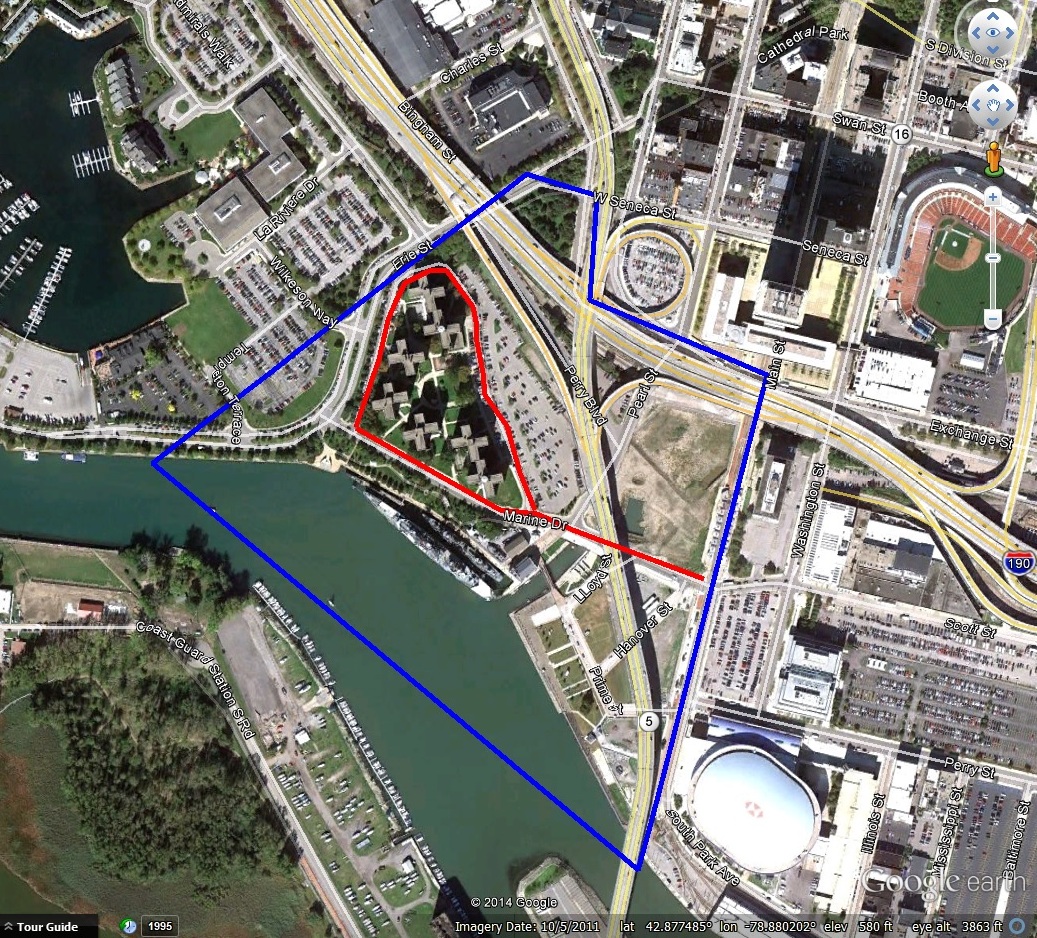
Marine Drive depicted in red.  Canal District depicted in blue.

Marine Drive depicted in red. Canal District depicted in blue.

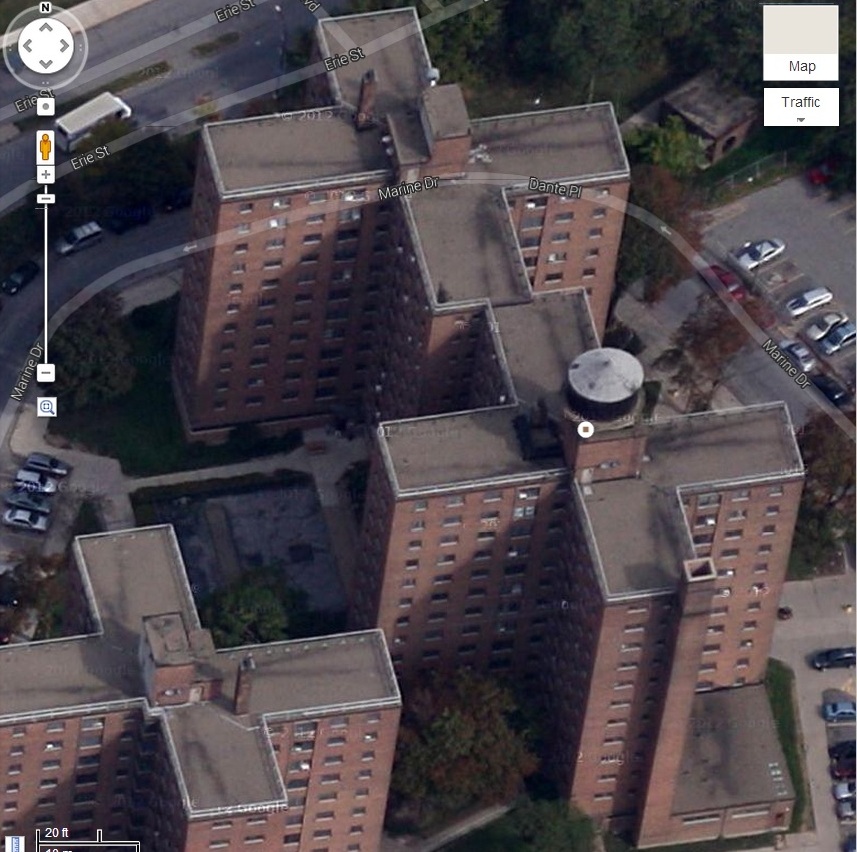
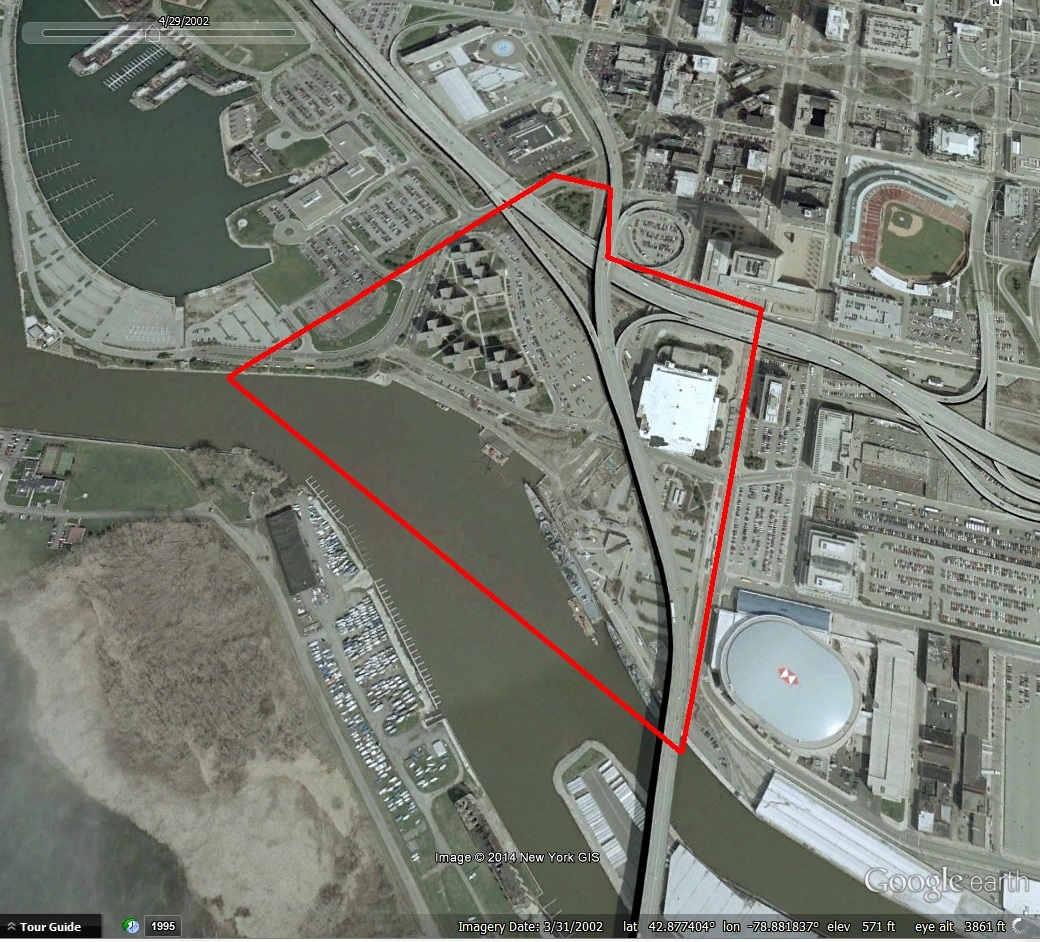
This post is the third and final park in a series on the history of Buffalo’s Canal District.  Click here to read Part One, about the early days of the Canal – the Canal Street era.  Click here to read Part Two – the Dante Place era.  Today’s post is about the Marine Drive era of the Canal District.  Marine Drive replaced Dante Place during the 1950s.  Marine Drive stretches from Main Street to Erie Street and forms a loop, intersecting upon itself after circling around the Marine Drive Apartments.  If you zoom in far enough on online maps, you’ll see that a small part of Marine Drive still holds its claim as “Dante Place”, at least according to google!

Little sliver of Dante Place (top center part of picture) still shows up in Google!

A little sliver of Dante Place (top center part of the picture) still shows up in Google!

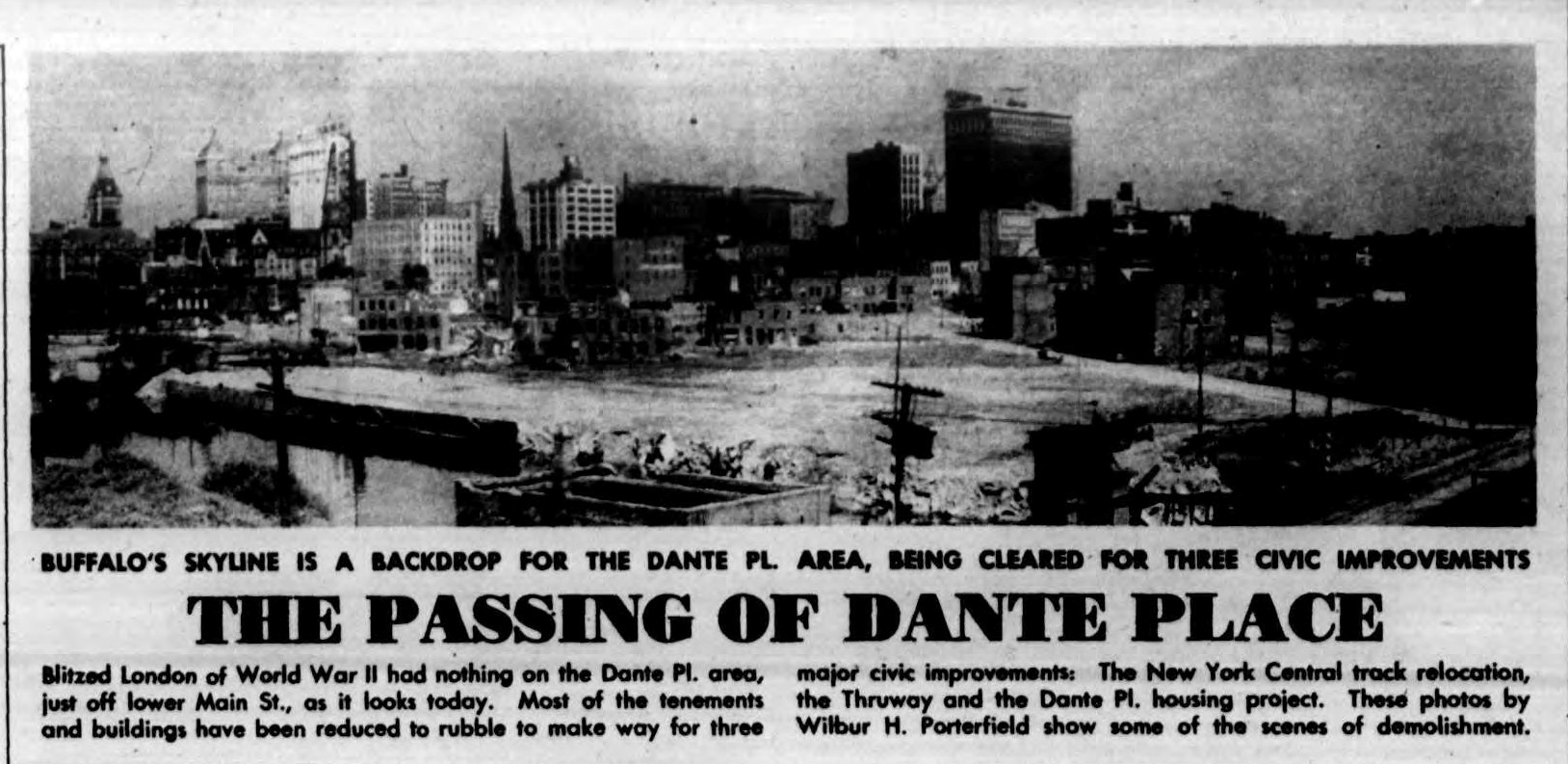
Plans were developed to build “Fairhaven Village”, a private development for 1,078 middle-income families.   After a building explosion in 1936 and the 1936 State Law allows cities the right to condemn and remove “unsafe and unsanitary” buildings,  buildings began to be demolished.  Approximately 500 families moved out of the neighborhood in the summer of 1937.   It was to be one of the first slum clearance rehabilitation projects in the Country.  Early plans for Fairhaven Village  in 1938 called for accommodations for 962 families with a total of 2,942 rooms.  The apartments were to include a 500 car garage to be built below grade of the apartments.  The apartments were to average $17.50 a room, including hot and cold water, gas, electricity and refrigeration.  It was going to be the first project of its kind to be privately owned, managed and financed.    At the time, there was a rental shortage in Buffalo, and reports estimated that there were close to 7,000 families living doubled (or tripled) up in apartments meant for one family.   However, the effects of the Great Depression and later wartime restrictions limited the construction funds to build the development.

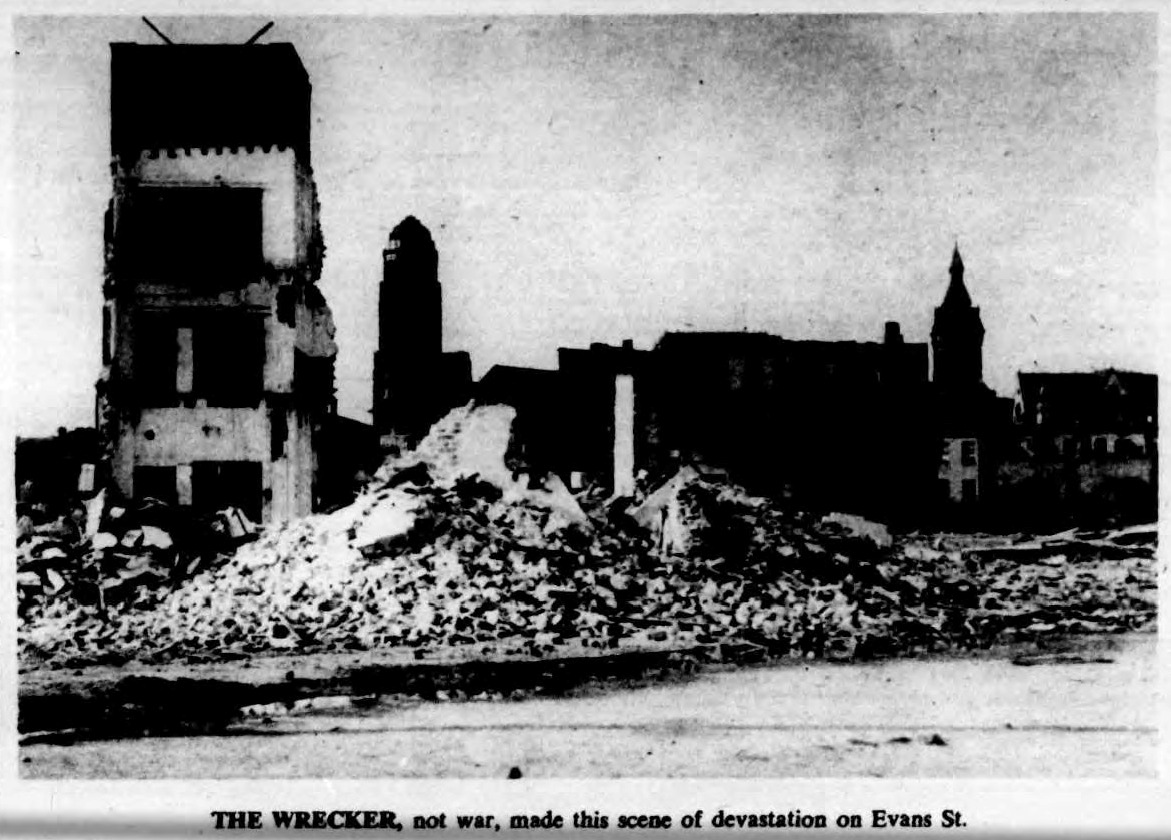
Evans Street Demolition 1950s.  Note City Hall in the rear background of the photo.

Evans Street Demolition 1950s. Note City Hall in the rear background of the photo.

After WWII, the Buffalo Municipal Housing Authority began plans for low-income housing in the Dante Place district, despite local opposition.  In 1948, 90 families were displaced by the State for construction of new housing, which began in 1950.  The Dante Place Projects were completed in 1952, residents moved in during September of that year.   The seven 12-story buildings were the first permanent state-aided housing in the City of Buffalo and consisted of 616 units.  Each building contains a mix of one, two, three, and four bedroom apartments.

Photo from the Courier Express - 1950 during demolition for construction of the Dante Place Project

Photo from the Courier Express – 1950 during demolition for construction of the Dante Place Project

When the Dante Place Project was in its planning stages, Howard Kelly of the Municipal Housing Authority stated:  “We hope that this will be the first step of a waterfront beautification program which will continue right through to Porter Ave”.

Ad for bathtubs installed in Dante Place Project

Ad for bathtubs installed in Dante Place Project

Dante Place Project tenants protesting their eviction.  Source:  Artvoice

Dante Place Project tenants protesting their eviction. Source: Artvoice

By 1960, many of the tenants of Dante Place Project were those displaced from condemned substandard housing on a the Lower East Side of Buffalo, a historically black section of the City.  The Dante Place projects had become again considered to be a slum area.  The BMHA was losing money due to unfilled apartments.  The BMHA responded by moving low-rent residents back to the Douglass Towers and the Ellicott and Talbert Mall.  This was the first attempt in the country to convert public low-cost housing into privately owned development.  The tenants formed the Dante Tenants Defense League to represent the 400 families remaining in the project and fight the evictions.  In 1960, the group went to the state housing commissioner, but they were unsuccessful fighting the conversion of the complex.   New York State Supreme Court Judge Catalano ruled in October 1960 that the conversion was not in violation of New York Public Housing Law.

1951 Aerial view of the Canal District

1951 Aerial view of the Canal District – Dante Place Project/ Marine Drive Apartments shown in center

By 1961, Dante Place resembled what had been originally been proposed as the Fairhaven Village – converting the complex from public housing to subsidized moderate income rental apartments.  A $300,000 remodel was completed and the apartments were rented out.  This project was the first time in the United States that a low-income housing project was converted into a private non-profit middle-income apartment development.  Once the new complex reached 92% occupancy, the tenant stockholders elected a board of directors and officers to manage the development.  The complex was renamed Marine Drive Apartments.

When planning for the Dante Place Projects, there was a great discussion among the City Planning Board members regarding what to name the new street.  Councilman John Ramunno argued for the new street to be named “Dante Place” to keep with the history of the neighborhood.  However, the Council President and others protested because they wanted a new name that did not have a connection to the past, the history of the neighborhood, or the Italian culture that it represented.  The Council eventually voted in favor of removing ties to the “old environment” and Marine Drive was named due to the waterfront neighborhood’s location.

As part of the Downtown Urban Renewal Plan, development of the Waterfront Village began.  The first condos opened in Waterfront Village in Summer 1972.   In 1974, the Erie Basin Marina was completed, built by slag from Bethlehem Steel.  The gardens at the Marina were developed by Stanley Swisher, supervisor of the grounds for the City’s Engineering Department.  Stanley Swisher would plant a new bed of perennials each year.

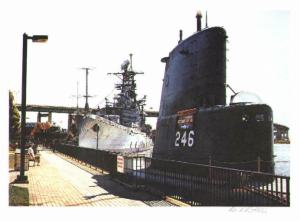
In 1979, the Buffalo Naval and Servicemen’s Park opened.  The original display included the USS Little Rock and the USS The Sullivans.  In 1988, the submarine the USS Croaker was added to the display.

Other than the Marine Drive Apartments and Waterfront Village, since the 1950s, much of the Canal District sat vacant and silent.  The Central Wharf and the Commercial Slip were buried and covered in stone and parking areas.

2002 Aerial View of the Canal District

2002 Aerial View of the Canal District

Buffalo and Erie County Naval and Military Park

Buffalo and Erie County Naval and Military Park

In 1999, as part of Phase I of the Erie Canal Harbor plan, the Naval Park moved as part of a $15.5 million dollar improvements to the Erie Canal Harbor.  Memorials were moved to the newly created Veteran’s Park.  The USS Little Rock, the Sullivans and the Croaker were repaired and moved to the new Naval Basin.  The existing esplanade facilities were enhanced and expanded to create a continuous walkway along the edge of the water.

Canalside

Canalside

The Erie Canal Harbor Development Corporation was created in 2005 to help restore economic growth to Buffalo and WNY’s waterfront.  Phase II of the Erie Canal Harbor plan was completed in 2008 and included the re-watering of the Commercial Slip, a towpath/walkway on the edges of the slip, construction of a bowstring truss bridge, the reconstruction of Commercial Street, Lloyd Street, Perry Street and Hanover Street, and the uncovering and preservation of the Steamboat Hotel and Lloyd street as an archeological site.  A wooden wharf was created, along with floating docks.  This area is referred to as Canalside, a 20-acre part of the historic Canal District. Canalside has been successful in drawing people down to the waterfront – offering programming, events, festivals and other attractions.   Canalside has more than 750 events and 750,000 visitors annually.

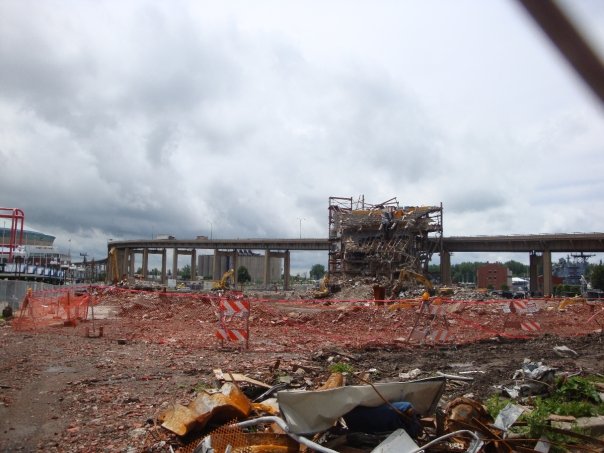
Demolition of the Aud

Demolition of the Aud

Memorial Auditorium closed in 1996, when the Buffalo Sabres, Blizzards and Bandits moved across the street to the newly built Crossroads Arena (now First Niagara Centerclick here to learn more about the name of the Arena).  Plans to renovate and repurpose the Aud were shuffled around for years, including the reuse of the Aud as a Bass Pro site.  In 2007, the Aud was sold by the City of Buffalo to ECHDC.  Salvageable items were removed to be sold, stored or removed.  Asbestos removal and environmental remediation of the Aud site was performed in 2008 and demolition began in January 2009.  A farewell ceremony was held June 30, 2009 to open the time capsule from 1939 and say goodbye to the Aud.

The Aud Block is currently being redeveloped, which includes development parcels based on the historic street grid.  One of the parcels will be developed by the Explore and More Children’s Museum.  Additional restaurant and public spaces are anticipated to be developed as well.  Water features on the Aud Block will be interpretations of the alignment of the Erie Canal, Main and Hamburg Canal, and the Commercial Slip.  Across Main Street on the Donovan Block, south of the newly opened One Canalside, a portion of the canal water feature will be included, as well another development parcel.  These projects, along with Harbor Center, will create the next phase of the Canal District’s development.

2011 View of the Area, showing the rewatered commercial slip, recreated historic street pattern an demolished Aud site

2011 View of the Area, showing the rewatered commercial slip, recreated historic street pattern and the demolished Aud site

Buffalo’s Canal District has been a unique part of Buffalo’s story since the founding of the City of Buffalo.  The district has had several lives – from seedy underbelly, Little Italy’s crowded tenements, public housing, to sitting dormant and the recent redevelopment. As Canalside continues to be developed, the story will continue to unfold.  I can’t wait to see what comes next!

Check out the Street Index to read about other streets.

Sources:

  1. “Housing Project Rises wehre Canalers Roistered” Courier Express 10-29-1952
  2. “Lusty Canal St. Lived Hard and Fast in Heyday” Courier Express 10-26-1952
  3. “Dante Area Streets Get Single Name” Courier Express, November 11, 1960 Buffalo Streets Vol 1.
  4. America’s Crossroads:  Buffalo’s Canal Street/ Dante Place.  Buffalo NY Heritage Press, 1993.
  5. Dug’s Dive.   Buffalo Express Saturday Morning August 29,1874
  6. Hart, Mary Bronson.  Partitioning Poverty:  Zones of Influence in Social Work.  Boston Evening Transcript.  August 29, 1900.
  7. Syracuse, Buffalo Illustrate Broadened UR Concept.  The Evening News.  Newburgh, NY.  August 9, 1961.
  8. Yans-McLaughlin, Virginia.  Family and Community:  Italian Immigrants in Buffalo, 1880-1930.
  9. First Tenants to Move into Dante Project.  Buffalo Courier-Express.  August 31, 1952.  8-A.
  10. Crowbars End Lurid History of Slum Area.  Buffalo Courier Express.  July 11, 1948.
  11. Move to Clear Buffalo Slum Area Launched.  Buffalo Courier Express.  October 2, 1936.  p 7.
  12. Dante Tenants Fight Eviction.  Baltimore Afro-American.  August 30, 1960.
  13. Queen City Waterfront Plan

Read Full Post »

This post is Part Two in a series of three posts about Buffalo’s Canal District.  Click here to read Part One, discussing the early days of the Erie Canal, when the area was part of the seedy underbelly of Buffalo.  Part Three will come out next week and will discuss the most recent years of Buffalo’s Canal District.  Today’s post discusses the Italian Quarter and Dante Place, the street that replaced Canal Street.

1925 Map of the Canal District

1925 Map of the Italian Quarter

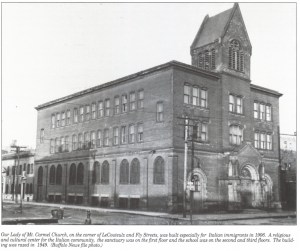
Our Lady of Mount Carmel Church, built in 1906 on LeCouteulx Street

Our Lady of Mount Carmel Church, built in 1906 on LeCouteulx Street Source: America’s Crossroads by Michael Vogel

The Canal District slowly died as trade along the canal was replaced by railroads.  Industry and immigration began to change the landscape of the area.  The sailors and canal business moved out of the area and sought work elsewhere.  The vacant buildings were taken over by immigrants.  The Canal District made way to what was called the Italian Quarter, due to the influx of Italian immigrants.  Between 1900 and 1920, the Italian population of Buffalo increased from 6,000 to 16,000 (Buffalo’s total population in 1920 was 506,775).  The Italian community separated in Buffalo based on the territories and villages of their homeland – each settling into different parts of the City of Buffalo.  The Abbruzzese moved to the upper East Side; the Campobassini moved to the Lower East Side; the Calabrians moved to South Buffalo; and the companies moved to an area near Downtown Buffalo.  The Italians who settled in the Canal District were coming mainly from Sicily to escape a famine and high taxes.

The area was also known as “The Hooks” after the cargo hooks that the dockworkers and longshoremen used.  Near the entrance to the district was “the Coop”, an Italian fruit vendor stand.  The bath house posted instructions in both English and Italian.    The name of Canal Street was changed to Dante Place in 1909.  The impact of changing the name of the street had a large impact on the neighborhood. The rule limiting the women of Canal Street from venturing north into Buffalo proper was lifted.  After the women left, the saloons and concert halls began to close.  The once notorious dance hall saloon known as the Only Theater became a “normal” tavern and politicians meeting place.
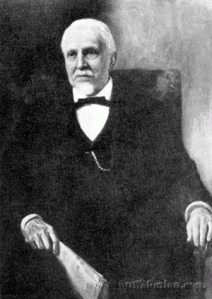
Jacob Schoellkopf, a millionaire who made his money from tanning...owner of the Revere Block

Jacob Schoellkopf, a millionaire who made his money from tanningowner of the Revere Block.  Newspaper articles of the day criticized him for the poor conditions in his buildings.

Former brothels and hotels for canal workers and travelers became tenements.  These three and four story brick buildings housing multiple families in crowded conditions. The tenements were poorly-ventilated, small rooms with little heat, frozen pipes in winter and little sunlight. Cholera and pneumonia were common in the tenements.  Many of the immigrants lived in poverty. Rooms rented for $6/month (about $100-130 in current dollars).  In 1890, one old hotel called the Revere Block, originally designed to hold 100 guests, had 1,040 residents living in crammed conditions.  Reports in other buildings included 18 families crammed into four rooms; 56 people sharing eight bedrooms.  Conditions in many of these tenements were disgusting and unsanitary. Social work organizations began working to help deal with the conditions in the district.  Charity Organization Society and Miss Maria Love began to work with the churches around 1895, working to organize efforts against poverty throughout the City of Buffalo.   Seventy-six churches, of 12 denominations, pitched in to help around the city.  Each church was responsible for a district, working for the “moral elevation of the people, and for the relief of all the needy and neglected persons of whatever religious faith within the district”.  Instead of offering direct relief, many of these societies attempted to address the cycle of poverty.

Images from Welcome Hall, one of the settlement houses in Dante Place.   Click here to see in greater detail

Images from one of the settlement houses in Dante Place.
Click here to see in greater detail

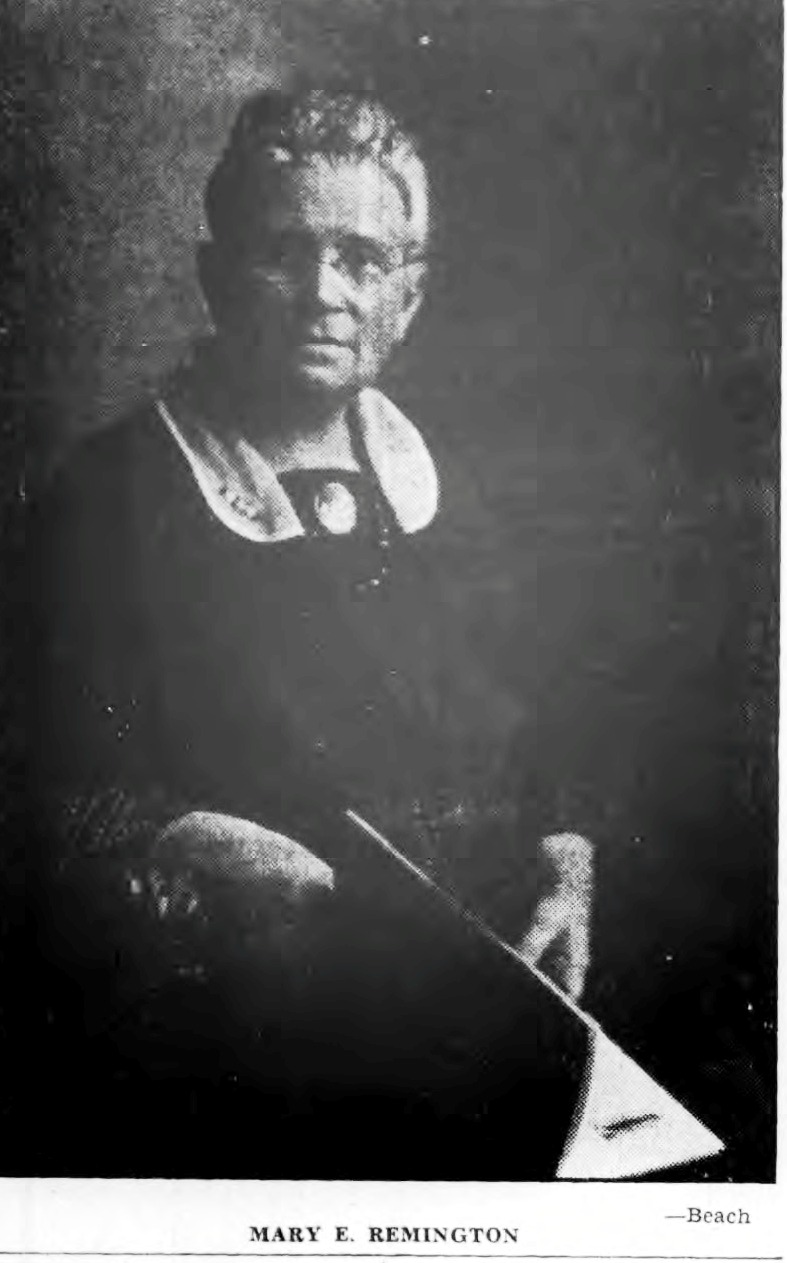
Remington Hall was located at the corner of Erie Street and Canal Street (next to the Revere Block) and was one of the settlement houses located in the canal district.  Miss Mary Remington was the head of the settlement house, working with First Presbyterian Church to reform one of the “vilest tenements in Buffalo”.

Mary Remington was born in 1859 in Connecticut and began working to help others at a young age.  At the time, social service was in its infancy and community centers were not common.  In 1894, when Miss Remington came to Buffalo, she noticed that the churches were ignoring the Canal street district, but she saw that the need there was the greatest.  Many Buffalonians did not believe that she could make a difference in that neighborhood, but she was determined to try.

Mary Remington in 1933 Source:  Buffalo Courier Express

Mary Remington in 1933
Source: Buffalo Courier Express

Remington Hall included a kitchen, sewing classes, a Sunday School, mothers’ meetings, a nursery and kindergarten, vocational education, housekeeping and cleanliness classes and recreational programs.  Miss Remington served as landlord, cook, leader of religious services, pianist, teacher and friend to the needy regardless of their race, creed, age or reputation.  She was referred to as “mea madre” by many of the Italian immigrants.  She wrote letters for the men who could not write, she delivered soup and tea to sick women, bailed neighbors out of jail and helped out her neighborhood in any way she could as part of her daily routine.  During the Pan American Exposition in 1901, she took in extra borders and raised $1,000 to do repairs to her building and open a fresh air lodge at the old International Hotel in Fort Erie for poor residents to go to experience a summer change of scenery. She helped more than 100 women who had kept brothels by showing them a different, upstanding way of life.  She sustained the Remington Hall primarily by the rents she charged her tenants.  She was named among the “Woman’s Who’s Who of America” in 1914.  In 1933, Miss Remington said, “If I could live my life over, I would again spend it among the poor”.  During the depression, Miss Remington’s health declined and she was forced to move to the country.  She still continued to provide for the needy, knitting mittens and sending vegetables from her gardens in to the city.

The Settlement House Movement was strong in Buffalo and settlement houses existed across Buffalo.  Two of the oldest – Westminster Community House (1893) and Neighborhood House Association (1894) merged to form the Buffalo Federation of Neighborhood Centers (BFNC) in the 1980s and still provide services in the Fruit Belt Neighborhood.

While settlement workers tried hard to make conditions better for the residents in poverty stricken areas, many of the early social workers were viewed as outsiders.  They were thought to undermine old world culture rather than seeing its positive value.  In Dante Place, they misunderstood many of the Italian immigrants, and the Italians misunderstood them.  The American values of sobriety, thrift, sociability, industry, cleanliness, patriotism and “properness” were foreign to the southern Italians of the district.  Many of the Sicilian men resented the settlement’s intrusions into family life. The district was described as “looking more and more like Little Italy by day, and the old-time pit of vice and iniquity by night”.  There were reports of organized crime, but for this area, this was nothing new.

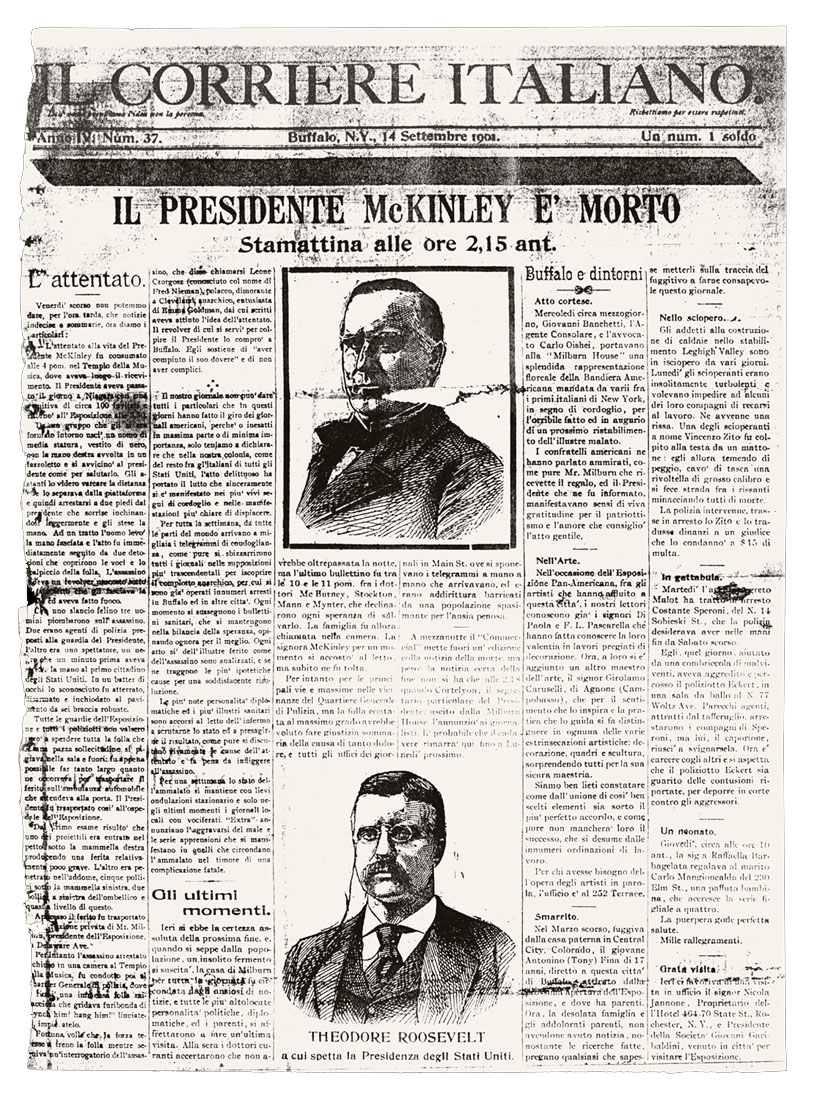
Il Corriere Italiano from the day President McKinley died in 1901

Il Corriere Italiano from the day President McKinley died in 1901

Many of the Italians formed their own fraternal organizations, professional societies and cultural clubs.  There were so many of these groups that a Federation of Italian-American Societies was established in 1906.  One of the important Italian newspapers in Buffalo was known as Il Corriere Italiano (the Italian Courier).  The paper was published from 1898 until the 1950s.   The editor of the paper also published a book in 1908 called La Citta di Buffalo, NY (the City of Buffalo, NY) which was written to bring potential immigrants from Italy.

Most of Buffalo’s Italians worked as laborers.  Many of the Italians worked on construction of the Pan-American Exposition in the northern part of the City of Buffalo in 1901.  During the Pan-American Exposition, the Italians were represented by the Venice in America attraction on the Midway of the Exposition.  The attraction included mandolin and guitarist players.

Here is a view of the area from 1921:

1921 View of the Area

1921 View of the Area

During the 1920s, New York State began to fill in the Erie Canal.  At the time, the abandoned canal waters stood stagnant and polluted.  By the 1930s, the area was considered one of Buffalo’s worst slums.  Citizens living in the “proper” part of Buffalo continued to cast their eyes down on the waterfront.   City Planners began a 40-year fight to change the area to create something new on the waterfront, to create something of which the whole city could be proud.

A typical tenement in Dante Place - 42 Fly Street

A typical tenement in Dante Place – 42 Fly Street

Little Italy lingered on for a little longer; however, the neighborhood began to look old and dilapidated.  Many of the Italians from Little Italy began to integrate into the rest of the city, as their families began to earn enough to move into houses on the Lower West Side.  The paved streets, concrete sidewalks and trees of the Lower West Side was seen as an improvement from the manure filled cobblestones and wooden sidewalks of the Canal District.  In 1949, Mount Carmel Church closed, and St. Anthony’s on Court Street replaced it as the main Italian church in Buffalo.  The Italians celebrated many of the feast days with parades and large religious festivities.  Among these was the Feast of St. Anthony, when people came together for a parade and festivities.  The St. Anthony’s Festival on Connecticut Street began in 1976 as a way to bring back the days of the old traditions.  The Connecticut Street festival was moved to Hertel Avenue in the 1980s and is the annual Italian Heritage Festival, held every summer and attracting an estimated 600,000 annually.
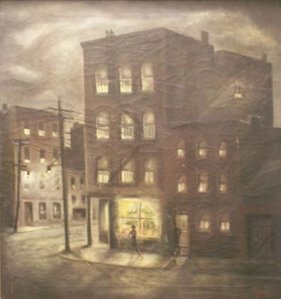
A 1947 painting titled Dante Place by Joseph Carvana

A 1947 painting titled Dante Place by Joseph Carvana

In 1936, one of the residents of a tenement in Dante Place lit a candle and went into the basement, causing a Natural Gas explosion that lifted the entire building off its foundations.  Five people died in the blast, bringing national attention to slum areas, which spurred new legislation.   Buffalo quickly moved to raze the substandard buildings in Dante Place, and by 1937, over 160 buildings had been demolished.  In 1948, only 90 families remained in the area.  The Buffalo Courier Express noted in October 1936 that this may have been the first slum clearance rehabilitation project in the United States.  In the 13 block area, there had once been 1500 residents and by 1936, there were only 124 remaining.

City officials used Works Progress Administration (WPA) funds to construct Memorial Auditorium on the northeastern portion of Little Italy.  The Aud replaced the Broadway Auditorium.   When construction began, the Buffalo News reported:

As if overnight, the Terrace once more is coming to life.  The massive new hall will be the mainstay, but city planners also want to improve the section with a boulevard in the old canal bed, waterfront parks and relocation, if not removal of the New York Central tracks.  Visible proof of these good intentions is construction of the new hall.
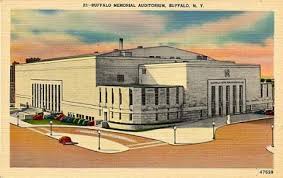
Postcard of Memorial Auditorium

Postcard of Memorial Auditorium

The Aud opened in October 1940.  The Aud was host to many events, including circuses, concerts, sports and political events.  Over the years, the Aud was home to the Buffalo Bisons of the AHL, the Buffalo Sabres of the NHL, the Buffalo Braves of the NBA, the Buffalo Stallions of the MSL, the Buffalo Bandits of the MILL, the Buffalo Blizzard of the NPSL, and the Buffalo Stampede of the RHI.  Additionally,  The last of the old saloons was the Peacock Grill, located at 136 Dante Place.  In 1950, Libby and Joe Guillo sold the rights to the Peacock Grill building and moved up to Main Street.  The era of the Canal District as Little Italy had ended.

Stay tuned for Part Three, which discusses the last 60 years of Buffalo’s Canal District.

Learn about other streets by checking out the Street Index.

Sources:

  1. Courier Express Dec 17, 1952 p 15
  2. Buffalo Evening News 4-15-1950 “Echoes of Revelry Have Faded out and Earth-Movers Clang Away.
  3. “Housing Project Rises where Canalers Roistered” Courier Express 10-29-1952
  4. “Lusty Canal St. Lived Hard and Fast in Heyday” Courier Express 10-26-1952
  5. “Dante Area Streets Get Single Name” Courier Express, November 11, 1960 Buffalo Streets Vol 1.
  6. America’s Crossroads:  Buffalo’s Canal Street/ Dante Place.  Buffalo NY Heritage Press, 1993.
  7. Dug’s Dive.   Buffalo Express Saturday Morning August 29,1874
  8. Hart, Mary Bronson.  Partitioning Poverty:  Zones of Influence in Social Work.  Boston Evening Transcript.  August 29, 1900.  http://news.google.com/newspapers?nid=2249&dat=19000829&id=z40-AAAAIBAJ&sjid=qFkMAAAAIBAJ&pg=6968,6102881
  9. Yans-McLaughlin, Virginia.  Family and Community:  Italian Immigrants in Buffalo, 1880-1930.
  10. Maggiotto, Anthony, Sr.  LaTerra Promessa:  The Promised Land:  200 Years of WNY Italian-American Experiences.  Federation of Italian-American Societies of Western New York,  2007.
  11. Mary E. Remington Founder of Dante Place Mission.  Buffalo Courier Express, August 27, 1933.  P 4.

Read Full Post »
tifftstTifft Street forms an important east-west path in South Buffalo, running from McKinley Parkway to Fuhrmann Boulevard/Route 5.  It is one of the few streets in South Buffalo that reaches the waterfront.   The road is named after the man who first owned the land in the vicinity of the street, G.W. Tifft.

George Washington Tifft was born in January 1805 in Nassau, Rensselaer County, New York.  One of Tifft’s first land purchases was 5 acres in Orleans County.  He cleared the land to sell  the wood.  He hired men to chop timber, realizing that he could reap a profit on the labor of each man.  He later bought a more land and hired additional men to work for him.

tifftBy the time George was 21, he had saved $1,200.  Mr. Tifft received another $1,000 from his father’s estate, and began a new business venture.  He first traveled to Michigan City, Indiana, where he bought grain to ship to the east.  At the time, all grain was shipped through the lakes.  While in Michigan City, he learned of Buffalo’s shipping and moved to Buffalo in 1842.

Mr. Tifft formed a partnership with Dean Richmond, a member of a prominent Buffalo family.  Mr. Tifft set up the Troy and Michigan Six Day Line, named b/c it did not operate on Sunday.  He purchased more mills to increase his commercial holdings. Mr. Tifft established the International Bank of Buffalo and was the first president of the bank in 1854.  He invested $100,000 in the Buffalo Steam Engine Company and was elected president of the New York, Lake Erie and Western Railroad in 1858.

Tifft House

Tifft House

He then turned his attention to his Buffalo real estate holdings.  In 1863, Mr. Tifft erected 74 houses, a hotel (the Tifft House) and the Tifft Grain Elevator.  The Tifft House hotel opened in 1865 and was demolished in 1902, after serving as a hotel during the Pan American Exposition, and was replaced in 1903 with the William Hengerer Company department store.

Mr. Tifft also purchased a 600-acre tract of land in the southern portion of Buffalo which people referred to as the Tifft Farm.  Mr. Tifft was among the first in Buffalo to experiment with growing “winter wheat”.  He invested his money in the Pennsylvania coal fields and experimented with smelting processes.  His vast land holdings spread across the country – he owned a 5,000-acre farm in Shelby county, Iowa which was stocked and cultivated.  The large Tifft Farm tract in South Buffalo was broken up into residential and industrial areas when Mr. Tifft sold it to Pennsylvania capitalists who leased the land to the Lehigh Valley Railroad Company for 50 years.

The canals at Tifft Farm shown near center of this photograph

The canals at Tifft Farm shown near center of this photograph

The Lehigh Valley Railroad Company constructed 11,400 feet of canal to connect a system of canals on the Tifft Farm property with the City Ship Canal and Buffalo Creek (now Buffalo River).  They also constructed 9,280 feet of dock on the Tifft Farm, each dock had railroad facilities and totaled 20.6 miles of railroad.  Today, Tifft Farms has been renamed “Tifft Nature Preserve” and is managed by the Buffalo Science Musem.  The preserve was created in 1972 from 264 acres of land the City of Buffalo purchased for a landfill site.  Concerned citizens worked with city legislators to plan for preservation of the area.  The landfill incorporated safety measures, which allowed the land to serve a new purpose and the preserve opened in 1976.  The former canals have been allowed to revert to nature and now form Lisa Pond, Beth Pond and Lake Kirsty on the Nature Preserve site.  The “mound” area of the preserve contains landfilled waste materials brought on site from Squaw Island.   During the 1980s, approximately 100 drums of acid sludge from a nearby industrial plant were found dumped into Lake Kirsty.

tifft engines

Mr. Tifft’s later years were spent managing the George W. Tifft Sons and Company, successors to the original Buffalo Steam Engine Works.  He also owned a group of stores at the corner of Washington and Mohawk Streets and had a furniture business there. George Washington Tifft married Lucy Enos in 1827.  They had seven children.  Mr. Tifft was an active supporter of the Republican Party and an admirer of President Lincoln.  Mr. Tifft donated large sums in support of the Civil War, and also towards charities, always considering that he had been blessed to have made his fortunes and eager to help others.

Tifft Monument

Tifft Monument

Mr. Tifft died on June 24, 1882 and is buried in Forest Lawn.  There is also a cenotaph for George at the Tifft Cemetery in Nassau, New York, located on the former Tifft homestead.  One obituary read:  “His name was a tower of strength, and was sought in every movement requiring moral, social or financial support.  He filled a large place in the affairs of the city he has done so much to build up.  His name will long be enshrined in the hearts of a people that had learned to know his worth and appreciate his virtues”.

Check out how other streets got their name in the Street Index.

 Sources:

  1. Buffalo Directory, 1860, pg. 12.
  2. Holder, Robert “The Beginnings of Buffalo Industry.”  Adventures in WNY History Series.  Buffalo and Erie County Historical Society, 1960
  3. Mansfield, John Brandts, editor.  History of the Great Lakes.  Volume 1.  J.H.Beers & Co:  Chicago.  1899.
  4. Magazine of Western History. Western History Co. Mar 1886.

Read Full Post »

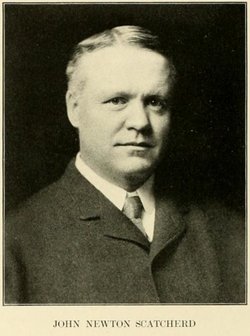
scatcherdScatcherd Place is a short road off of Peabody Street.  The street has never been more than just a short road leading to a driveway. Historically, this road led into Scatcherd and Son lumberyard, which later became Atlantic Lumber Company and is now owned by Battaglia Demolition.  While the street might not be on many people’s radars, it is legal city-owned right-of-way, and was named after a prominent father-son team who may have been forgotten.

James Newton Scatcherd was born in Wyton, Ontario in 1824.  He grew up on his father’s farm in London, Ontario.  James’ father, John, was a prominent Canadian citizen and a member of the Canadian Parliament for many years.  James’ brothers Thomas and Robert both also served as members of the Canadian House of Commons.

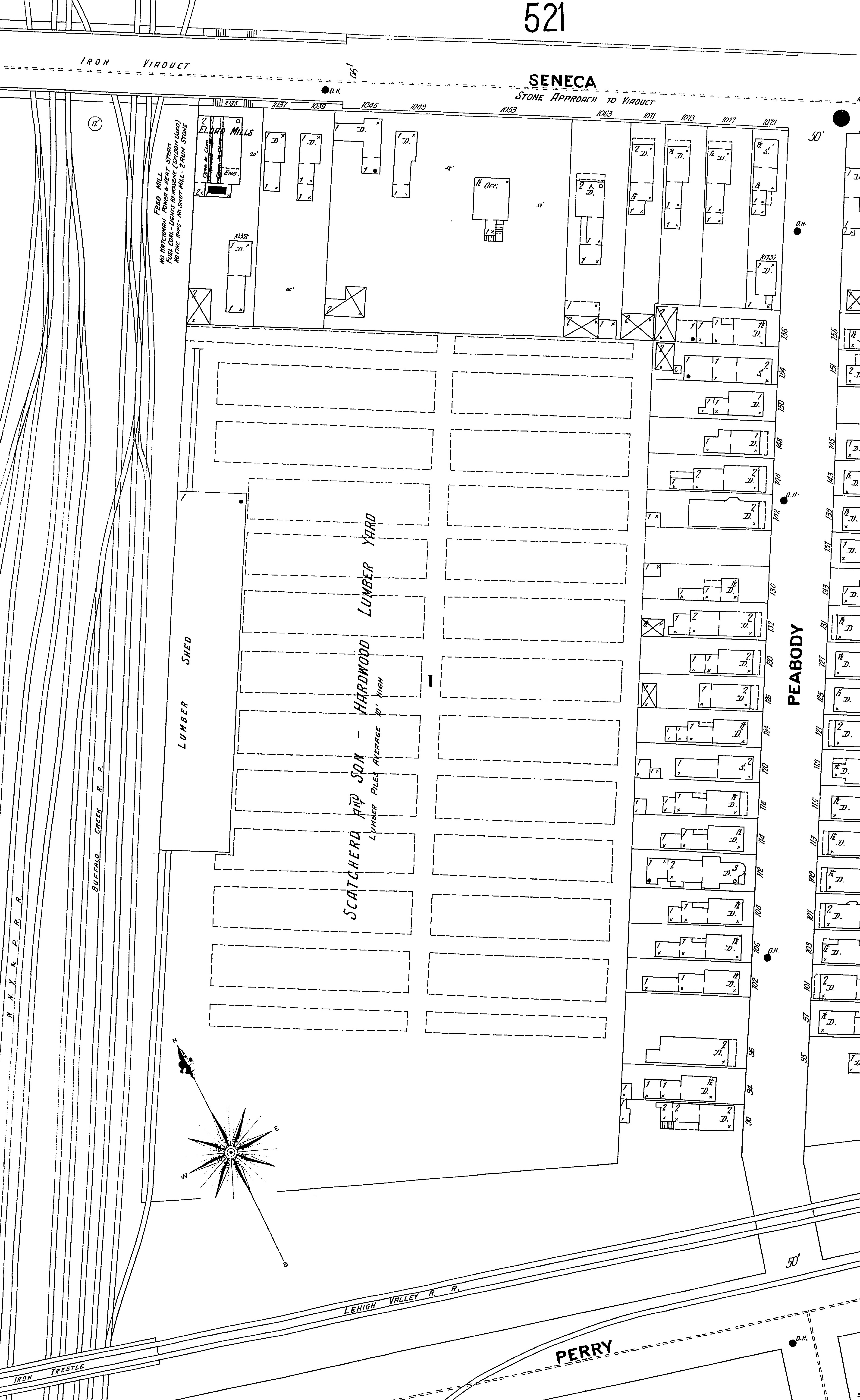
Scatcherd and Son Lumber Yard, 1900.  (Scatcherd Place is the lot between 136 and 142 Peabody Street)

Scatcherd and Son Lumber Yard, 1900. (Scatcherd Place is the lot between 136 and 142 Peabody Street)

James Scatcherd was taught about lumbering from an early age, as it was an important industry in his neighborhood.  Mr. Scatcherd moved to Buffalo in 1852 as an agent of Famer, de Blaquiere & Deeds, lumber manufacturers, dealers and shippers.  James took over the lumber firm in 1857 and became one of the principal lumber dealers in the United States.  In 1879, James’ son, John Scatcherd, joined the firm and the firm was renamed Scatcherd & Son.  The firm’s specialty was expensive hard woods.

James Scatcherd made two important contributions to the welfare of Buffalonians:  First, when he became chairman of the Buffalo Water Commission, he found the water supply was controlled by favoritism and political influence.  Politicians and friends obtained water for a small fee, while other consumers were charged more.  He served for 4 years as chairman of the Water Commission and established equal rates for all consumers, and established efficient management of the water system.  Secondly, Mr. Scatcherd served as president of the Board of Trustees of the Buffalo General Hospital.  At the time, the institution was burdened with large amounts of debt, and was cutting services due to budget constraints.  Within ten years of James’ leadership, the hospital was completely out of debt.

Mr Scatcherd married Annie Belton of Fairfield, Canada.  Mr. Scatcherd was a founder and trustee of the Delaware Avenue M.E. Church (built by Selkirk, now known as Babeville).    James and Annie had one son, John, and a daughter, Mrs. Seward Cary.  James died in 1885 and is buried in Forest Lawn.

John Scatcherd

John Scatcherd

John Scatcherd was also a prominent member of Buffalo society.  He was a leader in the lumber industry and served as president of The National Wholesale Lumber Association and the Buffalo Lumber Exchange.  John had a part in business interests including the Batavia and New York Wood Working Company, the Bank of Buffalo, and the Ellicott Square Corporation, all of which he was President.  He was a director in the Buffalo Railway Company (which became the I.R.C), the Market Bank, the Third National Bank, and the Buffalo Loan, Trust and Safety Deposit Company.

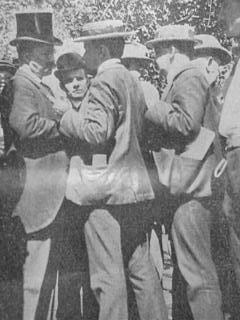
Teddy Roosevelt (on left) in Buffalo in 1901

Teddy Roosevelt (on left) in Buffalo in 1901

From 1900-1901, Mr. Scatcherd spent most of his time working as Chairman of the Executive Committee of the Pan-American exposition.  When President McKinley was shot at the Exposition, Vice President Theodore Roosevelt was summoned to Buffalo.  Due to President McKinley’s seemingly improving health, Mr. Roosevelt left Buffalo.  When the President died, the scramble to get Mr. Roosevelt to Buffalo for the Oath of Office left him without a suitable hat.  John Scatcherd loaned Theodore his hat and Mr. Roosevelt was inaugurated as the 26th President. (You can learn more about Roosevelt’s inauguration by visiting the TR Inaugural Site on Delaware Avenue)

John Scatcherd married Mary Eunice Wood in 1879.  They had two children, a daughter Madeline Steele Scatcherd and a son, James Newton Scatcherd.  John Scatcherd died in 1917 and is buried near his father in Forest Lawn.

Scatcherd Grave

Scatcherd Grave

Be sure to check out the Street Index to learn about other streets.

Sources:

  1. Memorial and Family History of Erie County New York.  The Genealogical Publishing Company:  New York-Buffalo, 1906.
  2. “Scatcherd Street Honors Memory of Civic Leaders, Father and Son”.  Courier Express, April 9, 1939, sec. 5, p.10.

Read Full Post »

langLang Avenue is located between Bailey Avenue and East End Avenue, between Genesee Street and Delavan Avenue, in the Schiller Park neighborhood of the East Side of Buffalo.  Portions of the street are paved in brick.

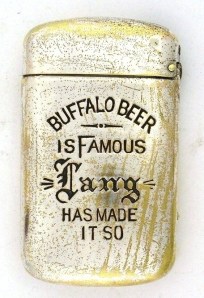
Lang Avenue is named after Gerhard Lang, owner of one of Buffalo’s premiere and largest breweries at the turn of the 19th Century, the Gerhard Lang Brewery.

langportraitGerhard Lang was born in Germany in 1835.  He came to Buffalo in 1848 at the age of 14 with his father, Jacob Lang.  Jacob Lang was a butcher and Gerhard learned English while working in the butcher shop.   Around 1862, he assumed control of the Born brewery at the corner of Genesee and Jefferson streets.   Mr. Lang married Born’s daughter and assumed control of the brewery after a few years of marriage.

In 1875, he purchased the a site at Jefferson and Best Streets to expand his facilities.   He toured other breweries across the country to determine the best design for his facility. The Gerhard Lang Brewery was located on the entire block bounded by Jefferson, Best, Berlin and Dodge Streets was the largest brewery in the State outside of New York City.   Berlin Street was renamed Pershing after WWI (in 1920).

breweryThe Lang Brewery was called “the Palace Brewery”, because it was built with a typical Victorian opulence.   Once the new brewery was built, Mr. Lang used the old brewery at Jefferson and Genesee Street for bottling works and malting house.    The annual capacity of the Gerhard Lang Brewery was over 300,000 barrels.  Lang’s beer was known all over the country for its excellence in quality, purity and wholesomeness.

By 1887, the brewery employed 110 men and distributed to Virginia, Boston, Baltimore, Washington, Philadelphia and New York City.

In addition to the brewery, Mr. Lang served as Alderman of the Sixth Ward and was a Trustee in the Western Savings Bank.  Mr. Lang was a member at St. Louis Roman Catholic Church and donated one of the stain glass windows to the church.

lang graveGerhard Lang died in 1892 and is buried in the United German and French Cemetery in Cheektowaga.  After his death, Edwin G.S. Miller took over the brewery, along with Jacob Lang, Gerhard’s son.

Before Prohibition, the Lang Brewery also owned many saloons that sold its brews.  It is said that Lang’s owned more saloons and beer gardens than anyone in Buffalo, as many as 80 at one point.

Before the automobile, horses were used to transport beer around town.  The brewery kept 500 horses in a stable in Fort Erie to distribute Lang’s beer.

During Prohibition, Lang’s produced dairy and soda products.  There was Lang’s Dairy & Creamery, Lang’s Bakery and products like “Hyan-Dry” brand soda and “Liberty Brew”, a malt extract beverage.  After Prohibition, Lang’s was one of the first to start back up.  However, the market had changed, and the new regulations and taxes made it difficult for local breweries to stay competitive.

The Gerhard Lang Brewery shut down in January of 1949 after 109 years in business.

Langs-Brewery-Match-Safes-Gerhard-Lang-Brewery_62722-2

Gerhardt Street, located on a portion of where the Brewery was located was likely also named after Gerhard Lang, although I was not able to find any specifics linking this together.

To learn about other streets, check out the Street Index.

Sources:

  1. A History of the City of Buffalo:  Its Men and Institutions.  Published by the Buffalo Evening News:  Buffalo, 1908.
  2. History of the City of Buffalo and Erie County:  With Illustrations and Biographical Sketches of some of its Prominent Men and Pioneers.  Edited by H. Perry Smith, D. Mason & Co Publishers, Syracuse NY 1884.

Read Full Post »

Hertel Avenue is a major east-west thoroughfare in North Buffalo running from Main Street to the Niagara River. The street was previously known as Cornelius Creek Road, named after the creek, which ran near the street. Hertel Avenue was named for John Stephen Hertel, former County Supervisor.

Hertel Avenue and others Named After Black Rock Land Company Associates

Hertel Avenue and other streets named after Black Rock Land Company associates

Mr. Hertel was one of three owners of the land that is now Riverside Park and was a founder of the Black Rock Land Company, the first land development company in Buffalo. The Black Rock Land Company was founded in 1888 and consisted of John Hertel, John Esser, Frank Argus, Louis Roesch and Frederick Ullman. You’ll notice that several other streets in the Black Rock/Riverside neighborhoods are named after these men.

John Stephen Hertel came to Black Rock with his parents at the age of two, immigrating from Edesheim Germany. Mr. Hertel attended St. Francis School and learned the cooper trade, making barrels for brewers and distillers. He then became involved in the hotel business. He opened a hotel at the corner of what would become Hertel Avenue and Niagara Street. Before the 1890s, the Riverside area was primarily rural countryside. At the time, the street that would become Hertel Avenue only extended from Niagara Street to Military Road. When the Niagara Horse Car Line was extended to Hertel Avenue, the legend says that Mr. Hertel was so excited, he ran out of the hotel without a coat to be the first to ride on the first horse-car to pass the hotel.

John S. Hertel, 1899

John S. Hertel, 1899

Mr. Hertel was also the director of the Erie Fire Insurance Company and had extensive real estate holdings. The Black Rock Land Company was formed in 1888 and was one of the first development companyies in the City of Buffalo. The Land Company included Mr. Hertel, Mr. Esser, Mr. Argus, Mr. Roesch and Mr. Ullman. Mr. Hertel’s property included most of the land occupied by Peoria Street and Hartman Place. He subdivided the streets and named the latter for the family of his wife, the former Anna S. Hartman of Rochester. The hotel was successful for Mr. Hertel. He then went into business with John J. Esser and Frank Argus to purchase what was known as Germania Park, which at the time was a private picnic grounds with a boat launch. They built a hotel at Germania Park. The City of Buffalo offered to purchase their property.  The City of Buffalo used this site to create Riverside Park.

Rvierside Park, about 1910

Riverside Park, about 1910

At the time, there was great support for the City to buy Germania Park, to give the public a place to enjoy the river “where any resident of Buffalo could go with his whole family and be free from beer saloons and drunken men”. Riverside Park was the final park designed for Buffalo by the Olmsted Architecture Firm, following Frederick Law Olmsted’s retirement. The park was designed in 1898, at the time the Erie Canal traversed the park, separating the shoreline from the main part of the park. The original 22-acre park included a boat dock and canal overpass. The New York State Thruway I-190 currently runs along the Erie Canal alignment. The park was expanded in 1912 to include an additional 17 acres on the south side of the park. The original southern boundary was a line extending from Esser Avenue to the Niagara River.

After selling Germania Park, Mr. Hertel and Mr. Esser left the hotel business. They entered into the coal and wood business, establishing the business near the corner of Niagara and Farmer Streets. They also established the Tonawanda Street Planing Mill at Tonawanda and Arthur Streets.

John Hertel and his wife Anna lived with their family at 362 Dearborn Street. The Hertel family lived in the house for several generations, his son John Stephen Hertel II, his daughter Mrs. Franscis Healy and his grandson John Hertel Healy all lived in the Dearborn house.

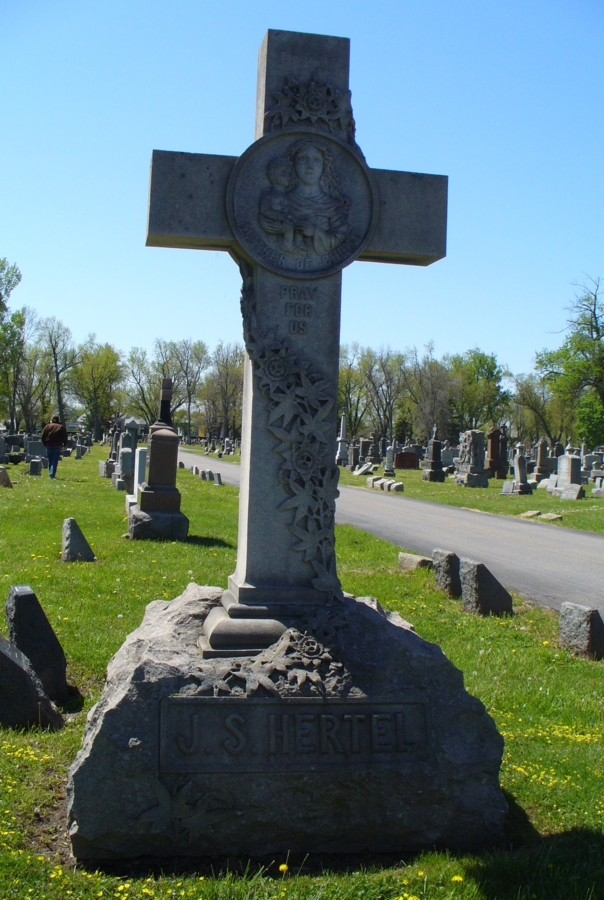
hertel grave

John Stephen Hertel was a life long democrat and was active in local politics. He was unsuccessful in a campaign for congress. For 27 years, he was a lieutenant colonel of the Knights of St. John. He was a member of St. Mary’s Commandery and an organizer of the commendary at St. Francis Church.  St. Francis Church is now the Buffalo Religious Arts Center. He was active in the Knights of Columbus, the Catholic Men’s Benevolent Association, the Foresters of America and the Black Rock Businessmen’s Association. He died in 1917 and is buried at the United German and French Cemetery in Cheektowaga

To learn about other streets, check out the Street Index.

Sources:

Read Full Post »

« Newer Posts - Older Posts »

Field Notes

Live from Buffalo, NY

Grants.gov Community Blog

Connecting the grant community to #LearnGrants

Dienna Howard

I create, therefore I am.

Hidden Waters blog

Companion blog for the book "Hidden Waters of NYC"

Hoping for a Tail Wind

Because I definitely brought way too much gear.

priorhouse blog

Photos, art, and a little bit of LIT.

Sheepie Niagara

Bleating the Beat Since 2015