Feeds:
Posts
Comments

Today, we’re continuing our discussion about the Butlers of Buffalo.  Last post, we discussed Butler Street and Butler Place (and the Fitch Institute/Fitch Creche of Buffalo).  Today, we will discuss the third of the Butlers, Butler Avenue.  Butler Avenue is a street in the Hamlin Park neighborhood of Buffalo, running between Lonsdale Road and Humboldt Parkway.  The street is named for Edward H. Butler, the Founder and Publisher of The Buffalo News.

Screenshot (83)

Butler Avenue is shown in red on the map.

Butler Avenue was laid out in 1915 between Lonsdale and Wohlers Avenue.  The street was developed by the International Home Building Company.  International Home Building Co’s offices were on East Ferry at the corner of Wohlers.  Demand for houses on the street was so high that they decided to open it to Humboldt Parkway after just a few months.  Hamlin Park’s development was centrally located and within easy riding distance of Buffalo’s downtown.  A 1915 article states, “the development that has taken place (on Butler Ave) in the last year or two shows what it means when building operations start in a large city.”  

Buffalo’s first newspaper was the Buffalo Gazette, first published in 1811.  It was published “occasionally” and later became a weekly newspaper.  The first daily newspaper in Buffalo was the Western Star, which began publishing published daily in 1834.  Through a series of purchases and mergers over the years, the Western Star newspaper eventually evolved into the Buffalo Courier-Express in 1926.

Edward H. Butler, Senior
Screenshot (81)

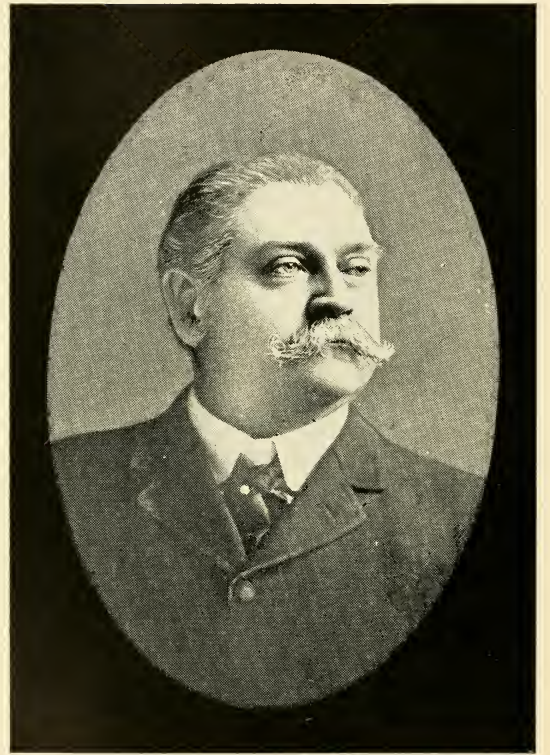
Edward H Butler, Sr. Source: 20th Century Buffalo

Edward Hubert Butler was born in 1850 in LeRoy in Genesee County, New York, to Irish immigrants Dennis and Lucy Butler.  He attended public schools.  The first newspaper he worked for was the LeRoy Gazette.  He later became connected with the Scranton Times as City Editor and the Scranton Free Press as a Financial Interest Reporter.  

In 1873, just 23 years old, Mr. Butler came to Buffalo to establish The Sunday News.  This venture was regarded by many as reckless, but very quickly, Mr. Butler was able to prove that his judgment was sound.  Other Sunday newspapers had failed to take hold, but The Sunday News was successful.  In 1879, Mr. Butler established the Bradford Sunday News, published for four years before selling it to devote more time to his Buffalo newspapers. The Sunday News was published out of 200 Main Street in Downtown Buffalo.  

Founding of the Buffalo Evening News
buffalo news second edition

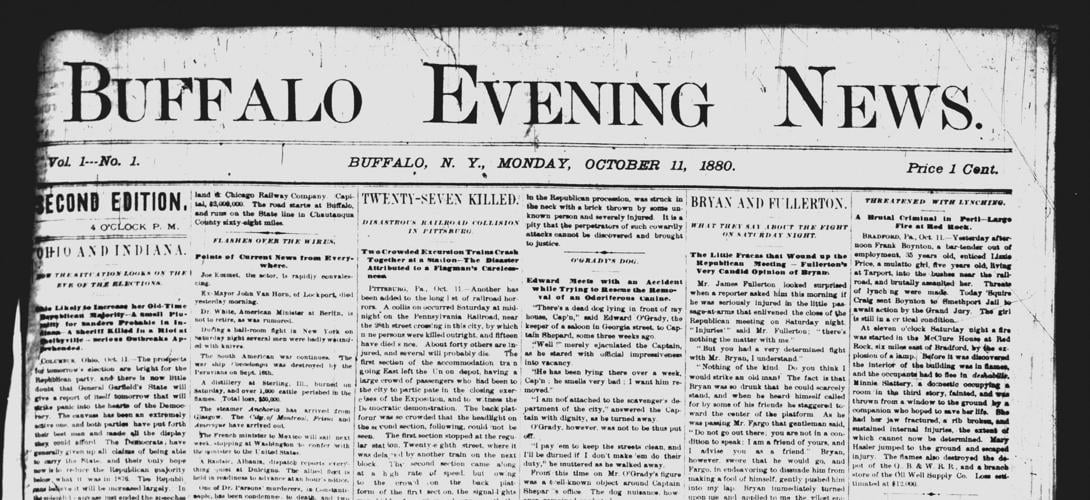
First Issue of the Buffalo Evening News from October 11, 1880. Source: The Buffalo News.

The first copy of the Buffalo Evening News was published by Mr. Butler on October 11, 1880.  You may notice in the picture that the first issue was actually the Section Edition.  The First Edition actually never made it to print.  It was supposed to be off the presses at 2pm.  Due to an elevator incident, the First Edition wound up on the floor, becoming “a tangled mess of handset type.”  They reset the type, and the Second Edition rattled off the presses at 4pm, starting The Buffalo Evening News’ storied history.

With the expansion of The Evening News, The News moved to temporary quarters at 214 Main Street.  The Evening News started as a four-page newspaper that cost 1 cent (about 30 cents today), less than the other daily newspapers of the time, which were 5 cents ($1.54 today).  The first-day circulation was 7,000 newspapers.  By 1882, just two years later, it had risen to 18,000 daily. The News was distributed by Buffalo’s system of horse-drawn streetcars.  The papers were loaded aboard them.  The News had a single horse-drawn, two-wheel cart for areas not reachable by streetcar.  This was the only circulation department for the first several years.  Eventually, a fleet of horse-drawn carriages replaced the streetcars for distribution.  Some of those carriages were used again during the 1940s during WWII gas rationing. 

buffalo news building

Buffalo News Building on Main Street around 1908. Source: A History of the City of Buffalo, Its Men and Institutions.

In 1881, The News moved to 218 Main Street, a 20-foot-wide, four-story building.  The business office (known as the counting room) was on the first floor, and the newsroom was on the second floor.  By 1885, the Buffalo Evening News ran five editions daily, which would continue for a century.  In 1896, the original 218 Main Street and the adjacent 216 Main Street were demolished for a new, larger building, which was used until 1973.  The News building at 216-218 Main Street was described as “one of the finest publishing houses in the State” when it opened in 1898.  

From the start, The Buffalo News differed from other newspapers in Buffalo and in cities other than New York City at the time.  The News sent reporters out on the streets to bring their reports to life.  It also offered something for everyone – news reports, market news, sports, prose and poetry, and advertisements.  One of Mr. Butler’s adages was to “print nothing in The News a child may not read”, to keep The News clean and help it have appeal with everyone.  It was designed to be “the People’s Newspaper” and to hold the public good above all else. 

In 1885, The Buffalo News bought the Buffalo Telegraph.  The Telegraph had been founded on October 30, 1880, just a few weeks after the Buffalo Evening News.  The Telegraph had been run by James and George Scripps and John Sweeney.  It had tried to compete with The News, but not been a financial success, so Mr. Butler took the opportunity and removed his competition.  
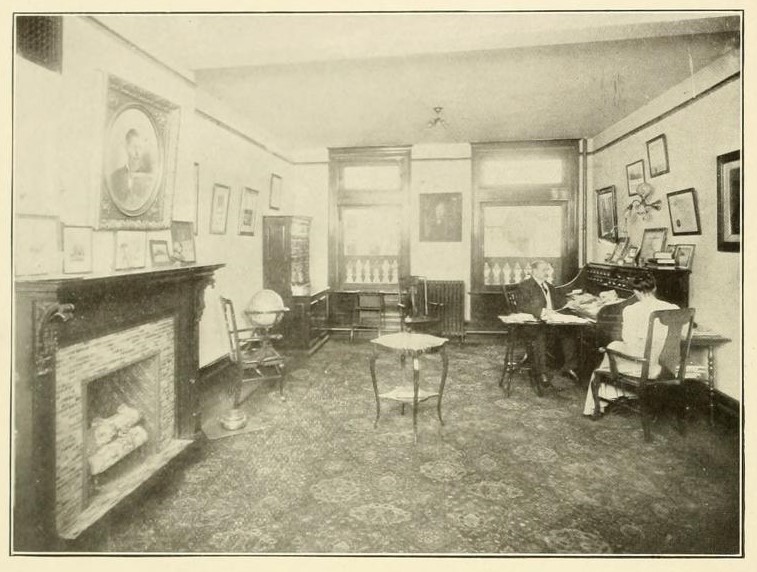
mr butlers private office history of buffalo its men and insitutions

Mr Butler’s Private Office at The Buffalo News, circa 1908. Source: A History of the City of Buffalo, its Men and Institutions

Under Mr. Butler’s ownership, The Buffalo News was very successful. It grew from a four-page daily newspaper into one of the most important newspapers in the country in its first 40 years.   By 1908, The Buffalo News had the largest circulation of any daily paper between New York and Chicago.  It was recognized as one of the best newspapers in the country outside of the two or three largest cities.  It was said that “his success as a journalist is due to his business capacity, his intellectual force and his habit of being in touch with people.”  He kept in touch with every department and paid attention to the operations of his paper.  When he was working on growing the newspapers’ circulation, there were times he was known to ride the train with the newspapers to ensure they made the connection to transfer for delivery of newspapers outside of Buffalo proper, personally ensuring that The News would get to people.  

The Butler Family

Edward Butler married Mary E. Barber of West Pisston in 1871.  They had four children, but only two survived – Ada Deen Butler, born May 31, 1879, and Edward H. Butler Jr, born June 19, 1883.  The other two children were likely named Clara and Ambrose.   [Note:  It was difficult to find the names of the children who died young, as they do not show up in any records I could find.  Special thanks to the staff at Forty Fort Cemetery in Pennsylvania, who took a peak into the Butler Mausoleum and found the crypts for Clara and Ambrose.  There are no dates on their crypts, but many sources mentioned that Mary Butler was buried with her babies, so I will assume that Clara and Ambrose are the two children who died.  Since there are no dates, there’s a possibility they were stillborn or died shortly after birth.]  The Butler family attended Westminster Presbyterian Church.  

In 1875, the Butlers lived at 109 Carolina Street (no longer extant).  Along with Edward and his wife Mary, his brother Ambrose Butler was also living with them while he was working as a clerk in the Canal office.  They also lived with a Domestic Servant – 19-year-old Mary Gorman, and a Housekeeper –  65-year-old Caroline Strong.  

In 1880, the Butlers lived at 377 Prospect Street (still standing).  The house had been the home of Seth Clark before the Butlers.  Along with Edward, Mary and daughter ADA, Edward’s brother Ambrose also lived in the home.  They lived with 20-year-old hosler (keeper of horses) John Collins, and 19-year-old servant Mary Schneck.  

429_Linwood

Image of 429 Linwood Ave as featured in Buffalo News, May 1984.

From 1890 to 1897, the Butlers lived at 429 Linwood Avenue (still standing).  This house is often called the “Lock-Butler House, as it was constructed by William Lock and then was home to the Butlers.  The house is an example of the Romanesque Style in Buffalo.  Mrs. Mary Butler died in August 1893 at the age of just 38 after an illness of three months.  She was buried in Forty Fort Cemetery in Forty Fort, Pennsylvania, in a plot near her two children who had passed away, her father, and her brother.    

In 1905, Mr. Butler lived at 522 Delaware Avenue (no longer extant).   He lived with his son Edward, daughter Ada and niece, 28-year-old Josephine Barber, a niece of the late Mrs. Mary Butler, who served as homemaker for the household.  They had four servants – 38-year-old Catherine Clark, 32-year-old Anna Peterson, 32-year-old Anna Sticht, and 29-year-old Mary Gerhardt.  Rounding out the household was 33-year-old Coachman August Gernoudt and his 32-year-old wife Nellie.  
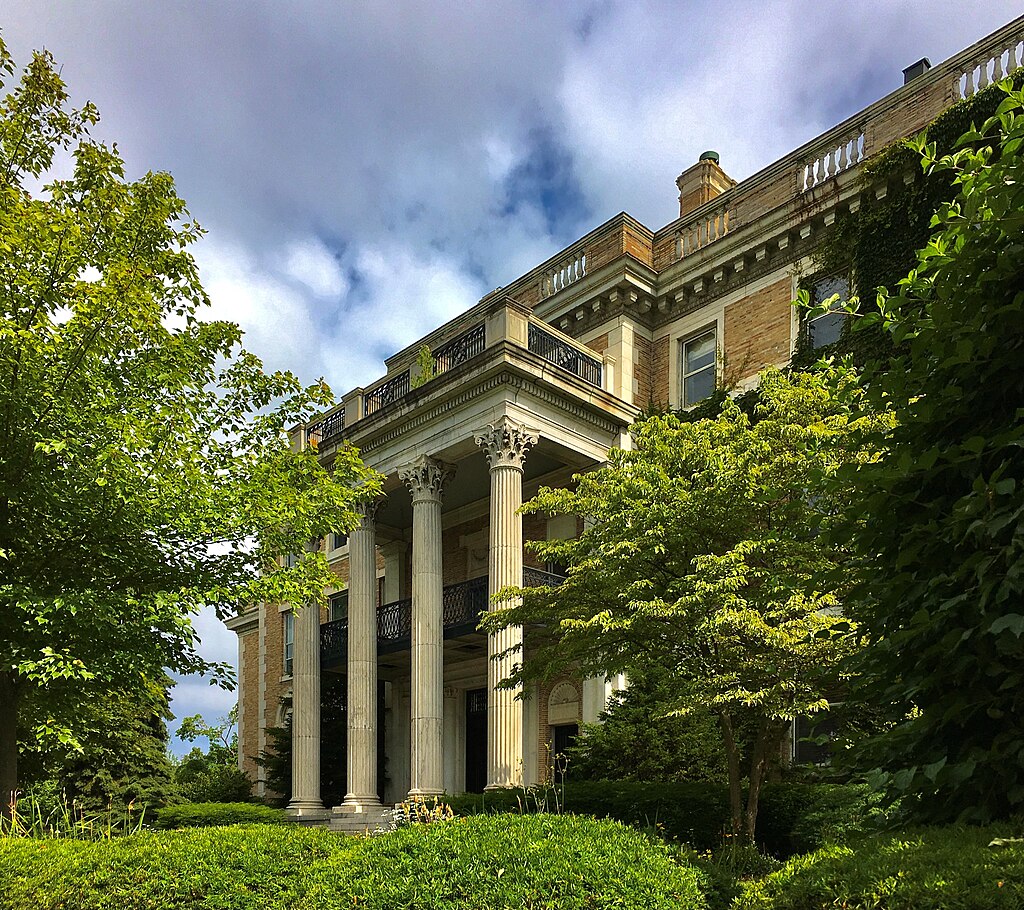
672_Delaware_Ave_-_1

Butler Mansion at 672 Delaware Avenue

In 1909, Edward Butler, Jr. married Kate Maddox Robinson of Atlanta, Georgia.  Also that year, the Butler family (Edward Sr., along with Edward Jr, his new bride Kate, and sister Ada) moved into the house at 672 Delaware Avenue, often called the Butler Mansion (still standing today).  The mansion was originally built for banker and leather manufacturer George Williams.  It is a three-story, Georgian Revival-style mansion with 40 rooms.  It was designed by Mead McKim and White architects, and the two-acre property consists of a 16,000-square-foot mansion and an 8,000-square-foot carriage house.  

In 1910, Mr. Butler lived with his son Edward Jr, daughter-in-law Kate, daughter Ada, and 8 servants:  butler Herman Werne, and servants Pauline Benner,  Caroline Killins, Antoinette Burnod, Emily Schnicklart, Gertrude Beck, Agnes Gambert, and Agnes Kelly.  

Mr. Butler’s Other Involvements

Mr. Butler was very involved with enacting of grade crossing law that created the Grade Crossing Commission and served as a member of the Commission from its founding for its first 20 years.  The Commission erected numerous grade crossing structures within the City of Buffalo city limits.  

Mr. Butler was also involved in constructing the McKinley Monument in Niagara Square.  The Buffalo News was able to help secure appropriations that made the monument possible.  Mr. Butler was President of the Commission that erected the monument.  Mr. Butler worked closely on the memorial to President McKinley with George E Matthews of the Buffalo Express.   

Mr. Butler served as a member of the Board of Trustees for the State Normal School for many years and was President of the Board for the last three years of his life.  He was President of the Buffalo Daily Newspaper Publishers Association, Vice-President of the United Press, Director of the Associated Press, and President of the State Editorial Association.   He was a member of the Buffalo, Ellicott, Park and Country Clubs in Buffalo; the Lotus and Larchmont Clubs in  New York’s Clover Club in Philadelphia and the Capital City Club in Atlanta.  

According to the book 20th Century Buffalo, in 1902, Buffalo had the following newspapers:  

  • Morning Newspapers:  Buffalo Morning Express (established 1846), Buffalo Courier (established 1842), and Buffalo Review (established 1883).  
  • Evening Papers:  Buffalo Commercial (established 1835), Buffalo Evening News (established 1880), Buffalo Evening Times (established 1883), Buffalo Enquirer (established 1891), Demokkrat (German – established 1837), Freie Presse (German – established 1855), and Polak W’Amervca (Polish – established 1887).
  • Sunday Papers:  The Illustrated Buffalo Express (established 1883), Buffalo Sunday News (established 1873), Buffalo Courier (established 1885), and the Buffalo Sunday Times (established 1879).

The circulation of the Buffalo Evening News at the time was 75,000 daily.  This was much more than the daily circulation of its closest competitors – the Buffalo Courier at 55,000 daily and the Buffalo Evening Times, The Buffalo Enquirer and the Buffalo Morning Express at 30,000 daily.  By 1927, the Buffalo New daily circulation was reportedly at 150,000.  By the mid-70s, the circulation was reportedly 280,000, with 300,000 on weekends.  

The Death of Edward H. Butler
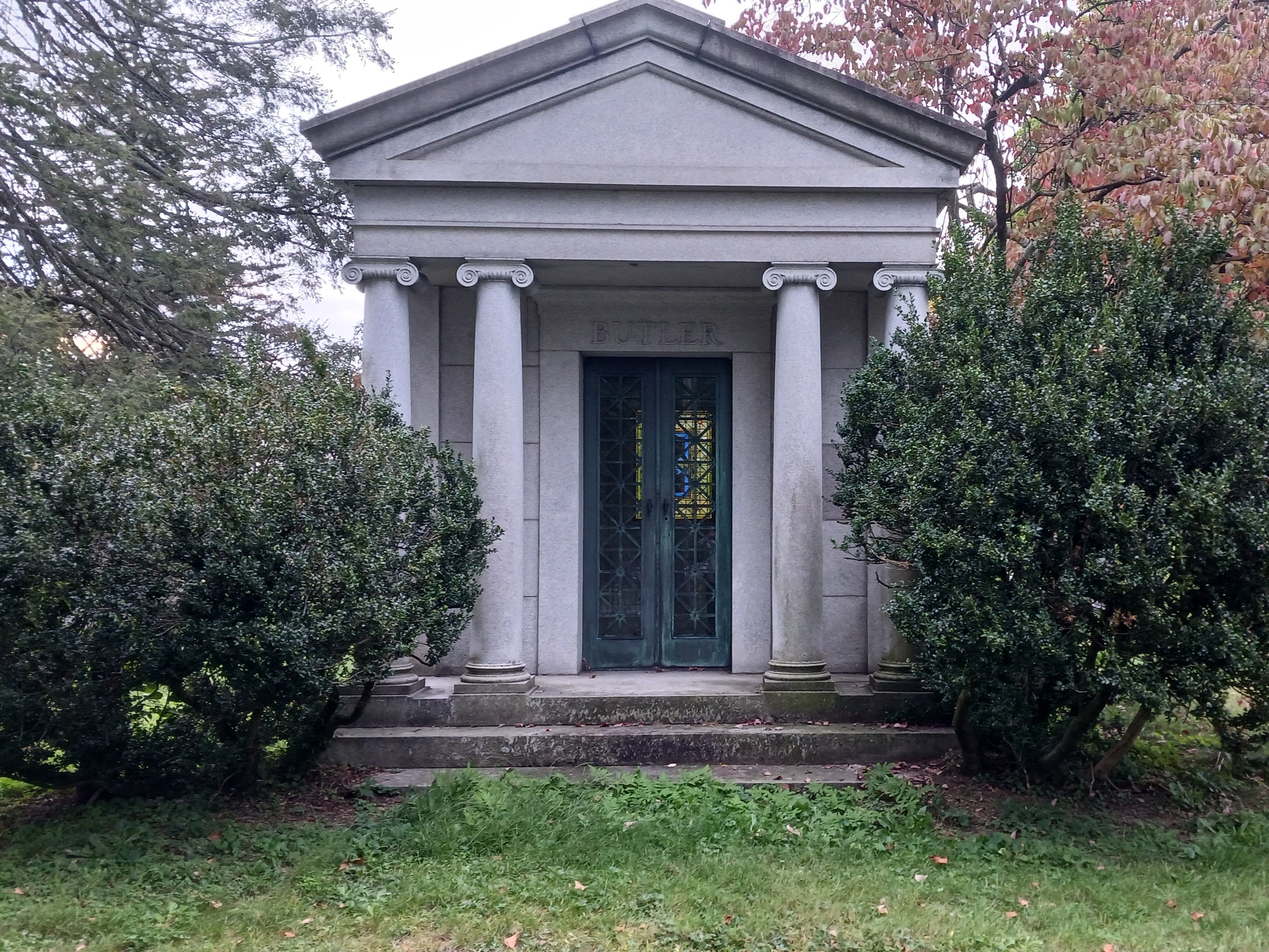
IMG_20240923_075453

Butler Mausoleum in Forty Fort Cemetery in PA

In 1914, Edward H. Butler died at his residence near the corner of North and Delaware.  He had been in poor health for about ten years, mainly due to diabetes.  He had recently had an operation for mastoiditis, an infection of the ear.  He did not recover well from the surgery.  His funeral was held at Westminster Presbyterian Church on Delaware Ave in Buffalo.  He was buried in a mausoleum in Forty Fort Cemetery in Forty Fort, Pennsylvania, next to his wife and the two babies who had passed away. 

IMG_20240923_091356

Interior of Butler Mausoleum showing Mr. Butler’s crypt.

Mr. Butler’s will gave to many charities.  It was believed that Mr. Butler left personal property valuing $25,000(about $787,000 in today’s dollars) and real estate valued at $25,000(about $787,000) or more.  He gave $60,000 (about $1.9 Million) dispersed amongst 40 charities/institutions.  [Note:  For a deep dive into Mr. Butler’s Bequests, we will discuss his will in my next post, going into each organization that received the money, the story of the charities and if they exist anymore.  Stay tuned for that!]

Outside of Buffalo, he donated to the cemetery where he and his wife are buried and to the cemetery in LeRoy where his mother and other relatives were buried.  He distributed approximately $60,000 (another $1.9 Million) to his personal friends, relatives and employees.  Every employee of The Buffalo News who had worked there for at least three years was given $100(about $3,147 today).  

Edward H. Butler, Jr.

edwardbutlerjr

Sketch of Edward Butler Jr. Source: The Fourth Estate.

Following Mr. Butler’s death, son Edward H. Butler, Jr. took over as Editor of The Buffalo News. Edward Jr also inherited the house at Delaware and North Streets, all of the oil paintings, plates, china, rugs and furnishings.    Daughter Ada inherited her house at Delaware and Highland Avenue, which had recently been completed, along with $50,000 to equalize her brother’s more significant inheritance of the larger family home.  

Edward Jr also inherited six-tenths of Mr. Butler’s ownership of the buildings used and occupied by the Buffalo Evening News and the Buffalo Sunday Morning News – 216 and 218 Main Street, the press and composition rooms on Pearl Street south of Seneca Street, the building at West Seneca Street and Lower Terrace that was used as a garage for the news vehicles, and all of the real estate used for the publication of the two newspapers.  The remaining four-tenths of The Buffalo News and Sunday Morning News went to Ada.  

Edward Jr had been well-trained to take his father’s place at The News.  He joined The News after graduating from Yale in 1907.  He took business courses at Bryant & Stratton Business Institute.  He also worked various jobs in all of the newspaper’s departments.  He knew all the people and how they made the newspaper work; the Butlers felt that learning and understanding every part of the business was important.  

In 1914, Buffalo readers had a choice of six English-language daily newspapers.  In the morning – The Courier and the Express.  In the afternoon, The Buffalo News, the Buffalo Times, the Buffalo Enquirer, and the Buffalo Commercial.  

One of Edward Jr.’s first tasks when he took over the newspapers was to close The Sunday News.  The Evening News was doing well, but The Sunday News was operating at a deficit.  Edward Sr had refused to kill The Sunday News as it was his first publishing venture in Buffalo.  Edward Jr quietly killed The Sunday News at the start of 1915.  The Buffalo News Sunday edition began again 63 years later when things shifted following the Butler family’s sale of the newspaper.

Edward Jr and Kate continued to live at 672 Delaware Avenue.  They had two children – first a son, Edward H Butler III, was born in August 1915. Sadly, Edward III passed away in June 1919, just a few months before his fourth birthday, after several days of illness.  According to his obituary, he had been in poor health for the previous year, suffering from “a peculiar glandular malady that had puzzled physicians.”   Daughter Kate Robinson Butler was born in November 1921.  

In the 1920s, Edward Jr became a pioneer in presenting news via radio.  The Radio Commission authorized WBEN to go on the air on September 8, 1930.  The WBEN stands for Buffalo Evening News.  WBEN broadcast from a studio on the 18th floor of the Hotel Statler.  WBEN started broadcasting with all live, local programs, no national programs and no prerecorded music. WBEN was a part of National Broadcasting Co.’s Red Network, which became the NBC Network.  In 1936, Edward Jr bought WEBR, part of the Blue Network that would later become ABC.  WEBR developed a slogan saying that their letters stood for We Extend Buffalo’s Regards. Edward Jr sold WEBR in 1942 to the Courier-Express.  

In 1928, Mrs. Kate Butler gifted the University of Buffalo with the tower clock in Hayes Hall and the four bells accompanying it.  Mrs. Butler was a member of the Council of the University of Buffalo.  The bells and the clock were restored between 2011 and 2015 during the renovations of Hayes Hall and still operate today.  

By the 1930s, the last competing daily newspapers, Buffalo Commercial Advertiser and Buffalo Times ceased publication.  This left Buffalo with just two newspapers – The Buffalo News and the Buffalo Courier Express.  

After WWII, Edward Jr brought The News to television in Buffalo.  WBEN-TV went on the air on May 14, 1948 and for the first five years was Western New York’s only television station.  In 1954, WBEN-TV became a CBS station.  In 1977, WBEN-TV became WIVB-TV, Channel 4 in Buffalo still to this day.      

Edward Jr was involved in many of the same causes as his father.  He was the Chairman of the Board of Buffalo State Teachers College (Now Buffalo State University).  He was involved with the efforts to move the school from his Normal Ave location to its current location on Elmwood Avenue.  He also served as a Trustee of Nichols School.  Edward Jr was a Director of Buffalo Trust Company and American Savings Bank.  He was a member of the Buffalo, Saturn, University, Park, Buffalo Athletic, and Buffalo Country Clubs.

185245182_1510853833

Butler Mausoleum in Forest Lawn Cemetery.

Edward Jr died in February 1956. He is buried in the Butler Mausoleum in Forest Lawn Cemetery.   Also buried there are his son, Edward H Butler III, his wife, Mrs. Kate Butler, daughter Kate Butler Wickham and two of Kate’s husbands – Bruce Wallis and Robert Wickham.  

Ada Butler and her Family

Edward Jr.’s sister, Ada Butler, married Roscoe Mitchell in April 1910.  Mr. Butler, Senior built the house at 1114 Delaware Avenue as a wedding gift for Ada.  The house is a three-story brick mansion designed by Buffalo architect Ulysses G Orr.  

Roscoe Mitchell was a well-known Buffalo attorney.  Ada and Roscoe had a daughter, Marjorie, born in 1911, and a son, Edward Butler Mitchell, born in 1912.  Sadly, both Roscoe Mitchell and Edward Butler Mitchell died in June and July 1932 after a long period of illness.  Roscoe was 49, and Edward was just 19. 
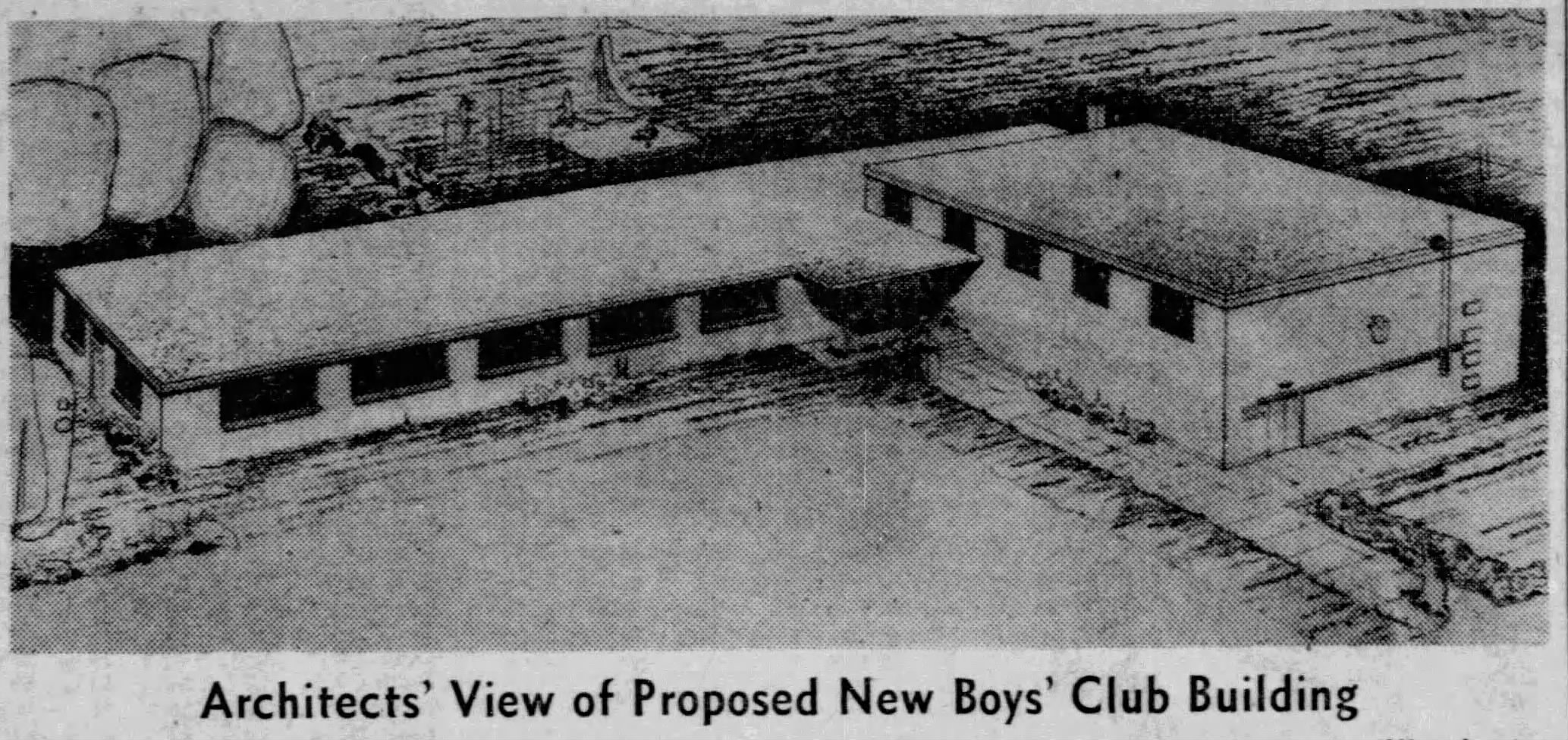
rendering_of_boys_club_building_on_Massachusetts_Ave

Rendering of Boys Club Building on Massachusetts Avenue. Source: Buffalo News, February 1955

The Butler Mitchell Boys Club was founded in the memory of Edward Butler Mitchell in 1933.  The story goes that Ada was driving around the West Side shortly after her son died and saw some young men playing in a makeshift clubhouse and she pulled up to them and talked with them. She decided to buy an old barn on Efner Street to give to the boys of the neighborhood to use.  The Butler Mitchell Club was founded to help the young men of the neighborhood, ages 16 to 24.  The group quickly grew and rented a space in a church at 254 Virginia Street by December of 1933 (this former church is where Hispanics United of Buffalo is located today).  In 1955, the Boys Club of Buffalo and the Boys Club of the Niagara Frontier joined together to erect a new building on the West Side at 370 Massachusetts Avenue, known as the Butler Mitchell Branch.  The Butler Mitchell Boys and Girls Club is still located on this site.  

After their father’s death, Edward Jr and Ada established and perpetually endowed the Edward H Butler Professorship in English Literature within the College of Arts and Science at the University of Buffalo.  This professorship was established in honor of their father and still exists today.

85130819_132955847061

Mitchell Family Plot in Forest Lawn Cemetery

Ada Butler died on April 1, 1934, in New York.  She was buried in Forest Lawn Cemetery with her husband and son.  The Mitchell family plot includes the graves of Roscoe, Edward, Ada, Marjorie and Marjorie’s husband Kent Schuyler McKinley, hence the “Mitchell McKinley” on the plot.  

Ada’s daughter Marjorie was married several times.  First to William Baird in July 1930.  Baird Point at Lake LaSalle on North Campus at UB and Baird Hall are named for the Baird family – William, his brother Cameron, and their father Frank. A street by the Peace Bridge that bisected Front Park, Baird Drive, was also named for them.  The road was removed in 2016 to restore park space to Front Park.  Marjorie and William had one daughter, Barbara Butler Baird, born in August 1931.  

Marjorie helped found the Butler-Mitchell Boys Club with her mother and served as president of the club from 1937 to 1952.  

In 1943, Marjorie Mitchell married Kent Schuyler McKinley.  As Marjorie McKinley, she financed the construction of the Edward H. Butler Auditorium in Samuel P Capen Hall [Note: this Capen Hall was located on South Campus; when North Campus opened, the Capen name moved to North Campus and Capen Hall on South Campus became Farber Hall…I am unsure if the auditorium still exists in Farber Hall – do any of my UB friends know?]

In 1950, Marjorie donated her family house on Delaware to the Episcopal Diocese of Buffalo.  The Diocese used the house as its headquarters, calling it the “Marjorie Mitchell McKinley Diocesan House,” though many called it as “The D’ House.”  The property has been the headquarters of Courier Capital since 2011.  

Marjorie and her husband Kent moved to Sarasota and founded the Sarasota News in 1954.  The Sarasota News was a daily afternoon newspaper.  Talk about a family with deep newspaper ties!  They sold the newspaper in 1962.

Also in 1962, Marjorie sold her 40% shares of The Buffalo News to her Aunt, Kate Butler. 

In 1965, Marjorie was named honorary chancellor of Florida Southern College, the first woman elected to the office.  That year, she also received an honorary doctor of fine arts degree from the college.  She was the main donor for the music building built on campus, the Marjorie M McKinley Music Building, which was named for her. 

Kent McKinley died in 1972.  Marjorie married Ted C Van Antwerp in 1973.  Marjorie passed away in November 1990.  Marjorie and Kent are buried in the Mitchell McKinley plot in Forest Lawn Cemetery.  

Mrs. Kate Butler

Mrs_Butler_August_1974Following Edward Jr’s death, his wife Kate Butler led The News.  She became President of The News in 1956.  She was known around town as “Mrs. Butler”, so I will call her that from here on out.  

The News had purchased additional properties over the years, taking over much of the area at Main and Seneca Streets.  In 1916, The News purchased a building on Pearl Street and remodeled it for use of the mailing department and for stock and file rooms.  In 1924, The News bought a building at Seneca and Pearl Streets; the four-story structure became part of The News’ press room.  In 1929, they purchased 214 Main Street and built an addition to their building.  They continued to need more space.  Mrs. Butler finished the construction of the printing plant, which her husband had begun.  The printing plant on Scott Street opened in 1958 on land that was once part of the Lehigh Valley railroad depot.  The new plant had 35 printing units arranged to operate as five giant presses.  On June 30, 1958, President Dwight D. Eisenhower pressed a button at the White House to start the first production run with the new presses. 

Mrs. Butler also became the Publisher of The News in 1971.  James Righter was publisher from 1956, when Edward Jr died, until 1971.  James Righter was married to Edward and Kate’s daughter Kate.  While the public word was that he took early retirement, reportedly, Mrs. Butler became Publisher because she fired her son-in-law when she found out he was having an affair.  

BN1

Buffalo News Birds Eye View, April 13, 1973. Source: Buffaloah.com

Mrs. Butler also made the tough decision to move The News from 218 Main Street after 75 years to the “new” Buffalo News building at the corner of Washington and Scott Streets.  The Main Street property was going to be a part of the City’s redevelopment program to build Marine Midland Center (now Seneca One Tower).  The new office building was built next door to the printing plant on Scott Street.  One News Plaza, as the new building was known, was designed by NYC Architect Edward Durrell Stone.  The modernist building is unusual because there are no support columns in the middle of the floor plates.  The five-story building also has an atrium that houses a garden with trees and plants.  The News moved into the new building at the corner of Washington and Scott Streets.  Mrs. Butler, unfortunately, was never able to set foot into the new building, as ill health had confined her to her house. 

 Kate Butler died in 1974.  She is buried in the Butler Mausoleum in Forest Lawn Cemetery.  

The Buffalo News After Mrs. Butler’s Death

Mrs. Butler had reportedly been counseled by her attorneys to take steps to minimize the tax consequences that would occur upon her death by gifting off some of her assets, otherwise a “fire sale” would occur.  After Mrs. Butler’s death, the Butler family decided to put The News up for sale.  The newspaper, TV station and radio stations were each sold to different buyers following Mrs. Butler’s death.  The News was officially out of broadcasting at that time.  

The Butler Mansion was donated to Roswell Park Cancer Institute in 1976.  In 1979, Jeremy Jacobs purchased the mansion for use as the headquarters of Delaware North Companies (the mansion is located at Delaware and North Streets, hence the Delaware North name).  In 1991, the mansion was sold to the Variety Corporation.  In 1999, Mr. Jacobs reacquired the mansion for the UB School of Management to use the property for executive training.  In 2001, the mansion was renamed the Jacobs Executive Development Center.  In December 2022, the UB Foundation announced the mansion’s sale to Douglas Development.  

In 1977, after 97 years of being owned by the Butler family, the newspaper was purchased by Warren Buffett for $32.5 Million.  Mr. Buffett became Chairman of The News.  When Mr. Buffett purchased The News, it was an afternoon newspaper published every day except Sunday.  Afternoon newspapers were dying across the country at the time due to the rise of office work over factory jobs and TV news, which made the afternoon edition feel out-of-date at the end of the work day.  The Evening News was different than most; it still sold more than double as many copies as the Courier-Express morning edition.  But it still lacked a Sunday paper.  One of Mr. Buffett’s first decisions was to restart the Sunday edition, which began on November 13, 1977.  There had been a gentleman’s agreement between The News and the Courier-Express that The News would be evening only and the Courier-Express would be morning only.  The Courier-Express fought against the Sunday edition by persuading a local judge to issue rules designed to cripple the distribution of the Sunday News.  In 1979, an appeals court overturned the crippling rules and scolded the judge who imposed them.   Two months later, the Connors family sold the Courier-Express to a Minneapolis newspaper company.  Three years later, on September 19, 1982, the Courier-Express published its last newspaper, leaving Buffalo with just one newspaper.  

After the Courier-Express closed, The Buffalo News became a seven-day newspaper.  In 1989, Buffalo News was the 27th largest newspaper in the United States, with 1100 full-time employees, 200 employees in editorial, and a circulation of 320,000 on weekdays and 390,000 on Sundays.  In 1990, 75% of the newspapers were delivered to homes by 4900 newspaper carriers (4400 youth, 500 adult carriers).   Like so many other Western New Yorkers, I delivered newspapers in middle school. The remaining newspapers were mailed out or found at newsstands/stores.  

The evening edition was abandoned in October 2006, and what had begun as The Buffalo Evening News became a morning-only newspaper.   

In January 2020, after 42 years of being a part of Warren Buffett’s Berkshire Hathaway group, The Buffalo News was sold to Lee Enterprises, just the third owner in the entire history of The News.  Lee Enterprises had ties to Berkshire Hathaway and had managed the Berkshire Hathaway newspapers, except for The Buffalo News, since 2018.   
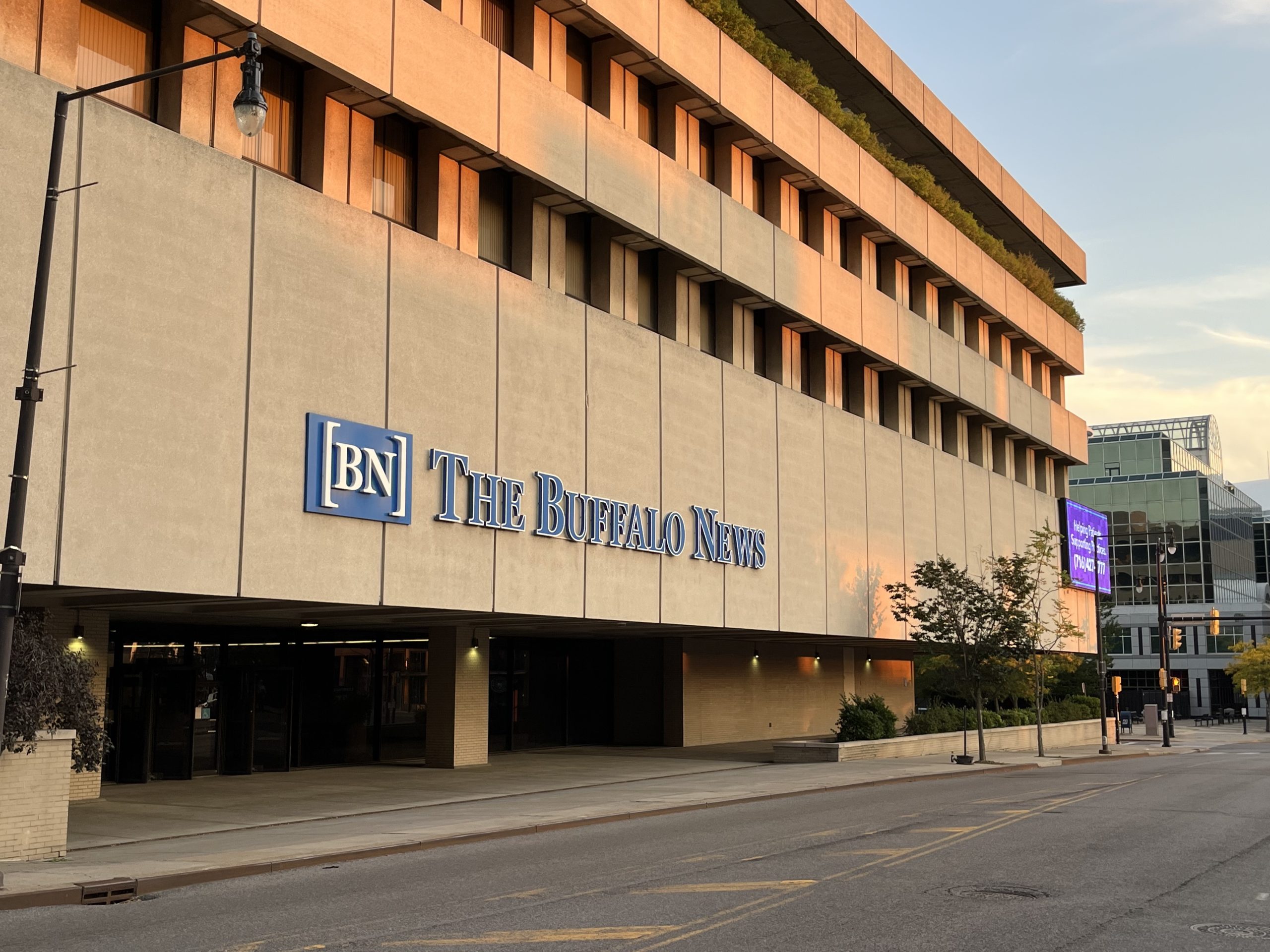
Buffalo-News_Sept.-26-2024-scaled

Former Buffalo News building from Washington Street.  The property is now vacant and fenced off.

In 2022, The Buffalo News announced they were selling their headquarters on Scott Street, moving out of Downtown Buffalo for the first time in almost 150 years. The 175 office employees relocated to 20,000 square feet in the Larkin Exchange Building on Exchange Street in October 2022.  The print production facilities were originally going to remain on Scott Street.  

In February 2023, The Buffalo News announced they were closing the printing production facility on Scott Street and moving print operations to Cleveland, Ohio, to the Plain Dealer printing facility.  About 130 employees across 8 different unions were affected by the closure of the print operations.   The final locally printed edition came off the presses on September 30, 2023.  

In 2024, The Buffalo News announced they would no longer publish a print issue on major holidays, including New Year’s Day, Martin Luther King Jr Day, Presidents Day, Memorial Day, Independence Day, Labor Day, Veterans Day, Thanksgiving and Christmas.  

The Buffalo News building was purchased by Douglas Jemal in July 2024. The sale included the office building, the adjacent production building and a parking lot across the street on Scott Street.  Douglas Jemal also owns the former HSBC Atrium building, just south of The Buffalo News properties, giving the developer control of approximately 14 acres of land in Downtown Buffalo near Canalside and the Arena – I can’t wait to see what he does with the properties!  

So the next time you drive down Butler Ave, or pass by the Former Buffalo News office or the Butler Mansion at Delaware and North, or read The Buffalo News, think of Mr. Edward H Butler and thank him for coming to Buffalo and giving us The Buffalo News and so much more.  What’s your favorite Buffalo News memory?  

Want to learn about other streets? Check out the Street Index. Don’t forget to subscribe to the page to be notified when new posts are made. You can do so by entering your email address in the box on the upper right-hand side of the home page. You can also follow the blog on Facebook. If you enjoy the blog, please share it with your friends; It really does help!

Sources:
  1. “Building is Active in Hamlin Park Now.”  Buffalo News.  November 20, 1915, p21.  
  2. “Butler Ave Just Opened New Street in Hamlin Park.”  Buffalo News.  May 15, 1915, p23.
  3. “Edward H. Butler Died Soon After Serious Operation.”  Buffalo Times.  March 10, 1914, p4.  
  4. “Will of Edward H. Butler is Filed This Afternoon”  Buffalo News.  March 18, 1914, p4.  
  5. “Edward H. Butler Jr and Kate Butler.”  Buffalo News.  November 1, 2015, p84.  
  6. “The News:  A radio and TV Pioneer.”  Buffalo News.  November 15, 2015, p92.
  7. “How the News Grew In Downtown Buffalo.”  Buffalo News.  November 22, 2015, p90. 
  8. “Buffalo’s Last Newspaper War.”  Buffalo News.  December 13, 2015, p94.   
  9. “Death of Mrs. Edward H Butler.”  Buffalo News.  August 21, 1893, p13. 
  10. “Striking Clock Being Installed at University.” Buffalo Times.  June 21, 1928.
  11. “Bennet, A Gordon.  Buffalo Newspapers Since 1870.”  Adventures in Western New York History, Buffalo and Erie County Historical Society, 1974.
  12. Hill, Richmond C.  Twentieth Century Buffalo:  an illustrated compendium of her municipal, financial, industrial, commercial and general public interests.  J.N.Matthews Co, Buffalo, 1902.  
  13. Downs, Winfield Scott.  Municipality of Buffalo:  A History, 1720-1923, Volume 1.  Lewis Historical Publishing Company, 1923.
  14. Kirchhofer, A.H.  “Romance in American Journalism.”  The Fourth Estate.  November 19, 1927.  
  15. “Jacobs Executive Development Center”.  University at Buffalo Archives.  library2.buffalo.edu/archives/campuses/detail.html?ID=118
  16. “Facts About The Buffalo News.” from The Buffalo News.  Updated 9/1990.  Found in the Newspapers Vertical File at the Central Library.  
  17. History of the City of Buffalo, It’s Men and Institutions.  Published by The Buffalo Evening News.  1908.
  18. “Obituary:  Edward H. Butler, Jr.”  Buffalo News.  June 23, 1919, p1.  
  19.  “Station WEBR Transferred; WBEN’s Status Unchanged.”  Buffalo News.  July 12, 1942, p8.  
  20.  Hsu, Charlotte.  “Journey to the Heart of the Hayes Hall Clock.”  UBNow, October 22, 2014.  buffalo.edu/ubnow/stories/2015/10/hayes_clock.html
  21. “Marjorie Van Antwerp Dies; Ex-News Executive”.  Buffalo News.  November 30, 1990, p5.  
  22. Butler Mitchell Alumni Association.  “Our History”.  bmalumni.com/history
  23.  Robinson, David.  “The Buffalo News is Being Sold to Lee Enterprises.”  Buffalo News.  January 20, 2020.
  24. Petro, Michael.  “Buffalo News Plans to Close Downtown Production Facility, Move Printing to Cleveland.”  Buffalo News.  February 20, 2023.  
  25. Glynn, Matt.  “Douglas Jemal agrees to buy Buffalo News complex to expand holdings near Canalside.”  Buffalo News.  March 19, 2024.  
  26. Ashley, Grant.  “Buffalo News no longer publishing print issue on ‘major holidays’.  WBFO.  July 6, 2024.  
  27. Light, Murray B.  From Butler to Buffett:  The Story Behind The Buffalo News.  Prometheus Books. 2011.  
  28. Sullivan, Margaret.  “Historic Change Coming for The News.”  Buffalo News.  October 1, 2006, p81.  
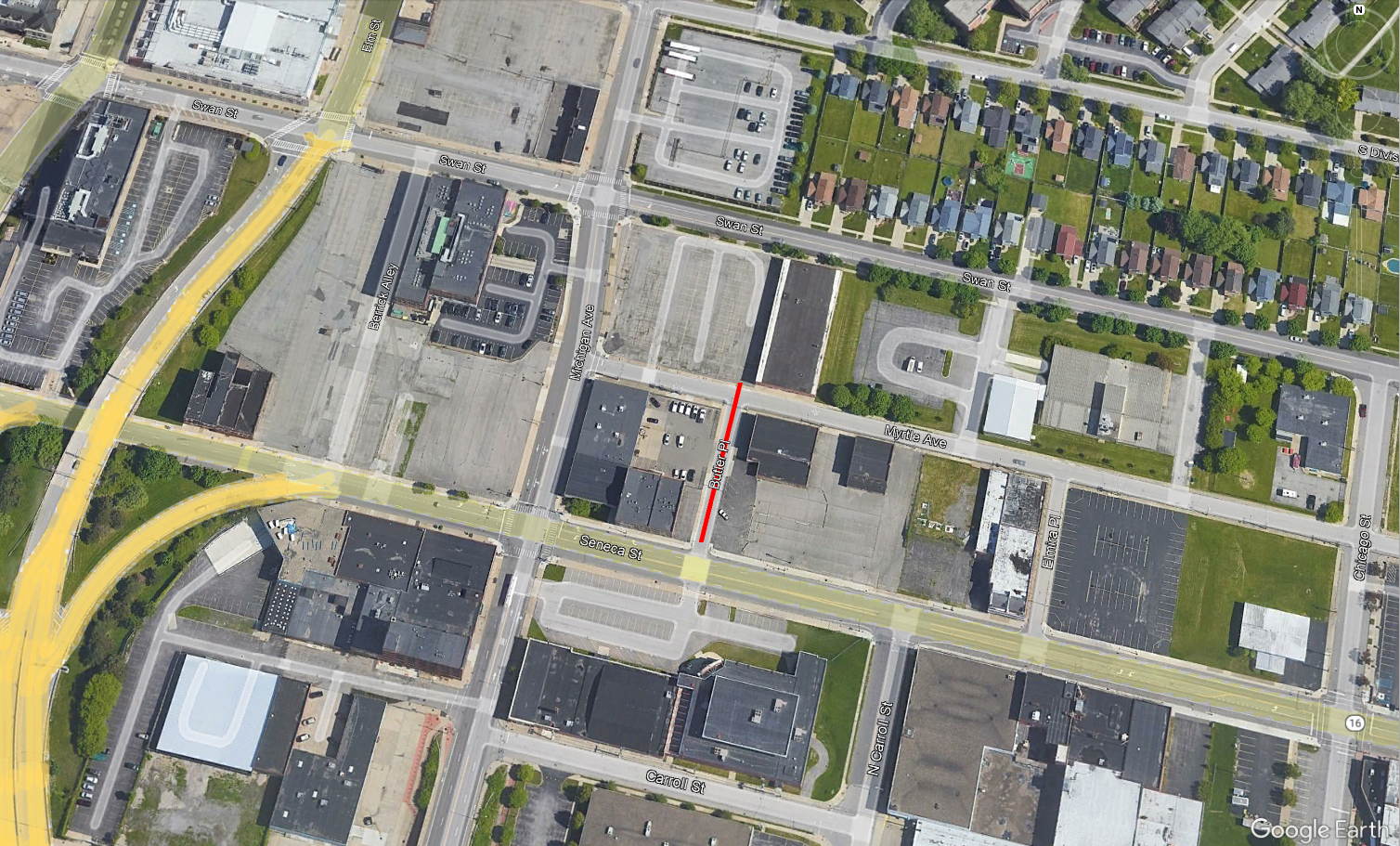
Screenshot (79)

Butler Place is shown on the map in red.

Today we’ll be talking about Butler Place, which was originally Fitch Alley.  We’ll be discussing both Mr. Joseph Butler and Mr. Benjamin Fitch in this post….because the Fitch name is very important in Buffalo’s social work history! Normally, I don’t write much about the original namesakes of streets but I don’t know when else I’d be able to tell the story of the Fitch Institute and the Fitch Creche otherwise. 

Another Butler – Butler Street

Most of the time, a municipality likes to ensure it doesn’t have duplicated street names, to avoid confusion for things like emergency services and mail delivery.  However, Buffalo has two streets called Butler:  Butler Place and Butler Avenue.  The next post, coming next week, will discuss Butler Avenue and its namesake, the founder of The Buffalo News.

1872 atlas of buffalo butler street

1872 Atlas of Buffalo map showing Butler Street, lined in orange.

There actually used to be a THIRD Butler!  Butler Street was laid out in 1855 between Delaware Avenue and the State Reservation Line (near Richmond Avenue).  Butler Street is now known as Lexington Avenue.  Frank Kraft, an undertaker who lived at what became 53 Lexington Avenue, decided the name of Butler Street was not “toney” enough, meaning “aristocratic or high-toned.”  Mr. Kraft convinced his neighbors to petition to become Lexington Avenue, thinking it sounded fancier.  The name change was granted in 1888.  There was a trend during this era to change street names to seem higher class.  At the time, people believed Avenues were nicer than Streets, so residents would petition to change their street names – Delaware and Michigan went from streets to avenues around this time.  During the same Streets Committee Meeting where Butler became Lexington, Cleveland Street became Cleveland Avenue.  Unfortunately, I could not determine who Butler Street was originally named for when it was laid out in 1855; several Butler families lived in Buffalo around that time.  However, neither the Butler Place nor the Butler Avenue namesakes lived in Buffalo in 1855, so it was not named for either of them.  

The Original Fitch Alley

So now, back to Butler Place….Butler Place runs for just one block between Swan Street and Myrtle Avenue, just east of Downtown Buffalo.  Butler Place was originally named Fitch Alley, after Benjamin Fitch, but was renamed in 1891 to honor Joseph Butler.  Mr. Fitch owned the land just west of Fitch Alley.  

1872 atlas of buffalo second ward fitch institute_zoom

1872 Atlas of Buffalo image showing some of the properties of Benjamin Fitch outlined in red. Property at the southwest corner of Swan and Michigan became home to the Fitch Creche (in the building located on the site on this map) and Fitch Institute on the vacant portion of that property. Note Fitch Alley’s name on the map. Intersects with Folsom Street, which is now Myrtle Avenue.

Mr. Benjamin Fitch

Benjamin_Fitch

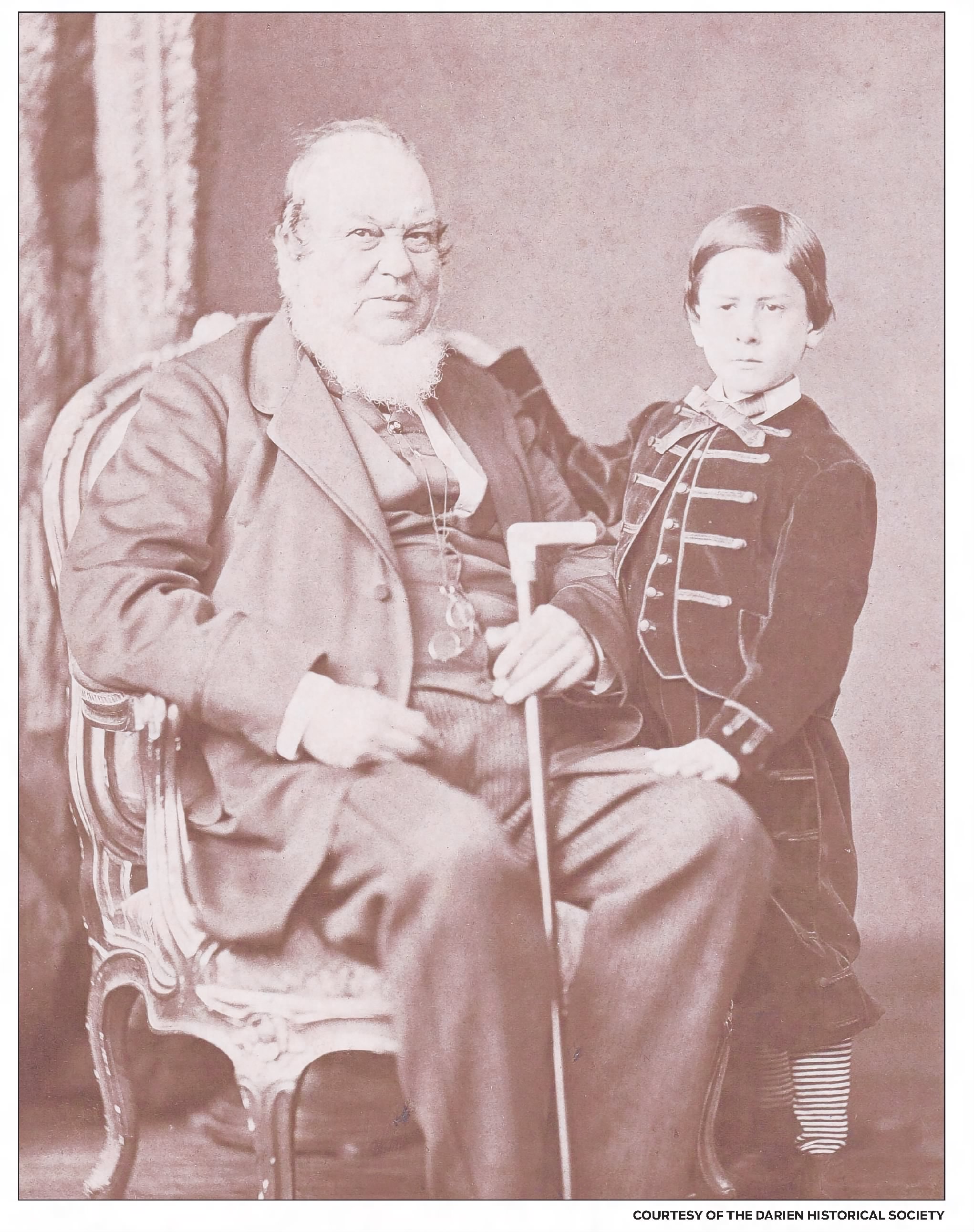
Benjamin Fitch and his grand-nephew Augustus. Source: Hartford Courant.

We’ll start with Mr. Fitch.  Benjamin Fitch was born in June 1802 to Charlotte Selleck and Stephen Fitch.  His birthplace is disputed among various records.  Charlotte petitioned the State of Connecticut for divorce on the grounds of being threatened and beaten by her husband.  The divorce was granted in 1808, and Charlotte moved away with two of Benjamin’s siblings.  Benjamin and two of his brothers lived with their father.  In 1812, at the age of 10, Stephen was working as an Indian Agent, and the family came to Buffalo to see Red Jacket.  They were still in Buffalo when it got burned by the British in 1813-1814, and they decided to move to Albany.  At that time, Benjamin ran away from his father and made his way back to New York City by working on the Hudson River in a sloop.  He reunited with his mother and lived in New York City for a few years, working as a store clerk.  He eventually went into business for himself.

In 1824, Benjamin Fitch returned to Buffalo to open a General Store.  After a few years of establishing his business, he returned to New York City but maintained a branch office in Buffalo.  In 1841, he returned to Buffalo as a member of the firm of Marvin, Bennett & Company.  The Bennett in Marvin, Bennett & Co is Mr. Bennett of Bennett Park fame, and the Marvin is Marvin Street’s namesake. The store was originally on the west side of Main Street between Seneca Street and the Terrace (the site is now a part of Seneca One Tower).  After a year or two, Benjamin returned back to New York.  In 1846, he returned to Buffalo, establishing Benjamin Fitch & Co., with branches in Buffalo and Chicago.  He split his time between Buffalo and New York City while his nephew ran the Chicago Branch.  Fitch & Co. had three stores in Buffalo at that time.  In 1853, he retired to New York City for good but retained many of his Buffalo land holdings.  After Mr. Fitch retired, his company eventually became a part of Flint & Kent, which operated until 1956.  

During the Civil War, Mr. Fitch contributed to many wartime causes.  Mr. Fitch saw many soldiers return wounded or broken by battle, unable to provide for their families.  In 1863, Benjamin Fitch founded Fitch’s Home for Soldiers and Orphans in Darien, Connecticut, with the endorsement of President Abraham Lincoln and Secretary of War Edwin Stanton.  The Home was formally dedicated on July 4, 1864, as a place for the support of at least 80 disabled soldiers and the support and education of their children.  It was the first home of its kind in the United States.  Mr. Fitch would take out bank accounts for each of the children there and deposit $5(about $100 today) into the accounts to get them started once they grew up and moved out.  Mr. Fitch later added a public hall and art gallery to the home.   After Mr. Fitch died, the State of Connecticut took over the facility.  Fitch’s Home for Soldiers operated until August 1940, when the 561 residents were moved to Rocky Hill for the State’s new Veterans Home and Hospital.  The only remaining building from Fitch’s Home is the chapel, which was moved across the street and is now a VFW Post.  Also in Darien, Mr. Fitch built a house for his mother in 1850 and helped endow a local church for her across the street, St. Luke’s Protestant Episcopal.

The Fitch Creche

fitch portrait

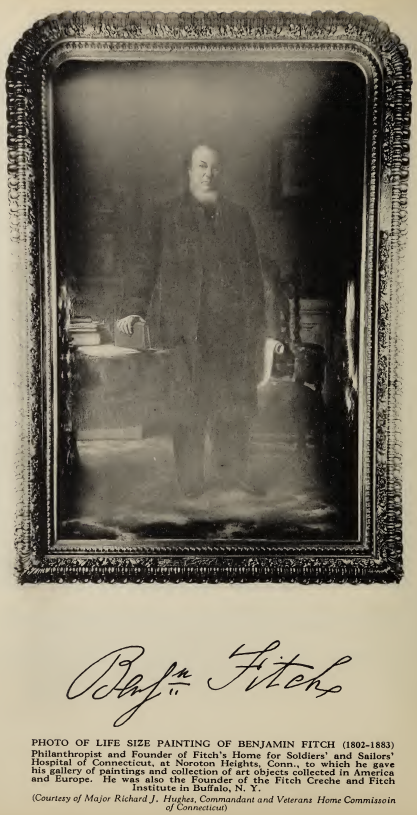
Life Size Portrait of Benjamin Fitch from the Soldiers Home. Source: History of the Fitch Family.

In the 1870s, Buffalo was beginning to look at starting a Charity Organization Society (COS).  While working to start COS, Reverand Gurteen and Ms. Maria Love visited Benjamin Fitch at his home in New York.  Reverand Gurteen was pastor at St. Paul’s Episcopal Church here in Buffalo, and Maria Love was a wealthy socialite who cared deeply about social work reforms of the time.  We’ll learn more about the Love family when I write about Love Alley.  Ms. Love had visited many creches in England, France and Italy while traveling with her nephew and thought about founding a model kindergarten and training school in Buffalo.  A creche is a nursery where babies and young children are cared for during the working day, what we’d call a daycare today.  The COS of Buffalo was incorporated in November 1879 and was the first Charity Organization Society in the United States.  The COS asked Mr. Fitch for assistance in leasing a property for the Society to build a creche.  While never marrying or having children of his own, Mr. Fitch felt strongly for their mission.  The property at 159 Swan Street was deeded to the Society by Mr. Fitch on January 1, 1880.  The house at 159 Swan Street was originally built by Lucius Pratt in 1835.  After Mr. Pratt’s death, Benjamin Fitch purchased it, and it was operated as a rooming house.  Some sources incorrectly state that the house was home to Mr. Fitch’s dry goods store or that Mr. Fitch lived in the house; neither of those statements appear to be correct based on my research.  The property was valued at $100,000 at the time(about $3 Million today).  The Fitch Creche was established on the property “for the care of infants and small children while their mothers are away from home at their daily labors; without regard to creed.”  Maria Love served as Chairman of the Fitch Creche Advisory Board.  

Fitch_Creche_sketch

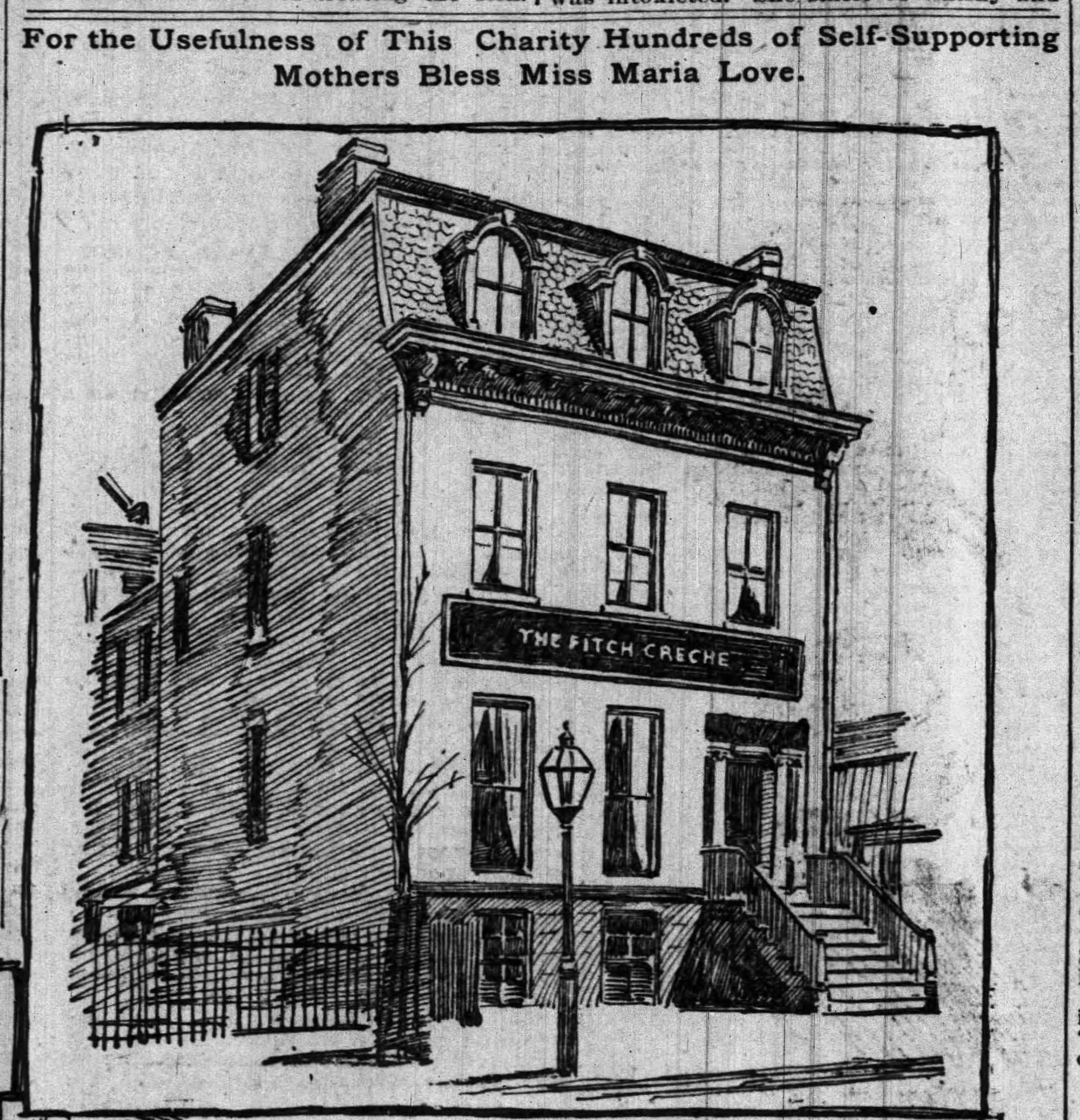
Sketch of Fitch Creche, 1897. Source: Buffalo Courier.

The Fitch Creche was quickly in operation, opening on January 5, 1881.  The Creche was funded by working mothers paying 5 cents a day (about $1.54 today).  This was the first organization of its kind at the time.  While we think of daycare as commonplace today, this was a new thing back then.  As the Buffalo Commerical put it at the opening, “The Creche was established to give poor working people’s young children a home to remain in during the day while the parents were seeking a livelihood outside.  The design was to keep such children as would otherwise be left in the streets or locked up in the house.”

The Creche served children from 2 months old to 10 years old and operated from 7 am to 6pm daily.  The children were provided 3 meals, Creche dresses, baths and shampoos, naps, and physical exams with treatment as needed.  There was a staff of 12 nurses, a housekeeper, a dietician, and three cleaning women.  Breakfast was at 8am and consisted of oatmeal and milk.  Dinner was served at noon, consisting of bread, broth, potatoes, meat, baked apples, rice and milk.  For tea at 5pm, they were served bread, applesauce and milk.  Children under one-year-old were fed with condensed milk out of a bottle.  The Creche had space for 50 children when it first opened.

A kindergarten was established in the Fall of 1884.  You sometimes hear that this was the first kindergarten in the country, which is not true.  The first kindergarten in America was established by Elizabeth Peabody in Boston in 1860.  Buffalo had a kindergarten established as early as 1867, run by Miss Mary Sheldon.  The Fitch Creche daycare is, however, believed to be the first daycare for working women in the United States.  The Fitch Crech established a training school for nursemaids was established in 1890. This was established as the “Nursery Maids Department of the Training School for Domestics,” and this was also the first program of its kind.  Four nursery maids graduated in the first year.

fitch creche

Fitch Creche. Source: History of the Fitch Family.

Over time, COS was able to arrange for some of the children to go away for the summer to Fresh Air Missions.  The first Fresh Air Mission was first established in 1888 by the Church of the Messiah, which was located on Main Street between Chippewa and Huron (now Fountain Plaza).  The Fresh Air Fund sent children to Corfu, Middleport, Orchard Park, Silver Creek, Evans and other country locations.  The idea was that getting kids out of the crowded, dirty city to spend a few weeks in the pure air of the countryside would be good for the children.  Cradle Beach Camp got its start as one of the Fresh Air Missions.  While the children were at camp, some of the working mothers were also sent away for vacations at homes in the countryside, including in East Aurora and Holland, to allow for them to get a vacation and some rest, too.  

Charity Balls were held to add supplemental income for the Creche, with the first ball held in 1880.  In 1903, the balls began to be held for the children, because they felt the ballroom was too beautiful to only hold one event a year.  Charity Balls stopped from 1917-1919 because of WWI but eventually were picked up again.  When the Fitch Creche closed in 1933, the Maria M Love Convalescent Fund was established to continue the mission through the balls.  The Children’s Charity Ball is still held to this day, with funds raised still going to people in need.  This year’s Charity Ball will be held for Middle School students in November of 2024.  

The Fitch Institute

fitchproperties

Map of properties donated to COS by Benjamin Fitch. Map by author.

Many people know the Fitch name in relationship to the Fitch Creche, but there were other institutions that bore the Fitch name in Buffalo – the Fitch Institute and the Fitch Accident Hospital!  In May 1881, Mr. Fitch donated several other properties to the COS for the “purposes of founding a maintaining in Buffalo a public institution for the physical, moral and intellectual benefit of the worthy poor of the city, without distinction of creed or sex.”  The Institute was to run a course of free lectures each year on scientific or other instructive topics, a free reading room, a provident coffee and soup room, a dispensary for supplying medicines and a medical attendant, a training school in domestic work for girls, a hospital for the temporary treatment of injured persons, and a place of deposit of small sums of money for working people to be drawn down as they need.  The properties had a value that totaled about $325,000 (about $10 Million today) of property donated to the organization.  The donation directed COS to build the public hall at the property on the southwest corner of Swan and Michigan, adjacent to the Fitch Creche.  They were able to sell, mortgage or lease the other properties to allow for income to provide for their mission. 

Screenshot (78)

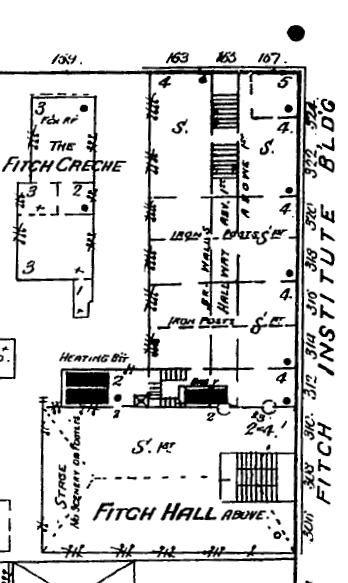
A portion of the 1889 Sanborn Map which shows the corner of Swan Street and Michigan Avenue, depicting the Fitch Creche and Fitch Institute Building.

The public hall was established as the Fitch Institute, located at 163-167 Swan Street and 304-310 Michigan Streets.  The Fitch Institute was designed to be similar to the Cooper Institute in New York.  The cornerstone was laid for the Fitch Institute on May 10, 1882.  The first floor of the building was designed to include a large office for COS where they could also operate the penny bank.  They were the only society in New York State to receive a penny bank charter since savings banks opposed penny banks.  A penny bank was a bank that allowed for any deposit to be made, no matter how small (even just a penny).  The charter for the penny bank allowed each person to deposit up to $50. 

The rest of the ground floor was set up as storefronts for the society to rent out for income.  The next floor called the ground floor, was set up for a hall for seating 200 people.  This was to be the home of the lectures.  Additional rooms on the ground floor were set up for surgeons and nurses to be known as the Fitch Accident Hospital.  On the next floor, called the second floor, was the reading room, library and coffee room for the Mechanics Institute.  On the third floor, half of the building was set up to be a hall for the Knights of Labor with the other half of the floor for housing for older couples.  Additional housing was on the fourth floor.

fitch institute

Fitch Institute Building. Source: History of Fitch Family.

Mr. Fitch’s Death

benjamin fitch crypt

Interment of Benjamin Fitch in St. Luke’s Church.

Mr. Fitch never married or had children, though he was close with his nephews and nieces and grandnephews and grandnieces.  Benjamin Fitch died in November 1883 at his house at 61 Fifth Avenue in New York City.  He is buried in Darien, Connecticut, in the crypt of the church he built.  It was estimated when he died that he had given away more than $500,000 of his wealth to charity (about $15.6 Million today).

The Legacy of the Fitch Institute and Fitch Creche

The Fitch Creche displayed a model creche in the Children’s Building at the World’s Fair in Chicago in 1893 and received medals at the New Orleans Exposition in 1885, the Paris Exposition in 1900, and the Pan American Exposition in Buffalo in 1901.  The Fitch Creche and the Fitch Institute were considered to be social work pioneers of their time!  

The Fitch Institute was host to countless events such as cooking classes, concerts and lectures on a variety of topics.  The Women’s Educational Industrial Union got its start in the Fitch Institute before spinning off as its own organization.  In October 1885, the Union hosted Julia Ward Howe at the Fitch Institute; she gave a lecture titled “Is Polite Society Polite?”  Julia Ward Howe is best known for writing the Battle Hymn of the Republic and founding Mother’s Day.  

The Fitch Accident Hospital closed in 1901 because it was felt that it was too costly for the COS to operate such a small hospital (served about 25 patients).  They also felt services were going to be duplicated by the nearby Emergency Hospital that was under construction. The Emergency Hospital had begun as a First Aid Station run by the Sisters of Charity in 1884 in a home near the railyards.  The new Emergency Hospital opened in January 1902 at the corner of Pine and Eagle Streets and was able to serve 100 patients. The Emergency Hospital was taken over by the Diocese of Buffalo in 1954 and was renamed in 1977 after receiving a donation from Paul V. Sheehan.  In 1979, a new 136-bed Sheehan Memorial Emergency Hospital opened on Michigan Avenue, in front of the former Pine Street hospital.  The old Emergency Hospital on Pine Street was demolished after the new hospital opened.  Sheehan Memorial closed in 2012.

After the hospital closed, the rooms were used as the Hotel Orizaba during the Pan-American Exposition.   After the Expo, the hotel space, along with the third and fourth floors of the Fitch Institute building, was turned over to be used as a Railroad YMCA.  Called the Union Terminal Railroad Department, it provided overnight shelter for train crews.  Railroad Y’s were located throughout Western New York to serve railroad employees. 

In 1907, the first tuberculosis dispensary in Buffalo was located in the Fitch Institute, having been established by the TB Committee of the COS.

After the Fitch Institute Closed

The Fitch Institute closed in 1933.  They had carried out the purposes of the society for as long as they could, but the character of the neighborhood had changed, and other agencies had taken over some of its functions.  The Great Depression was the death knell of many private charities, such as COS as public-operated social services came into existence.  The Charity Organization Society became the Family Services Society in 1934. Child and Family Services is the organization that today continues on the work of the COS and Family Services Society.  

In 1948, the Fitch Creche and Fitch Institute properties were purchased by the City at a tax foreclosure sale for $41,927 (about $547,000 today).  It had been determined that the properties were no longer exempt from taxes after they were no longer being used for charitable purposes.  The City listed the property for sale at Auction for $60,000 in June 1953(about $707,000 today).

In 1953, Arner Company, who were manufacturing pharmacists with headquarters across the street at 303 Michigan Avenue, leased the Fitch Institute building.  The building was used by Arner Company until 1960. 

In 1967, Erie County had considered using the Fitch Institute Building for a Men’s Shelter.  At the time, there was a real urgency to find a sufficient building because of the demolitions of Halfway House, Terrace House and the St. Francis Hotel.   They inspected the building and determined it would not work because the building had no heating or electrical service, the ceilings were too high, the floor and joists were made of wood, and the staircases were not fireproofed.  Due to the imminent need for a new shelter, they wanted something that could very quickly be turned over and passed on using the Fitch Building.  

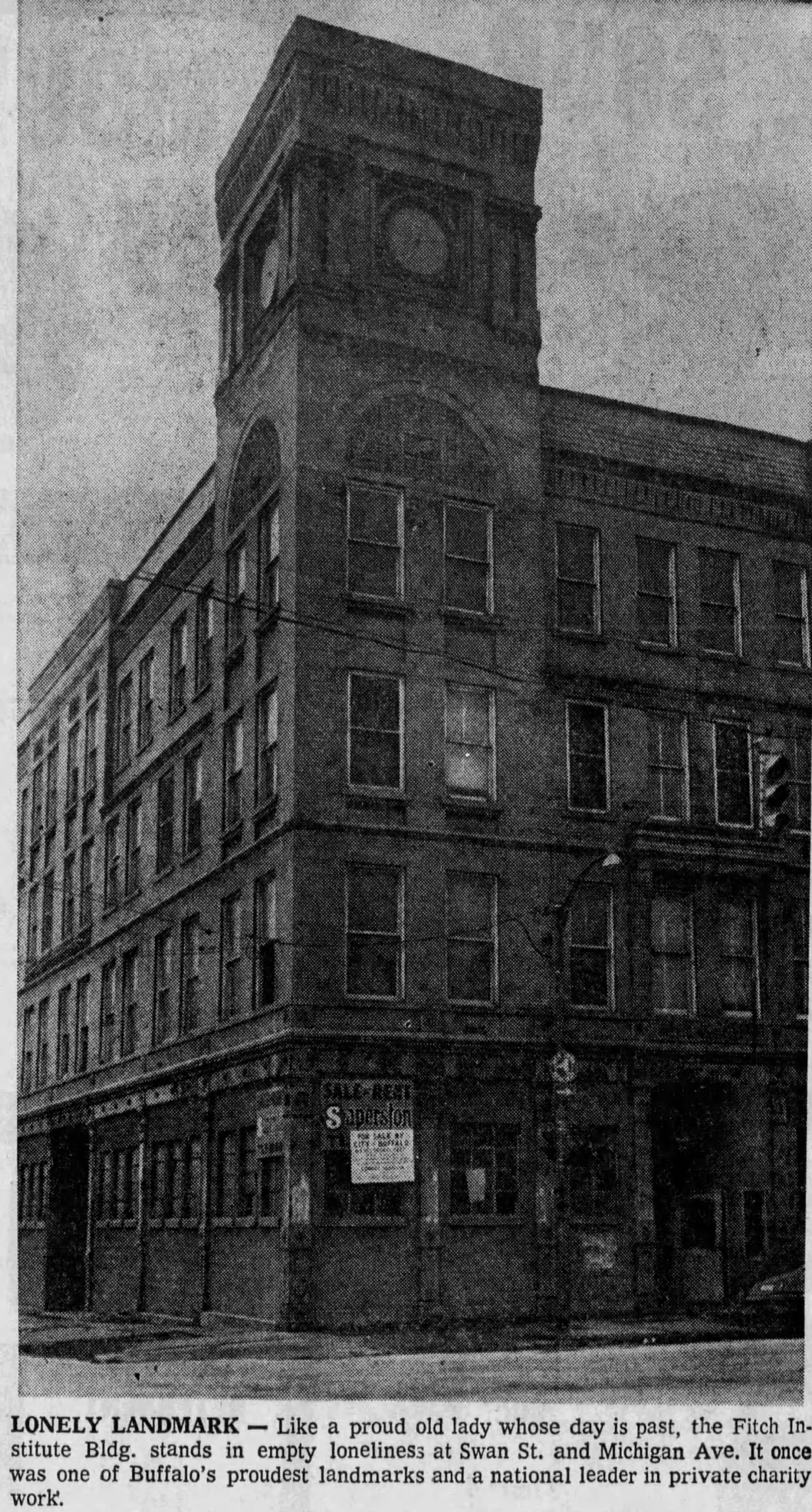
Fitch_institute

Fitch Institute Building as it looked in 1973 when it was listed for sale by the City. Source: Buffalo News.

In 1973, Ralph Dribble of the Buffalo News called the Fitch Institute “a genuine historical landmark.  It is a relic of times when private charity anticipated what politicians of later years would proclaim under such labels as New Deal, Fair Deal and Great Society.  It was a precursor of what would later become known as children’s hospitals, day nurseries, working girls’ homes, soup kitchens and credit unions.  In short, it is the high-water mark of the days when private charity tried to take care of society’s problems.”

In January 1973, the City of Buffalo put the Fitch property on the auction block.  In April 1973, Joseph Nasca, on behalf of Land Reclamation Inc., purchased the property for $5800(about $41,000 today)  with the agreement to demolish the building within 90 days.  In May 1973, the City Planning Division asked the Common Council to rezone the property for commercial.  It had been zoned as industrial when the property was used by Arner.  

Fitch_Building_Fire_1974

Fitch Building under fire in 1974. Source: Buffalo News.

On May 15, 1974, the Fitch Institute Building was burned down by an arsonist.  Several floors of the building had been saturated with combustible liquids and then set aflame.  Fire investigators were unsure of the reason for the fire since the building was supposed to be demolished by Land Reclamation Inc. by February 21st, 1974.  The extinguishing of the fire also caused water damage at the building next door, the former Fitch Creche, which was being used as a warehouse for rugs and floor coverings at the time.  One firefighter was hospitalized after the fire.  Land Reclamation Inc. had purchased the property because they had needed fill, but after the fire, they claimed they had gotten fill elsewhere and held off on demolishing the building.  They held off on demolishing as they were looking at purchasing other properties on the same block and were waiting to secure all of the properties so they could be demolished all at one time.  The fire-damaged ruins of the Fitch Building were demolished at the end of May 1974. 

159Swan1990s

159 Swan Street in the 1990s before demolition. Source: Preservation Ready Sites.

In the 1990s, preservations were working on getting the Fitch Creche building at 159 Swan Street listed on the National Register of Historic Places.  It had severe water damage.  The building was demolished in June of 1998.  Today, the former sites of the Fitch Institute and the Fitch Creche are a part of the parking lot associated with the Apartments at the Hub Property at 149 Swan Streeet.  

Back to Butler Place

Ok, so where were we….oh yes, Butler Place.  

Joseph Butler was born in 1865 in Erie, Pennsylvania, to John Butler and Margaret Collins.  Joseph Butler served as Alderman from 1894 to 1910, first for the Second and Third Wards.  Joseph Butler also operated a tavern with his brother Patrick at 204 Seneca Street, at the northeast corner of Seneca and Butler Place. The saloon was still in business in February 1931 when it was padlocked by an injunction order by the Assistant Federal Attorney.  The business was ordered to be padlocked for one year.  Overall, there was a campaign to close 250 saloons in Buffalo!  

Joseph Butler petitioned the city to get Fitch Alley to be renamed Butler Place, in honor of his father, John.  John Butler was a flagman with the New York Central Railroad.  John was well-known around town because he only had one arm.  Butler Place was officially named on September 23, 1891.  John Butler died in May 1896 of a heart attack.  Joseph Butler died in May 1945 at the age of 80.  Joseph is buried at Mount Olivet Cemetery in Kenmore.  I wasn’t able to determine exactly when their saloon at the corner of Seneca and Butler Place was demolished, but the property has been a parking lot for Seneca Plumbing at 192-196 Seneca Street (at the northwest corner of Seneca and Butler Place – now the Botanist and a law firm) since at least 1962.  

Next time you pass the corner of Michigan and Swan Streets, think of Buffalo’s early social workers, Mr. Fitch’s gift he gave to Buffalo, and the good work that happened at that corner between 1880 and 1933.  (And the next time you walk, bike, or drive down Lexington Avenue, ask yourself if you’re “toney” enough to be on the street, haha!)  

Want to learn about other streets? Check out the Street Index. Don’t forget to subscribe to the page to be notified when new posts are made. You can do so by entering your email address in the box on the upper right-hand side of the home page. You can also follow the blog on Facebook. If you enjoy the blog, please share it with your friends; It really does help!

Sources:

  • Sheehan Closure Plan, August 28, 2012.  NYS Department of Health.  http://www.health.ny.gov/events/public_hearing_reports/sheehan/docs/closure_plan.pdf
  • The History of Germans in Buffalo and Erie County.  Reinecke & Zesch. Buffalo NY, 1898.
  • “Motion, Resolution and Notices.”  Buffalo Express.  March 26, 1855, p3.
  • “What’s in a Name”.  Buffalo Sunday Truth.  March 18, 1888, p1.
  • “A Magnificent Charity:  Benjamin Fitch’s Gift to the Poor of Buffalo.” Buffalo Commercial.  April 13, 1881, p1.
  • “Benjamin Fitch’s Portrait.”  Buffalo Courier Express.  March 14, 1882, p4.
  • “Mr. Fitch Dead:  The Veteran Philanthropist Dies in New York at a Ripe Old Age.”  Buffalo Weekly Express.  November 8, 1883, p5.
  • “Maria M Love Fund Benefit Recalls Work of Founder.”  December 2, 1950, p13.
  • Stuart, Paul.  “Stephen Humphreys Gurteen”  Encylopedia of Social Work:  National Association of Social Workers Press.  June 11, 2013.
  • “Fitch Institute Laying the Corner Stone.”  Buffalo Courier Express, May 11, 1882, p3.
  • “Far-Sighted Liberality:  Darien’s Fitch Founded Nation’s First Veterans Home in 1864.”  Hartford Courant.  July 13, 2014, pB1.
  • “Benjamin Fitch’s Gift:  Buffalo’s Cooper Institute Nearly Completed”.  Buffalo Evening Telegraph.  April 9, 1883, p1.
  • “Formal Opening of the Institution Tomorrow Evening.”  Buffalo Commercial, Janaury 5, 1881.
  • “Fitch Institute’s Properties Sought for Business Use”.  Buffalo News.  June 9, 1953, p28.
  • “Tax Suit Recalls Fitch Gifts to Charity Here in 1870s”.  Buffalo News.  May 27, 1947, p11.
  • Child And Family Services, About Us.  http://www.cfsbny.org/about-us/
  • “Fifty Years of Family Social Work:  1877-1927”.  Charity Organization Society of Buffalo, October 1927.
  • “Mrs. Norman E Mack heads Charity Ball Committee.”  Buffalo News.  November 13, 1933, p10.
  • “Fitch Accident Hospital Abolished.”  Buffalo Times.  January 28, 1901, p1.
  • “Miss Mary Sheldon’s School for Young Ladies and Kindergarten”.  Buffalo Commercial.  August 17, 1867, p3. 
  • “Fitch Sites, in Tax Foreclosure, Bought by City for $41,927”.  Buffalo News.  March 26, 1948, p4.   
  • Brady, Karen.  “The Birth of Day Care”.  Buffalo News.  October 1, 1995, p126. 
  • Ernst, Dave.  “Fire-Ruined Fitch Building Had Been Sold, Should have been Demolished Months Ago.”  Buffalo News.  May 30, 1974, p21.  
  • “Fitch Institute Bldg, Only Shell of Past, Faces Provident Death.”  Dribble, Ralph.  Buffalo News.  April 10, 1973, p28.  
  • “How Buffalo Is Doing Good.”  Buffalo Courier.  Janaury 29, 1897, p2.  
  • Enrst, Dave.  “Investigators Claim Arsonist Started Fitch Blaze; The Question is Why”  Buffalo News.  May 15, 1974, p14.  
  • “Fitch Building is Found Unfit as Men’s Shelter.”  Buffalo News.  October 11, 1967, p77.
  • Anderson, Dale.  “Structure that Housed Nation’s First Day-Care Center for Working Women Razed.”  Buffalo News.  June 30, 1998, p11. 
  • “Joseph Butler, Alderman for 16 years, dies.”  Buffalo Courier Express.  May 21, 1945, p16.  
  • “Padlocks Placed on 6 Saloons Here.”  Buffalo News.  February 3, 1931, p3.  
  • Fitch, Roscoe Conkling.  History of the Fitch Family.  Privately Published by the Fitch Family.  1930. 
  • “Fresh Air Mission.”  Buffalo Commercial.  August 11, 1888, p3.   

street_contest_1 (1)

Can you guess what street this picture represents?

Time for some end-of-summer fun!  In November of 1910, the Buffalo Times newspaper launched the “Great Street Picture Contest.”  The idea behind the contest was to guess what street is represented by a picture.  Each day, a new picture would be printed in the Buffalo Times, with players instructed to keep track of all of the streets and then, at the end, submit the street contest forms to the newspaper for prizes.  The first picture for the Great Streets Picture Contest was published on Sunday, November 20, 1910. 

There were 581 prizes that were given out.  The prizes amounted to $6,604 in value (approximately$218,401 in 2024 dollars).  Some of the prizes:

  • First Prize – a 1911 five-passenger, four-door, torpedo body Reo Touring Car, including top, windshield, “etc, etc”, purchased at the Poppenberg Auto Co at 674 Main Street (best known today as the Former Tent City/the new Wurlitzer Lofts)- valued at $1,650 ($54,567 today)
  • Second Prize – a 1911 KRIT Runabout with mohair top, windshield, gas or electric lamps, Prestolite tank or generator and gas headlights from the Bison Motor Company at 1204 Main Street (now the site of Delta Sonic) – valued at $900 ($29,764 today)
  • Third Prize – a beautiful Krakauer Player Piano, purchased at Denton, Cottier & Daniels at Court and Pearl Street(Denton, Cottier & Daniels relocated to Amherst, but they JUST closed this year after 197 years in business – since 1827) – valued at $750 ($24,832 today)
  • Fourth Prize – a beautiful Krakauer Piano, also from Denton, Cottier & Daniels – valued at $450 ($24,803 today)
  • Fifth Prize – a handsome Upright Piano purchased at C.H. Utley, 557 Main Street (now a part of M&T Center at Fountain Plaza) – valued at $400 ($13,228 today)
  • Sixth Prize – a five-horsepower twin-cylinder Indian Motor Cycle purchased from Neal, Clark & Neal at 645 Main Street – valued at $275 ($9095 today)
  • Seventh Prize – a Regent style Columbia Grafonola(a brand of phonograph player) purchased from the Columbia Phonograph Company at 622 Main Street(the Theater Place building best known as home to Sue’s and The Tralf – now Electric City) – valued at $200 ($6,614 today)
  • Eighth Prize – one of the latest style Pony Coats from N. Lefkowitz, furrier at Main and Chippewa Streets – valued at $100 ($3307 today)
  • Ninth Prize – a Lady’s Diamond Rink from A.E. Sipe, Diamond Importer in the Brisbane Building (still standing today, and there’s even still a jewelry store there today -New Generation Jewelers!) – valued at $75 ($2,480 today)
  • Tenth Prize -a Gent’s Gold Watch from T. C. Tanke at 378 Main Street (now the location of the Main Place Mall) – valued at $50 ($1,653 today)
  • Other prizes included things like other jewelry, bicycles, furniture, and an encyclopedia set.  The 66th to 265th prizes were a Diamond-pointed Fountain Pen valued at $1.00($33 today) and the 266th to 581st prizes were all books valued at $1.00 each ($33 today).

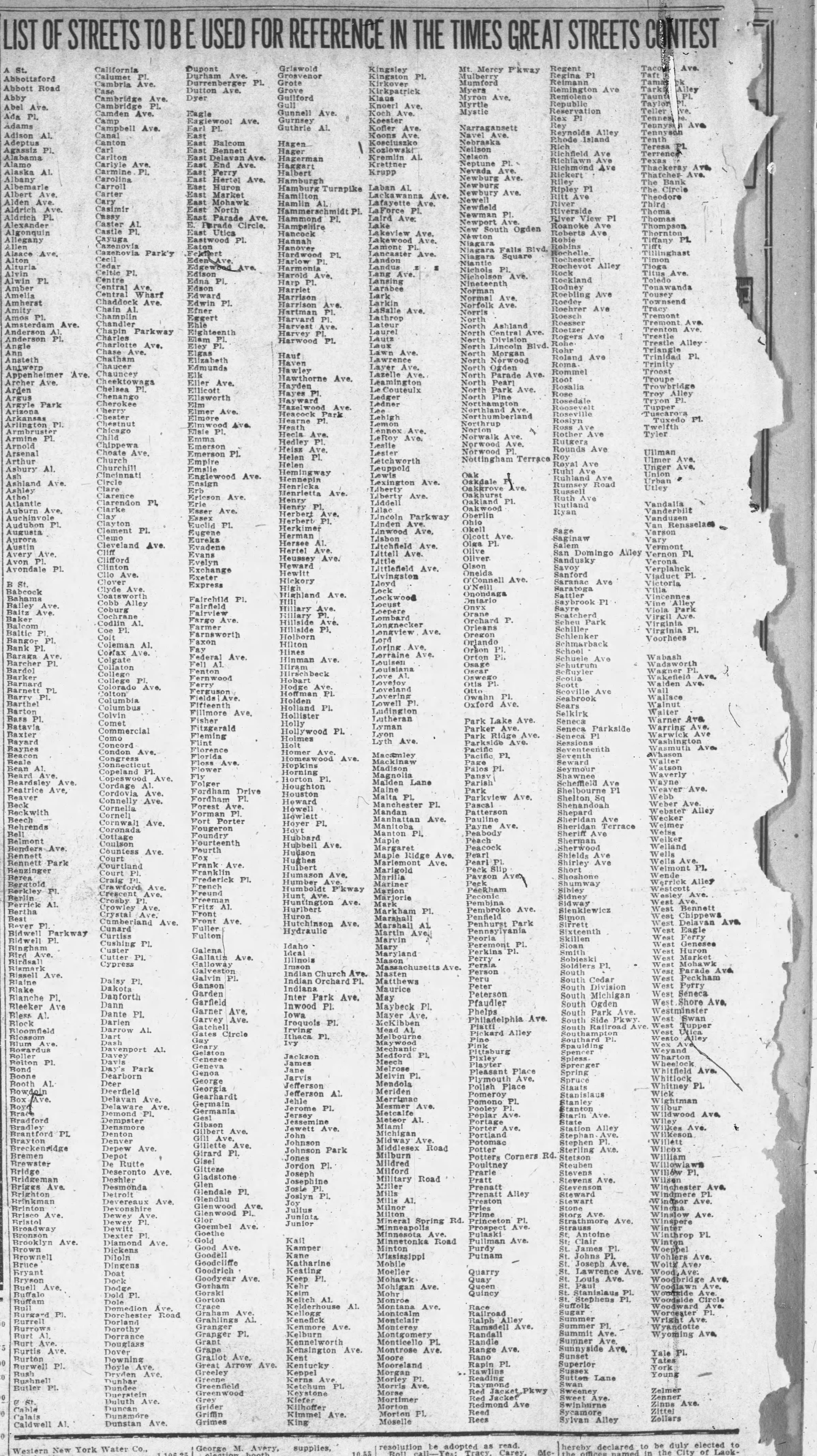
The contest was open to every reader of the Buffalo Times, “man, woman, boy or girl, whether living in Buffalo or out of town.”  The contest boasted that there was no cost to enter, however, you had to get a copy of the Buffalo Times each day – so indirect costs.  The paper was 1 cent during the week and 5 cents on Sundays (33 cents on weekdays and $1.65 on Sundays in today’s dollars).  Buffalo Times helped people out by also printing a list of all of the streets to help people know which street names were used for the 90 streets that were selected for the contest. 

Greats_Streets_Contest list of streets

Because there were so many prizes, they assumed that everyone who entered would be able to win a prize of some sort.  Entries must only include one guess per street picture, but each person was allowed to send in a maximum of three complete sets of answers.  Prizes were awarded to the persons who submitted complete or nearest complete lists of correct answers to the published pictures.  Employees of the Buffalo Times and their families were not eligible for prizes.  All contestants who won prizes had to sign a statement that they were not connected directly or indirectly with any employee of the Buffalo Times.  If there was a tie where certain people tied in the number of correct answers, “the award will be made on a basis of neatness.”  PENMENSHIP!!! 

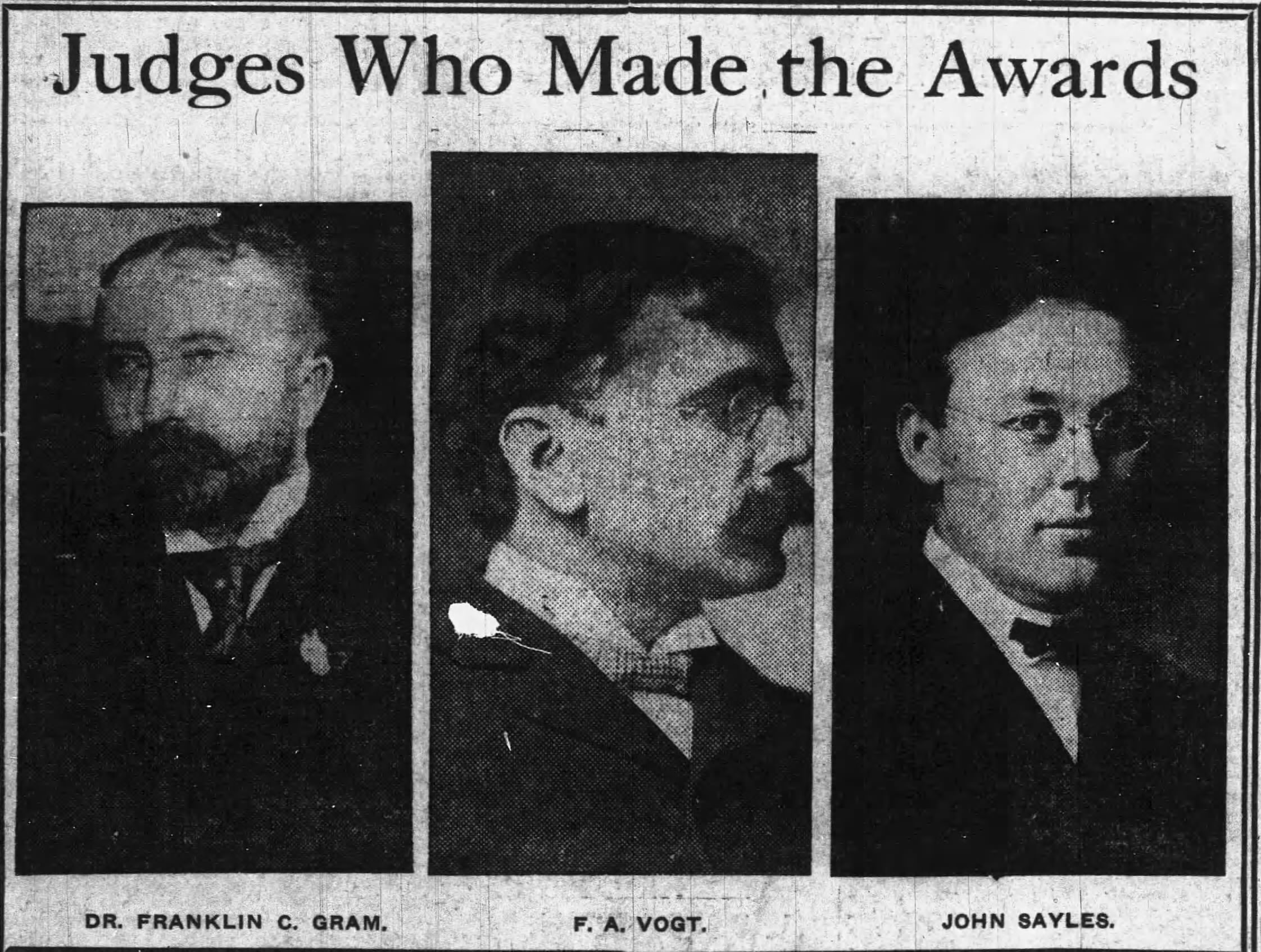
streets_contest_judgesThe contest ran until March 1911.  The judges took three weeks to review the responses.  A staff of 20 tabulated all of the results examined and checked the lists of submitted answers against the correct answers.  Judges then reviewed the submissions and made their awards.  The judges were Professor Frederick A Bogt, principal of Central High School; Dr. Franklin C Gram, registrar of vital statistics for the Department of Health; and John Sayles, secretary to Mayor Fuhrmann.   The Times reported that “it is unnecessary to say that a more competent and fair-minded trio of public citizens could not have been invited to assume these duties, which were both onerous and responsible.”  To keep things fair, the judges were not given the names attached to the submissions when they were selected for the awards. 

streets_contest_judges_certificate   

The Times received 20,000 answer submissions for the contest!   Some submissions were very uniquely submitted – one contestant submitted his answers in the rear of a miniature automobile he had constructed himself.  One lady submitted her answers attached to a beautiful satin pillow she had made.  Some submissions were painted in various colors; one submission colored each of the Streets Contest photos and submitted the colored versions with the answer forms.  

One man had been ill and passed away shortly after the contest ended – his widow submitted his answers, telling the Times that the contest had helped him pass the time through his illness.  He received a special post-humous award just based on that fact, and the Times sent the submission back to his wife so she could have them for sentimental value.  They did not publish which of the winners he was.  

The first prize winner was E.H. Lufkin.  He was a sign painter employed by Scott Sign Company.  He roomed at 16 East Eagle Street.  Mr. Lufkin was a lucky guy based on my research – in 1884, he won first prize in a five-mile race at the Buffalo Roller Skating Rink.  In 1927, Mr. Lufkin was also one of the winners of the Buffalo Times’ baseball contest!   The second prize winner was Miss Marion Kennedy, daughter of Professor Joseph Kennedy, principal of School No. 27.  She lived with her parents at 205 Breckinridge Street and was in 7th grade in School No. 18.  She said that the contest helped her brush up on her local geography.  The third prize winner was Mr. Thomas Patterson.  He lived with his family at 549 Goundry Street in North Tonawanda.  He won the player piano.  The fourth Prize winner was Thomas Pakenham, who lived at 376 Ellicott Street.  The fifth prize winner was Phil Kost, who lived at 269 Washington Street.  

The Times ran a streets contest again in 1913, with new images to represent streets.  In 1913, the prizes were given in gold!  The first prize was $1,000 in gold.  Second Prize was $500 in gold.  Third prize was $250 in gold.  Five prizes of $100 in gold were given, ten prizes of $50 in gold, twenty prizes of $25 in gold, and fifty prizes of $10 in gold.  In total, $5,000 in gold was given away in 1913.  Does anyone know how to calculate the value of gold in 1913 vs today?  

Here’s some more of the images:

streets_contest_1913_64    street_contest_7  

I will be running a series of the pictures on my facebook page for people to guess what streets are depicted, so head to facebook.com/buffalostreets to make some guesses over there on what streets are in the pictures!

My last tour of the summer will be on this coming Monday, September 2nd, at 2pm.  Celebrate Labor Day with a tour!  More information about the tour can be found here:  facebook.com/events/1002890391057778

Want to learn about other streets? Check out the Street Index. Don’t forget to subscribe to the page to be notified when new posts are made. You can do so by entering your email address in the box on the upper right-hand side of the home page. You can also follow the blog on Facebook. If you enjoy the blog, please share it with your friends; It really does help!

Sources:

  • “Four Guess Correctly in Times Baseball Contest.”  Buffalo Times.  April 29, 1927, p3.
  • “581 Prizes Worth In All $6604.00 Given Away Absolutely Free in the Times Great Street Contest”.  Buffalo Times.  November 28, 1910, p7.
  • “$5,000 in Gold:  Street Contest of Unparalleled Magnitude.”  Buffalo Times.  February 7, 1913, p10
  • “Roller Skating Match.”  Buffalo Sunday Morning News.  August 17, 1884, p1.  
  • “Names of Winners in the Times’ Great Street Contest.”  Buffalo Times.  April 9, 1911, p1.  
  • All Images from the Buffalo Times.

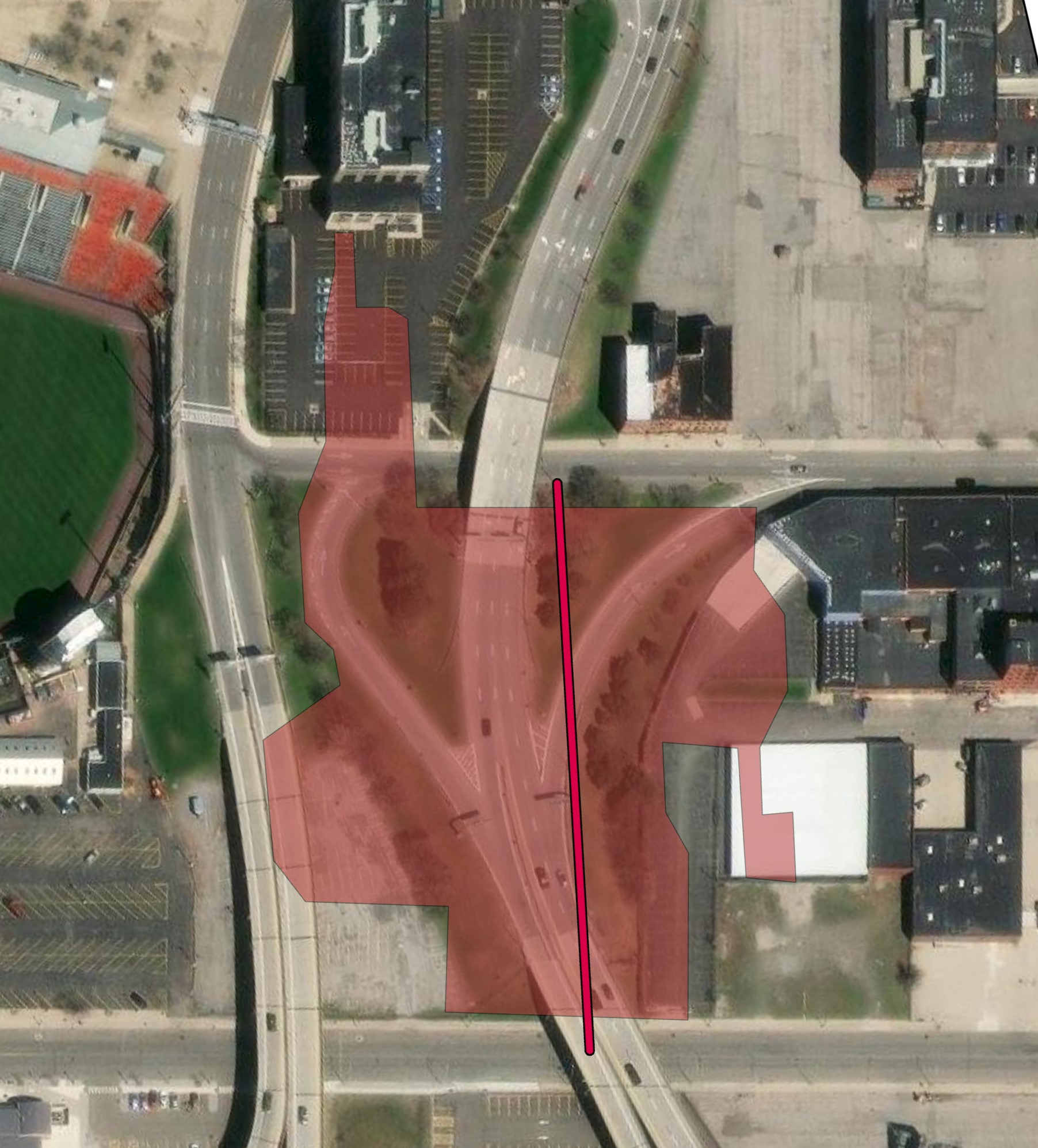
Screenshot (74)

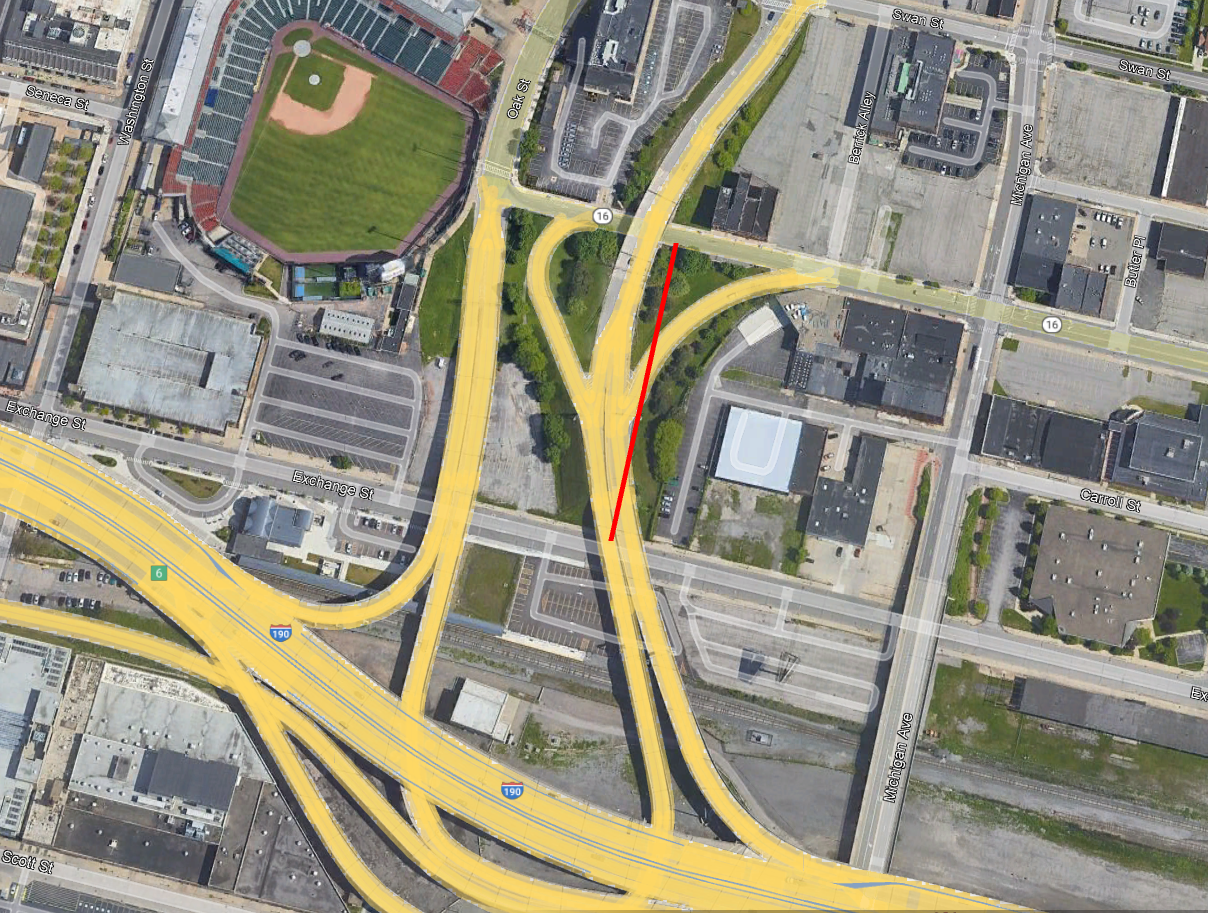
The former location of Wells Street is shown in red.

Wells Street is a street that is no longer extant in Downtown Buffalo.  It formerly ran for two blocks between Exchange and Seneca Street.  The former location of Wells Street is now hidden underneath the Elm Street exit ramps from the I-190.  Wells Street was once an important business center in Buffalo, serving both visitors and industry due to its location close to the railroads.

Many often believe that Wells Street is named after Henry Wells.  Henry Wells helped found Wells Fargo alongside William Fargo.  Henry Wells lived in Auhoorora in Cayuga County, New York.  Wells College is named for Henry Wells.  However, Wells Street here in Buffalo is named after Chandler J. Wells.  I could not find any relationship between Henry and Chandler, though they may be related many generations back.

The Early Life of Chandler Wells

The Buffalo Wells family – Joseph Wells and his wife Prudence – came to Buffalo around 1797 from Rhode Island.  There wasn’t much happening here in Buffalo, so they settled in Brantford, Ontario, where Prudence’s sister lived.  They came back to Buffalo around 1802.  Joseph and Prudence had their first son, Aldrich, in 1802 after returning to Buffalo.  Some reports say that Aldrich Wells was the first white male born in Buffalo, but there are several disputed claims to that title.  Joseph and Prudence had eleven children – six sons and five daughters.  Their seventh child, Chandler, is the namesake of the street.

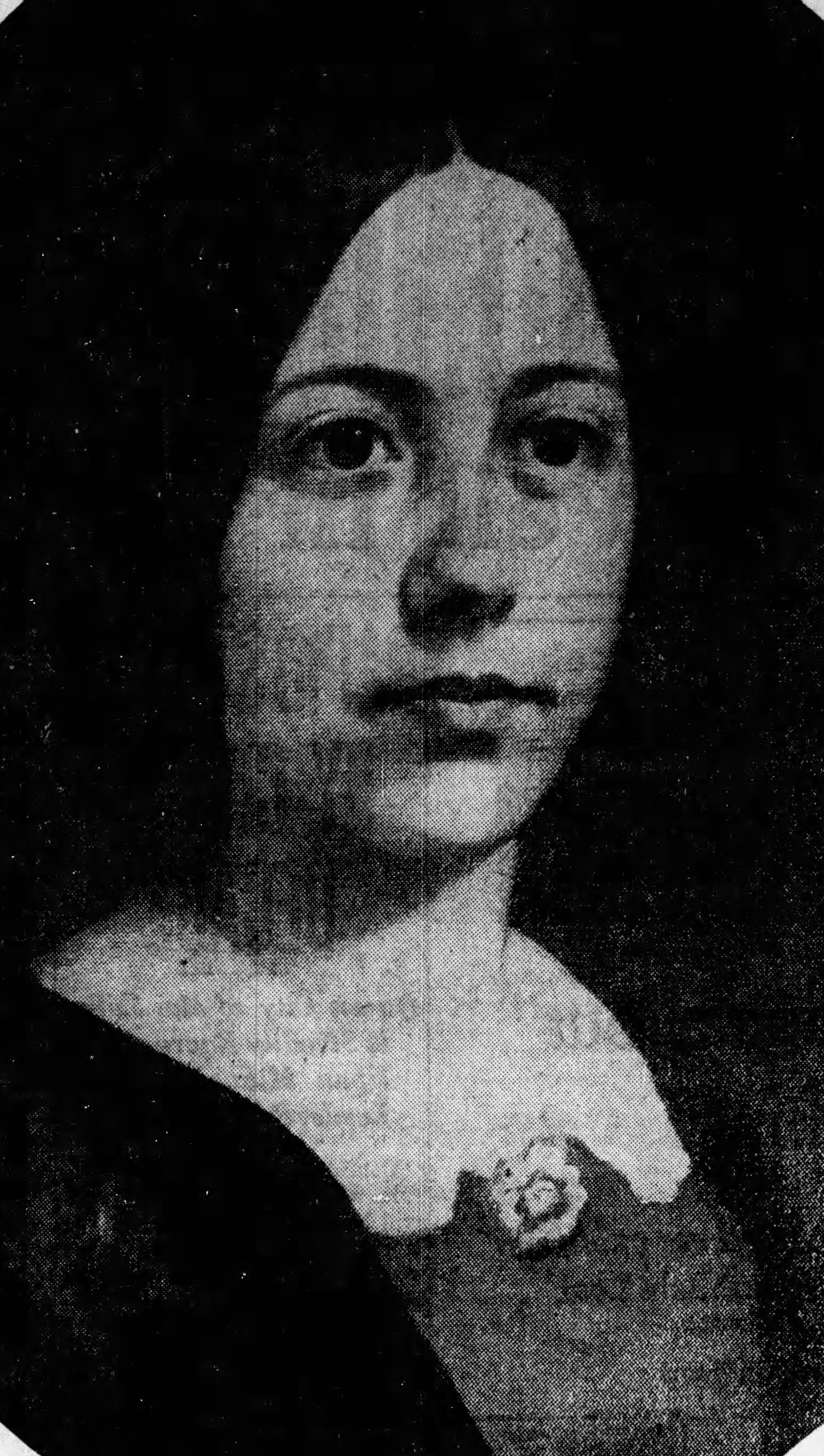
Chandler_J_WellsChandler Joseph Wells was born in Utica, New York, in June 1814.  The Wells family had fled to Utica after the Burning of Buffalo on December 30, 1813.  During the War of 1812, Joseph Wells served as a Captain and later a Major in the militia.  Shortly after Chandler’s birth, the Wells family returned to Buffalo with baby Chandler.  The Wells family lived at 150 Swan Street.  In 1815, Joseph Wells built a tannery on Main Street near Allen Street, where he also operated a farm and made bricks.
Chandler attended private schools when he was young.  At age 17, Chandler became a joiner’s apprentice, finding employment with Benjamin Rathbun.  He later worked for John Drew, who saw potential in Mr. Wells and put him in charge of constructing a building at Pearl and Tupper Streets.

In 1835, Mr. Wells partnered with William Hart as contractors and builders.  The partnership lasted for twenty years, and they were very successful.  At one time, they owned three sawmills and built many buildings around Western New York.  Among their buildings were the State Arsenal on Broadway, built in 1857, and the Dart Mansion at Niagara and Georgia Streets.

Grain Elevator Entrepreuneur

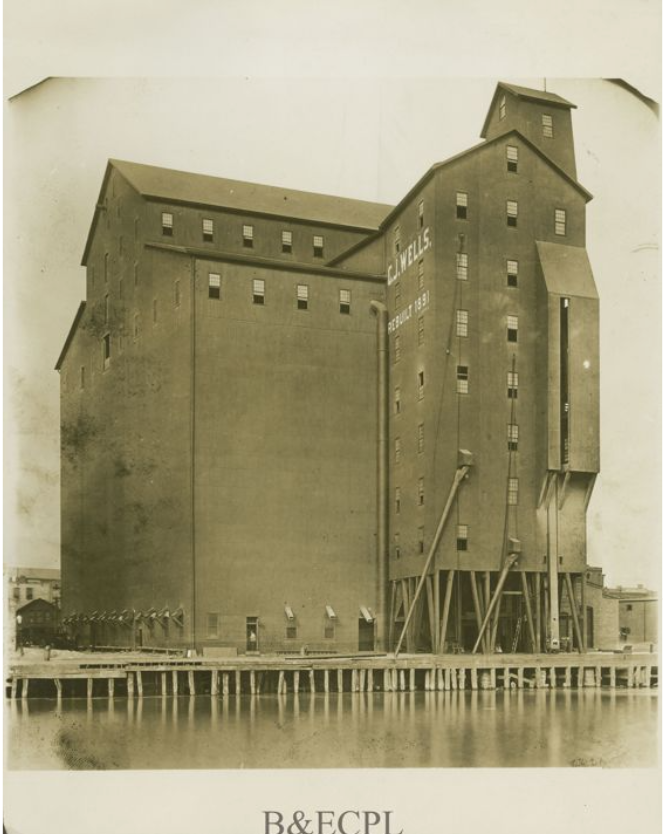
In 1857, Mr. Wells became interested in grain elevators.  His brother William was an elevator foreman.  Mr. Wells felt he could improve Joseph Dart’s elevator design.  The Wells Elevator was built in 1857-1858 and had a storage capacity of 100,000 bushels, double that of the Dart Elevator.  It could transfer nearly six times the amount of grain in an hour.  The elevator, known as the Wells Elevator (later became the Wheeler Elevator in 1884 and was replaced by the concrete Wheeler Elevator, constructed in 1909 and now part of Buffalo Riverworks), was located across the river from the New York Central Railroad freight house on Ohio Street.

wells

C.J. Wells Elevator, between Ohio and Indiana Streets…now the location of the DL&W Terminal. Source: Buffalo and Erie County Public Library.

In August 1860, Chandler Wells leased what was known as Coburn Square, located at Buffalo Creek, Ohio (now South Park Ave) and Indiana Streets.  He built the Coburn Elevator here.  It was destroyed by fire in 1863.  In September 1860, he built the CJ Wells Elevator to replace the Coburn Elevator on the site with some additional property he purchased.  The CJ Wells Elevator was built with stone, brick and lumber.  It was designed to be a model elevator of its day.  It had a capacity of 350,000 bushels and could elevate 8,000 bushels an hour.  The CJ Wells elevator burned down in 1912, and the DL&W Railroad Station was constructed on the site in 1917 (now the location of the NFTA Shops/Rail Yard).

Political Career of Chandler Wells

In 1854, Mr. Wells was elected Alderman for the 2nd Ward.  He was continuously elected for seven years.  In 1861, Wells was the unanimous Union Republican candidate for Mayor.  He was defeated by William Fargo, 6,431 to 5,986 votes.  In 1865, he was again named the Union Republican candidate, running again against William Fargo, who was looking to win his third term as mayor.  On November 7, 1865, Mr. Wells defeated Mr. Fargo 5,570 to 5,348.  On election night, a group of his supporters went to Mr. Wells’ Swan Street home and saluted him with a small cannon.

Mayor Wells was mayor during the Fenian Uprising in 1866.  Thousands of Fenians gathered in Buffalo, planning to enter Canada and destroy the Welland Canal, which would have crippled the Canadian trade.  Mayor Wells kept the mayors of Hamilton and Toronto informed of the movements of the Fenians.  General Grant arrived on the Battleship Michigan to guard the Niagara River.  The situation lasted for about a week.

In September 1866, General Ulysses S Grant, President Andrew Johnson and other dignitaries were guests at Mayor Wells’ home.  Mayor Wells did not seek a second term in office, deciding instead to retire.  Following his retirement, Mayor Wells served as commissioner of the first Board of Water Commissioners and held the position for six years.  During his time on the Board, the inlet pier and tunnel were built for Buffalo Water Works.  Many people at the time opposed the plan for the waterworks, thinking it impractical.  Mayor Wells threw his time and money into the project and worked hard to get the water system built.  The City later saw the value in the water inlet, and Mr. Wells was reimbursed for his expenses.  He is sometimes referred to as “the father of the waterworks.”

Chandler Wells also served as a founder and director of the Erie County Savings Bank, the Young Men’s Association, the Buffalo Historical Society, the Falconwood and Beaver Island Clubs, and the Buffalo Club.  Mayor Wells was also fond of horses.  He helped found the Buffalo Driving Park, one of the first organizations of its kind (horse-driving, not car-driving, FYI), and served as President for 15 years.  Mr. Wells was a founding member of the Board of the Buffalo Juvenile Asylum in 1856.  In 1862, Mr. Wells helped organize the Buffalo Academy of Fine Arts (now the AKG Museum).

The Wells Family

Elizabeth_Wells_daughter_of_Chandler_Wells

Portrait of Elizabeth Wells, daughter of Chandler. Source: Buffalo Times.

Mr. Wells married Susan Wheeler in April 1837.   The Wells had two children.  The first, Theodore, died after just six weeks in 1838.  The second child, daughter Elizabeth, died of Cholera in 1854 at age 16.  Her death was one of the reasons Chandler Wells cared so deeply about clean water and invested in the waterworks.  After the death of their daughter, Susan and Chandler’s niece, Lucy Ann Wells, lived with them.  Lucy was the daughter of Chandler’s brother, John.  Lucy got married in 1847 to Merrit W Green.  Lucy and Merrit had two daughters – Jeannie and Elizabeth.  Jeannie and Elizabeth were Chandler and Susan’s grand-nieces, but they were eventually adopted by Chandler and Susan when their parents moved to Michigan.  Jeannie and Elizabeth took the Wells name and were treated as a part of the Wells family.

In 1858, the Wells family built a red brick house at 77 Swan Street (near Oak Street).  At the time, Swan Street was the fashionable neighborhood of Buffalo, but eventually, the street changed to a business district; many families began to move to places like Delaware Avenue.  In the 1860s, the Wells Family built a house at 685 Main Street.  The house on Main Street is now the location of Town Ballroom.  In 1860, the family lived with servants Mary Ann Higgins, a 12-year-old girl, and Fanny Castillo, a 20-year-old woman who worked as a cook.  In 1870, Fanny was still working for the family as a cook, along with Eliza Killian, a 21-year-old domestic servant.   In 1880, Fanny was still working for the family, along with 30-year-old Margaret O’Brien.

Chandler_Wells_house_Swan_Street

Chandler Wells House on Swan Street. Source: Buffalo Times.


Chandler_Wells_house_on_Main_Street

Chandler Wells House on Main Street near Tupper. Source: Buffalo Times.


45247262_d8855dde-5367-431f-b369-6a1e44ece639

Mayor Wells Grave in Forest Lawn.

Mayor Wells died on February 4, 1887, after suffering from rheumatism of the heart for more than 13 weeks.  His obituary in the Buffalo News called him “a man of quick perceptions, rare judgment and unflinching integrity, with energy and perseverance far beyond the average; a bluff and outspoken manner to strangers, behind which, however, lay a heart good humor and a kindly generous heart.”  He is buried in Forest Lawn Cemetery.  Mrs. Wells died in October 1892.  The house at 685 Main Street was sold in February 1893 to the “Business Mens Investment Association.”  The house was rented out to Dr. L. E. DeCouriander and became the Buffalo Sanitorium/Invalids’ Hotel.  The former house site is now the location of Town Ballroom.

The Great Wells Street Fire of 1889

In 1889, Wells Street was the scene of a large fire.  The fire was reported as having “no parallel in the history of the Queen City of the Lakes,” measured in magnitude by the area of the burned district, by monetary loss, and by difficulty in slowing the flames.  Newspapers reported that the only fire worse was when all of Buffalo was burned to the ground during the War of 1812.  The 1889 fire affected Wells Street, Seneca Street, Carroll Street and Exchange Street.  This area was a major business center for Buffalo at the time.  Due to its location close to the railroad stations, it was a location for several well-known hotels and lodging facilities, as well as industry that used the rail, since it was close to the depots.

Fire_on_Wells_Street

Sketch of the Wells Street Fire after Burning for more than 12 hours

The fire broke out at 2:45am on February 2nd, 1889.  A night watchman saw flames on the fourth floor of the Root & Keating Building and sounded the alarm.  The wind quickly spread the fire to the surrounding buildings.  The flames were so high they could reportedly be seen as far away as North Street.  Strong winds helped the fire to spread quickly and caused a great deal of destruction.  The fire did an estimated $2.0 to $3.0 Million in damage ($68 Million to $102 Million in today’s dollars).

s-l1600

Postcard of Hotel Broezel located at the northeast corner of Wells and Carroll Streets

Guests at the Broezel House and the Arlington, two of the city’s better-known hotels, were able to escape just moments before the hotels went up in flames.  Within an hour, all of Wells Street was a mass of flaming ruins.

Forty buildings were damaged by the fire, with many destroyed entirely.  The tallest of the burned structures was the seven-story Hoffeld Building on Carroll Street.  Most of the buildings in the area were 4 to 5 stories tall.  Major Buildings/Businesses that burned included Zingsheim & Wile Clothing, Hoffeld & Co Soap and Leather, Moffatt & Bros Shoe Factory, Goldstein Boots & Shoes, A.T. Herr & Co Liquors, SS Jewett & Co Stoves and Ranges, Swift & Stantback Stoves and Tinwares, Reynolds Boots and Shoes, Campbell Hats and Caps, Sibley & Holmwood Candy Factory, Root & Keating Leather, Dentsch & Schauroth Boots and Shoes Factory, Schantz Button Factory, Hoffeld & Co Leather Belting, Anderson Harness Company, Zimmerman Saloon and Boarding House, Sheehan, French & McCarthy Saloon & Restaurant, Byers Saloon, Arlington Hotel, Grant Coffee & Spice Mill, American Express Supply Department, Broezel House Saloon and Boarding House, Egan Liquors, Ruslander Clothing, Fowler & Son Carriage and Woodwork, Churchill & Sons Groceries, Robertson Hats and Caps, Hearne Confectionary, Deuther Picture Frame Manufacturing Company, Donaldsons Stoves, S. Cohen Hats & Caps, Barmon Dry Goods and Millinery, Pinkel Dye Works, Wechter Furnishings, Brown Fancy Goods and MIllinery, Spencer & Co Tailor and the Wells Street Chapel.

map_of_burned_district_wells_street_fire

Map of the Burned District of destroyed buildings after the Wells Street Fire. Source: Buffalo Express.


wells street fire

Modern view of the burned district and Wells Street, both shown in red.

News of the fire was reported in newspapers across the country.  The fire began to be referred to as “the Great Wells Street Fire” or “the Great Seneca Street Fire.”  At least 20 people were injured during the fire – mostly firemen.  One fireman, Richard Marion, was trapped under fallen bricks in the Hotel Arlington when it collapsed and lost his life during the fire.  It took six hours to dig his body out of the debris.  Miraculously, no one else was killed.  Fire Chief Fred Hornung’s arm was nearly severed by a falling plate glass window.  It was estimated that 1,000 people were put out of work by the fire.  It took several weeks to clear the debris and reopen Wells Street after the fire.  Some businesses rebuilt, and some decided not to.  Hotel Broezel was rebuilt; the Hotel Arlington was not.  By August, the Buffalo News reported that the Seneca Street Burnt District was “building up better than ever.”  The Buffalo Sunday Morning News reported the day after the fire, “One beauty about Buffalo’s fires is this: there is a phoenix goes with every one of them.”

view_after_the_fire

View after the fire, Feb 10, 1889. Source: Buffalo Courier Express.

The Buffalo Fire Department referred to the Fire Alarm Box 29 at Wells and Seneca Street as the “Hoodoo Box” because it was believed to be cursed.  Several fires broke out in the area besides the Great Wells Street Fire of 1889.  In 1874, Fireman John D Mitchell was crushed to death by falling bricks at the Red Jacket Hotel fire.  In 1880, a fire occurred at the furniture factory on Carroll Street at Wells. In January 1907, a fire started at the 8-story brick Seneca Building at 103-107 Seneca Street.  Originally built as a hotel, the building had been converted into offices and a pawnshop. While fighting the fire, a collapsing wall trapped more than 20 firemen.  It took hours to rescue them.  Three firemen died – Lt William J. Naughton, Stephen E. Meegan and John R. Henky.  Another fire in 1913 at Box 29 sent two firemen to the hospital with smoke inhalation.  After so many fires at Box 29, the National Board of Fire Underwriters and insurance companies looked into the reason for so many fires in the area.  They concluded the fires were only coincidental that their location was so prevalent, determining it was due to the many factories and hazards in the area.

The area around Exchange, Wells, and Carroll Streets began to decline significantly once the NY Central Station on Exchange Street closed in 1929.  Exchange Street, once one of the most important thoroughfares, lost most of its businesses and became a ghost town after the railroad moved to Central Terminal in the Broadway Fillmore neighborhood.  Despite so many changes to the area by urban renewal projects, the “hoodoo” firebox 29 is still on Seneca Street and can be seen near where the intersection of Wells would have been.  

In 1978, Wells Street was acquired by the State of New York for the construction of the Elm Oak Arterial Highway.  Wells Street disappeared from Buffalo.  The next time you head downtown via Elm Street, you’ll be driving right over where Wells Street once was located.  When you take that ramp, think of Chandler Wells and be thankful that he fought for our water system and gave us clean drinking water.  And remember the commercial district that once existed there, wiped away by fire, urban renewal, and time.

I’ve scheduled some tours for this summer.  You can view the dates at this link: buffalostreets.com/2024/06/27/free-downtown-history-walking-tours-2/

Want to learn about other streets? Check out the Street Index. Don’t forget to subscribe to the page to be notified when new posts are made. You can do so by entering your email address in the box on the upper right-hand side of the home page. You can also follow the blog on Facebook. If you enjoy the blog, please share it with your friends; It really does help!

Sources:

  • Smith, H. Katherine.  “Wells Street a Mayor’s Memorial.”  Buffalo Courier Express.  January 15, 1939, p12.
  • “Buffalo Juvenile Asylum- Meeting Last Evening.”  Buffalo Daily Dispatch.  December 27, 1856, p2.
  • “Married”.  Buffalo Daily Commercial.  April 21, 1837, p2.
  • “Chandler J. Wells:  A Useful Life Ended.”  Buffalo News.  February 4, 1887, p1.
  • “Death of Chandler J. Wells.”  Buffalo Times.  February 4, 1887, p1.
  • Sheldon, Grace Carew.  “Wells Earned Title of Reconstruction Mayor by his Deeds in Office.”  Buffalo Times.  October 5, 1919, p50.
  • Burr, Kate.  “The Mansion that Housed a President.”  Buffalo Times.  June 27, 1926, p14.
  • “Unequaled:  A Great Business Center Burned.”  Buffalo Weekly Express.  February 7, 1889, p1.
  • Ditzel, Paul.  “The Hoodoo Box”.  Buffalo News.  May 15, 1983, p195.
  • “Notice of Appropriation of Property”.  Buffalo News.  June 14, 1978, p67.
  • “Buffalo Has A Big Fire.”  The New York Times.  February 3, 1889, p1.
  • “Extra! Fire! The Worst Buffalo Has Ever Had.”  Buffalo News.  February 2, 1889, p1.
  • “Beginning to Clear Up.”  Buffalo Courier Express.  February 12, 1889, p5.
  • “Well It Was Done.”  Buffalo Commercial.  February 21, 1889, p3.
  • “Where the Ruins Were.”  Buffalo News.  August 13, 1889, p10.
  • “Wells Residence Sold.”  Buffalo News.  February 24, 1893, p13.

This week marks 13 years that we’ve been on this Buffalo Streets journey together!  AND I have scheduled some dates for walking tours for the season!  

Once again, I am giving two distinct tours – Discover Downtown – Then and Now and Discover Lower Main Street.  These tours will be free, as I want to ensure they are accessible to all, but donations will be graciously accepted.  All money received will go directly into continuing to build up Discovering Buffalo, One Street at a Time.

lafayettesquareDiscover Downtown – Then and Now – we will look at the area around Lafayette and Niagara Squares and the core of Downtown Buffalo.  We’ll talk about the history of the central part of Downtown as the city grew and the buildings in the area.  You’ll also get an up-close look at the progress of the Main Street Multi-Modal Access and Revitalization Project (Cars Sharing Main Street), which is currently working on replacing the 35-year-old metro rail track bed.
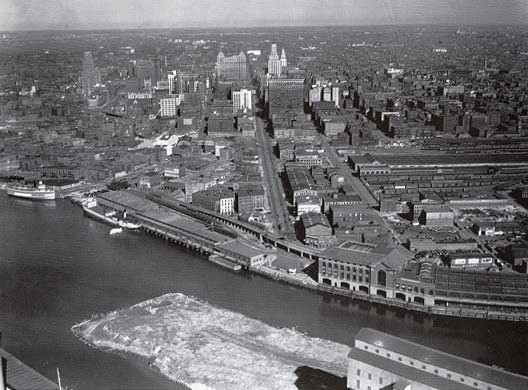
This tour meets outside of Public Espresso in the Hotel Lafayette, 391 Washington Street, at the corner of Washington Street and Clinton Street.  The tour will be about 1.5 miles and will be a loop that ends near the starting point.

Click for Facebook event link for Discover Downtown Then And Now tour here.

This tour will be offered:

  • Saturday, July 6th at 2:00pm
  • Wednesday, July 31st at 5:30pm
  • Saturday, August 10 at 2:00pm
  • Monday, August 19 at 5:30pm
  • Monday, September 2nd at 2pm  (LABOR DAY)  

lowermainDiscover Lower Main Street – this tour looks at the area of Lower Main Street, south of Church Street, portions of the former canal district, and the Erie Street corridor.  We’ll talk about some of the earliest history of Buffalo, how the area has changed over the last 150 years, and you’ll get a glimpse of the construction happening right now at the former location of Memorial Auditorium.
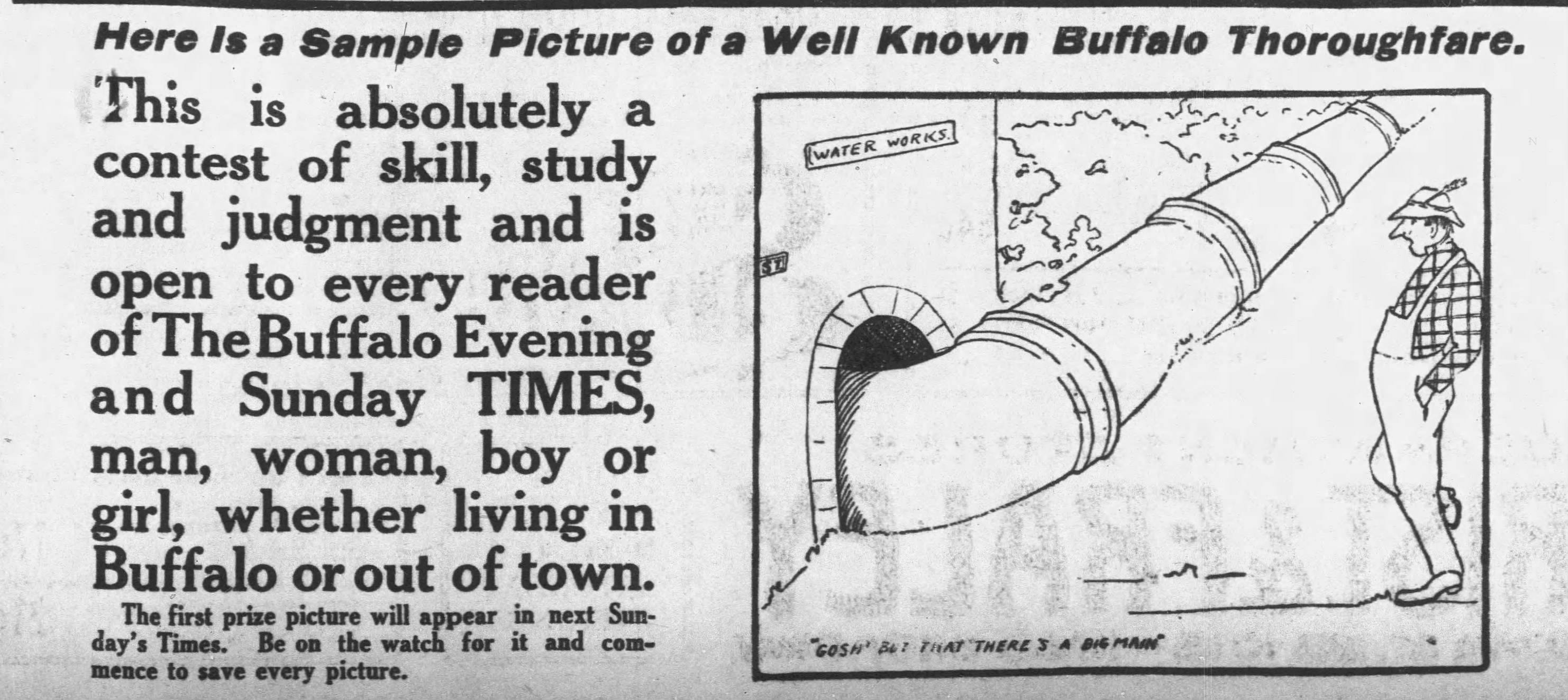
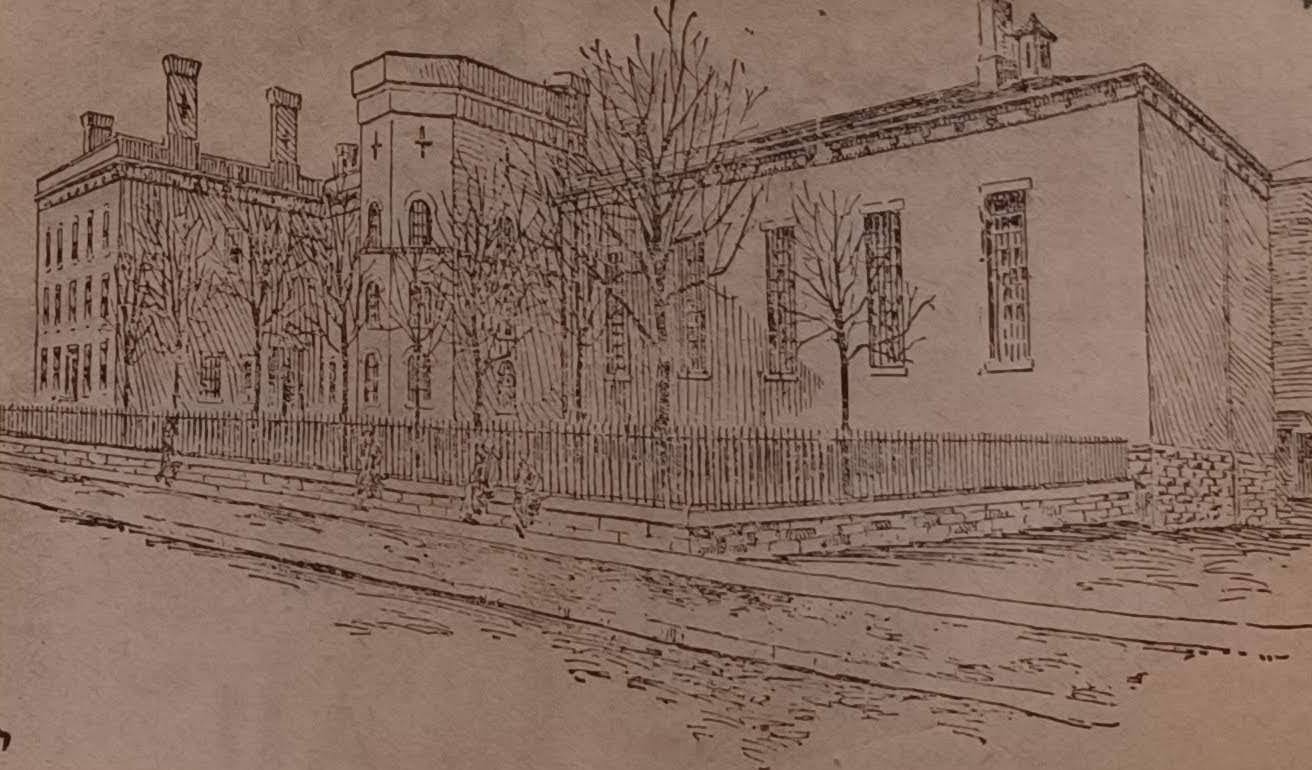
This tour will start at the Tim Hortons in Harbor Center, 1 Scott Street, corner of Main and Scott Streets.  The tour will be about 1.5 miles and will be a loop that ends near the start.  This tour does include going down one staircase, and walking up 2 other staircases, each about 15 steps.
 

This tour will be offered:

  • Wednesday, July 3rd at 5:30pm
  • Sunday, July 14th at 2:00pm
  • Sunday, July 28th at 11:00am
  • Saturday, August 24th at 2:00pm

To RSVP for any of the tours, you can email buffalostreets@gmail.com, RSVP to the facebook event links, or feel free to just show up!  Tours will be rain or shine. Looking forward to seeing some of you on tours!  I always enjoy getting to talk history with people in person.  I may add some tours in the fall depending on how the weather shakes out.  

street_contest

Example image for the street contest from 1910.  Guess the street!

Hope you’re all enjoying the start of summer!  Also coming later this summer, I will be running a contest on my facebook (facebook.com/buffalostreets) account and Instagram (instagram.com/discoveringbuffalo) that was run in a Buffalo newspaper back in 1910 where there were cartoon images that represented a street and you’d have to guess what street they meant.  They ran for 90 days in the newspaper, so we’re gonna have some fun with that (some of them are hard!)  

I have some new posts coming soon, I promise.  I’ve been working on a post that includes info about one of the worst commercial district fires in Buffalo History, which was eerie given the recent fires that occurred last week!  I have Thanks for sticking with me over the last 13 years.  It’s been a fun adventure learning about streets with all of you.  Your feedback and stories truly mean the world to me, even when I don’t have time to respond to them all.  Come out for a walking tour and let’s talk more about Buffalo!!  

Today, we are going to talk about three streets in the Lakeview Neighborhood of the Lower West Side – two of which are named after women!  Bonus women’s content:  we’ll also discuss a prison designed by a female architect! Today’s post is a partnership with the Buffalo Women’s Caucus for Women’s History Month.  Buffalo Women’s Caucus is an organization to empower women in all fields to become leaders and changemakers.  You can follow the Buffalo Women’s Caucus by clicking this link:  https://www.instagram.com/buffalowomenscaucus/  Today (March 8th) is International Women’s Day, a global holiday celebrating the social, economic, cultural and political achievements of women.

Screenshot (64)

The former location of Root Street shown in Yellow, directly between Rosetta Petruzzi Way and Sally Mae Cunningham Drive. The former Erie County Penitentiary Street, shown in Orange.

Root Street was a short street that ran one block between the Erie Canal and Fifth Street.  Fifth Street is now Trenton Avenue.  Root Street is no longer extant; it was removed during the construction of the Lakeview Projects.

Root Street was replaced by two new streets in the vicinity of where the street once was – Rosetta Petruzzi Way and Sally Mae Cunningham Drive, named after two women who lived in the neighborhood.

John Root was born in Southwick, Massachusetts, in 1773.  He practiced law in Delaware County, New York, for about ten years and then came to Buffalo around 1810.  When Mr. Root arrived in Buffalo, the lawyers in Buffalo were Ebenezer Walden, Jonas Harrison, and Heman B. Potter.  Potter Street between Broadway and William Street was named for Mr. Potter, but has been replaced by Nash Street.  Mr. Root’s first law office was at Washington and Exchange Streets, and he lived at Washington and Swan Streets.

Mr. Root married Christiana Merrill in May 1798.  When they first arrived in Buffalo, the Roots shared their home with Christiana’s brother, Frederick W. Merrill and sister, Mary Merrill.  Mary Merrill is the woman who is thought to have broken the heart of Seth Grosvenor, causing him to leave Buffalo.  Christiana Root died in 1821.  Mr. Root married Elizabeth Stewart in 1824.  While married twice, John Root had no children.

John Root was considered a brilliant lawyer and orator and was known around town as “Counselor Root.”  He was considered well-read in law and equity.  Counselor Root practiced in Buffalo for about 30 years before retiring to a lakeshore farm in Hamburg.  During his retirement, he provided advice to many young lawyers who’d come to visit him for consultations.  He died at his farm in September 1846 at the age of 76.  When he died, he was the oldest member of the Erie County bar.  He is buried at the Lakeside Cemetery in Hamburg.

Erie County Pen

Sketch of Erie County Penitentiary. Source: Courier Express, June 1894.

In 1847, Root Street became the home of the Erie County Work House.  This was designed as a workhouse for prisoners under sentence for minor offenses for whom there was neither room nor labor at the jail and whom it was not desirable to send to a State Prison.  The stone building was located between Pennsylvania and Root Streets on Fifth Street.  In 1851, the Work House name was changed to Erie County Penitentiary.  In 1892, the Pen, as it was known, served an average of 416 prisoners “for the reformation of convicts, not younger than 16 years”.  Most men committed to the Pen were “tramps” sent to the Pen for short sentences.  Superintendent of the Pen, Alfred Neal, was quoted in 1894 saying that “committing tramps and disorderliness for such brief sentences is a travesty of justice” and that “it wipes out their self-respect and creates a feeling of contempt and anger towards more crime.”  Quite progressive for that time!

Womens Cell

View of the Women’s Cells with two matrons.  The space was designed by Louise Bethune.  Source:  Buffalo News, March 1903.

In 1890, a women’s wing was added to the Erie County Penitentiary.  It was designed by Louise Bethune, the first female architect.  She was tasked with developing a new type of structure – the County had opted to update the entire facility with heat and water.  Louise had been doing landmark work with property sanitation in public school buildings, making her an expert in creating safe and functional spaces.

The Pen was home to some famous guests!  After assassinating President McKinley, Leon Czolgosz was first held at Police Headquarters.  A crowd of several thousand people gathered, calling for a lynching.  Police took Czolgosz away, spreading a rumor that they were taking him to a different city.  They ended up bringing him to the Women’s Wing of the Penitentiary and keeping him in the dungeon.  Another famous Pen resident was Jack London, the author, who spent 30 days at the Pen in 1900 for vagrancy.

Screenshot (68)

1899 Sanborn Map showing the Erie County Penitentiary Site.

By 1903, the Pen no longer took on long-term sentences and was more of a home for petit thieves, habitual drunkards and “unfortunate women” than a place for genuine criminals.  For some, it was a better home than on the streets.  They had better food and a warm place to sleep.  Around the same time, some people wanted to turn the Pen property over to the State to build a Prison and a new Penitentiary at the Erie County Almshouse site (where UB South Campus is now).  At the time, the Pen saw about 4,000 to 5,000 persons received and discharged annually (sometimes the same person multiple times).  The Head Keeper at the time described the Pen as not so much a prison but a boarding school for the “discipline of adults.”

Starting in the early 1900s, the county would use land in Alden, the Wende Farm, to use farm prison labor to feed the inmates at the Penitentiary.  The land had been donated by Otto Wende to the County.  The Work House/Penitentiary was located on the west side from 1847 until 1923, when they moved to a new facility at the Wende farm in Alden.  The new facility was designed by William Beardsley, a noted prison architect, and built using inmate labor.  The new facility opened on July 12, 1923.  The city Penitentiary site was considered a “dungeon” compared to the 800-acre farm in Wende.   Farm labor was considered appropriate for inmates, and the farm helped the County financially sustain the prison.  The county-run farm had 40 Holstein cows, 200 pigs, and up to 12,000 chickens.  Up to 80 inmate farm workers tended to the farm.  Chicken raising was the first to go, then cows, but the pigs were still on the farm until 1984.  The Erie County farm was one of the last county penitentiary farms in the state – the only other was in Nassau County.  The State converted the Wende facility into a state-owned and operated correctional facility in 1983.  The County then built a new facility at the site for a new Erie County Correctional Facility.  The farm was also home to the Erie County Home and Infirmary, which moved to the site in 1928 and closed in 2005.

Ruins of old pen

Children playing on the grounds of the abandoned Penitentiary. Source: Buffalo Courier, October 1929.

Once the inmates moved to Wende, some people, including the Penitentiary Board, hoped the Federal Government might want to buy the Root Street site for federal use.  In 1925, the Acting Superintendent of United States Prisons, HC Heckman, had a press conference with Congressman James M. Mead to state that the federal government was not interested and probably never would be in the property.   In 1926, the abandoned Erie County Penitentiary was recommended for purchase by the City.  At this time, the City was working on building City Hall and moving out of the combined City-County Hall on Franklin Street (now referred to as Old County Hall).  In 1929, the City would receive its share of the City-County Hall building value when the County took it over. The City’s share was set at $862,500.  The old penitentiary site was 5.5 acres in size and valued at $225,000.  The City considered turning the site into a playground, park or public stadium.  The neighborhood around the old penitentiary was thickly populated and could benefit from some public recreation space.
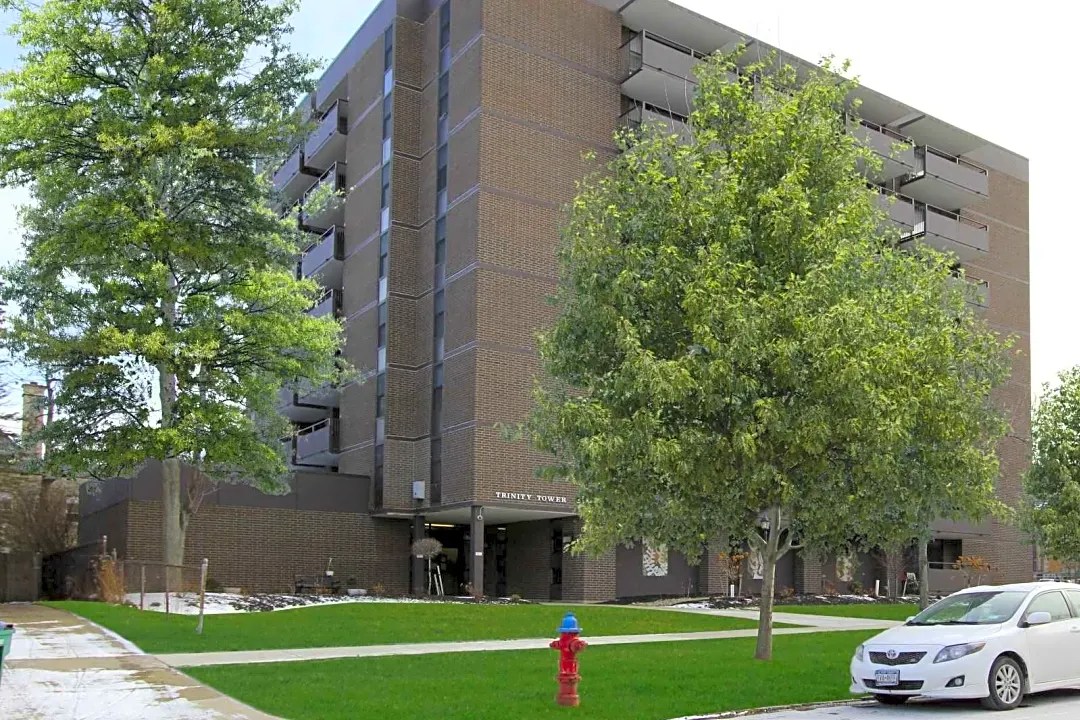
Birdseye_view_of_Lakeview_projects

Birdseye View of the Lakeview Housing Project. Rendering by Green & James. Source: Buffalo Courier Express, June 1938.

In 1938, the Lakeview Housing Project began construction on the site as a US Housing Authority project, part of the New Deal program.  The project cost $5,000,000 to complete.  It was one of the largest construction projects in Buffalo since the Great Depression began.  The construction industry was excited to bid on the project, bringing thousands of man-hours of labor and a huge demand for material supplies.  The project called for 350 tons of structural steel, 1200 tons of reinforcing, 250 tons of steel joists, 240 tons of steel roofing and 100 tons of steel window frames – a total of 2,140 tons of steel!  Not to mention other building materials like cement, brick, lumber, paint, glass, nails, plumbing, etc.  Lakeview Project was designed by architects Green & James, who also designed the Commodore Perry Homes, Lasalle and Langfield Projects.  The Lakeview Housing was bounded by Jersey, Hudson, Lakeview, Trenton and the Erie Canal.

Screenshot (61)

A 1995 Aerial Photo shows the Lakeview Housing Project outlined in Blue. Note that the Thruway I-190 runs over the former Erie Canal bed.

During the construction of the Lakeview Housing Project, John W Cowper Company, a Buffalo-based contractor, developed a concrete handling method.  Their method allowed an entire concrete floor to be poured to cover thousands of square feet in a single day.  The method was then used again on the Commodore Perry and Dante Place projects by the company here in Buffalo.  By the 1950s, the method was used by most big contractors across the country.  The old method involved loading concrete at ground level into two-wheel buggies, raising it on elevators to the construction floor, dumping and sending the buggy down the elevator empty.  The new method brings the concrete in the mixer truck, dumping it into crane buckets that can carry 2 cubic yards of concrete each.  The new method involved significant time and cost savings for construction projects!

The Erie Canal, forming the southwestern boundary of the Lakeview Housing site, was filled in to build Perry Boulevard, which is now the Niagara Section of the New York State Thruway.  The Lakeview Project included 668 units but was increased to 1,028 by the end of 1939.  Families began moving into the projects in July 1939.

By the mid-1950s, the Lakeview Housing Project was considered dangerous.  The closeness of the projects to the Thruway meant that if there were an accident, a car could crash into one of the homes.  Perry Boulevard running through the complex was so narrow that cars had to hop curbs when two cars needed to pass each other.  The highway noise and the railroad noise made it impossible to sleep in the uninsulated houses.

By the 1960s, the area was home to fights and issues.  Unemployment was an issue across the City of Buffalo as deindustrialization began to take effect, and thousands of Buffalonians were laid off from the steel mills.  Unemployment impacts were much greater in the Black Community.  Police misconduct was a major source of racial tension in Buffalo.  On June 26, 1967, two white police officers intervened in a small fight between two Black teenagers in the Lakeview Projects.  It quickly escalated into violence.  The next night, approximately 200 people, many residents of Lakeview, responded to the excessive force with demonstrations.  The protests that ensued were in response to the many issues facing the Black community at the time – substandard housing, public school education, unemployment and lack of neighborhood investment.   The action spread across the East Side, continuing until July 1st.  The five-night riot resulted in sixty injuries, over 180 arrests and approximately $250,000 worth of property damage to stores and homes.  The Buffalo riot was part of a wave of riots that swept across urban areas of the North in the late 1960s.  The Black Community today continues to fight for many of the same things that caused the riots back then, as was seen during the 2020 protests after the death of George Floyd.

Now, on to the women – Rosetta Petruzzi Way and Sally Mae Cunningham Drive!  These two streets are named after women who were instrumental in the Lakeview Housing complex over the years.

117744005_1403591976

Sally Mae Cunningham’s gravestone, Concordia Cemetery

Sally Mae Cunningham was a long-time resident of the Lakeview Housing complex.  She was known by her neighbors as “the mother of the West Side.”  Sally Mae was born in 1914 and grew up in Anniston, Alabama.  When she was ten, her stepfather had defied a white shop owner who refused to sell to Black customers.  That night, her house was visited by the local Ku Klux Klan.  Her grandfather stood up to the Klansmen, unmasked one of them, called him by name and told them to leave.  Mrs. Cunningham would later say that memory gave her strength throughout the rest of her life.

In 1952, Mrs. Cunningham and her three children became the first Black family to move into the Lakeview Projects.  She was greeted by her neighbors by trash thrown on the lawn and a brick through her window.  Sally Mae was quoted in the Buffalo News as saying, “I was threatened lots of times, but I was never afraid.”  She was said to have countered the hostility and suspicion with kindness and was able to win over the neighbors and make many friends.

Mrs. Cunningham lived at 971 Perry Blvd for 38 years.  She helped to organize the first Lakeview Tenants Council and took an active role in the tenants’ rights movement.  She was also a Director of the Community Action Organization (CAO).  CAO is a non-profit organized in May of 1965 that serves individuals and families to mitigate poverty throughout low-income communities.   Mrs. Cunningham also served as the West Side representative of B.U.I.L.D.(Building Unity, Independence, Liberty and Dignity), a civil rights advocacy group.  She was best known for her work during the late 1960s when fights between street gangs were common across the City.  She worked with police and teenagers to help stem the violence in her neighborhood.  In 1980, she received B.U.I.L.D.’s Outstanding Community Service Award for her youth activities.  Sally Mae Cunningham died in January 1990.  She is buried in Concordia Cemetery.  Shortly after her death, State Senator Anthony Masiello renamed legislation he was proposing as the Sally Cunningham Bill.  The legislation was to require the Common Council to to confirm housing directors of the Buffalo Municipal Housing Authority.  Masiello said, “Sally Cunningham made decent public housing the focal point of her life.”

Rosetta_Petruzzi

Rosetta Petruzzi at the new playground at the Lakeview Development. Source: Buffalo News, May 1995.

Rosetta Ann Petruzzi was also a long-time resident of the Lakeview Housing complex.  She lived there for more than 50 years!  Rosetta Petruzzi was born Rosetta Scott in Warren, Illinois, in 1926.  She came to Buffalo in 1944 after marrying Anthony Petruzzi.  She was very active in youth activities at the complex and helped to establish a well-baby clinic in the complex.  Along with Mrs. Cunningham, she helped to establish the first Tenants Council.  In the mid-1960s, Mrs. Petruzzi served as President of the Lakeview Community Council and helped open a wading pool/splash pad in 1965.  The pool had been closed for 20 years at that point.  The pool had been shut down due to often needing to be closed for cleaning.  Glass was often being thrown into it, so the Buffalo Municipal Housing Authority opted to close it rather than deal with the high cost of draining for cleaning out the glass.  Mothers in the Lakeview Council, led by Mrs. Petruzzi, were instrumental in reopening the pool.  The mothers agreed to watch the pool from 1pm to 4pm each day.  She was quoted in the Buffalo News as saying, “Some people thought that we’d never get a pool closed down 20 years back in operation, but I guess you can get anything if you try long enough.”  Mrs. Petruzzi was also active in the Cub Scout Pack at Lakeview Homes and was a den mother to the troop for many years.

Mrs. Petruzzi was active in the Democratic Party and served on the City of Buffalo Citizens Council on Human Relations.  This group was formed in June 1963 to help with the problems of employment, education and housing affecting minority groups.

245409524_15cd9358-7f05-4fd3-a7c3-9c9c2c015614

Rosetta Petruzzi stone in Mausoleum at Forest Lawn

In May 1995, the Lakeview Tenant Council and the Buffalo Municipal Housing Authority dedicated a playground and plaque to Rosetta Petruzzi at the complex. The picture above is from the playground’s opening.  I was unable to determine exactly where the playground dedicated to Mrs. Petruzzi was located, though I know it is not the playground currently on Fourth Street.  If anyone who lived at Lakeview remembers where it was in the 90s, let me know! Mrs. Petruzzi passed away in September 2001 and is buried in Forest Lawn Cemetery.

In the late 1990s, plans to demolish the Lakeview Housing project began to be developed.  The reconfiguration of the Projects was part of the federally-funded HOPE VI initiative of the Clinton Administration.  There was a lot of controversy involved with demolishing all of the units of Lakeview Housing to replace them.  At the time, Lakeview was a little rundown, but most of the units had been renovated, and it was considered “Buffalo’s best family project.”  One of the major issues around Lakeview was the substandard housing located in the neighborhood around the projects, as opposed to the actual Lakeview Housing itself.  All 660 original Lakeview units were demolished.  They were replaced by 360 new townhomes and 74 apartments in a new, four-story senior citizen building.  There were also 40 townhouses for ownership.  Phase 1 was completed in 2001. The units were designed for families with low to moderate income levels.  The new streets in the Lakeview HOPE VI housing were named for Sally Mae and Rosetta, along with Hope Way (for HOPE VI) and Anthony Tauriello Drive, named for Anthony Tauriello, but we’ll learn about him another day – I wanted to focus on the ladies for today! The redevelopment project included a park setting with green space and newly planted trees between the Thruway and Fourth Street.  With the exception of a small playground, the site is mostly a grassy field and a berm to protect from the highway.  Plans for Ralph Wilson Park (the $110 Million reconstruction of Lasalle Park into a world-class park) include some plans for the Fourth Street site.

Screenshot (62)

A Modern Aerial shows the outline of the former Lakeview Housing, highlighted in blue. Note the new Hope VI housing on the northeastern half of the site.

In 2004, Dierdre William from the Buffalo News described the Lakeview HOPE VI development as if “Someone took Pleasantville and put it in the middle of the Lower West Side.”  The new development has a suburban look that’s a far cry from the brick public housing units they replaced.  Critics of the Lakeview HOPE VI project stated that while the new units of housing are visually appealing, between the Lakeview houses and Niagara Street, the rest of the neighborhood was still in decline.  It was anticipated that residents of Lakeview HOPE VI would open small businesses like daycare and beauty shops.  The spin-off development that was expected to happen has been slow to happen.

Next time you’re over on the Lower West Side, or maybe taking the pedestrian bridge into Ralph Wilson Park, think of the Penitentiary and all the people sentenced to the site over the years; think of Louise Bethune, a woman architect breaking down barriers and designing prisons; and think of women like Sally Mae Cunningham and Rosetta Petruzzi who fought to improve conditions for everyone around them.  I think sometimes, during months like Women’s History Month, it’s important to remember the major women who accomplished major things, but it’s also important to remember the work of regular women, too.  Sally Mae and Rosetta were moms fighting for a better neighborhood.  It’s important to remember them and all the other unsung women who’ve been working hard for decades to make their communities better. Happy Women’s History Month!  Want to learn about other influential Buffalo women?  Check out my roundup of Streets Named after Women here.

Want to learn about other streets? Check out the Street Index. Don’t forget to subscribe to the page to be notified when new posts are made. You can do so by entering your email address in the box on the upper right-hand side of the home page. You can also follow the blog on Facebook. If you enjoy the blog, please share it with your friends; It really does help!

Sources:

  • “Mothers Pool Their Efforts to Reopen Wading Area.”  Buffalo News.  July 20, 1965, p10.
  • Hill, Henry Wayland, editor.  Municipality of Buffalo, New York:  A History 1720 – 1923.  Lewis Historical Publishing Company:  New York, 1923.
  • “Council Urged to Buy Disused County Prison.”  Buffalo Evening News.  October 25, 1926, p3.
  • “Weather Slows Progress on Redevelopment Project.”  Buffalo Business First.  January 15, 2001.
  • “US Not Interested in Old Penitentiary”.  Buffalo News.  February 28, 1925, p12.
  • Buyer, Bob.  “Prison Farm Gets County Reprieve.”  Buffalo News.  June 22,1987, p12.
  • Hays, Johanna.  Louise Blanchard Bethune:  America’s First Female Professional Architect.  McFarland & Company, Publishers, Jefferson, North Carolina.  2014.
  • Smith, H. Katherine.  “Two Streets Memorial to Early Buffalo Lawyers.” Buffalo Courier-Express.  March 1, 1942, Sec 4, p8.
  • “Local Companies Awarded Most MHA Contracts.”  Buffalo Evening News.  October 30, 1954, p13.
  • “In a Model Prison:  A Humane Keeper and His Excellent Methods.”  Buffalo Courier.  June 1, 1894.
  • “Make State Prison Out of Penitentiary”.  Buffalo News.  March 13, 1903.
  • “Winter Resort of Buffalo’s Army of Unfortunates.”  Buffalo News.  March 1, 1903.
  • “Rosetta A Petruzzi, Active in Community”.  Buffalo News.  September 9, 2001, p13.
  • “Housing Cash.”  Buffalo Courier-Express.  April, 11, 1939, p7.
  • “Lakeview Housing Project Site Called Dangerous”.  Buffalo Evening News.  January 20, 1958, p18.
  • “Million-Dollar Canal Parkway Plan is Pushed.”  Buffalo Courier-Express.  March 7, 1939, p11.
  • Downs, Winfield Scott.  Municipality of Buffalo, New York:  A History, 1720-1923.  Lewis Historical Publishing Company, 1923.
  • “Inequality, neglect – not just Floyd’s death- fuels protests.”  Buffalo News.  June 8, 2020, p1.
  • “Plan calls for razing entire Lakeview project.”  Buffalo News.  August 20, 1999, p31.
  • Tan, Sandra.  “Hopeful Housing.”  Buffalo News.  September 18, 2000, p1.
  • Ashiley, Nii Ashaley Ase.   “When Black New Yorkers Decided to Unite for their Own:  Buffalo Race Riots of 1967”.  Face2Face Africa.  June 27, 2019.  https://face2faceafrica.com/article/when-black-new-yorkers-decided-to-unite-for-their-own-buffalo-race-riots-of-1967
  • Alfonso, Rowena I.  “They Aren’t Going to Listen to Anything But Violence:  African Americans and the 1967 Buffalo Riot.”  Afro-Americans in New York Life and History, Volume 38, Issue 1.  January 2014.
  • “Citizens Unit Established to Aid Minority Groups.”  Buffalo Courier-Express. June 24, 1963, p7.
  • “Dynamite Ends Reign of Old Buffalo Pen”  Buffalo Times, July 13, 1930
  • “Bill Will Honor Sally Cunningham.  Buffalo Challenger.  January 17, 1990, p7.
  • “Mother of the West Side:  Sally Mae Cunningham Dies.”  Buffalo Challenger.  January 17, 1990, p7.
  • Documents of the Assembly of the State of New York, Volume 13.  New York State Legislature, Assembly.  1892.
  • Williams, Dierdre.  “A New Hope for Public Housing Suburban-Looking Community Rises on Vestige of Lakeview Homes.”  Buffalo News.  June 17, 2004.

Happy Women’s History Month!!  As any reader of this blog knows, our streets are often named after rich white men.  I think when we think of women’s history, we often remember the big changemakers, but I think it’s important to remember all the women who lived fairly regular lives.  These women were daughters, maids, workers, wives, and mothers. They may never have held elected office, owned large amounts of real estate, or run successful businesses. And I think it’s important to celebrate these women, remembering that our lives today are built on these women.  Behind every man I’ve written about, there was almost always a woman on the sidelines.  Many of those women are forgotten to history, their names written as Mrs. Husband’s Name. Even more are completely forgotten in the pages of history all together.  So, we remember those women.

I remember women like Sally Hodge. Sally married William Hodge when she was 14 years old. Sally arrived in Buffalo in 1805 as the 17-year-old bride of 23-year-old William and the mother of two babies. They came from Richfield, NY, by wagon to Utica, where they embarked on a boat up the Mohawk River, into Wood Creek, through Oneida Lake, down the Oswego River into Lake Ontario to the Niagara River. When they reached Lewiston, the boat was taken out of the river and carried on a wagon by an ox team and put back into the river past Niagara Falls and they traveled down to Buffalo Creek. The total trip took 20 days. Twenty days of boat travel with two babies under 3! The Hodge family had no money and no land. They existed on their own ingenuity and what they could do with their own hands. The family lived on the outskirts of town, near Main and Utica, well out of the Village of Buffalo limits. Sally had more children – Sophia in 1807, Philander in 1809, Sabrina in 1811, and Julia in 1813. Sabrina unfortunately died at 16 months old in May 1812.

On December 30th, 1813, during the Battle of Buffalo, the Hodge family originally thought they were ok. They figured that the Americans would not be defeated, plus they were well outside the Village (which only reached Tupper Street). When they saw the militia hurrying past their house, they realized it was time to leave. Sally bundled up her children and fled. The day was bright, but cold. There had been a heavy snowfall, which still lingered in the woods, but the roads were clear. The roads were full of villagers fleeing into the forest. The Hodges threw some household goods into a wagon, along with their children ages 11, 10, 7, 5, and a 2-month-old baby. Fleeing their home, they went to Harris Hill in Clarence. More than 500 settlers fled their homes. About 100 houses and numerous other buildings were reduced to ashes. Where there had been a thriving village with a promising future was left a scene of devastation and ruin where barely a living thing could be seen. The Hodge house was burned to the ground on New Year’s Day 1814, reportedly the last building burned by the British.

Six days later, on January 6th, 1814, Mr. Hodge brought his family back into town to live in the ruins of their house while he rebuilt it. Imagine living in a burnt-out shell of a house as a 26-year-old with your 5 children! Now imagine doing it in the middle of winter. While the Battle of Buffalo was over, the war had not yet ended. Twice during that winter, enemy troops crossed the river again. Thankfully, they were driven back by soldiers stationed here. Most of those who returned had little to live on except what was issued by the commissary department of the army. Sally’s next baby was born stillborn in December 1815. I can’t help but wonder if perhaps the trauma of all of this may have something to do with it? Sally went on to have more babies in 1816, 1821, 1824, 1826, 1830 and 1833. The rest of the babies all lived to adulthood. In total, Sally had 13 babies in 30 years. Hodge Street is named for her husband. I haven’t been able to find a photograph of her; all that remains is her gravestone.

Do you think Sally Abbott Hodge ever imagined a world where her life could have been different? A world where she could have choices? A world where Kathy Hochul, a girl who grew up in WNY, serves as Governor? Women back then were made of steel. Our city was built on the backs of these women. Women like Sally Hodge who persisted in a world where 14-year-old girls were expected to simply get married and have babies.

Here are the highlights of some of our streets named after women. 

  • Mary Talbert Blvd – Mrs. Talbert was considered the “most famous colored person in the country” during her time.  Read about her here in Part OnePart Two and Part Three.
  • Lovejoy Street – Sarah Lovejoy was the only woman killed defending Buffalo during the War of 1812.  You can read about her here.  
  • St. John’s Place – Margaret St. John’s home was the only house spared during the Burning of Buffalo during the War of 1812.  You can read about her here.  
  • Ripley Place – Mary Ripley was a teacher at Central High School.  She was charged with taming the boy’s study hall classes, which were the source of riots and police calls during the 1860s.  You can read about her here.
  • Marion Street and Wade Avenue – both named for Marion Wade Nicholson, an insurance saleswoman and singer. You can read about her here.
  • Sprenger Ave – Named for Magdalena Sprenger Warner by her husband. Likely the only street in Buffalo named after a Jewish woman. You can read about her here.
  • The Bristol Home – while Bristol Street is named for a man, this post about it discusses the Bristol Home, a home for women, run by women which existed in Buffalo for many decades. You can read it here.
  • Lovering Ave – Sarah Lovering Truscott, along with her niece and daughter give this street its name.  Her niece, Mary Lovering, was one of the first society women in Buffalo to earn her living outside of the home.  You can read about them here.  
  • Gill Alley – Helen Gill decided to build a home in the Elmwood Village after her husband died.  This was unusual at the time, since most Victorian era homes were run by the man of the house.  You can read about her here.  
  • Gladys Holmes Blvd and Mary Johnson Blvd – Gladys and Mary were community activists on the East Side of Buffalo, living in the Talbert Mall.  You can read about them here.  
  • Minnie Gillette Drive – Minnie Gillette was our first Black County Legislator and helped to save the Old Post Office in Downtown (now ECC City Campus).  You can read about her here.  
  • Ora Wrighter Drive – Ora Wrighter was a community activist on the East Side of Buffalo.  You can read about her here.  
  • Wasmuth Avenue – Caroline Wasmuth was the first female land developer in Buffalo, back in the 1880s.  You can read about her here.  
  • Austin Street – While the street is named after her husband, Livinia Austin took over his business (with her daughter Delia) after his death and did some developing of her own, including converting the Unitarian Church at 110 Franklin Street from a church into a commercial space.  The county is currently rehabbing the building for use once again, calling it the Lincoln Building.  You can read about Livinia and the Austin family here. Lavinia Austin
  • Shumway Street – while the street is named after Mr. Shumway, he was influential for women as he introduced to the New York State Legislature the first bill to guarantee the protection of a married woman’s property rights, which resulted in New York’s Married Women’s Property Act of 1848. You can read more about him here.
  • Many of the streets with women’s names were named after the children of a developer or landowner.  Examples of some of these streets that I’ve written about here include – Alice, Edith, Fay, Gail, Janet, Kay, May, Phyllis and Millicent. 

Of course, I have to give a shout-out to the original Buffalo Streets girl herself, H. Katherine Smith.  She was a reporter for the Buffalo Courier for more than 40 years, and she was blind!  I wish I could tell her how much her story inspires me every single time I read one of her articles. I owe her such a debt of gratitude for her work; so much of my research is based on the work she did in the 1930s documenting the next of kin of so many street namesakes!

Of course, these women are just a few examples of some of the great Buffalo Women over the years!  We’ll have a new post this week for International Women’s Day that will discuss TWO more streets named after women. In the comments, feel free to tell me your favorite stories about your favorite Buffalo Women!  I’ll go first: In 1881, Maria Love established the nation’s first daycare, the Fitch Creche on Swan Street, providing daycare services to the working poor.

January 2024 Update

Today, we’re not covering a street.  I wanted to share some quick updates about a couple of things. 

This week, I became a bit of a Taylor Swift influencer.  I shared a post from my Patreon account from June about how Taylor’s Great-Great-Grandparents are from Dunkirk, New York.  It’s gotten a LOT of views this week.  It’s been really fun and very silly.  A lot of people think history is really boring (I’m sure most of you reading this don’t think that), but I think this is one of those instances where history can be really fun.  I know some of you are probably sick of hearing about Taylor, but I’m a fan.  I think it’s pretty cool that her family had a music store here in Western New York.  Here’s the link to the Taylor post if you’re interested in learning more:  https://www.patreon.com/posts/83061148  

The Taylor story got picked up by a bunch of news outlets:

Secondly, did you read my last post about Hersee Alley?  Remember I mentioned not being able to find pictures of the house at 33 Linwood?  Photos were found in the Holy Trinity Lutheran Church archives!!!  David Hehr, who provided a great description of the house that I included in the previous post, was able to find these.  These photos definitely match up to his memories!  

IMG_2574

Late 1960s view of 33 Linwood Ave. Source: Holy Trinity.


IMG_2573

Late 1960s view of the rear of 33 Linwood. Source: Holy Trinity


IMG_2575

Detail of 33 Linwood. Source: Holy Trinity.

Once someone invents a time machine, I will be going back in time to visit this house, because it truly looks awesome!.  Other places I plan to visit: to May 1901 for the Opening Day of the Pan American Exposition; to WWII era Lackawanna to see Bethlehem Steel at peak operation; to 1865 Buffalo to take a walk down Swan Street when it was the “fashionable neighborhood”; and probably to 1910s St. Patrick’s School on Division Street so I can see my Great Grandma Susie in school and see if the nuns really made her put her gum on her nose as often as she said they did!

Lastly, I started a new job a couple of weeks ago.  I am now a Revitalization Specialist with the New York State Department of State.  Still in the urban planning field, just now at the state level.  I’ll be working on revitalization projects in communities across Western New York.  As you all know, starting a new job is a big change, so I thank you in advance for your patience as I may not be able to get out as many posts in the next few months – I promise I have a bunch of stuff coming up that just needs to be flushed out and finished so stay tuned!  This also means I won’t be on the upcoming University Express schedule for the spring/summer.  But don’t worry, I’ll be back once things get settled!  I do hope to do tours again this summer, so we have that to look forward to as well.  

20240120_134456

Me in the Grosvenor Room at the Downtown Central Library.

I hope you’re all staying warm and doing alright after winter arrived with a vengeance here in Western New York.  To the ex-pats who’ve moved to sunnier climates, please send us some warmth or at least some sunshine!  The library reopened after being closed for a couple of days, so I’m back in the Grosvenor Room today, working on some research for some upcoming posts.  Some things to look forward to – information about a convent, a skating rink, a penitentiary, and a housing project.  That sounds like the start-up of some kind of joke….I promise they’re all related to different streets!  If anyone wants to guess what streets those things refer to, I’ll give you a gold star.

All the best to you all!  I hope 2024 will be a great year.  It’s certainly been an adventure for me already!  

Love, 

Angela

And, of course, GO BILLS!!!!

Screenshot 2023-12-10 200646

Map showing Hersee Alley in Red.

Hersee Alley is an alley that runs between Ellicott Street and Oak Street in Downtown Buffalo.  It was originally Koons Alley until March 1886, when it was renamed.  One of the reasons the street was changed was because there was confusion between Koons Alley and Koons Avenue.  Hersee Alley is named for a business that was located on Ellicott Street adjacent to the alley, Hersee Furniture Company, which was in business for nearly 100 years.

Thompson Hersee was born in Arundel, Sussex, England, on May 13, 1814.  He came to Buffalo in 1834 and engaged in the furniture trade.  Hersee & Co. was established in 1836.  Mr. Hersee was in business for a few years with Benjamin Timmerman, and the company became known as Hersee & Timmerman, but most people reportedly still called it Hersee & Co. during those years.  Mr. Timmerman left the firm in 1866 and the firm name became Hersee & Co once again.  Mr. Hersee’s stores were at 307-309 Main Street for several years.  Main Street has been renumbered; Mr. Hersee’s store was midway between Eagle and Clinton Streets.  The site of his store was later replaced with the J.N. Adam Department Store and then AM&As, which many of you may remember.

Hersee & Co. was known as a business that provided quality, quantity, service, and value.  Thompson Hersee felt that a business should never charge more than an article was worth and refused to mark prices up for some and down for others, a common business practice.

Hersee & Co. was well known throughout Western New York and Northern Pennsylvania but also sold across the country.  Following the Gold Rush in California, they’d send furniture destined for California office buildings around “the Horn” (of South America) by steamship.  They also had vessels that sailed the Mississippi River to deliver chairs and desks made by the Hersee factory.    The firm furnished many homes over the more than three generations they were in business.  They made much of their own furniture at their factory in Buffalo but also dealt with some of the best-known furniture makers in Grand Rapids and other manufacturing centers.

25_Linwood_Ave_Buffalo_NY_Courier_Express_1902

Ad for the sale of 25 Linwood Avenue. Source: Courier Express, April 1902

Mr. Hersee married Annette C. Moses from Attica in September of 1844.  They had six children – Thompson Jr, William, Orton, Walter, Carrie, and Porter (who was called Benny).  The Hersees lived at 371 Washington Street, at the corner of Eagle Street.  They attended Trinity Episcopal Church.  The family later moved to 25 Linwood Avenue.  They then attended the Church of the Ascension on North Street, practically across the street from their house.

Sadly, many of the Hersee children died young.  Son Orton died in 1859 at the age of 9. Son Benny also died in 1859, one day after Orton.  Benny was just one year old.  Orton and Benny’s death notices were published together in the newspaper. The fact that the two boys died so close to each other, I wonder if they died from an illness.  Son Water died tragically at the age of 11 when he was playing on the steps of Trinity Church in 1863.  He tried to jump over the iron fence but slipped and fell onto the fence, which pierced his stomach.  Son Thompson Jr. died in 1875 at the age of 30 of rheumatism.  Son William died in 1891 at the age of 43 of congestion of the brain.

In 1849, Mr. Hersee was nominated by the Democratic Party for Mayor but lost to Henry K. Smith.

Sherwood Pages from The_Picture_Book_of_Earlier_Buffalo

Sherwood Mansion at 652 Main Street, Downtown Buffalo. Source: Picture Book of Earlier Buffalo

Hersee & Co. built a mill on Elm Street.  In 1870, they built a large showroom in what was then the old Sherwood Home at 652 Main Street.  We discussed this house a bit in our last post.  Hersee & Co took over the mansion and decorated the various rooms to showcase furniture – i.e., the parlor, chamber, dining room, and library were all set up as such to show examples of how people could furnish their own homes.  You could view things in the showroom, and then you could make a purchase from the store, just a few blocks away down Main Street.  This was modeled after the example of Mr. Chickering in New York City, who did something similar with a large private dwelling on 14th Street.  They also had a large upholstery department and also manufactured and finished interior fittings such as mantels, doors, wainscotings, etc.  The Sherwood house was a great place for Hersee & Co to do this, as there were 34 rooms in total in the house!

20231105_150553

Hersee Factory on Ellicott Street.  Source:  Buffalo & Erie County Public Library Scrapbook.

In 1872, son William Hersee took over management of the company.  The company closed the Showroom and the store on Main Street company moved to 303-311 Ellicott Street, along what would become Hersee Alley fourteen years later.  The new store included six stories of sales floor and warehouse space.  The company had a staff of 100 skilled cabinetmakers.  The factory was situated between Ellicott Street and Blossom Street, just south of what became Hersee Alley.

Screenshot 2023-12-10 200114

1899 Sanborn Map showing the location of Hersee & Co furniture factory.

The 652 Main Street property remained in the Hersee Family’s hands after the showroom closed.  They turned the Sherwood house into a hotel called the Hersee House.  At the time, the City lacked hotel accommodations, particularly in this part of town.  Mr. Hersee also purchased land on the south and north side of the house.  He worked with Cyrus K. Porter, a well-known architect, to prepare plans for a larger hotel that would incorporate the Sherwood house into its design.  The Sherwood House would form the middle of the structure, with wings on either side, connected to the house via hallways.  The plan was for the Hersee Hotel to have 150 rooms.  Instead of building the larger hotel, the Hersee family turned the house into a boarding house.  The house was referred to as The Sherwood and also as Hersee House.

20231124_144714

Hersee Family Plot at Forest Lawn. Photo by Author.

Mr. Thompson Hersee died on December 1, 1884.  He died on the same day as Cyrenius Bristol of Bristol Sarsaparilla fame! Thompson Hersee is buried in the Hersee family plot in Forest Lawn Cemetery, which is the eternal home of 18 members of the Hersee family.

Son William ran the Hersee business following Thompson’s death, along with his mother Annette.  Annette Hersee also managed the Hersee’s large real estate portfolio.  They owned several properties around Symphony Circle, including the lands where St. John and Orton Places.  Annette Hersee established the grading and paving of those two streets in April 1885.  I have no documentation, but I surmise that Orton Place may have been named for Orton Hersee, who was the first of the children to die.  Annette also managed the estate of Harry Hersee, her brother-in-law, after he died in 1898.

In 1888, William and Annette Hersee submitted a bid to the US Government to build a new post office on the 652 Main Street site.  There were 11 bids received.  Interestingly, none of the sites were selected for the post office building.  The Post Office ended up being built at the corner of Ellicott and South Division Streets in 1897.  The building still stands today and is home to Erie Community College.

Daughter Carrie was the only of the Hersee children to grow old.  Carrie married George Coit in 1877. George Coit was hired and rose up in the ranks at Hersee & Co., becoming Managing Partner and Director of the firm’s business policy in 1887. Carrie and George lived at 33 Linwood, next door to the Hersee home.  George Coit was the third generation of Coits in Buffalo; his grandfather was also George Coit, the one who built the Coit House, which still stands on Virginia Street and is generally believed to be the oldest house still standing in Buffalo.  Coit Street is named after the Grandpa George Coit.

When William Hersee died in 1891, Annette took over the Hersee & Co. business, with George Coit as managing partner of Hersee & Co.  Annette C. Hersee passed away on June 10, 1901.  The newspaper listed the hymns sung at her funeral at the Church of the Ascension as “Lead Kindly Light,” “Abide With Me,” and “Hark, Hark, My Soul.”

When Annette died, the entirety of the estate went to her daughter, Carrie Coit, the last remaining Hersee child.  The estate of Mrs. Hersee was estimated to be around $800,000 (about $28.6 Million in 2023 dollars).  The estate also included some of the best real estate in Buffalo, including the family home on Linwood, the Hersee factory on Ellicott Street, the property on Main Street above Chippewa Street, a building at Chippewa and Main Streets, and other properties.

A cousin of Carrie Hersee Coit, Stanford Whiting, tried to claim that he was supposed to be left a part of the estate since he had lived with the Hersees for several years as a child.  He sued for $200,000 (about $7 Million in 2023 dollars) of the estate.  He lost his fight in April 1904 when the jury voted against his claim for 1/3 of the estate.  Carrie Coit became the sole inheritor of the Hersee estate.  She and George ran the Hersee & Co. business.

650 Main Street

Hersee Building on Main Street.  Photo by author.

In 1902, Carrie and George decided to build a commercial structure on the property where the Sherwood Mansion stood.  The building was designed by Lansing & Beierl and took up the site of two former houses – the Sherwood Mansion and another house.  When it opened, the building was known as the Hersee Building and consisted of 8 storefronts on the first floor and offices on the second floor.  At the time, there was a trend of businesses locating in this portion of “uptown” from the city’s original business district, on Lower Main Street.  Division Street was named such because it divided the business and residential districts.  Around the turn of the century, many other residential properties in what we now call the Theater District were converted into commercial sites – such as the Spaulding Building and the Sidway Building.  The Hersee Building is still standing at 646-662 Main Street.

In 1924, the Hersee Building was leased to Shea’s Amusement Company for 60 years at a cost of about $5,000,000 (about $90 Million in 2023 dollars).    Michael Shea, head of Shea’s Amusement Company, constructed his theater with the lobby at 646-648 Main Street, just south of the Hersee Building.  The Shea’s Theater wraps around the west side of the Hersee Building along the Pearl Street frontage on what was the Hersee property.  Shea’s Buffalo opened in January 1926.

Screenshot 2023-12-10 203124

Location of Hersee Building and Shea’s between Main and Pearl Streets. Hersee Building is outlined in red, and Shea’s is outlined in Blue.

Laub_s_Old_Spain_April_1936_Courier_Express

Interior of Laub’s Old Spain, located in the Hersee Building, as it looked in April 1936. Source: Buffalo Courier Express.

The Hersee building was the long-time home to Laube’s Old Spain restaurant beginning in 1928.  After leasing the Hersee Building in 1924, the building was eventually purchased by Shea Operating Corporation in July 1931.  The upper floor was occupied by the Hippodrome Billiard Academy beginning in 1931.  The City of Buffalo obtained the building through tax foreclosure in 1975, the same year that Shea’s closed.  In 1976, many of the interior fixtures, including leaded and stained glass windows, wrought iron, mirrors, and woodwork, were stolen during a robbery.  After Laub’s closed in 1968, two other restaurants tried to locate in the building but failed and went out of business.

Screenshot 2023-12-03 201717

Hersee Building on Main Street 1988. Source: NYS SHPO.

In 1985, the Herseee building was purchased by George Smilanich, owner of George & Co.  The building was partially renovated by Mr. Smilanich and partly by the Swiss Chalet restaurant.  Swiss Chalet was located across the street at 643 Main Street, but their structure was destroyed by a fire in May 1984. Swiss Chalet is a Canadian chain mostly known for its rotisserie chicken.  George & Co. originally began in Buffalo as Buffalo Novelty Bazaar in 1901.  George & Co. was looking for a new space because their space across the street at 615 Main Street was being taken by the City of Buffalo for the Days Inn and Market Arcade Movie Theater project.  George & Co. and Swiss Chalet were located on the first floor of the Hersee Building.  George & Co.’s dice and poker chip manufacturing operation was located on the second floor of the building.

In 2002, George & Co. separated the business and manufacturing sides of the business.  The manufacturing moved to Florida.  George & Co. is in its fourth generation of operation and still operates as “Buffalo’s most unusual store” in Transit Town Plaza at Main and Transit(Note from Angela:  I went to elementary school with a member of the family that runs the store…if you see this, Hi Jill!)  Swiss Chalet left downtown in 1996 and closed all of the WNY restaurants in 2010.  You can still find them in Canada and can often find me there, feasting on rotisserie chicken.

The Hersee Building was purchased by Shea’s O’Connell Preservation Guild LTD in 2000.  They currently use the building for their box office, Shea’s Smith Theatre, and Shea’s Bistro & Bar.   Shea’s Smith Theatre has operated since 2000 and is a 200-seat black box theater.

Back to the Hersee furniture business – After George Coit died in 1920, the Hersee & Co. firm was managed by Carrie Hersee Coit and her son Thompson Hersee Coit.

hersee_ad_1924

Hersee Ad from January 1924.  Source:  Buffalo Courier Express.

20231124_145550

Carrie and George Coit’s graves.  Photo by author.

Carrie Hersee Coit died in 1930.  Carrie’s estate was valued at $1,000,000 (about $18 Million in today’s dollars) and was to be evenly divided between her six children.  The heirs decided to sell several of the properties and close Hersee & Co. to settle the estate.  This is also when the Hersee Building was sold to Michael Shea.  The Hersee heirs listed the Hersee & Co. property for sale in November 1930.  They had a sizeable going-out-of-business sale.  After 94 years in business in Buffalo, Hersee & Co. closed in January 1931.

Fun fact:  Downtown Buffalo used to be home to many furniture companies.  Today, the only remaining furniture business is Scherer Furniture, which actually got its start with Hersee Furniture.  Frederick Scherer began working with Hersee & Co. in the 1890s.  On April 7, 1897, he established his own firm at 156 Genesee Street.  He did business at that site until 1937 when he bought the present location of Scherer Furniture at 124 E Genesee Street.  Scherer is currently run by the fourth generation of the Scherer family.

The Hersee & Co. building on Ellicott Street was demolished in 1932 by the Liberty Housewrecking Company.  Many of the building materials from the building were salvaged to be resold by the Liberty Housewrecking Company at their site at the corner of Seneca and Oneida Streets.

Hersee___Co_before_demolition

Hersee Co. on Ellicott Street before demolition.  Source:  Buffalo Times.

A parking lot was established at 303 Ellicott Street in 1933 by James A Watt and Hector MacDonald.  They developed three parking lots in the Ellicott and Oak Streets area.  The lot was later operated by Gusto Mattioli and then his wife, Mary Mattioli.  In 1951, the site was looked at as a possible location for a parking ramp.  The ramp ended up being constructed across Ellicott Street, which is still the site of the Mohawk Ramp today.  The parking lot has been owned since 1968 by Ferguson Electric, which operates its business out of the buildings north of the parking lot.

1702258885068-8cc124fb-0c1f-430c-9a8b-6f07c1b6e5b2_

The only known picture of the Hersee Family’s Main Street Orchard.  The orchard is where Holy Trinity is now. Source: Holy Trinity.

What happened to the Hersee Estate on Linwood?  The Main Street portion of their property was formerly their orchard.  The orchard was a popular place for the Hersees to host parties.  The orchard portion of the property was sold to Holy Trinity Lutheran Church in 1899, which opened its “new” church on the site in April 1905(note from Angela:  this is my church).  Holy Trinity Church was designed by Lansing & Beierl, the same architects who designed the Hersee Building on Main Street.

IMAG1419

Holy Trinity, located at 1080 Main Street, the former location of the Hersee family’s orchard.  Photo by Author

1899Sanborn

The 1899 Sanborn Map shows Hersee Property outlined in red, with the houses along Linwood.  The orchard was located along Main Street.

1951Sanborn

1951 Sanborn Map with the former Hersee Property outlined in red.  Note Holy Trinity Church along Main Street and the two houses still standing along Linwood Avenue.

The Hersee Family house at 25 Linwood was sold in 1911.  The house stood until the early 1960s. The Coit family heirs converted Carrie and George Coit’s house at 33 Linwood into a rooming house.  The 33 Linwood House was purchased by Holy Trinity in 1946.  The house was used as a parish house and as a meeting space for various groups.  I have been trying to find pictures of the house, but I have not yet been able to.  I have contacted a former resident of the house and one of the Hersee-Coit descendants.  If I can find a picture, I will add it to the post and share it on Facebook.  I was, however, able to talk with a long-time member of Holy Trinity, David Hehr, who was able to provide me with this great description of the house:

“A grand shingle style mansion, 3 stories high, and very dark green colored in its last iteration.  It had a protruding three-story side entrance that was circular in shape, and surmounted by a cupola, I recall.  This columnar shaped appendage contained the side stairwell that went all the way up to the third floor.  You ascended a short flight of maybe 6 or 8 rickety wooden steps up to the porch that led to the side entrance door.  Just inside the side entrance door there was a foyer.  Believe it or not, in those Baby Boom years, all of the Sunday School classrooms in the rooms above the church offices were filled to capacity, so 33 Linwood was used for overflow classrooms.  Three rooms on the first floor of the mansion were used.  The front room, along the south and east (possibly the dining room and adjoining kitchen?), was where I had my 5th grade class.  The front room, along the south and west side, was where we had my 6th grade class.  There was also a room in the middle, which led from the foyer off in a northerly direction, and which had no windows.  Each of these three rooms fanned out from the side entrance.  I recall white marble fireplaces in each of the three rooms.  Each room also could be closed in from the foyer by pocket doors containing multiple panel grid-like glass lites.  Directly behind 33 Linwood, between the mansion and the church offices, the Sunday School created the “Garden of Praise,” a nice flower and shrub garden with a picket fence, curving trellis with roses and ivy climbing up it, etc.”

trinitytowers

Trinity Towers at 33 Linwood Avenue

The Coit House at 33 Linwood Avenue was demolished in 1970 to build Trinity Towers, an 83-unit senior housing complex.  The $2 Million apartment building, Trinity Towers, opened in 1971.  It was the first private development in Buffalo in which financing through the New York State Housing and Urban Renewal Commission was combined with federal interest subsidy loans.  Trinity Towers still operates as affordable senior housing today.

modernview

Modern view with Former Hersee property outlined in red. Holy Trinity Church along Main Street and Trinity Towers along Linwood Avenue.

The next time you drive past Hersee Alley, think of the nearly 100 years of a furniture business that operated here in Buffalo.  Check the back of any old furniture pieces; you can still find Hersee pieces occasionally.  If you have a piece, I’d love to see pictures of it!  Here’s a link to an example of one of their pieces:  https://www.chairish.com/product/8404637/early-1900s-hersee-co-furniture-american-empire-period-flame-mahogany-veneer-mirrored-tall-chest-of

Want to learn about other streets? Check out the Street Index. Don’t forget to subscribe to the page to be notified when new posts are made. You can do so by entering your email address in the box on the upper right-hand side of the home page. You can also follow the blog on Facebook. If you enjoy the blog, please share it with your friends; It really does help!  Interested in getting even more content from me?  You can become a Friend of Buffalo Streets on Patreon, where I post unique extra content at least once a month.   You can go to https://www.patreon.com/buffalostreets/ to join.

Sources:

  • “Died.”  The Buffalo Advocate.  July 30, 1863, p3.
  • “Died.”  Buffalo Courier Express.  August 16, 1859, p2.
  • “Death of William M. Hersee.”  Buffalo Courier Express.  October 1, 1891, p5.
  • “George Coit’s Sudden Death a Great Shock”.  Buffalo Times.  January 22, 1920, p1.
  • “85th Birthday of Hersee Co.”  Buffalo Times.  September 30 1931, p4.
  • “Plumbing and Building Supplies at Low Prices.”  Buffalo Times.  February 20, 1932, p14.
  • “Hersee & Co to Close Forever on Wednesday”.  Buffalo Courier.  January 18, 1931.
  • “Hersee & Co Closing up After 94 years in City”.  Buffalo Courier.  October 19, 1930.
  • “Old Established House of Hersee and Co Still Leads for Best Goods in All Grades.”  Buffalo Express.  March 23, 1902.
  • “Thompson Hersee.”  Buffalo Times.  September 3, 1921.
  • “Incorporation Papers Are Filed By Local Concerns.”  Buffalo Courier Express.  April 21, 1932, p22.
  • “New Building On Main Street”.  Buffalo Commercial.  April 29, 1902, p9.
  • “A New Feature.”  Buffalo Commercial.  May 18, 1879, p1.
  • “A Model Establishment – The Furniture Exhibition Rooms of Messrs T. Hersee & Co.” Buffalo Commercial.  April 29, 1870, p3.
  • “New Hotel Enterprises – The Hersee House.”  Buffalo Courier Express.  March 8, 1873, p1.
  • “Corporation Proceedings.”  Buffalo Times.  April 21, 1885, p3.
  • “The Sites Offered for the New Buffalo Post Office.”  Buffalo Commercial.  April 25, 1888, p3.
  • “Notice to Creditors.”  Buffalo News.  May 12, 1888, p25.
  • “Funeral of Mrs. Hersee.”  Buffalo Commercial.  June 12, 1901, p9.
  • “Seeks Part of Hersee Estate.”  Buffalo Enquirer.  April 12, 1904, p6.
  • “Lost His Fight for a Fortune.”  Buffalo News.  April 16, 1904, p1.
  • “Parking Privilege Nearly Upsets Main Street Deal.”  October 12, 1924, p86.
  • “Chippewa and Tupper Streets Fashionable Center When Main Street Was Van Stophorst Avenue.”  Buffalo Courier.  October 26, 1924, p68.
  • “Laube’s Building to Be Renovated.”  Buffalo News.  February 12, 1985, p32.
  • “Old Spain Renovation Has May Target Date.”  Buffalo News.  March 4, 1980, p35.
  • “Mrs. Mary P Mattioli.”  Buffalo Courier Express.  July 23, 1963, p13.
  • “Lux Baffled by Associates on Ramp Votes.”  Buffalo Courier Express.  July 11, 1951, p1.
  • “Furniture Man Reviews his 50 Years in Field.”  Buffalo Courier Express.  November 19, 1944, p39.
  • “Building Permits.”  Buffalo News.  February 28, 1936, p37.
  • “Hersee Home Sold.”  Buffalo Times. March 16, 1911, p13.
  • This Faith Tremendous.  Holy Trinity Lutheran Church, Buffalo, 1979.
  • “Coit Will Disposes of $1,000,000 Estate.”  Buffalo News.  July 9, 1930, p14.
  • “Site Embracing Shea’s Buffalo Changes Hands.”  Buffalo Courier Express.  June 7, 1931, p35.
  • “Linwood Rezoning Asked by Church for Elderly Housing.”  Buffalo News.  June 25, 1970, p38.
  • “Holy Trinity Lutheran Battles City Blight.”  Buffalo News.  October 10, 1970, p5.
Screenshot (93)

Map Showing Sherwood Street on West Side.

Today we are going to talk about two streets – Sherwood and Sidney.  They were both named for members of the same family.   Sherwood Street is a short street, running one block between Hampshire and Arkansas Street on the Lower West Side of Buffalo.  It is named for Merrill Bennett Sherwood, Jr, a soap manufacturer.  

The second street, Sidney Street, runs between Humboldt Parkway and Fillmore Avenue in the MLK Park Neighborhood on the East Side and is named for Merrill Sherwood’s son, Sydney. 

Screenshot (94)

Map showing Sidney Street on the East Side.


20230301_103916

George Washington’s Vault at Mount Vernon which Adiel Sherwood based on his family vault on.  Photo by author.

The first Sherwood family member to live in Buffalo was John Adiel Sherwood, who went by Adiel.  He was born in 1785 in Kingsbury in what is now Washington County, New York.  Adiel’s cousin was General Isaac Sherwood who served with George Washington at Valley Forge.  Adiel arrived in Buffalo in 1815, when it was still a small village.   Adiel Sherwood purchased a farm in what was known as Buffalo Plains.  The farm was in the vicinity of what is now Bennett High School.  Adiel erected a vault on his lot which was an exact replica of the Washington’s Vault at Mount Vernon.  When Forest Lawn opened, a city ordinance was passed that prohibited burials on private property.  All bodies were removed from the burying ground on the Sherwood Farm and moved to the Sherwood family plot at Forest Lawn in 1886.  Adiel Sherwood died in 1839.  

20231119_143553 (1)

Adiel Sherwood Grave. Photo by Author.

Adiel Sherwood invested heavily in Buffalo because he believed in the future of the community.  At one time, he owned 3,000 acres, most of it on Main Street.  He was appointed Commissioner of Deeds by the Governor.  Adiel Sherwood married Anna Woods and they had eight children.  Their son, Merrill Bennett Sherwood, Sr. was born in 1809. 

Merrill Sr came to Buffalo with his family as a child in 1815.  He later purchased oil properties in Pennsylvania and was involved in various Buffalo banks. In 1840, he was President of Erie County Bank.  He was also President of the Farmers’ Joint Stock Company.  Many farmers were lured by Mr. Sherwood to place their savings in the bank, however, there were reports that the bank was a scam.  The story goes that Mr. Sherwood was threatened by the farmers and fled Canada never to return again, but plenty of sources list Mr. Sherwood as still living in Buffalo until his death.  Other reports said that the banknotes were good and were widely used throughout Erie County.  Either way, the bank was affected by the Panic of 1857, so many lost money.  All banks in Buffalo suspended business during the panic, except for White’s Bank down by the Canal.  In 1912, Frank Hayward Severance wrote about the story about the bad bank notes and fleeing to Canada in the Picture Book of Earlier Buffalo that “this, however, is ancient gossip and not history.”  

Merrill Sherwood married Harriet Griffin, daughter of Zachariah Griffin in 1837.  Mr. Griffin, Harriet’s father, had a farm on the site of what is now City Hall.  Merrill and Harriet Sherwood first live in a modest home on Main Street north of Chippewa.  They had five children, Griffin, Merrill Jr, Hiram, Harriet, and Mary. 

Sherwood Pages from The_Picture_Book_of_Earlier_Buffalo

Sherwood Mansion at 652 Main Street, Downtown Buffalo. Source: Picture Book of Earlier Buffalo

In 1854, the Sherwoods built a home which was a three-story brick mansion and a showplace for Buffalo.  The house had 50 rooms and was topped by a massive square observatory.  Nearly everything in the house was brought from France via sailing vessels.  The doors were of solid mahogany.  The lawns and gardens were surrounded by an ornamental handwrought iron fence.  The house was known for its beautiful rose garden.  In 1860, the Sherwood family lived in the house with hostler (a caretaker of horses) James Reed and servants Bridget McGowan, and Rosa Reine.  

The Sherwoods moved out of the house by 1867.  After the Sherwoods moved out, the house had several uses.  It was used as a display house for Hersee Furniture (we’re going to learn more about them in our next post!).  The Sherwood Mansion was then used as an upscale boarding house called The Sherwood.  It was used for visitors to the Pan American Exposition in the last year of its life.  The Sherwood Mansion on Main Street was torn down in 1902 to make way for the growing business district of the City of Buffalo.  The site is now home to Shea’s Performing Arts Center.  

Merrill Sherwood Sr. suffered during the financial panics of the 1870s and 80s and was forced to sell off much of his oil property and real estate in Buffalo.  Mr. Sherwood Sr died in April 1886.  He is buried in Forest Lawn.

Pages from MB Sherwood Patent for curing meat

M. B. Sherwood, Jr.’s patent for meat preservation.  Source:  Google Patents.

Merrill Sherwood Jr, for whom the street is named, was born in Buffalo in 1837.  He grew up in the Sherwood Mansion.  Merrill Jr originated a formula for a nationally used toilet soap and operated a soap factory in the City of Buffalo.  The firm was called Sherwood & Hovey and was located at 39 Lloyd Street.  In 1868, he also patented a method for curing and salting meat.  This method was said to be more useful for preserving meat, particularly in warm climates.  

Sources said that Merrill Jr was not as successful in business as his father, but filled his time with his hobbies – music and the study of the Bible.  He was also a pianist.  

Merrill Jr. married Phoebe Cordelia Burt, daughter of George Burt of East Aurora.  They had five sons, Sydney, Charles, Hiram, Edwin, and William.  They lived at 365 Franklin Street, next to the Cyclorama Building.  They later moved to 50 Park Street. 

Merrill Jr also worked as a traveling salesman.  He died in a hotel in Newark, New Jersey in 1888.  His death was determined to be from apoplexy and not to accident.  Mrs. Sherwood, his widow, had to sue the Insurance Company to cover his life insurance costs, claiming that there were bruises on his head, indicating that he had likely fallen and that caused his stroke.  Mrs. Sherwood was successful and received a judgment of $4,918.66 ($166,363 in today’s dollars).  

Sydney_Sherwood

Sydney Sherwood. Source: Buffalo News.

Sherwood Street and Sidney Street were both named by Merrill’s son, Sydney G. Sherwood (in sources, sometimes his first name was spelled Sydney and sometimes Sidney…since his grave says Sydney, I will use that.).  Sydney was born on February 5, 1857.  He attended old Central High School on Niagara Square and at the medical college of the University of Buffalo.  He had a keen interest in people, which is what led him to medicine, but he decided not to continue his studies, instead, he moved his interests to reporting on people.  Sydney Sherwood was a well-known local newspaperman and said that his desire to understand human nature stemmed from the same quest for understanding that had led him to medical school originally, and it helped him as a writer.  Sydney Sherwood started his career in 1879 as a reporter on the Sunday News, a publication of the Buffalo Evening News.  In 1885, Sydney became a railroad editor of the Buffalo Commercial Advertiser.  He founded the Buffalo Real Estate and Building News.  In 1894, he became editor of the Eastern Contractor and also edited the Mercantile Review.  From 1901 to 1905, he was commercial editor of the Buffalo Express and then published the Buffalo Live Stock Record.  In 1912, he became editor of the Co-Operative Magazine.  From 1920 to 1925, he was financial editor of the Buffalo Times.  

Sidney Sherwood grave

Sydney Sherwood Grave. Photo by Author.

Sydney Sherwood was also a partner in the land company that developed the land that became Sherwood Street.  He requested that the street be named after his father, Merrill Sherwood, Jr.  Sydney also developed the tract that includes Sidney Street.  Sydney passed away in 1935.  Like his father, grandfather, and Great Grandfather, he is buried in the Sherwood family plot.  There are 17 Sherwood family members buried in the plot.  Interestingly, both Merrill and Merrill Jr are buried in the lot, but neither had headstones.  There are only headstones for about half of the family members in the plot. 

20231119_144122

Sherwood Family Plot in Forest Lawn includes the headstone in the front, the five headstone stones in the center, and the three ledger (flat to the ground) stones to the right of the center stones. Photo by author.


William Sherwood Pages from The_Picture_Book_of_Earlier_Buffalo-2

William Sherwood House on Niagara Street. Source: Picture Book of Earlier Buffalo.

Merrill Sherwood Senior’s brother, William Sherwood, also had a well-known house in Buffalo.  His house was at the corner of Carolina and Niagara Streets.  It was built in the 1850s.  This house was demolished in 1892 to build the current apartment building which is located at the site.  You sometimes see sources that say that the Sherwood Mansion on Main Street was demolished in 1892, which is incorrect – they are talking about this house on Niagara Street.  It is confusing because newspapers of the time referred to both houses as the “Sherwood Homestead”.  William Sherwood worked as a merchant.  In 1860, he lived in this house with his wife Frances Lord, children William and John, and three Irish servants – Rose Mooney, Isabella Cowan, and James Dow.  Several years before his death, William and his family moved to Kansas City, Missouri.  He died in 1897 in Clinton Missouri.

So, the next time you head to Shea’s, think about the house that was located there before and the family that lived there!  Want to learn about other streets? Check out the Street Index. Don’t forget to subscribe to the page to be notified when new posts are made. You can do so by entering your email address in the box on the upper right-hand side of the home page. You can also follow the blog on Facebook. If you enjoy the blog, please be sure to share it with your friends, it really does help.  Interested in getting even more content from me?  You can become a Friend of Buffalo Streets on Patreon.   You can go to https://www.patreon.com/buffalostreets/ to join.

Sources:

  • Smith, H. Katherine.  “Sherwood Street Carries Name of Local Pioneers’ Descendant.”  Buffalo Courier Express.  July 6, 1941, p19. 
  • “End of the Sherwood House.”  Buffalo Courier Express.  May 18, 1902, p8.
  • “Did He Die By Accident?”  Buffalo Commercial.  May 4, 1892, p9. 
  • “Joint Stock- Public Meeting”.  The Buffalo Daily Republic.  December 11, 1854, p2. 
  • “Recalls Story of the Sherwood House and Others”..  Buffalo Courier Express.  May 6, 1902, p7.
  • Sydney G. Sherwood, Newspaperman Dies.”  Buffalo News.  April 22, 1935, p17.
  • Smith, H. Katherine.  “Sidney Street is Memorial to Newswriter, Developer of Area.”  Buffalo Courier Express.  September 14, 1941, p17.
  • “For Sale”.  Buffalo Courier Express.  March 12, 1867, p3.
  • “Landmark to Go”.  Buffalo Courier Express.  April 29, 1892, p.6.

Field Notes

Live from Buffalo, NY

Grants.gov Community Blog

Connecting the grant community to #LearnGrants

Dienna Howard

I create, therefore I am.

Hidden Waters blog

Companion blog for the book "Hidden Waters of NYC"

Hoping for a Tail Wind

Because I definitely brought way too much gear.

priorhouse blog

Photos, art, and a little bit of LIT.

Sheepie Niagara

Bleating the Beat Since 2015