Feeds:
Posts
Comments

Posts Tagged ‘Buffalo’

Today, we’re continuing our discussion about the Butlers of Buffalo.  Last post, we discussed Butler Street and Butler Place (and the Fitch Institute/Fitch Creche of Buffalo).  Today, we will discuss the third of the Butlers, Butler Avenue.  Butler Avenue is a street in the Hamlin Park neighborhood of Buffalo, running between Lonsdale Road and Humboldt Parkway.  The street is named for Edward H. Butler, the Founder and Publisher of The Buffalo News.

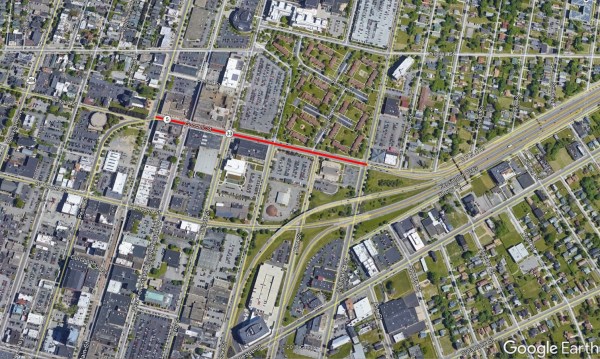
Screenshot (83)

Butler Avenue is shown in red on the map.

Butler Avenue was laid out in 1915 between Lonsdale and Wohlers Avenue.  The street was developed by the International Home Building Company.  International Home Building Co’s offices were on East Ferry at the corner of Wohlers.  Demand for houses on the street was so high that they decided to open it to Humboldt Parkway after just a few months.  Hamlin Park’s development was centrally located and within easy riding distance of Buffalo’s downtown.  A 1915 article states, “the development that has taken place (on Butler Ave) in the last year or two shows what it means when building operations start in a large city.”  

Buffalo’s first newspaper was the Buffalo Gazette, first published in 1811.  It was published “occasionally” and later became a weekly newspaper.  The first daily newspaper in Buffalo was the Western Star, which began publishing published daily in 1834.  Through a series of purchases and mergers over the years, the Western Star newspaper eventually evolved into the Buffalo Courier-Express in 1926.

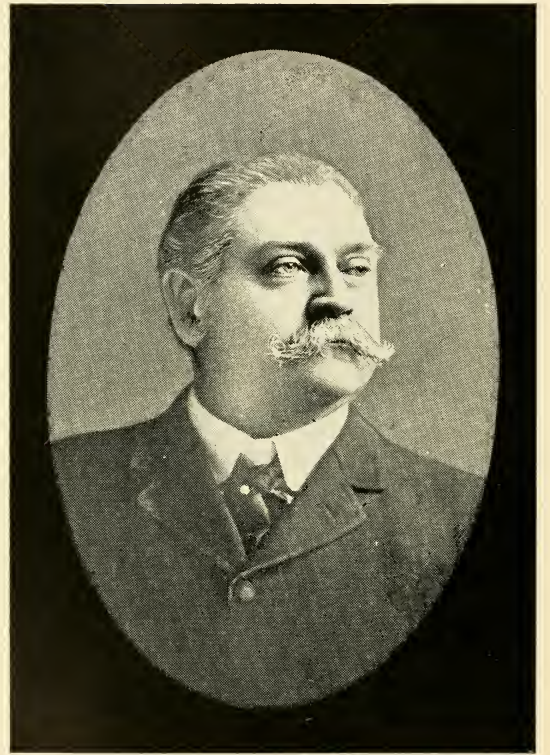
Edward H. Butler, Senior
Screenshot (81)

Edward H Butler, Sr. Source: 20th Century Buffalo

Edward Hubert Butler was born in 1850 in LeRoy in Genesee County, New York, to Irish immigrants Dennis and Lucy Butler.  He attended public schools.  The first newspaper he worked for was the LeRoy Gazette.  He later became connected with the Scranton Times as City Editor and the Scranton Free Press as a Financial Interest Reporter.  

In 1873, just 23 years old, Mr. Butler came to Buffalo to establish The Sunday News.  This venture was regarded by many as reckless, but very quickly, Mr. Butler was able to prove that his judgment was sound.  Other Sunday newspapers had failed to take hold, but The Sunday News was successful.  In 1879, Mr. Butler established the Bradford Sunday News, published for four years before selling it to devote more time to his Buffalo newspapers. The Sunday News was published out of 200 Main Street in Downtown Buffalo.  

Founding of the Buffalo Evening News
buffalo news second edition

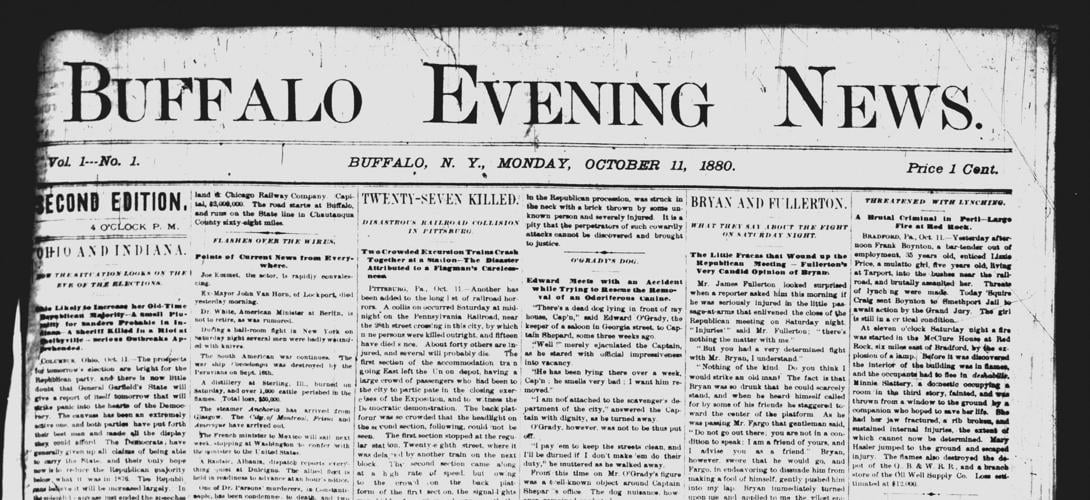
First Issue of the Buffalo Evening News from October 11, 1880. Source: The Buffalo News.

The first copy of the Buffalo Evening News was published by Mr. Butler on October 11, 1880.  You may notice in the picture that the first issue was actually the Section Edition.  The First Edition actually never made it to print.  It was supposed to be off the presses at 2pm.  Due to an elevator incident, the First Edition wound up on the floor, becoming “a tangled mess of handset type.”  They reset the type, and the Second Edition rattled off the presses at 4pm, starting The Buffalo Evening News’ storied history.

With the expansion of The Evening News, The News moved to temporary quarters at 214 Main Street.  The Evening News started as a four-page newspaper that cost 1 cent (about 30 cents today), less than the other daily newspapers of the time, which were 5 cents ($1.54 today).  The first-day circulation was 7,000 newspapers.  By 1882, just two years later, it had risen to 18,000 daily. The News was distributed by Buffalo’s system of horse-drawn streetcars.  The papers were loaded aboard them.  The News had a single horse-drawn, two-wheel cart for areas not reachable by streetcar.  This was the only circulation department for the first several years.  Eventually, a fleet of horse-drawn carriages replaced the streetcars for distribution.  Some of those carriages were used again during the 1940s during WWII gas rationing. 

buffalo news building

Buffalo News Building on Main Street around 1908. Source: A History of the City of Buffalo, Its Men and Institutions.

In 1881, The News moved to 218 Main Street, a 20-foot-wide, four-story building.  The business office (known as the counting room) was on the first floor, and the newsroom was on the second floor.  By 1885, the Buffalo Evening News ran five editions daily, which would continue for a century.  In 1896, the original 218 Main Street and the adjacent 216 Main Street were demolished for a new, larger building, which was used until 1973.  The News building at 216-218 Main Street was described as “one of the finest publishing houses in the State” when it opened in 1898.  

From the start, The Buffalo News differed from other newspapers in Buffalo and in cities other than New York City at the time.  The News sent reporters out on the streets to bring their reports to life.  It also offered something for everyone – news reports, market news, sports, prose and poetry, and advertisements.  One of Mr. Butler’s adages was to “print nothing in The News a child may not read”, to keep The News clean and help it have appeal with everyone.  It was designed to be “the People’s Newspaper” and to hold the public good above all else. 

In 1885, The Buffalo News bought the Buffalo Telegraph.  The Telegraph had been founded on October 30, 1880, just a few weeks after the Buffalo Evening News.  The Telegraph had been run by James and George Scripps and John Sweeney.  It had tried to compete with The News, but not been a financial success, so Mr. Butler took the opportunity and removed his competition.  
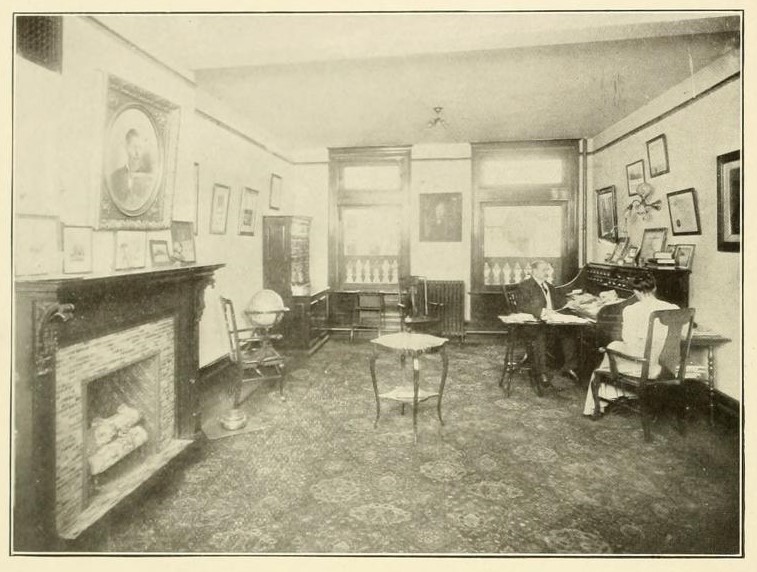
mr butlers private office history of buffalo its men and insitutions

Mr Butler’s Private Office at The Buffalo News, circa 1908. Source: A History of the City of Buffalo, its Men and Institutions

Under Mr. Butler’s ownership, The Buffalo News was very successful. It grew from a four-page daily newspaper into one of the most important newspapers in the country in its first 40 years.   By 1908, The Buffalo News had the largest circulation of any daily paper between New York and Chicago.  It was recognized as one of the best newspapers in the country outside of the two or three largest cities.  It was said that “his success as a journalist is due to his business capacity, his intellectual force and his habit of being in touch with people.”  He kept in touch with every department and paid attention to the operations of his paper.  When he was working on growing the newspapers’ circulation, there were times he was known to ride the train with the newspapers to ensure they made the connection to transfer for delivery of newspapers outside of Buffalo proper, personally ensuring that The News would get to people.  

The Butler Family

Edward Butler married Mary E. Barber of West Pisston in 1871.  They had four children, but only two survived – Ada Deen Butler, born May 31, 1879, and Edward H. Butler Jr, born June 19, 1883.  The other two children were likely named Clara and Ambrose.   [Note:  It was difficult to find the names of the children who died young, as they do not show up in any records I could find.  Special thanks to the staff at Forty Fort Cemetery in Pennsylvania, who took a peak into the Butler Mausoleum and found the crypts for Clara and Ambrose.  There are no dates on their crypts, but many sources mentioned that Mary Butler was buried with her babies, so I will assume that Clara and Ambrose are the two children who died.  Since there are no dates, there’s a possibility they were stillborn or died shortly after birth.]  The Butler family attended Westminster Presbyterian Church.  

In 1875, the Butlers lived at 109 Carolina Street (no longer extant).  Along with Edward and his wife Mary, his brother Ambrose Butler was also living with them while he was working as a clerk in the Canal office.  They also lived with a Domestic Servant – 19-year-old Mary Gorman, and a Housekeeper –  65-year-old Caroline Strong.  

In 1880, the Butlers lived at 377 Prospect Street (still standing).  The house had been the home of Seth Clark before the Butlers.  Along with Edward, Mary and daughter ADA, Edward’s brother Ambrose also lived in the home.  They lived with 20-year-old hosler (keeper of horses) John Collins, and 19-year-old servant Mary Schneck.  

429_Linwood

Image of 429 Linwood Ave as featured in Buffalo News, May 1984.

From 1890 to 1897, the Butlers lived at 429 Linwood Avenue (still standing).  This house is often called the “Lock-Butler House, as it was constructed by William Lock and then was home to the Butlers.  The house is an example of the Romanesque Style in Buffalo.  Mrs. Mary Butler died in August 1893 at the age of just 38 after an illness of three months.  She was buried in Forty Fort Cemetery in Forty Fort, Pennsylvania, in a plot near her two children who had passed away, her father, and her brother.    

In 1905, Mr. Butler lived at 522 Delaware Avenue (no longer extant).   He lived with his son Edward, daughter Ada and niece, 28-year-old Josephine Barber, a niece of the late Mrs. Mary Butler, who served as homemaker for the household.  They had four servants – 38-year-old Catherine Clark, 32-year-old Anna Peterson, 32-year-old Anna Sticht, and 29-year-old Mary Gerhardt.  Rounding out the household was 33-year-old Coachman August Gernoudt and his 32-year-old wife Nellie.  
672_Delaware_Ave_-_1

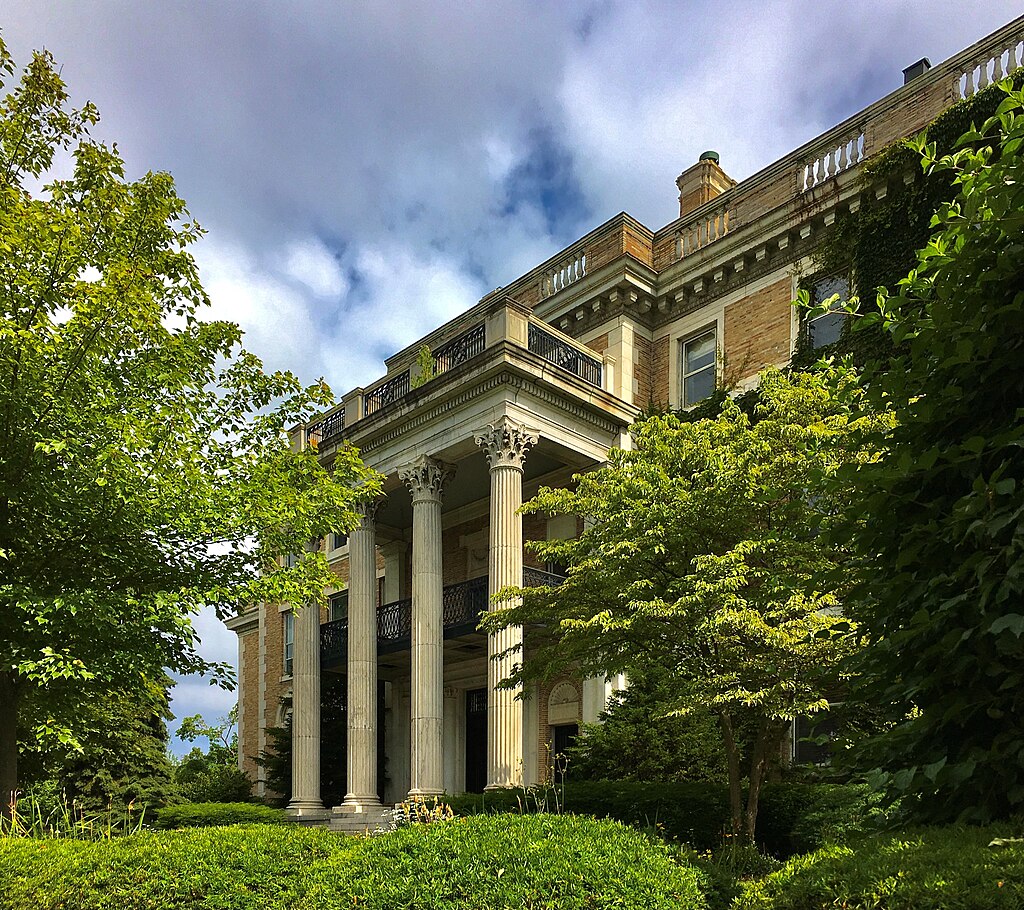
Butler Mansion at 672 Delaware Avenue

In 1909, Edward Butler, Jr. married Kate Maddox Robinson of Atlanta, Georgia.  Also that year, the Butler family (Edward Sr., along with Edward Jr, his new bride Kate, and sister Ada) moved into the house at 672 Delaware Avenue, often called the Butler Mansion (still standing today).  The mansion was originally built for banker and leather manufacturer George Williams.  It is a three-story, Georgian Revival-style mansion with 40 rooms.  It was designed by Mead McKim and White architects, and the two-acre property consists of a 16,000-square-foot mansion and an 8,000-square-foot carriage house.  

In 1910, Mr. Butler lived with his son Edward Jr, daughter-in-law Kate, daughter Ada, and 8 servants:  butler Herman Werne, and servants Pauline Benner,  Caroline Killins, Antoinette Burnod, Emily Schnicklart, Gertrude Beck, Agnes Gambert, and Agnes Kelly.  

Mr. Butler’s Other Involvements

Mr. Butler was very involved with enacting of grade crossing law that created the Grade Crossing Commission and served as a member of the Commission from its founding for its first 20 years.  The Commission erected numerous grade crossing structures within the City of Buffalo city limits.  

Mr. Butler was also involved in constructing the McKinley Monument in Niagara Square.  The Buffalo News was able to help secure appropriations that made the monument possible.  Mr. Butler was President of the Commission that erected the monument.  Mr. Butler worked closely on the memorial to President McKinley with George E Matthews of the Buffalo Express.   

Mr. Butler served as a member of the Board of Trustees for the State Normal School for many years and was President of the Board for the last three years of his life.  He was President of the Buffalo Daily Newspaper Publishers Association, Vice-President of the United Press, Director of the Associated Press, and President of the State Editorial Association.   He was a member of the Buffalo, Ellicott, Park and Country Clubs in Buffalo; the Lotus and Larchmont Clubs in  New York’s Clover Club in Philadelphia and the Capital City Club in Atlanta.  

According to the book 20th Century Buffalo, in 1902, Buffalo had the following newspapers:  

  • Morning Newspapers:  Buffalo Morning Express (established 1846), Buffalo Courier (established 1842), and Buffalo Review (established 1883).  
  • Evening Papers:  Buffalo Commercial (established 1835), Buffalo Evening News (established 1880), Buffalo Evening Times (established 1883), Buffalo Enquirer (established 1891), Demokkrat (German – established 1837), Freie Presse (German – established 1855), and Polak W’Amervca (Polish – established 1887).
  • Sunday Papers:  The Illustrated Buffalo Express (established 1883), Buffalo Sunday News (established 1873), Buffalo Courier (established 1885), and the Buffalo Sunday Times (established 1879).

The circulation of the Buffalo Evening News at the time was 75,000 daily.  This was much more than the daily circulation of its closest competitors – the Buffalo Courier at 55,000 daily and the Buffalo Evening Times, The Buffalo Enquirer and the Buffalo Morning Express at 30,000 daily.  By 1927, the Buffalo New daily circulation was reportedly at 150,000.  By the mid-70s, the circulation was reportedly 280,000, with 300,000 on weekends.  

The Death of Edward H. Butler
IMG_20240923_075453

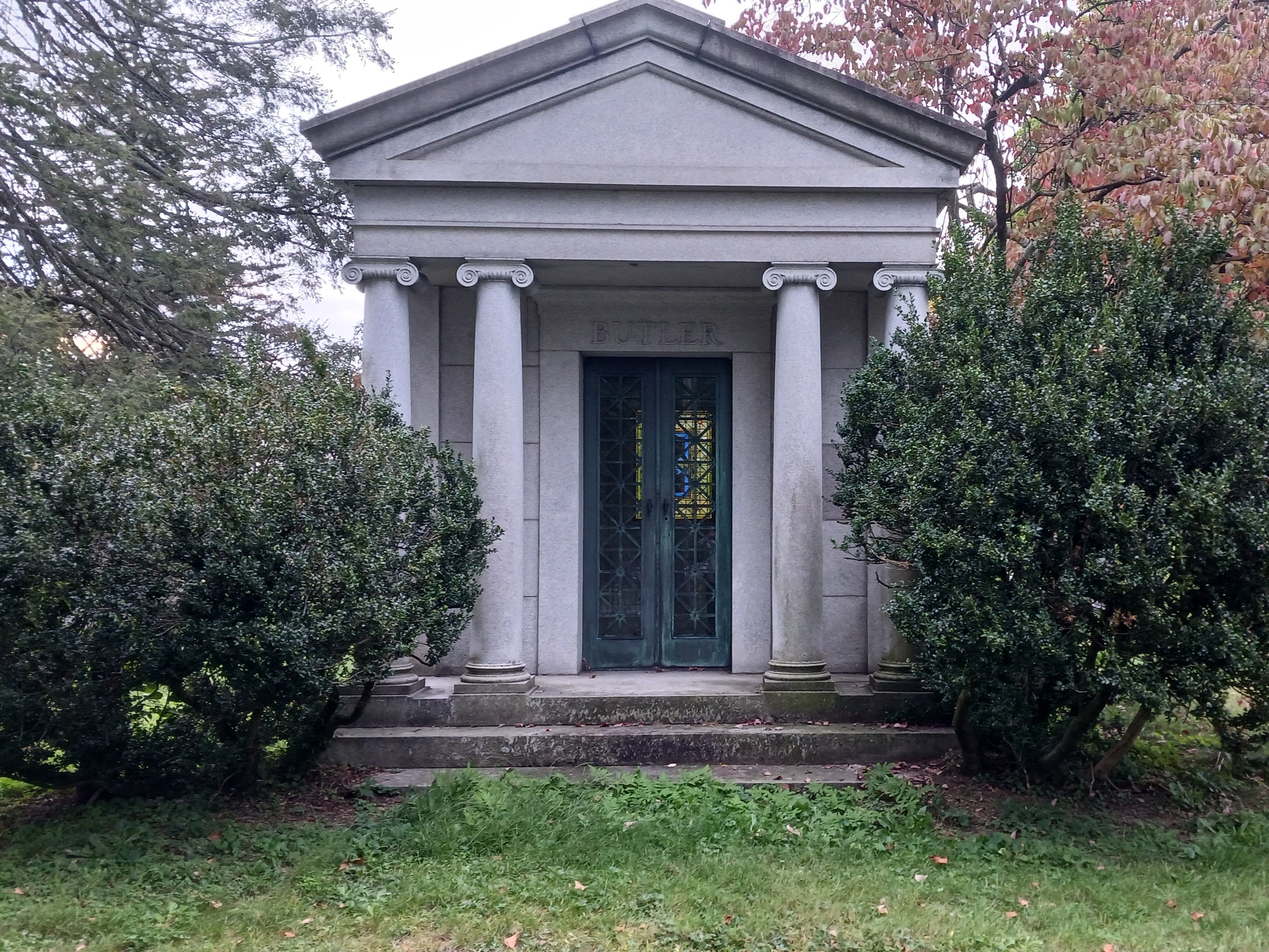
Butler Mausoleum in Forty Fort Cemetery in PA

In 1914, Edward H. Butler died at his residence near the corner of North and Delaware.  He had been in poor health for about ten years, mainly due to diabetes.  He had recently had an operation for mastoiditis, an infection of the ear.  He did not recover well from the surgery.  His funeral was held at Westminster Presbyterian Church on Delaware Ave in Buffalo.  He was buried in a mausoleum in Forty Fort Cemetery in Forty Fort, Pennsylvania, next to his wife and the two babies who had passed away. 

IMG_20240923_091356

Interior of Butler Mausoleum showing Mr. Butler’s crypt.

Mr. Butler’s will gave to many charities.  It was believed that Mr. Butler left personal property valuing $25,000(about $787,000 in today’s dollars) and real estate valued at $25,000(about $787,000) or more.  He gave $60,000 (about $1.9 Million) dispersed amongst 40 charities/institutions.  [Note:  For a deep dive into Mr. Butler’s Bequests, we will discuss his will in my next post, going into each organization that received the money, the story of the charities and if they exist anymore.  Stay tuned for that!]

Outside of Buffalo, he donated to the cemetery where he and his wife are buried and to the cemetery in LeRoy where his mother and other relatives were buried.  He distributed approximately $60,000 (another $1.9 Million) to his personal friends, relatives and employees.  Every employee of The Buffalo News who had worked there for at least three years was given $100(about $3,147 today).  

Edward H. Butler, Jr.

edwardbutlerjr

Sketch of Edward Butler Jr. Source: The Fourth Estate.

Following Mr. Butler’s death, son Edward H. Butler, Jr. took over as Editor of The Buffalo News. Edward Jr also inherited the house at Delaware and North Streets, all of the oil paintings, plates, china, rugs and furnishings.    Daughter Ada inherited her house at Delaware and Highland Avenue, which had recently been completed, along with $50,000 to equalize her brother’s more significant inheritance of the larger family home.  

Edward Jr also inherited six-tenths of Mr. Butler’s ownership of the buildings used and occupied by the Buffalo Evening News and the Buffalo Sunday Morning News – 216 and 218 Main Street, the press and composition rooms on Pearl Street south of Seneca Street, the building at West Seneca Street and Lower Terrace that was used as a garage for the news vehicles, and all of the real estate used for the publication of the two newspapers.  The remaining four-tenths of The Buffalo News and Sunday Morning News went to Ada.  

Edward Jr had been well-trained to take his father’s place at The News.  He joined The News after graduating from Yale in 1907.  He took business courses at Bryant & Stratton Business Institute.  He also worked various jobs in all of the newspaper’s departments.  He knew all the people and how they made the newspaper work; the Butlers felt that learning and understanding every part of the business was important.  

In 1914, Buffalo readers had a choice of six English-language daily newspapers.  In the morning – The Courier and the Express.  In the afternoon, The Buffalo News, the Buffalo Times, the Buffalo Enquirer, and the Buffalo Commercial.  

One of Edward Jr.’s first tasks when he took over the newspapers was to close The Sunday News.  The Evening News was doing well, but The Sunday News was operating at a deficit.  Edward Sr had refused to kill The Sunday News as it was his first publishing venture in Buffalo.  Edward Jr quietly killed The Sunday News at the start of 1915.  The Buffalo News Sunday edition began again 63 years later when things shifted following the Butler family’s sale of the newspaper.

Edward Jr and Kate continued to live at 672 Delaware Avenue.  They had two children – first a son, Edward H Butler III, was born in August 1915. Sadly, Edward III passed away in June 1919, just a few months before his fourth birthday, after several days of illness.  According to his obituary, he had been in poor health for the previous year, suffering from “a peculiar glandular malady that had puzzled physicians.”   Daughter Kate Robinson Butler was born in November 1921.  

In the 1920s, Edward Jr became a pioneer in presenting news via radio.  The Radio Commission authorized WBEN to go on the air on September 8, 1930.  The WBEN stands for Buffalo Evening News.  WBEN broadcast from a studio on the 18th floor of the Hotel Statler.  WBEN started broadcasting with all live, local programs, no national programs and no prerecorded music. WBEN was a part of National Broadcasting Co.’s Red Network, which became the NBC Network.  In 1936, Edward Jr bought WEBR, part of the Blue Network that would later become ABC.  WEBR developed a slogan saying that their letters stood for We Extend Buffalo’s Regards. Edward Jr sold WEBR in 1942 to the Courier-Express.  

In 1928, Mrs. Kate Butler gifted the University of Buffalo with the tower clock in Hayes Hall and the four bells accompanying it.  Mrs. Butler was a member of the Council of the University of Buffalo.  The bells and the clock were restored between 2011 and 2015 during the renovations of Hayes Hall and still operate today.  

By the 1930s, the last competing daily newspapers, Buffalo Commercial Advertiser and Buffalo Times ceased publication.  This left Buffalo with just two newspapers – The Buffalo News and the Buffalo Courier Express.  

After WWII, Edward Jr brought The News to television in Buffalo.  WBEN-TV went on the air on May 14, 1948 and for the first five years was Western New York’s only television station.  In 1954, WBEN-TV became a CBS station.  In 1977, WBEN-TV became WIVB-TV, Channel 4 in Buffalo still to this day.      

Edward Jr was involved in many of the same causes as his father.  He was the Chairman of the Board of Buffalo State Teachers College (Now Buffalo State University).  He was involved with the efforts to move the school from his Normal Ave location to its current location on Elmwood Avenue.  He also served as a Trustee of Nichols School.  Edward Jr was a Director of Buffalo Trust Company and American Savings Bank.  He was a member of the Buffalo, Saturn, University, Park, Buffalo Athletic, and Buffalo Country Clubs.

185245182_1510853833

Butler Mausoleum in Forest Lawn Cemetery.

Edward Jr died in February 1956. He is buried in the Butler Mausoleum in Forest Lawn Cemetery.   Also buried there are his son, Edward H Butler III, his wife, Mrs. Kate Butler, daughter Kate Butler Wickham and two of Kate’s husbands – Bruce Wallis and Robert Wickham.  

Ada Butler and her Family

Edward Jr.’s sister, Ada Butler, married Roscoe Mitchell in April 1910.  Mr. Butler, Senior built the house at 1114 Delaware Avenue as a wedding gift for Ada.  The house is a three-story brick mansion designed by Buffalo architect Ulysses G Orr.  

Roscoe Mitchell was a well-known Buffalo attorney.  Ada and Roscoe had a daughter, Marjorie, born in 1911, and a son, Edward Butler Mitchell, born in 1912.  Sadly, both Roscoe Mitchell and Edward Butler Mitchell died in June and July 1932 after a long period of illness.  Roscoe was 49, and Edward was just 19. 
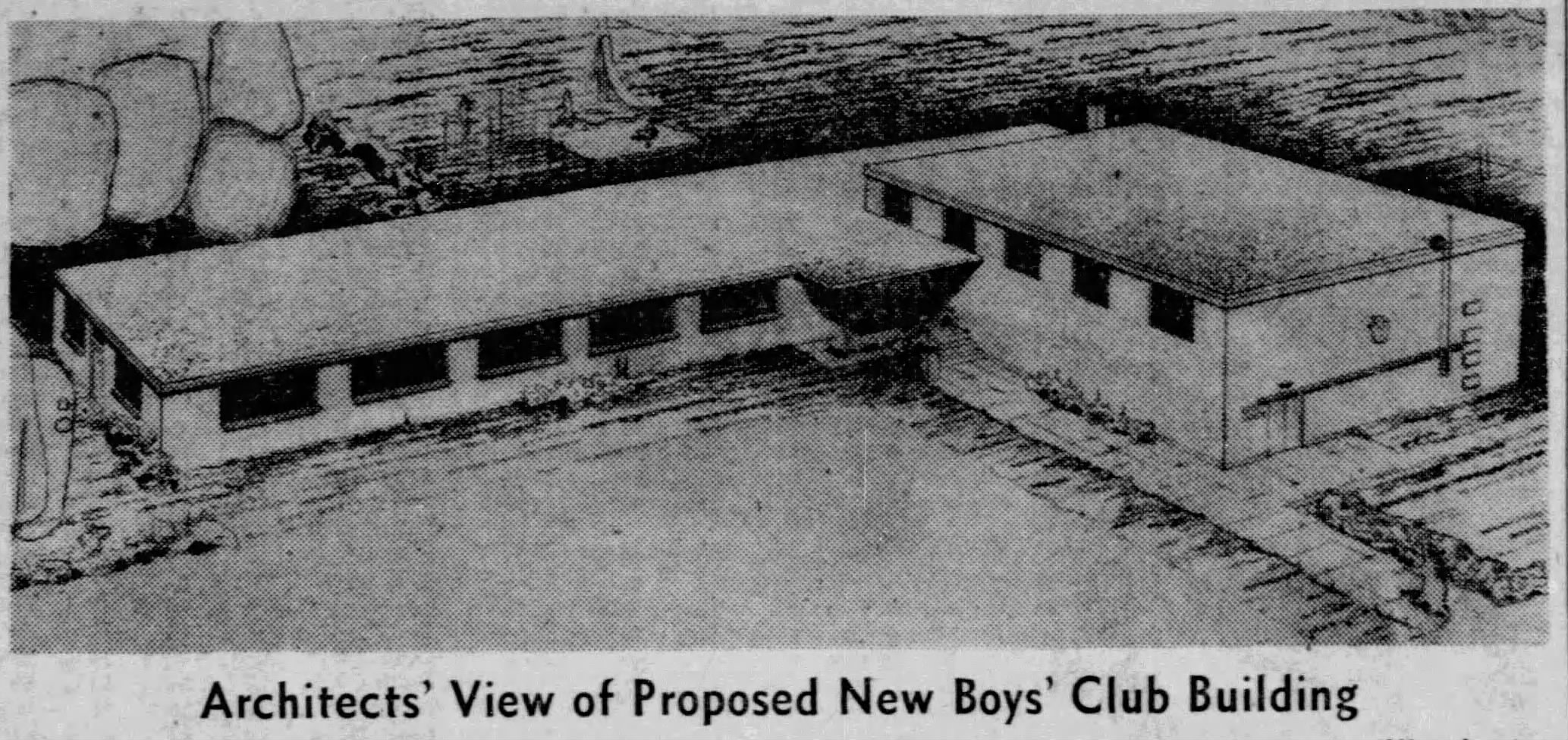
rendering_of_boys_club_building_on_Massachusetts_Ave

Rendering of Boys Club Building on Massachusetts Avenue. Source: Buffalo News, February 1955

The Butler Mitchell Boys Club was founded in the memory of Edward Butler Mitchell in 1933.  The story goes that Ada was driving around the West Side shortly after her son died and saw some young men playing in a makeshift clubhouse and she pulled up to them and talked with them. She decided to buy an old barn on Efner Street to give to the boys of the neighborhood to use.  The Butler Mitchell Club was founded to help the young men of the neighborhood, ages 16 to 24.  The group quickly grew and rented a space in a church at 254 Virginia Street by December of 1933 (this former church is where Hispanics United of Buffalo is located today).  In 1955, the Boys Club of Buffalo and the Boys Club of the Niagara Frontier joined together to erect a new building on the West Side at 370 Massachusetts Avenue, known as the Butler Mitchell Branch.  The Butler Mitchell Boys and Girls Club is still located on this site.  

After their father’s death, Edward Jr and Ada established and perpetually endowed the Edward H Butler Professorship in English Literature within the College of Arts and Science at the University of Buffalo.  This professorship was established in honor of their father and still exists today.

85130819_132955847061

Mitchell Family Plot in Forest Lawn Cemetery

Ada Butler died on April 1, 1934, in New York.  She was buried in Forest Lawn Cemetery with her husband and son.  The Mitchell family plot includes the graves of Roscoe, Edward, Ada, Marjorie and Marjorie’s husband Kent Schuyler McKinley, hence the “Mitchell McKinley” on the plot.  

Ada’s daughter Marjorie was married several times.  First to William Baird in July 1930.  Baird Point at Lake LaSalle on North Campus at UB and Baird Hall are named for the Baird family – William, his brother Cameron, and their father Frank. A street by the Peace Bridge that bisected Front Park, Baird Drive, was also named for them.  The road was removed in 2016 to restore park space to Front Park.  Marjorie and William had one daughter, Barbara Butler Baird, born in August 1931.  

Marjorie helped found the Butler-Mitchell Boys Club with her mother and served as president of the club from 1937 to 1952.  

In 1943, Marjorie Mitchell married Kent Schuyler McKinley.  As Marjorie McKinley, she financed the construction of the Edward H. Butler Auditorium in Samuel P Capen Hall [Note: this Capen Hall was located on South Campus; when North Campus opened, the Capen name moved to North Campus and Capen Hall on South Campus became Farber Hall…I am unsure if the auditorium still exists in Farber Hall – do any of my UB friends know?]

In 1950, Marjorie donated her family house on Delaware to the Episcopal Diocese of Buffalo.  The Diocese used the house as its headquarters, calling it the “Marjorie Mitchell McKinley Diocesan House,” though many called it as “The D’ House.”  The property has been the headquarters of Courier Capital since 2011.  

Marjorie and her husband Kent moved to Sarasota and founded the Sarasota News in 1954.  The Sarasota News was a daily afternoon newspaper.  Talk about a family with deep newspaper ties!  They sold the newspaper in 1962.

Also in 1962, Marjorie sold her 40% shares of The Buffalo News to her Aunt, Kate Butler. 

In 1965, Marjorie was named honorary chancellor of Florida Southern College, the first woman elected to the office.  That year, she also received an honorary doctor of fine arts degree from the college.  She was the main donor for the music building built on campus, the Marjorie M McKinley Music Building, which was named for her. 

Kent McKinley died in 1972.  Marjorie married Ted C Van Antwerp in 1973.  Marjorie passed away in November 1990.  Marjorie and Kent are buried in the Mitchell McKinley plot in Forest Lawn Cemetery.  

Mrs. Kate Butler

Mrs_Butler_August_1974Following Edward Jr’s death, his wife Kate Butler led The News.  She became President of The News in 1956.  She was known around town as “Mrs. Butler”, so I will call her that from here on out.  

The News had purchased additional properties over the years, taking over much of the area at Main and Seneca Streets.  In 1916, The News purchased a building on Pearl Street and remodeled it for use of the mailing department and for stock and file rooms.  In 1924, The News bought a building at Seneca and Pearl Streets; the four-story structure became part of The News’ press room.  In 1929, they purchased 214 Main Street and built an addition to their building.  They continued to need more space.  Mrs. Butler finished the construction of the printing plant, which her husband had begun.  The printing plant on Scott Street opened in 1958 on land that was once part of the Lehigh Valley railroad depot.  The new plant had 35 printing units arranged to operate as five giant presses.  On June 30, 1958, President Dwight D. Eisenhower pressed a button at the White House to start the first production run with the new presses. 

Mrs. Butler also became the Publisher of The News in 1971.  James Righter was publisher from 1956, when Edward Jr died, until 1971.  James Righter was married to Edward and Kate’s daughter Kate.  While the public word was that he took early retirement, reportedly, Mrs. Butler became Publisher because she fired her son-in-law when she found out he was having an affair.  

BN1

Buffalo News Birds Eye View, April 13, 1973. Source: Buffaloah.com

Mrs. Butler also made the tough decision to move The News from 218 Main Street after 75 years to the “new” Buffalo News building at the corner of Washington and Scott Streets.  The Main Street property was going to be a part of the City’s redevelopment program to build Marine Midland Center (now Seneca One Tower).  The new office building was built next door to the printing plant on Scott Street.  One News Plaza, as the new building was known, was designed by NYC Architect Edward Durrell Stone.  The modernist building is unusual because there are no support columns in the middle of the floor plates.  The five-story building also has an atrium that houses a garden with trees and plants.  The News moved into the new building at the corner of Washington and Scott Streets.  Mrs. Butler, unfortunately, was never able to set foot into the new building, as ill health had confined her to her house. 

 Kate Butler died in 1974.  She is buried in the Butler Mausoleum in Forest Lawn Cemetery.  

The Buffalo News After Mrs. Butler’s Death

Mrs. Butler had reportedly been counseled by her attorneys to take steps to minimize the tax consequences that would occur upon her death by gifting off some of her assets, otherwise a “fire sale” would occur.  After Mrs. Butler’s death, the Butler family decided to put The News up for sale.  The newspaper, TV station and radio stations were each sold to different buyers following Mrs. Butler’s death.  The News was officially out of broadcasting at that time.  

The Butler Mansion was donated to Roswell Park Cancer Institute in 1976.  In 1979, Jeremy Jacobs purchased the mansion for use as the headquarters of Delaware North Companies (the mansion is located at Delaware and North Streets, hence the Delaware North name).  In 1991, the mansion was sold to the Variety Corporation.  In 1999, Mr. Jacobs reacquired the mansion for the UB School of Management to use the property for executive training.  In 2001, the mansion was renamed the Jacobs Executive Development Center.  In December 2022, the UB Foundation announced the mansion’s sale to Douglas Development.  

In 1977, after 97 years of being owned by the Butler family, the newspaper was purchased by Warren Buffett for $32.5 Million.  Mr. Buffett became Chairman of The News.  When Mr. Buffett purchased The News, it was an afternoon newspaper published every day except Sunday.  Afternoon newspapers were dying across the country at the time due to the rise of office work over factory jobs and TV news, which made the afternoon edition feel out-of-date at the end of the work day.  The Evening News was different than most; it still sold more than double as many copies as the Courier-Express morning edition.  But it still lacked a Sunday paper.  One of Mr. Buffett’s first decisions was to restart the Sunday edition, which began on November 13, 1977.  There had been a gentleman’s agreement between The News and the Courier-Express that The News would be evening only and the Courier-Express would be morning only.  The Courier-Express fought against the Sunday edition by persuading a local judge to issue rules designed to cripple the distribution of the Sunday News.  In 1979, an appeals court overturned the crippling rules and scolded the judge who imposed them.   Two months later, the Connors family sold the Courier-Express to a Minneapolis newspaper company.  Three years later, on September 19, 1982, the Courier-Express published its last newspaper, leaving Buffalo with just one newspaper.  

After the Courier-Express closed, The Buffalo News became a seven-day newspaper.  In 1989, Buffalo News was the 27th largest newspaper in the United States, with 1100 full-time employees, 200 employees in editorial, and a circulation of 320,000 on weekdays and 390,000 on Sundays.  In 1990, 75% of the newspapers were delivered to homes by 4900 newspaper carriers (4400 youth, 500 adult carriers).   Like so many other Western New Yorkers, I delivered newspapers in middle school. The remaining newspapers were mailed out or found at newsstands/stores.  

The evening edition was abandoned in October 2006, and what had begun as The Buffalo Evening News became a morning-only newspaper.   

In January 2020, after 42 years of being a part of Warren Buffett’s Berkshire Hathaway group, The Buffalo News was sold to Lee Enterprises, just the third owner in the entire history of The News.  Lee Enterprises had ties to Berkshire Hathaway and had managed the Berkshire Hathaway newspapers, except for The Buffalo News, since 2018.   
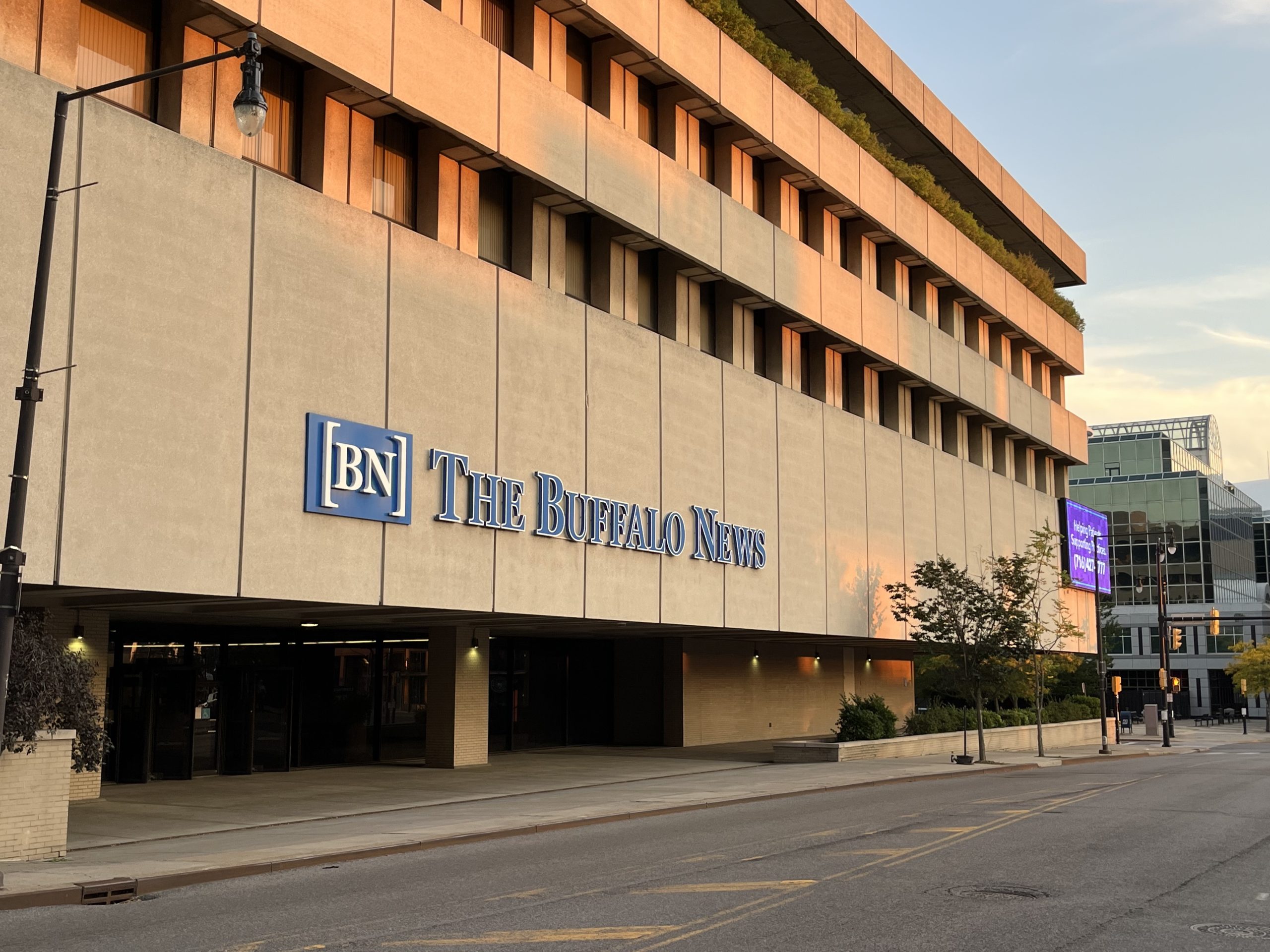
Buffalo-News_Sept.-26-2024-scaled

Former Buffalo News building from Washington Street.  The property is now vacant and fenced off.

In 2022, The Buffalo News announced they were selling their headquarters on Scott Street, moving out of Downtown Buffalo for the first time in almost 150 years. The 175 office employees relocated to 20,000 square feet in the Larkin Exchange Building on Exchange Street in October 2022.  The print production facilities were originally going to remain on Scott Street.  

In February 2023, The Buffalo News announced they were closing the printing production facility on Scott Street and moving print operations to Cleveland, Ohio, to the Plain Dealer printing facility.  About 130 employees across 8 different unions were affected by the closure of the print operations.   The final locally printed edition came off the presses on September 30, 2023.  

In 2024, The Buffalo News announced they would no longer publish a print issue on major holidays, including New Year’s Day, Martin Luther King Jr Day, Presidents Day, Memorial Day, Independence Day, Labor Day, Veterans Day, Thanksgiving and Christmas.  

The Buffalo News building was purchased by Douglas Jemal in July 2024. The sale included the office building, the adjacent production building and a parking lot across the street on Scott Street.  Douglas Jemal also owns the former HSBC Atrium building, just south of The Buffalo News properties, giving the developer control of approximately 14 acres of land in Downtown Buffalo near Canalside and the Arena – I can’t wait to see what he does with the properties!  

So the next time you drive down Butler Ave, or pass by the Former Buffalo News office or the Butler Mansion at Delaware and North, or read The Buffalo News, think of Mr. Edward H Butler and thank him for coming to Buffalo and giving us The Buffalo News and so much more.  What’s your favorite Buffalo News memory?  

Want to learn about other streets? Check out the Street Index. Don’t forget to subscribe to the page to be notified when new posts are made. You can do so by entering your email address in the box on the upper right-hand side of the home page. You can also follow the blog on Facebook. If you enjoy the blog, please share it with your friends; It really does help!

Sources:
  1. “Building is Active in Hamlin Park Now.”  Buffalo News.  November 20, 1915, p21.  
  2. “Butler Ave Just Opened New Street in Hamlin Park.”  Buffalo News.  May 15, 1915, p23.
  3. “Edward H. Butler Died Soon After Serious Operation.”  Buffalo Times.  March 10, 1914, p4.  
  4. “Will of Edward H. Butler is Filed This Afternoon”  Buffalo News.  March 18, 1914, p4.  
  5. “Edward H. Butler Jr and Kate Butler.”  Buffalo News.  November 1, 2015, p84.  
  6. “The News:  A radio and TV Pioneer.”  Buffalo News.  November 15, 2015, p92.
  7. “How the News Grew In Downtown Buffalo.”  Buffalo News.  November 22, 2015, p90. 
  8. “Buffalo’s Last Newspaper War.”  Buffalo News.  December 13, 2015, p94.   
  9. “Death of Mrs. Edward H Butler.”  Buffalo News.  August 21, 1893, p13. 
  10. “Striking Clock Being Installed at University.” Buffalo Times.  June 21, 1928.
  11. “Bennet, A Gordon.  Buffalo Newspapers Since 1870.”  Adventures in Western New York History, Buffalo and Erie County Historical Society, 1974.
  12. Hill, Richmond C.  Twentieth Century Buffalo:  an illustrated compendium of her municipal, financial, industrial, commercial and general public interests.  J.N.Matthews Co, Buffalo, 1902.  
  13. Downs, Winfield Scott.  Municipality of Buffalo:  A History, 1720-1923, Volume 1.  Lewis Historical Publishing Company, 1923.
  14. Kirchhofer, A.H.  “Romance in American Journalism.”  The Fourth Estate.  November 19, 1927.  
  15. “Jacobs Executive Development Center”.  University at Buffalo Archives.  library2.buffalo.edu/archives/campuses/detail.html?ID=118
  16. “Facts About The Buffalo News.” from The Buffalo News.  Updated 9/1990.  Found in the Newspapers Vertical File at the Central Library.  
  17. History of the City of Buffalo, It’s Men and Institutions.  Published by The Buffalo Evening News.  1908.
  18. “Obituary:  Edward H. Butler, Jr.”  Buffalo News.  June 23, 1919, p1.  
  19.  “Station WEBR Transferred; WBEN’s Status Unchanged.”  Buffalo News.  July 12, 1942, p8.  
  20.  Hsu, Charlotte.  “Journey to the Heart of the Hayes Hall Clock.”  UBNow, October 22, 2014.  buffalo.edu/ubnow/stories/2015/10/hayes_clock.html
  21. “Marjorie Van Antwerp Dies; Ex-News Executive”.  Buffalo News.  November 30, 1990, p5.  
  22. Butler Mitchell Alumni Association.  “Our History”.  bmalumni.com/history
  23.  Robinson, David.  “The Buffalo News is Being Sold to Lee Enterprises.”  Buffalo News.  January 20, 2020.
  24. Petro, Michael.  “Buffalo News Plans to Close Downtown Production Facility, Move Printing to Cleveland.”  Buffalo News.  February 20, 2023.  
  25. Glynn, Matt.  “Douglas Jemal agrees to buy Buffalo News complex to expand holdings near Canalside.”  Buffalo News.  March 19, 2024.  
  26. Ashley, Grant.  “Buffalo News no longer publishing print issue on ‘major holidays’.  WBFO.  July 6, 2024.  
  27. Light, Murray B.  From Butler to Buffett:  The Story Behind The Buffalo News.  Prometheus Books. 2011.  
  28. Sullivan, Margaret.  “Historic Change Coming for The News.”  Buffalo News.  October 1, 2006, p81.  

Read Full Post »

emerson placeEmerson Place is a small one-block street that runs between Michigan Avenue and Masten Avenue in the Masten Park neighborhood on the East Side.  The Street is named for Henry P. Emerson, superintendent of the Buffalo Public Schools.  The Emerson neighborhood and Emerson School of Hospitality are also named after Henry Emerson.  In Addition to the Emerson School on Chippewa, the Buffalo schools are about to start classes in a new location on West Huron, where the former CW Miller Livery was converted into classroom space and a new gymnasium was built on a parking lot.  The new school will be The Buffalo School of Culinary Arts and Hospitality Management, formerly known as Emerson Annex.  The school expansion project was one of Mark Croce’s projects.  Mark passed away earlier this month.  He was a friend of this blog and I always enjoyed talking with him about the history of his buildings.  Since there’s no Croce Street, I write this post in memory of Mark, as well as in celebration of the new space for the students!

emerson

Henry Pendexter Emerson was born in Lynn Field, Massachusetts in 1847. He was the son of Oliver and Eliza (Weston) Emerson and is a relative of Ralph Waldo Emerson. He attended Phillips Andover Academy. in Massachusetts. He received his A.B. Degree in 1871 and A.M. in 1874. He was a member of Phi Beta Kappa. After graduation, he started teaching Greek and Latin at Potsdam Normal School.

Mr. Emerson came to Buffalo in 1874 to teach at Old Central (located on Niagara Square). After nine years, he became principal of the school. While he was principal, he obtained $60,000 in appropriations to enlarge the school. This was a very large appropriation at the time.

At the time, the superintendent of schools was a political office. Dr. Emerson ran for it in 1892 on the Republican ticket. He was elected for six successive four-year terms. After the office ceased to be an elected office, he was appointed to continue as superintendent by Mayor Louis Fuhrman. In 1919, Dr. Emerson retired.

Dr. Emerson married Mary Estey of Middleton, Massachusetts in 1874. They lived on Allen Street at the site of what is now the Allendale Theatre (Theatre of Youth) and later at 122 College Street in Buffalo.  The family returned to Middleton every summer and kept a home there on a lake. After retirement, they moved to Middleton full time. They returned to Buffalo every winter for more than a decade to reunite with his fellow teachers and friends.

While Dr. Emerson was superintendent, he was considered an education reformer. He often said, “Better schools make a Better Buffalo”.  Buffalo’s rapid growth had caused school problems at the time.  The population had more than doubled between 1870 and 1900 (from 117,714 to 255,000 people).  Schools were crowded and the quickest growing immigrant populations lived in areas where there were often no schools.  In 1900, almost 3/4ths of the school population was foreign-born or the children of foreign-born.  City services – such as garbage pickup, water supply, sewer, trolley service, etc had difficulty keeping up with the growth, and schools were no exception.  Classrooms at the time could be jammed with as many as 100 students assigned to a single teacher.  The schools were poorly ventilated and poorly lit, with inadequate seating.  Students learned by rote, reciting text together, and passed each grade with a written test, if they passed at all.  In 1890, 76% of children were in 1st and 2nd grade.  There was no school board, school policy was set by the City Council.  As superintendent, Dr. Emerson appointed and supervised the 700 teachers.  Many of the teachers at the time were poorly educated young women from politically connected families.  An October 1892 article in Forum, described the school system of Buffalo as an example of how not to run a public school system.

Dr. Emerson introduced free textbooks for public schools, the first local kindergartens and the first evening classes. He also introduced the first courses in home economics and industrial arts, from which Buffalo’s vocational schools developed. While he was superintendent, four public high schools were built – Lafayette, Masten, South Park and Technical. The Masten High School building is now City Honors. Technical High School was located at Cedar Street and Clinton Avenue (now school administration offices and storage). Technical High School merged with Hutchinson and Central High Schools and is now Hutchinson Central Technical High School (typically called Hutch Tech these days). Lafayette High School and South Park High School are also both still in operation, though Lafayette is now Lafayette International High School.

Dr. Emerson provided free medical and dental exams for students, as well as special classes for the physically and mentally handicapped.  He also introduced non-academic subjects such as music and art.  Dr. Emerson also founded the first local teacher training school. He published two books while he was here – a Latin textbook, “Latin in High Schools” in 1891 and an English grammar textbook “A Course in English For Schools” in 1905. The books were widely used in schools across the country for many years.

Dr. Emerson was president of three educators’ organizations – the Council of School Superintendents of New York State, the State Teachers’ Association, and the National Education Association. He was loyal to his students and encouraged them to finish high school and if possible, college. At the time, it was typical for many students to go into the world of work after they completed 5th or 8th grade, as opposed to completing high school.  For many, it was more important for the students to earn money to help the families than to go on to higher education.  In 1915, the number of students who reached 9th grade was five times more than in the 1890s.  Class sizes were smaller and teachers had better training.

61914729.oFj8sowu.EmersonVoc

The Former Emerson Vocational School on Sycamore Street (now Harvey Austin School)

In addition to the street, Emerson Vocational High School is named after Dr. Emerson. The school had originally opened as Peckham Boys Vocational School in 1911, at the corner of Peckham and Townsend Streets. Peckham Vocational School was the first vocational school in Buffalo to have its own facilities. The school focused on upholstery, tailoring, cabinetmaking, machine shop, welding, drafting, painting, baking and culinary arts. The school was located at the corner of Sycamore Street and Koons Avenue from 1926 to 2002. It was named in Dr. Emerson’s honor in 1937. Emerson school became co-ed in 1975. In 2002, Emerson school moved to Chippewa Street and became Emerson School of Hospitality. The school at Sycamore and Koons was remodeled and became Harvey Austin Elementary School.  Emerson School operates Emerson Commons, also on Chippewa, a cafeteria-style restaurant operated by students.

buff-cbd-emersonsecondsite-0229_750xx3744-4992-0-0

The former CW Miller Livery before renovations into classroom space for Emerson School (Source:  Buffalo Business First)

In addition to the Emerson School of Hospitality on Chippewa, Buffalo’s schools will be expanding its footprint very soon.  The Buffalo School of Culinary Arts and Hospitality Management will be in the renovated former CW Miller Livery on Huron.  Construction of an adjacent gymnasium building is being completed in what was a parking lot.  Students are expected to move in next week (January 2020).  The CW Miller Livery has had a fascinating history of its own – it was built as a “palace for horses” and was considered to be one of the finest stables in the United States.  It uses a unique construction as the floors were suspended from steel trusses at the top of the building.  It provided stalls for approximately 250 horses when it was built.  C.W. Miller was a businessman who had made his fortune providing horse transportation to Buffalonians.  After WWI, the livery was converted to a parking garage for cars.  The building was vacant for several decades before being renovated into the expansion of the school by a development team and the Buffalo Public Schools.

Dr. Emerson also donated Emerson Lodge to Camp Rotary, a camp near his home in Massachusetts that allowed poor boys an opportunity to enjoy outdoor life.  While Camp Rotary still exists, I was unable to determine if the lodge is still standing.

While at college, Henry met Frank Fosdick, who became a lifelong friend. They promised to name their children after each other. Frank Fosdick served as principal of Masten High School from 1914 until 1926. Masten High School was renamed Fosdick-Masten High School in Frank Fosdick’s honor in 1927.  Dr. Emerson had no children himself, but Mr. Fosdick kept his promise and named his first son Henry Emerson Fosdick.  Henry Emerson Fosdick was a prominent pastor, serving at First Presbyterian Church in the West Village, Manhattan and the historic, inter-denominational Riverside Church in Morningside Heights, Manhattan.  He was featured in a Time Magazine cover store on October 6, 1930.

Dr. Emerson died in 1930. He is buried in Oakdale Cemetery in Middleton, Massachusetts.

36b1b669-2552-4397-88df-6de4272ed3ad_l

Emerson Row Houses

Emerson Place is also known for its rowhouses.  It’s one of the only remaining sets of rowhouses left in Buffalo (it was never a common housing style here).  The rowhouses on Emerson were built in 1893 by Benjamine B. Rice.  Benjamin Rice was a real estate developer who developed several streets in the Masten Park neighborhood.  The Emerson rowhouses consist of two seven-unit row houses.  They became a City of Buffalo Local Landmark in 1981 and are listed on the National Register of Historic Places.

So the next time you grab lunch at Emerson Commons or are driving through Masten Park, think of Dr. Emerson and his attempts to reform our schools.

To learn about more streets, check out the Street Index.   Be sure to subscribe to the blog so that new posts are sent directly to you – you can do so on the right hand side of the home page.  You can also like my blog page on facebook at facebook.com/buffalostreets.

Sources:

  1.  Smith, Katherine H.  “Emerson Place Memorial to Long-Time School Head”.  Buffalo Courier Express.  November 16, 1941, sec6 p3.
  2. “Emerson High School Students Take Part in Funeral Services”.  Buffalo Courier Express.  April 23, 1937. p12.
  3. Motter, HL, editor.  International Who’s Who:  Who’s Who in the World:  A biographical dictionary of the world’s notable living men and women.  William G. Hewitt Press, Brooklyn NY, 1912.
  4. Seller, Maxine.   “The Education of Immigrant Children in Buffalo”,  April 1976.  Found in Institutional Life:  Family, Schools, Race and Religion. Shumsky, Neil Larry, editor.  .  Garland Publishing, Inc, New York.  1996.
  5. LaChiusa, Chuck.  “C.W. Miller Livery Stable”  Buffalo as an Architectural Museum.  https://buffaloah.com/a/whur/75/75.html (online January 2020)
  6. Buffalo City Directories
  7. Emerson Place Row.  Building Structure Inventory Form.  Accessed from NYS Office of Parks and Recreation via cris.parks.ny.gob (online January 2020)

Read Full Post »

goodellstreetGoodell Street is an east-west street that runs Michigan Avenue to Main Street.  Goodell Street forms the northern boundary of the Central Business District and typically “south of Goodell” is used as a definition for what constitutes “Downtown Buffalo”.  North of Goodell Street is the Medical Campus and the Fruit Belt neighborhood.  Until the 1950s, Goodell Street ran thru to an intersection with Cherry and Locust Streets.  The Kensington Expressway, which ends at Goodell Street, cut through the Fruit Belt.  I am currently working on a multipart series about the streets of the Fruit Belt and the historic development of the neighborhood.  Stay tuned!  Goodell Street is named for Jabez Goodell, one of the early residents of Buffalo.

Jabez Goodell was born in Holland, Massachusetts in 1776.  He was the only son of Icabod Goodell.  Jabez had three sisters – Huldah, Mary, and Persis.  Jabez came to Buffalo in 1806.  At the time, Buffalo had four shops, consistent mostly of Indian goods and a small drug shop, one blacksmith, one shoemaker, one carpenter and a joiner.  He purchased lands at their original price from the Holland Land Company.  His purchases were at the northern edge of the original layout for the Village of Buffalo.  Due to the growth of the city over the next half-century, his lands increased in value to create a substantial estate.

outerlots goodell

Properties owned by Jabez Goodell

Mr. Goodell owned Outer Lots 135, 136, 137 and 145, 146, and 147.  This included properties along Genesee Street and the property where Goodell Street would eventually be laid out.  He also owned lot 33, west of Delaware Avenue near Tupper.

Goodell Street ran through Mr. Goodell’s property.  He operated the Broadwheel Tavern at the corner of Goodell and Main Streets.  The Tavern was located where the Sidway Building now stands.  It was said that his tavern “entertained man and beast”.  His house was burned during the War of 1812, along with the rest of Buffalo.  He rebuilt at Goodell and Oak Street.  His house was later owned by Mayor Solomon Scheu.

st peters

The former St. Peter’s Evangelical Church

Mr. Goodell donated land on Genesee Street at Hickory to the German Evangelical Society of Buffalo in 1834.  The first worshiped on the site in a building that was originally built as the original First Presbyterian Church but was moved to the Genesee Street Site.  Their second church was the original St. Paul’s Episcopal Church, which was moved to their property in 1850.  In 1851, they became St. Peters German United Evangelical Church.  In 1877, they built the current Victorian Gothic church that is located on the site.  The tower on the church was removed in 1991, along with small pinnacles that had been surrounding it.  The congregation moved in 1974 when they merged with Lloyd’s Memorial Church to become New Covenant Church of Christ.

Mr. Jabez was a stockholder in the Batavia Street Plank Road Company and served as President of the company.  Batavia Street became Broadway.   Plank roads were common in New York State during the late 1840s and 1850s.  A plank road is made of wooden planks or logs.  The wooden roads were easier and cheaper to maintain that McAdam roads, another common road type of the time period.  The first plank road in the United States was built in Syracuse.  The Batavia Street Plank Road Company controlled 2.5 miles of the roadway and invested $13,000 ($428,910 in 2019 dollars) of capital improvements into the road in 1850.  These road companies were organized and regulated under New York State law.

6Mr. Goodell died in September 1851 at 75 years old.  In death, he donated 10 acres and $10,000 (about $333,000 in 2019 dollars) to the newly formed Buffalo Female Academy to build a 30,0000 square foot school.  Ten months after he died, Goodell Hall opened at the school, just behind the Evergreen Cottage at the corner of Johnson Park and Delaware.  Classes had been held in Evergreen Cottage (Mayor Ebenezer Johnson’s former home) for the 1851 school year.  In 1852, the school moved into Goodell Hall and the cottage was used as a home for the Principal.  The Academy was renamed Buffalo Seminary in 1889 and they moved to their current location on Bidwell Parkway in 1909.

goodell

Jabez Goodell Grave

Mr. Goodell married Diadamia Day, but they had no children.  After the donation to the school, he left his the remainder of his property and estate to be distributed to different societies as well as to religious, missionary and education associations of the Presbyterian church.  Mr. Goodell had been an elder at First Presbyterian Church.  The Goodell estate at his time of death was worth about $400,000 when he died.  That would be more than $13 Million today.  At the time of his death, he was the largest public benefactor who had lived in Buffalo.  He also left $500 ($16,672 in 2019 dollars) to his hometown of Holland, Massachusetts, to provide perpetual care of the cemetery.  He is buried in Forest Lawn, which opened only two years before he passed away.

The rest of the Goodell family was also prominent in Western New York and the Southern Tier.  The Goodell Family at the time was reportedly considered the way the Kennedy Family is in Massachusetts.  Robert Goodell was born in 1601 and immigrated from Dennington England to Massachusetts with his wife and children in 1634.  Jabez was a sixth generation Goodell in America.  Robert was his great-great-great grandfather.  The NFL commissioner Roger Goodell is a 12th generation Goodell and fourth cousin, six times removed to Jabez Goodell.

It is often said in Buffalo that the road is actually pronounced “GOOD-ul”, but because Roger Goodell’s branch of the family pronounces it as “Good-elle”, the pronunciation has changed as his career has risen in the NFL.  I’d love to hear from some Buffalo old timers, especially those who live in the Fruit Belt…how do you pronounce it?

To learn more about other streets, check out the Street Index.   Stay tuned for my upcoming series about more streets in the Fruit Belt area!  You can subscribe to the site on the homepage and new articles will be emailed to you as soon as they are posted.

Sources:

  1. Boltwood, Robert.  “St. Louis’ Pioneer Catholic Church, Enters 12th Decade”.  Buffalo Courier Express, Sunday August 27, 1939, p L7.
  2. “St. Peter’s to Honor Founding 102 Years Ago”. Buffalo Courier Express.  Feb 6, 1937, p 25.
  3. Graham, Tim.  “The Other Goodell:  How NFL commissioner’s dad ran afoul of Nixon”.  Buffalo News.  February, 3 2018.
  4. Ketchum, William.  An Authentic and Comprehensive History of Buffalo.  Rockwell, Baker & Hill Printers:  Buffalo NY.  1865.
  5. Severance, Frank.  “Jabez Goodell”.  As found in Lovering, Martin. History of the Town of Holland, Massachusetts.  The Tuttle Company:  Rutland, Vermont.  1915.
  6. “Batavia Street Plank Road Co”.  Daily Courier.  January 15, 1850.
  7. Zobel, Michael.  “Letter: Learn the correct pronunciation of Buffalo’s Goodell Street”.  Buffalo News.  April 29, 2019.


Read Full Post »

smithSmith Street is a 2 mile long road on the East Side of Buffalo running from the Buffalo River to Broadway. Smith Street is one of the interchanges from the I-190 Thruway, Exit 4.

Henry Kendall Smith was born on the island of Santa Cruz (now Saint Croix) on April 2, 1811. His parents were Jeremiah Smith and Jane Cooper Smith, who were of English origin. At the time of his birth, the island was in possession of the English during the Napoleonic Wars. In 1815, following the peace between Britain and France, the island was once again a Danish territory. Mr. Smith, Henry’s father, was an architect and builder. While the English had occupied the Island, there had been prosperity. When Denmark returned to power, property values depreciated greatly and many plantation owners were ruined. The change in government caused Mr. Smith to lose a great deal of money. However, his social standing allowed him to achieve the rank of major in the Danish provincial army, which allowed him an income as opposed to financial ruin. One day, while passing through a fort, some quicklime was accidentally throw into his face. Following the accident, he was confided to bed for weeks and blinded for life. At the time, the family consisted of Jeremiah and Jane, along with two sons and two daughters. The family struggled to make ends meet. Mrs. Smith, was not discouraged by the family’s misfortune, and helped her children to look towards the future. A long litigation took place revolving around the accident. Eventually, rather than continue the ligation to get his fair share due to him, Henry’s father accepted a settlement of $1,500 from the party responsible for his injuries, in order to be able to educate Henry.

At the age of 8, Henry was sent to Baltimore to study under Reverend Dr. Berry, a minister of the Church of England and a scholar. When Henry left for Baltimore, his father told him that he would now have to take care of himself and that it was his responsibility as to whether he would sink or swim. Henry reported replied that he would swim, and left behind his family forever.

For those who have seen the musical Hamilton, or know Alexander Hamilton’s history, Henry’s story will sound familiar. Alexander Hamilton was also from St. Croix, and was sent to America to receive an education after experiencing poverty early in life.

Henry_Kendall_Smith,_mayor_of_Buffalo

Henry Smith’s Mayoral Portrait

At age 17, he became a clerk at a wholesale dry goods store in New York City. In his free time, he would continue his studies of the classics, believing that there was another occupation out there for him, and that he would not be a clerk forever. One day, his employer told Henry that he was acting like a woman or a “clumsy boor”. So Henry told his employer that he could do the work himself, and left the store. Shortly prior, he had met Daniel Cady of Johnstown, New York. who was engaged in a trial in New York. After listening to Cady’s arguments and the reply by Ogden Hoffman, Henry was inspired and decided he would become a lawyer.

Henry traveled to Johnstown, found Mr. Cady, and asked to enter his office as a law student. At the time, lawyers did not go to law school, but rather learned the trade in a law office. Mr. Cady welcomed Henry into his office. Henry was devoted to his books and continued his studies under Mr. Cady until he was ready for his examination. While he was studying, he earned an income by teaching at a school. Henry was admitted to the bar in May 1832 and continued to practice in Johnstown. In October of that year, the Young Men’s State Democratic Convention met in Utica, and Mr. Smith was one of the delegates from Montgomery County. During the convention, he delivered a speech regarding the nomination of a gubernatorial candidate which gave him the reputation of an accomplished and logical speaker. At the convention, Henry met Honorable Israel T. Hatch, from Buffalo, who invited Henry to come to Buffalo.

Henry moved to Buffalo in spring of 1837, to form a partnership with Mr. Hatch. After working with Mr. Hatch, Henry also worked with George W Clinton, Mr. Williams, Isaac Verplanck and others in Buffalo.

At the breakout of the Patriots War in 1837, Henry was made Captain of one of the five companies of volunteers formed by citizens for the protection of Buffalo. He continued in the militia service for some time, passing through the ranks until he attained the rank of Colonel. When he was made Colonel, he was given a gold watch that had the inscription, “The citizens of Buffalo to Hon. Henry K Smith, the eloquent and efficient advocate of the Erie Canal and the rights of the City.”

In 1838, Mr. Smith was appointed District Attorney for Erie County. He resigned after seven months, because he was being requested so often for other civil business as a lawyer.

In 1844, he accepted the office of Recorder of the City of Buffalo, an office he held for four years. Subsequently, in 1846, he was appointed postmaster of Buffalo and held the office for two and a half years. In 1850, he was elected Mayor of Buffalo. He was nominated for state assembly, state senate and congress. In 1840 he was a delegate to the national convention which re-nominated Martin Van Buren for president (Van Buren lost that election to William Henry Harrison).

Mr. Smith married Miss Vorhees in spring of 1834. She was the daughter of a wealthy merchant of Johnstown. Unfortunately, she passed away shortly after their marriage. In 1838, he married Miss Sally Ann Thompson, the daughter of Shelton Thompson of Buffalo. After 18 months, she too passed away, leaving behind a son, Sheldon Thompson Smith. Henry suffered greatly after the death of both of his wives. To deal with his grief, he focused on the care and education of his son, on his professional duties and politics.

45246516_1431364435.jpg

Mr. Smith had considerable musical talents. He taught himself to play the violin. He would often be found singing with his family and would sing the Star Spangled Banner, God Save the King, and other patriot songs on festive occasions such as the Fourth of July or St. Patrick’s Day. He was a member of St. Paul’s Episcopal, during the time of Rev. Shelton, for whom Shelton Square was named.

Mr. Smith died on September 23, 1854, at age 43. He is buried in Forest Lawn.

During the 1950s and 1960s, there was a Proposed East Side Expressway that went through several iterations. The Expressway was originally planned to start at the Kensington Expressway at an interchange at Best Street, run along the south side of Humboldt Park, now MLK Park, and to continue along Walden Avenue. They then decided to shift the expressway south of Walden in order to preserve the Walden Business Corridor. The Expressway was going to run 2.6 miles and end at Walden Avenue near the City Line. The Expressway was included in New York State Highway Law 1957. In 1958, they decided that it would be better if they were also able to connect the Thruway I-190 to the Expressway with an additional route. This highway was thought to be beneficial to the planned opening of the Thruway Industrial Park and to help bring people into the struggling Broadway-Fillmore shopping district. At the time, Broadway-Fillmore was the 2nd most dense area, second only to Downtown in both size and value.

20190914_165054~2-1.jpg

One of the plans for the East Side Expressway and Smith Street Spur

The Proposed Smith Street spur would start at the East Side Expressway with an interchange at Miller Avenue, and continue southwest along Memorial Drive to Fillmore Avenue, then would follow Fillmore to Smith to the Smith Street interchange of the I-190. Reports at the time said that this spur of highway was “essential to the lifeblood of the East Side”. More than 300 houses were planned to be demolished as part of this Smith Street Spur proposal. The plan was debated for many years, with various alignments discussed and fought over. Elmer Youngmann, the District Engineer for the New York State Department of Public Works (for whom the Youngmann Expressway – I 290- was named) was against putting the spur down Memorial Avenue due to the high costs of the road due to the private properties along the route. Neither the East Side Expressway in this alignment nor the Smith Street Spur were ever built.

Want to learn about other streets? Check out the Street Index!

Sources:

1. Proctor, L.B. “Sketches of the Buffalo Bar: Henry K. Smith”. Published in Buffalo Courier & Republic, 1869.

2. Viele, Henry K. “Sketch of the Life of Hon. Henry K. Smith”. Published in Buffalo Courier & Republic, May 25, 1867.

3. Rizzo, Michael. Through the Mayor’s Eyes. Lulu Enterprises, Inc. 2005.

4. The Proposed East Side Expressway and Proposed New Arterial Route. Buffalo: 1961.

Read Full Post »

wasmuthWasmuth Avenue runs between Genesee Street and Walden Avenue near Martin Luther King Jr Park on the East Side of Buffalo.  The street is named after one of the first female developers in Buffalo, Caroline Wasmuth.  Ms. Wasmuth was one of Buffalo’s pioneer business women.

Caroline Geyer arrived in America alone in 1845 at the age of 16.  The trip from Germany by boat took three months.  She got a job working for the Lautz (sometimes also spelled Lauts) family.   The Lautz family were an early Buffalo German family who manufactured candles and soaps as Lautz Brothers & Co.  She wasn’t able to continue her formal education in America, but learned to speak, read and write English. She enjoyed reading and educated herself through her books.  

Her first business experience began at her husband’s grocery store at Carlton Street and Michigan Avenue.  Ms. Wasmuth invested all of their savings into a savings and loan company.  During the 1880s, there was a land boom in Buffalo and she was asked to become a partner in the Buffalo Land Association.  The company developed the land in the Genesee-Walden district.  They later formed the Ontario Land Company to develop land in Cheektowaga.

She had a stand at the Elk Street market for 47 years, specializing in berries and fresh vegetables.   The Elk Street market was located on what is now South Park Avenue (you can read more about the change in street name here) You can also learn more about the Elk Street Market at this link, where Steve Cichon notes that it was the largest fruit and garden truck market in the United States.  During Ms. Wasmuth’s time, farmers were prohibited from bringing their produce into Buffalo.  She would walk to the City line to meet them and make her selection.  She could carry as many as five 30-quart trays of berries on her head from the City Line to the Elk Street market, likely about 4 miles!  She was known for having a kind heart towards anyone not being able to have food and a reputation for giving a meal to anyone who came to her door.  She was well known for her generous nature, particularly towards people who were struggling.

Ms. Wasmuth enjoyed singing and was a member of the Saengerbund, a well known German singing society, and the choir of St. Peters Evangelical Lutheran Church, located at the corner of Genesee and Hickory.  She was a member of the Women’s Society of that church.  She was also a member of the Seven Stars Rebekah Lodge No. 136, which was the women’s branch of the Independent Order of Odd Fellows who met at 145 High Street.  She was also a member of the Gertrude Lodge No 47, Daughters of Herman, which was a German aid society located at 260 Genesee Street. 

Ms. Wasmuth was noted for being unusual among early businesswomen because she did not try to dress like a man.  She loved her pretty clothes and jewelry.

She was known for adopting new inventions that could be useful to her.  Her husband, George Peter Wasmuth, was the first Buffalonian to  bottle horseradish.   She convinced her husband to buy one of the first foot-power machines for grinding horseradish, relieving the family of grinding horseradish for hours.  They used to buy from twenty to thirty tons of horseradish at a time.  Her nine children helped around the house.

During an interview during the 1940s, her son Fredrick said that many of the family members were still living on land originally purchased by Ms. Wasmuth.  However, he lamented that they would have been happier if they owned a piece of land she had passed on the purchase of – she could have bought the property where Buffalo Savings Bank stands downtown for $0.50 a foot.   The passed on the purchase, and bank was built.  We typically refer to the building today as the Gold Dome; the property would certainly be worth more than that today!

wasmuthMs. Wasmuth was married twice and had four sons and five daughters:  Frank, George, Maggie, Lillian, Anna, Caroline, John, Fredrick, and Charles.  The family lived on Michigan Street (now Ave) near Carlton Street, on what is now the Buffalo Niagara Medical Campus.  She was also one of the investors in the Pan American Exposition, having bought a subscription in 1899.  She died in 1904 at the age of 75.  She is buried in Forest Lawn Cemetery. 


Sources:

  1. “Wasmuth Avenue Honors Business Woman” Buffalo Courier Express, Sunday January 28, 1940.  
  2. “Pan-American Subscriptions” Buffalo Evening News, Saturday January 28, 1899.
  3. 1880 United States Federal Census.  Accessed via Ancestry.com 

Read Full Post »

military road

Military Road’s modern alignment through the City of Buffalo and Town of Tonawanda

Military Road is a part of NYS Route 265, a 19.75 mile long state road that runs between Niagara Falls and Buffalo.  The portions called Military Road are located in the City of Buffalo/Town of Tonawanda and then again in Niagara Falls, NY.  The road dates back to 1801, when it was laid out as a road to connect Black Rock with Fort Niagara, near Lake Ontario.  The route begins at the intersection of Niagara Street and the Scajaquada Expressway.  It runs along Tonawanda Street through Black Rock, Amherst Street, then turns into Military Road where it runs for 4.3 miles until the City of Tonawanda border.  In the City of Tonawanda it is Main Street, in North Tonawanda it is River Road, in Niagara Falls it is Buffalo Ave before it turns back into Military Road through most of Niagara Falls where it ends at a junction with NY 104 (Lewiston Road) in Lewiston.  From Lewiston to Youngstown, the River Road that ran up to the Fort was already built, so that was used to connect the Military built road to Fort Niagara.

map of military road - from buffalo history gazette

Historic Map showing the route of Military Road Source: Buffalo History Gazette

Military Road was one of the first roads in the country planned for military purposes.  Roads for defense have been around for a long time and are still around in modern times – much of the United States Highway System was built as the “Dwight D. Eisenhower National System of Interstate and Defense Highways”, designed for defense and modeled partly after the German Autobahn network that Eisenhower saw in Germany during WWII.  After the Revolutionary War, the federal government realized they needed a highway extending from the town of the Lewiston Escarpment to the bluff at Black Rock.  At the time, they were planning a large fort on the Black Rock bluff to guard the entrance to the Niagara River.  Most of WNY’s roads at the time were based on Native American trails and the trails of the earliest settlers.  These trails typically took the path of least resistance, to avoid things like creeks, marshes, or heavily wooded areas.  The highway would replace the old Portage Road, which was too winding, as it followed closely to the course of the river, rather than in a more direct line.  The Historic Map shows both the routes of the Military Road, which has a smoother path than the Portage route, which curves further to the west towards the Falls.

After the Revolutionary War, there were boundary disputes between New York and Massachusetts.  An agreement signed in Hartford, Connecticut in 1786 deeded the land once occupied by the Haudenosaunee to New York State, but Massachusetts maintained that they had a right to the area west of Seneca Lake once the Native American title was extinguished, except for a one-mile strip, which New York State reserved for itself.  The strip ran one mile inland along the Niagara River, from Buffalo to Stedman’s Farm (also known as Fort Schlosser, near where the water intakes are currently located along the Niagara Scenic Parkway/Robert Moses Parkway in Niagara Falls). Despite the State’s reservation of the parcel, the Seneca maintained that they retained the title to the Mile Strip, which was affirmed in the 1794 Pickering Treaty.   Massachusetts sold the rights to the surveyed portion of the land to Robert Morris in 1791.  Keeping a portion of the land for his own purposes, Robert Morris sold the rest of the land (which the exception of Grand Island and the Mile Strip) to the Holland Land Company, the company which Joseph Ellicott was the land agent.  You can read more about Joseph Ellicott and the Holland Land Company by clicking these links for Part One, Part Two and Part Three.  In 1798, Seth Pease surveyed the Mile Line for the Holland Land Company.  In 1802, the Seneca claim to the Mile Strip was extinguished by a treaty signed in Albany.  There had been little settlement in the area by the Seneca, only two Seneca families lived there year-round.  The treaty was initiated because the government wanted to construct a fort at Black Rock (also known as Upper Black Rock).  In 1803, the Deputy State Surveyor, Joseph Annin began to survey the Mile Strip into lots.  Fort Niagara was given 716 acres which were set aside for the Federal government.  The Stedman’s Farm/Fort Schlosser farm lot was set aside at 680 acres.  The Jones and Parrish tracts, which were each 640 acres, were also set aside and were given to Mr. Jones and Mr. Parrish who had been Haudenosaunee captives during the war.  The Jones and Parrish lots were near the Scajaquada Creek.  A total of 111 lots were laid out within the remainder of the Mile Strip, the majority of which were 160 acres in size, but due to the curve of the river, many were slightly larger.  One square mile was set aside at the southern end for the Village of Black Rock.  For more on the laying out of Black Rock, you can read about Peter Porter, the streets named after states, and the numbered streets.

In 1801, General Moses Porter, commander at Fort Niagara, was ordered by the War Department to use his troops to build the road.  I was unable to find out if General Porter was related to Mr. Porter of Black Rock during my research.  They called the road Military Road because it was built by the soldiers.  Between 1802 and 1805, the right of way for the road was cleared.  At the time, road building typically consisted of cutting trees and brush wide enough  to bring an oxcart.  Military Road was built in a strip 100-feet wide.  Marshy areas were made passable by laying logs down, which was often referred to as a “corduroy road”.  It was a tough task, as the road was built through forests and over swamp lands to cut a straight path.  Bridges were built in Tonawanda, but work was stopped and the road surface was not finished for seven years, due to disagreements between the State and the Federal Governments. In 1808-1809, New York State gave $1,500 (about $30,000 in 2018 dollars) to the project and the road was complete.

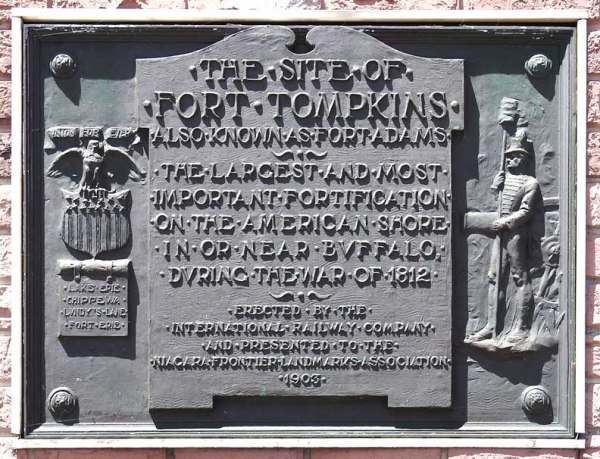
fort tompkins signThe large fort planned for Black Rock was never built, but a smaller one was built in 1807 and became Fort Tompkins in August 1812.  Fort Tompkins was also known as Fort Adams.  The fort was actually large mounds which were mounting points for seven guns.  It was technically a battery, which is a cluster of cannons in action as a group put into position during a battle of a fort or city.  Fort Tompkins was the largest of eight batteries that were built during the war.  It was located at the top of the bluff at the bend in Niagara Street.  The escarpment here allowed them to overlook the river, giving advantages over the attacks from the water.   The location was later the sight of railway barns.  A plaque was hung on the railway barn and still hangs on the building located at 1010 Niagara Street.  The more famous Fort Tompkins was located on Staten Island and was built in 1663.  They were both likely named for Governor Daniel Tompkins, Governor of New York from 1807 to 1817.  Fun fact for if you’re ever on Jeopardy:  Daniel Tompkins was later President Monroe’s Vice President and the only VP in the 19th century to serve two full terms.
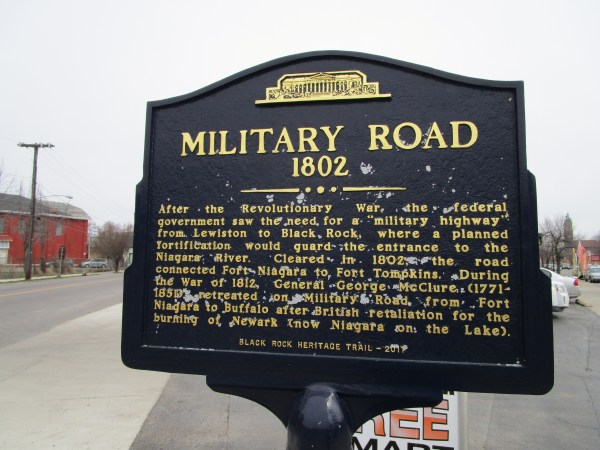
Military Road Marker

Historic Marker near Amherst Street and Military Road

One of the only military uses of the road was during the War of 1812.  American General McClure lost Fort George after a significant battle.  General McClure then gave the notice to burn Fort George and the Village of Newark (now Niagara on the Lake) to deny shelter to the British.  The Americans then retreated to Fort Niagara.  The British reoccupied Fort George and planned an assault on Fort Niagara in retaliation for the burning of Newark.  General McClure claimed he had acted on Secretary of War’s order in the burning of Newark.  He had been told earlier in the year to destroy Newark if necessary but to give the residents several days notice to ensure they were not left destitute.  McClure had only given two hours notice, leaving residents without shelter or possessions during a heavy snowstorm.  This was against war conventions at the time.  McClure’s superiors disavowed his orders and McClure never again held command.

On December 19th, 1813, more than 500 soldiers crossed the Niagara River at a location known as Five Mile Meadows. They turned towards Youngstown and the Americans were taken by surprise and the story goes that they obtained the password to get into the fort by using a fake southern accent.  The British gained control of Fort Niagara and the British and their Native American allies marched upriver.  With the American Army gone, there were only civilian militias left to defend their land.  The British marched south, destroying farms and villages between Youngstown and Manchester (now Niagara Falls, NY).  The second British raid happened a few weeks later, December 31, 1813, which burned as far south as Black Rock and Buffalo.  General McClure retreated from Fort Niagara to Buffalo via Military Road after losing Fort Niagara.

The road fell into disuse and became overgrown, partly due to a debate between the state and federal governments as to who was supposed to maintain it.  Sections of it were used by local farmers.  Niagara County took over the road in 1820 and reconditioned it (at the time present day Erie County was part of Niagara County).  By 1832, it was cleared and repaired and became a state highway.

The idea behind the road was to facilitate travel of troops and munitions of war from Lake Ontario to Lake Erie.  Though the road was built for military function, it also helped to allow for commercial development of the area, with settlements occurring all along the Military Road.

In 1891, trolley service was extended along Military Road into the fledgling Village of Kenmore, allowing residents of Kenmore to arrive at the Military Road Station of the Belt Line, which would take them downtown for work.

miliatry marker sheridan drive

highlight-for-xml

Installation of the Boulder on Sheridan Drive, 1926. Source: Buffalo Courier Express

A boulder with a plaque honoring the Military Road was placed in Sheridan Drive by the Buffalo Chapter of the DAR in 1936.  It was part of a celebration of the centennial of the Town of Tonawanda.  The Centennial was held on exhibition grounds at the corner of Delaware Avenue and Sheridan Drive.  The dedication occurred on what was referred to as “Pioneer Day”.   New York State Historian, Dr. Alexander Flick, was on hand to give a speech and celebrate some of the oldest residents of Tonawanda.  Between 1906 and 1936, the Town had grown from 2,000 residents to 30,000.  Prizes were given to some of the residents including  the oldest married couple present, the oldest school teacher present, and the oldest male and female present.  Mrs. John Walters was unable to be present at the awards ceremony, but she had been a resident of Tonawanda for 93 years!

So the next time you drive along Military Road, think about the military history of WNY and remember the war fought right in our backyard, and the people who were determined enough to stay after their villages were burned to the ground.

Source:

  1. “Town Pioneers honor Guests and Centennial”.  Buffalo Courier Express, July 3 1936. p8.
  2. “Military Highway Will be Scene of Ceremonies” Buffalo Courier Express.  June 13, 1936, p13.
  3. Clinton Brown Architecture, pc.  Reconnaissance Level Historic Resources Survey:  Black Rock Planning Neighborhood.  November 2010.
  4. History of Old Fort Niagara.  https://www.oldfortniagara.org
  5. Lewis, Clarence.  “Evolution of Roadways in County Linked with Important Historical Happenings”.  Niagara Falls Gazette, July 29, 1954.
  6. Malloy, Jerry.  “Why is it Called Military Road?”  Buffalo History Gazette.  August 8, 2010.  http://www.buffalohistorygazette.net
  7. Percy, John & Graham Miller.  Images of America: Kenmore, New York.  Arcadia Publishing:  Charleston, South Carolina, 1998.


Read Full Post »

Today’s post doesn’t deal with a street, forgive me. It’s the seventh anniversary of Discovering Buffalo, One Street at a Time! This blog started as a research project for me to find out how Keppel Street got its name since that’s my last name. Seven years ago this week, I began researching in earnest and I realized I was learning all these cool stories.  By the first week in July, the blog posts started. In honor of the anniversary, I have decided to write about the woman who came 75 years before me, as the Original Buffalo Streets Girl, H. Katherine Smith.  She has basically become my new favorite Buffalo Gal!

highlight-for-xml.jpgHelen Katherine Smith was born in Wilkes-Barre, Pennsylvania. She went professionally by H. Katherine Smith and was known as Kate to her friends. Miss Smith’s paternal grandfather was director and general manager of the original Gas Company in Wilkes-Barre and her maternal grandfather was a founder and director of the Wilkes-Barre Deposit and Savings Bank. The family noted that Miss Smith got her business sense and drive from her grandfathers and that if she ever got tired of writing, she’d have made a wonderful business executive. Miss Smith’s first writing was to write rhymes for greeting cards, which she would sell with her father’s help as a young girl, for 25 cents a card.

Miss Smith was hired by the Buffalo Courier-Express in June of 1928. She had just graduated Phi Beta Kappa from Vassar College with a degree in journalism. Her most well known Sunday column was titled “Buffalo’s Good Listener”, a series that began in 1936. Published on Sunday’s, her articles were considered to be as important to Buffalonians as going to church. Other columns written by her were “Men You Ought to Know”, “Women of Achievement” and “Who’s Retired”.

Miss Smith also wrote a series of articles where she interviewed the descendents of families for whom Buffalo’s streets were named. These are one of the sources that I use as the first step of my research for this blog. This website is literally indebted to Miss Smith…if I hadn’t been referred to her articles seven years ago by the Research Librarian at the Buffalo History Museum (Cynthia Van Ness), none of what I’ve accomplished so far would have been possible. I like to think MIss Smith would be proud of the silly Buffalo Gal who found inspiration in her articles, seventy-five to eighty years after they were written. She was about my age when she was writing them too!

Miss Smith’s biggest accomplishment – she did it all while blind. She had been inspired by a journalism professor and decided that she wanted a newspaper job. After she graduated, she and her widowed mother had planned to travel from city to city to find a way to make it happen. Her father had passed away in 1913. Their first stop, five days after graduation, was in Buffalo and she got the job. Unknown to Miss Smith at the time, the same day she met with Courier Editor, the newspaper had run an editorial about her accomplishment of graduation with honors despite her blindness, commending her courage and success despite her obstacles and wished her luck in all her endeavors. She arrived in the editor’s office later that day and was hired. She found a niche at the Courier Express and produced many, many articles. By the end of her first nine years, she had already conducted more than 1,000 interviews.

She worked with the Courier-Express for more than 48 years, until her retirement in 1976, when she moved to Florida. In all the interviews she did over the years, she said “men are often easier to interview than women, for they are more certain of what they want to tell you, while women have a better memory for picturesque details”.

Most of her articles revolved around her interviews with people, in Western New York and beyond. She traveled to Hollywood, Europe, and South America. In her travels, she flew in a glider, floated down a river in Ecuador on a balsa raft, and raced across Lake Erie on an experimental hydro-skimmer. She covered press conferences in Washington, DC, during the presidency of Franklin Delano Roosevelt.

In 1936, she covered South America and preparations for the Pan-American Peace Conference in Buenos Aires that fall. She sailed from New York and visited universities at Santiago, Chile, Lima, Peru, and Quito, Ecuador. She took two years of Spanish in college, and studied with a private tutor and became competent in Spanish. At the start of World War II, the President of Peru was in Buffalo for a press conference. All of the press were provided with the same summary sheet. Because of her Spanish skills, she was able to quickly ask him about Peru’s efforts to help the US War Effort while he shook all the reporters’ hands. She was the only reporter with the scoop because she was the only reporter to understand his response (in Spanish). In addition to her Spanish language skills, she minored in French in college and was an active member of the French Club of Buffalo.

TKRSummer1936_Page_21.jpg
Miss Smith lived in a second floor flat with her dog and her mother. Each day, one of her five volunteers would read her the local papers, which she would use to gather ideas for articles about personalities around the region. Many of her leads came from friends or readers. Often, the people she would interview would come to her home, otherwise, she would have someone drive her to their house or office. Her mother would often accompany her to the interviews, as a silent partner, reading silently while Miss Smith did her work. Sometimes, before the interview began, her mom would whisper to her details of the room that could serve as a lead in a story – for example, a picture of Lincoln over the fireplace or a stamp collection on the desk. Her mother would often read aloud for entertainment at home, as at the time, less than 1 percent of books were available in Braille and books on tape did not yet exist.

All of Miss Smith’s notes were taken in braille, which she learned at age 4, when she started kindergarten. The teacher herself taught herself braille and used the method to teach her. She had a private teacher for five years and then attended the Wilkes-Barre Institute before she attended Vassar. In 1969, she bought a tape recorder to help use during interviews when there were technical terms she was unfamiliar with. She always preferred not to use the tape recorder. After she’d type her story on her braille typewriter, she’d have someone read it to her for corrections before it was mailed in to the newsletter. Editors noted that her work was typically free from typographical errors.

She was active outside of her journalism work. She swam every morning at the Buffalo Athletic Club. She played bridge and may have been the only player to compete in championship tournaments while openly using marked cards. She won at least two tournaments in the Niagara Frontier. She had been a Camp Fire Girl and was awarded the Women of Achievement Medal from the Camp Fire Girls in 1939.

She was in demand as a speaker for many women’s and civic groups. One of her most popular presentations was titled “Adventures in Newspaper Writing”.

In addition to her journalism work, she also worked as a tutor for the blind, teaching braille to many students. She was an advocate for self-reliance for the sightless. Stating that she did “not believe that sightless people should be much together”. She felt that anyone that has to deal with adjustments to live is: “They must assume their own responsibility. They must bear extra expense and they must do extra work; it simply means working harder.” And Miss Smith surely worked hard to accomplish all she did. She was often invited to speak at schools for the blind. At one graduation, she said, “I was able to do it and I see no reason why you shouldn’t be able to go ahead and make a mark for yourself. Of course, it requires courage”

I’ve really been inspired by Miss Smith’s story lately. I have had some difficulties with a condition called uveitis, which has led to a few bouts of temporary blindness. I am currently in one of those flares right now. It’s been a struggle, but I think to the example of Kate and everything she accomplished, and the prospect of my issues becoming permanent don’t seem quite as scary. It tends to put a damper in my ability to write for this blog at times, because so much of my research is done reading old books and microfilm, which aren’t exactly optimized for the visually impaired. It’s tough, but I know I’ll get through this.
Screenshot_20180604-211540.pngIn an interview after her retirement, Miss Smith said her favorite food was Italian eggplant (eggplant parmesan). She enjoyed cooking, but she didn’t like to bread the eggplant, because it’s too much work. A newspaper in Florida published her recipe for Italian eggplant, and I intend to add it to my repertoire. As those who know me know, eggplant parm is my favorite meal and a staple of my diet. I often will buy three eggplant at the farmer’s market and spend the afternoon breading them all at once and freeze the slices, because I also hate breading it too! I like to think Miss Smith and I would have been good friends. I can’t wait to sit around and chat with her in the great hereafter….imagine the two of us as a tag-team of interviewers! We’d be able to write-up some interesting stories for sure.
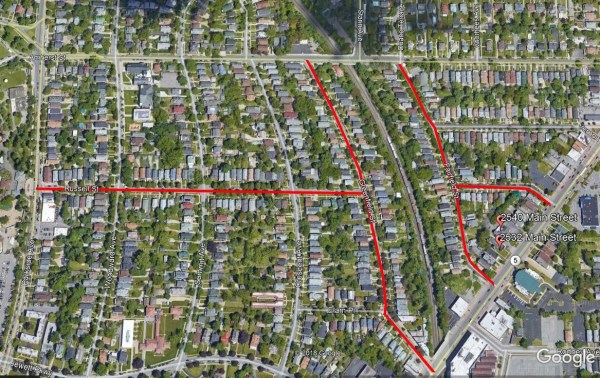
I still can’t believe I’ve been writing here on this blog for seven years! We’re a growing group of Buffalo History fans.  Thank you, thank you, thank you to every single one of you. It makes me so happy to share these stories and to hear your stories in return. I wish I could have a get together with all 6,800 of you and talk about history and Buffalo and everything else. Thank you to everyone who has read my posts or come to any of my lectures.  Please continue to share my posts with your friends, because the more the merrier.  I love writing these posts and I hope you all have gotten something from them too.   In addition to my regular streets presentations, I have a new presentation that I’ve been giving called “Which Side of the Skyway Do You Stand On?” about the history of the skyway; please contact me if you’re interested in having me give a presentation to your group.   I also have plans down the road to create a downtown walking tour to mesh together my love of history with my career as an urban planner.  So stay tuned, there’s always more to come.  We have covered close to 175 street names in the past seven years!   We’ve got a lot more yet to come!  Want to start back at the beginning?  Check out the street index to read all of the entries.  And again, from the bottom of my heart, thank you!

Sources:

  1. Ritz, Joseph. “The Good Listener: Chatty for 33 Years” The Braille Monitor. January 1970. Inkprint Edition. National Federation of the Blind, Berkeley California..
  2. “Intrepid Reporter” The Key Reporter: The Phi Beta Kappa News Magazine. Summer 1936. Published by the United Chapters.
  3. “Journalism A Career of Rewards”. Palm Beach Post. Feb 22, 1980.
  4. Camp Fire Girls of Buffalo and Erie County , “Camp Fire Girls Women of Achievement Project, Helen Katherine Smith, 1939,” Digital Collections – University at Buffalo Libraries, accessed June 1, 2018, https://ubdigit.buffalo.edu/items/show/55927.
  5. “Katherine Smith, Blind Journalist, Great Personage”. The Post, Ellicottville NY July 18, 1934.
  6. Lyon, Jean. “A Newspaper Feature Writer Takes Notes in Braille” Perkins School for the Blind Bound Clippings: Occupations, 1908-1937.
  7. Winn, Marcia. “Buffalo Woman Tells of Her Work Here”. Perkins School for the Blind Bound Clippings: Occupations, 1908-1937.

Read Full Post »

russell

Map showing the locations of Russell, Fairfield and Greenfield Streets and Orchard Place.

Russell Street is a street in the Parkside neighborhood of Buffalo.  It runs for four blocks between Parkside Avenue and Greenfield Street.   Greenfield and Fairfield Street, as well as Orchard Place, were also named because of the Russell family.  You can explore the Parkside neighborhood at the Parkside Tour of Homes on Sunday, May 20th.  The tour starts this year at the corner of Russell Street and Parkside Avenue.  The tour runs from 11 am to 4:30 pm and you can get more information and buy tickets by clicking on this link.  All money raised goes to support the Parkside Community Association and all the good work they do in the neighborhood.

Russell Street is named after Washington Adams Russell II and his family.  His name is sometimes misprinted (including by myself on my blog post about Elam Jewett) as Washington Russell III.  A Russell relative currently living in New York City, the Great Grandson of Washington Adams Russell II, corrected me and provided some of the information provided below.  There were three Washington A. Russells.  The first two were Washington Adams, the third one’s middle name was Alfred.

Washington Adams Russell, the first, was born in 1799.  He built the oldest home in the Parkside area around 1841.  Mr. Russell was born in Middletown, Pennsylvania (near Harrisburg).  The Russells were a prominent family in Middletown, and Russell Street there was likely named after Washington Russell’s father, James Russell, who had served in the Revolutionary War.  James named his son after the first two presidents – Washington and Adams (the only two presidents at that time!)  Washington Adams Russell came to Buffalo with his father-in-law, Rudolph Barr (originally Bär or Baer), a Swiss brewer.  Mr. Barr had a brewery near Ferry and Main Street.  The Barr family operated Cold Spring Tavern there from 1826 until about 1849.  Mr. Russell bought 200-acres of land in what is now Parkside and built the first brick home in the Parkside area in 1841, at 2540 Main Street.  The house still stands and is now a church.

Washington Adams Russell had eight children.  His daughter Eliza was born in 1827 and married Barton Atkins, a Great Lakes ship captain.   The son, Washington Adams Russell II, was born in 1828.  Mr. Russell the elder died in August 1876 and is buried at Forest Lawn Cemetery.

Buffalo map 1872 (1)_Page_1

Map depicting land owners. Washington Russell’s land is near the center of the photo.  His father-in-law, Henry Mochel’s land can be seen across Main Street to the northeast of the Russell Farm.    Source: 1872 Hopkins Atlas of Buffalo

Washington Russell II went to California in 1849.  He returned to Buffalo and married Mary Magdalena Mochel in 1867.  Mary Russell’s parents ran a tavern across Main Street, near what became Bennett High School.   Washington II and Mary had four children.  Their first-born son, Washington Alfred Russell (called Fred), was born in 1869. A second son, James, was born in 1877.  Daughters, Nellie and Lilian were born in 1872 and 1880 respectively.  The family lived in the Russell House on Main Street.

Washington Russell II, along with Elam Jewett and Dr. J. White, formed the Parkside Land Improvement Company in 1885.  The men began to develop and sell off the lots.   Russell Street was the cowpath the family’s cows would walk to drink from the spring in the Delaware Park Meadow.  Fairfield and Greenfield were the names of pastures on the Russell farm, near where the streets are today.  Orchard Place was the site of the family’s fruit orchard.   The streets were laid out in 1886 by the Parkside Land Company and dedicated to the city in 1889.  Olmstead had planned for Parkside to be comprised of large lots for quiet villas, the developers opted instead to decrease the size of many of the lots from 300 feet to 100-200 feet, in order to maximize profits by allowing more lots to be sold and more houses to be built.  As such, the neighborhood has Olmsted’s curving streets and building setbacks, but not the large lot sizes.  Russell Street was originally known as Russell Avenue, but at some point was changed to Street.

IMG_0133 (3)

Washington Adams Russell II strolling in front of his house (on the right of the photograph). His son’s more ornate Victorian era home at 2532 Main Street is behind him to the left of the photo. Both houses are still standing today. Photo from Robert Russell’s family collection

Washington Russell II. died in November 1904 and is buried in Forest Lawn Cemetery.

James Russell, son of Washington of Parkside Land Improvement Company, was grandfather of Robert Russell who provided information for this post.  James was sometimes considered a black sheep of the family, because he married a Catholic girl.  Her father also ran a tavern.  James and his family lived at 39 Fairfield Street, which backed into the property at 2540 Main Street where his father lived.   James’ daughter Jean was born in 1908 and was part of the first graduating class of Bennett High School in 1926.  James’ son was James Washington Russell, and James Washington Russell’s son was Robert Russell.

Nellie and Lillian lived in the old house at 2540 Main Street.  Lillian had married Merritt Cook, but they had no children.  Robert Russell notes that in her old age, Lillian was stooped and had a screechy voice, so she fit “the old lady living in an old house is a witch” trope often perpetuated by neighborhood children.

highland lodge

Historic Image of the Highland Lodge on Main Street

Washington Alfred Russell (known as Fred) attended University of Rochester and University of Buffalo Law School.  He was a lawyer and 33rd degree Mason.  The Highland Lodge #835 is at 2456 Main Street.  The building was built by Green & Wicks Architects in 1905 and was used as the community center for Central Presbyterian Church for some time.  The lodge is still standing today.  Fred lived at 2532 Main Street, adjacent to his parents, his house can be seen in the photograph above.  The house is also still standing today.  Fred died in 1944 and is buried in Forest Lawn Cemetery.


1928_Olympics_4x100m_relay

Henry Russell at the Olympics.    Source:  U&U 1928

Fred had a son named Henry Argue (called Hank).  Hank was born in 1904 and ran track at Cornell.  In the 1928 Olympics Trials, Hank placed third in the 100 meter at the finals.  in Amsterdam at the 1928 Olympics, Hank was eliminated in the semi-finals of the 100 meter, but he anchored the 4 by 100 relay, winning a gold medal and tying a world record.  He later left Buffalo to work for DuPont.  Hank died in 1986 in West Chester, Pennsylvania (near Philadelphia).

The Washington name continued thru the Russell family for another generation.  Robert Russell had an uncle, Washington Arthur Russell.  His son was named W Arthur Russell, as his mother couldn’t quite accept the Washington name.

Don’t forget to stop by the Tour of Homes on May 20th and impress all your friends with random facts about the Russell family while on the tour!  Tickets can be purchased here.  Very special thanks to Robert Russell for all of his insight and sharing of his family story.  Got a story to share about your family?  I’d love to hear them!

To learn about other streets – check out the street index here.


Sources:

  • Severance, Frank H, editor.  “Mr. Hodge’s Reminiscences”.  Buffalo Historical Society Publications.  Volume Twenty-Six.  Buffalo, New York, 1922.
  • Powell, S. R., Rushing the Growler:  A History of Brewing in Buffalo.  Apogee Design, 1996.
  • History of the Great Lakes.  Volume II.  J.H. Beers & Co, Chicago:  1899.
  • Parkside East Historic District.  National Register Nomination Form.  National Register:  90OR3175.  New York State Office of Parks, Recreation and Historic Preservation.
  • Recollections of Robert Russell.  Spring 2018.
  • Cichon, Steve.  “Parkside After the War of 1812”.  blog.buffalostories.com/parkside-after-the-war-of-1812/

Read Full Post »

gill alleyGill Alley runs between Breckenridge Street and Auburn Avenue in the Elmwood Village.  Gill Alley is one of a common type of alley that exists in Buffalo, particularly around the West Side.  These alleys give access to carriage houses and garages via the rear of the properties along the adjacent streets.  Housing ads in the early parts of the 1900s used frontage along the alleys as a selling point for homes.  Many of these carriage houses have now been converted into apartments.

Gill Alley is named in honor of Helen Gill.  Mrs. Gill was the daughter of Guy C. Martin, who came to Buffalo from Vermont via canal boat.  He lived in Griffins Mills, a hamlet in the Town of Aurora.  There, he began working at the Rumsey tanneries.  He became superintendent of the Rumsey tannery in Holland and later of their Louisiana Street tannery.  He died in 1921 at the age of 102.  Helen was born in 1845, one of nine children.

Helen married Thaddeus S. Gill, the superintendent of Bush & Howard Company, a tannery that was located at Chicago and Scott Streets.  The family lived on North Division Street, when Mr. Gill passed away in 1888 at the age of 44.  Shortly before his death, the family had been discussing building a house further out of the congested areas of the city, in the new residential sections being developed north of downtown.  Between 1880s and 1900, the Elmwood area was being developed as a streetcar suburb, allowing residential living away from the hustle and bustle of downtown.

Helen decided after Thaddeus died that she would still build the house, despite her husband’s death.  She lived in a time when a woman’s place was considered to be in the home, but the man was the master of the house.  She purchased the property herself and even sketched out the original plans of the house.  The architect in charge of the construction only made minor changes to her design.

The Gill house is located at 482 Ashland Avenue.  When the Gill’s family home was built, the area was a part of John J Albright’s cow pasture.  Wild blackberry bushes grew around the pasture, which Mrs. Gill baked into pies.

helen gill graveMrs. Gill developed a large garden in the rear of her home.  She was a member of Lafayette Avenue Presbyterian Church and a Vice President of the Crippled Children’s Guild.  She lived for nearly thirty years in the home she had built for herself.  She died in 1919 and is buried in Forest Lawn.
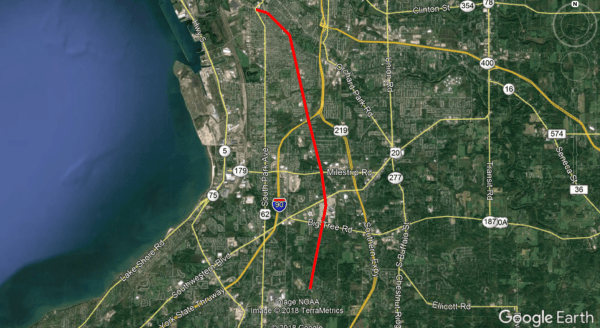
Helen’s son, Howard M. Gill, was born in the North Division Street house, and continued to live in the Ashland house after his mother died.  He attended West Side School on School Street and Masten Park High School.  He worked for the New York Central Railroad, American Car & Foundry, and Goodyear Rubber Company.  He managed his mother’s estate following her death.

To learn about other streets, check out the Street Index

Source:  Buffalo Courier-Express, June 2, 1940. p 14-W.


Read Full Post »

abbott.jpgAbbott Road is a road that starts in the City of Buffalo at an intersection of Bailey Avenue and South Park Avenue and runs to an intersection at Bayview Road/Armor Duells.  Abbott Road is about 9 miles in length and runs through not only the City of Buffalo, but also the City of Lackawanna and the Town of Orchard Park.   Abbott Road used to continue north across the Buffalo River towards the First Ward neighborhood, but that portion of the road was changed to South Park Avenue during the 1930s.
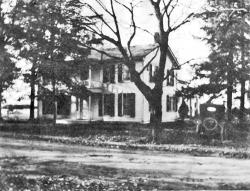
Brothers Samuel and Seth Abbott helped to build Abbott Road in 1809.  Seth Abbott lived at Abbott’s Corners and was interested in constructing a road to lead into Buffalo.  Samuel was one of the earliest settlers in Orchard Park.  The brothers helped clear the road of huge primeval trees, using their teams of oxen brought here from Vermont in 1807.  The road still follows, with only slight deviations, the same path that the brothers originally cleared.

The brothers’ ancestors came from England to Massachusetts in 1646.  Another ancestor, Timothy Abbott, was one of the first settlers of Rutland, Vermont.  From Vermont, Seth and Samuel made their way through the forest and ended in the vicinity of Orchard Park and Armour (a hamlet on the boundary between the towns of Hamburg and Orchard Park).  Armour was originally known as Abbott’s Corners after the Abbott brothers.  Abbott Road was originally known as Abbott’s Corners Road.  Often on the journey, they would have to leave their ox carts to go ahead to clear passages through the forest by hand before being able to bring the cart through the forest.

The Abbott brothers invested in large amounts of land.  Samuel was a farmer and surveyor and surveyed most of the principal early roads of Erie County.  In 1812, Samuel was first overseer of highways and fence viewer for District 10, East Hamburg.  During the war of 1812, Samuel Abbott and his wife, Sophia (Brown) Abbott were afraid that the British would continue south and burn them out.  They hid their most valuable possessions in the well next to their home.

samuel abbott house.jpg

Samuel Abbott’s house in Orchard Park circa 1915 (source:  Orchard Park Bee)

Samuel was also the second supervisor of the Town of Hamburg in 1813.  He then moved to the Town of Boston, where at the first town meeting in 1818, he was elected first supervisor of the Town of Boston.  Around 1825, he returned to East Hamburg (now Town of Orchard Park) and built a home on East Quaker Road in front of the log cabin he had built ten years prior.  After Samuel died, his son Chauncey Abbott and wife Charlotte moved from Buffalo to the Hamburg house in 1851.  The house is at the corner of Franklin Chauncey Lane and Franklin Street were named after Chauncey and Franklin Abbott, sons of Samuel.

Seth and his wife Sophia (Starkweather) Abbott lived in Amour, formerly Abbott’s Corners.  Before Seth settled in the area, it was known as Wright’s Corners.  From 1812 until about 1850, Abbott’s Corners was the business center for Hamburg, also being the location of the post office.  In 1891, an influential resident Mr.  Louis Hepp, proposed renaming Abbott’s Corners to Armour, supposedly after the Armour Meat Packing Company after a trip to Chicago.Seth opened a tavern in 1820.  The tavern went by several names and had several owners before being destroyed by fire in 1912.   A new building containing a tavern and an inn was built in it’s place.  In April 1824, a meeting of concerned citizens was held at Seth Abbott’s home.  As a result of the meeting, the first public library in Southern Erie County was established.  The library opened in 1824 with $102 in seed money, selling subscriptions to fund the project.  Little else is known about this early library in Hamburg.

seth abbott graveSeth Abbott died on June 8, 1831 and is buried in Hillcrest Cemetery in Hamburg.


samuel abbott graveSamuel Abbott died on October 2, 1846 and is buried in Deuel Cemetery in Orchard Park.


To learn about other streets, check out the Street Index.

Sources:

  1. “Abbott Brothers Helped Build Road of that Name.”  Courier Express July 10, 1938, section 6 p. 10
  2. White, Truman, ed.  Our County and Its People:  A Descriptive Work on Erie County, New York, Volume 2.  The Boston History Company:1898.
  3. Kulp, Suzanne and Joseph Bieron.  Images of America:  Orchard Park.  Acadia Publishing, Portsmith, NH:  2004.
  4. Kulp, Suzanne.  History of Orchard Park.  http://orchardparkny.org/content/history  accessed February 24, 2018.
  5. “Seder’s Armor inn, historic site of Seth Abbott’s original hotel, later become Hook’s Armor Inn”.  Hamburg Sun.  December 17, 2009.


Read Full Post »

Older Posts »

Field Notes

Live from Buffalo, NY

Grants.gov Community Blog

Connecting the grant community to #LearnGrants

Dienna Howard

I create, therefore I am.

Hidden Waters blog

Companion blog for the book "Hidden Waters of NYC"

Hoping for a Tail Wind

Because I definitely brought way too much gear.

priorhouse blog

Photos, art, and a little bit of LIT.

Sheepie Niagara

Bleating the Beat Since 2015