 Today’s post is about two streets – Ramsdell Street and Eugene Avenue. Ramsdell Street is an east-west street running between Delaware Avenue and Grove Street in North Buffalo. At the end of the street is a park, Ramsdell Park.
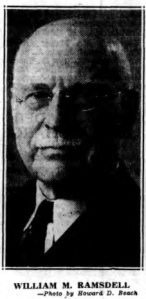
The street is named for William Mayhew Ramsdell. Mr. Ramsdell’s parents, Henry and Mary Ann came to Buffalo from New London Connecticut in the early 1850s via the Erie Canal. The family is descended from Elder Brewster of Mayflower fame. William was born in July 1864 at 49 Mariner Street. At the time, Mariner Street ran from Virginia Street into the”North Street woods”. Between Virginia Street and the Ramsdell Home, there was a large vacant lot. Mr. Ramsdell attended the old School 36 on Day’s Park and the Old Central HIgh School.
In 1879, at age 15, Mr. Ramsdell began delivering the Buffalo Express along the waterfront. Two years later, he applied for a job in the office of the newspaper. His job was a combination of office boy and printer’s devil – an assistant to the printer. He quickly advanced through the ranks, serving as collector, cashier, assistant business manager, advertising manager, business manager and in 1901, he became publisher of the Buffalo Express. He remained with the Express as publisher until the merger with the Buffalo Courier, at which time he retired.
In 1893, he founded the first newspaper travel bureau in the state outside of New York City. Mr. Ramsdell enjoyed traveling himself. He made seven trips to Europe between 1907 and 1937. In 1912, while in Europe, he met Rudyard Kipling (author of the Jungle Book). Mr. Ramsdell and Mr. Kipling corresponded for many years. mr. Rasmdell was also an acquaintance of Presidents Cleveland, McKinley, Taft, Harding, Coolidge and Hoover.
Mr. Ramsdell married Margaret Scott Adam in 1894. Margaret was the adopted daughter of Robert B. Adam of AM&As. They had one son, Robert, and three daughters: Margaret, who married Dexter P Rumsey Jr; Gay, who married John L Kimberly; and Jean, who married Luther E. Wood. The family lived for 11 years at 54 Ashland Avenue and for 31 years at 1132 Delaware Avenue (now an Amigone Funeral Home). After retirement, the Ramsdells lived in the Windsor Apartments on West Ferry Street.
Mr. Ramsdell was known for his sense of humor. When asked on forms where a space was listed for “college degree”, he’d write that he “once lived at 48 College Street.”

View from Eberhardt Mansion (large building at NW corner Delaware and Kenmore Ave)
Mr. Ramsdell was a member of the Delaware Avenue Land Company, which bought and developed a tract of land from Delaware Avenue to Military Road, north of the Beltline Railroad. They purchased the land in the 1890s. At the time, Mr. Ramsdell stated “that property seemed so far from the center of town that we owners were considered very optimistic in our expectation that homes and factories would be built there”. The land company ended up struggling to develop the land and sold it for barely more than what they had paid for it. The land company dissolved in 1898, the same year the electric street car first extended to Kenmore, with the Village of Kenmore incorporating in 1899. If they had held on a little longer, they may have been able to make more money from the land.
In the early days of Kenmore, they referred to this section of North Buffalo as “South Kenmore”. There was a two room school house built on Ramsdell Avenue that accommodated 40 students. The school was also used by the Baptist Congregation of Kenmore. The school later suffered a fire and remodeled as a home, still standing at 29 Ramsdell Avenue.

Mr. Ramsdell was a life member of the Wanakah Country Club, the Buffalo Academy of Fine Arts, the Buffalo Public Library and the Fort Niagara Association. He attended Westminster Presbyterian Church. Mr. Ramsdell died in 1948 and is buried in Forest Lawn.
 Eugene Avenue is a north-south street running from Washington Avenue in Kenmore to a dead end near Delaware Consumer’s Square (Target Plaza). One of Ramsdell’s partners in the Delaware Avenue Land Company was Eugene Fluery. Eugene Street is named after him. Mr. Fleury was a former music critic and cirulation manager at the Buffalo Express, working with Mr. Ramsdell there. Mr. Fleury was born and educated in New York City. He was associated with newspapers of Cleveland and other cities before coming to Buffalo. He worked for the Express for 17 years. He lived on Linden Avenue and died on December 8, 1903.
If you’d like to learn about additional streets, check out the Street Index. Be sure to subscribe to the blog so that new posts are sent directly to you. You can do so on the right hand side of the homepage. You can also like the page on facebook at facebook.com/buffalostreets .
Sources:
- “Descendant of Elder Brewster has a Street Bearing His Name”. Buffalo Courier-Express. July 7, 1940. 4L.
- “W.M. Ramsdell, 83, is Dead; Ex-Carrier Rose to Publisher”. Buffalo Evening News. Jan 2, 1948,33.
- “Land Company Dissolution”. Buffalo Evening News. October 21, 1898.
- “Eugene Street Carries Given Name of Express Music Critic”. Buffalo Courier Express. February 2, 1941. 2, sec 6.
- Parkhurst, Frederick. History of Kenmore, Erie County, New York. Village of Kenmore, New York, 1926.
- Percy, John and Graham Miller. Images of America: Kenmore, New York. Arcadia Publishing. Charleston South Carolina, 1998.
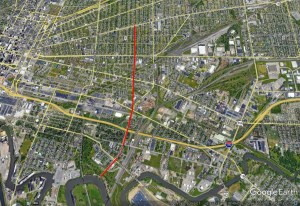


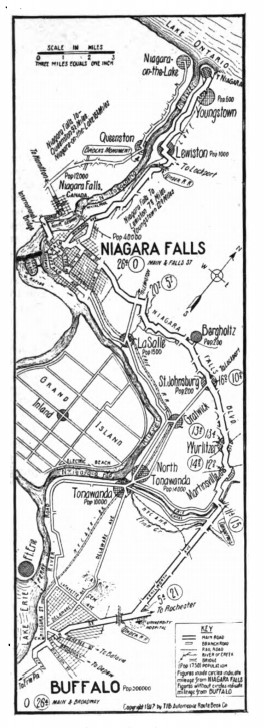




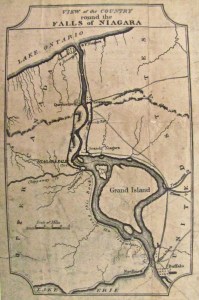
 The large fort planned for Black Rock was never built, but a smaller one was built in 1807 and became Fort Tompkins in August 1812. Fort Tompkins was also known as Fort Adams. The fort was actually large mounds which were mounting points for seven guns. It was technically a battery, which is a cluster of cannons in action as a group put into position during a battle of a fort or city. Fort Tompkins was the largest of eight batteries that were built during the war. It was located at the top of the bluff at the bend in Niagara Street. The escarpment here allowed them to overlook the river, giving advantages over the attacks from the water. The location was later the sight of railway barns. A plaque was hung on the railway barn and still hangs on the building located at 1010 Niagara Street. The more famous Fort Tompkins was located on Staten Island and was built in 1663. They were both likely named for Governor Daniel Tompkins, Governor of New York from 1807 to 1817. Fun fact for if you’re ever on Jeopardy: Daniel Tompkins was later President Monroe’s Vice President and the only VP in the 19th century to serve two full terms.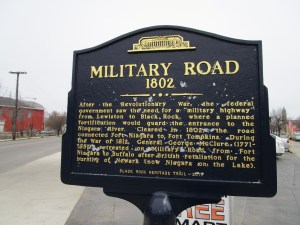

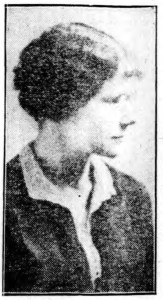 Helen Katherine Smith was born in Wilkes-Barre, Pennsylvania. She went professionally by H. Katherine Smith and was known as Kate to her friends. Miss Smith’s paternal grandfather was director and general manager of the original Gas Company in Wilkes-Barre and her maternal grandfather was a founder and director of the Wilkes-Barre Deposit and Savings Bank. The family noted that Miss Smith got her business sense and drive from her grandfathers and that if she ever got tired of writing, she’d have made a wonderful business executive. Miss Smith’s first writing was to write rhymes for greeting cards, which she would sell with her father’s help as a young girl, for 25 cents a card.
 In an interview after her retirement, Miss Smith said her favorite food was Italian eggplant (eggplant parmesan). She enjoyed cooking, but she didn’t like to bread the eggplant, because it’s too much work. A newspaper in Florida published her recipe for Italian eggplant, and I intend to add it to my repertoire. As those who know me know, eggplant parm is my favorite meal and a staple of my diet. I often will buy three eggplant at the farmer’s market and spend the afternoon breading them all at once and freeze the slices, because I also hate breading it too! I like to think Miss Smith and I would have been good friends. I can’t wait to sit around and chat with her in the great hereafter….imagine the two of us as a tag-team of interviewers! We’d be able to write-up some interesting stories for sure.
 Gill Alley runs between Breckenridge Street and Auburn Avenue in the Elmwood Village. Gill Alley is one of a common type of alley that exists in Buffalo, particularly around the West Side. These alleys give access to carriage houses and garages via the rear of the properties along the adjacent streets. Housing ads in the early parts of the 1900s used frontage along the alleys as a selling point for homes. Many of these carriage houses have now been converted into apartments.
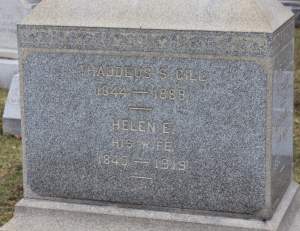 Mrs. Gill developed a large garden in the rear of her home. She was a member of Lafayette Avenue Presbyterian Church and a Vice President of the Crippled Children’s Guild. She lived for nearly thirty years in the home she had built for herself. She died in 1919 and is buried in Forest Lawn.
 Abbott Road is a road that starts in the City of Buffalo at an intersection of Bailey Avenue and South Park Avenue and runs to an intersection at Bayview Road/Armor Duells. Abbott Road is about 9 miles in length and runs through not only the City of Buffalo, but also the City of Lackawanna and the Town of Orchard Park. Abbott Road used to continue north across the Buffalo River towards the First Ward neighborhood, but that portion of the road was changed to
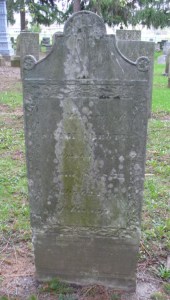 Seth Abbott died on June 8, 1831 and is buried in Hillcrest Cemetery in Hamburg.
 Samuel Abbott died on October 2, 1846 and is buried in Deuel Cemetery in Orchard Park.
 Kimmel Avenue is a short street, running two blocks between Abbott Road and Cazenovia Creek in South Buffalo. The street is named after Christian Kimmel, an inventor.
 Mr. Kimmel owned much of the real estate on the street that now bears his name. In addition to real estate and politics, he enjoyed working in his yard and garden and was proud of his horses, which he’d drive around town on their carriage.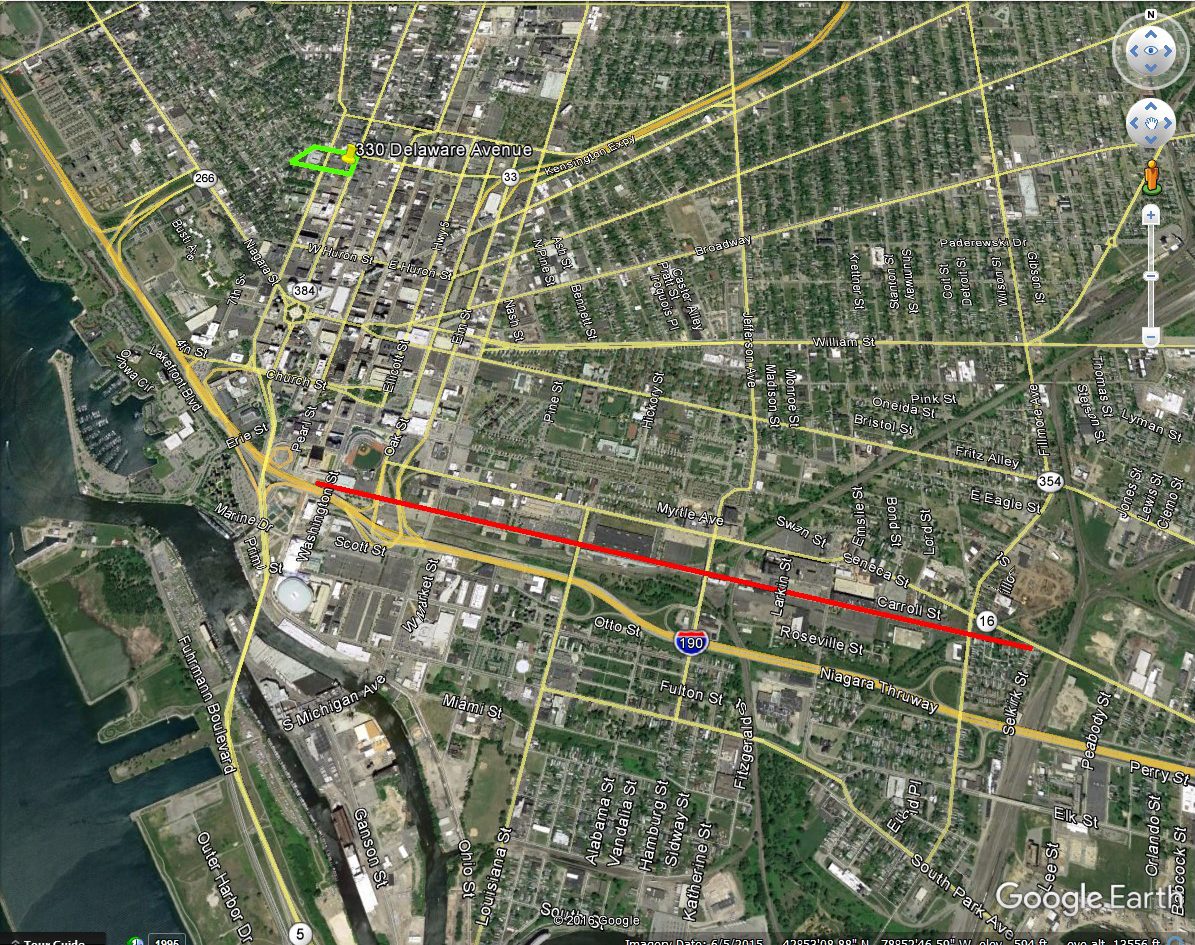





 Discovering Buffalo, One Street at a Time