Feeds:
Posts
Comments

Posts Tagged ‘Buffalo’

Lafayette Avenue runs approximately 2 miles from west to east across the center of Buffalo, from Main Street to Niagara Street.  Lafayette Avenue crosses both Gates Circle and Colonial Circle.  The street was originally named Bouck Avenue.   There was a Governor of New York, William Bouck, but don’t quote me on it being named after him.  Before he was Governor, Bouck was involved in the building of the Erie Canal; his job was to bring the money to the workers in the western portion of the state.

Lafayette Square, located at Main Street between Broadway and Clinton, was originally laid out by Joseph Ellicott in 1804.  Lafayette Square was known in those days as Courthouse Square.  The Courthouse was located where the Buffalo and Erie County Public Library is currently located.

(more…)

Read Full Post »

In the Broadway/Fillmore neighborhood, there are three streets running between Broadway and Genesee Streets:  Guilford Street, Reed Street and Wilson Street.

All three of these streets are named for Guilford Reed Wilson.  Mr. Wilson was a pioneer coal dealer and an early member of the Buffalo Board of Trade.  He was born in Burlington NJ in 1813 and was educated in Philadelphia.  He was associated with lumber interests in Corning in his 20s.  He came to Buffalo at the age of 25 and embarked in the iron and coal business.  He was also director of several local banks and a member of the Board of Trade.  He was also one of the earliest members of the Buffalo Club.

Mr. Wilson acquired extensive real estate and owned and developed the tract of land through which Guilford, Reed and Wilson Streets were cut.  He owned the land along with other prominent Buffalonians – the Rich and Townsend Families.  He was married to Jane Townsend, daughter of Charles Townsend (a judge and prominent Buffalonian himself).  After their marriage, Wilson and his wife lived in Judge Townsend’s mansion at Main and Tupper Streets.  Mr. Wilson remained in Buffalo until his death in 1877.

Sources:

  1. “Three Streets Honor Pioneer Coal Dealer”Courier Express Dec 25, 1938, sec. 7 p 8.
  2. Memorial and Family History of Erie County.  The Genealogical Publishing Company:  Buffalo, NY 1906.

Read Full Post »

This post is at the request of John Fell.  Don’t forget, if you have any requests for specific streets- leave them in the comments or send me an email at buffalostreets (at) gmail (dot) com!

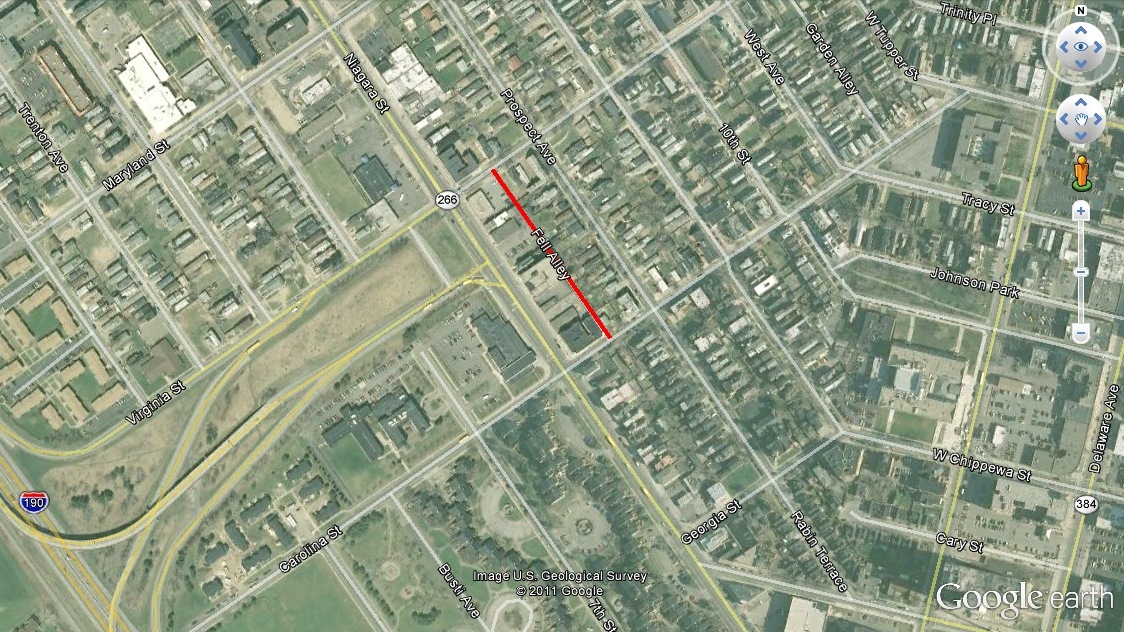
Fell Alley is a small,  two block alley running between Niagara Street and Prospect Avenue, from Carolina to Virginia Street.

Fell Alley was named for Dr. George Edward Fell.  Dr. Fell was the inventor of the Fell motor, a submarine life-preserver, and co-inventor of the electric chair.  The Fell motor is a device used for mechanical respiration and was used until the invention of the pulmotor in 1911.   The first Fell motor was invented in 1887, and used bellows, piping and a breathing valve to resuscitate unconscious patients.  At the time, the restoration of respiration was believed to be impossible, however Dr. Fell made it possible and saved many lives.    The submarine life-preserver not only kept you afloat,  it also provided an air supply to allow easier breathing should you go overboard.

Dr. Fell was a professor of  microscopy in the medical department of Niagara University (which is now the UB Medical School).    George Fell also worked as a surgeon.   While he was opposed to capital punishment, his work on the creation of the electric chair was intended to minimize the pain of the death penalty.

While he attended medical school in the evenings, George Fell also had worked as a City Engineer from 1882-1883.  He worked on the installation of one of the break walls from the harbor along the south shore of Lake Erie to the South Buffalo Lighthouse.  When George Fell completed medical school, his brother Charles took his place in the Engineering Department and completed the break wall.    Charles Fell is responsible for many of the plans for the City’s sewer lines, although many of them were not built until after his death.

George Fell was also considered to be a great humanitarian.   Dr. Fell’s home and office was at 72 Niagara Street.  He had four daughters and a son.  He moved to Chicago in 1917 and died in 1918.

Sources:

  1. Essig, Mark.  Edison and the Electric Chair: A Story of Light and Death.  Walker and Company:  USA, 2003.
  2. “Fell Alley memorial to Physician – Inventor” Courier Express May 19, 1940 sec 5, p7.
  3. Fell, George.  “A New Method of Saving Life at Sea:  The Fell Submarine Life Preserver”.  Buffalo medical journal, Volume 71.  August 1915
  4. Fell, George.  “The Influence of Electricity on Protoplasm.”  Physician and Surgeon 10.  October 1890,p 441-442.

Read Full Post »

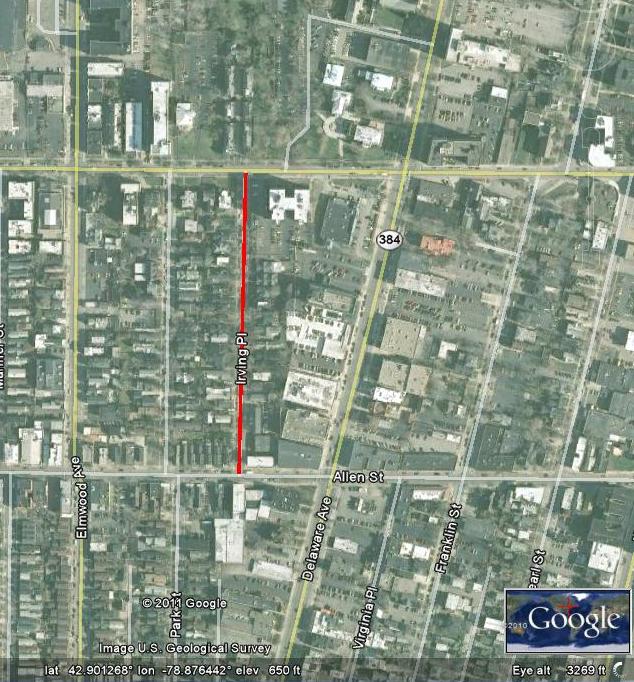
Irving Place is a short street running for about 1/4th of a mile in Allentown between North Street and Allen Street.

The road was originally called Bowery Street, named after the trees that once bowered overhead.  The residents became uncomfortable with the name Bowery.  At this time, Manhattan’s Bowery section was becoming an area of brothels, low-brow theaters and slums.   The residents of Bowery Street in Buffalo didn’t want to be associated with such things.   So, in 1874, Bowery Street became Irving Place – named for author Washington Irving.   Residents of the street voted to choose the name of the street, so perhaps they were fans of Ichabod Crane and the Headless Horseman?  Interestingly, during the revitalization of The Bowery in Manhattan, there was a movement to change the name of the street there as well.  The name stuck in Manhattan, but went away in Buffalo.

Fun fact about Irving Place:  F. Scott Fitzgerald, author of The Great Gatsby, lived at 29 Irving Place as a boy.  His father was an employee at Proctor & Gamble.

Sources:

“Business Changes Along the Bowery:  Attractive Retail Shops have Taken the Place of Old Time Saloons”,  New York Times, December 21, 1921.

Allentown Association.  http://www.allentown.org/Streets/Irving/

Read Full Post »

Finally, a new entry!  Thanks for holding tight while I dealt with my unexpected move and got all my stuff in order.

Today, instead of talking about a specific street I want to talk about my new apartment.  Interestingly enough, the history of one street will actually come into play as well.  I lived on Franklin Street prior to this move.  This move brought me further downtown, so far downtown that I actually live within the boundaries of the Joseph Ellicott 1804 Plan of Buffalo.  Being the history buff, I am, I couldn’t resist doing some historical research of the plot of land I now call home.

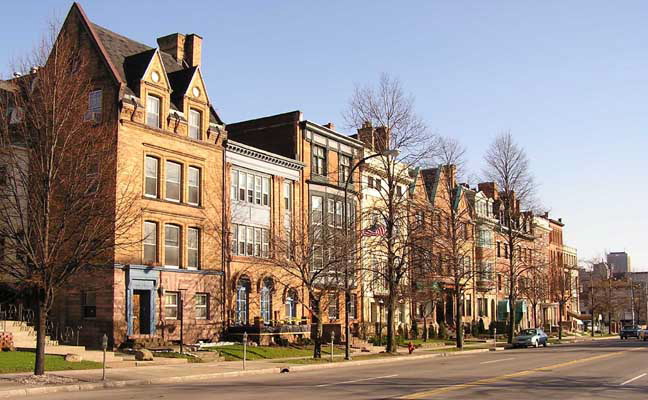
Delaware Ave Row Houses...possibly what my block looked like in 1890

I’m amazed at how much history exists in my little plot of land that’s not even a quarter of an acre.  My building was built in 1932.  It’s currently a restaurant with four apartments above it.  Historically, in the 1890s, there were row houses on the property, and likely houses before that.

(more…)

Read Full Post »

Sorry for the last of posts this week (and probably next week).   I’m in the process of moving; once I get settled, I’ll get back into my Tuesdays-Saturdays posting routine.

Let’s have an interactive entry.  The Skyway was named such because the City of Buffalo had a contest to name it.  There was a cash prize, as well as the bragging rights to say that  you named the road that one day Infrastructurist would call one of the top seven highways to tear down.

So, if you had the power to rename any street (including the skyway) in Buffalo, what would it be and why?  Would you name a street after yourself?  After Justin Beiber?  Let me know in the comments…I want to hear your ideas!

Read Full Post »

Putnam Street runs about 0.3 miles on the West Side of Buffalo, west of Richmond Avenue, between Lafayette Avenue and West Ferry Street.    The street was named for James O Putnam.

James Osborne Putnam was  a friend of Lincoln before he became president and worked on Lincoln’s election campaigns.  He was also appointed by President Garfield to represent the US as minister to Belguim.

Putnam’s relatives arrived in Salem, Massachusetts in the early 1600s.  James was related to the Revolutionary War general, Israel Putnam.  The Putnam family arrived in Western New York in 1817 and built a log cabin.  James O. Putnam was born a year later.  James studied law at Yale and came back to Buffalo to practice.  While waiting on clients, he spent his time writing a book of essays and biographical sketches of Buffalonians.  His book can be found  here.

The Putnams lived on Swan Street, but later moved into a brick house at 756 Washington Street (The Putnam House was used as a kindergarten and nursery school for years after his death).  James O Putnam owned a farm that covered most of the land west of Richmond Avenue including Putnam Street.  He bought the land as an investment, and subdivided it into building lots and sold them.   The trees on the east side of Richmond Ave from Colonial Circle to Breckinridge were planted by James O Putnam.  He was a perfectionist, and inspected the trees year after year.  The weakling trees would be uprooted and replaced throughout the years.   At the age of 80, Mr. Putnam was selected to present the flags to the Buffalo soldiers and sailors leaving for the Spanish American War.    He also served as Chancellor of the University of Buffalo.  He is buried in Forest Lawn Cemetery.

Source:  “Named for James O Putnam”.  Courier Express Aug 28, 1938, Located in ECBPL Buffalo Streets Scrapbook, Vol 2.

Read Full Post »

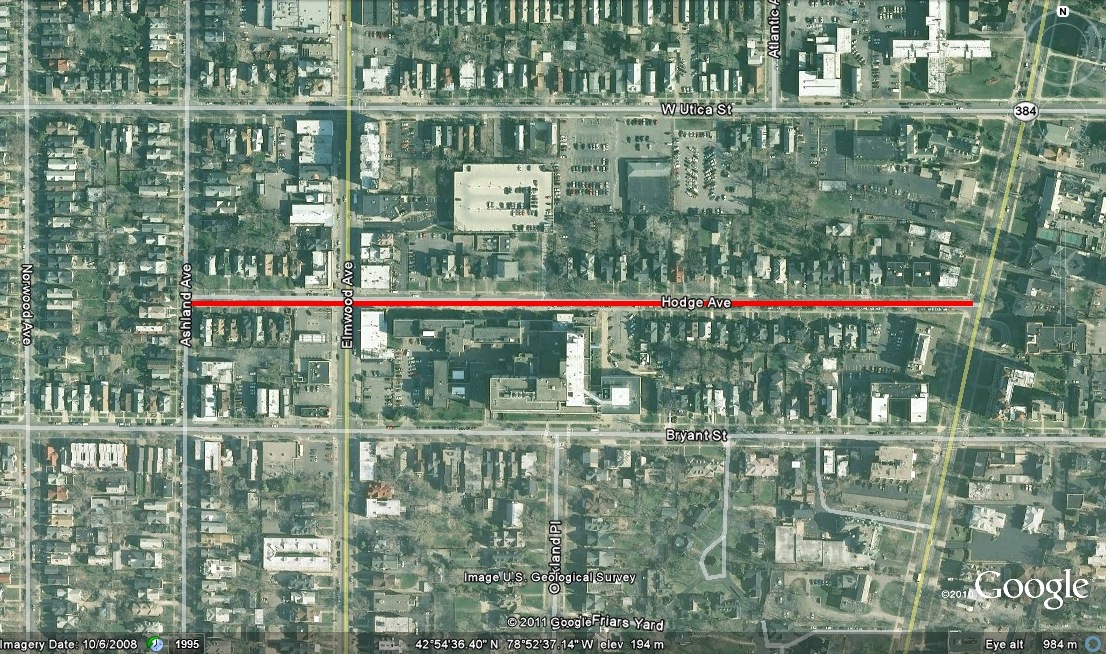
Hodge Avenue runs approximately a half-mile between Delaware Avenue and Ashland Avenue.  Like many of the streets in the Elmwood Village, Hodge Street is lined with beautiful homes and large stately trees.  It’s hard to imagine the City of Buffalo without it’s street trees.  Although, the trees might not even be there if it wasn’t for the Hodge family….

(more…)

Read Full Post »

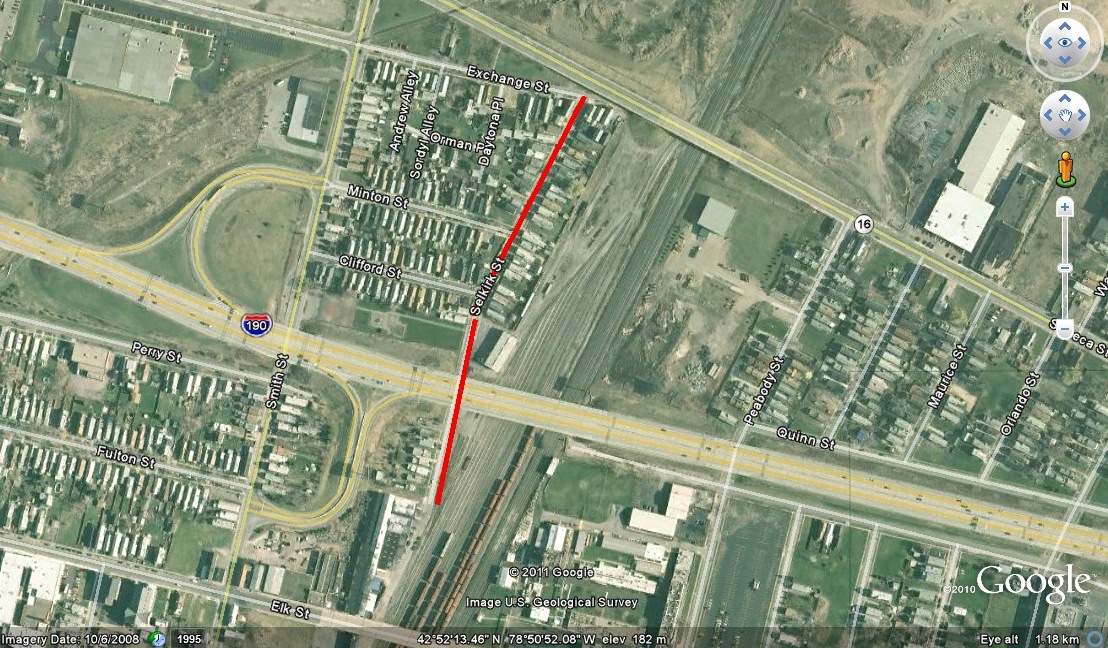
Selkirk Street is a street running approximately 1/4th of a mile south of Exchange Street, near the railroad corridor.   The land around Selkirk Street was originally owned by Henry Box.  Box was a lawyer in Buffalo, and when his land was subdivided for development, he decided to name one of the streets after his brother-in-law, John Harley Selkirk, an architect.

Erie County Savings Bank

John Henry Selkirk was born in Connecticut in 1808.   He studied architecture and moved to Buffalo in the early 1830s.  When he arrived, the Village of Buffalo had not been fully restored after the burning by the British during the War of 1812.  Therefore, it was a good time to be an architect.   Many of his buildings were built in the Romanesque Revival style, which is most famously represented in Buffalo by the Richardson Complex near Buffalo State College (designed by Henry Hobson Richardson).

Delaware Asbury Church in the 1950s

Selkirk designed and built the Asbury Delaware Methodist Church (aka Ani DiFranco’s Church) at Delaware and Tupper, the Calvary Presbyterian Church on Delaware and Tracy Street (demolished), old Central Presbyterian Church at Pearl and Genesee (at the time the largest protestant church in town).  In addition to the churches, he designed the Buffalo Gas Works Building (now the facade of the Health Now Building on Church Street), Western Savings Bank and the Erie County Saving Bank.  He also built many homesteads including the Rumsey Homestead at Delaware and Tracy, the Rich home at Main near Dodge, and the Sheldon Thompson mansion at Niagara Street and Porter Avenue.   He also built twin houses on Niagara Street between Huron and Georgia Streets for himself and his son.  At the time, that portion of Niagara Street was one of Buffalo’s better neighborhoods.

John Henry Selkirk died in 1879.  The only remaining buildings designed by him are the Church at Delware & Tupper and the facade of the Gas Works on Chruch Street.

Buffalo Gas Works

Source:  “Named for John Selkirk”.  Courier Express Aug 21, 1939, sec 5 p2.

Read Full Post »

Numbered Streets in Buffalo

One thing many people don’t understand is Buffalo’s numbered streets.  Sure, we don’t have a perfect numbered grid like New York City, but our radial street pattern and unique street names are important to the City of Buffalo’s identity.  (Also, it gives me a reason to blog).

While Buffalo does have some numbered streets, the numbered streets  seem not to make any sense at all.  They are scattered throughout the west side of Buffalo in a seemingly random fashion.  We have the following numbered streets:

  • 4th
  • 7th
  • 10th
  • 14th
  • 15th
  • 16th
  • 17th
  • 18th
  • 19th

Why do they start with number 4?  Why do they skip numbers?  Why don’t they make any sense?

(more…)

Read Full Post »

« Newer Posts - Older Posts »

Field Notes

Live from Buffalo, NY

Grants.gov Community Blog

Connecting the grant community to #LearnGrants

Dienna Howard

I create, therefore I am.

Hidden Waters blog

Companion blog for the book "Hidden Waters of NYC"

Hoping for a Tail Wind

Because I definitely brought way too much gear.

priorhouse blog

Photos, art, and a little bit of LIT.

Sheepie Niagara

Bleating the Beat Since 2015