 Emerson Place is a small one-block street that runs between Michigan Avenue and Masten Avenue in the Masten Park neighborhood on the East Side. The Street is named for Henry P. Emerson, superintendent of the Buffalo Public Schools. The Emerson neighborhood and Emerson School of Hospitality are also named after Henry Emerson. In Addition to the Emerson School on Chippewa, the Buffalo schools are about to start classes in a new location on West Huron, where the former CW Miller Livery was converted into classroom space and a new gymnasium was built on a parking lot. The new school will be The Buffalo School of Culinary Arts and Hospitality Management, formerly known as Emerson Annex. The school expansion project was one of Mark Croce’s projects. Mark passed away earlier this month. He was a friend of this blog and I always enjoyed talking with him about the history of his buildings. Since there’s no Croce Street, I write this post in memory of Mark, as well as in celebration of the new space for the students!

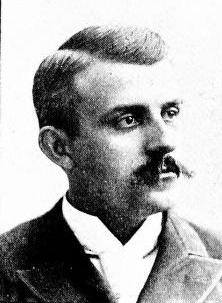
Henry Pendexter Emerson was born in Lynn Field, Massachusetts in 1847. He was the son of Oliver and Eliza (Weston) Emerson and is a relative of Ralph Waldo Emerson. He attended Phillips Andover Academy. in Massachusetts. He received his A.B. Degree in 1871 and A.M. in 1874. He was a member of Phi Beta Kappa. After graduation, he started teaching Greek and Latin at Potsdam Normal School.
Mr. Emerson came to Buffalo in 1874 to teach at Old Central (located on Niagara Square). After nine years, he became principal of the school. While he was principal, he obtained $60,000 in appropriations to enlarge the school. This was a very large appropriation at the time.
At the time, the superintendent of schools was a political office. Dr. Emerson ran for it in 1892 on the Republican ticket. He was elected for six successive four-year terms. After the office ceased to be an elected office, he was appointed to continue as superintendent by Mayor Louis Fuhrman. In 1919, Dr. Emerson retired.
Dr. Emerson married Mary Estey of Middleton, Massachusetts in 1874. They lived on Allen Street at the site of what is now the Allendale Theatre (Theatre of Youth) and later at 122 College Street in Buffalo. The family returned to Middleton every summer and kept a home there on a lake. After retirement, they moved to Middleton full time. They returned to Buffalo every winter for more than a decade to reunite with his fellow teachers and friends.
While Dr. Emerson was superintendent, he was considered an education reformer. He often said, “Better schools make a Better Buffalo”. Buffalo’s rapid growth had caused school problems at the time. The population had more than doubled between 1870 and 1900 (from 117,714 to 255,000 people). Schools were crowded and the quickest growing immigrant populations lived in areas where there were often no schools. In 1900, almost 3/4ths of the school population was foreign-born or the children of foreign-born. City services – such as garbage pickup, water supply, sewer, trolley service, etc had difficulty keeping up with the growth, and schools were no exception. Classrooms at the time could be jammed with as many as 100 students assigned to a single teacher. The schools were poorly ventilated and poorly lit, with inadequate seating. Students learned by rote, reciting text together, and passed each grade with a written test, if they passed at all. In 1890, 76% of children were in 1st and 2nd grade. There was no school board, school policy was set by the City Council. As superintendent, Dr. Emerson appointed and supervised the 700 teachers. Many of the teachers at the time were poorly educated young women from politically connected families. An October 1892 article in Forum, described the school system of Buffalo as an example of how not to run a public school system.
Dr. Emerson introduced free textbooks for public schools, the first local kindergartens and the first evening classes. He also introduced the first courses in home economics and industrial arts, from which Buffalo’s vocational schools developed. While he was superintendent, four public high schools were built – Lafayette, Masten, South Park and Technical. The Masten High School building is now City Honors. Technical High School was located at Cedar Street and Clinton Avenue (now school administration offices and storage). Technical High School merged with Hutchinson and Central High Schools and is now Hutchinson Central Technical High School (typically called Hutch Tech these days). Lafayette High School and South Park High School are also both still in operation, though Lafayette is now Lafayette International High School.
Dr. Emerson provided free medical and dental exams for students, as well as special classes for the physically and mentally handicapped. He also introduced non-academic subjects such as music and art. Dr. Emerson also founded the first local teacher training school. He published two books while he was here – a Latin textbook, “Latin in High Schools” in 1891 and an English grammar textbook “A Course in English For Schools” in 1905. The books were widely used in schools across the country for many years.
Dr. Emerson was president of three educators’ organizations – the Council of School Superintendents of New York State, the State Teachers’ Association, and the National Education Association. He was loyal to his students and encouraged them to finish high school and if possible, college. At the time, it was typical for many students to go into the world of work after they completed 5th or 8th grade, as opposed to completing high school. For many, it was more important for the students to earn money to help the families than to go on to higher education. In 1915, the number of students who reached 9th grade was five times more than in the 1890s. Class sizes were smaller and teachers had better training.

The Former Emerson Vocational School on Sycamore Street (now Harvey Austin School)
In addition to the street, Emerson Vocational High School is named after Dr. Emerson. The school had originally opened as Peckham Boys Vocational School in 1911, at the corner of Peckham and Townsend Streets. Peckham Vocational School was the first vocational school in Buffalo to have its own facilities. The school focused on upholstery, tailoring, cabinetmaking, machine shop, welding, drafting, painting, baking and culinary arts. The school was located at the corner of Sycamore Street and Koons Avenue from 1926 to 2002. It was named in Dr. Emerson’s honor in 1937. Emerson school became co-ed in 1975. In 2002, Emerson school moved to Chippewa Street and became Emerson School of Hospitality. The school at Sycamore and Koons was remodeled and became Harvey Austin Elementary School. Emerson School operates Emerson Commons, also on Chippewa, a cafeteria-style restaurant operated by students.

The former CW Miller Livery before renovations into classroom space for Emerson School (Source: Buffalo Business First)
In addition to the Emerson School of Hospitality on Chippewa, Buffalo’s schools will be expanding its footprint very soon. The Buffalo School of Culinary Arts and Hospitality Management will be in the renovated former CW Miller Livery on Huron. Construction of an adjacent gymnasium building is being completed in what was a parking lot. Students are expected to move in next week (January 2020). The CW Miller Livery has had a fascinating history of its own – it was built as a “palace for horses” and was considered to be one of the finest stables in the United States. It uses a unique construction as the floors were suspended from steel trusses at the top of the building. It provided stalls for approximately 250 horses when it was built. C.W. Miller was a businessman who had made his fortune providing horse transportation to Buffalonians. After WWI, the livery was converted to a parking garage for cars. The building was vacant for several decades before being renovated into the expansion of the school by a development team and the Buffalo Public Schools.
Dr. Emerson also donated Emerson Lodge to Camp Rotary, a camp near his home in Massachusetts that allowed poor boys an opportunity to enjoy outdoor life. While Camp Rotary still exists, I was unable to determine if the lodge is still standing.
While at college, Henry met Frank Fosdick, who became a lifelong friend. They promised to name their children after each other. Frank Fosdick served as principal of Masten High School from 1914 until 1926. Masten High School was renamed Fosdick-Masten High School in Frank Fosdick’s honor in 1927. Dr. Emerson had no children himself, but Mr. Fosdick kept his promise and named his first son Henry Emerson Fosdick. Henry Emerson Fosdick was a prominent pastor, serving at First Presbyterian Church in the West Village, Manhattan and the historic, inter-denominational Riverside Church in Morningside Heights, Manhattan. He was featured in a Time Magazine cover store on October 6, 1930.
Dr. Emerson died in 1930. He is buried in Oakdale Cemetery in Middleton, Massachusetts.
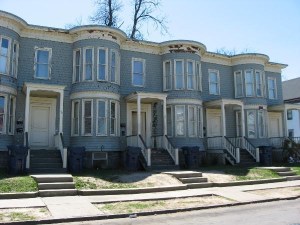
Emerson Row Houses
Emerson Place is also known for its rowhouses. It’s one of the only remaining sets of rowhouses left in Buffalo (it was never a common housing style here). The rowhouses on Emerson were built in 1893 by Benjamine B. Rice. Benjamin Rice was a real estate developer who developed several streets in the Masten Park neighborhood. The Emerson rowhouses consist of two seven-unit row houses. They became a City of Buffalo Local Landmark in 1981 and are listed on the National Register of Historic Places.
So the next time you grab lunch at Emerson Commons or are driving through Masten Park, think of Dr. Emerson and his attempts to reform our schools.
To learn about more streets, check out the Street Index. Be sure to subscribe to the blog so that new posts are sent directly to you – you can do so on the right hand side of the home page. You can also like my blog page on facebook at facebook.com/buffalostreets.
Sources:
- Smith, Katherine H. “Emerson Place Memorial to Long-Time School Head”. Buffalo Courier Express. November 16, 1941, sec6 p3.
- “Emerson High School Students Take Part in Funeral Services”. Buffalo Courier Express. April 23, 1937. p12.
- Motter, HL, editor. International Who’s Who: Who’s Who in the World: A biographical dictionary of the world’s notable living men and women. William G. Hewitt Press, Brooklyn NY, 1912.
- Seller, Maxine. “The Education of Immigrant Children in Buffalo”, April 1976. Found in Institutional Life: Family, Schools, Race and Religion. Shumsky, Neil Larry, editor. . Garland Publishing, Inc, New York. 1996.
- LaChiusa, Chuck. “C.W. Miller Livery Stable” Buffalo as an Architectural Museum. https://buffaloah.com/a/whur/75/75.html (online January 2020)
- Buffalo City Directories
- Emerson Place Row. Building Structure Inventory Form. Accessed from NYS Office of Parks and Recreation via cris.parks.ny.gob (online January 2020)
 Today’s post is about two streets – Ramsdell Street and Eugene Avenue. Ramsdell Street is an east-west street running between Delaware Avenue and Grove Street in North Buffalo. At the end of the street is a park, Ramsdell Park.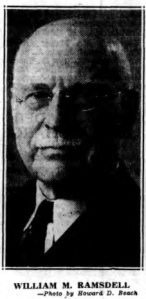


 Eugene Avenue is a north-south street running from Washington Avenue in Kenmore to a dead end near Delaware Consumer’s Square (Target Plaza). One of Ramsdell’s partners in the Delaware Avenue Land Company was Eugene Fluery. Eugene Street is named after him. Mr. Fleury was a former music critic and cirulation manager at the Buffalo Express, working with Mr. Ramsdell there. Mr. Fleury was born and educated in New York City. He was associated with newspapers of Cleveland and other cities before coming to Buffalo. He worked for the Express for 17 years. He lived on Linden Avenue and died on December 8, 1903.
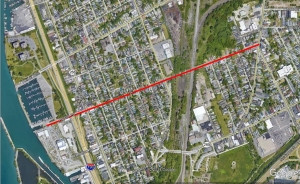 Austin Street is a street in the Black Rock neighborhood of Buffalo, running between the Niagara River and Military Road. The road is about one mile long because the land it originally ran through was the State Reservation, which was a one mile strip of land from the river inland. When the Village of Black Rock was incorporated in 1813, Austin Street was the northern boundary of the Village. The part of Black Rock north of the Scajaquada was often referred to as “Lower Black Rock”, as opposed to Upper Black Rock which
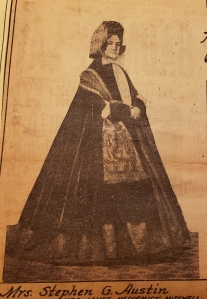
 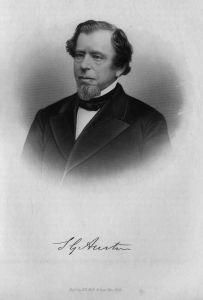 Stephen Goodwin Austin was born in West Suffield, Connecticut to Joseph Austin, a farmer, and Sarah Goodwin, a sea captain’s daughter, in October 1791. He studied at the academy in Westfield, Massachusetts. In 1811, he began his studies at Yale College and graduated with honor in 1815.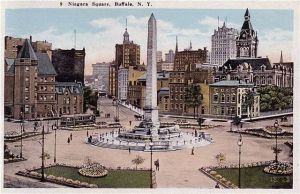
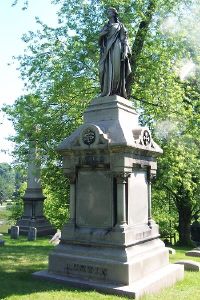
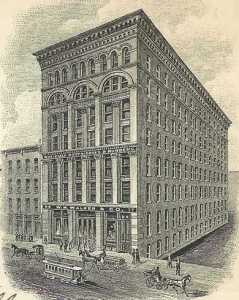
 Goodell Street is an east-west street that runs Michigan Avenue to Main Street. Goodell Street forms the northern boundary of the Central Business District and typically “south of Goodell” is used as a definition for what constitutes “Downtown Buffalo”. North of Goodell Street is the Medical Campus and the Fruit Belt neighborhood. Until the 1950s, Goodell Street ran thru to an intersection with Cherry and Locust Streets. The Kensington Expressway, which ends at Goodell Street, cut through the Fruit Belt. I am currently working on a multipart series about the streets of the Fruit Belt and the historic development of the neighborhood. Stay tuned! Goodell Street is named for Jabez Goodell, one of the early residents of Buffalo.

 Mr. Goodell died in September 1851 at 75 years old. In death, he donated 10 acres and $10,000 (about $333,000 in 2019 dollars) to the newly formed Buffalo Female Academy to build a 30,0000 square foot school. Ten months after he died, Goodell Hall opened at the school, just behind the Evergreen Cottage at the corner of Johnson Park and Delaware. Classes had been held in Evergreen Cottage (
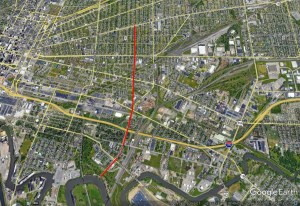


 Chandler Street runs between Military Road and what used to be NY Central Railroad tracks. Historically, this area was home to factories and industrial buildings. The street’s access to the rails made it a prime place for these types of businesses. The buildings along the street were home to the Jewett Refrigerator Company, the Double Truss Cornice Brake Company, the Acme Steel and Malleable Iron Works, Barcalo Manufacturing, Buffalo Weaving & Belting Company, Linde Air Products, Loblaw Groceteria, and others.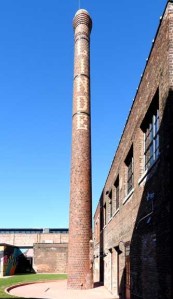

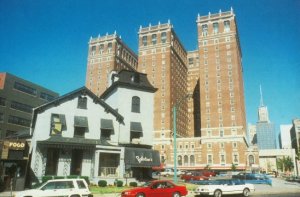
 Henry Chandler owned sorrel horses which he rode along Delaware Avenue. Mr. Chandler also donated money to First Baptist Church, Buffalo Historical Society, the Young Men’s Association (which became the Buffalo Public Library). He was also a member of the Buffalo Museum of Science, the Beaver Island Club and the Buffalo Field Club. He was an accomplished poet, and his poetry was published in several magazines. He died December 21, 1896. He is buried in Forest Lawn.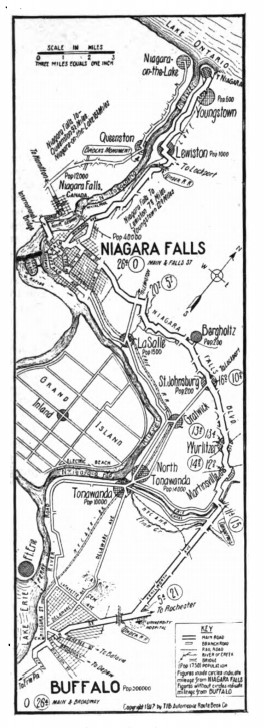




 Tillinghast street is named after James Tillinghast, a railroad executive. Mr. Tillinghast’s father, Gideon, built one of New York State’s first cotton mills. James was born in Cooperstown in 1822. He learned about mill machinery while growing up around his father’s mills, gaining practical knowledge as a mechanic without the typical process of being an apprentice. He decided he wanted to learn a different business as well. At age 15, he began working as a clerk at a country store. By the time he was 20, he was part owner of the Cotton Manufacturing Company’s store in Brownsville. He became interested in transportation from selling to Great Lakes vessels. He got involved in the lake trade, and operated a machine shop and foundry in Little Falls, New York with his father. In 1850, he gave the business to his father to enter the railroad business.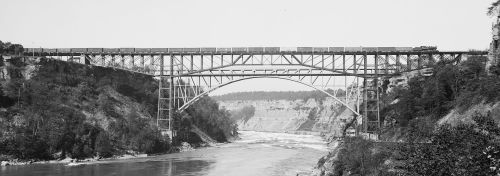
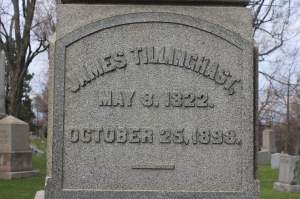 Mr. Tillinghast mostly retired around age 70, but he was still involved with the New York Central & Hudson River Railroad. He died at age 77 in 1898 and is buried in Forest Lawn. One of Mr. Tillinghast’s life rules was “to try and do his whole duty to whatever interests were placed in his charge, and he has never yet asked that his compensation be made any particular sum; invariably leaving that to the person tendering him a position”. People must have seen value in him and compensated him well enough. When he passed away, his estate was valued at more than $1.5 Million (about $42 Million in current dollars).
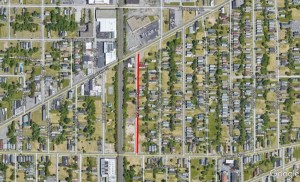 Wasmuth Avenue runs between Genesee Street and Walden Avenue near Martin Luther King Jr Park on the East Side of Buffalo. The street is named after one of the first female developers in Buffalo, Caroline Wasmuth. Ms. Wasmuth was one of Buffalo’s pioneer business women.
 Ms. Wasmuth was married twice and had four sons and five daughters: Frank, George, Maggie, Lillian, Anna, Caroline, John, Fredrick, and Charles. The family lived on Michigan Street (now Ave) near Carlton Street, on what is now the Buffalo Niagara Medical Campus. She was also one of the investors in the Pan American Exposition, having bought a subscription in 1899. She died in 1904 at the age of 75. She is buried in Forest Lawn Cemetery.
 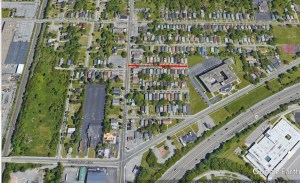 Van Gorder Street is a short street located off of Fillmore Avenue in the Fillmore-Leroy neighborhood of Buffalo. The street runs one block east of Fillmore Ave where it dead-ends at Burgard High School (PS #301).
 The street is named after Greenleaf S. Van Gorder, a politician and banker.
 Discovering Buffalo, One Street at a Time