Feeds:
Posts
Comments

ripleyRipley Place is a short, one-block street on the west side of Buffalo, running between Vermont and Connecticut Streets, near Richmond Avenue.

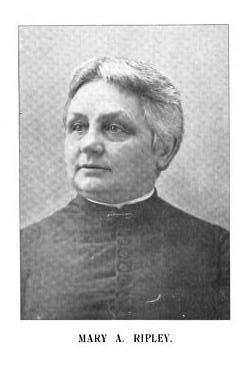
Mary A. Ripley was a teacher at Central High School from the 1860s through the 1880s.  She was born in Windham, Connecticut in 1831, but grew up in Alden, New York and attended local schools.  She was known around town as one of the few woman who dared in the 1880s to wear her hair short.

mary ripleyMiss Ripley taught for seven years at School 7.  In 1861, she became a member of the faculty at Central High School.  She was determined to make over the school.  At the time, the teachers often had to call in the police to stop the students’ riots.  Miss Ripley asked for the job of taking care of the boys’ study hall, which was where many of the riots originated.  The male teachers doubted she’d be able to handle the boys, but Miss Ripley kept order with little difficulty.  She would tell people her goal was to develop young people’s conduct and character.

In 1867, Miss Ripley published a volume of poems.  She also wrote a textbook of Parsing Lessons for small school room use and a book titled Household Service.  Many considered Miss Ripley a talented poet and writer; however, her heart was truly dedicated towards her students.  She made long lasting impacts on her students.

Several of her poems were featured in magazines.  The following comes from the Magazine of Poetry and Literary Review, Volume 6:

ripley poem

When the State Normal School opened in Albany, Miss Ripley was summoned there to become one of its first teachers.  She went to Albany to teach for a few years, but missed her old school so she returned to Buffalo.  She taught at Central until 1888.

Miss Ripley received many honors in her years teaching.  During the Civil War, at a Washington’s Birthday celebration, she was seated with former President Millard Fillmore.  In 1886, for her 25th anniversary of teaching at Central, she was given a gold watch and roses.  For her retirement, she was given a diamond ring from “Miss Ripley’s Boys and Girls”.  They formed the Mary A. Ripley Association, which met for several years.  Miss Ripley passed away in 1893.

Mary Ripley Library in the Union Hall.  Source:  WNY Heritage

Mary Ripley Library in the Union Hall. Source: WNY Heritage

The Mary A. Ripley Memorial Library was established in the Women’s Educational and Industrial Union building.  Miss Ripley was a member of the Board of Directors of the Union.  The Ripley Memorial Library was furnished at a cost of $2,000 and contained 500 volumes when it first opened.  The Ripley Memorial Library was established with the Public Libraries division of the University of the State of New York.  The library was widely used as a place to read and study.

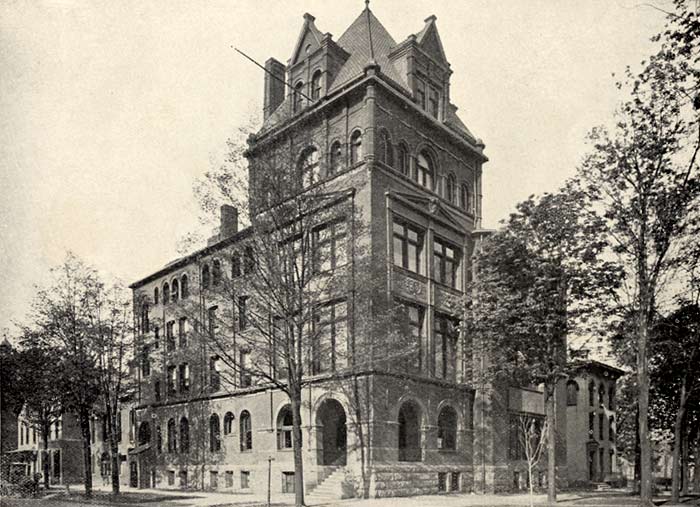
The Women’s Educational and Industrial Union was established in 1884 by Harriet Townsend.  We’ll get to more about the Townsend men and Townsend Street on another day, but it’s women’s history month, so we’ll talk about her today!  Mrs. Townsend was made the CEO of the organization due to her intelligence, vision and management skills.  She had no children, which allowed her to work full time for the advancement of women, advocating for women’s rights all of her life.  The Union building was located on Delaware Ave at Niagara Square (site of the City Court Building) in the former Babcock house, which was later demolished to build a larger building.  During the dedication ceremony of the new building, Miss Ripley recited a poem she had written.

Membership into the Union was $1. Union reports stated “We no longer listen to the selfish moralist who cries ‘Let the woman stay in her home, her only safe haven'”, and that “it is not, an association of benevolent, well-to-do women, joined for the purpose of reaching down to help the poor and persecuted women, but a Union of all classes and conditions of women”.  The concept was unique at the time.

Union Building on Niagara Square c. 1890.  Source:  WNY Heritage

Union Building on Niagara Square c. 1890. Source: WNY Heritage

The Union building contained the first gymnasium for women in Buffalo, kitchen space for instruction in nutrition and cooking, and provided classes on various topics not provided in public schools.  The Union gave scholarships to women to attend Bryant and Stratton and trained women for low wage jobs, such as cooks, domestics, and seamstresses.   The Union taught members how to navigate the bureaucracy of government.  The Union lobbied to establish equal guardianship rights for women in case of divorce.  The Union successfully got a women appointed to the School Board and fought for rights for all women.

The Union dissolved in 1915, finding that its work was finished – most of its groundbreaking programs had been adopted by educational, governmental and civic organizations.  These Women’s Union began programs we take for granted today such as vocational education, physical education, night school, free kindergartens, probation officers, Legal Aid, etc.  The building then became Townsend Hall, part of the University at Buffalo and was the college’s first College of Arts and Sciences, named after Harriet Townsend.  The building was razed in 1959 after it was destroyed by fire.  The Townsend Hall name was transferred to a building on South Campus.

Learn about other streets in the Street Index.

Sources:

  1. “Ripley Place is Memorial To Beloved Central High Teacher” Courier Express Oct 5, 1941, sec 5 p 3
  2. “Streets Have Historical Link” Buffalo Courier Express. Dec 7 1952 p 7-8
  3. The Women’s Educational and Industrial Union of Buffalo.  Compiled by Mrs. Frederick J. Shepard.
  4. “Harriet A. Townsend:  The Women’s Union.”  Susan Eck.  Western New York Heritage Press.
  5. The Magazine of Poetry, A Monthly Review.  Charles Wells Moulton.  Buffalo NY 1894.

griderGrider Street is located on the East Side of Buffalo, running north-south between Leroy Street and East Delavan Avenue.  The street is one of the main thoroughfares through the Delavan-Grider neighborhood. The Erie County Medical Center (ECMC) is located on Grider Street.

Daniel Grider (also spelled Greider) was born in Pennsylvania in 1787.  He came to Buffalo in a covered wagon drawn by oxen in the early 1820s.

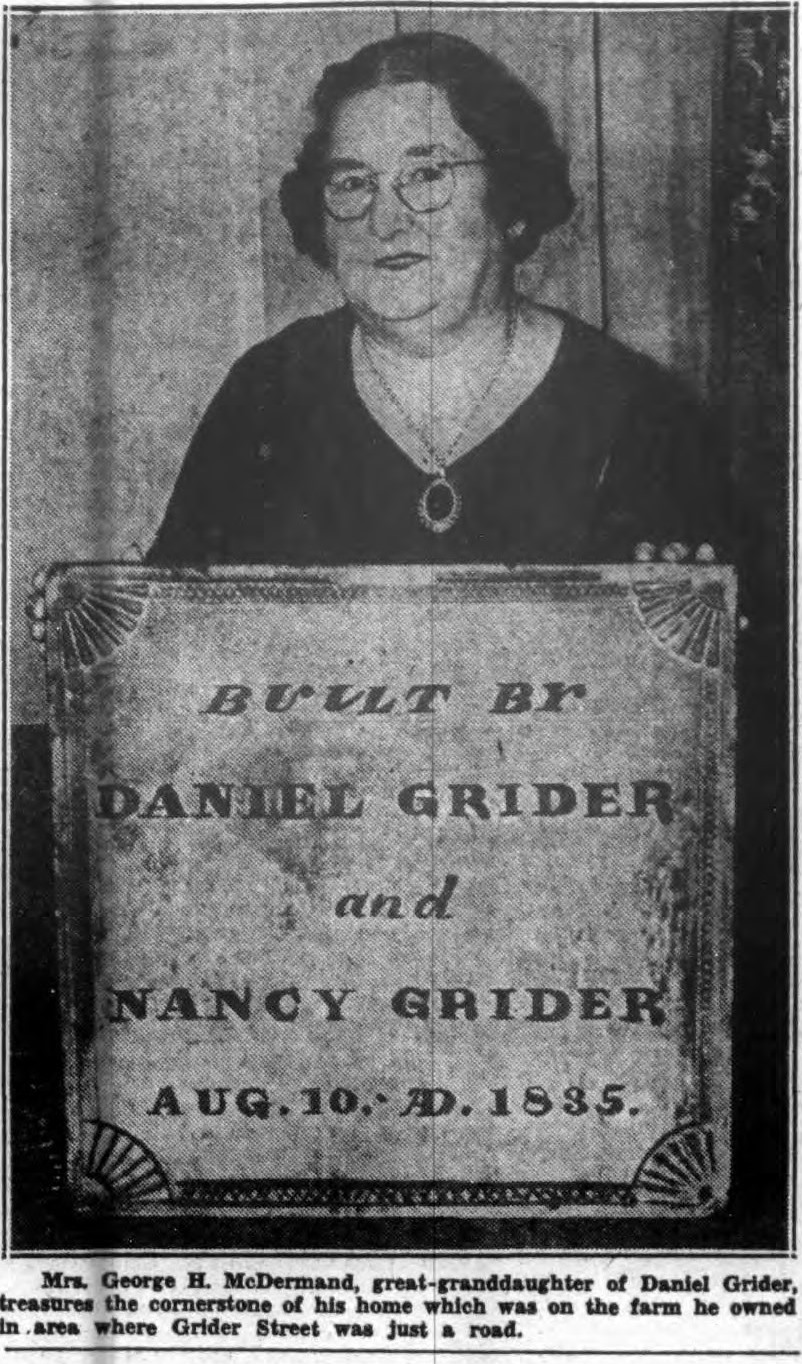
Daniel Grider's great-granddaughter.  Courier-Express, February 4, 1940

Daniel Grider’s great-granddaughter with the family cornerstone. Courier-Express, February 4, 1940

Daniel Grider bought a 48-acre farm for 50 cents an acre.  He built a frame house opposite the site of the Buffalo City Hospital (now ECMC).   Mr. Grider’s family spoke German in his youth.  One way that Daniel would save money was to hire newly arrived German immigrants to work on his farm in Buffalo, giving them food and board and teaching them English.  By 1835, he had prospered and built a larger, more substantial house in its place.

Mr. Grider and his wife Nancy, had two daughters, Fanny and Nancy.  He was well respected in Buffalo, but never ran for public office.  Mr. Grider served as a representative from Erie County for the Canal Convention regarding upgrades to the Erie Canal in 1837.

The Grider farm was subdivided when the Erie and Lackawanna railroads passed through Buffalo.  At that time, the farm was cut into building lots and streets were laid out.

Mr. Grider passed way on March 25, 1855.  The family operated a burial plot on the Grider farm.  When the property was sold, the family members’ graves were moved to Mount Hope Cemetery at Pine Ridge.

Learn about other streets by checking out the Street Index.

Source:  “Grider street Recalls Name of Land Owner”  Courier Express Feb 4 1940 Sec 5 p 4

aldrichAldrich Place is a short street in South Buffalo between South Park Avenue and McKinley Parkway near the Buffalo-Lackawanna border.  The street is named after a man who was one of the first settlers in that part of South Buffalo.

Alexander Aldrich came to Buffalo from England as a young man with his wife, Lucinda.  In 1855, Mr. Aldrich purchased a 50-acre farm that included the land that is now Aldrich Place.  His farm stretched from the present day South Park Avenue to McKinley Parkway, south to the railroad lines and north to Downing Street.  His farm mainly raised celery, black walnuts and flowers.  At the time, this section of South Buffalo was famous for its celery.  He built a greenhouse for the flowers on the South Park Avenue side of his property, selling to people on their way to Holy Cross Cemetery.

In those days, the Aldrich farm was located in a sparsely populated neighborhood.  Lucinda would tell stories of days when Native Americans would peer in the window.  They were curious about the light coming out of the windows and wanted to watch what a white family did at night.

During the Civil War, Alexander and Lucinda traveled to Washington, DC.  While there, Alexander had his photo taken with President Lincoln on the steps of the White House.  If any members of the Aldrich family are reading this, I’d love to see the photo if it still exists!!

Alexander and Lucinda had three sons – Henry, Wallace, and Albert – and a daughter, Sally, who became Mrs. Ace Reed.  Henry was a taxidermist.  Albert was in charge of most of the excavating and grading for the South Park Botanical Gardens.  To do this work, ten teams of horses were used; Albert hired his neighbors to assist in the work.

Alexander Aldrich's Grave

Alexander Aldrich’s Grave

Mr. Aldrich later sold his farm to the Pixley Land Company for development in 1903.  The Aldrich family house was moved to Downing Street and converted into apartments.

Alexander Aldrich died in 1897 and is buried in Woodlawn Cemetery in Orchard Park.

Alexander’s grandson, Robert Reed, was the first mayor of Lackawanna.

Check out the street index to learn about other streets!


Source:

Memorial to Farmer-florist.  Courier Express Se. 1, 1940, sec 6 p3

walden aveWalden Avenue is an east-west thoroughfare that begins at the intersection of Genesee and Best Streets on the East Side of Buffalo and runs eastward to Alden.  In Alden, Walden Ave meets back up with Genesee Street and turns into NY Route 33.  Outside of the City of Buffalo limits, Walden Avenue is designated as New York State Route 952Q.  The route is the longest non-parkway reference route in New York State.  The road is named after Ebenezer Walden.

walden_ebEbenezer Walden was born in Massachusetts in 1777.  He graduated from Williams College in 1799.  He then studied law and while he became well-known in the law community in Massachusetts, he decided to make his start in a young community that he could help develop.  He came to Buffalo in 1806.  Part of his trip included a 40-mile walk through the woods from Batavia.

Mr. Walden was the first lawyer in Buffalo. There weren’t enough people in the Village at the time to sustain a full-time lawyer.  Mr. Walden set up a law office in a hut on Willink Street (now Main Street) between Crow (now Exchange) and Seneca.  He filled his days serving as a clerk in stores and doing other odd jobs to maintain his livelihood.  He invested in what became known as the Walden Farm near what is now Walden and Fillmore.

In 1812, Mr. Walden married Suzanna Marvin.  The same year, he was elected to represent the area that now contains Erie, Niagara, Chautauqua and Cattaraugus Counties in the State Legislature.

Mr. Walden was committed to building up Buffalo and Western New York, and was considered by his neighbors to be kind and brave.  During the Burning of Buffalo, he was captured with Mr. Cyrenius Chapin.  When his captors left him for a moment, he escaped and ran back into town to help those left behind in the rubble.

Judge Walden's house to rear of picture

Judge Walden’s house at Main and West Eagle to rear of picture

Following the Burning of Buffalo,  Mr. Walden practiced law in Williamsville while the village was rebuilding. Mrs. Walden served as a leader in women’s war work.  After peace was restored, Mr. Walden was a member of the committee to appraise losses during the war.  The Waldens returned to Buffalo and built a brick home at the northeast corner of Main and West Eagle Streets.

In 1823, when Erie County was established, Mr. Walden served as the first county judge.  He served as a judge for five years.  When the Village of Buffalo was incorporated, he was one of the four trustees.  In 1828, he was a Presidential Elector for John Quincy Adams.   In 1838, he was elected Mayor of Buffalo as a member of the Whig party.

The Waldens House at Main and Edward

The Waldens House at Main and Edward

As Buffalo grew, the Waldens moved further up Main Street, near Edward.  Their property extended to Franklin Street and contained lawns, orchards and gardens.  Judge Walden purchased many other properties in the Buffalo region.  One of his properties was a large farm at Walden and Fillmore Avenues.  While the Waldens never lived on the farm, it was known as the Walden Farm, so when the road was laid out in 1873, it was named Walden Avenue.

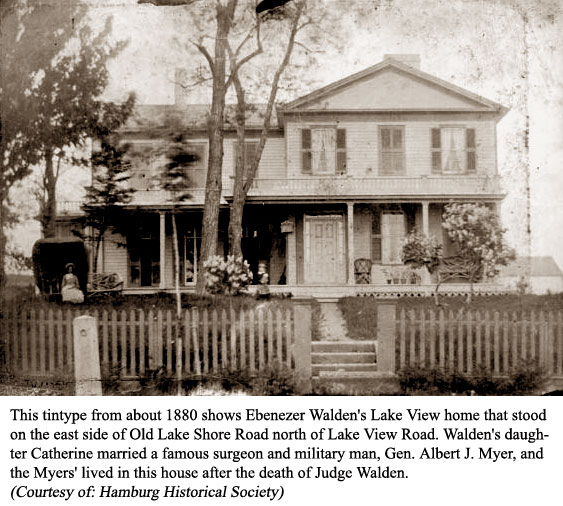
The Waldens Home Lake View

The Waldens Home Lake View

After retirement, Judge Walden lived on a 272-acre farm in what is now Lake View, which he purchased in 1837.  He built a mansion which he named Lake View, which became the name of the hamlet that eventually developed nearby.  Much of the present hamlet of Lake View was part of this farm.  In 1853, Judge Walden deeded a strip of land across his farm to the Buffalo and State Line Railroad.   Judge Walden died in 1857 at 80 years old.  His integrity, benevolence, profound culture and unselfish patriotism were remembered in Buffalo long after his death.  He is buried in Forest Lawn Cemetery.

Walden-Myer Mausoleum

Walden-Myer Mausoleum

The Lake View Hotel - still stands at 1957 Lake View Road

The Lake View Hotel

Judge Walden’s son James became the first postmaster of Lake View in 1868.  Judge Walden’s daughter Catherine built the Lake View Hotel in 1880 to serve the traveling salesmen who would come to Lake View on the daily trains to sell their wares.   The Lake View Hotel building still stands today at 1957 Lake View Road.

 Check out the Street Index to learn about other streets.

Sources:

  1. “Two Streets Perpetuate Names of Early Jurists”Courier Express Nov 2, 1941 sec 6 p 3
  2.  Picture Book of Earlier Buffalo.  Buffalo Historical Society, Buffalo, New York:  1912.

fillmoreFillmore Avenue runs north-south through the East Side of the City of Buffalo, between Seneca Street in the south to Main Street in the north.  The street is named after President Millard Fillmore, the 13th President of the United States.

Millard Fillmore was born in Locke, Cayuga County, New York on January 7th, 1800.  His parents, Nathaniel Fillmore and Phoebe Millard were among the pioneer settlers of the so-called Military Tract.  Nathaniel was a farmer and built a log cabin for his family.  Millard worked on his father’s farm and attended local schools until he was 15 years old.
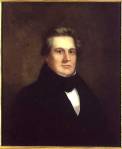
Millard Fillmore portrait from the National Portrait Gallery

Millard Fillmore portrait from the National Portrait Gallery

In 1815, Millard served as an apprentice in a carder and cloth-dressers business in Newhope, New York (carding is the process of preparing wool for use as textile).  While working for the shop, he began to self educate himself, reading everything he could get his hands on.  When Millard was 18, he taught school for the Town Of Scott for a term.  He decided that he wanted to study law, and entered into the law-office of Judge Walter Wood at Martville.  In 1821, he arrived in Aurora to teach a winter school in East Aurora.  In 1822, he came to Buffalo and taught at a district school while also studying law under Asa Rice and Joseph Clary.  While in Buffalo, one of his students was  Alvan Dodge.

In Spring 1823, Mr. Fillmore was admitted to practice in the Court of Common Please, and opened his office in East Aurora.   The Fillmore house in East Aurora is now the Millard Fillmore Museum.  In 1827, he was admitted as an attorney of the Supreme Court and became counselor in 1829.  In 1830, he moved to Buffalo to form a law partnership with Joseph Clary.

Fillmore House on Franklin Street

Fillmore House on Franklin Street

He lived at 180 Franklin Street in Buffalo (near Franklin and Huron…the house has been demolished).  He practiced law until 1848, when his duties as a politician forced him to give up his private practice.  The firm he was a part of still practices in Buffalo today as Hodgson Russ, LLP, one of Buffalo’s oldest law firms.

Mr. Fillmore was elected to the New York State Assembly in 1828.  He served in the Assembly until 1832, when he was elected to Congress.  He served in Congress until 1842, when he declined renomination.  In 1847, he was elected New York State Comptroller, and in 1848, he was elected Vice President of the United States.  When President Taylor died in July 1850, Millard Fillmore became President of the United States.

President Fillmore came into his presidency at a critical period of national affairs.  He took great pains to complete his presidential duties with what has been described as unswerving conscientiousness, purity and patriotism.  In 1856, Fillmore was nominated for the Presidency by the National American Convention, but he did not win the election.

Millard Fillmore House on Niagara Square

Millard Fillmore House on Niagara Square

President Fillmore retired from public life after his presidency.  He passed his days at home in Buffalo advancing scholarly activities.  After his presidency, he and his new wife, Carolyn decided that the Franklin Street house was not fit for a former president.  He purchased a large mansion on Niagara Square in 1858.  His house was located where the Statler Hotel is today.

Millard Fillmore contributed significantly to Buffalo’s growth and development.  He helped to frame the charter that established the Village of Buffalo into the City of Buffalo.  He was one of the founders of the University at Buffalo in 1846, and served as the school’s first Chancellor, a position he served until his death.   While Fillmore was a Unitarian and is often criticized for being “anti-catholic”, he contributed substantial money to the construction of St. Joseph’s Cathedral.   During his time in Congress, he secured funding to enlarge the Buffalo Harbor and to expand the Erie Canal.  He helped to found the Buffalo Historical Society (now the Buffalo History Museum) in 1862 and served as its first president.  He served as Chairman of the Buffalo Committee of Public Defense and helped incorporate the Buffalo Fine Arts Academy (now the Albright Knox Art Gallery).   He spearheaded a campaign to raise money for Buffalo’s Society of Natural Sciences (now the Buffalo Museum of Science).  In 1867, he helped to found the Buffalo Club, the city’s first exclusive social club, and served as its first president.  He contributed financially to the construction of the Buffalo General Hospital, which opened in 1858.  In 1870, he served as President of the Buffalo General Hospital.  From 1870 until 1874, he served as a trustee of the Grosvenor Library, one of the predecessors of the Buffalo Public Library and one of the nation’s most comprehensive reference libraries.  He founded the Society for the Prevention of Cruelty to Animals (SPCA) and served as its vice president.

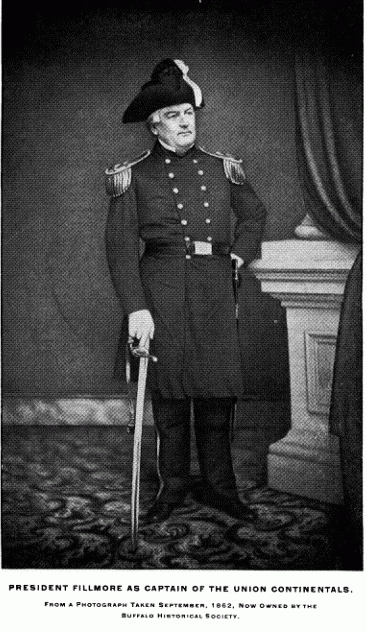
Millard Fillmore as Captain of the Union Continentals

Millard Fillmore as Captain of the Union Continentals

During the Civil War, Fillmore denounced secession and supported the Union War efforts.  He commanded the Union Continentals, a corps of men over the age of 45 from Upstate New York.  The Continentals trained to defend Buffalo in the event of a Confederate attack.  The corps performed military drill and ceremonial functions at parades, funerals and events.  The Union Continentals guarded Lincoln’s funeral train when it came through Buffalo, and continued operations following the war.  Fillmore remained involved with them until his death.

Millard Fillmore died on March 8, 1874.  He is buried in Forest Lawn Cemetery.  Since 1937, a celebration to honor Fillmore’s legacy in Buffalo occurs every year at the Fillmore grave on his birthday.   His home in East Aurora is a National Historic Landmark and operates as the Millard Fillmore House Museum.
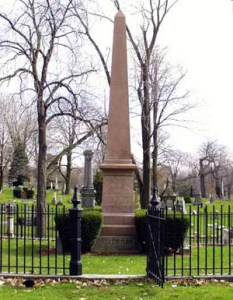
Fillmore Grave Plot

Fillmore Grave Plot

When Frederick Law Olmsted designed Buffalo’s park and parkway system for Buffalo, Fillmore Avenue was extended to Abbott Road and upgraded south of Best Street as a parkway.  In Olmsted’s plans, the Avenues (such as Fillmore) were designed with a single drive lane with a double row of trees on either side.   The thoroughfare was linked by Abbott Road (now South Park Avenue) to Heacock Park, an existing park in South Buffalo.  Heacock Park forms the start of the South Buffalo park system.  The difficulties in creating a parkway connection were complicated by the Buffalo River and numerous railroads.  Buffalo City Engineers argued that if there was an at grade railroad-crossing, the road could not be considered a parkway.  Alternatives included a bridge which would have carried Fillmore Avenue over the railroads and the Buffalo River into South Buffalo.  The design of Fillmore Avenue was never fully realized and Fillmore Avenue was opened to commercial traffic in 1906.

To read about other streets, check out the Street Index.

Sources:

  1. Hillman, Jordan.  “Millard Fillmore:  Buffalo’s Good Samaritan”.  National Portrait Gallery.   May 5, 2011.
  2. Smith, Lester, editor.  Guide to the Microfilm Edition of the Millard Fillmore Papers.  Buffalo and Erie County Historical Society.  1974.
  3.  White, Truman, Editor.  Our County and Its People:  A Descriptive Work.  The Boston History Company.  1898.
  4. Buffalo Park Commission.  The Projected Park and Parkways on the South Side of Buffalo. 1888.
Lovejoy Street

Lovejoy Street

Lovejoy is a street, a neighborhood and a council district on the East Side of Buffalo.  The street used to run to Fillmore Avenue but when the railroads near the Central Terminal cut Lovejoy Street in half, the portion in the Polish neighborhood was renamed Paderewski.

Sarah Johnson was born October 21, 1771.  Sarah married Joshua Lovejoy.  The Lovejoys came to Buffalo in 1807 or 1808 from Avon on the Genesee River.

Etching of the Burning of Buffalo

Etching of the Burning of Buffalo

Sarah Lovejoy was the only woman killed in the defense of Buffalo when it was burned by the British in 1813.   When the British came, most of the men went to Black Rock to defend against the attack.  Sarah remained with her 12-year-old son, Henry.  On December 30th, 1813, she sent Henry into the woods as the British Native Americans arrived in Buffalo.  She was afraid they would take him prisoner but felt that they would not harm her since she was a woman.  Henry is said to have grabbed his musket and went towards Black Rock, rather than hiding as his mother asked him.

As the Native Americans went ransacked her house, she fought hard to save her treasured belongings.  The house was located at 465 Main Street, across from the St. John House.  The St. John family tried to convince Sarah to come to their house, but she chose to stand her ground and defend her home.  It is said that she stated “When my property goes, my life shall go with it.”  As she tried to pull a shawl out of the intruders hands, she was stabbed with a tomahawk. Her body was dragged into the yard.

When the troops left, her body was carried into the house and placed on her bed by the St. Johns and Ebenezer Walden.  The British returned the next day to finish their pillaging of Buffalo, and her house was burned with her body in it.  There is a cenotaph in Forest Lawn Cemetery to honor Sarah and also a memorial in Mumford Rural Cemetery near her parents.

Sarah Lovejoy memorial in Mumford Cemetery

Sarah Lovejoy memorial in Mumford Cemetery

Henry Lovejoy

Henry Lovejoy

Joshua Lovejoy married Sarah Grey Ferriss, a war widow who’s husband had died while bringing supplies to Erie during Commodore Perry’s victory on Lake Erie.  Joshua Lovejoy died in 1824 at age 53.  Sarah and Joshua’s son, Henry Lovejoy became a well-known surveyor in Buffalo.  Henry laid out the streets and ran lot lines in most of the older parts of Buffalo.  Henry died in 1872 and is buried in Forest Lawn Cemetery in the Lovejoy family plot.

Lovejoy family plot in Forest Lawn Cemetery

Lovejoy family plot in Forest Lawn Cemetery

Check out the Street Index to learn about other streets.

Sources:

  1. Ketchum, William.  An Authentic and Comprehensive History of Buffalo.  Rockwell, Baker & Hill, Printers:  Buffalo, NY.  1865.
  2. Smith, Henry Perry.  History of the City of Buffalo and Erie County.  D. Mason & Co, Publishers.  Syracuse, NY:  1884.
Richmond Avenue

Richmond Avenue

Richmond Avenue runs north-south through the West Side of Buffalo, running between Forest Avenue and North Street.  The road was originally known as Rogers Road and served as a trail from Buffalo to what was known as a Shingletown area in the north.  Even when the City reached to North Street, Shingletown was still mainly open fields used for grazing animals and raising vegetables.  The most prominent building on the street was a tavern located on a terrace within a fruit orchard at the corner of Rodgers (now Richmond) and Utica Avenues.  The tavern allowed travelers heading between Buffalo and Black Rock a place to rest.  Residential development of the area increased in the 1880s and by 1900 the area resembled its current appearance.  The street was named in 1879 in honor of Jewett Richmond, who was involved in the salt and grain industries.

jewett richmondJewett Richmond was born in Syracuse in 1831.  He entered the salt business at a young age and began shipping salt to Buffalo and Chicago.  On his trips to Buffalo, he saw Buffalo’s potential to become a grain center.  He moved to Buffalo in 1854 and entered the grain business, building a grain elevator and establishing a company on the lakeshore.  He built the Buffalo and Jamestown railroad.  He was president of the Marine Bank, the Mutual Gas Light Company and the Buffalo Board of Trade.  He also served on the City Council.

At one point, in 1881, a delegation of prominent citizens wanted him to run for Mayor.  Mr. Richmond was among 5 people they asked to run for Mayor that year (Major Doyle was another).  Mr. Richmond suggested that they ask Grover Cleveland first.  Grover Cleveland accepted, and was elected to his first important political post.

Mr. Richmond was involved in many organizations.  He was a member of the Young Men’s Association, which established the Buffalo Public Library.  He was a trustee of the Charity Organization Society and the Forest Lawn Cemetery Association.  He was a charter member of the Buffalo Historical Society (now the Buffalo History Museum), the Buffalo Society of Natural Sciences (now the Buffalo Museum of Science) and the Buffalo Academy of Fine Arts (now the Albright-Knox Art Gallery).   He was a founder of the Buffalo Club and the Country Club of Buffalo.

The Richmond family lived at 844 Delaware Avenue.  The property originally encompassed all of the land between Delaware Avenue and Richmond Avenue and was landscaped with gardens and some of the oldest trees in Buffalo.  In 1879, a petition was submitted to City Council to rename Rogers Road to Richmond Avenue in Mr. Richmond’s honor.

844 Delaware Avenue

844 Delaware Avenue

In January 1887, the Richmond house was destroyed by a fire.  In 1888, a new home was built at 844 Delaware Avenue.  The house is often referred to as the Lockwood house, as the 2nd owner of the house was Thomas B. Lockwood.  The house is currently owned by Child and Family Services.

Mr. Richmond died in 1899.  In addition to the street, two stained glass windows are also dedicated to his memory – one in Westminster Church and one in the Richmond Chapel in St. Paul’s Cathedral.

Richmond Monument in Forest Lawn Cemetery

Richmond Monument in Forest Lawn Cemetery

1920s version of the Richmond Avenue Extension

1920s version of the Richmond Avenue Extension

During the late 1920s and early 1930s, there was a proposal to extend Richmond Avenue further south of North Street.  During the late 1930s, residents of Richmond Avenue petitioned to have the city change the name from Richmond Avenue to Richmond Parkway in order to preserve the residential nature of the street.  In Olmsted’s plan, the “Avenues” were single drive lanes with double rows of trees on either side, while the “Parkways” were the double drive lanes with a carriage path in the center.  The residents were determined to keep the street as only a street of “homes and churches”.  Another proposal to extend Richmond Ave came to life after the construction of the Skyway in the 1950s.  This proposal would have connected Richmond Avenue to the Skyway.  None of these proposed extensions were built.

Check out the Street Index to learn about other streets.

Sources:

  1. Times, Oct 26, 1929, “Days of Auld Lang Syne” Buffalo Streets Scrapbook, vol 2
  2. Richmond Ave may extend to downtown Courier Express July 10 1935, p 13
  3. Named after Jewett Richmond “Richmond Avenue Perpetuates Memory of Cleveland Sponsor” Courier Express Oct 16, 1938 sec 5 p 3
  4. “Name Change Asked:  Richmond Would become Parkway” Courier Express December 2, 1938.  Found in Buffalo Streets Scrapbook, Vol 2 p 134


tupperTupper Street is an east-west road in downtown Buffalo that runs between Maryland Street and the Elm-Oak arterials.  Tupper Street was one of the first streets added to Buffalo after the original plan for the Village of Buffalo was laid out by Joseph Ellicott.

Samuel Tupper first came to Western New York in 1789 as a young surveyor.  He came from Connecticut and served for many years as a surveyor.  He worked on the Phelps and Gorman lands (between Lake Ontario and the PA State line, in the vicinity of Seneca Lake and the Genesee River), the Holland Purchase and as chief surveyor for the Connecticut Land Company on the “Western Reserve” in Ohio.  Mr. Tupper worked for Moses Cleaveland and laid out the City of Cleveland.  He also gave the city its name, deciding to name the city he was laying out after his boss.

Map of Buffalo Outer Lots - Samuel Tupper purchased lot 17, north of Chippewa Street in 1808

Map of Buffalo Outer Lots – Samuel Tupper purchased lot 17, north of Chippewa Street in 1808

In 1804, when New Amsterdam was laid out by Joseph Ellicott, there were only 14 landowners here in Buffalo.  In 1805, five more land owners were added, and Samuel Tupper was among them.  He came to Buffalo to run a contractor’s store, which were the stores that took care of purchasing and dispatching supplies to American military posts in the West.  He purchased inner lot 7 in 1805, which was at the northeast corner of Seneca Street and Willink Avenue (which became Main Street).  In 1808, he purchased outer lot 17.  He gave his name to the street north of his property on the outer lot and built his house at the corner of Main and Tupper.  Judge Tupper’s house was the 2nd house burned during the War of 1812.  Following the war, Judge Tupper built a large mansion on the site and served on a committee to investigate losses in Buffalo.

In 1808, Buffalo was made the county seat of what was then Niagara County (breaking off from Genesee County).  The first Judge was Augustus Porter, with Samuel Tupper and Erastus Granger working as his associates.  Mr. Tupper was not trained as a judge, but was known to have capabilities and qualities that were required of society at the time.  It was possible at the time to serve on the bench without legal training.  His title was Associate Judge of the Common Pleas.  He served as a judge until his death in December 1817.

Judge Tupper had no children.  An adopted daughter of his became the wife of Manly Colton, the Erie County Clerk.  The Colton family occupied the Tupper house for many years following Judge Tupper’s death.

To learn about other streets, check out the Street Index.

Sources:

  1. “Two Streets Perpetuate Names of Early Jurists”.  Courier Express Nov 2, 1941 sec 6 p 3
  2. Smith, Perry H.  History of the City of Buffalo and Erie County.  D. Mason & Co., publishers.  Syracuse, NY:  1884.


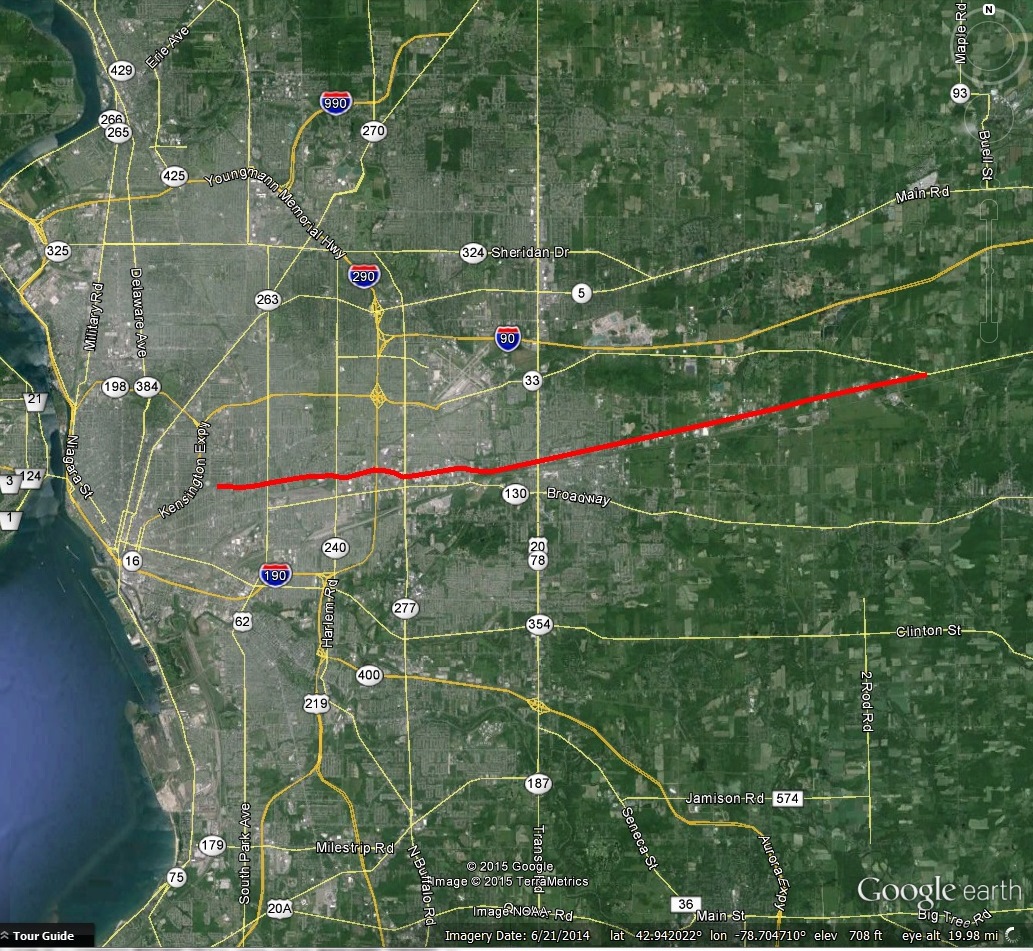
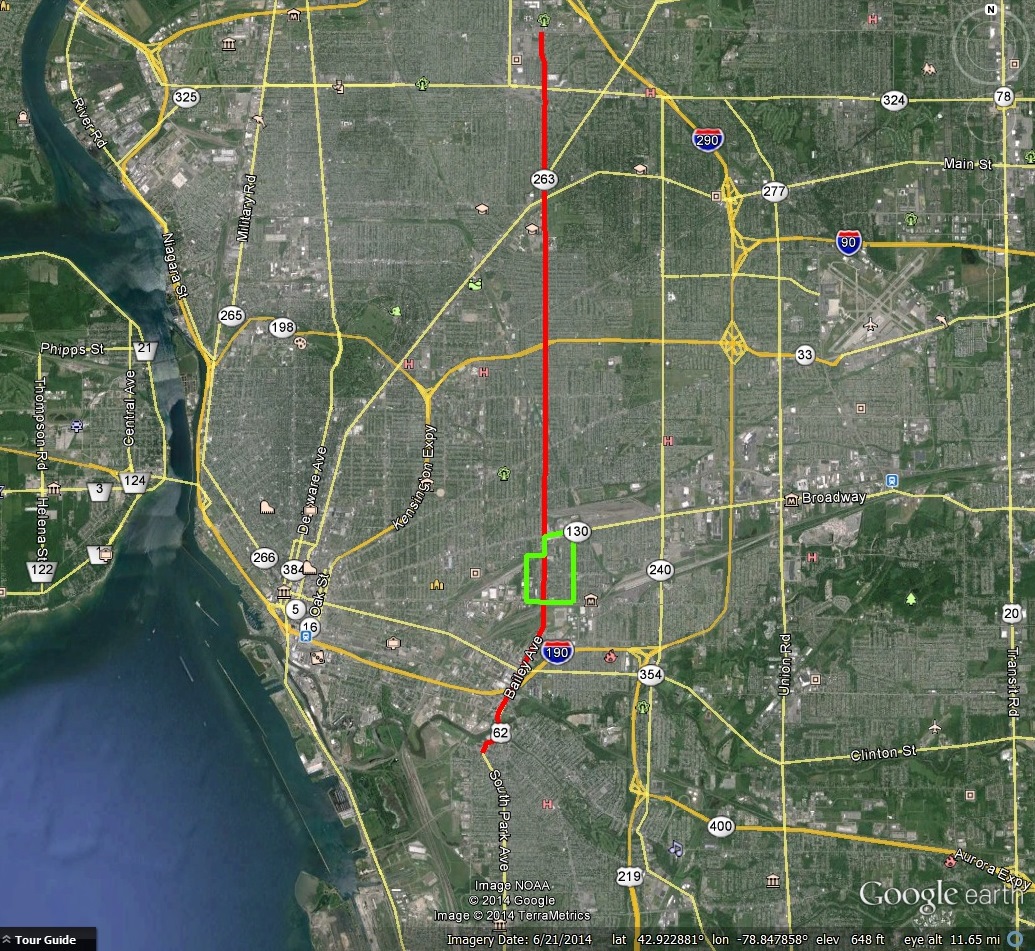
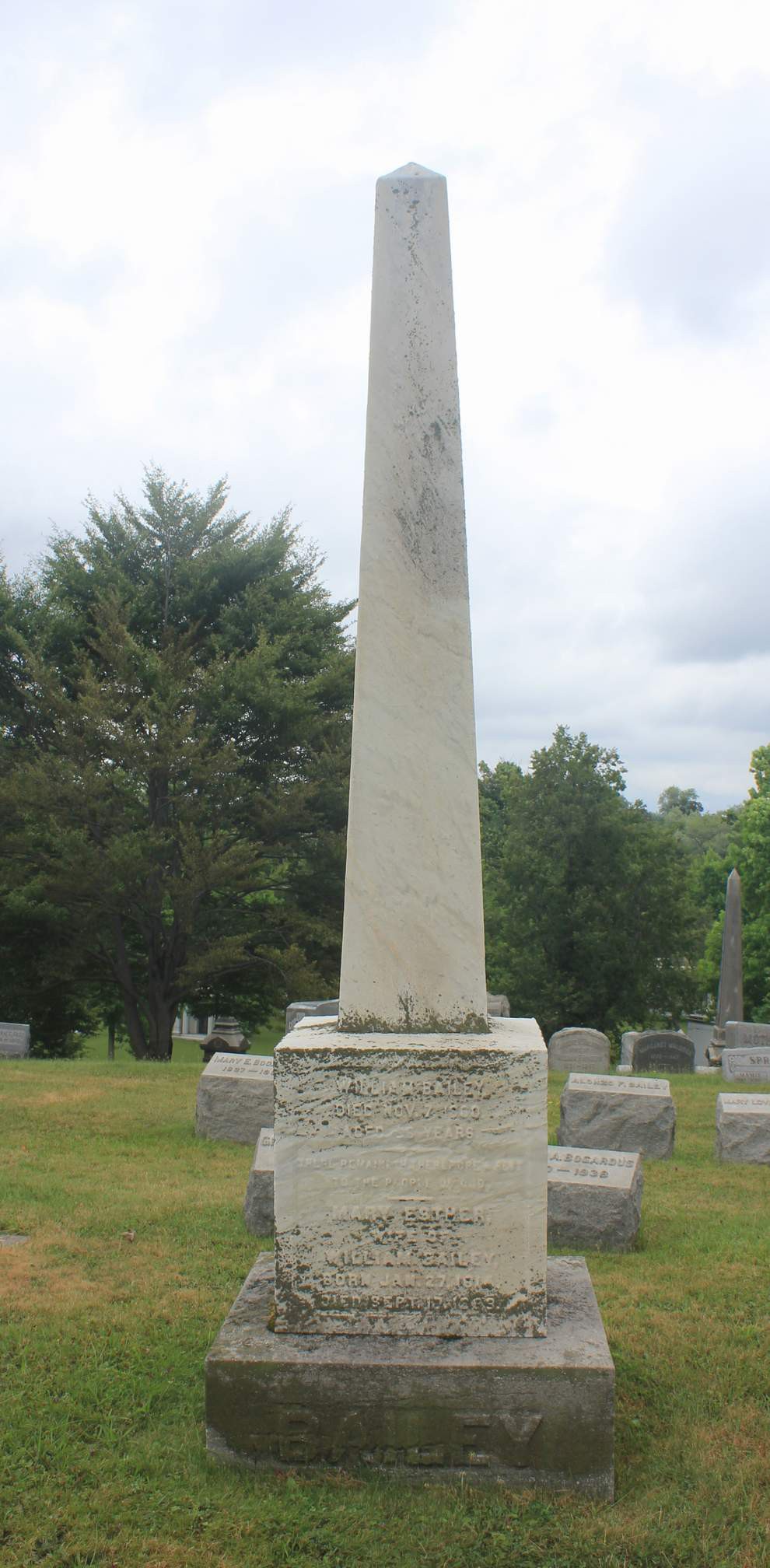
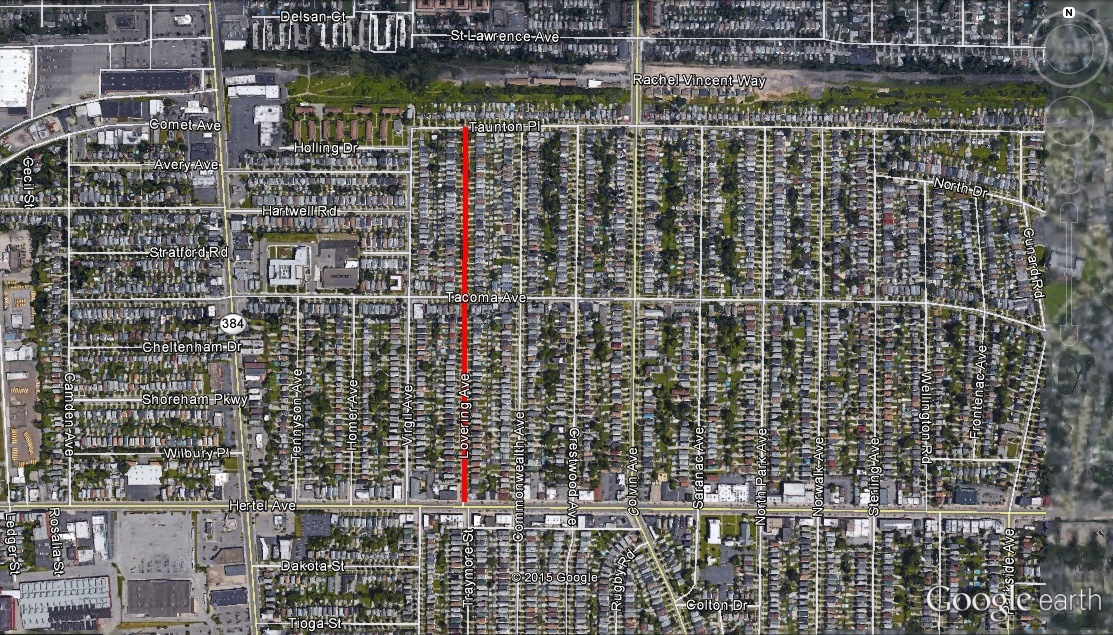
Bailey Avenue alignment shown in red, approximate boundaries of Bailey Farm shown in green

Bailey Avenue alignment shown in red, approximate boundaries of Bailey Farm shown in green

Bailey Avenue is one of the longest roads in Buffalo, and a major north-south corridor,  running from Abbott Road in South Buffalo to Ridge Lea in the Town of Amherst.  U.S. Route 62 follows Bailey Avenue for most of its alignment.  The Route 62 designation has applied since the 1930s.

William Tracey Bailey came from a pioneer American Family.  His first American ancestor, John Bailey, crossed the Atlantic in 1630.  William Bailey was born in Connecticut in 1804.  At age 26, he felt the pioneer spirit of his ancestors and traveled through the wilderness of Western New York.  He arrived in Buffalo two years before Buffalo became a city.

Mr. Bailey married Mary Esther Clark, of his hometown.  His wife’s father was a wealthy Revolutionary War veteran and provided many beautiful things for the Bailey family’s homes.  The Bailey first settled in a large white house at Main and Pearl Street (the site later became the Teck Theater).   At one point, the house was raided by Native Americans.  The Native Americans were fascinated by the fancy carpets, which they had likely never seen.  They cut pieces into the carpets to make moccasins.

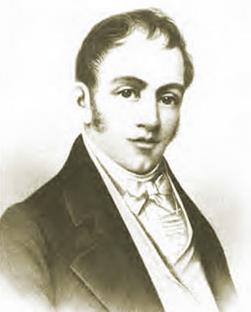
The Baileys later moved to a farm on the outskirts of the City.  When William Bailey first bought his property, it was at the intersection of Williamsville Road and Batavia Street. Mr. Bailey extended and improved the narrow Williamsville Road to better facilitate the removal of lumber from his property for sale.  In recognition of his improvements, the name was changed to Bailey’s Road.  When the street became a part of the City of Buffalo, Mr. Bailey donated a mile and a half of his land that is now Bailey Avenue to the City.  Batavia Street later became Broadway.

William T. Bailey

William T. Bailey

The Bailey farm and woods were bounded approximately by Dingens Street, Broadway, the Erie Railroad tracks, the West Shore tracks and the Village of Cheektowaga.  In 1854, New York Central railroad built tracks across the rear of the Bailey Farm.  Mr. Bailey sold the railroad the rights-of-way, as well as stone from his quarry for bridges, culverts and shops for the railroad.

The Bailey family had five sons and three daughters.  There was no school near the Bailey farm, so Mr. Bailey hired a teacher to instruct his children and his neighbor’s children.  He later built a school on Broadway and allowed the teacher to live at the Bailey home as a guest of the family.

The Bailey family attended Washington Street Baptist Church in Buffalo, where William was a deacon.  After church, many of the families would enjoy a horseback ride or a walk in the woods to visit the Bailey farm for a feast.

At the time, Buffalo was booming, but there were years that there simply were not enough jobs for the immigrants who continued to arrive in Buffalo.  Mr. Bailey would allow the poor to cut wood on his farm, and every two weeks, Mr. Bailey would provide their families with flour, beans, lard, coffee and other foods.

William and Mary Bailey Grave

William and Mary Bailey Grave

In 1856, Mr. Bailey built a house on Franklin Street near Tupper.  The house was well-known in Buffalo because it had the first plate-glass windows in town.  The house was later sold to the Altman family and was known as the Altman House.

Mr. Bailey died in 1860 and is buried in Forest Lawn Cemetery.

After Mr. Bailey’s death, his son Earl operated the limestone quarry on the farm.  The quarry was located near where the NY Central railroad tracks cross Bailey Avenue.

Check out the Street Index to learn about other streets.

Source:

“Bailey Avenue Named for Area Pioneer”.  Courier Express Mar 3, 1940, sec. 5 p.9

streetPerry Street was originally named Beaver Street by Joseph Ellicott in the original 1804 Plan of New Amsterdam/Buffalo.  In 1907, Alderman Hendrick Callahan suggested new names for a bunch of streets.  The streets that he renamed were Liberty, Erie, Columbia, and Perry.  He also suggested renaming Main Street to Iroquois Avenue; however, this was not approved.  Liberty Street was later renamed Baltimore Street.  Perry also lends his name to the Commodore Perry projects, located near Perry Street.

Additionally, Perry Boulevard used to be located along the former route of the Erie Canal where the I-190 Thruway is currently located.  The road led from Main Street up to Porter Avenue, and was constructed when the canal was filled in during the construction of the Lakeview Housing Project.  At the time, the unused canal bed was considered a health hazard, so it was filled in to protect the residents of the public housing.  A short portion of the roadway under the Thruway is still called Perry Boulevard.

OliverHazardPerryEngraving

Oliver Hazard Perry

Oliver Hazard Perry was born in 1785 in Rhode Island.  His younger brother Matthew Calbraith Perry was involved in the opening of Japan. Matthew Perry also served under his brother during the Battle of Lake Erie.

Perry served in the West Indies, the Mediterranean, and the Caribbean, but he is best known as the “Hero of Lake Erie” for his role during the War of 1812.   At the start of the War of 1812, the British Navy controlled the Great Lakes, except for Lake Huron.  The American Navy controlled Lake Champlain.  The American Navy had only a small force, which allowed the British to make advances on the Great Lakes and northern New York waterways.

Perry was named Chief Naval Officer in Erie, P.A., and built a fleet on Presque Isle Bay.   On September 10, 1813, Perry fought a successful action during the Battle of Lake Erie.  During the battle, Perry’s ship, the USS Lawrence, was severely disabled.  the British Commander, Robert Barclay, thought Perry would surrender.  Commander Barclay sent over a small boat to request that the Americans pull down the flag.

1911 Painting of the Battle of Lake Erie by Edward Percy Moran.  Perry is standing in front of the boat

1911 Painting of the Battle of Lake Erie by Edward Percy Moran. Perry is standing in front of the boat

Perry remained faithful to the phrase “DON’T GIVE UP THE SHIP”, which were paraphrased from the dying words of Captain Lawrence, Perry’s friend and the ship’s namesake.  The men rowed through heavy gunfire to transfer to the USS Niagara.  Perry’s forces continued until Barclay’s ships surrendered.  Although Perry was aboard the Niagara during the fighting of the battle, he had the British surrender on the deck of the Lawrence to allow the British to see the price his men had paid.  Perry’s report following the battle was brief but became famous:  “We have met the enemy and they are ours; two ships, two brigs, one schooner and one sloop”.  This was the first time in history that an entire British naval squadron had surrendered.

Perry's Congressional Gold Medal

Perry’s Congressional Gold Medal

He was awarded a Congressional Gold Medal and for his role during the Battle of Buffalo.  He also helped completed successful outcomes at all nine Lake Erie military campaigns, which was a turning point during the War of 1812.
The Perry statue in Front Park was erected by the State of New York Perry Victory Centennial Committee.  The statue was dedicated at the 100th annual reunion of the New York Veterans Association.  The statue has recently been restored and returned to the park, along with cannons that were originally located in the park due to the park’s connection to Fort Porter, which was located near where the Peace Bridge plaza is currently located.

statue

Perry Statue, Front Park

Commodore Perry did not live to old age.  He died in 1819, on his 34th birthday, of yellow fever while at sea.  He was buried at Port of Spain, Trinidad with full military honors.  In 1826, his remains were moved to Newport, Rhode Island.

Learn about the origins of other street names by checking out the Street Index.

Sources:

  1. “What Think You Of These Names” Buffalo Express May 31, 1907
  2. News May 6 1937 (clipping in local street scrapbook vol 2)
Field Notes

Live from Buffalo, NY

Grants.gov Community Blog

Connecting the grant community to #LearnGrants

Dienna Howard

I create, therefore I am.

Hidden Waters blog

Companion blog for the book "Hidden Waters of NYC"

Hoping for a Tail Wind

Because I definitely brought way too much gear.

priorhouse blog

Photos, art, and a little bit of LIT.

Sheepie Niagara

Bleating the Beat Since 2015