Feeds:
Posts
Comments

Archive for 2017

McKinley Parkway is one of the Frederick Law Olmsted designed parkways.  The parkway system Olmsted designed allows the greenspace of the park system to radiate out into the neighborhoods.  McKinley Parkway runs from the main entrance of South Park past McKinley and McClellan Circles to Heacock Place.  During the 1890s, much of the land for the parkway was donated by residents of South Buffalo who wanted to have the benefit of having a parkway in front of their homes.  McKinley Parkway was often referred to as the Delaware Avenue of South Buffalo, as it was a street of stately homes occupied by prominent Buffalonians.  During the 1930s, a portion of McKinley was extended north across Abbott Road to connect to Bailey Avenue.  The parkway was originally known as South Side Parkway.  The name was changed in December 1915, to honor McKinley.  South Side Parkway’s name was selected as the street name to change because many residents about their mail delivery – residents living on South Park and South Side Parkway often got each others mail.  At this time, they also changed the name of Woodside Circle to McClellan circle, for a similar reason.  The traffic circle at McKinley and Dorrance Avenue is known as McKinley Circle, but was also originally known as South Side Circle.   When South Park Avenue was created from various South Buffalo Streets in 1939, they renamed a portion of the former South Park Avenue, reusing the Southside Parkway name.

Heacock Place – the start of the South Buffalo Olmsted Parks and Parks system and where McKinley Parkway originates

The South Buffalo Olmsted parks and parkways system was listed on the National Register of Historic Places in 1982.  The system consists of the following:  Heacock Place, McKinley Parkway, McClellan Circle (formerly Woodside Circle), Red Jacket Parkway, Cazenovia Park, McKinley Circle and South Park.  The South Park-Cazenovia Parks and Parkways were created later than the Delaware Park-Front Park-Humboldt Park system.  Fillmore Parkway was originally designated to be a link between Humboldt Park (now Martin Luther King Jr Park) to South Park.  Olmsted originally proposed the plans for South Park in 1887.  South Park was built on a smaller scale than originally planned, as by 1893 when the park was approved by Common Council, industrial development had begun to take over the lakefront area originally designated for the park.  Planning for Cazenovia Park coincided with the development of South Park, and Olmsted planned for the South  Side Parkways to link the two parks.  Fillmore Avenue was partially laid out, but the full vision was never completed to connect the southern parks with the older parkway system in the northern part of town.

President McKinley on Cayuga Island, 1897.
Source: Niagara Gazette, March 26 1931, pg 8

President McKinley enjoyed world’s fairs, and referred to them as “the timekeepers of progress” and said that “they record the world’s advancement”.  He attended the Colombian Exposition in Chicago in 1893 and the Cotton States Exposition in Atlanta in 1895.  He was involved in the Pan American Exposition as well.  He came to Western New York to celebrate the choice of Cayuga Island in Niagara Falls as an exposition location in 1897.  This fair was to happen in 1899 but was pushed back by a few years due to the Spanish-American War.  After a selection committee examined a slate of 20 different potential fair locations,  the Pan American Exposition committee selected Mr. Rumsey’s land in North Buffalo.
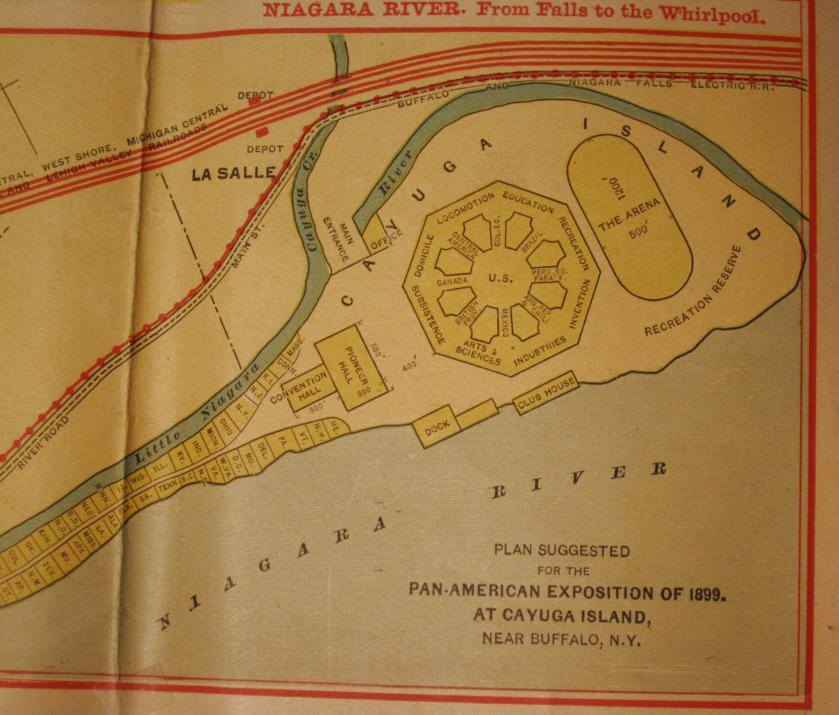
The original Cayuga Island plan for the Pan American Exposition of 1898

The McKinleys had hoped to be in town for the Pan American’s opening day in May of 1901, but Mrs. McKinley fell ill.  The President sent Vice President Theodore Roosevelt in his place.  Vice President Roosevelt talked to the President about how impressed he was with fair and particularly the electric tower, increasing President McKinley’s desire to come to see it for himself.  On September 4th, the McKinleys made it to Buffalo.  The following is a link to Thomas Edison footage of McKinley’s speech at the Exposition.
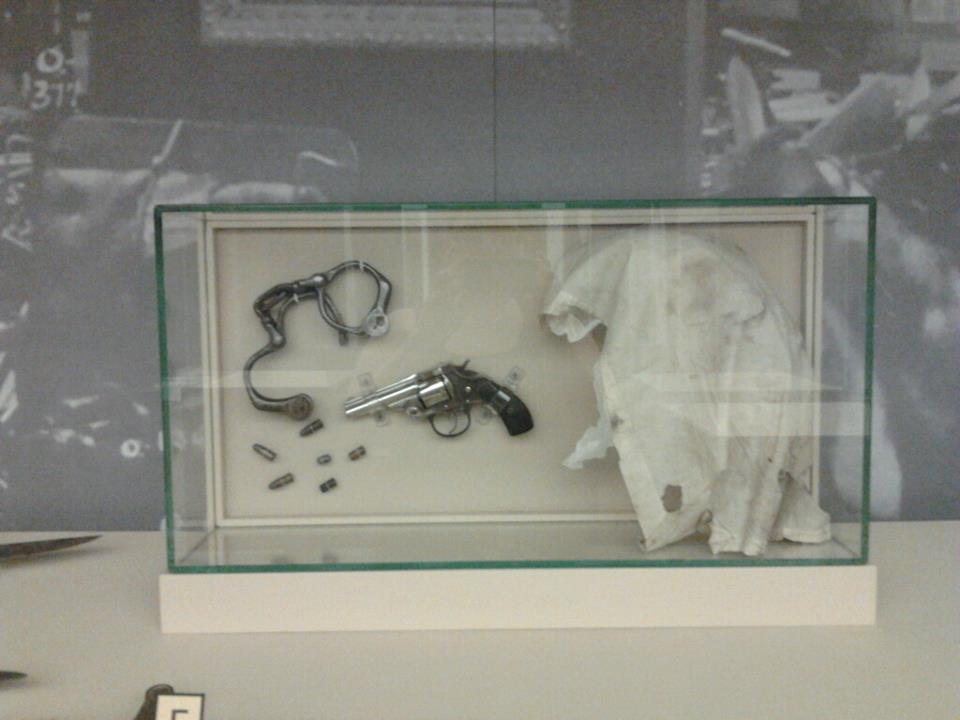
The gun that shot McKinley, in the collection of the Buffalo History Museum

The rest, as they say, is history.  On September 6, 1901, at the Pan-American Exposition in Buffalo, New York, anarchist Leon Czolgosz shot President William McKinley.  President McKinley held on for a few days, but died on the 14th.  Vice President Teddy Roosevelt was inaugurated as President at the Wilcox Mansion on Delaware Avenue here in Buffalo.  Following the closure of the Pan American Exposition, the fair was torn down and the land was subdivided for residential development.  The location where McKinley was shot is marked by a boulder with a plaque on it on one of these residential streets.

Front page of the Buffalo Courier following McKinley’s shooting.
From the Collection of the Newseum in Washington, DC
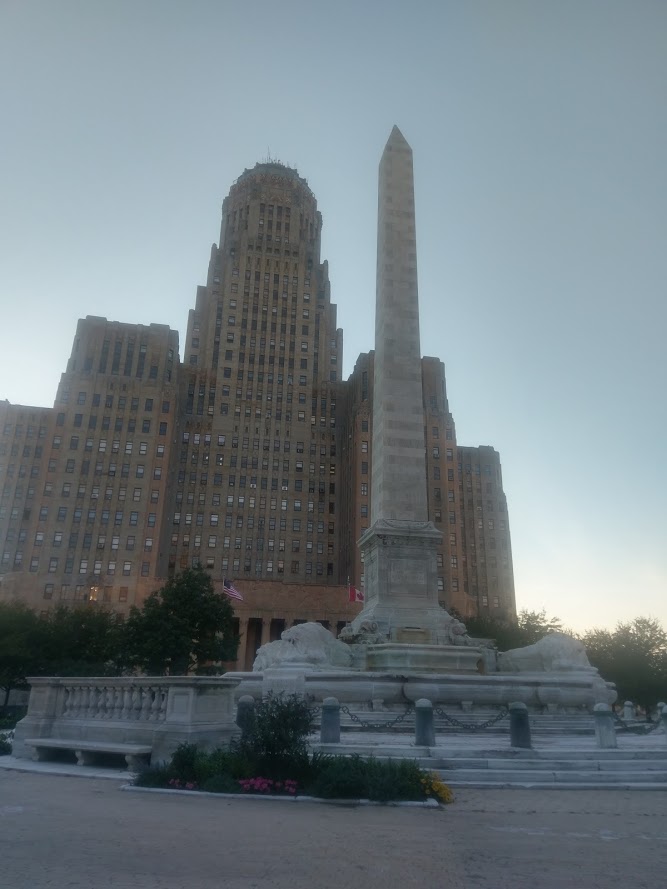
McKinley Monument in Niagara Square

The McKinley monument in Niagara Square was dedicated in 1907.  Daniel Burnham was called in to Buffalo to consult about the design of the monument.  The monument was designed by Carrere and Hastings, who also designed the Pan American Exposition and had worked with Daniel Burnham on the Chicago Exposition in 1893.   The sleeping lion and turtles sculptures were designed by A. Phimister Proctor.  The lions represent strength and the turtles represent eternal life.

The McKinley Monument was restored this summer, the monument’s first full restoration in 110 years.  The work was coordinated by the City of Buffalo, Buffalo Arts Commission and Flynn Battaglia Architects.  The monument should be completed on September 6, 2017, the 116th anniversary of McKinley’s shooting.

Want to learn about other streets?  Check out the street index here.


Sources:

  1. “Change Street Names to Avoid Confusion”.  Buffalo Courier.  December 19, 1915, pg. 82.
  2. Goldman, Mark.  City on the Edge.  Amherst:  Prometheus Books.  2007.
  3. Kowski, Francis, et.a.  Cambridge:  MIT Press, 1981.
  4. Sommer, Mark.  First Restoration of McKinley Monument in 110 Years Begins.  Buffalo News.  June 12, 2017.
  5. Williams, Deirdre.  City Hallways (August 31):  Rehab work at McKinley Monument wrapping up.  Buffalo News.  August 31, 2017.
Read Full Post »

expressway

Scajaquada Expressway (NYS 198)

The Scajaquada Express (aka NYS 198) has been in the news a lot in the last few years.  Everyone has a lot of opinions on the road and what it should look like – whether to remain an expressway, be downgraded to a parkway, etc.  Of course, the expressway takes its name from the creek along who’s route it follows.  Did you know that in addition to the creek, there is also a second Scajaquada Street in Buffalo?

scajaquada street

Scajaquada Street

Scajaquada Street runs between Bailey Avenue and Grider Street on the east side of Buffalo, cut into two pieces by railroad tracks.  Scajaquada is the type of word that Buffalonians know, but the kind of word that immediately stumps out-of-towners, a relic of our Native American roots here in Western New York.  Both the street and the expressway get their names from Scajaquada Creek.  Did you know that Scajaquada Creek was named after a person?

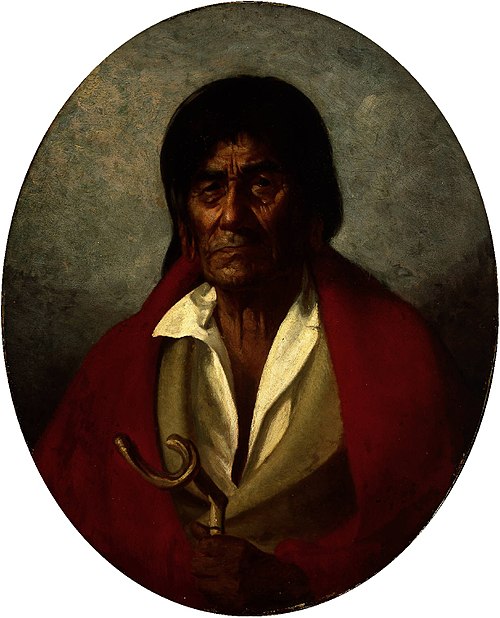
The creek is named after Philip Conjockety.  His name was also spelled Kenjockety.  He was also known as Ska-dyoh-gwa-deh (meaning “Beyond the Multitude”), which was also spelled Skandauchguaty or Conjaquady.  There are estimated to be as many as 90 different spellings of the word.  No wonder we still have trouble spelling the word today!  (One of my favorite Buffalo jokes:  How do you spell Scajaquada?  “198”)  The Seneca name was commonly Ga-noh-gwaht-geh, meaning “after a peculiar kind of wild grass that grew near its borders”.  The grass was important to early settlers, because it was used to create woven baskets, fishing nets, and supplies.

1850 Portrait of Philip Conjockety by Lars Gustaf Sellstedt

Philip had come to Buffalo with the Senecas shortly after the Revolutionary War, when they were driven away from the Genesee Valley.  Philip’s great grandfather was a member of the Kah-kwahs, who once lived in the Western New York area.  The Kah-kwahs were overtaken by the more powerful Senecas around 1651, and the survivors were adopted into the Seneca nation.  Philip’s father, John, became Chief of the Seneca, and was part of the influence which brought the Seneca Nation to the banks of the Niagara River near what became Scajaquada Creek when they left the Genesee Valley.

Philip was born near the Tonawanda Reservation and lived in Fort George during the Revolutionary War, when he fought with the Senecas against the Americans.

Philip died April 1, 1866, at Newtown, on the Cattaraugus Reservation.  When he died, the Courier reported at the time that he was the oldest resident of the region.  Some accounts listed him as 120 to 130 years old, but it was generally believed that he was nearly 100 when he died.  His mind was clear in his old age, so much of the early history of Buffalo was gathered from Philip’s stories.

During the War of 1812, the navy yard at the mouth of Scajaquada Creek was where five of Commodore Perry’s ships were reconditioned during 1813.  A plaque commemorating this location of this navy yard is on the Niagara Street Bridge, north of Forest Ave.   On South Side of the creek near its mouth was Sailor’s Battery – the last in a line of 8 batteries stretching from the Terrace to the Creek that helped defend during the War of 1812.   The Sailor’s Battery was the first to be overtaken during the night of December 29, 1813 during the Battle of Black Rock which led to the Burning of Buffalo.

Doreen-DeBoth-Buffalo-NY

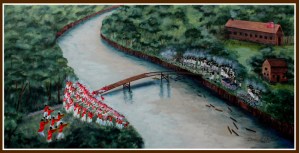
“Battle of Scajaquada Creek Bridge” Artist: Doreen Boyer DeBoth

The Battle of Scajaquada Bridge was fought August 3, 1814.  British forces were attacked by American forces at the bridge, west of where Niagara Street crosses the creek.  The American forces were entrenched on the south side of the creek and began to dismantle the bridge to prevent the British from crossing.  The British attempted to rebuild the bridge, but failed and ended up retreating to Canada.  The outnumbered American men were able to stand up to the British men in what was the last act of British aggression towards Buffalo during the war.  The victory is described as a decisive engagement and a triumph for the United States.

By 1902, the area around the mouth of Scajaquada Creek had become a city dump.  The area was a popular place for “mouchers” to rifle through the discarded waste of the city to resell things.  Of the Scajaquada Creek dump, it was written:  ” Once it was a picturesque stream, but here its glory is departed.  It has banks of ashes six or eight feet high and between them flows the noble stream in a sluggish, dirty current.  Its channel obstructed by peach baskets, bottomless coffee pots, kerosene cans, bed springs, tin cans and other materials which the moucher rejects.”

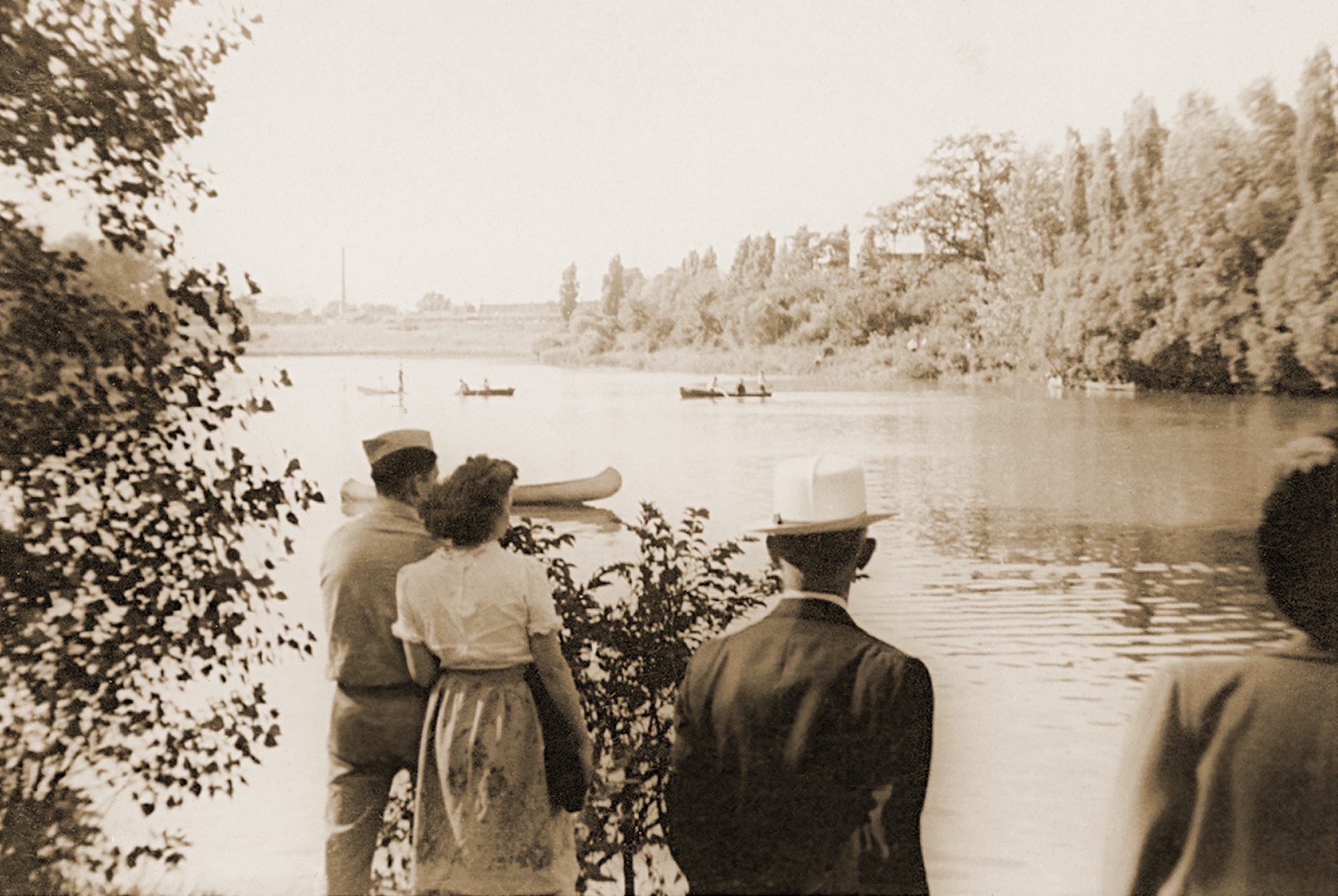
Historic View of Scajaquada Creek Source: Buffalo News

In 1899, the National Motor Transit Company entered into a 1 year contract with the Park Board of Buffalo to operate an automobile transit service to travel along what would become, 60 years later, the route of the City’s first intra-urban highway, the Scajaquada Creek Expressway.  Four cars traveled from Lincoln Parkway past the zoo to Humboldt Parkway and Main Street every half hour.

Around 1946, New York State began planning for a system of highways throughout the City of Buffalo in a report titled Report on the New York State Thruway and Arterial Routes in the Buffalo Urban Area.  In 1951, the Buffalo Planning Commission adopted a Major Traffic Ways Plan that included the Scajaquada Expressway as a component of the system.  Traffic was quickly growing within the City and the highways were designed to find a place for the cars by channeling them onto expressways.  The Scajaquada Expressway was constructed during the 1950s and 1960s.   The route was designated by the Surface Transportation Act of 1982 as NYS Route 198.

Buffalo NY Courier Express 1958 a - 2435

Proposed plan for Delaware Park Shortway. Source: Courier Express, September 5, 1958

Other plans to create a second limited access highway was proposed for Delaware Park in 1958.  The “Delaware Park Shortway” would have run parallel to 198 across the north side of the Delaware Park meadow.  The City Planning board tabled the proposal in order to finish construction of the Scajaquada and Kensington Expressways to be completed before the Shortway was built, so plans never came to fruition.

Studies have been going on since the late 1990s regarding downgrading and/or removal of the Scajaquada Expressway, particularly the section through Delaware Park.

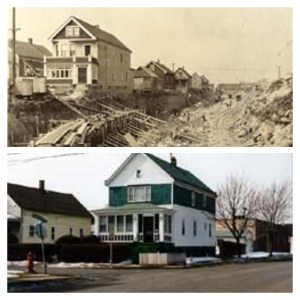
Historically, Scajaquada Creek was a shallow, wide, meandering creek.  Over time, the creek was channelized and portions were routed underground in three ares.  Residents would use the creek to dump their waste, creating a public health issue in the stagnant water.  Putting the creek underground would help resolve this issue, and created numerous pocket parks along the former length of the creek.  The largest tunnel was created as the Scajaquada Drain project in 1928.  This project buried 3.5 miles of the creek, from Pine Ridge Road to Forest Lawn Cemetery.  A portion of the buried creek runs under Scajaquada Street.

FotoJet

Top photo 1924.  Bottom photo modern image same site.  Corner Scajaquada Street and Kilhoffer during construction of Scajaquada Drain.  Source:  WNY Heritage.

During the 1930s, the sewer systems crossing the creek were disconnected, connected the creek into the city’s combined sewer overflow system.  The Delevan Drain was built to try to divert the combined sewage near Main Street, but it is designed to function during low flows, and during storm events or high flows, the water exits the Delevan tunnel and flows into the stream channel.  At Forest Lawn Cemetery, the creek is recharged by underground springs, and the Onondaga Escarpment creates Serenity Falls within the Cemetery.  When Delaware Park was originally designed, the 42 aces lake was formed by damming Scajaquada Creek.  As part of the Expressway construction, park, portions of the lake were filled.  The lake retains little of its original shoreline.  During the 1950s, the lake was declared by the Department of Health a health hazard and was closed to the public due to the sewage overflow issues.  The creek was rerouted to separate it from the lake in the early 1980s.  Buffalo Niagara Riverkeeper and other organizations are working to restore and provide environmental restoration to the creek.

So the next time you drive over the Scajaquada, think of Philip Konjockety, a highway that were never built, and a creek that’s been buried.  To learn about other streets, check out the street index.

Sources:
  1. Carstens, Patrick Richard and Timothy L. Sanford.  Searching for the Forgotten War – 1812.  Xlibris Corporation:  2012.
  2. “Death of Philip Kenjockety”.  Courier & Republic.  Wednesday Evening, April 4, 1866.
  3. OH Marshall. “The Niagara Frontier” Vol. II Buffalo Historical Society Publications
  4. Parke, Bill.  “Battle of Scajaquada Bridge”.  Black Rock Historical Society.  Online at http://www.blackrockhistoricalsociety.info/battle-of-scajaquada-creek-bridge.html
  5. Delaware Park Shortway. Courier Express. September 5, 1958.  Pg 6.
  6. Cichon, Steve.  The Buffalo You Should Know:  The Slow Death of Humboldt Parkway in Building the 33 & 198.  Buffalo News. May 8, 2016.
  7. NYSDOT.  NY Route 198 Scajaquada Corridor Study P.I.N. 5470.14.  June 2005
  8. WNY Heritage.  Scajaquada Drain Project.  Online at https://www.wnyheritage.org/content/scajaquada_drian_project_-_1920s/index.html
  9. Treasure at the Dump.   The Illustrated Buffalo Express.  1902.


Read Full Post »

(Note from Angela:  Today I am pleased to share a guest post from Dr. Caitlin  Moriarty.  Dr. Caitlin Moriarty specializes in historical and cultural analysis of the built environment. She is the Director of Architectural History for Preservation Studios, a historic preservation consulting firm. Caitlin moved to Buffalo in 2011 and lives in North Buffalo with her husband and two sons.  Enjoy!)

If Lewis J. Bennett read the Buffalo Express Morning on September 7, 1911, he may have protested the verbiage of an article about “Revere place, the pretty new street in the Central Park district.” Bennett, the visionary behind the Central Park area bounded by Main Street, Woodbridge Avenue, Parkside Avenue, and Amherst Street, intended for that neighborhood to be an exclusive enclave of large homes on expansive lots. With the strike of a pen, however, the newspaper associated several new streets north of Huntington Avenue with Bennett’s prestigious residential development.

Willam Suor

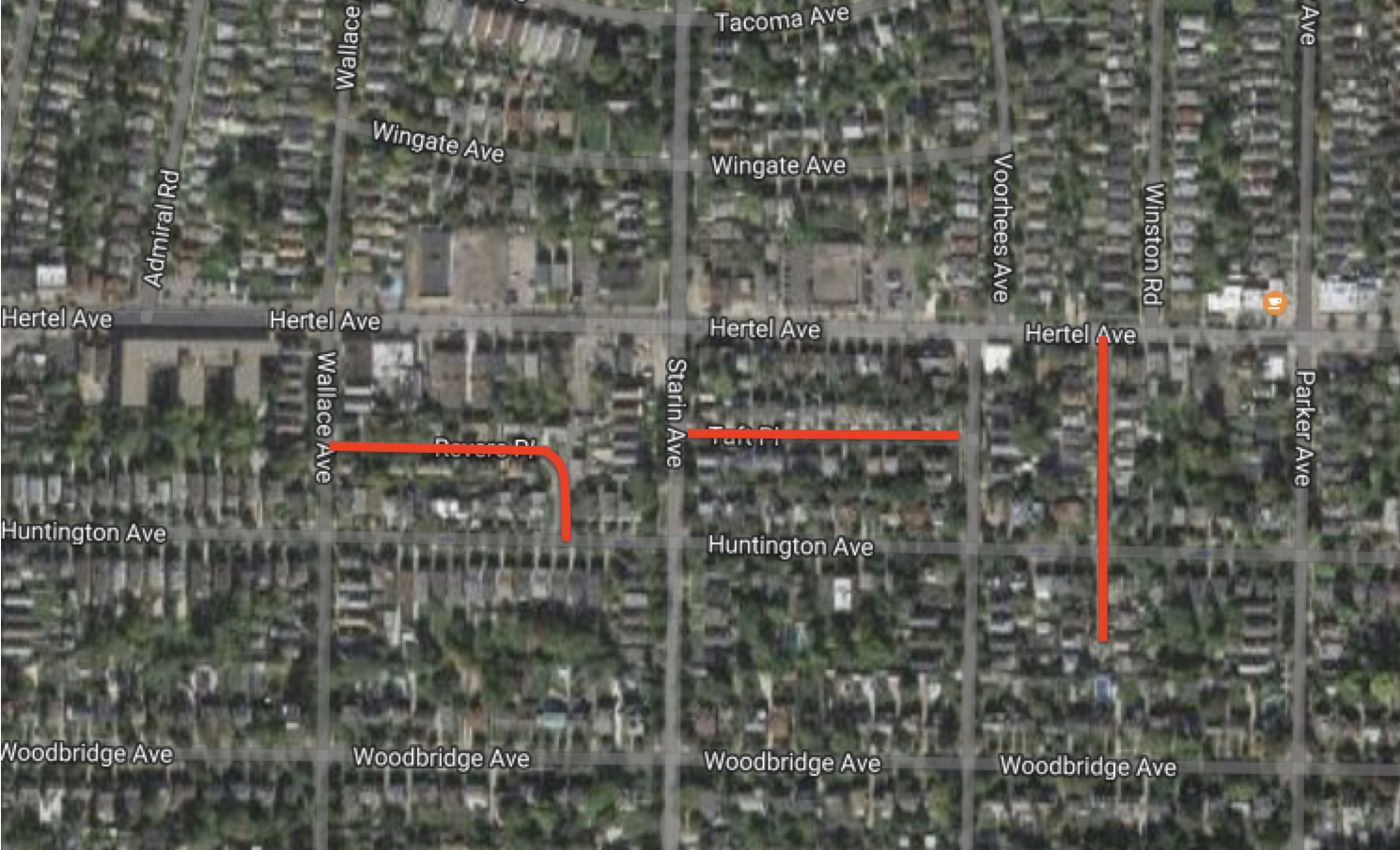
Brothers William C.T. (1873-1959) and Arthur Suor (1874-1936) developed several streets just beyond Central Park as the frontier of residential development in Buffalo pushed northward. Between roughly 1908 and 1912, the brothers developed a handful of one-block streets near some of the main thoroughfares of Central Park, including Starin and Vorhees Avenues. Unlike Central Park streets such as Depew, Morris, and Wesley Avenues, however, Revere Place, Taft Place, and Sagamore Terrace featured speculatively built homes on modest lots (see map).

At the time, Arthur Suor worked for Thorne & Angell, one of Buffalo’s largest and most successful real estate development firms at the turn of the twentieth century.* Pursuing the opportunity to lead their own development projects, the Suors capitalized on their connection to Thorne & Angell: “When this company took over a big section of land to develop, the Suor boys would buy a little slice, working nights and holidays to sell it.” For instance, in 1910, the Suors created Revere Place through the middle of block “H” (bounded by Wallace, Huntington, Starin and Hertel Avenues) of the Fairmount Park tract. They appealed to the Common Council in March of that year for permission to lay water pipes on the new street, and by May, construction was underway on ten Revere Place homes.**

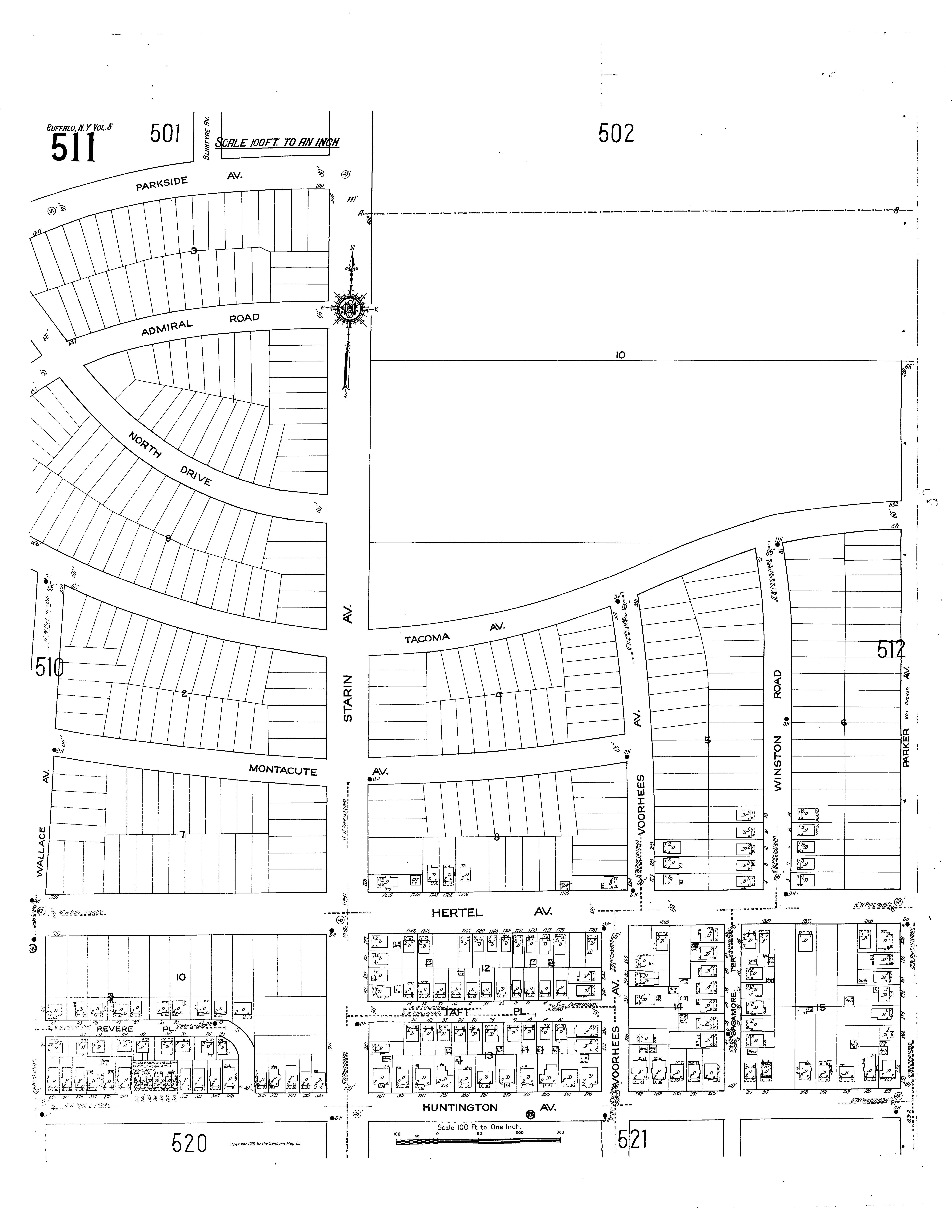
The Suor & Suor Building Company constructed homes and led a marketing campaign that offered modern amenities expected of new houses in this growing area of town to a middle class consumer that could not afford to live in Central Park proper. This business model started at the foundational level of how they created streets and parcels. Revere Place, Taft Place, and Sagamore Terrace are one-block streets that bisect three consecutive city blocks located between Wallace and Parker Avenues on the west and east, and Huntington Avenue and Hertel Avenues on the south and north. Revere Place cuts a curvilinear path between Wallace and Huntington Avenues, and Taft runs straight through the middle of the block between Starin and Vorhees Avenues. Sagamore Terrace extends a block and a half south from Hertel Avenue, reaching into the adjacent block below Huntington Avenue. As a result of cutting new streets though larger, more traditional city blocks, the Suors created more street frontage, more lots, and ultimately, more houses to sell.

The lots on these streets were significantly smaller than those in Central Park. On Revere Place, lots averaged 49×56 feet, while narrower and deeper lots—measuring approximately 36×80 feet—lined Taft Place. Sagamore Terrace featured the largest lots, with frontage averaging 45 feet and depths ranging from 80 to 130 feet. Compared with representative lot sizes of 60×157 feet on Woodbridge and 70×180 feet on Depew, the Suors’ homes clearly targeted a different consumer.

The Suors appealed to an upwardly mobile middle class by highlighting both the modernity and affordability of their homes. Descriptions of their “high-grade single-family houses of up-to-date design,” filled the real estate pages of Buffalo’s newspapers. The promise of “no flats being allowed” on their streets bolstered an air exclusivity that resonated with the high status of Central Park.*** Modern features of the new, “artistic homes,” included steam heating, electricity, and mission oak and white enamel finishes. The homes did not, however, include garages, although advertisements indicated that there was room to erect a garage on the lot. The lack of garages both kept costs down and reflected the likelihood that residents of Suor & Suor’s homes used public transportation.****

The company offered prices and payment options for their modern homes that catered to middle class consumers. While regulations stipulated that homes on Central Park lots exceed $5,000, not including the price of the land, most surpassed $6,000 and several reached over $20,000. By comparison, the “Central Park bargains” on Taft Place, Revere Place, and Sagamore Terrace started at $4,350, all-inclusive. Sagamore Terrace, with the largest lots, featured the most expensive homes, reaching up to $7,500. In addition to lower prices, the Suors boasted an attractive payment plan intended to turn renters into homeowners: “Don’t sign another lease,” their advertisements appealed. While some homes sold in cash transactions, the “very practical plan of easy payments [made] it possible for the man with a limited income to buy an up-to-date home on about the same as a rental basis.” The prices and payment plan made it accessible for members of the middle class to buy a new house in an up and coming area of the city.

While it is hard to imagine today how remote this area felt in 1910, North Buffalo was mostly farmland. Years later, longtime residents of Taft Place explained, “When they moved there they could look across Hertel and see the cows placidly chewing in the pastures.” In fact, without homes on Starin, early residents on Revere Place and Taft Place could probably see one another through their yards. Yet, the Suors’ new streets signaled the growing momentum of development in what is now North Buffalo.

1916 Map of Streets (click to enlarge)

By 1930, two decades after the Suor brothers opened these three streets, continued residential and commercial development in the area transformed the surrounding blocks.  No longer the edge of the city, Revere Place, Taft Place, and Sagamore Terrace faded into the pattern of residence-lined streets. Looking back in that year, Buffalo Times reporter Sybil Reppert conveyed the sense of community and seclusion from the city that early residents of Sagamore Terrace and Taft Place prized. As more people moved onto nearby streets, however, some residents lamented the area’s character, “getting more and more metropolitan.”

By contrast, as a current Revere Place resident, I find the “metropolitan” location of these streets between Hertel Avenue and Central Park part of their appeal. I relish both the privacy of my one-way street and easy access to the commercial offerings on Hertel Avenue and the picturesque streetscapes of Central Park. The Suors quickly moved on to new developments after opening Taft Place, Revere Place, and Sagamore Terrace; yet, their “Central Park bargains,” remain charming urban streets that connect residents with the contemporary city while also embodying its past.

Notes:

*Thorne & Angell is responsible for developing streets including Richmond, Elmwood, Lafayette and Plymouth.

**Numbers 41, 43, 44, 45, 49, 50, 53, 54, 60, and 61 were under construction in May.

***Despite this rhetoric, it appears that Suor & Suor constructed several flats on Huntington and Vorhees Avenues.

****According to the City Council minutes, several Revere Place residents erected garages in 1917, 1918, and 1921.


Sources:

  1. “Main Street Homesteads Sold,” Buffalo Express Morning, September 7, 1911.
  2. “Real Estate Dealer 60-Year Veteran Here,” The Buffalo Courier-Express, September 30, 1951, 18-D.
  3. Proceedings of the Common Council of the City of Buffalo. Buffalo: Common Council, 1910.
  4. “Central Park—New Houses,” The Buffalo Courier, September 27, 1911, 11.
  5. “Central Park,” Commercial September 20, 1907, Buffalo Library, Streets Clippings, 97.
  6. “Main Street Homesteads Sold,” Buffalo Express Morning, September 7, 1911.
  7. Sybil Reppert, “Taft Place—They Dwell Together in Unity,” Buffalo Times, September 30, 1930. Streets Scrapbook pg. 73-74.
  8. Sanborn Fire Insurance Company, Buffalo, New York, 1916, Sheet 511.
  9. Sybil Reppert, “‘Home Folks’ Live on Sagamore Terrace,” Buffalo Times, August 30, 1930. Streets Scrapbook pg. 44-45.


Read Full Post »

Field Notes

Live from Buffalo, NY

Grants.gov Community Blog

Connecting the grant community to #LearnGrants

Dienna Howard

I create, therefore I am.

Hidden Waters blog

Companion blog for the book "Hidden Waters of NYC"

Hoping for a Tail Wind

Because I definitely brought way too much gear.

priorhouse blog

Photos, art, and a little bit of LIT.

Sheepie Niagara

Bleating the Beat Since 2015