Feeds:
Posts
Comments

Posts Tagged ‘History’

zittelLouis Zittel was born in Johnsonsburg, Wyoming County, New York in February 1836.   His parents, Anna and Peter, came to the States from Germany shortly before Louis was born.  Mr. Zittel was educated in the public schools.  As a young man in the 1860s, Mr. Zittel moved to Buffalo and purchased a farm at the corner of Seneca and Cazenovia Streets.  At the time, the area we know of as South Buffalo only consisted of four streets – Buffum, Seneca, Cazenovia and Indian Church.  You could take a stagecoach to South Buffalo from Buffalo, and the trip was so long, it was generally only worth it if you were going to spend the night.  Mr. Zittel established a post office in South Buffalo.  Before 1891, the Post Office Department had no established policies regarding post office naming.  Postmasters were allowed to name their post offices as they wished.  Mr. Zittel named his post office “South Buffalo”, thereby creating the hamlet of South Buffalo and forever banishing “south side” from our city’s geography.

In 1887, Frederick Law Olmsted was commissioned to design a new park for the southern portion of the City (at this point, he had already designed what we know as Delaware, Front and Martin Luther King Parks).  Olmsted’s original vision for the South Buffalo park consisted of a large waterfront park along the Lake Erie shore south of what is now Tifft Street, east to the railroad corridor.  The original design was rejected as it was too costly, too likely to be damaged by storms coming off the lake and too far away from the residential areas of South Buffalo.  In 1888, Park Commissioners began looking for another site suitable for park use.  Three sites were identified to be used – the 76-acre Hart Farm which was being promoted for residential development along Cazenovia Creek, the grove at Mineral Springs, and a 156-acre just outside the southern boundary of the City limits.  The Parks Commissioners ended up approving two parks, that we now know as South Park and Cazenovia Park.

Olmsted's Cazenovia Park Plan

Olmsted’s Cazenovia Park Plan

Louis Zittel was a strong proponent for creating the park at the Cazenovia Creek site.  Serving as a Park Commissioner, Mr. Zittel worked hard to get the unused Hart Farm tract used as a park.  The park is a monument to Mr. Zittel’s perseverance and interest in benefiting his section of the City.  After the park was laid out, he moved to 150 Cazenovia Street, where he could view the park from his front windows.  The property where his house stood is now the American Legion.

After his move, he subdivided his farmland and developed the streets surrounding the street that bears his name.

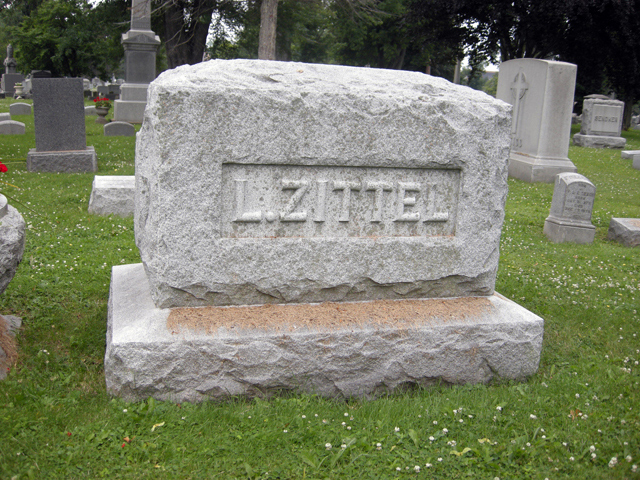
Mr. Zittel died on April 22, 1921 at his home on Cazenovia Street at the age of 87 years.  He is buried in Forest Lawn.

grave

To read about other streets, check out the Street Index.

Sources:

  1. “Proceedings of the Society”, Volume 26. Edited by Frank H. Severance.  Buffalo Historical Society Publications, 1922.
  2. “Named after Park Commissioner”.  Courier Express, March 12 1939, sec 5, p 12.

Read Full Post »

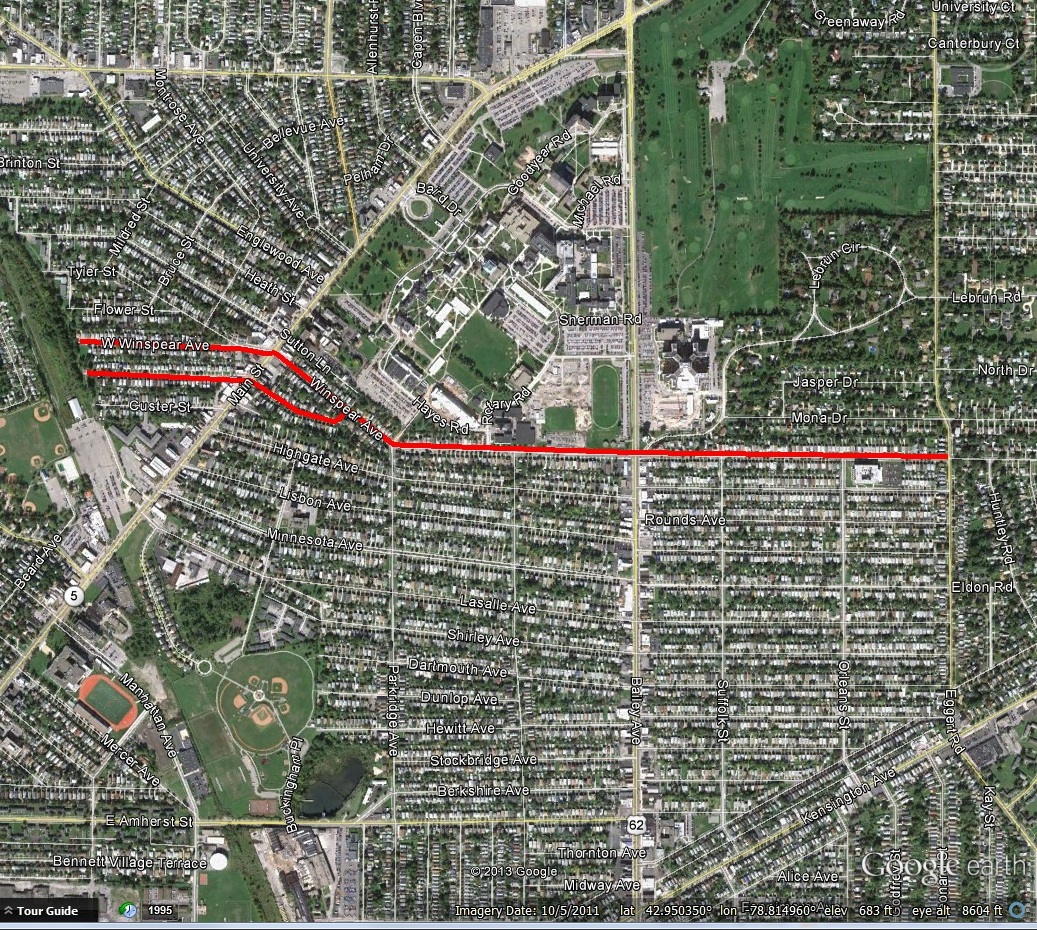
winspearWinspear Avenue and Northrup Place are located in the University Heights neighborhood of North Buffalo.    Winspear Avenue runs between the former Erie Railroad corridor across Main Street to Bailey Avenue.  Northrup place runs parallel to W. Winspear, meeting up with Winspear just across Main Street.

The streets were named after business partners who developed the streets in the vicinity of  the streets that were named after them and what is now the University of Buffalo – Charles Winspear and Eli Northrup.  Charles and Eli both grew up in Elma, New York, sons of two of the first settlers in Elma.

Three members of the Winspear family have held important public positions.  William Winspear settled in Elma prior to the Civil War and served on the Erie County Board of Supervisors.   William owned a mill on the south side of Big Buffalo Creek.  Winspear Road in Elma is named after William Winspear.  Captain Robert Winspear, William’s nephew served on the Buffalo police department for more than 30 years.

Charles W. Winspear

Charles W. Winspear

William’s son and Robert’s cousin, Charles, was born in 1854 in Elma and began his education in the rural schools.  Charles came to Buffalo as a young man.   At the age of 23, he was appointed clerk of the Erie County Almshouse and Insane Asylum, which later became what are now Crosby and Hayes Halls on the University of Buffalo South Campus.

The original Almshouse had been built around 1850.  The first Almshouse burned in 1854 and its replacement burned in 1862.  The almshouse was located where Crosby Hall is today.  The Insane Asylum building was constructed in 11874 to replace the outdated structure and is now Hayes Hall.  By 1900, the Insane Asylum had become the County Hospital.  Hayes Annex D and Wende Hall were also a part of the County Hospital Complex and have been around since at least 1900.

Winspear Avenue was laid out around 1880.  Around this time, development of the neighborhood was attempted by Alexander Ross. This attempt failed because transportation to this northern corner of the City of Buffalo was difficult.  The street car only went to Cold Spring (around Ferry Street and Main Street).  The City boundary did not include the area that became University Heights at this time.  Buffalo’s growing population and improved transportation spurred successful development further away from the downtown core.  The Buffalo and Williamsville Electric Railway trolley opened in 1893 and ran along Main Street.  In 1898, the City boundary had expanded to include this area.

Erie County Almshouse and Insane Asylum (source:  http://www.poorhousestory.com/ERIE.htm)

Erie County Almshouse and Insane Asylum
(source: http://www.poorhousestory.com/ERIE.htm)

In 1893, Charles became superintendent of the New York State Custodial Asylum for Feeble-minded Women in Newark, New York (in Wayne County_.  Although he lived in Newark until his death in 1916, he retained many connections in Buffalo.  Charles Winspear is buried in Newark Cemetery in Newark, NY.

Eli B. Northrup

Eli B. Northrup

While working in Newark Institution in 1909, Charles formed a partnership with Eli Northrup in the real estate business.  They bought large tract of land south of Englewood Avenue and developed several streets, including Winspear Avenue and Northrup Place.   West Northrup Place was originally called Morton Street, Northrup Place was originally Hillary Place and Winspear was known as Wilmer Avenue.

It is likely that Charles and Eli sensed that there was potential for growth as the University of Buffalo purchased the almshouse and farm from the County following its closure in 1909.  This was a unique location because you were close to the streetcar to take you into Downtown Buffalo via Main Street and also close to the Train Station to take you to Niagara Falls (it was located at Main Street and LaSalle Avenue).

Eli Baker Northrup was born in January 1836 in Holland, NY and raised in Elma.  His father, Lewis Northrup, had built the first house in the Spring Brook hamlet of Elma in 1843.  Northrup Road in Elma is named after Lewis.  Lewis Northrup built a saw mill on Cazenovia Creek in 1844 and a grist mill ten years later.  Eli Northrup inherited the saw mill and grist mill in 1866.  Eli remodeled the mills and built a stone dam in 1873.    Eli died in January 1912. and is buried in Union Cemetery in Elma, New York.

Learn about other streets by checking out the Street Index.

Sources:

  1. Winspear Avenue Memorial to State Charities Agent – Courier Express, Jan 29, 1939, Buffalo Streets Vol 2, pg. 167
  2. “University at Buffalo – Draft GEIS:  University at Buffalo Comprehensive Physical Plan”, SUNY at Buffalo, October 2011
  3. Jackman, Warren.  History of the Town of Elma, Erie County, 1620-1900.   Printed by G.M. Hasauer & Son, 1902.

Read Full Post »

Dodge Street

Dodge Street

Dodge Street is a street in the Cold Springs neighborhood on  the East Side of Buffalo.  The street runs for about a mile, from Main Street to Humboldt Parkway and is named for Alvan Leonard Dodge.

Alvan’s father, Alvan Senior was considered courageous when he built a log cabin on Main Street, north of Summer Street in 1811.   At the time, this was well outside the Village limits and well into the primeval forests.  The area was at high risk for attacks from the Native Americans.  However, the Dodge family lucked out when the village was burned in 1813, as their house was well outside the village, and therefore, left standing.  They were one of the few families to be able to return to their home following the fire.  Alvan Senior served as Magistrate of the County of Niagara (at the time, Niagara County included what is now Erie County) and held other official positions in the towns of Black Rock and Buffalo.  Alvan Senior died in 1846 and is buried at Forest Lawn.

Alvan Leonard Dodge witnessed Buffalo’s development from a tiny frontier village into one of the most important cities in the country.  By the end of his life, the Dodge family farm was close to being in the middle of the City that had grown up during Alvan’s lifetime.  Alvan, Junior was born on March 21, 1808 in Lowville, NY and came with his family to settle in Buffalo in 1811.

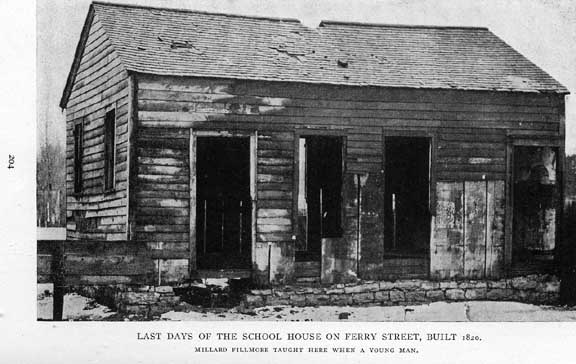
Ferry Street Schoolhouse source

Ferry Street Schoolhouse
source

He was educated in the school in a schoolhouse on Ferry Street that was known as Buffalo District School #2 at the time.  One term, his teacher was Millard Fillmore, who taught while he was also reading law and serving as postmaster.  At the time, the actual Cold Springs still flowed through the neighborhood.    The waters from this spring became the Jubilee Water Works, one of Buffalo’s first water systems.  The springs feed into the lake in Forest Lawn Cemetery.

As a young man, Alvan, Junior acquired a farm of several hundred acres, bounded by Main, East Ferry, Best and Jefferson.  Mr. Dodge built a house at the corner of Main and Dodge Streets, using lumber cleared from his property to build the house.

He sold part of his land to the City of Buffalo in 1880.   After selling the land to the City, he subdivided the remainder of his property for development and laid out streets on his land.  The area became the place for many prominent German families to live.   Legend has it that there was one field that grew the best corn around, so Mr. Dodge refused to convert it to a building lot.

The City used the property they had purchased to build a reservoir.  At the time, the City relied on reservoirs for water service.  This reservoir was known as Prospect Reservoir, since it replaced the reservoir of the same name which was located on Prospect Hill.  When the Colonel Ward Pumping Station opened in 1915, it rendered most of the reservoirs obsolete.

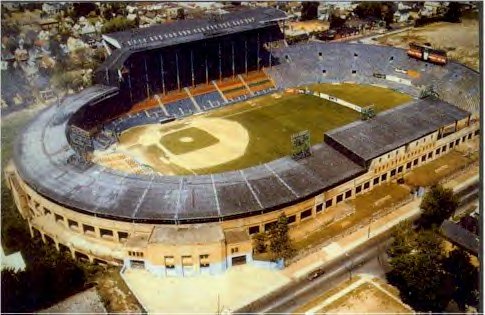
1988 WAR MEMORIAL STADIUM BUFFALO COLOR edited The reservoir sat unused until the 1930s.  Between 1936 and 1938, Buffalo Civic Stadium was built as a WPA project.  It was originally going to be named Roesch Memorial and then Grover Cleveland Stadium before Buffalo Civic Stadium became its official name.  The stadium was nicknamed “The Rockpile” since it seemed to rise out of the quarried land that had been the reservoir.  The stadium became home of the Buffalo Bills football team in 1946.  The stadium was renamed War Memorial Stadium in 1960.  The Buffalo Bisons baseball team used the stadium after Offerman Stadium at Michigan and East Ferry was demolished.  The Bills left the stadium in 1972 when Rich Stadium was built.  The Bisons left the stadium when Pilot Field opened in 1988.

Once the stadium was empty, many of the nearby residents wanted the stadium demolished.  The stadium hadn’t been maintained well during its final years and was in poor condition..   The Dodge-Jefferson and the Best-Jefferson entrances are all that remain today of War Memorial Stadium, which has been converted into the Johnnie B. Wiley Sports Pavilion.   Johnnie B. Willey was a city resident who worked to help young people of the East Side.

Dodge Mill in Williamsville source:  http://www.edyoungs.com/images/dodgemillfront.jpg

Dodge Mill in Williamsville
source

Alvan’s brother, J. Wayne Dodge moved to Williamsville and purchased the flour and grist-mill in 1864 and changed its name to Dodge Roller Mills. The Dodge Mill was across Glenn Falls from the Historic Williamsville Mill that is still standing today.   Dodge Road in Amherst is named after J.Wayne Dodge.  The Dodge Mill burned in 1894, Johnathan Dodge lost is life battling the fire.  The foundations of the mill are still visible near the wall of the creek behind Mill Street.

dodge tombstone

Alvan Dodge married Ruth Bosworth of Clarence.  They had four sons and three daughters.  He died in 1881 at the age of 73 and is buried in Forest Lawn.  The Buffalo Courier said that “his life was quiet and relatively uneventful, yet his life was the history of Buffalo”.

To read about other streets, be sure to check out the Street Index.

Sources:

  1. “Dodge Street Memorial to Pioneer” Courier Express May 21, 1939, sec. 7, p. 5
  2. Steele, O.G. “The Buffalo Common Schools”.  Publications of the Buffalo Historical Society, Volume 1.  Pg. 405.
  3. Smith, H. Perry.  “History of the Town of Amherst, Chapter XXXIX” .  History of the City of Buffalo and Erie County.  D. Mason & Co Publishers:  Syracuse, NY 1884.

Read Full Post »

This week marks two years since I started my Buffalo Streets project.  It  started when I began researching how Keppel Street was named.  I started to uncover these stories, and I needed to share them with the world.  I am blown away by all of your love and support; I amazed that anyone reads what I write.  It makes me really proud of our city and our heritage that so many people are interested in learning more about it.   Our history is something to be proud of, and as we are redeveloping and revitalizing our City, I think it’s important to take note of where we have been.

I apologize that I don’t get to update more frequently.   I prefer to have well developed posts, rather than quick updates.  Life, work and exploring the city often gets in the way.   I hope to update more often this summer.  I’m making it my goal to write a post at least twice a month for the coming future.  I have lots of research on many streets that I have not published yet, so if you  ever have a question about a certain aspect of Buffalo history, feel free to email me (buffalostreets (at) gmail.com to ask.  

Also, I have been doing a few speaking gigs, presenting on Buffalo history and architecture.  Let me know if you’re interested in having me speak to your group.  

Thanks to everyone who reads the blog and shares it with their friends.  It’s been an adventure to really dig into our city’s history.  I have so much more to learn.  Thanks for coming around for the ride!

Read Full Post »

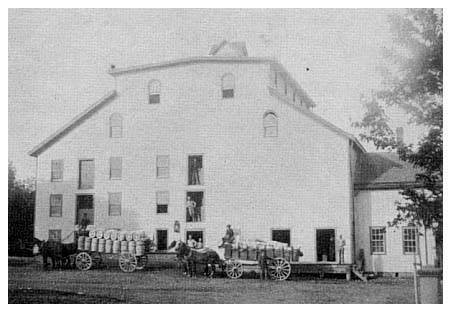
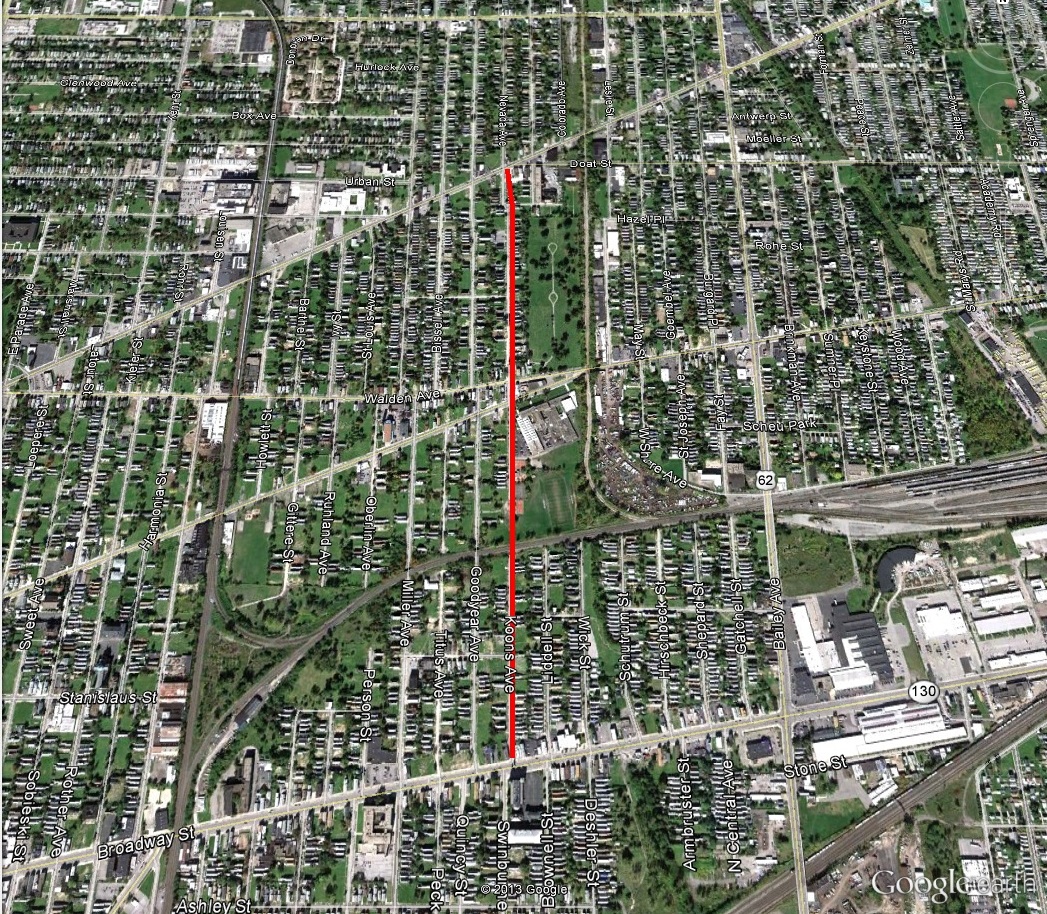
koonsaveKoons Avenue is located in the Emerson Neighborhood of the East Side of Buffalo.  Koons Avenue was named for the Koons brothers, Henry and Edward, who developed the neighborhood along with Judge Titus and Frank and Henry Goodyear.

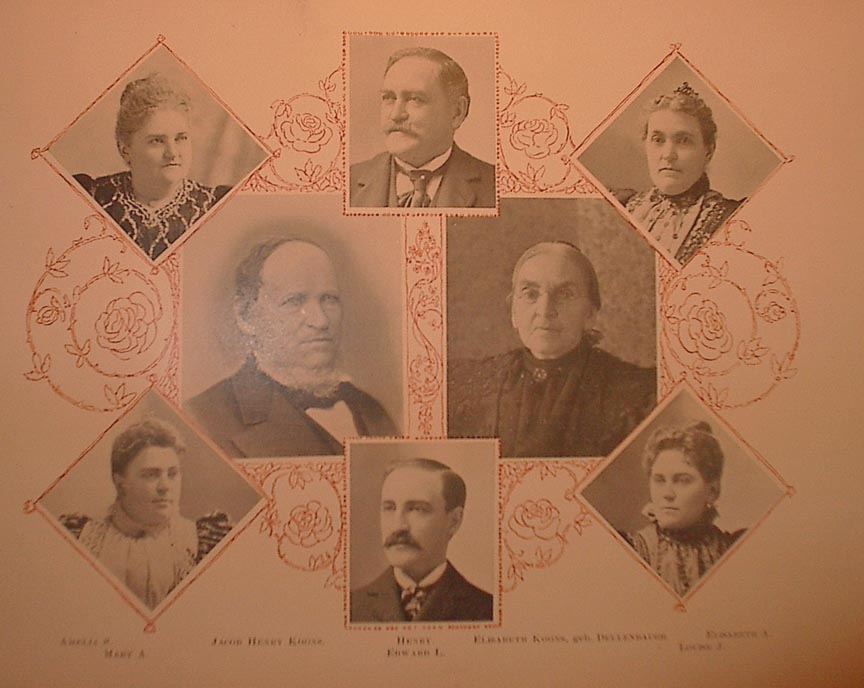
The Koons brothers, Edward and Henry, were born into a prominent Buffalo family.  Their father, Jacob Koons, was a merchant, political official and a leader in church and charitable affairs.  Jacob came from Europe in 1828 and became a farm hand outside of Albany, new York.  He came to Buffalo in 1832 and established a store (history books refer to it as an emporium)  for the sale of clocks, dry-goods and groceries at Main Street near Genesee.   The store was successful and branched out to a second store in Paris, Ohio.  Jacob Koons left the business in 1848.  He was then involved in local politics.  He was appointed Superintendent of the Poor in 1856.    Jame Koons, along with his wife and six children, lived at 73 East Huron.  Jacob Koons was a member of St. John’s Lutheran on Hickory Street and was involved in building and improving St. John’s Orphan Home.   You can read more about the Orphan Home here.   Mr. Jacob Koons died on May 9, 1889.

Top: Amelia, Henry, and Elisabeth Center:  Jacob and Elisabeth, nee Dellenbaugh Bottom:  Mary, Edward and Louise

The Koons Family
Top: Amelia, Henry, and Elisabeth
Center: Jacob and Elisabeth, nee Dellenbaugh
Bottom: Mary, Edward and Louise

Henry Koons was born in Buffalo on October 9, 1838 and was educated in the public schools.  He worked for the American Express Company for two years.   Henry then headed West to learn the trade of tanning with G. Pfisler & Company of Milwaukee, Wisconsin.  He returned to Buffalo a few years later.  He worked as a search clerk in the County Clerk’s office from 1865 to 1871, engaging in abstracting and tracing titles.  During his time in the clerk’s office, he also started working in the real estate business.   He set up his real estate shop on the 400 block of Main Street.  On June 1, 1884, he formed the firm Henry & Edward Koons, when his brother joined the firm.   Henry boasted that the reason for his success was that his guiding principle was absolute honesty in all business transactions.

Edward Koons was born on October 1, 1861.  He was a schoolmate of Francis Folsom, future wife of President Grover Cleveland.  Edward read law in the office of William Glenney.  His knowledge of law and real estate helped him to become a great success in the real estate business.  He founded and was president of Abstract Title and Mortgage and was director of Buffalo Insurance for more than 50 years.  He was the first Vice President of Buffalo Savings Bank and in 1920 became president of the Chamber of Commerce.

The brothers helped Grover Cleveland become Mayor by managing his campaign.  They were prominent in his campaign for Governor and President as well.  The brothers helped Grover Cleveland become Mayor by managing his campaign.  They were prominent in his campaign for Governor and President as well.

Edward and Henry, along with Judge Titus and Frank and Henry Goodyear, bought a large amount of East Side land and quickly resold it for development.

Sylvanite Gold Mines Kirkland Lake, ONIn 1891, Edward opened the Erie County Guaranteed Search Company, an abstract and title search company.  In 1906, Edward Koons was appointed a member of the commission to revise the City Charter.

The Koons brothers invested their profits in gold mines in Ontario, calling their venture Sylvanite Gold Mines.  Sylvanite is found in the Kirkland Lake Gold District in Canada.  The mine was active until 1961.  Henry Koons never married and died in April 1904 in Buffalo.

Edward married Anna Hengerer, daughter of the founder of Hengerer’s Department Store.  Edward and Anna lived at 1131 Delaware Avenue, which is commonly referred to as the Charles Germain House, after the first resident of the house.

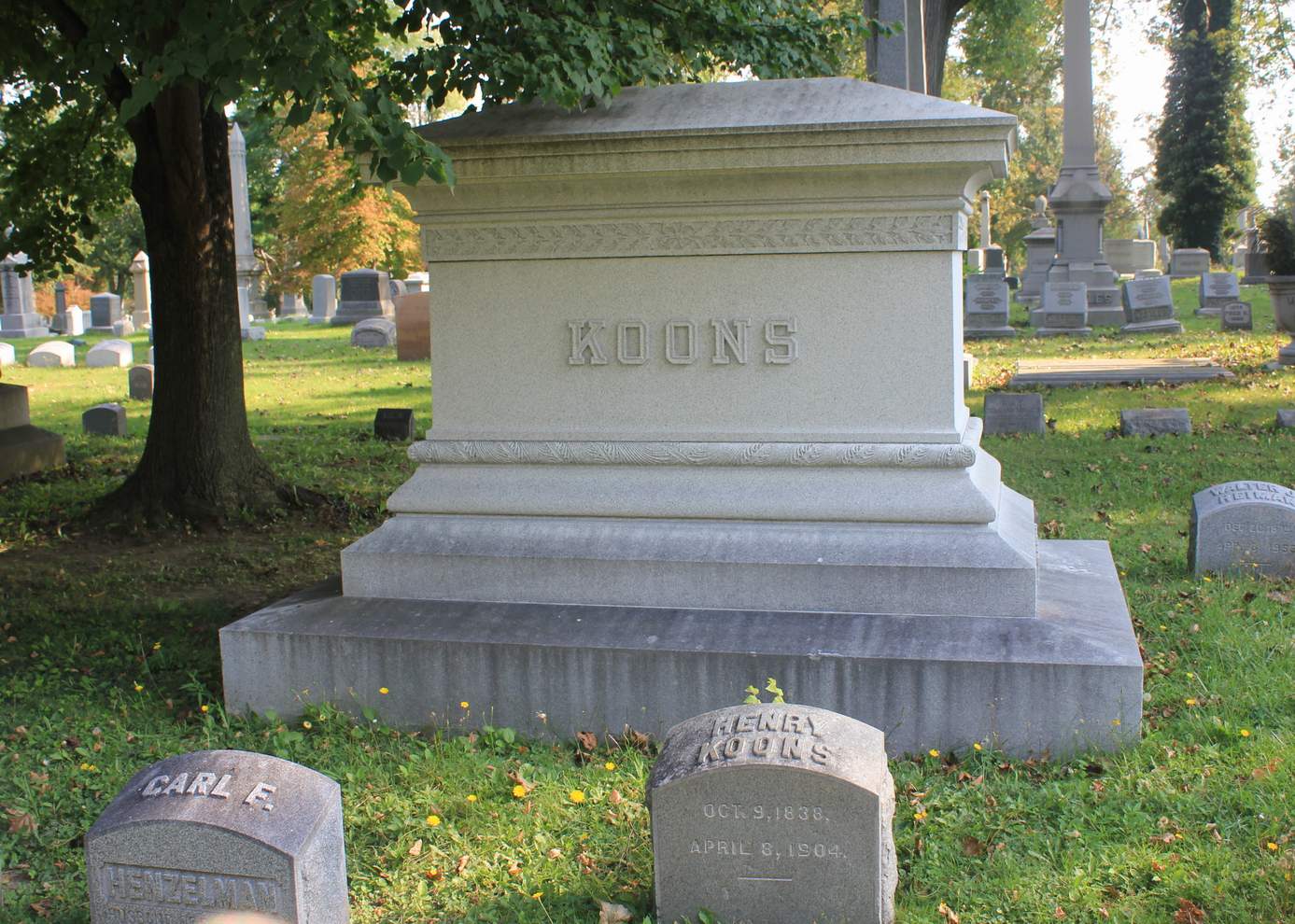
Edward Koons died at eighty-four in the Park Lane Apartments in February 1946.  Edward and Henry are both buried in the Koons plot in Forest Lawn Cemetery.

Koons Plot in Forest Lawn

Koons Plot in Forest Lawn

Learn about other streets in the Street Index.

Sources:

  1. Our County and it’s People:  A Descriptive Work on Erie County, New York.  Edited by: Trumen C. White.  The Boston History Company, Published 1898.
  2. Recalling Pioneer Days.  Volume XXVI, Publications of the Buffalo Historical Society.  Edited by Frank H. Severance, 1922.
  3. History of the Germans in Buffalo and Erie County.  Reinecke & Zesch, Publishers.  Buffalo NY 1898.

Read Full Post »

knox street

Today’s post was inspired by my trip this past week to the Knox Farm for the Junior League’s Decorator’s Showhouse.  The house is open until May 19th.  The Aurora Historical Society is also doing walking tours of the Village of East Aurora that includes Millard Fillmore’s House and the Elbert Hubbard Museum.  I highly recommend heading out to East Aurora to do both these things!   Knox Street is a small street in North Buffalo, just north of Delaware Park.  The street is named after Seymour H. Knox I.  The Knox family has been an important family in Buffalo since the early 1900s.

Seymour H. Knox I

Seymour H. Knox I

Seymour Horace Knox I was born in Russel, New York in April 1861.  His great-grandfather fought in the American Revolution after coming to Massachusetts from Belfast, Ireland in 1737.  Seymour attended local schools.  At 17, he moved to Hart, Michigan, where he worked as a sales clerk.  He then moved to Reading, Pennsylvania where he entered into a partnership with his cousins.  The Woolworth & Knox store opened on September 20, 1884.  Seymour used his entire life savings to enter into the partnership.  The second store opened in Newark, New Jersey and the third store opened in Erie, Pennsylvania.   The first Buffalo Store opened in Buffalo on October 13, 1888 at 409 Main Street.  In 1889, he bought out his cousins, but kept a business relationship with his cousins after the buyout.

Seymour opened S.H. Knox Co 5 and 10 Cent Store in 1890, partnering with Earle Perry Charlton.  The first store was in the 409 Main Street location.  He second store opened at 549 William Street on June 20, 1891.  In 1893, the Main Street store moved to 519 Main Street after the first store was destroyed by a fire.  In 1895, the store moved to 395 Main Street.

S. H. Knox & Co. 5 & 10c store, 115-117 West National Ave., BrazAt the time of the 1911 incorporation of F.W. Woolworth Company, Knox operated 98 US and 13 Canadian locations.  In 1912, he received $12 Million of the merger proceeds and was appointed Director and Senior Vice President of the Corporation.

In 1913, Seymour purchased Stephen Clement’s interests in Marine National.  At his death, Seymour was Vice President of the Woolworth Co. and Chairman of the Board of the Marine Trust Co.  He was the first of three generations of the family to serve as Chairman.

knox house porter avenueSeymour married Grace Millard in 1890.  Seymour and Grace first lived at 414 Porter Avenue.   They then moved to 467 Linwood Avenue.

Seymour then built the house at 1035 Delaware Avenue in 1903.   The Knox family lived in the 1035 Delaware House until 1918.  They had three children:  Seymour II, Marjorie and Dorothy.  Grace established the University of Buffalo’s first endowment fund in 1916 when she donated $250,000.

1035 Delaware

Following Seymour I’s death, Grace Millard Knox began construction on the 806 Delaware Ave Mansion following her husband’s death.  The Grace Millard Knox house is now known as 800 Delaware Avenue and is now owned by Computer Task Group.

800 Delaware Avenue - The Grace Mallard Knox House

800 Delaware Avenue – The Grace Mallard Knox House

Seymour’s sister Dorothy Knox married Frank Goodyear.  Dorothy and Frank built the Knox Farm House in 1916 as a summer home.  She later sold the house to her brother, Seymour II.  Following Seymour II’s death, Seymour III and his wife lived in the Knox Farm house.  New York State acquired the 633-acre farm in 2000 to create the Knox Farm  Park.  The house is currently on display through the end of May as the Junior League’s Decorator’s Showhouse.

Knox Summer House on the Knox Farm in East Aurora

Knox Summer House on the Knox Farm in East Aurora

Seymour Knox I died on May 17, 1915.  He is buried in Forest Lawn at the Knox Mausoleum.

Knox Mausoleum at Forest Lawn

Knox Mausoleum at Forest Lawn

Seymour II and his wife Helen

Seymour II and his wife Helen

Seymour II was born on September 1, 1898 and was known as Shorty due to his height.  Shorty attended Hotchkiss Preparatory School and graduated from Yale in 1920.  His interest in art began with his parents, who were active in the Buffalo Fine Arts Academy.   He joined the Board of the Buffalo Fine Arts Academy in 1925.  In 1939, he and his family donated money to establish a room of contemporary art in memory of Grace Millard Knox.  The gallery used this money to purchase works by Picasso, Matisse, Mir, Mondrian, Beckmann and Braque.

During the 1950s, the director of the gallery allowed Shorty to buy pieces by abstract expressionist painters.  The Albright was the first museum in the world to buy works by Clyfford Still.  The artist gifted 31 paintings to the gallery.

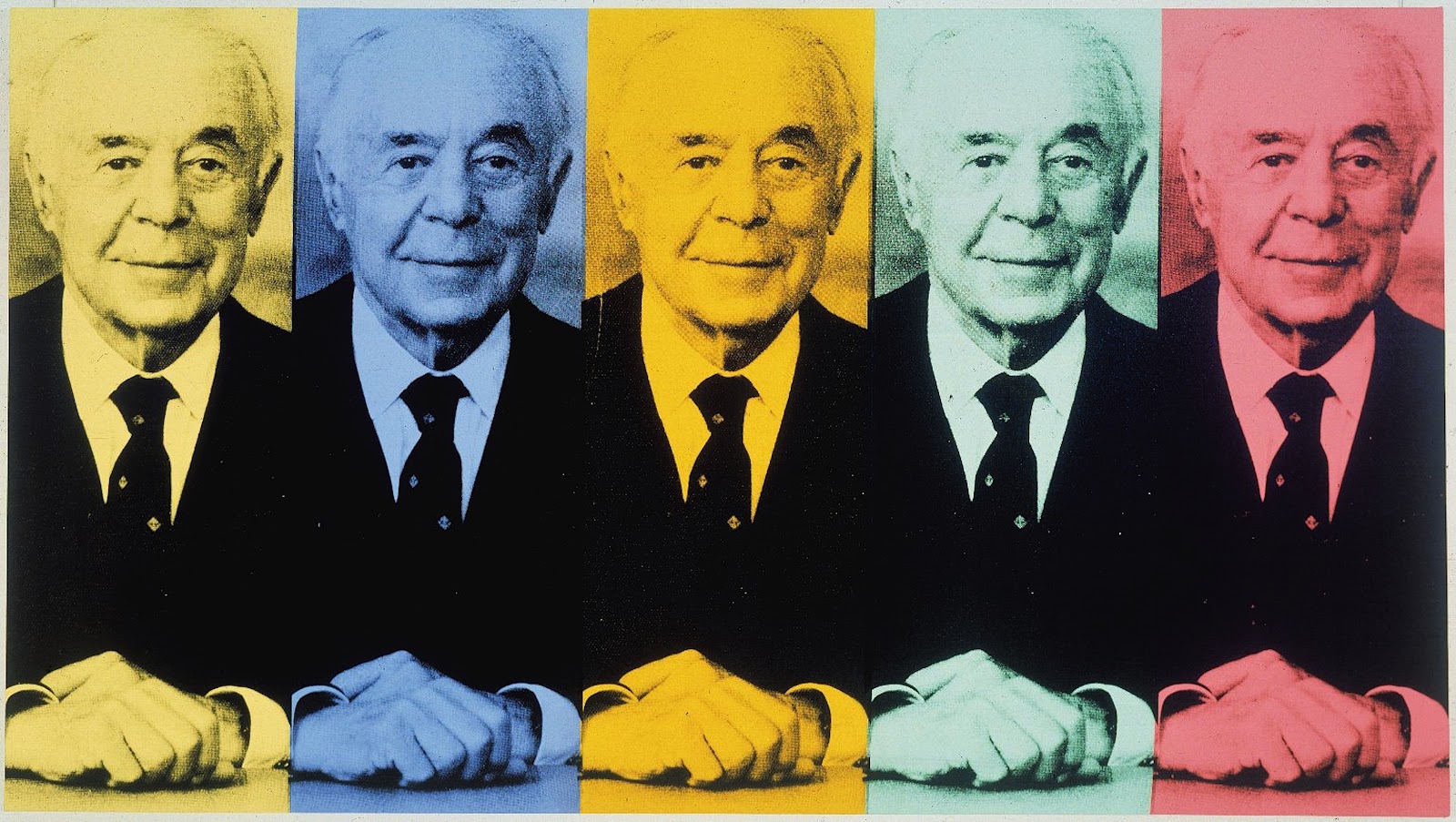
Andy Warhol Portrait of Seymour Knox II

Andy Warhol Portrait of Seymour Knox II

Shorty served as chairman of the New York State Council on the Arts from 1960 to 1975.  In 1986, he was awarded a National Medal of Art at the White House by President Reagan for his contributions to the arts in Buffalo and the Nation.

Shorty married Helen Northrup Knox.  Helen and Shorty lived at 57 Oakland Place, in a house on the estate of Grace Millard Knox’s 806 Delaware Avenue mansion.  They had two children, Seymour III and Northrup Rand Knox.  Shorty died in 1990.

Seymour Knox III dropping the puck at the First Sabres Game, 1970

Seymour Knox III dropping the puck at the First Sabres Game, 1970

Seymour III was born in March 1926.  Seymour III was educated at Yale and Columbia before becoming a Corporal in the United States Army Field Artillery in World War II.  He then embarked in a successful banking career.

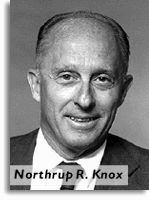
Northrup Knox was born 1928.  Northrup served as Chairman of Marine Midland Bank, Director of the Seymour Knox Foundation, and Vice President and Director of the Buffalo Fine Arts Academy.

KnoxNNorthrup was closely associated with the University at Buffalo, following in the family connection with UB that started with his grandmother’s endowment fund.  Northrup served as director of the UB Foundation.  Northrup received the UB President’s Medal in 1994.

Northrup and Seymour III are best known in Buffalo for bringing major league hockey to Buffalo with the Buffalo Sabres in 1970.  The Sabres colors of blue and gold were chosen because those were the colors of the Knox family Polo team. The Knox brothers first applied for a NHL franchise in 1965, but were unsuccessful.  In 1969, their efforts to bring a team to Buffalo were successful.  They assembled what was considered to be a top-rated operation.  The Sabres qualified for playoffs in only their third season and reached the Stanley Cup Finals within the first five seasons.

In 1975, Seymour III was named the Hockey News Executive of the Year.  Seymour III served on the NHL’s Board of Governor’s for 25 years and was director of the US hockey Hall of Fame.  The Knox brothers were also behind the establishment of the Buffalo Bandits lacrosse and Buffalo Blizzard soccer teams.  Seymour III was inducted into the Hockey Hall of Fame in 1993.   Northrup and Seymour III were both inducted into the Greater Buffalo Sports Hall of Fame in 1992 and the Buffalo Sabres Hall of Fame in 1996. The brothers owned the Sabres until their deaths in 1996 and 1998.

The Knox family is still an important family in Buffalo today.  Seymour IV is on the board of several local organizations.

Be sure to check out the Street Index to learn about other streets.

You can also check out Discovering Buffalo…One Street at a Time on Facebook.!

Sources:

  1. “Knox Street Named for Seymour H. Knox” Courier Express July 13, 1941, sec 7 p 6
  2. http://www.friendsofknoxpark.org/pdfs/Preservation_Plus_Tour_%20Knox.pdf
  3. Glueck, Grace.  “Seymour H. Knox Is Dead at 92;  Buffalo Banker Was Art Patron”.  New York Times Obituaries.  September 28, 1990.  http://www.nytimes.com/1990/09/28/obituaries/seymour-h-knox-is-dead-at-92-buffalo-banker-was-art-patron.html
  4. “Northrup R. Knox, 69, banker sportsman, community leader”.  UB Reporter Obituary.  Volume 30, Number 1.  August 27, 1998.
  5. http://www.legendsofhockey.net/LegendsOfHockey/jsp/LegendsMember.jsp?type=Builder&mem=B199301&list=ByName

Read Full Post »

titusgoodyearkoonsTitus Avenue is a street running between Broadway and Walden in the Emerson Neighborhood of the East Side of Buffalo. The street was named for Judge Robert Titus.  Judge Titus went into a partnership with Charles Goodyear, Frank Goodyear, Edward Koons and Henry Koons to subdivide and develop the land on these streets.  You can read about the Goodyear brothers by clicking here.

Robert Cyrus Titus was born in Eden, New York  in October 1839.  His parents came from Otsego County, New York to the “far west”, as the Holland Purchasewas called in 1817.  At the time, there were no roads through the countryside surrounding the small Village of Buffalo.  Guideposts along the way were blazed trees along the lines most frequently traveled by the occasional settler.  By 1831, they had plowed fields and built a house with a large fireplace and dutch oven.  In this house, Robert Titus grew up, the youngest of six siblings.

judgetitusRobert Titus was educated in a one-room school-house and then attended Oberlin College.  He taught school during the winter term to help finance his own education.  He studied law and set up a practice with Horace Boies in Hamburg, New York.  He opened a practice in Hamburg, New York.  In 1863, Mr. Titus organized a company, which became part of the 98th Regiment of the National Guard of New York State.  The regiment was in service from August 10, 1864 to December 22, 1864.  After he returned home, he was admitted to the bar.  Shortly thereafter  he was appointed Special Deputy Clerk of Erie County and held the office until 1864.  In 1867, he was a candidate for the New York State Assembly, but was defeated.  His first public office was Supervisor of Hamburg from 1868-1871.

In 1873, Mr. Titus moved to Buffalo with his wife Arvilla  to enter into a partnership with Joel Walker.  In 1878, he was elected district attorney.  In 1879, Mr. Titus was made a partner in the firm of Osgoodby, Titus & Moot and practiced with them until 1883, when he formed a partnership with B.S. Farrington.   In 1881   he went to Albany as a State Senator.  During his term in Albany, there was a great opposition to the Erie Canal, however Robert was a strong supporter to keeping the canal open.

In 1885, Mr. Titus was elected Judge of the Superior Court of Buffalo.   He was made Chief Judge in 1891.  When the Court was abolished in 1895, the judges were transferred to the New York Supreme Court.

An Artist's Depiction of President McKinley's Assassination.

An Artist’s Depiction of President McKinley’s Assassination.

Robert Titus was considered to be one of the state’s leading trial lawyers before he ascended to the bench. He was chosen by the state Bar Association to defend  President William McKinley’s assassin in 1901.  The trial of Czolgosz was notorious for how quickly it was completed.  President McKinley died on Saturday, September 14th, Czolgosz was indicted on Monday September 16th.    The jury for the trial was selected in two hours and twelve minutes.  The trial began on September 23rd, as soon as the final juror was named.  By the following afternoon, it was over.  Judge Titus had been in Milwaukee attending a masonic convention when he heard he was assigned to the case.

While the judges were highly respected, neither he nor his partner on the case, Judge Loran Lewis, had worked as a trial lawyer in years.  Judge Titus and Judge Lewis had not wanted to represent the assassin; however, they took the side of justice to ensure that he was given a fair trial.  The public outrage over the murder of the President was demanding a speedy trial and at the time, there was fear that it might not be a fair one.  It was a credit to the both of theirs honor that they ensured that Czolgosz was dignified with a fair trial and not disposed of by “lynch or mob law”.  Czolgosz assisted with the trial’s speed by refusing to cooperating with his legal counsel.  Czolgosz tried to enter a plea of guilty; however, due to the magnitude of the trail, he was not allowed. The jury took only 30 minutes to determine that Czolgosz was guilty and he was sentenced to death on September 26th.   One month later, Czolgosz was electrocuted in Auburn Prison.

Judge Titus' House on Columbus Parkway

Judge Titus lived on Seventh Street.  The portion of 7th Seventh Street on which he lived later became Columbus Parkway.  Mr. Titus died on April 28, 1918 at the age of 79.  He was survived by his son, Lieutenant Allan S. Titus, and daughter, Amy Titus Worthington.  Judge Titus is buried in Hillcrest Cemetery in Hamburg, New York.

Don’t forget to check out the Street Index to find out about other streets!

Sources:

  1. Contemporary American Biography:  Biographical Sketches of Representative Men of the Day.  Volume 1, Part 2.  Atlantic Publishing and Engraving Co:  New York, 1895.
  2. Lord, Walter.  The Good Years:  From 1900 to the First World War.  Kessinger Publishing, LLC, 2007.
  3. Our County and its people:  A descriptive work on Erie County, New York.  Edited by: Truman C. White.  The Boston History Company, 1898
  4. Miller, Scott.  The President and the Assassin.  Random House Publishing Group:  New York, 2011.
  5. “Assassin Czolgosz Refuses to Plead:  His Lawyer Enters a Provisional Plea of Not Guilty”.  New York Times, September 18, 1901.
  6. Obituary of the Honorable Robert C. Titus.  Buffalo Morning Express, Sunday April 28, 1918.

Read Full Post »

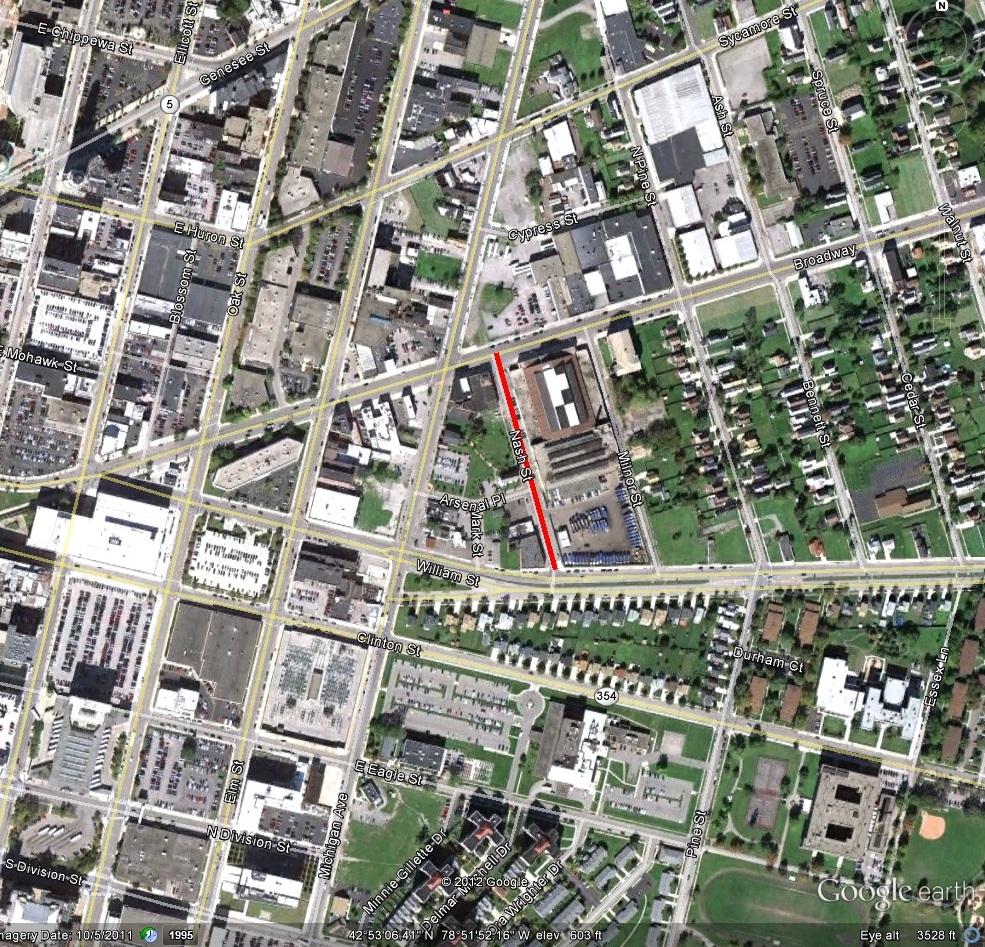
Nash Street is a short street a close walk from the Central Business District, between Broadway and William Street near Michigan Avenue.  The street is less than a quarter-mile long, but is a part of the rich history of Buffalo.  Nash Street was known as Potter Street until the 1950s.

The Street is named after Jesse Edward Nash, Sr.  Dr. Nash was one of the City of Buffalo’s most prominent African-American citizens for the first half of the 20th Century.

J. Edward  Nash was born in Occoquan Virginia in 1868.  He worked as a farm hand, a blacksmith, a mason and a boatman.    He was a student at Virginia Union College in Richmond with Reverend Adam Clayton Powell, Senior, the pastor of Harlem’s Abyssinian Baptist Church.   Rev. Powell’s son was the first African-American elected to congress.  Reverend Nash became a minister at age 18.  At age 24, he came to Buffalo in 1892 to serve as pastor of Michigan Avenue Baptist Church.  He was pastor from 1892 until he retired in 1953.   Dr. Nash married Frances Jackson in 1925 and moved to 36 Potter Street in 1925.  Dr. and Mrs. Nash had one son, Jesse Junior, who became a professor at Canisius College.

Dr. Jesse Edward Nash, Senior

The City of Buffalo has had a strong history of African-Americans living in freedom.  When the City was incorporated in 1832, the city directory listed the names of 68 colored heads of families.  The majority of the African-Americans in Buffalo lived in the 4th Ward of Buffalo at the time – east of Main Street between North Street and South Division Street.  Michigan Avenue was the heart of the African-American neighborhood.  The Michigan Avenue Baptist Church was founded in 1836.  The current church was built in 1845, prior to this, they worshiped in a meeting room on Niagara Street near Pearl Street.

During the early 1900s, Buffalo’s African-American community was growing quickly, due to the City’s industrial economy.  When Dr. Nash came to Buffalo, there were only three established African-American churches.  By 1952, there were more than 30 churches.  Because of his education, Dr. Nash was well respected and he became one of the main representatives and spokesperson for the City’s African-American Community.

Reverend Nash helped to found the Buffalo Urban League.  This functioned as an agency to welcome African-Americans to Buffalo when they arrived from the south, by helping them find housing and jobs.  The Buffalo Urban League is still in operations today.

Reverend Nash was unique in his role in Buffalo.  He was widely respected by the city’s white leadership, so he had access to the Mayor and elected officials.  This was uncommon in many other cities during this time.   He worked to put together community meetings of black Buffalonians to intercede on behalf of other black citizens who were being wronged because of their race.

Dr. Nash was well-known, not just in Buffalo, but throughout New York State and the entire country.  He hosted Booker T. Washington in 1910 in Buffalo.  In addition to Mr. Washington, many nationally known African-American leaders were guests of Dr. Nash’s, including WEB DuBois.  Dr. Nash’s neighbor was Mary Talbert, another significant African-American in Buffalo during this time period, but we’ll get to her later (there’s a street named after her as well).

In 1912, Virginia Union University awarded Nash an honorary doctorate.  Dr. Nash served as treasurer of the Western New York Baptist Association, secretary of the Baptist-Disciples Ministers Fellowship.  He was chaplain at Meyer Memorial Hospital (the predecessor to ECMC).

During the 1950s. Buffalo was undergoing a series of urban renewal projects.  Many of these projects impacted African-American neighborhoods disproportionately.   Dr. Nash advocated for fair housing and worked to stop the loss of affordable housing which was occurring under the name of “slum clearance”.

Dr. Nash retired as pastor in 1953.  To commemorate his retirement, the City renamed the street from Potter Street to Nash Street.  In 1954, Dr. Nash was awarded one of the first Brotherhood Awards from the National Conference of Christians and Jews.  He passed away in 1957 and was survived by his wife and his son Jesse Edward Nash, Junior.  He is buried at Forest Lawn.

Nash House, 36 Nash Street

The Nash House is located at 36 Nash Street.  The Buffalo Preservation Board and Buffalo Common Council designated the NAsh House a local historic landmark in 2001.  The house was originally built as a two-family residence, with an upper and lower unit.  Many of the houses in Buffalo were built like this as a practical form of housing for the urban middle class.   The Nash family lived on the second story of the house and rented out the lower floor.

The house was built around 1900.   Few changes have occurred through the years, and the historic integrity of the structure has been preserved.  The house and its contents, which included most of Dr. Nash’s papers, were acquired by the Michigan Street Preservation Corporation in 2000.  Restoration from 2002-2003 included restoration of the clapboard, windows and front porch.  The Nash family living quarters is fully restored, and the lower levels was rehabilitated for office and research space.

Dr. Nash and his family lived in the house from 1925 until 1987.   He passed away in 1957, but his widow occupied the house until she died in 1987.

The Nash House was restored and opened as the Nash House Museum in May 2007.   The museum provides a glimpse into what life was like in the early 1900s on Buffalo’s East Side.  The museum is open Thursdays and Saturdays from 11:30-4pm.   My interest has been piqued and I intend to check out the museum, hopefully this weekend.

For more information on the Michigan Street Heritage Corridor Commission and some of the amazing African-American history of Buffalo that happened in this neighborhood, please read this report prepared for the Commission by a UB Planning Studio.  

Dellenbaugh Block

This neighborhood has a personal history for me, as my uncle owned the complex of buildings known as the Dellenbaugh Block at the corner of Broadway and Michigan for much of my childhood.  He operated a car wash and pizzeria on the Broadway side of the block.  There was a pharmacy on the Michigan side of the building which always reminded me of the pharmacy in It’s a Wonderful Life.  The pharmacy here in this building was the first 24-hour pharmacy in Buffalo.

The Langston Hughes institute has plans to develop the Dellenbaugh Block.   More on their plans can be found here.

Some of my most vivid childhood memories were spent exploring that building and being fascinated by the neighborhood and the history.  The dark and scary basement of the building always freaked me out, because legend has it that it was a part of the underground railroad.  Portions of the building were built in 1842.  The city lists the building as being built in 1890, but to my childhood imagination, there were civil war era ghosts in that basement.

The Dellenbaugh Block is a designated landmark with the City of Buffalo.  The block is named for Frederick Dellenbaugh, a German immigrant.  Mr. Dellenbaugh was a physician and built his home and office at 173 Broadway circa 1842.  The house is visible from Nash Street, behind the newer storefront.   The storefront was the location of a Deco restaurant in the 1930s.

Broadway Arsenal in 1858

Across Nash Street is the Broadway Barns, a City of Buffalo DPW garage.  This building was originally designed as a New York State Arsenal.  Portions of the original circa 1865 armory still exist and can be seen from the inside of the building.  Once the regiments left the Arsenal, the building was converted to an exposition and event hall.
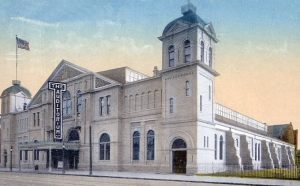
Broadway Auditorium in 1915

This was used for events prior to the construction of the Buffalo Memorial Auditorium on the Terrace.  There are pictures of elephants walking down Broadway to get to the circus at the old Broadway Auditorium.   After the Memorial Auditorium was built, the Buffalo Streets Department began using it as a garage.  What a change this building has seen in the past 150 years!  What a history in this little pocket of a neighborhood!


Check out the Street Index to learn about other streets in Buffalo.


Sources:

Cottrell, Kevin.   “J. Edward Nash History”.  accessed at: http://www.motherlandconnextions.com/nash.html

“Dr. J. Edward Nash, Sr.” (Obituary).  Buffalo Courier Express.  27 January 1957

http://www.showcase.com/property/163-173-Broadway-Street/Buffalo/New-York/1435912

http://greaterbuffalo.blogs.com/gbb/2005/12/campaign_landma.html

http://www.nashhousemuseum.org/history.html

Read Full Post »

Sanborn Map depicting Polonia Park in 1925

While researching Curtiss Street, I noticed that there was Polonia Park marked on some of the maps.  I have a great interest in the Broadway-Fillmore neighborhood and the area around the Central Terminal in particular, and I had never heard of this before.  I got sidetracked from my street researching and ended up finding out some interesting stuff which I would like to share with you all.  I know it’s not a street history, but hopefully you all will enjoy these tidbits of information as much as I do.

Polonia Park was located on Curtiss Street prior to the Central Terminal’s construction.  The park was purchased by the City in 1913 at the same time as the land for Schiller Park, Willert Park, an extension to Riverside Park and an addition to Lanigan Park.

In June 1916, the Buffalo Live Wire (a publication published monthly by the Buffalo Chamber of Commerce) posted that “A well-prepared city plan is indispensable to the intelligent acquisition of park properties, and if we enjoyed the guidance of a city plan in our recent campaign for additional parks, we would not now be wondering why we purchased, at a cost of $60,000, Polonia Park, consisting of lands useful for neither park nor playground.”

The article did not elaborate on this, but my guess is that because the land had been part of the railroad corridor, it was ill-suited for parkland.  Railroads use a great deal of pesticides to keep foliage from blocking the tracks, as can be seen when abandoned railroad corridors are still free from most grasses and shrubs long after the trains stopped coming through.  The West Shore Railroad, which connected Buffalo to New York City formerly cut through this park, following approximately the path which Memorial Drive follows today.

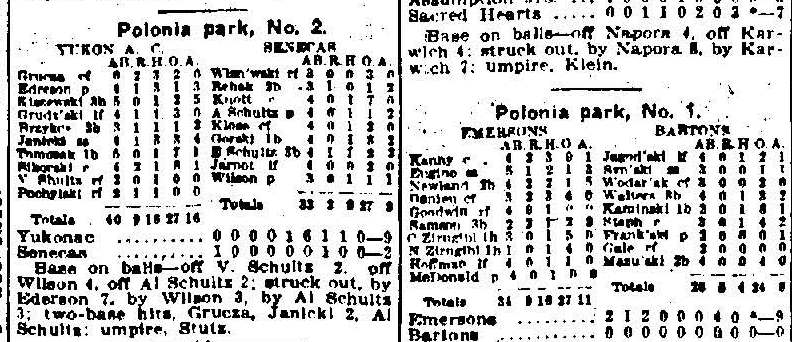
Despite the reports that the land was not useful as a park, the park was used during the early 1920s, as there are reports in the newspapers of baseball scores for games played in Polonia Park.

August 24, 1924
Buffalo Morning Express

By March of 1925, the property was owned by the Buffalo Board of Education as the intended site of the Peckham Vocational School.   Peckham Vocational was located at the corner of Peckham and Townsend, however they originally started out in the Adam Mickiewicz Library on Fillmore while the original school was being constructed.   As this ad from the Buffalo Morning Express, August 29, 1922 shows, there were four vocational schools in Buffalo at the time.  This was the time when many students would go out in the world to work after they completed 8th grade.  Vocational schools were a way to continue your education, while also learning a useful trade.

Ad for Vocational Schools
Buffalo Morning Express, August 29, 1922

Peckham Students

Peckham Vocational was a source of pride for Buffalo’s polish community.  The residents of Polonia were concerned that the high schools located in Buffalo were overlooking their community, so the residents rallied successfully to open a school in their neighborhood.  Peckham Vocational opened in 1911.  Board of Education had plans to build a new school and was about to let the contract to build when the railroad approached them to purchase the property to build what at the time was being called the “Fillmore Station”.   In exchange for the Polonia Park property, the Board fo Education received the property at the corner of Sycamore Street and Koons Avenue.  Peckham Vocational School was renamed Emerson Vocational School in 1937, after the school’s superintendent.  The school operated at its Sycamore Street address for 62 years until 1999.  Since then, the building has been remodeled and renamed Harvey Austin Public School 97, and operates as an elementary school.

After I posted my post on Curtiss Street, Marty from Forgotten Buffalowas kind enough to share these pictures of another planned park in Polonia.  It was clear that the people who lived in this neighborhood wanted a park, since they used the land that the chamber of commerce called unsuitable for a park as a park, and then plans were development for this park around 1938.  For reference, this map north is towards the bottom.  This land is currently the residential neighborhood between the Central Terminal and Broadway.

New Park Design For Park North of Central Terminal

Sadly, this park was never built.  While the residents of Polonia had successfully rallied to get a school built in their neighborhood in 1911, it seems that they were unable to rally enough support to build a neighborhood park.  Perhaps because it would have involved tearing down houses?

Recent efforts have occurred at the Central Terminal to build an urban habitat in the vicinity of the former Polonia Park.  The Urban Habitat Restoration project is working to reclaim the land which was used as a parking lot during the height of the Central Terminal’s use as a train station.  This project is working to restore some of the landscape, using native plants and green sustainable methods.   For more on this project, check out the Central Terminal Website here.

Over the course of  the past 100 years, this piece of property has transformed from railroad corridor, to park, planned use as school, to use as a parking lot, and now is being restored back to natural landscape.  Not too shabby of a history for our little piece of land that was once known as Polonia Park.


Learn about the history of other streets in Buffalo by checking out the Street Index.


Sources:

  1. “Buffalo’s Towering Temple of Transportation”, Greg Jandura.  accessed online, July 25, 2012:  http://www.trainweb.org/wnyrhs/nyctermpt1.htm
  2. “Council Wants Action on New School Tract”  Buffalo Morning Express March 21, 1925, pg 11
  3. Buffalo Live Wire, Vol. VII, No. 6,  June 1916, published by the Buffalo Chamber of Commerce.
  4. “Again Central Secures Delay” Buffalo Express Dec 14, 1905
  5. http://www.buffaloschools.org/m/content.cfm?subpage=39590
  6. Bucki, Carl,  “Polish Vocational School Was The Source Of Community Pride”.  Am-Pol Eagle.  Access online: http://ampoleagle.com/polish-vocational-school-was-br-the-source-of-community-pride-p5222-147.htm
  7. Plans for park designed by Joseph Fronczak provided by Marty Biniasz.

Read Full Post »

Curtiss Street
Present Day Alignment

Curtiss Street is runs along the railroad tracks near the Central Terminal.  The street follows the curves of the railroad, which has been there since at least the 1880s.  The streets in the vicinity of the Terminal have changed a bit in the last 100 years.  More information about other streets will be coming in other blog posts.  Since the construction of the Central Terminal, Curtiss Street has run underneath the Terminal at the curve.  (click photos to enlarge for easier reading)

Curtiss Street in 1889

Curtiss Street in 1925

Curtiss Street in 1950

People often believe the street is named after Glenn Curtiss, known for Curtiss Aeroplane Company.  However, Glenn Curtiss wasn’t born until 1878, and the street was named by at least 1889.  While it would have been very interesting if the street had been named in honor of an 11-year-old who ended up being as remarkable as Glenn Curtiss, this was not the case.   I was unable to find any concrete evidence linking Glenn Curtiss to the other Buffalo Curtiss family.  If anyone has any information of their linkage, please let me know in the comments.  But no, Curtiss Street is NOT named for Curtiss-Wright airplanes.

Curtiss Street is named for Charles Gould Curtiss.  Mr. Curtiss was an officer of the Lancaster and Depew Land Company, which developed Curtiss Street and several other streets in its vicinity.

Mr. Charles Gould Curtiss was born in 1827 and grew up in Utica, New York.  He ran the news stand at the Utica Rail Station while he was a boy, and eventually became a produce salesman.  At the age of 23, he formed a connection with a wholesale grocer, which brought him to New York City.  He made many connections while in New York. For a short time, he became an executive of Breckinridge County Coal Oil Company in Louisville Kentucky.  He worked to substitute coal oil for sperm oil. The discovery of petroleum caused the business to fail, as the coal oil was no longer necessary.

In 1857, Mr. Curtiss came to Buffalo to join Levi Willard in the insurance business.  In 1873, he organized a barley and malt firm that continued to operate for nearly half a century.  Charles and his wife Amelia lived in a large stone house at 63 West Huron Street.  He kept his horses at Efner’s Livery Stable at Franklin and Chippewa, and it is said that he rode his horses through Delaware Park on a daily basis.  At the time, the roads were only paved as far as North Street, so riding to the park was a ride out to the country.

In 1882, Charles was a delegate to the Democratic Convention where his friend Grover Cleveland was nominated for Governor.  After his election, Cleveland appointed Mr. Curtiss to the Board of Trustees of the Buffalo State Hospital for the Insane.  The Curtiss family also kept a farm at Delavan and Main Street where he raised chickens and kept a cow.  He felt that “the country was the best place for growing boys”, so he spent a great deal of time on the farm with his sons Harlow and Alexander.   Although his own schooling was limited, Charles felt an education was important, so he sent both sons to college.

Alexander Curtiss House
(currently the Ronald McDonald House)

Alexander studied medicine at the University of Rochester after coursework at Cornell.  Dr. Curtiss (Alexander) was in charge of the first hospital established in Denver, Colorado.  Following the birth of his first son, Colman, Dr. Curtiss returned to Buffalo and became a surgeon for Buffalo State Hospital.  Colman eventually ran his grandfather Charles’ barley and malt firm.  Colman was president of the company when it went under due to prohibition.  Following the closure of the malt firm, Colman worked in insurance for John Hancock Life Insurance Company.  Colman married Sally Cary, daughter of Trumbull Cary (another prominent Buffalonian).  Alexander and his family lived at 780 West Ferry, the house which is better known today as the Ronald McDonald House.

Ethel Mann Curtiss House
(100 Lincoln Parkway)

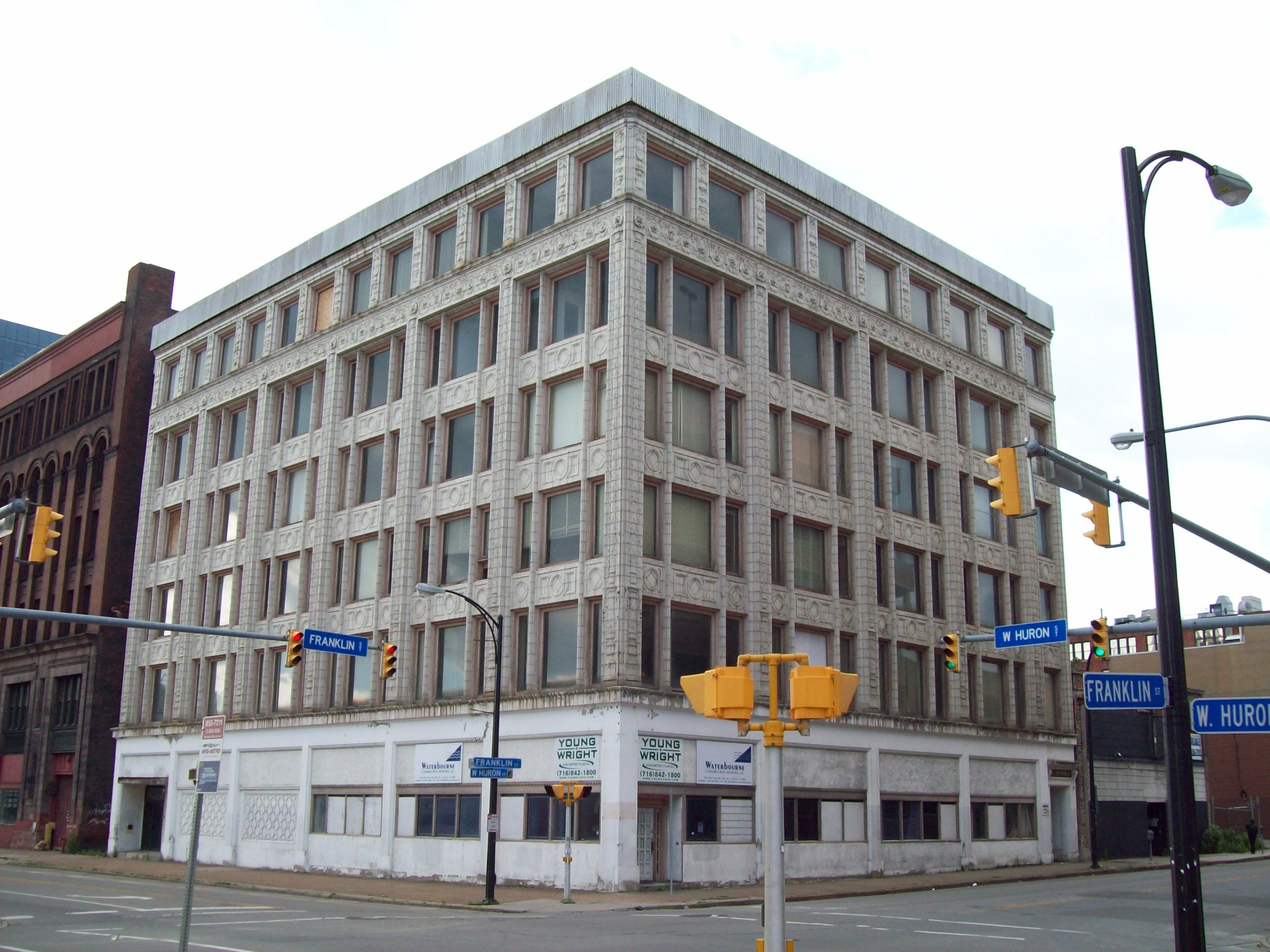
Harlow was a graduate of Trinity College in Hartford, Connecticut and studied law under Grover Cleveland.  Harlow became a lawyer and became an extensive real estate owner throughout the City.  Harlow and his wife Ethel were prominent in Buffalo during the early 1900s.  Ethel was originally Ethel Mann, the daughter of Matthew Mann, the doctor who operated on President William McKinley after he was shot on the Pan-Am grounds in 1901.  Harlow was influential in the development of the Curtiss Building at the corner of Franklin and Huron.  Ethel was considered a community leader as well, she worked with the Buffalo Council of Campfire Girls and conducted programs to develop leadership skills for women.  Ethel and Harlow lived at 100 Lincoln Parkway.

Curtiss Building
Franklin and Huron Streets

The Curtiss Building at Franklin and Huron Streets was designed by Harlow’s brother-in-law, Paul Mann, and was built in 1912.   The building is also known as the King & Eisele Building due to a jewelry firm which located in it during the 20s and 30s.  It was later known as the Hoelscher Building after the Hoelscher Building Corporation which was located there from the 1940s until the 1990s.  Mark Croce currently owns the building and had plans for a boutique hotel about 5 years ago.  However, the project appears to be at a standstill.

COMING SOON:   I became intrigued by the old maps when I saw the land where the Central Terminal now sits was once a park.  Coming later this week:  What was Polonia Park?

Sources:  “Curtiss Street Memorial to Trade Board Head, Developer” Courier Express Oct 22, 1939 sec. 6. p 10.

Read Full Post »

« Newer Posts - Older Posts »

Field Notes

Live from Buffalo, NY

Grants.gov Community Blog

Connecting the grant community to #LearnGrants

Dienna Howard

I create, therefore I am.

Hidden Waters blog

Companion blog for the book "Hidden Waters of NYC"

Hoping for a Tail Wind

Because I definitely brought way too much gear.

priorhouse blog

Photos, art, and a little bit of LIT.

Sheepie Niagara

Bleating the Beat Since 2015