Feeds:
Posts
Comments

Archive for 2014

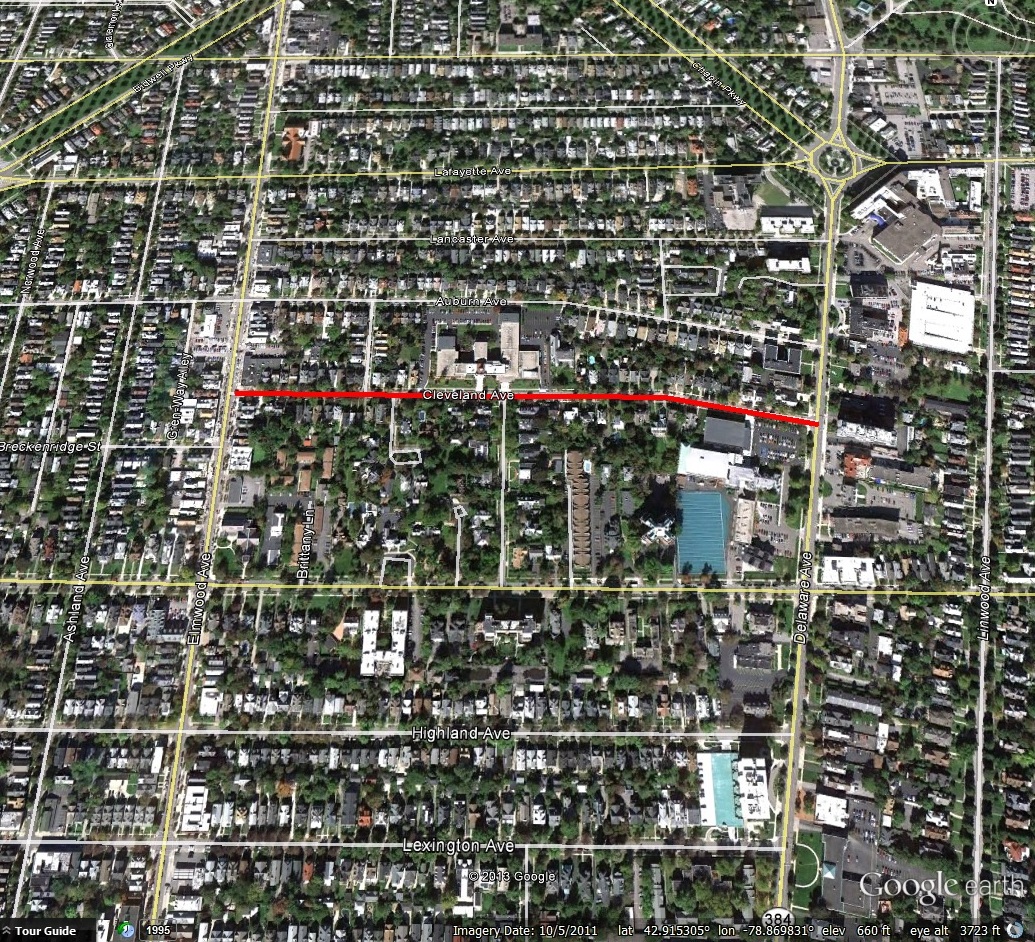
clevelandCleveland Avenue is a street in the Elmwood Village, running between Elmwood Avenue and Delaware Avenue.  Cleveland Avenue is named after one of Buffalo’s most prominent citizens, President Stephen Grover Cleveland!  Today (March 18th) is Grover’s birthday.

Grover Cleveland’s story is a rare one.  He rose to political fame from the position of an unknown lawyer in Buffalo in a period of only three years.  He was not connected via his lineage, but rather worked hard and represented himself with integrity, which led to his success. While much has been written about President Cleveland’s campaigns and White House years, I’m going to focus on his time before he was president.

Grover Cleveland Birthplace, now a museum Source

Grover Cleveland Birthplace, now a museum
Source

Mr. Cleveland’s family came to America in the 1600s, settling in Massachusetts from England. Stephen Grover Cleveland was born on March 18, 1837 in Caldwell, New Jersey, the son of a Presbyterian minister.  He was named after the previous pastor at the church where his father now preached – Dr. Stephen Grover.  The first name was dropped; however, and he always went by Grover.  He was educated in public schools in Fayetteville, New York and at the Academy in Clinton, New York.  He served as a grocery clerk in Fayetteville as his first job.  He later became an assistant in the Institution for the Blind, New York City.  

Grover Cleveland as a young attorney

Grover Cleveland as a young attorney

In 1855, Mr. Cleveland came to Buffalo.  He was heading to Ohio to seek fortune, but first came to visit his uncle, Lewis Allen, who lived on a farm.  Mr. Allen convinced Grover to stay in Buffalo, by giving him a place to stay and introducing him to members of a law firm.

Mr. Cleveland studied law with Bowen & Rogers and was admitted to the bar in 1859.  One of the local legends is that when Mr. Cleveland first started at a law firm in Downtown Buffalo, he made such a little impression on the lawyers while he studied, the lawyers forgot he was there, and locked up the office for the day while he was still in the office.  He vowed that “someday, I will be better remembered”.

During the Civil War, Mr. Cleveland was drafted. His two younger brothers enlisted. At the time, the Enrollment Act of 1863 allowed draftees to pay $300 to have a substitute go to war for you.  Grover borrowed money to pay a substitute, so that he could stay in Buffalo and take care of his mother.

In 1866, Mr. Cleveland formed a partnership with I.K. Vanderpool.  The two worked together for 4 years.  He then worked with P. Laning and Oscar Folsom, working with them for two years when Mr. Cleveland was then elected to be Sheriff of Erie County in 1870.

Mr. Cleveland was considered to be just and fair in his term as Sheriff.  He showed a disregard for partisan interests and he was considered a reformer.  He served as Sheriff until 1874, using his down time to continue his studies.  When he returned to the bar after his time as Sheriff, he was more confident and was considered to be a better lawyer.  He never became wealthy as a lawyer but was distinguished among the law community for his hard work and strong ethics.
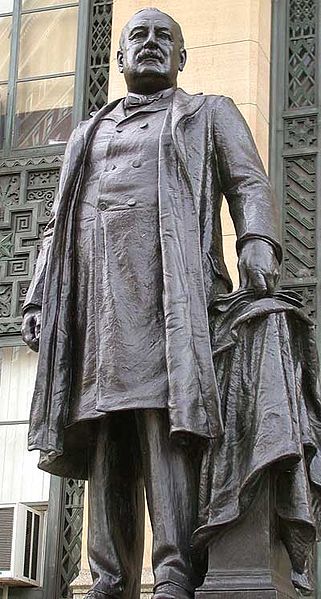
Statue of Cleveland at Buffalo City Hall

Statue of Cleveland at Buffalo City Hall

In 1881, the City of Buffalo was considered to have a corrupt government that was driving the city towards ruin.  The population was growing quickly; politics and business were intertwined, and there was a demand for reform.  Citizens were looking for a mayoral candidate who could bring about reform.  They found their man in Grover Cleveland.   With some convincing by Peter Doyle, he decided to run.  He was elected with a majority that was the largest ever given to a candidate up until that time.  His main principal for his official life is expressed by one of his messages to the Common Council:  “There is, or there should be, no reason why the affairs of our city should not be managed with the same care and the same economy as private interests”.

Mr. Cleveland clung to and fought for what he thought was right.   He was known as the “Veto Mayor” (and later the “Veto Governor” and “Veto President”).  As Mayor, he was careful with city expenditures.  Mr. Cleveland’s term as Mayor was noticed throughout the state and led to his nomination for Governor.

Mr. Cleveland’s strength in the gubernatorial campaign lay in the fact that he was relatively unknown, and, therefore, not part of the machine that had run New York politics.  He had never met many of the representatives of the Democratic Party until the night of the convention.  He was elected in 1882, defeating Charles Folger by nearly 193,000 votes.

On election night, Grover wrote to his brother William, “But the thought that has troubled me is Can I well perform my duties and in such a manner has to do some good to the people of the State?  I know there is room for it and I know that I am honest and sincere in my desire to do well, but the question is whether I know enough to accomplish what I desire.”
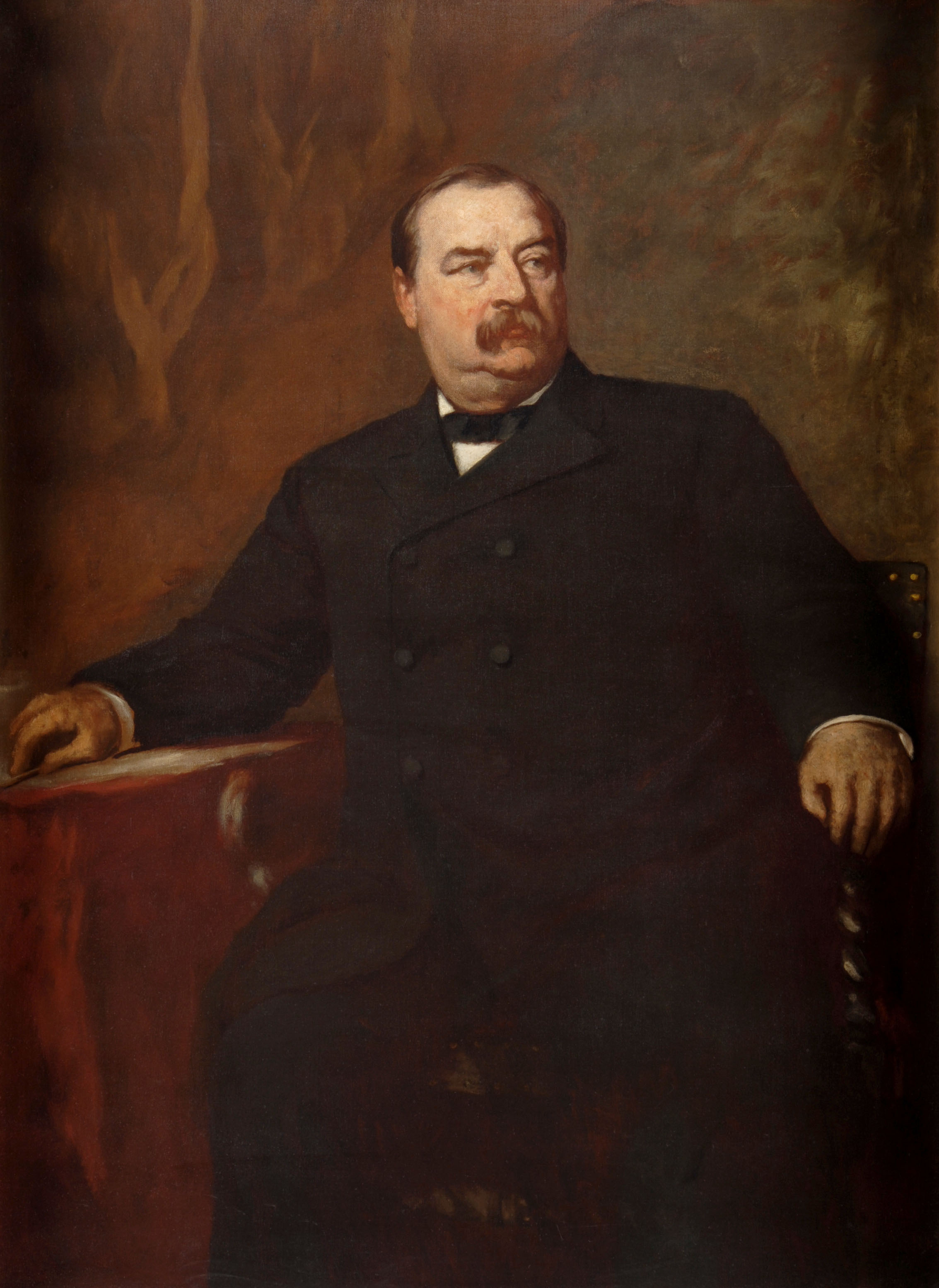
Grover Cleveland as Governor

Grover Cleveland as Governor

His guiding principles while Governor were retrenchment, economy, integrity and reform.  He worked from early morning until late at night, carefully and deliberately undertaking the tasks at hand.  It is said that he did little to attract the attention of the party leaders outside of New York State, but in doing so, his honesty and personal habits set him apart from the pomp, circumstance and parade of importance around which many public servants surround themselves.

When the Democratic National Convention met in Chicago in 1884, Mr. Cleveland was nominated for Presidency.  He won the election by beating James G. Blaine, and became President of the United States.  After being defeated by Benjamin Harrison in 1888, Cleveland returned to New York City to work as a lawyer.  In 1892, Cleveland defeated President Harrison and became the first president to be elected for non-consecutive terms.
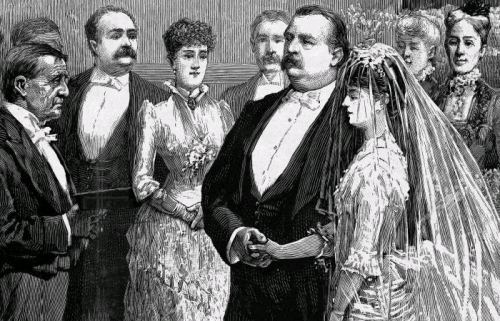
President Cleveland's Wedding to Frances Folsom

President Cleveland’s Wedding to Frances Folsom
Source: 1886, Harper’s Weekly

During his first term as president, in 1886, Mr. Cleveland married Buffalonian Frances Folsom.  He is the only president to be married during his term, with the wedding taking place in Blue Room of the White House.  When Oscar Folsom (Cleveland’s business partner and Frances’ father) died, Grover became executor of his estate, but was never the legal guardian of Frances, as many believe.  Frances was the youngest first lady in history, 21 at the time of their wedding.  She was a popular first lady, people purchased souvenirs bearing her likeness and copied her hairstyles and clothing.  Frances was born in Buffalo; her house still stands on Edward Street.  A slice of  the Clevelands’ wedding cake from 1886 is in the collection of the Buffalo History Museum. Frances and Grover had three daughters and two sons.

Grover Cleveland's Grave

Grover Cleveland’s Grave

In 1896, Cleveland declined the nomination for a third term, and retired to his estate, Westland Mansion, in Princeton, New Jersey.  He became a trustee at Princeton University.  He also served as a consultant to President Theodore Roosevelt.  He died of a heart attack in 1908.  His last words were “I have tried so hard to do right”.  He is buried in the Princeton Cemetery.

Other things named after Cleveland in the Buffalo Area:

  • Grover Cleveland Hall at Buffalo State College (Cleveland served on the Board of Directors when it was the Buffalo Normal School)
  • Grover Cleveland High School in Buffalo (the building now houses the International Preparatory School)
  • Grover Cleveland Golf Course
  • Cleveland Hill Neighborhood and School District in Cheektowaga
  • Cleveland Avenue, Niagara Falls
  • Cleveland Drive, Cheektowaga
  • Cleveland Avenue, City of Tonawanda

To read about other streets, check out the Street Index.

Sources:

  • Triplett, Frank.  The Authorized Pictorial Lives of Stephen Grover Cleveland and Thomas Andrews Hendricks.  New York:  E.B. Treat, Publisher.  1884.
  • Memorial and Family History of Erie County, New York.  Volume 1.  New York-Buffalo:  Genealogical Publishing Company, 1906.
  • Peckham, Caroline.  The Pre-Presidential Career of Grover Cleveland.  University of Wisconsin:  1922.
  • “Mr. Cleveland is Dead at 71”.  New York Times:  June 25, 1908.

Read Full Post »

churchChurch Street is one of the main east-west streets in Downtown Buffalo, connecting to Main Street to what is now the Interstate-190.  The street was originally laid out by Joseph Ellicott and was named Stadnitski after Pieter Stadnitski, a Dutch banker and one of the agents of the Holland Land Company.  The street was renamed in honor of St. Paul’s Episcopal, St. Joseph’s Roman Catholic and First Presbyterian Churches.

The Downtown Buffalo core used to be home to other churches, but many moved uptown as their congregants moved out of downtown towards “suburbs”, such as the case with First Presbyterian Church or Lafayette Presbyterian Church.

The Three Church Street Churches circa 1880s

The Three Church Street churches circa 1880s

St. Paul’s Cathedral

St. Paul's Cathedral

St. Paul’s Cathedral

St. Paul’s Episcopal Cathedral is the cathedral of the Episcopal Diocese of Western New York.  The congregation started in 1820, and their first church was built on land donated by Joseph Ellicott, at the corner of Main and Erie Streets.  Reverend William Shelton came to the church in September 1829 and served as Rector until 1881.  The congregation started to grow significantly following the opening of the Erie Canal.  The current church opened (on the site of the old church) in 1851, on Shelton Square.  The church was designed by Richard Upjohn, who is considered one of the greatest American Gothic church designers.  The congregation wanted the church to be made out of limestone; however, they could not afford the limestone.  Upjohn instead used Medina sandstone.

On May 10, 1888, the church was almost destroyed following an explosion and fire.  All that remained was the walls.  The church was rebuilt according to Upjohn’s original plans and reopened in 1890.  St. Paul’s was listed on the National Register of Historic Places in 1973 and was named a National Historic Landmark in 1987.

Rev. Shelton

Rev. Shelton

Shelton Square was named after Reverend William Shelton in 1897.  Shelton Square was a public space within Joseph Ellicott’s original street layout for Buffalo, at the intersection of Erie, Church, Main and Niagara, North Division and South Division Streets.  The area was where Joseph Ellicott originally planned to build his house.  He later donated land at Shelton Square to the churches.  In the 1950s, Shelton Square was considered Buffalo’s “Piccadilly Circus”.  A trolley/bus shelter was located in the middle of the square, and this served as the main hub for the entire city – serving the International Railway Company and then the Niagara Frontier Transit system.   Shelton Square disappeared during the 1970s, when a portion of Shelton Square was covered by the Main Place Mall, and Erie street was replaced by Cathedral Park.

Shelton Square 1908

Shelton Square 1908

St. Joseph’s Cathedral

St. Joseph's Cathedral in 1914

St. Joseph’s Cathedral in 1914

St. Joseph’s Roman Catholic Cathedral is located at 50 Franklin Street.  The church serves as the cathedral church for the Buffalo Diocese.  Buffalo’s first Bishop, John Timon, established St. Joseph’s in 1847.  The cathedral was dedicated in 1855 and was consecrated in 1863.  The original plans for the cathedral called for two towers at the north and south ends of the facade, but only the south tower was built.  The tower contained a 43 bell carillon (a musical instrument consisting of bells, typically found in church towers or municipal buildings).  At the time of installation in 1869, the carillon was the largest in America and the third largest in the world.  The bells were too large for the tower and never worked properly, so all but two were removed from the church.

In 1902, the Buffalo Diocese determined that a new cathedral was necessary, so property was purchased at Delaware Avenue and West Utica Street.  The New St. Joseph Cathedral opened in 1915, and St. Joseph’s downtown was known as “St. Joseph’s Old Cathedral”. The new cathedral was not built for Buffalo’s climate and major repairs had to be made as soon as 1924.  The exterior marble started to fall off and in 1976, the Bishop decided repairs would be too costly.  In 1977, after demolition of the new cathedral, the “old cathedral” reverted to its former name of St. Joseph’s Cathedral.

First Presbyterian Church

Color Portrait of the First Building of the First Presbyterian Church  (First Presbyterian Church archives)

Color Portrait of the First Building of the First Presbyterian Church (First Presbyterian Church archives)

The third of the churches was First Presbyterian Church.  When First Presbyterian Church was organized on February 2, 1812, it was the first organized religious body formed in Western New York.  The first building for the church was built at the corner of Pearl Street and Niagara Street.  The church opened in 1824 and was used by the church until 1827. As the congregation grew, the building was sold to another congregation in 1828 and moved to the corner of Genesee and Hickory Streets, and was later moved to Walnut Street in 1878.  The building saw many uses over the years – a school-house, a tenement,  a cooper’s shop and an icehouse for a brewery.  It was destroyed by a fire in 1882.  No pictures of the building are known to exist.

"Old First" Presbyterian Church (1827-1890) from the First Presbyterian Church Archives

“Old First” Presbyterian Church (1827-1890) from the First Presbyterian Church Archives

First Presbyterian’s “Brick Church” was dedicated in March 1827.  With seating for 800, it was the largest church west of the Genesee River.  The church’s bell was referred to as the “town clock bell” and served all of Buffalo as a fire alarm.  When sounding alarm for a fire in 1833, the bell cracked, but was quickly recast and served the church until the church was razed.  The bell was then presented to a church in North Tonawanda.

As the congregation grew, members also moved away from the central part of the City of Buffalo.  At the time of founding, most of the congregation lived near the church, but as the central business district developed, many had moved uptown and found congregations closer to their homes.  The church was at risk of closing.  Many members of the congregation were against moving the church, so the matter had to be taken up with the Presbytery and was taken to court.  The matter was resolved in favor of moving.

First Presbyterian Church today on Symphony Circle

First Presbyterian Church today on Symphony Circle

In 1887, Mrs. Truman Avery, who lived where Kleinhans Music Hall is now located, donated a parcel of land across the circle, at the corner of Wadsworth and Pennsylvania Streets.  In April 1889, the congregation was ordered by the city to sell the property to Erie County Savings Bank to make way for the bank’s new office.  (the bank was located at Shelton Square until the 1970s, when it was demolished for construction of the Main Place Mall).

Sources:

  1. The Catholic Church in the United States of America:  Undertaken to Celebrate the Golden Jubilee of His Holiness, Pope Pius X.  Volume 3.  Catholic Editing Company, New York, 1914.
  2. DeMille, George.  St. Paul’s Cathedral, Buffalo, 1817-1967:  A Brief History.
  3. Rote, David.  30-A Shelton Square.  1994.  accessed through City of Buffalo Website:  https://www.ci.buffalo.ny.us/Home/OurCity/Buffalo_My_City/Buffalo_My_City_Watercolors/30A_Shelton_Square_1994

Read Full Post »

tifftstTifft Street forms an important east-west path in South Buffalo, running from McKinley Parkway to Fuhrmann Boulevard/Route 5.  It is one of the few streets in South Buffalo that reaches the waterfront.   The road is named after the man who first owned the land in the vicinity of the street, G.W. Tifft.

George Washington Tifft was born in January 1805 in Nassau, Rensselaer County, New York.  One of Tifft’s first land purchases was 5 acres in Orleans County.  He cleared the land to sell  the wood.  He hired men to chop timber, realizing that he could reap a profit on the labor of each man.  He later bought a more land and hired additional men to work for him.

tifftBy the time George was 21, he had saved $1,200.  Mr. Tifft received another $1,000 from his father’s estate, and began a new business venture.  He first traveled to Michigan City, Indiana, where he bought grain to ship to the east.  At the time, all grain was shipped through the lakes.  While in Michigan City, he learned of Buffalo’s shipping and moved to Buffalo in 1842.

Mr. Tifft formed a partnership with Dean Richmond, a member of a prominent Buffalo family.  Mr. Tifft set up the Troy and Michigan Six Day Line, named b/c it did not operate on Sunday.  He purchased more mills to increase his commercial holdings. Mr. Tifft established the International Bank of Buffalo and was the first president of the bank in 1854.  He invested $100,000 in the Buffalo Steam Engine Company and was elected president of the New York, Lake Erie and Western Railroad in 1858.

Tifft House

Tifft House

He then turned his attention to his Buffalo real estate holdings.  In 1863, Mr. Tifft erected 74 houses, a hotel (the Tifft House) and the Tifft Grain Elevator.  The Tifft House hotel opened in 1865 and was demolished in 1902, after serving as a hotel during the Pan American Exposition, and was replaced in 1903 with the William Hengerer Company department store.

Mr. Tifft also purchased a 600-acre tract of land in the southern portion of Buffalo which people referred to as the Tifft Farm.  Mr. Tifft was among the first in Buffalo to experiment with growing “winter wheat”.  He invested his money in the Pennsylvania coal fields and experimented with smelting processes.  His vast land holdings spread across the country – he owned a 5,000-acre farm in Shelby county, Iowa which was stocked and cultivated.  The large Tifft Farm tract in South Buffalo was broken up into residential and industrial areas when Mr. Tifft sold it to Pennsylvania capitalists who leased the land to the Lehigh Valley Railroad Company for 50 years.

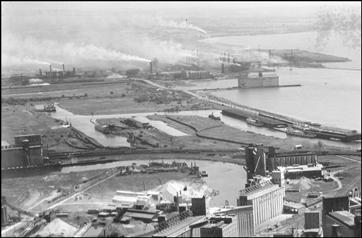
The canals at Tifft Farm shown near center of this photograph

The canals at Tifft Farm shown near center of this photograph

The Lehigh Valley Railroad Company constructed 11,400 feet of canal to connect a system of canals on the Tifft Farm property with the City Ship Canal and Buffalo Creek (now Buffalo River).  They also constructed 9,280 feet of dock on the Tifft Farm, each dock had railroad facilities and totaled 20.6 miles of railroad.  Today, Tifft Farms has been renamed “Tifft Nature Preserve” and is managed by the Buffalo Science Musem.  The preserve was created in 1972 from 264 acres of land the City of Buffalo purchased for a landfill site.  Concerned citizens worked with city legislators to plan for preservation of the area.  The landfill incorporated safety measures, which allowed the land to serve a new purpose and the preserve opened in 1976.  The former canals have been allowed to revert to nature and now form Lisa Pond, Beth Pond and Lake Kirsty on the Nature Preserve site.  The “mound” area of the preserve contains landfilled waste materials brought on site from Squaw Island.   During the 1980s, approximately 100 drums of acid sludge from a nearby industrial plant were found dumped into Lake Kirsty.

tifft engines

Mr. Tifft’s later years were spent managing the George W. Tifft Sons and Company, successors to the original Buffalo Steam Engine Works.  He also owned a group of stores at the corner of Washington and Mohawk Streets and had a furniture business there. George Washington Tifft married Lucy Enos in 1827.  They had seven children.  Mr. Tifft was an active supporter of the Republican Party and an admirer of President Lincoln.  Mr. Tifft donated large sums in support of the Civil War, and also towards charities, always considering that he had been blessed to have made his fortunes and eager to help others.

Tifft Monument

Tifft Monument

Mr. Tifft died on June 24, 1882 and is buried in Forest Lawn.  There is also a cenotaph for George at the Tifft Cemetery in Nassau, New York, located on the former Tifft homestead.  One obituary read:  “His name was a tower of strength, and was sought in every movement requiring moral, social or financial support.  He filled a large place in the affairs of the city he has done so much to build up.  His name will long be enshrined in the hearts of a people that had learned to know his worth and appreciate his virtues”.

Check out how other streets got their name in the Street Index.

 Sources:

  1. Buffalo Directory, 1860, pg. 12.
  2. Holder, Robert “The Beginnings of Buffalo Industry.”  Adventures in WNY History Series.  Buffalo and Erie County Historical Society, 1960
  3. Mansfield, John Brandts, editor.  History of the Great Lakes.  Volume 1.  J.H.Beers & Co:  Chicago.  1899.
  4. Magazine of Western History. Western History Co. Mar 1886.

Read Full Post »

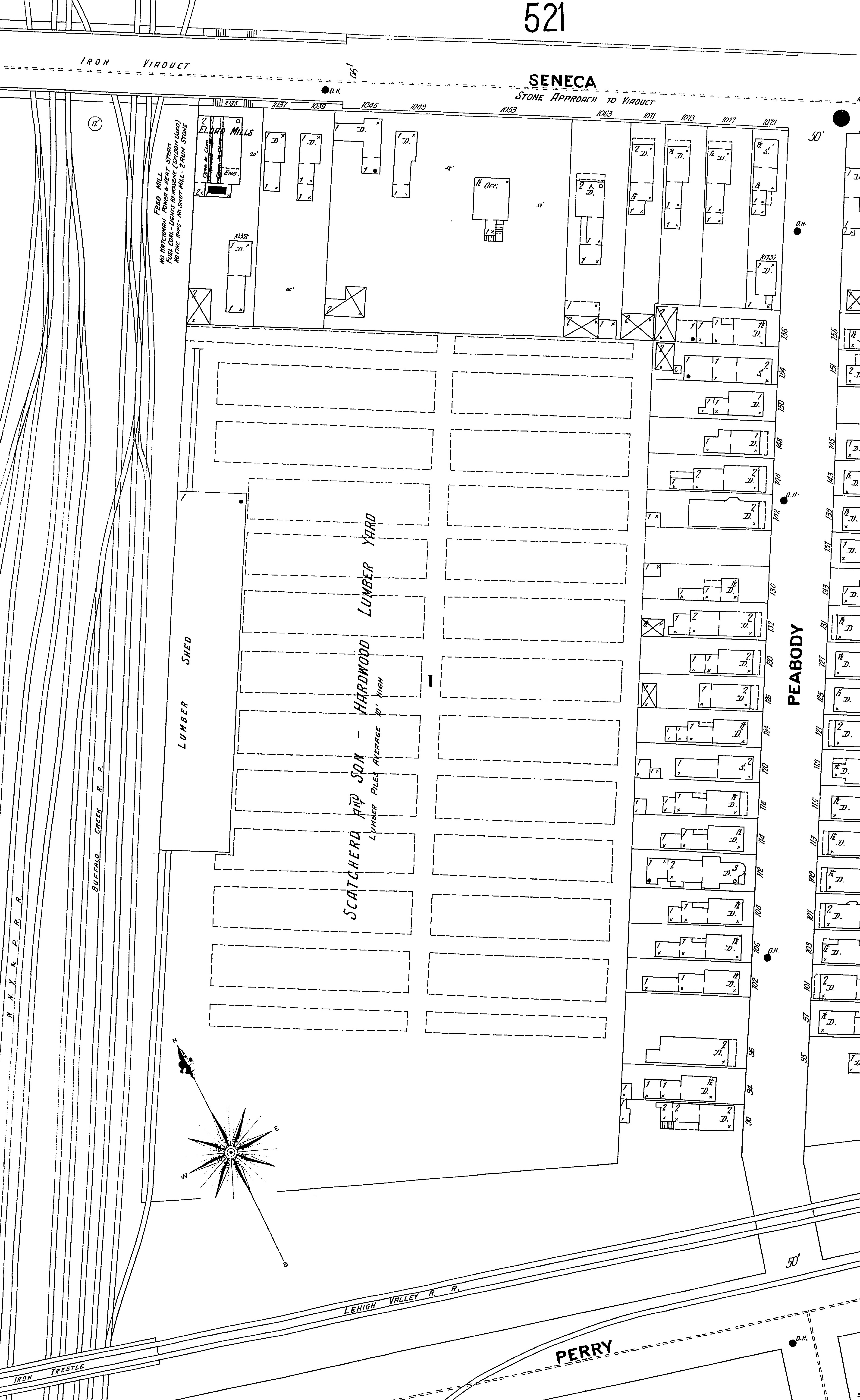
scatcherdScatcherd Place is a short road off of Peabody Street.  The street has never been more than just a short road leading to a driveway. Historically, this road led into Scatcherd and Son lumberyard, which later became Atlantic Lumber Company and is now owned by Battaglia Demolition.  While the street might not be on many people’s radars, it is legal city-owned right-of-way, and was named after a prominent father-son team who may have been forgotten.

James Newton Scatcherd was born in Wyton, Ontario in 1824.  He grew up on his father’s farm in London, Ontario.  James’ father, John, was a prominent Canadian citizen and a member of the Canadian Parliament for many years.  James’ brothers Thomas and Robert both also served as members of the Canadian House of Commons.

Scatcherd and Son Lumber Yard, 1900.  (Scatcherd Place is the lot between 136 and 142 Peabody Street)

Scatcherd and Son Lumber Yard, 1900. (Scatcherd Place is the lot between 136 and 142 Peabody Street)

James Scatcherd was taught about lumbering from an early age, as it was an important industry in his neighborhood.  Mr. Scatcherd moved to Buffalo in 1852 as an agent of Famer, de Blaquiere & Deeds, lumber manufacturers, dealers and shippers.  James took over the lumber firm in 1857 and became one of the principal lumber dealers in the United States.  In 1879, James’ son, John Scatcherd, joined the firm and the firm was renamed Scatcherd & Son.  The firm’s specialty was expensive hard woods.

James Scatcherd made two important contributions to the welfare of Buffalonians:  First, when he became chairman of the Buffalo Water Commission, he found the water supply was controlled by favoritism and political influence.  Politicians and friends obtained water for a small fee, while other consumers were charged more.  He served for 4 years as chairman of the Water Commission and established equal rates for all consumers, and established efficient management of the water system.  Secondly, Mr. Scatcherd served as president of the Board of Trustees of the Buffalo General Hospital.  At the time, the institution was burdened with large amounts of debt, and was cutting services due to budget constraints.  Within ten years of James’ leadership, the hospital was completely out of debt.

Mr Scatcherd married Annie Belton of Fairfield, Canada.  Mr. Scatcherd was a founder and trustee of the Delaware Avenue M.E. Church (built by Selkirk, now known as Babeville).    James and Annie had one son, John, and a daughter, Mrs. Seward Cary.  James died in 1885 and is buried in Forest Lawn.

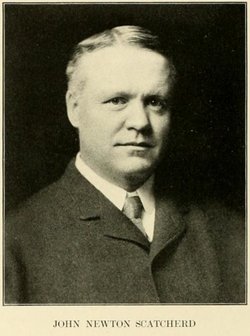
John Scatcherd

John Scatcherd

John Scatcherd was also a prominent member of Buffalo society.  He was a leader in the lumber industry and served as president of The National Wholesale Lumber Association and the Buffalo Lumber Exchange.  John had a part in business interests including the Batavia and New York Wood Working Company, the Bank of Buffalo, and the Ellicott Square Corporation, all of which he was President.  He was a director in the Buffalo Railway Company (which became the I.R.C), the Market Bank, the Third National Bank, and the Buffalo Loan, Trust and Safety Deposit Company.

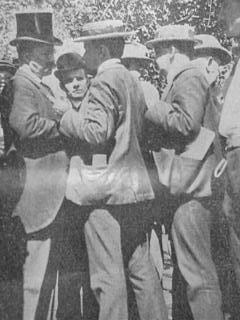
Teddy Roosevelt (on left) in Buffalo in 1901

Teddy Roosevelt (on left) in Buffalo in 1901

From 1900-1901, Mr. Scatcherd spent most of his time working as Chairman of the Executive Committee of the Pan-American exposition.  When President McKinley was shot at the Exposition, Vice President Theodore Roosevelt was summoned to Buffalo.  Due to President McKinley’s seemingly improving health, Mr. Roosevelt left Buffalo.  When the President died, the scramble to get Mr. Roosevelt to Buffalo for the Oath of Office left him without a suitable hat.  John Scatcherd loaned Theodore his hat and Mr. Roosevelt was inaugurated as the 26th President. (You can learn more about Roosevelt’s inauguration by visiting the TR Inaugural Site on Delaware Avenue)

John Scatcherd married Mary Eunice Wood in 1879.  They had two children, a daughter Madeline Steele Scatcherd and a son, James Newton Scatcherd.  John Scatcherd died in 1917 and is buried near his father in Forest Lawn.

Scatcherd Grave

Scatcherd Grave

Be sure to check out the Street Index to learn about other streets.

Sources:

  1. Memorial and Family History of Erie County New York.  The Genealogical Publishing Company:  New York-Buffalo, 1906.
  2. “Scatcherd Street Honors Memory of Civic Leaders, Father and Son”.  Courier Express, April 9, 1939, sec. 5, p.10.

Read Full Post »

Happy New Year Update

Hello to all my new blog readers!    The blog has gotten a lot of press in the last few weeks!  I’d like to welcome all the new subscribers.  And Happy New Year to all the subscribers who have been here since the beginning.  I love you all.

I was on WKBW Channel 7 news on Monday night, discussing the 200th anniversary of the Burning of Buffalo.   I can’t seem to find the story online, but let me know if you happened to see it.

If you want to hear about some of Buffalo’s streets in person, I will be speaking next month at Forest Lawn Cemetery.  I have been attending their Sunday afternoon lectures for several years now, and I am thrilled to be working them.  For more information, or to buy tickets, please visit the Forest Lawn website here:   http://www.forest-lawn.com/page/calendar/title/buried-in-forest-lawn-alive-on-our-city-streets/

I am working on a few neat posts coming up in the next few months.  I’m hoping to stick to my two posts a month schedule for the new year.

Do you have any neat Buffalo related New Year’s resolutions?  I’d love to hear them.

I hope everyone is staying warm and bundled up like buffaloes today!!

1528548_840787303811_867214175_n

Read Full Post »

« Newer Posts

Field Notes

Live from Buffalo, NY

Grants.gov Community Blog

Connecting the grant community to #LearnGrants

Dienna Howard

I create, therefore I am.

Hidden Waters blog

Companion blog for the book "Hidden Waters of NYC"

Hoping for a Tail Wind

Because I definitely brought way too much gear.

priorhouse blog

Photos, art, and a little bit of LIT.

Sheepie Niagara

Bleating the Beat Since 2015