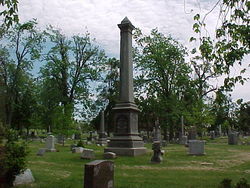
Feeds:
Posts
Comments

Archive for the ‘East Side’ Category

sattlerSattler Avenue is a short, block-long street in the Schiller Park neighborhood on the East Side of Buffalo.  Sattler Ave runs for a block and a half off of Doat Street, where it dead-ends in Schiller Park.  The street was originally called “Princess Ave” when it was first laid out.  The street is named after John G. Sattler, of Sattler’s Department Store fame.

Mr. Sattler’s father, George Sattler, had come to the County from Hessen-Darmstadt, Germany.  John Sattler was born in East Aurora, but moved to Buffalo during his early childhood. He attended local public schools and Bryant & Stratton business school.

John G. Sattler Shoe Store, 998 Broadway source

John G. Sattler Shoe Store, 998 Broadway
source

At age 15, John G. Sattler got a job at Eckhardt’s department store on Broadway.  His wage was $3/week.  His first solo business venture was a one-man shoe store, located only a few feet from what became Sattler’s best-known establishment.  John’s mother owned the building; the family lived upstairs so he could work all hours of the day.  The store opened in March 1889.  He hung a bell at the front door, and they would run downstairs to assist customers and all times.  he took pride in customer service and would study the behavior of his customers.  If they came in and did not purchase anything, he would ask them why.  If their answer was “you don’t have what I am looking for”, he would go out of his way to order it for them. Mr. Sattler purchased properties adjacent to his store as the business grew.  The business continued to grow and later include clothing.  The original address of the shoe store was 992 Broadway.  In 1900, a larger, modern building was built, with the address of 998 Broadway.

In 1926, the store was reorganized to become Sattler’s Department Store.  At Sattler’s Department Store’s peak, the store employed 800 people.  Mr. Sattler claimed to know them all by name.  Once the store was established in the 1920s, Mr. Sattler allowed his son-in-law, Charles Hann, Jr. to take over the day to day operations.

Mr. Sattler then began to work in real estate.  Mr. Sattler’s first real estate development was on Sattler Avenue, where he had once owned a summer country home.  He saw that the city was beginning to develop towards that direction, so he built houses.  The street was formally dedicated as Sattler Avenue in 1904.   Mr. Sattler also developed the Kenilworth subdivision in Tonawanda in 1908 following the closure of Kenilworth Park race track.

Entranceway at Main and Westfield Road, part of Sattler's Holllywood Subdivision in Snyder

Entranceway at Main Street and Westfield Road, part of Sattler’s Hollywood Subdivision in Snyder

Mr. Sattler’s real estate holdings spread throughout the city – stores, homes and businesses in every section of the City.  He also owned and developed properties Tonawanda and Amherst.  He owned the Lautz Estate, east of the Village of Williamsville and the Hollywood subdivision, which included Westfield and Ivyhurst Roads in Snyder, and the Tennyson Terrace near transit Road.  He built a house for himself at Main Street and Ivyhurst Road in 1919.  While many developers of the time in the suburbs were catering to the rich, Sattler built houses for the working class, who desired modest homes.  Mr. Sattler is responsible for the entranceways on Main Street at Ivyhurst Road and Westfield Road, which are listed on the National Register of Historic Places.
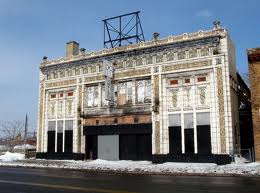
Sattler Theater on Broadway

Sattler Theater on Broadway

In 1914, Mr. Sattler opened Sattler Theater at 516 Broadway.  Mr. Sattler felt there should be a theater on the East Side of Buffalo; however, the theater was considered to be a failure since it was too far away from the theater district and shopping opportunities.  It was sold in the 1920s and became Basil’s Broadway Theater.  The theater was then home to a series of religious groups- Muhammad’s Mosque, God’s Holy Temple and Joy Temple.  In 1996, the last of the groups left the building and the building was abandoned.

Mr. Sattler considered Business School a valuable resource and would select promising young men from his employees and send them to business school on scholarship. Mr. Sattler had two daughters, Doris Sattler and Mrs. Charles Hahn, Junior. Mr. Sattler moved to Ivyhurst Drive in Eggertsville, where he owned seven acres of lawns and gardens. In 1939, he had three canaries and a number of chickens. He became fond of the chickens, and raised them as pets rather than food, and stopped eating chicken completely.

Sattler Mausoleum

Sattler Mausoleum

Mr. Sattler witness a great change in Buffalo during his lifetime.  He is quoted as saying:  “I remember when Broadway was a cobblestone street with plant sidewalks on each side of it. Fillmore Avenue was then a parkway, lined with beautiful trees, and on Gibson Street, just off Broadway, there was a swimming hole.”  Mr. Sattler died in 1941 and is buried in a mausoleum in Forest Lawn.  Sattler’s Department Store remained in business for nearly 100 years, spreading across the WNY Region.

The store continued to grow after Mr. Sattler stepped down and gave the business to his son-in-law.  In 1927, Sattler’s hired a buyer for women’s wear, then added men’s boys’ furniture, appliances, housewares and a food market.  As more departments were added, they hired an advertising and promotions manager.  During the 1940s, Sattler’s was at it’s peak.  They had promotional schemes that were considered outlandish at the time.  They’d give away cars, they hired high wire walkers.   The store would purchase good from a bankrupt sore or a fire sale and pass along name-brand products at extreme discounts for its customers.   The store was located outside of the downtown area, so there weren’t theaters, restaurants or hotels to draw shoppers.  Sattler’s depended on clever advertising to draw in crowds.  In May 1949, they used more than $60,000,000 worth of aviation equipment for an airshow.  They won an award that year as the National Retail Dry Goods Association’s winner for best coordinated campaign.

Sattler's Toyland Ad, Christmas 1954 Source

Sattler’s Toyland Ad, Christmas 1954
Source

The store continued to expand the store at 998 Broadway into the 1950s.  In 1954, the company leased the former Jahraus-Braun store at 1021 Broadway to turn it into the Sattler’s Home Annex store.  They later added an appliance store at 3610 Main Street in University Plaza.  In 1957, Sattler’s opened another appliance store in Hamburg and a trade-in store at 1025 Broadway.  In 1961, the appliance stores were consolidated into the Annex Store.  In 1962, a new store was built at the new Boulevard Mall in Amherst, and one in Rochester, New York.  The Rochester store was only open one year.  In 1963, Sattler’s Drugs opened four free-standing stores and added a pharmacy inside each Sattler’s store.

Sattler’s celebrated its 74th anniversary with a motorcade from City Hall to 998 Broadway and a ribbon cutting ceremony with company officials and Mayor Chester Kowal.  In 1965, the company opened a warehouse, home furnishings and food store in a former plant at 1803 Elmwood and Hertel Avenue in North Buffalo – calling it Sattler’s Wonderful World of Foods and Home Furnishings City USA.  The store was called ” a giant step forward in space age selling, bold and imaginative merchandising”.

In 1969, Sattler’s opened a new store in the new Seneca Mall in West Seneca.  Both the Boulevard Mall and Seneca Mall locations were considered to be more upscale than the other stores, different than what the average Sattler’s customers expected.   In 1972, the Thruway Plaza store closed, mainly due to its proximity to the Seneca Mall location.  In 1973, Sattler’s moved downtown when Kobacker’s closed in teh Main Place Mall.  In 1979, the store returned to Cheektowaga into the converted Thruway Plaza, which was now the Thruway Mall., opening a “specialized fashion store”.

Sattlers at the Boulevard Mall

Sattlers at the Boulevard Mall Source

The 998 Broadway location filed a going out of business sale in March 1981.  In January 1982, the Thruway, Seneca and Main Place Mall Stores closed as part of bankruptcy proceedings.  The last remaining store was at the Boulevard Mall, which closed by December 1982.  The 998 Broadway building was demolished in 1989.  A K-Mart was built on the site, but that also closed shortly thereafter.

For more on Buffalo’s retail history, be sure to check out Mike Rizzo’s book:  Nine Nine Eight:  The Glory Days of Buffalo Shopping.

To read about other street names, check out the Street Index.

Sources:

“Sattler Avenue Bears Name of Merchant” Courier Express Mar 26, 1939, sec 5 p 4

Rizzo, Michael.  Nine Nine Eight:  The Glory Days of Buffalo Shopping.  Lulu Enterprises:  Morrisville, North Carolina, 2007.
Read Full Post »

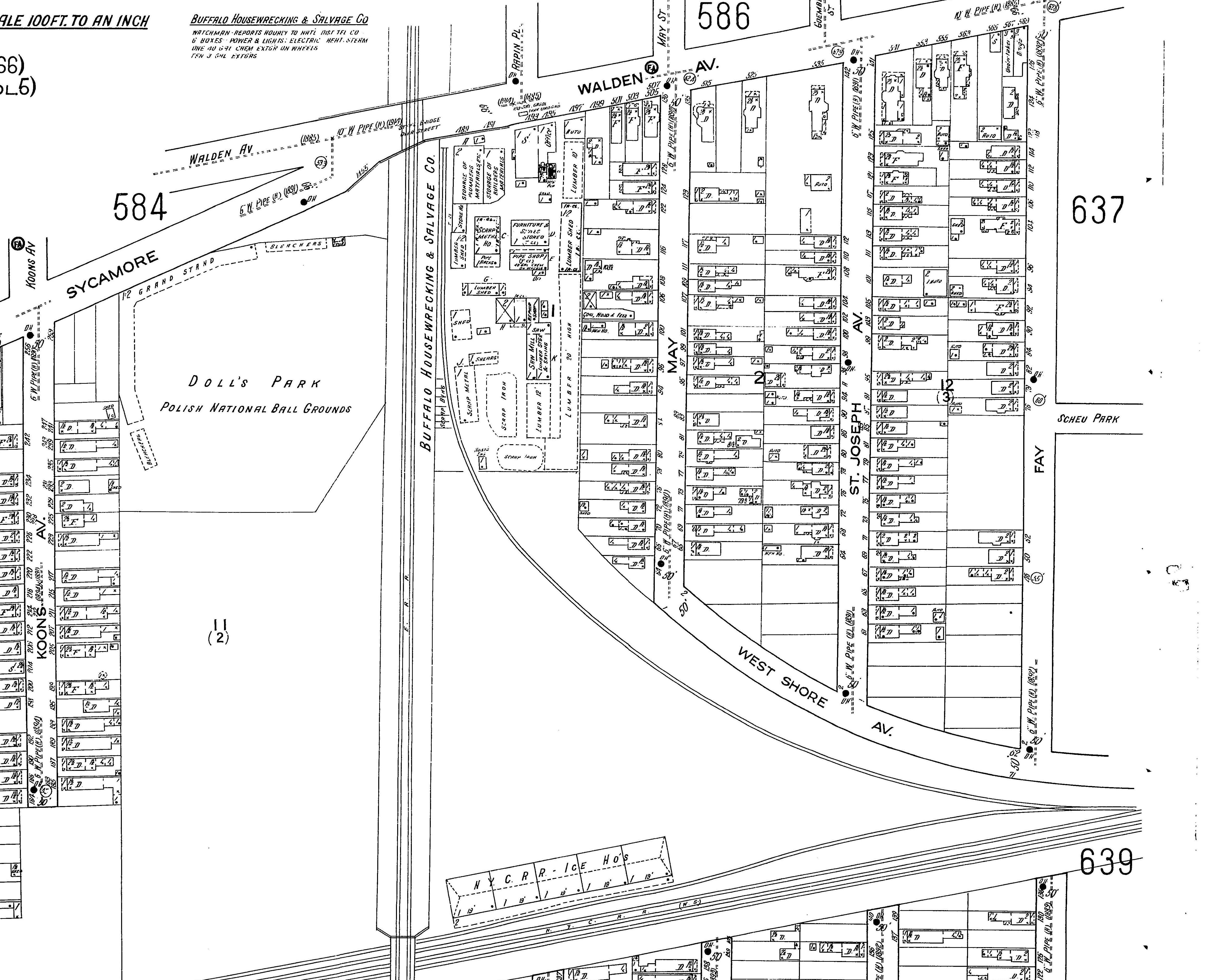
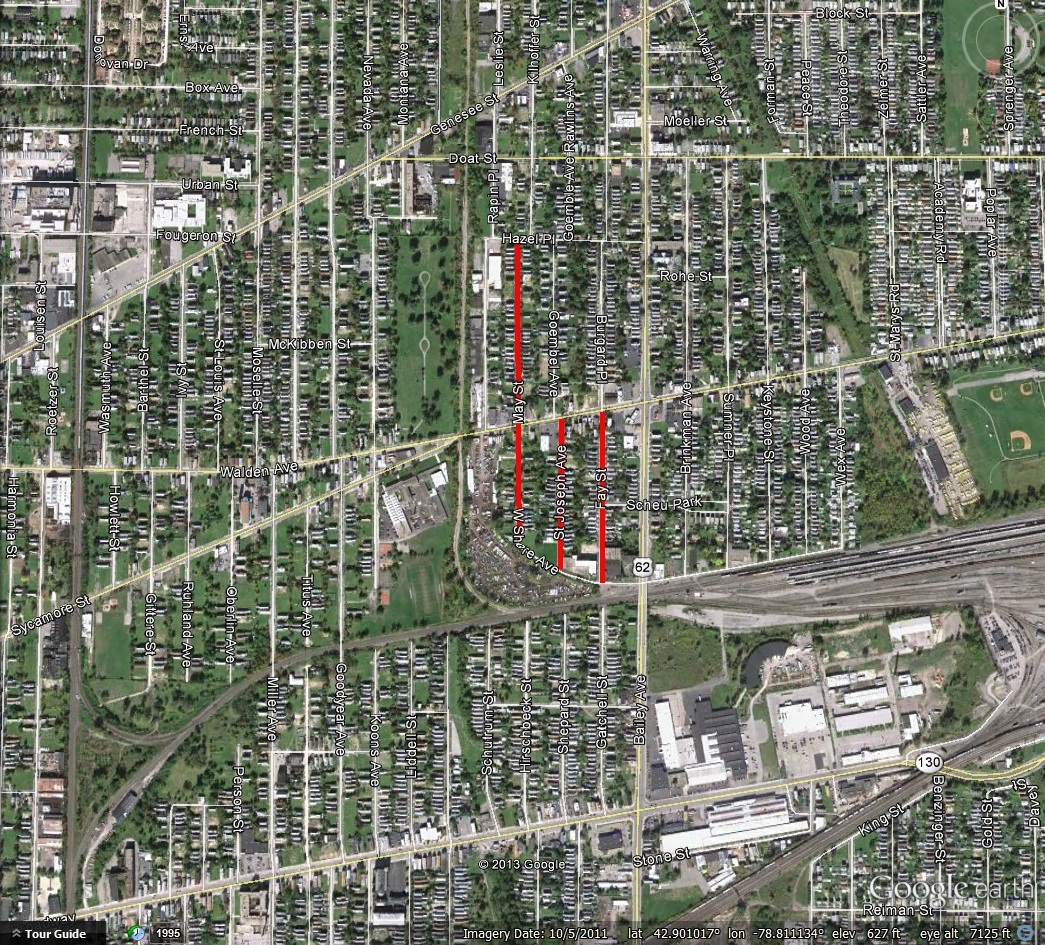
faymayFay, May and St. Joseph Streets are three streets in the Emerson Neighborhood on the East Side of Buffalo.  The three streets run between Walden Avenue and the New York Central Railroad tracks (with May Street reaching north to Hazel Place).  The streets were named after Joseph, May and Fay, members of the Doll family.

Joseph Doll owned a farm that included the land that became Saint Joseph, Fay and May Streets.  He opened the streets and built the houses on them.  The first street, he developed to run from West Shore to Genesee Street.  He originally named it Doll Avenue.  The family name is pronounced “dole” as opposed to a child’s doll.  Doll Avenue was often confused with Dole Street, so Joseph was asked to change its name.  So, he named it May Street after his daughter.  He named the other streets after his granddaughter Fay and his patron Saint Joseph.

Joseph Doll was born on a farm at Main and Huron Streets in 1839.  His parents bought the land when they came from Baden, Germany in the early 1830s.  They came across the Atlantic on a ship that took 72 days.  The final portion of the journey came via the Erie Canal, which was at the time still under construction, so their voyage was partly via canal boat, partly via stagecoach and partly via foot, carrying their baby daughter (Joseph’s sister) at the time.  Their original farm was unsuccessful as there was yellow sand for soil.  They purchased another farm at what is now the corner of Niagara and Connecticut Streets.  That farm was also a failure.  They then bought a 43-acre farm at Bailey and Walden, extending to the present New York Central Tracks and halfway to Broadway.  They ran a general store and saloon out of their farmhouse, which stood at 535 Walden Avenue,  near what today is the intersection of St. Joseph Ave and Walden Avenue.

Joseph Doll took over the store as he got older.  Joseph also ran the farm, raising wheat, barley, cattle, oats, apples, pears, pigs, plums and cherries.  In 1882, West Shore Railroad bought seven acres from the Doll farm.  After the railroad was built along the southern edge of the farm, the Wagner Palace Car shops and other factories came into the area.  Joseph Doll decided to subdivide the property and build houses.  In addition to the streets named for his daughter and granddaughter, and his patron saint.  He also named St. Louis Avenue for St. Louis Roman Catholic Church (for which he was a founder).

1917 view of the Former Doll Farm after the railroad was built and the streets were subdivided and developed. Note "Doll's Park", the future location of Emerson Vocational School (now School 97, Harvey Austin School)

1917 view of the Former Doll Farm after the railroad was built and the streets were subdivided and developed. Note “Doll’s Park”, the future location of Emerson Vocational School (now School 97, Harvey Austin School)


joseph doll graveHe died in 1909 and is buried in Doll family plot the United German and French Cemetery in Cheektowaga.

Read about other Buffalo Street’s by checking out the Street Index.

Source:  “Three Streets Remind of Landowner” Courier Express Jan 22, 1939.  Found in Buffalo Streets Scrapbook, Vol 2 p 166


UPDATE:  April 29, 2016:  One of the best parts of writing this blog is getting information from you, my readers.  I recently received an email from a member of the Doll family.  Michael Schuessler’s Great Grandmother, Louisa (Doll) Williams, was one of Joseph Doll’s younger sisters.  Mr. Schuessler has been generous enough to send in this great photograph of the family at Mr. Doll’s store!   He also provided a copy of Mr. Doll’s obituary.  Thanks for sharing a part of your family history!

Photo 1.jpg

1909 Joseph Doll obit

Read Full Post »

langLang Avenue is located between Bailey Avenue and East End Avenue, between Genesee Street and Delavan Avenue, in the Schiller Park neighborhood of the East Side of Buffalo.  Portions of the street are paved in brick.

Lang Avenue is named after Gerhard Lang, owner of one of Buffalo’s premiere and largest breweries at the turn of the 19th Century, the Gerhard Lang Brewery.

langportraitGerhard Lang was born in Germany in 1835.  He came to Buffalo in 1848 at the age of 14 with his father, Jacob Lang.  Jacob Lang was a butcher and Gerhard learned English while working in the butcher shop.   Around 1862, he assumed control of the Born brewery at the corner of Genesee and Jefferson streets.   Mr. Lang married Born’s daughter and assumed control of the brewery after a few years of marriage.

In 1875, he purchased the a site at Jefferson and Best Streets to expand his facilities.   He toured other breweries across the country to determine the best design for his facility. The Gerhard Lang Brewery was located on the entire block bounded by Jefferson, Best, Berlin and Dodge Streets was the largest brewery in the State outside of New York City.   Berlin Street was renamed Pershing after WWI (in 1920).

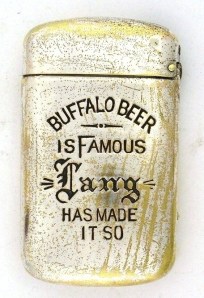
breweryThe Lang Brewery was called “the Palace Brewery”, because it was built with a typical Victorian opulence.   Once the new brewery was built, Mr. Lang used the old brewery at Jefferson and Genesee Street for bottling works and malting house.    The annual capacity of the Gerhard Lang Brewery was over 300,000 barrels.  Lang’s beer was known all over the country for its excellence in quality, purity and wholesomeness.

By 1887, the brewery employed 110 men and distributed to Virginia, Boston, Baltimore, Washington, Philadelphia and New York City.

In addition to the brewery, Mr. Lang served as Alderman of the Sixth Ward and was a Trustee in the Western Savings Bank.  Mr. Lang was a member at St. Louis Roman Catholic Church and donated one of the stain glass windows to the church.

lang graveGerhard Lang died in 1892 and is buried in the United German and French Cemetery in Cheektowaga.  After his death, Edwin G.S. Miller took over the brewery, along with Jacob Lang, Gerhard’s son.

Before Prohibition, the Lang Brewery also owned many saloons that sold its brews.  It is said that Lang’s owned more saloons and beer gardens than anyone in Buffalo, as many as 80 at one point.

Before the automobile, horses were used to transport beer around town.  The brewery kept 500 horses in a stable in Fort Erie to distribute Lang’s beer.

During Prohibition, Lang’s produced dairy and soda products.  There was Lang’s Dairy & Creamery, Lang’s Bakery and products like “Hyan-Dry” brand soda and “Liberty Brew”, a malt extract beverage.  After Prohibition, Lang’s was one of the first to start back up.  However, the market had changed, and the new regulations and taxes made it difficult for local breweries to stay competitive.

The Gerhard Lang Brewery shut down in January of 1949 after 109 years in business.

Langs-Brewery-Match-Safes-Gerhard-Lang-Brewery_62722-2

Gerhardt Street, located on a portion of where the Brewery was located was likely also named after Gerhard Lang, although I was not able to find any specifics linking this together.

To learn about other streets, check out the Street Index.

Sources:

  1. A History of the City of Buffalo:  Its Men and Institutions.  Published by the Buffalo Evening News:  Buffalo, 1908.
  2. History of the City of Buffalo and Erie County:  With Illustrations and Biographical Sketches of some of its Prominent Men and Pioneers.  Edited by H. Perry Smith, D. Mason & Co Publishers, Syracuse NY 1884.

Read Full Post »

Dodge Street

Dodge Street

Dodge Street is a street in the Cold Springs neighborhood on  the East Side of Buffalo.  The street runs for about a mile, from Main Street to Humboldt Parkway and is named for Alvan Leonard Dodge.

Alvan’s father, Alvan Senior was considered courageous when he built a log cabin on Main Street, north of Summer Street in 1811.   At the time, this was well outside the Village limits and well into the primeval forests.  The area was at high risk for attacks from the Native Americans.  However, the Dodge family lucked out when the village was burned in 1813, as their house was well outside the village, and therefore, left standing.  They were one of the few families to be able to return to their home following the fire.  Alvan Senior served as Magistrate of the County of Niagara (at the time, Niagara County included what is now Erie County) and held other official positions in the towns of Black Rock and Buffalo.  Alvan Senior died in 1846 and is buried at Forest Lawn.

Alvan Leonard Dodge witnessed Buffalo’s development from a tiny frontier village into one of the most important cities in the country.  By the end of his life, the Dodge family farm was close to being in the middle of the City that had grown up during Alvan’s lifetime.  Alvan, Junior was born on March 21, 1808 in Lowville, NY and came with his family to settle in Buffalo in 1811.

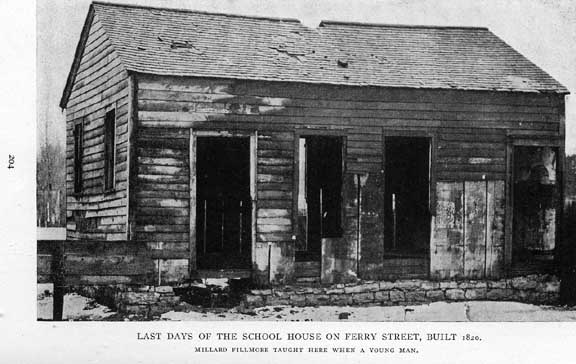
Ferry Street Schoolhouse source

Ferry Street Schoolhouse
source

He was educated in the school in a schoolhouse on Ferry Street that was known as Buffalo District School #2 at the time.  One term, his teacher was Millard Fillmore, who taught while he was also reading law and serving as postmaster.  At the time, the actual Cold Springs still flowed through the neighborhood.    The waters from this spring became the Jubilee Water Works, one of Buffalo’s first water systems.  The springs feed into the lake in Forest Lawn Cemetery.

As a young man, Alvan, Junior acquired a farm of several hundred acres, bounded by Main, East Ferry, Best and Jefferson.  Mr. Dodge built a house at the corner of Main and Dodge Streets, using lumber cleared from his property to build the house.

He sold part of his land to the City of Buffalo in 1880.   After selling the land to the City, he subdivided the remainder of his property for development and laid out streets on his land.  The area became the place for many prominent German families to live.   Legend has it that there was one field that grew the best corn around, so Mr. Dodge refused to convert it to a building lot.

The City used the property they had purchased to build a reservoir.  At the time, the City relied on reservoirs for water service.  This reservoir was known as Prospect Reservoir, since it replaced the reservoir of the same name which was located on Prospect Hill.  When the Colonel Ward Pumping Station opened in 1915, it rendered most of the reservoirs obsolete.

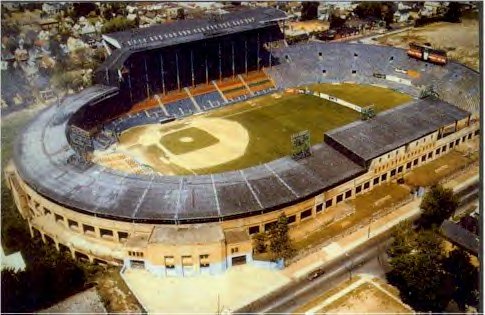
1988 WAR MEMORIAL STADIUM BUFFALO COLOR edited The reservoir sat unused until the 1930s.  Between 1936 and 1938, Buffalo Civic Stadium was built as a WPA project.  It was originally going to be named Roesch Memorial and then Grover Cleveland Stadium before Buffalo Civic Stadium became its official name.  The stadium was nicknamed “The Rockpile” since it seemed to rise out of the quarried land that had been the reservoir.  The stadium became home of the Buffalo Bills football team in 1946.  The stadium was renamed War Memorial Stadium in 1960.  The Buffalo Bisons baseball team used the stadium after Offerman Stadium at Michigan and East Ferry was demolished.  The Bills left the stadium in 1972 when Rich Stadium was built.  The Bisons left the stadium when Pilot Field opened in 1988.

Once the stadium was empty, many of the nearby residents wanted the stadium demolished.  The stadium hadn’t been maintained well during its final years and was in poor condition..   The Dodge-Jefferson and the Best-Jefferson entrances are all that remain today of War Memorial Stadium, which has been converted into the Johnnie B. Wiley Sports Pavilion.   Johnnie B. Willey was a city resident who worked to help young people of the East Side.

Dodge Mill in Williamsville source:  http://www.edyoungs.com/images/dodgemillfront.jpg

Dodge Mill in Williamsville
source

Alvan’s brother, J. Wayne Dodge moved to Williamsville and purchased the flour and grist-mill in 1864 and changed its name to Dodge Roller Mills. The Dodge Mill was across Glenn Falls from the Historic Williamsville Mill that is still standing today.   Dodge Road in Amherst is named after J.Wayne Dodge.  The Dodge Mill burned in 1894, Johnathan Dodge lost is life battling the fire.  The foundations of the mill are still visible near the wall of the creek behind Mill Street.

dodge tombstone

Alvan Dodge married Ruth Bosworth of Clarence.  They had four sons and three daughters.  He died in 1881 at the age of 73 and is buried in Forest Lawn.  The Buffalo Courier said that “his life was quiet and relatively uneventful, yet his life was the history of Buffalo”.

To read about other streets, be sure to check out the Street Index.

Sources:

  1. “Dodge Street Memorial to Pioneer” Courier Express May 21, 1939, sec. 7, p. 5
  2. Steele, O.G. “The Buffalo Common Schools”.  Publications of the Buffalo Historical Society, Volume 1.  Pg. 405.
  3. Smith, H. Perry.  “History of the Town of Amherst, Chapter XXXIX” .  History of the City of Buffalo and Erie County.  D. Mason & Co Publishers:  Syracuse, NY 1884.

Read Full Post »

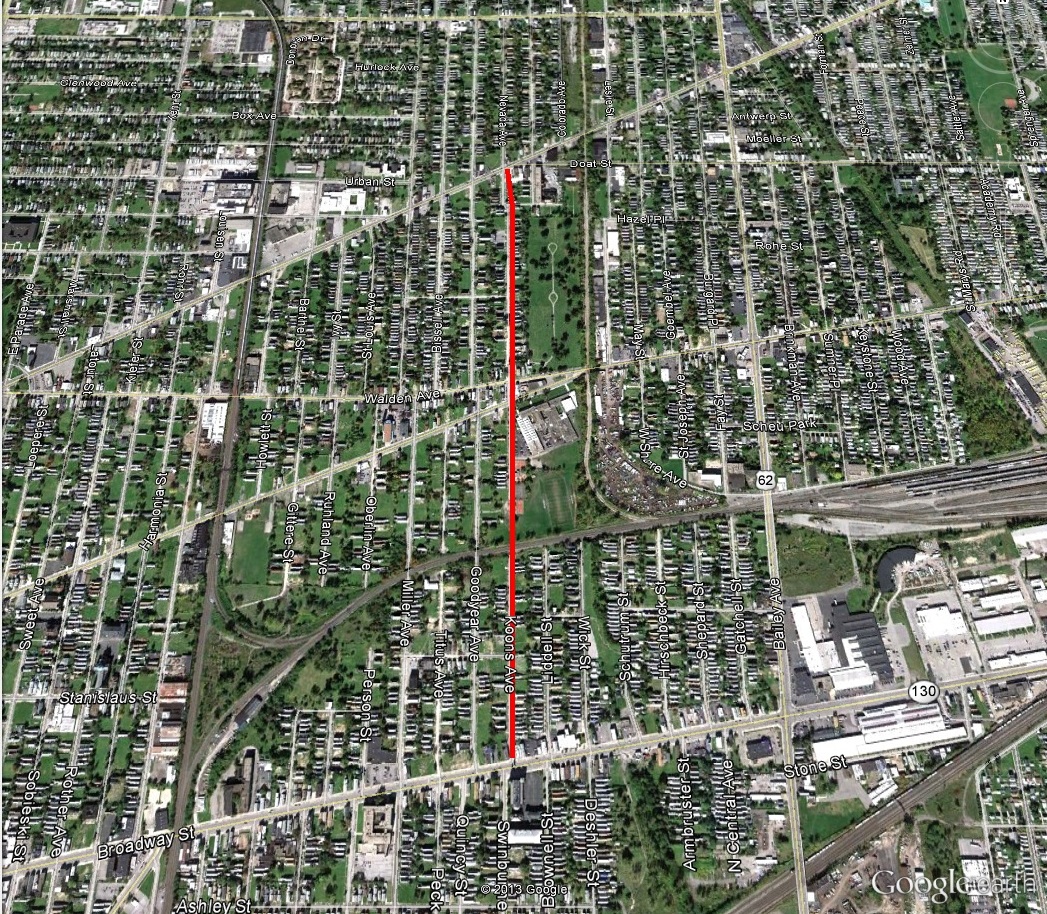
koonsaveKoons Avenue is located in the Emerson Neighborhood of the East Side of Buffalo.  Koons Avenue was named for the Koons brothers, Henry and Edward, who developed the neighborhood along with Judge Titus and Frank and Henry Goodyear.

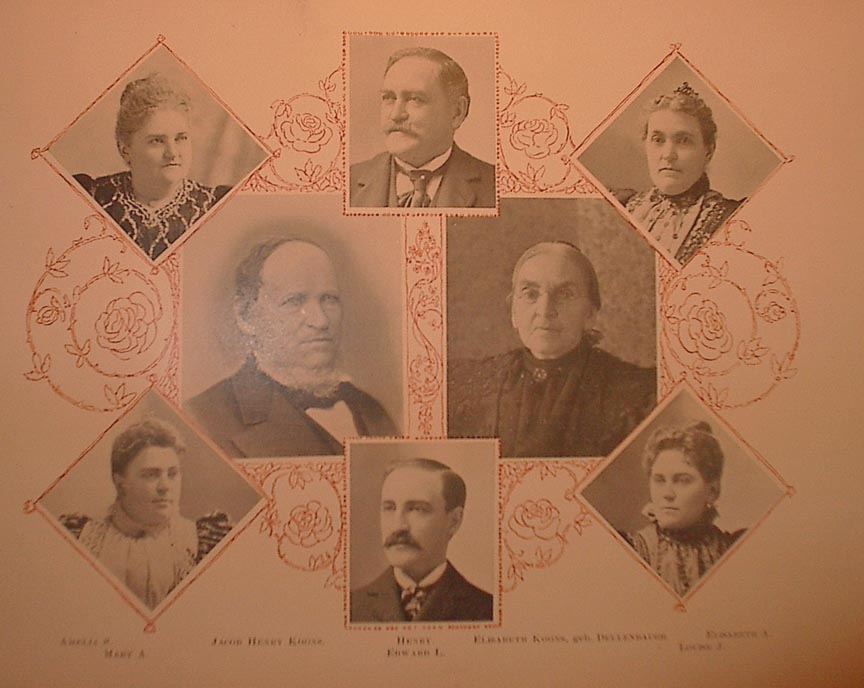
The Koons brothers, Edward and Henry, were born into a prominent Buffalo family.  Their father, Jacob Koons, was a merchant, political official and a leader in church and charitable affairs.  Jacob came from Europe in 1828 and became a farm hand outside of Albany, new York.  He came to Buffalo in 1832 and established a store (history books refer to it as an emporium)  for the sale of clocks, dry-goods and groceries at Main Street near Genesee.   The store was successful and branched out to a second store in Paris, Ohio.  Jacob Koons left the business in 1848.  He was then involved in local politics.  He was appointed Superintendent of the Poor in 1856.    Jame Koons, along with his wife and six children, lived at 73 East Huron.  Jacob Koons was a member of St. John’s Lutheran on Hickory Street and was involved in building and improving St. John’s Orphan Home.   You can read more about the Orphan Home here.   Mr. Jacob Koons died on May 9, 1889.

Top: Amelia, Henry, and Elisabeth Center:  Jacob and Elisabeth, nee Dellenbaugh Bottom:  Mary, Edward and Louise

The Koons Family
Top: Amelia, Henry, and Elisabeth
Center: Jacob and Elisabeth, nee Dellenbaugh
Bottom: Mary, Edward and Louise

Henry Koons was born in Buffalo on October 9, 1838 and was educated in the public schools.  He worked for the American Express Company for two years.   Henry then headed West to learn the trade of tanning with G. Pfisler & Company of Milwaukee, Wisconsin.  He returned to Buffalo a few years later.  He worked as a search clerk in the County Clerk’s office from 1865 to 1871, engaging in abstracting and tracing titles.  During his time in the clerk’s office, he also started working in the real estate business.   He set up his real estate shop on the 400 block of Main Street.  On June 1, 1884, he formed the firm Henry & Edward Koons, when his brother joined the firm.   Henry boasted that the reason for his success was that his guiding principle was absolute honesty in all business transactions.

Edward Koons was born on October 1, 1861.  He was a schoolmate of Francis Folsom, future wife of President Grover Cleveland.  Edward read law in the office of William Glenney.  His knowledge of law and real estate helped him to become a great success in the real estate business.  He founded and was president of Abstract Title and Mortgage and was director of Buffalo Insurance for more than 50 years.  He was the first Vice President of Buffalo Savings Bank and in 1920 became president of the Chamber of Commerce.

The brothers helped Grover Cleveland become Mayor by managing his campaign.  They were prominent in his campaign for Governor and President as well.  The brothers helped Grover Cleveland become Mayor by managing his campaign.  They were prominent in his campaign for Governor and President as well.

Edward and Henry, along with Judge Titus and Frank and Henry Goodyear, bought a large amount of East Side land and quickly resold it for development.

Sylvanite Gold Mines Kirkland Lake, ONIn 1891, Edward opened the Erie County Guaranteed Search Company, an abstract and title search company.  In 1906, Edward Koons was appointed a member of the commission to revise the City Charter.

The Koons brothers invested their profits in gold mines in Ontario, calling their venture Sylvanite Gold Mines.  Sylvanite is found in the Kirkland Lake Gold District in Canada.  The mine was active until 1961.  Henry Koons never married and died in April 1904 in Buffalo.

Edward married Anna Hengerer, daughter of the founder of Hengerer’s Department Store.  Edward and Anna lived at 1131 Delaware Avenue, which is commonly referred to as the Charles Germain House, after the first resident of the house.

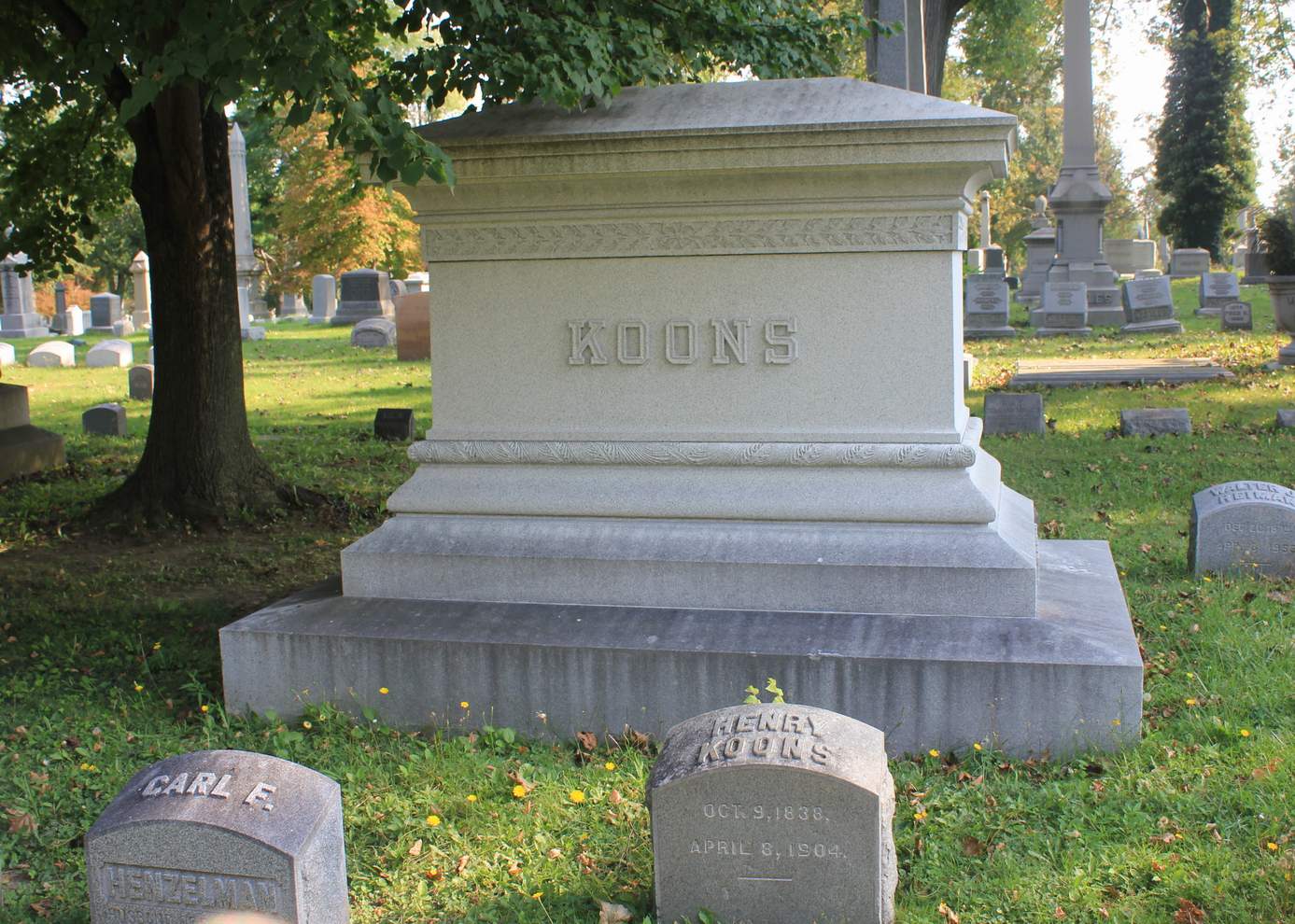
Edward Koons died at eighty-four in the Park Lane Apartments in February 1946.  Edward and Henry are both buried in the Koons plot in Forest Lawn Cemetery.

Koons Plot in Forest Lawn

Koons Plot in Forest Lawn

Learn about other streets in the Street Index.

Sources:

  1. Our County and it’s People:  A Descriptive Work on Erie County, New York.  Edited by: Trumen C. White.  The Boston History Company, Published 1898.
  2. Recalling Pioneer Days.  Volume XXVI, Publications of the Buffalo Historical Society.  Edited by Frank H. Severance, 1922.
  3. History of the Germans in Buffalo and Erie County.  Reinecke & Zesch, Publishers.  Buffalo NY 1898.

Read Full Post »

titusgoodyearkoonsTitus Avenue is a street running between Broadway and Walden in the Emerson Neighborhood of the East Side of Buffalo. The street was named for Judge Robert Titus.  Judge Titus went into a partnership with Charles Goodyear, Frank Goodyear, Edward Koons and Henry Koons to subdivide and develop the land on these streets.  You can read about the Goodyear brothers by clicking here.

Robert Cyrus Titus was born in Eden, New York  in October 1839.  His parents came from Otsego County, New York to the “far west”, as the Holland Purchasewas called in 1817.  At the time, there were no roads through the countryside surrounding the small Village of Buffalo.  Guideposts along the way were blazed trees along the lines most frequently traveled by the occasional settler.  By 1831, they had plowed fields and built a house with a large fireplace and dutch oven.  In this house, Robert Titus grew up, the youngest of six siblings.

judgetitusRobert Titus was educated in a one-room school-house and then attended Oberlin College.  He taught school during the winter term to help finance his own education.  He studied law and set up a practice with Horace Boies in Hamburg, New York.  He opened a practice in Hamburg, New York.  In 1863, Mr. Titus organized a company, which became part of the 98th Regiment of the National Guard of New York State.  The regiment was in service from August 10, 1864 to December 22, 1864.  After he returned home, he was admitted to the bar.  Shortly thereafter  he was appointed Special Deputy Clerk of Erie County and held the office until 1864.  In 1867, he was a candidate for the New York State Assembly, but was defeated.  His first public office was Supervisor of Hamburg from 1868-1871.

In 1873, Mr. Titus moved to Buffalo with his wife Arvilla  to enter into a partnership with Joel Walker.  In 1878, he was elected district attorney.  In 1879, Mr. Titus was made a partner in the firm of Osgoodby, Titus & Moot and practiced with them until 1883, when he formed a partnership with B.S. Farrington.   In 1881   he went to Albany as a State Senator.  During his term in Albany, there was a great opposition to the Erie Canal, however Robert was a strong supporter to keeping the canal open.

In 1885, Mr. Titus was elected Judge of the Superior Court of Buffalo.   He was made Chief Judge in 1891.  When the Court was abolished in 1895, the judges were transferred to the New York Supreme Court.

An Artist's Depiction of President McKinley's Assassination.

An Artist’s Depiction of President McKinley’s Assassination.

Robert Titus was considered to be one of the state’s leading trial lawyers before he ascended to the bench. He was chosen by the state Bar Association to defend  President William McKinley’s assassin in 1901.  The trial of Czolgosz was notorious for how quickly it was completed.  President McKinley died on Saturday, September 14th, Czolgosz was indicted on Monday September 16th.    The jury for the trial was selected in two hours and twelve minutes.  The trial began on September 23rd, as soon as the final juror was named.  By the following afternoon, it was over.  Judge Titus had been in Milwaukee attending a masonic convention when he heard he was assigned to the case.

While the judges were highly respected, neither he nor his partner on the case, Judge Loran Lewis, had worked as a trial lawyer in years.  Judge Titus and Judge Lewis had not wanted to represent the assassin; however, they took the side of justice to ensure that he was given a fair trial.  The public outrage over the murder of the President was demanding a speedy trial and at the time, there was fear that it might not be a fair one.  It was a credit to the both of theirs honor that they ensured that Czolgosz was dignified with a fair trial and not disposed of by “lynch or mob law”.  Czolgosz assisted with the trial’s speed by refusing to cooperating with his legal counsel.  Czolgosz tried to enter a plea of guilty; however, due to the magnitude of the trail, he was not allowed. The jury took only 30 minutes to determine that Czolgosz was guilty and he was sentenced to death on September 26th.   One month later, Czolgosz was electrocuted in Auburn Prison.

Judge Titus' House on Columbus Parkway

Judge Titus lived on Seventh Street.  The portion of 7th Seventh Street on which he lived later became Columbus Parkway.  Mr. Titus died on April 28, 1918 at the age of 79.  He was survived by his son, Lieutenant Allan S. Titus, and daughter, Amy Titus Worthington.  Judge Titus is buried in Hillcrest Cemetery in Hamburg, New York.

Don’t forget to check out the Street Index to find out about other streets!

Sources:

  1. Contemporary American Biography:  Biographical Sketches of Representative Men of the Day.  Volume 1, Part 2.  Atlantic Publishing and Engraving Co:  New York, 1895.
  2. Lord, Walter.  The Good Years:  From 1900 to the First World War.  Kessinger Publishing, LLC, 2007.
  3. Our County and its people:  A descriptive work on Erie County, New York.  Edited by: Truman C. White.  The Boston History Company, 1898
  4. Miller, Scott.  The President and the Assassin.  Random House Publishing Group:  New York, 2011.
  5. “Assassin Czolgosz Refuses to Plead:  His Lawyer Enters a Provisional Plea of Not Guilty”.  New York Times, September 18, 1901.
  6. Obituary of the Honorable Robert C. Titus.  Buffalo Morning Express, Sunday April 28, 1918.

Read Full Post »

titusgoodyearkoons

Goodyear Avenue is the center of these three streets

Goodyear, Titus, and Koons Avenue are three streets running between Walden and Broadway in the Emerson Neighborhood on the East Side of Buffalo.

The streets were named after Charles Waterhouse Goodyear, his brother Frank H. Goodyear, Judge Robert Titus, Edward Koons, and his brother Henry Koons.   These men entered into a partnership to subdivide and develop the streets and much of the land surrounding these streets.  This post is going to focus on the Goodyear brothers, entries for the Koons Brothers and Judge Titus will follow shortly.

Note:  Buffalo’s Charles Goodyear is not the same Charles Goodyear that Goodyear tires are named after.  Charles Goodyear of the tire fame invented vulcanized rubber around 1844 in Massachusetts.

charlesgoodyearCharles Waterhouse Goodyear was born in Cortland, New York in 1846.  He attended school in Cortland, Wyoming, and East Aurora, New York.  He came to Buffalo in 1868 to study law and was admitted to the bar in 1871.  He joined Grover Cleveland’s firm of Cleveland, Bissell, and Sicard when Cleveland left to run for president in 1883.

In 1887, Charles gave up law to enter into business with his brother to form F. H. & C. W. Goodyear.   Together, Charles and Frank expanded the railroad and merged it with the Buffalo and Susquehanna Railroad from Buffalo to Wellsville.  They profited by using the railroad to ship lumber, rather than floating it down streams, as was the practice of the time.

Charles held the office of Trustee of the Buffalo Normal School, now known as Buffalo State College.  He was also was one of the organizers of the Pan American Exposition and was President of the Buffalo Club.  He was a close friend of President Grover Cleveland and Cleveland’s Secretary of State, Daniel Lamont.  Charles and his wife were the first guests of President Cleveland at the White House.

Goodyear Mansion at 888 Delaware

Goodyear Mansion at 888 Delaware

Charles and his wife Ella lived in a mansion at 888 Delaware Avenue, which was built in 1903 and designed by Green & Wicks.  Charles died in 1911 and is buried in Forest Lawn Cemetery.

Following Charles’ death, Ella established the Charles W. Goodyear Fund at the Albright-Knox Art Gallery.  Charles and Ella’s son Anson Goodyear later served on the board of the Albright Art Gallery (now the Albright-Knox).  Anson was one of the board members who insisted that the gallery begin to acquire modern art, of which the museum is now well-known.

Ella lived in the Delaware Ave mansion until her death in 1940.  At that time, the mansion was sold to the Blue Cross Corporation.  The mansion was then sold to the Catholic Diocese of Buffalo in 1950 when it became Bishop McMahon High School.   It was purchased in 1988 by Women & Children’s Hospital of Buffalo and was used as the Robert B. Adam Education Center.  In 2005, Oracle Charter School purchased the building.

Goodyear Hall on UB South Campus

Goodyear Hall on UB South Campus

In 1960, the family donated $500,000 to the University at Buffalo in Ella Goodyear’s name.   This money was used to build Goodyear Hall on South Campus.  The building of Goodyear Hall was important to the development of UB towards becoming a residential college.  Part of the UB2020 plan involves renovating Goodyear Hall and converting it from dormitory rooms into student apartments.

frankgoodyearFrank Henry Goodyear was born in Groton, Tompkins County, New York on March 17, 1849.  Shortly after he was born, the family moved to Holland, New York.  He attended public and private schools and the East Aurora Academy.  In 1871, he moved to Buffalo to engage in the coal and wood business.  He later entered the lumber business and was one of the largest lumber manufacturers in the United States at the time.  His firm manufactured over 150,000,000 feet of lumber yearly.  In 1884, Frank built the Sinnemahoning Railroad, which connected to the WNY&P Railroad in Keating Summit, Pennsylvania.  In 1887, he entered into business with his brother Charles.

goodyearmansionFrank Goodyear built a mansion at 762 Delaware Avenue, at the northwest corner of Summer Street.  Frank passed away in 1907 of Bright’s Disease shortly after moving into the mansion.    Frank made many donations to Buffalo parks.   Frank’s wife Josephine lived in the house until she died in 1915.  Following Josephine’s death, the house was lived in by Frank and Josephine’s son, Frank Junior. The mansion was demolished in 1938 and is now the site of the parking lot for the Red Cross.

Don’t forget to check out the Street Index to learn about other streets.

Sources:

  1. Our County and it’s People:  A Descriptive Work on Erie County, New York.  Edited by: Trumen C. White.  The Boston History Company, Published 1898.
  2. Dunn, Edward.  Buffalo’s Delaware Avenue:  Mansions and Families.  Canisius College Press, 2003.
  3. http://wnyheritagepress.org/photos_week_2007/goodyear_mansion/goodyear_mansion.htm

Read Full Post »

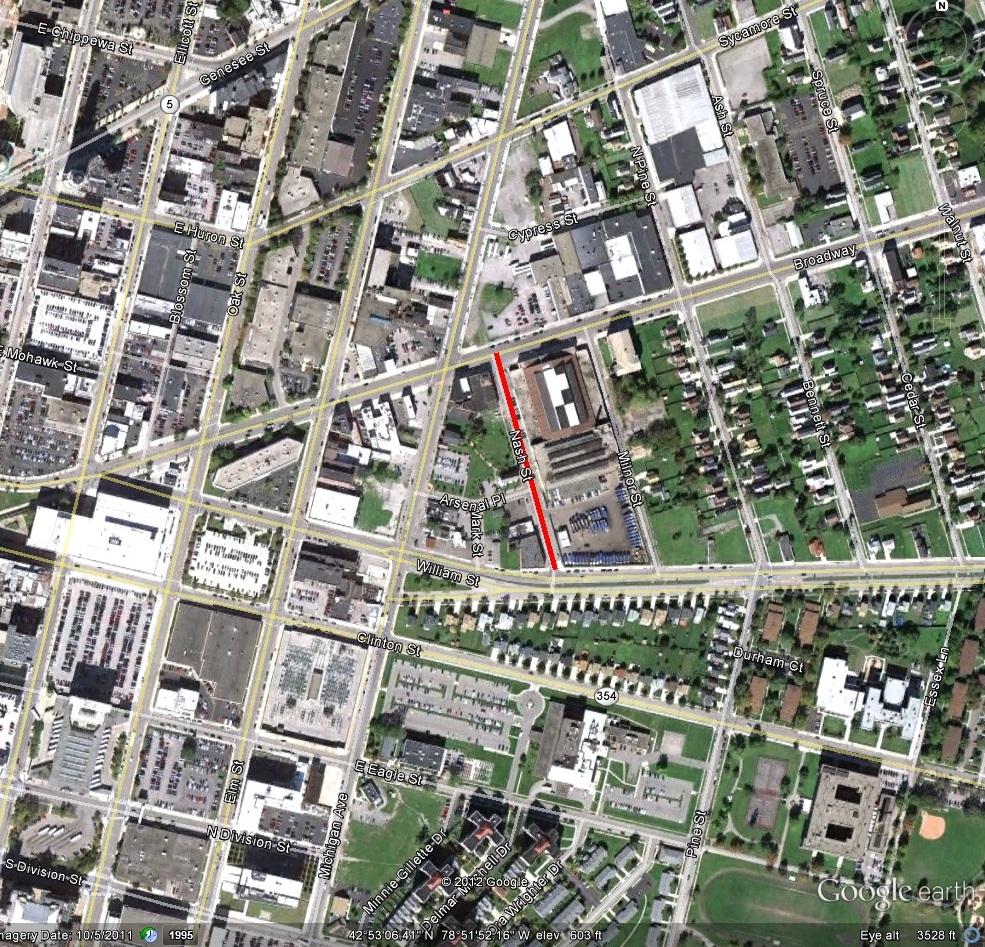
Nash Street is a short street a close walk from the Central Business District, between Broadway and William Street near Michigan Avenue.  The street is less than a quarter-mile long, but is a part of the rich history of Buffalo.  Nash Street was known as Potter Street until the 1950s.

The Street is named after Jesse Edward Nash, Sr.  Dr. Nash was one of the City of Buffalo’s most prominent African-American citizens for the first half of the 20th Century.

J. Edward  Nash was born in Occoquan Virginia in 1868.  He worked as a farm hand, a blacksmith, a mason and a boatman.    He was a student at Virginia Union College in Richmond with Reverend Adam Clayton Powell, Senior, the pastor of Harlem’s Abyssinian Baptist Church.   Rev. Powell’s son was the first African-American elected to congress.  Reverend Nash became a minister at age 18.  At age 24, he came to Buffalo in 1892 to serve as pastor of Michigan Avenue Baptist Church.  He was pastor from 1892 until he retired in 1953.   Dr. Nash married Frances Jackson in 1925 and moved to 36 Potter Street in 1925.  Dr. and Mrs. Nash had one son, Jesse Junior, who became a professor at Canisius College.

Dr. Jesse Edward Nash, Senior

The City of Buffalo has had a strong history of African-Americans living in freedom.  When the City was incorporated in 1832, the city directory listed the names of 68 colored heads of families.  The majority of the African-Americans in Buffalo lived in the 4th Ward of Buffalo at the time – east of Main Street between North Street and South Division Street.  Michigan Avenue was the heart of the African-American neighborhood.  The Michigan Avenue Baptist Church was founded in 1836.  The current church was built in 1845, prior to this, they worshiped in a meeting room on Niagara Street near Pearl Street.

During the early 1900s, Buffalo’s African-American community was growing quickly, due to the City’s industrial economy.  When Dr. Nash came to Buffalo, there were only three established African-American churches.  By 1952, there were more than 30 churches.  Because of his education, Dr. Nash was well respected and he became one of the main representatives and spokesperson for the City’s African-American Community.

Reverend Nash helped to found the Buffalo Urban League.  This functioned as an agency to welcome African-Americans to Buffalo when they arrived from the south, by helping them find housing and jobs.  The Buffalo Urban League is still in operations today.

Reverend Nash was unique in his role in Buffalo.  He was widely respected by the city’s white leadership, so he had access to the Mayor and elected officials.  This was uncommon in many other cities during this time.   He worked to put together community meetings of black Buffalonians to intercede on behalf of other black citizens who were being wronged because of their race.

Dr. Nash was well-known, not just in Buffalo, but throughout New York State and the entire country.  He hosted Booker T. Washington in 1910 in Buffalo.  In addition to Mr. Washington, many nationally known African-American leaders were guests of Dr. Nash’s, including WEB DuBois.  Dr. Nash’s neighbor was Mary Talbert, another significant African-American in Buffalo during this time period, but we’ll get to her later (there’s a street named after her as well).

In 1912, Virginia Union University awarded Nash an honorary doctorate.  Dr. Nash served as treasurer of the Western New York Baptist Association, secretary of the Baptist-Disciples Ministers Fellowship.  He was chaplain at Meyer Memorial Hospital (the predecessor to ECMC).

During the 1950s. Buffalo was undergoing a series of urban renewal projects.  Many of these projects impacted African-American neighborhoods disproportionately.   Dr. Nash advocated for fair housing and worked to stop the loss of affordable housing which was occurring under the name of “slum clearance”.

Dr. Nash retired as pastor in 1953.  To commemorate his retirement, the City renamed the street from Potter Street to Nash Street.  In 1954, Dr. Nash was awarded one of the first Brotherhood Awards from the National Conference of Christians and Jews.  He passed away in 1957 and was survived by his wife and his son Jesse Edward Nash, Junior.  He is buried at Forest Lawn.

Nash House, 36 Nash Street

The Nash House is located at 36 Nash Street.  The Buffalo Preservation Board and Buffalo Common Council designated the NAsh House a local historic landmark in 2001.  The house was originally built as a two-family residence, with an upper and lower unit.  Many of the houses in Buffalo were built like this as a practical form of housing for the urban middle class.   The Nash family lived on the second story of the house and rented out the lower floor.

The house was built around 1900.   Few changes have occurred through the years, and the historic integrity of the structure has been preserved.  The house and its contents, which included most of Dr. Nash’s papers, were acquired by the Michigan Street Preservation Corporation in 2000.  Restoration from 2002-2003 included restoration of the clapboard, windows and front porch.  The Nash family living quarters is fully restored, and the lower levels was rehabilitated for office and research space.

Dr. Nash and his family lived in the house from 1925 until 1987.   He passed away in 1957, but his widow occupied the house until she died in 1987.

The Nash House was restored and opened as the Nash House Museum in May 2007.   The museum provides a glimpse into what life was like in the early 1900s on Buffalo’s East Side.  The museum is open Thursdays and Saturdays from 11:30-4pm.   My interest has been piqued and I intend to check out the museum, hopefully this weekend.
For more information on the Michigan Street Heritage Corridor Commission and some of the amazing African-American history of Buffalo that happened in this neighborhood, please read this report prepared for the Commission by a UB Planning Studio.  

Dellenbaugh Block

This neighborhood has a personal history for me, as my uncle owned the complex of buildings known as the Dellenbaugh Block at the corner of Broadway and Michigan for much of my childhood.  He operated a car wash and pizzeria on the Broadway side of the block.  There was a pharmacy on the Michigan side of the building which always reminded me of the pharmacy in It’s a Wonderful Life.  The pharmacy here in this building was the first 24-hour pharmacy in Buffalo.

The Langston Hughes institute has plans to develop the Dellenbaugh Block.   More on their plans can be found here.

Some of my most vivid childhood memories were spent exploring that building and being fascinated by the neighborhood and the history.  The dark and scary basement of the building always freaked me out, because legend has it that it was a part of the underground railroad.  Portions of the building were built in 1842.  The city lists the building as being built in 1890, but to my childhood imagination, there were civil war era ghosts in that basement.

The Dellenbaugh Block is a designated landmark with the City of Buffalo.  The block is named for Frederick Dellenbaugh, a German immigrant.  Mr. Dellenbaugh was a physician and built his home and office at 173 Broadway circa 1842.  The house is visible from Nash Street, behind the newer storefront.   The storefront was the location of a Deco restaurant in the 1930s.

Broadway Arsenal in 1858

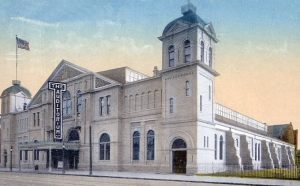
Across Nash Street is the Broadway Barns, a City of Buffalo DPW garage.  This building was originally designed as a New York State Arsenal.  Portions of the original circa 1865 armory still exist and can be seen from the inside of the building.  Once the regiments left the Arsenal, the building was converted to an exposition and event hall.

Broadway Auditorium in 1915

This was used for events prior to the construction of the Buffalo Memorial Auditorium on the Terrace.  There are pictures of elephants walking down Broadway to get to the circus at the old Broadway Auditorium.   After the Memorial Auditorium was built, the Buffalo Streets Department began using it as a garage.  What a change this building has seen in the past 150 years!  What a history in this little pocket of a neighborhood!


Check out the Street Index to learn about other streets in Buffalo.


Sources:

Cottrell, Kevin.   “J. Edward Nash History”.  accessed at: http://www.motherlandconnextions.com/nash.html

“Dr. J. Edward Nash, Sr.” (Obituary).  Buffalo Courier Express.  27 January 1957

http://www.showcase.com/property/163-173-Broadway-Street/Buffalo/New-York/1435912

http://greaterbuffalo.blogs.com/gbb/2005/12/campaign_landma.html

http://www.nashhousemuseum.org/history.html

Read Full Post »

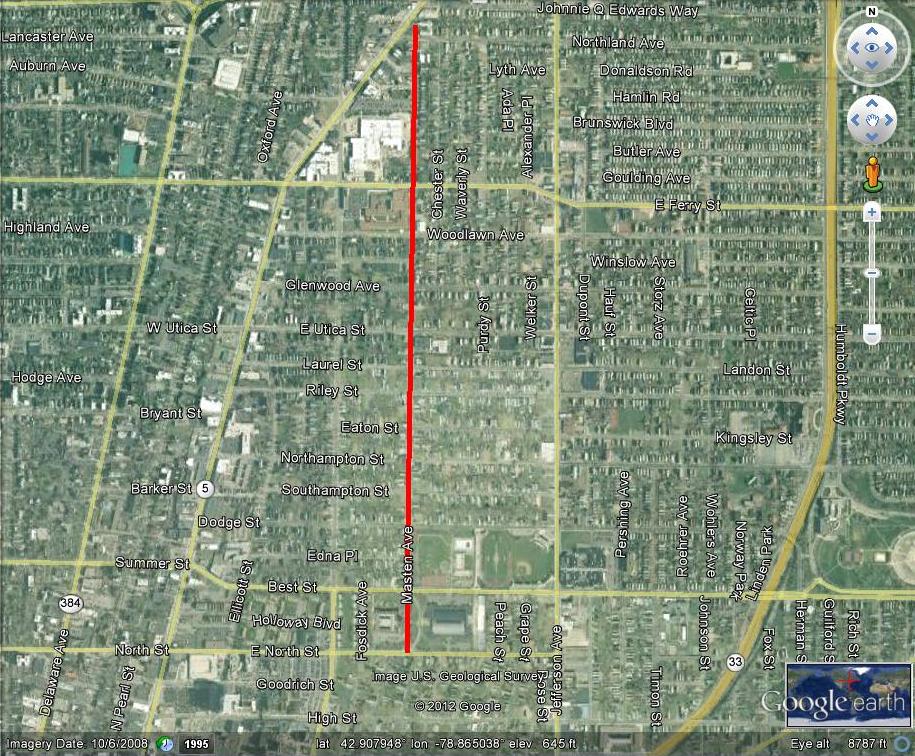
Masten Avenue runs north-south for about a mile on the East Side of Buffalo, between North and Ferry Streets.   The Masten Park neighborhood, Masten Avenue, Masten Park and the former Masten Park High School (currently City Honors), all get their name from former City of Buffalo Mayor Joseph Masten.

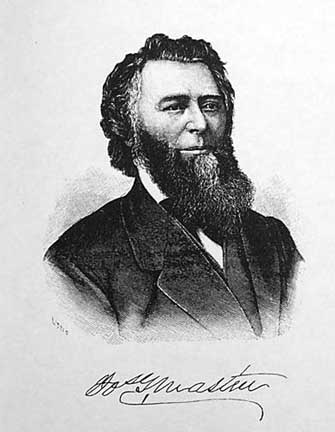
Joseph Griffiths Masten was born in 1809, in Red Hook, New York.  He came to Buffalo in 1836 after studying law.  He was elected Mayor in 1843.   While he was Mayor, he issued the law which says that owners/occupants of buildings and owners of vacant lots need to keep their sidewalks and gutters free of snow and dirt.  Blame him if you get a ticket for not shoveling your walk!

Buffalo was an exciting place to be while Masten was Mayor.  He was Mayor when Joseph Dart invented the grain elevator and expansion of the city resulted as the City began to become an important grain hub.  He was also Mayor during the founding of the University of Buffalo.  He and his wife, Christina, were the first owners of the Wilcox Mansion on Delaware Avenue.  At the time it was an army barracks and the Mastens converted it into a residence; today the mansion serves as the Theodore Roosevelt Inaugural Site.

After his time as Mayor, Masten served as a judge.  It is said that he went on long walks around his neighborhood, always stopping to talk to neighbors and people he met along the way.   He died in 1871 and is buried in Forest Lawn.  His tombstone reads:  “An upright judge, an eminent lawyer, a faithful public servant, an esteemed citizen, a true gentleman”.

Source:  “Masten Avenue Honors Memory of 1843 Mayor”. Courier Express, Dec 4, 1938 sec 7 p 4

Read Full Post »

« Newer Posts

Field Notes

Live from Buffalo, NY

Grants.gov Community Blog

Connecting the grant community to #LearnGrants

Dienna Howard

I create, therefore I am.

Hidden Waters blog

Companion blog for the book "Hidden Waters of NYC"

Hoping for a Tail Wind

Because I definitely brought way too much gear.

priorhouse blog

Photos, art, and a little bit of LIT.

Sheepie Niagara

Bleating the Beat Since 2015