Feeds:
Posts
Comments

Archive for the ‘Downtown/Harbor’ Category

Screenshot (79)

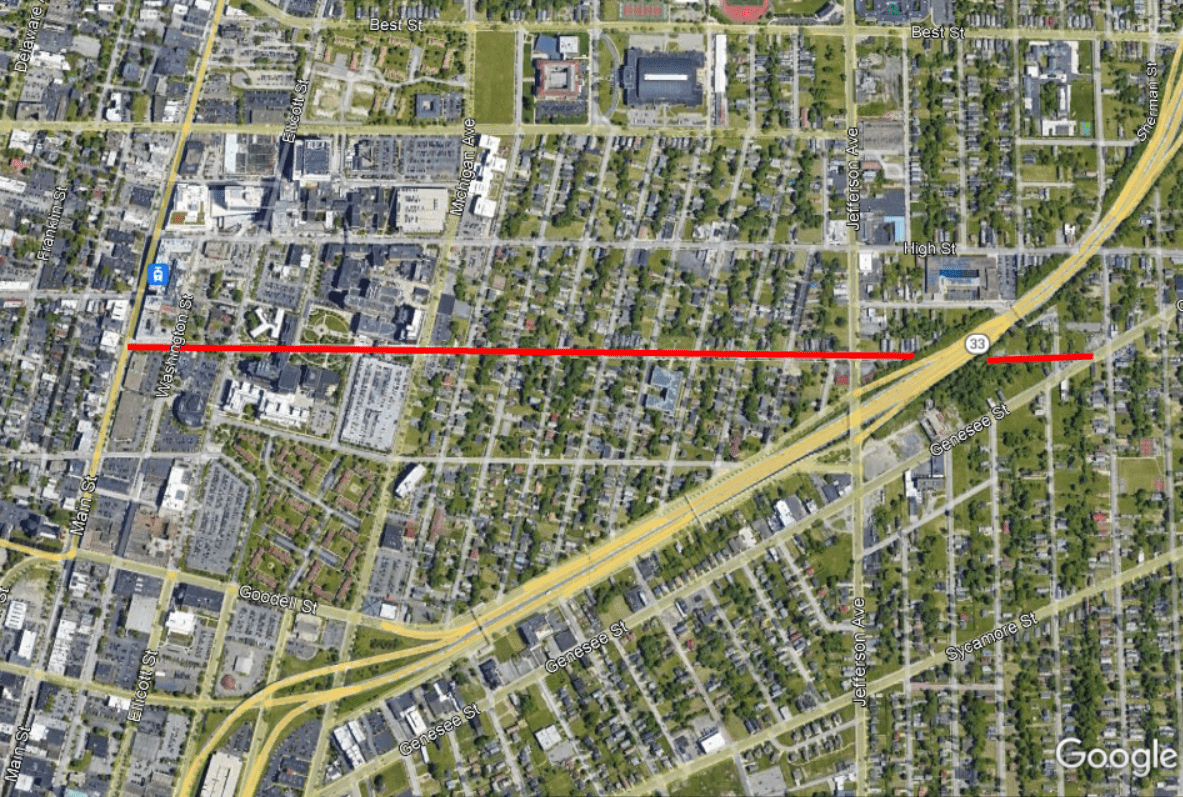
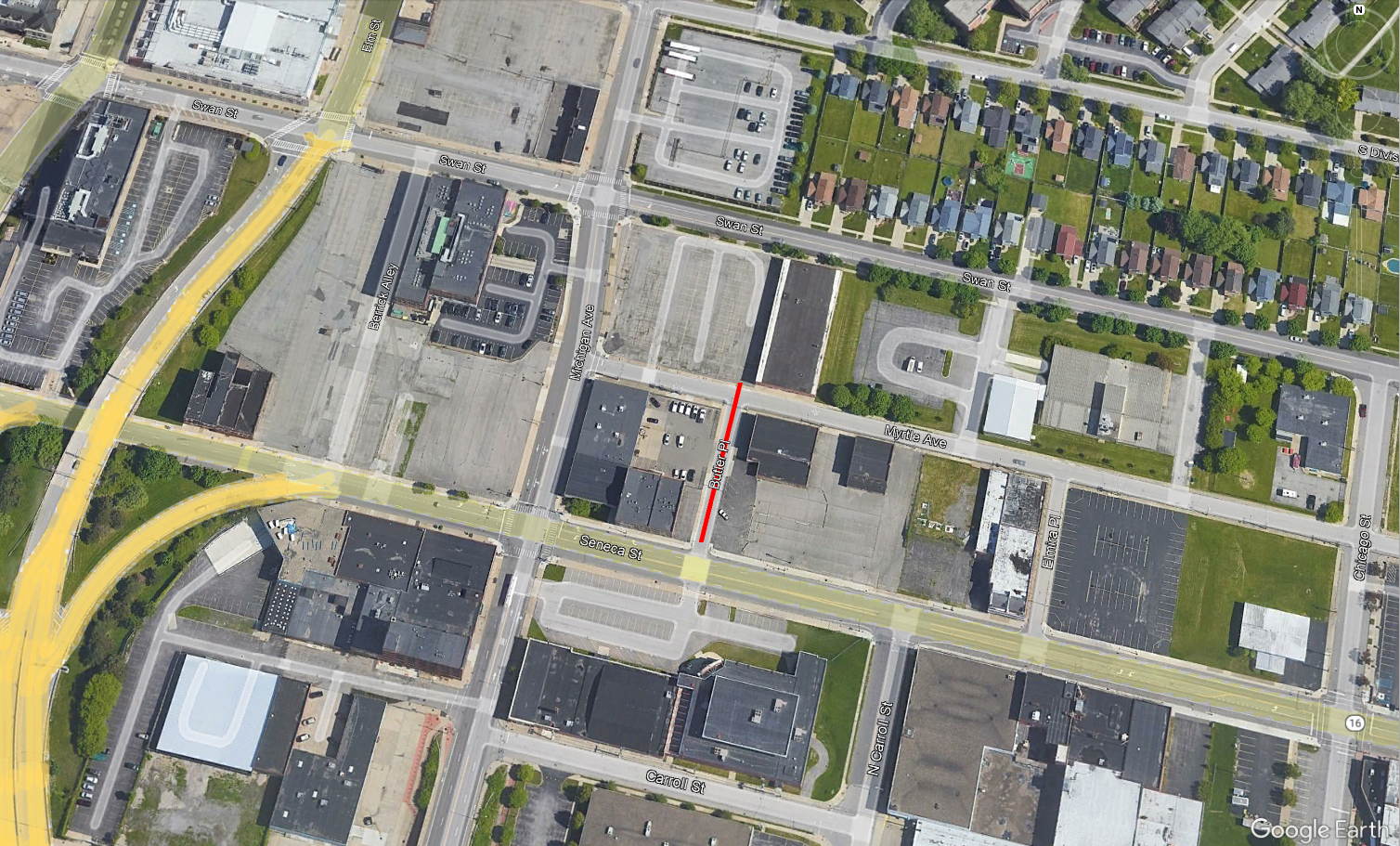
Butler Place is shown on the map in red.

Today we’ll be talking about Butler Place, which was originally Fitch Alley.  We’ll be discussing both Mr. Joseph Butler and Mr. Benjamin Fitch in this post….because the Fitch name is very important in Buffalo’s social work history! Normally, I don’t write much about the original namesakes of streets but I don’t know when else I’d be able to tell the story of the Fitch Institute and the Fitch Creche otherwise. 

Another Butler – Butler Street

Most of the time, a municipality likes to ensure it doesn’t have duplicated street names, to avoid confusion for things like emergency services and mail delivery.  However, Buffalo has two streets called Butler:  Butler Place and Butler Avenue.  The next post, coming next week, will discuss Butler Avenue and its namesake, the founder of The Buffalo News.

1872 atlas of buffalo butler street

1872 Atlas of Buffalo map showing Butler Street, lined in orange.

There actually used to be a THIRD Butler!  Butler Street was laid out in 1855 between Delaware Avenue and the State Reservation Line (near Richmond Avenue).  Butler Street is now known as Lexington Avenue.  Frank Kraft, an undertaker who lived at what became 53 Lexington Avenue, decided the name of Butler Street was not “toney” enough, meaning “aristocratic or high-toned.”  Mr. Kraft convinced his neighbors to petition to become Lexington Avenue, thinking it sounded fancier.  The name change was granted in 1888.  There was a trend during this era to change street names to seem higher class.  At the time, people believed Avenues were nicer than Streets, so residents would petition to change their street names – Delaware and Michigan went from streets to avenues around this time.  During the same Streets Committee Meeting where Butler became Lexington, Cleveland Street became Cleveland Avenue.  Unfortunately, I could not determine who Butler Street was originally named for when it was laid out in 1855; several Butler families lived in Buffalo around that time.  However, neither the Butler Place nor the Butler Avenue namesakes lived in Buffalo in 1855, so it was not named for either of them.  

The Original Fitch Alley

So now, back to Butler Place….Butler Place runs for just one block between Swan Street and Myrtle Avenue, just east of Downtown Buffalo.  Butler Place was originally named Fitch Alley, after Benjamin Fitch, but was renamed in 1891 to honor Joseph Butler.  Mr. Fitch owned the land just west of Fitch Alley.  

1872 atlas of buffalo second ward fitch institute_zoom

1872 Atlas of Buffalo image showing some of the properties of Benjamin Fitch outlined in red. Property at the southwest corner of Swan and Michigan became home to the Fitch Creche (in the building located on the site on this map) and Fitch Institute on the vacant portion of that property. Note Fitch Alley’s name on the map. Intersects with Folsom Street, which is now Myrtle Avenue.

Mr. Benjamin Fitch
Benjamin_Fitch

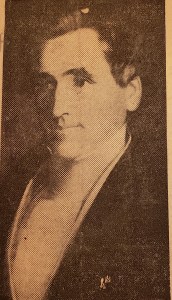
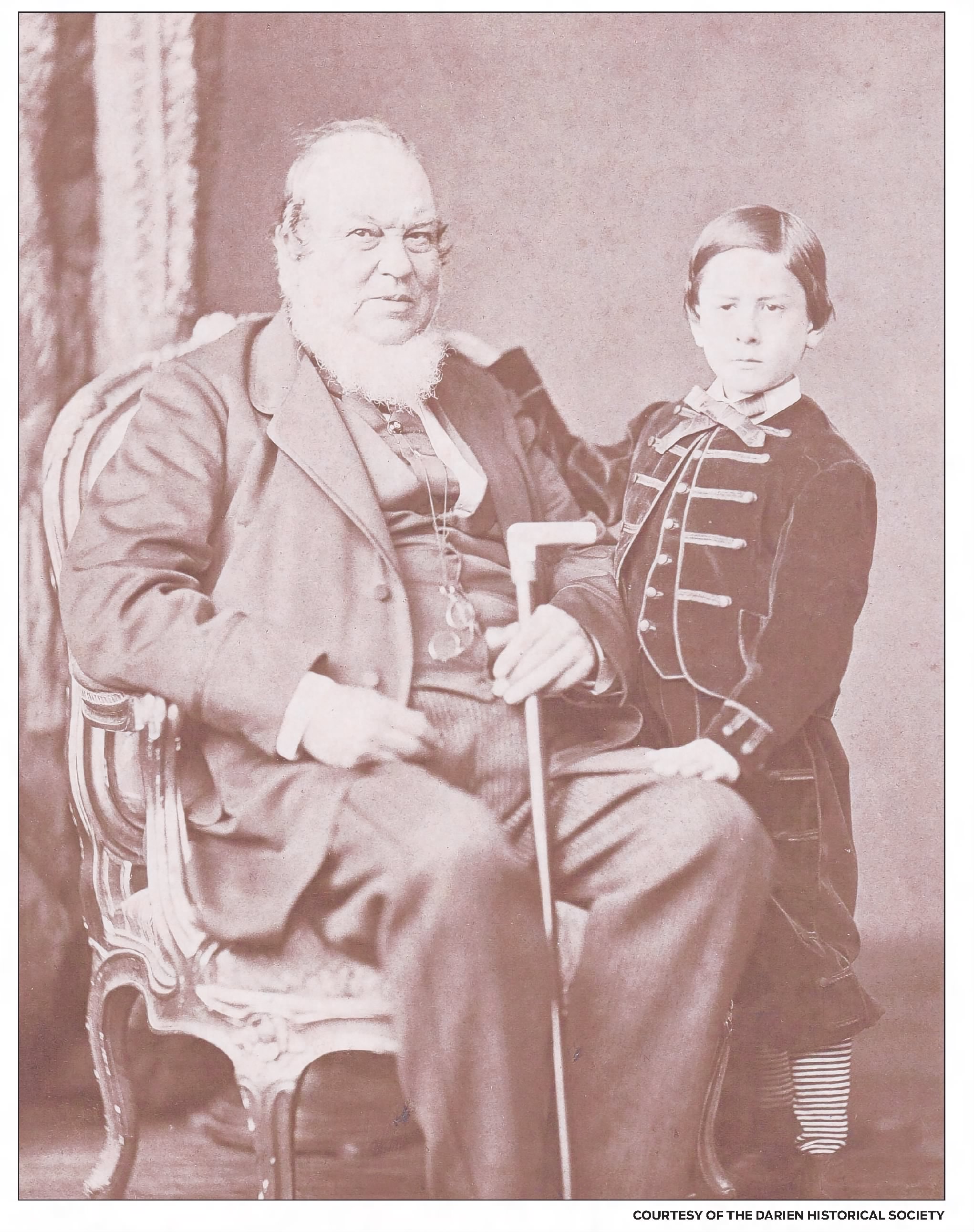
Benjamin Fitch and his grand-nephew Augustus. Source: Hartford Courant.

We’ll start with Mr. Fitch.  Benjamin Fitch was born in June 1802 to Charlotte Selleck and Stephen Fitch.  His birthplace is disputed among various records.  Charlotte petitioned the State of Connecticut for divorce on the grounds of being threatened and beaten by her husband.  The divorce was granted in 1808, and Charlotte moved away with two of Benjamin’s siblings.  Benjamin and two of his brothers lived with their father.  In 1812, at the age of 10, Stephen was working as an Indian Agent, and the family came to Buffalo to see Red Jacket.  They were still in Buffalo when it got burned by the British in 1813-1814, and they decided to move to Albany.  At that time, Benjamin ran away from his father and made his way back to New York City by working on the Hudson River in a sloop.  He reunited with his mother and lived in New York City for a few years, working as a store clerk.  He eventually went into business for himself.

In 1824, Benjamin Fitch returned to Buffalo to open a General Store.  After a few years of establishing his business, he returned to New York City but maintained a branch office in Buffalo.  In 1841, he returned to Buffalo as a member of the firm of Marvin, Bennett & Company.  The Bennett in Marvin, Bennett & Co is Mr. Bennett of Bennett Park fame, and the Marvin is Marvin Street’s namesake. The store was originally on the west side of Main Street between Seneca Street and the Terrace (the site is now a part of Seneca One Tower).  After a year or two, Benjamin returned back to New York.  In 1846, he returned to Buffalo, establishing Benjamin Fitch & Co., with branches in Buffalo and Chicago.  He split his time between Buffalo and New York City while his nephew ran the Chicago Branch.  Fitch & Co. had three stores in Buffalo at that time.  In 1853, he retired to New York City for good but retained many of his Buffalo land holdings.  After Mr. Fitch retired, his company eventually became a part of Flint & Kent, which operated until 1956.  

During the Civil War, Mr. Fitch contributed to many wartime causes.  Mr. Fitch saw many soldiers return wounded or broken by battle, unable to provide for their families.  In 1863, Benjamin Fitch founded Fitch’s Home for Soldiers and Orphans in Darien, Connecticut, with the endorsement of President Abraham Lincoln and Secretary of War Edwin Stanton.  The Home was formally dedicated on July 4, 1864, as a place for the support of at least 80 disabled soldiers and the support and education of their children.  It was the first home of its kind in the United States.  Mr. Fitch would take out bank accounts for each of the children there and deposit $5(about $100 today) into the accounts to get them started once they grew up and moved out.  Mr. Fitch later added a public hall and art gallery to the home.   After Mr. Fitch died, the State of Connecticut took over the facility.  Fitch’s Home for Soldiers operated until August 1940, when the 561 residents were moved to Rocky Hill for the State’s new Veterans Home and Hospital.  The only remaining building from Fitch’s Home is the chapel, which was moved across the street and is now a VFW Post.  Also in Darien, Mr. Fitch built a house for his mother in 1850 and helped endow a local church for her across the street, St. Luke’s Protestant Episcopal.

The Fitch Creche
fitch portrait

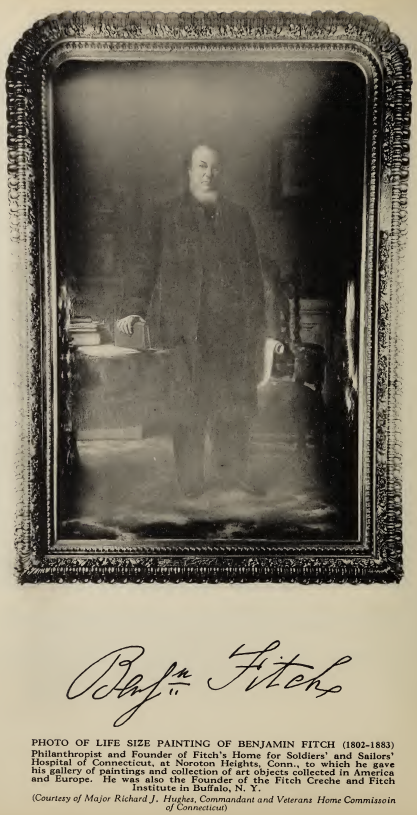
Life Size Portrait of Benjamin Fitch from the Soldiers Home. Source: History of the Fitch Family.

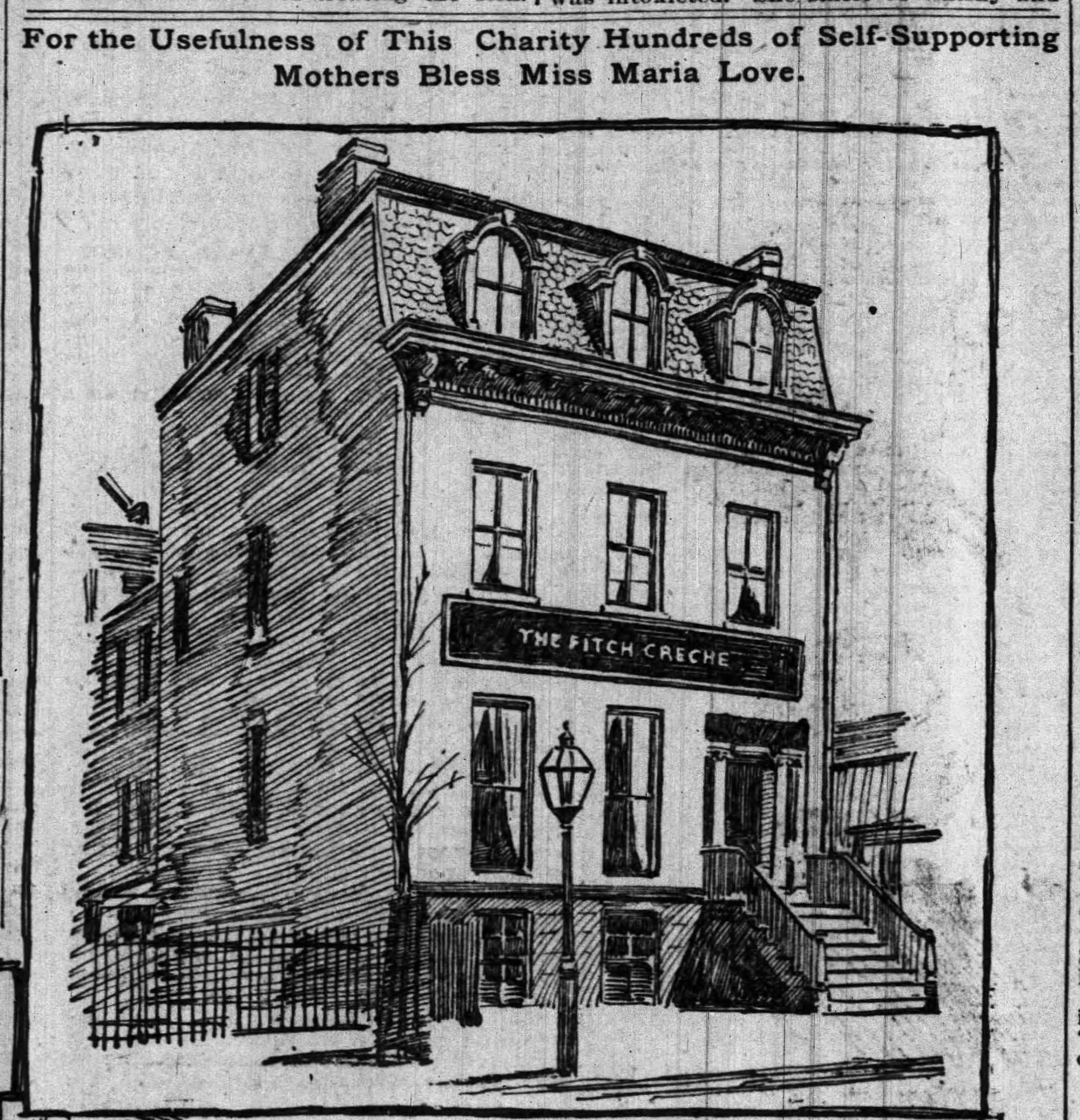
In the 1870s, Buffalo was beginning to look at starting a Charity Organization Society (COS).  While working to start COS, Reverand Gurteen and Ms. Maria Love visited Benjamin Fitch at his home in New York.  Reverand Gurteen was pastor at St. Paul’s Episcopal Church here in Buffalo, and Maria Love was a wealthy socialite who cared deeply about social work reforms of the time.  We’ll learn more about the Love family when I write about Love Alley.  Ms. Love had visited many creches in England, France and Italy while traveling with her nephew and thought about founding a model kindergarten and training school in Buffalo.  A creche is a nursery where babies and young children are cared for during the working day, what we’d call a daycare today.  The COS of Buffalo was incorporated in November 1879 and was the first Charity Organization Society in the United States.  The COS asked Mr. Fitch for assistance in leasing a property for the Society to build a creche.  While never marrying or having children of his own, Mr. Fitch felt strongly for their mission.  The property at 159 Swan Street was deeded to the Society by Mr. Fitch on January 1, 1880.  The house at 159 Swan Street was originally built by Lucius Pratt in 1835.  After Mr. Pratt’s death, Benjamin Fitch purchased it, and it was operated as a rooming house.  Some sources incorrectly state that the house was home to Mr. Fitch’s dry goods store or that Mr. Fitch lived in the house; neither of those statements appear to be correct based on my research.  The property was valued at $100,000 at the time(about $3 Million today).  The Fitch Creche was established on the property “for the care of infants and small children while their mothers are away from home at their daily labors; without regard to creed.”  Maria Love served as Chairman of the Fitch Creche Advisory Board.  
Fitch_Creche_sketch

Sketch of Fitch Creche, 1897. Source: Buffalo Courier.

The Fitch Creche was quickly in operation, opening on January 5, 1881.  The Creche was funded by working mothers paying 5 cents a day (about $1.54 today).  This was the first organization of its kind at the time.  While we think of daycare as commonplace today, this was a new thing back then.  As the Buffalo Commerical put it at the opening, “The Creche was established to give poor working people’s young children a home to remain in during the day while the parents were seeking a livelihood outside.  The design was to keep such children as would otherwise be left in the streets or locked up in the house.”

The Creche served children from 2 months old to 10 years old and operated from 7 am to 6pm daily.  The children were provided 3 meals, Creche dresses, baths and shampoos, naps, and physical exams with treatment as needed.  There was a staff of 12 nurses, a housekeeper, a dietician, and three cleaning women.  Breakfast was at 8am and consisted of oatmeal and milk.  Dinner was served at noon, consisting of bread, broth, potatoes, meat, baked apples, rice and milk.  For tea at 5pm, they were served bread, applesauce and milk.  Children under one-year-old were fed with condensed milk out of a bottle.  The Creche had space for 50 children when it first opened.

A kindergarten was established in the Fall of 1884.  You sometimes hear that this was the first kindergarten in the country, which is not true.  The first kindergarten in America was established by Elizabeth Peabody in Boston in 1860.  Buffalo had a kindergarten established as early as 1867, run by Miss Mary Sheldon.  The Fitch Creche daycare is, however, believed to be the first daycare for working women in the United States.  The Fitch Crech established a training school for nursemaids was established in 1890. This was established as the “Nursery Maids Department of the Training School for Domestics,” and this was also the first program of its kind.  Four nursery maids graduated in the first year.

fitch creche

Fitch Creche. Source: History of the Fitch Family.

Over time, COS was able to arrange for some of the children to go away for the summer to Fresh Air Missions.  The first Fresh Air Mission was first established in 1888 by the Church of the Messiah, which was located on Main Street between Chippewa and Huron (now Fountain Plaza).  The Fresh Air Fund sent children to Corfu, Middleport, Orchard Park, Silver Creek, Evans and other country locations.  The idea was that getting kids out of the crowded, dirty city to spend a few weeks in the pure air of the countryside would be good for the children.  Cradle Beach Camp got its start as one of the Fresh Air Missions.  While the children were at camp, some of the working mothers were also sent away for vacations at homes in the countryside, including in East Aurora and Holland, to allow for them to get a vacation and some rest, too.  

Charity Balls were held to add supplemental income for the Creche, with the first ball held in 1880.  In 1903, the balls began to be held for the children, because they felt the ballroom was too beautiful to only hold one event a year.  Charity Balls stopped from 1917-1919 because of WWI but eventually were picked up again.  When the Fitch Creche closed in 1933, the Maria M Love Convalescent Fund was established to continue the mission through the balls.  The Children’s Charity Ball is still held to this day, with funds raised still going to people in need.  This year’s Charity Ball will be held for Middle School students in November of 2024.  

The Fitch Institute

fitchproperties

Map of properties donated to COS by Benjamin Fitch. Map by author.

Many people know the Fitch name in relationship to the Fitch Creche, but there were other institutions that bore the Fitch name in Buffalo – the Fitch Institute and the Fitch Accident Hospital!  In May 1881, Mr. Fitch donated several other properties to the COS for the “purposes of founding a maintaining in Buffalo a public institution for the physical, moral and intellectual benefit of the worthy poor of the city, without distinction of creed or sex.”  The Institute was to run a course of free lectures each year on scientific or other instructive topics, a free reading room, a provident coffee and soup room, a dispensary for supplying medicines and a medical attendant, a training school in domestic work for girls, a hospital for the temporary treatment of injured persons, and a place of deposit of small sums of money for working people to be drawn down as they need.  The properties had a value that totaled about $325,000 (about $10 Million today) of property donated to the organization.  The donation directed COS to build the public hall at the property on the southwest corner of Swan and Michigan, adjacent to the Fitch Creche.  They were able to sell, mortgage or lease the other properties to allow for income to provide for their mission. 
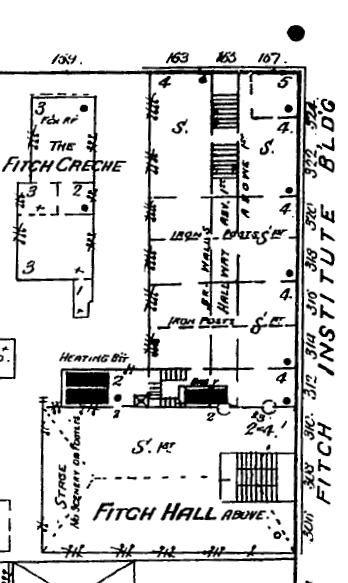
Screenshot (78)

A portion of the 1889 Sanborn Map which shows the corner of Swan Street and Michigan Avenue, depicting the Fitch Creche and Fitch Institute Building.

The public hall was established as the Fitch Institute, located at 163-167 Swan Street and 304-310 Michigan Streets.  The Fitch Institute was designed to be similar to the Cooper Institute in New York.  The cornerstone was laid for the Fitch Institute on May 10, 1882.  The first floor of the building was designed to include a large office for COS where they could also operate the penny bank.  They were the only society in New York State to receive a penny bank charter since savings banks opposed penny banks.  A penny bank was a bank that allowed for any deposit to be made, no matter how small (even just a penny).  The charter for the penny bank allowed each person to deposit up to $50. 

The rest of the ground floor was set up as storefronts for the society to rent out for income.  The next floor called the ground floor, was set up for a hall for seating 200 people.  This was to be the home of the lectures.  Additional rooms on the ground floor were set up for surgeons and nurses to be known as the Fitch Accident Hospital.  On the next floor, called the second floor, was the reading room, library and coffee room for the Mechanics Institute.  On the third floor, half of the building was set up to be a hall for the Knights of Labor with the other half of the floor for housing for older couples.  Additional housing was on the fourth floor.

fitch institute

Fitch Institute Building. Source: History of Fitch Family.

Mr. Fitch’s Death

benjamin fitch crypt

Interment of Benjamin Fitch in St. Luke’s Church.

Mr. Fitch never married or had children, though he was close with his nephews and nieces and grandnephews and grandnieces.  Benjamin Fitch died in November 1883 at his house at 61 Fifth Avenue in New York City.  He is buried in Darien, Connecticut, in the crypt of the church he built.  It was estimated when he died that he had given away more than $500,000 of his wealth to charity (about $15.6 Million today).

The Legacy of the Fitch Institute and Fitch Creche

The Fitch Creche displayed a model creche in the Children’s Building at the World’s Fair in Chicago in 1893 and received medals at the New Orleans Exposition in 1885, the Paris Exposition in 1900, and the Pan American Exposition in Buffalo in 1901.  The Fitch Creche and the Fitch Institute were considered to be social work pioneers of their time!  

The Fitch Institute was host to countless events such as cooking classes, concerts and lectures on a variety of topics.  The Women’s Educational Industrial Union got its start in the Fitch Institute before spinning off as its own organization.  In October 1885, the Union hosted Julia Ward Howe at the Fitch Institute; she gave a lecture titled “Is Polite Society Polite?”  Julia Ward Howe is best known for writing the Battle Hymn of the Republic and founding Mother’s Day.  

The Fitch Accident Hospital closed in 1901 because it was felt that it was too costly for the COS to operate such a small hospital (served about 25 patients).  They also felt services were going to be duplicated by the nearby Emergency Hospital that was under construction. The Emergency Hospital had begun as a First Aid Station run by the Sisters of Charity in 1884 in a home near the railyards.  The new Emergency Hospital opened in January 1902 at the corner of Pine and Eagle Streets and was able to serve 100 patients. The Emergency Hospital was taken over by the Diocese of Buffalo in 1954 and was renamed in 1977 after receiving a donation from Paul V. Sheehan.  In 1979, a new 136-bed Sheehan Memorial Emergency Hospital opened on Michigan Avenue, in front of the former Pine Street hospital.  The old Emergency Hospital on Pine Street was demolished after the new hospital opened.  Sheehan Memorial closed in 2012.

After the hospital closed, the rooms were used as the Hotel Orizaba during the Pan-American Exposition.   After the Expo, the hotel space, along with the third and fourth floors of the Fitch Institute building, was turned over to be used as a Railroad YMCA.  Called the Union Terminal Railroad Department, it provided overnight shelter for train crews.  Railroad Y’s were located throughout Western New York to serve railroad employees. 

In 1907, the first tuberculosis dispensary in Buffalo was located in the Fitch Institute, having been established by the TB Committee of the COS.

After the Fitch Institute Closed

The Fitch Institute closed in 1933.  They had carried out the purposes of the society for as long as they could, but the character of the neighborhood had changed, and other agencies had taken over some of its functions.  The Great Depression was the death knell of many private charities, such as COS as public-operated social services came into existence.  The Charity Organization Society became the Family Services Society in 1934. Child and Family Services is the organization that today continues on the work of the COS and Family Services Society.  

In 1948, the Fitch Creche and Fitch Institute properties were purchased by the City at a tax foreclosure sale for $41,927 (about $547,000 today).  It had been determined that the properties were no longer exempt from taxes after they were no longer being used for charitable purposes.  The City listed the property for sale at Auction for $60,000 in June 1953(about $707,000 today).

In 1953, Arner Company, who were manufacturing pharmacists with headquarters across the street at 303 Michigan Avenue, leased the Fitch Institute building.  The building was used by Arner Company until 1960. 

In 1967, Erie County had considered using the Fitch Institute Building for a Men’s Shelter.  At the time, there was a real urgency to find a sufficient building because of the demolitions of Halfway House, Terrace House and the St. Francis Hotel.   They inspected the building and determined it would not work because the building had no heating or electrical service, the ceilings were too high, the floor and joists were made of wood, and the staircases were not fireproofed.  Due to the imminent need for a new shelter, they wanted something that could very quickly be turned over and passed on using the Fitch Building.  
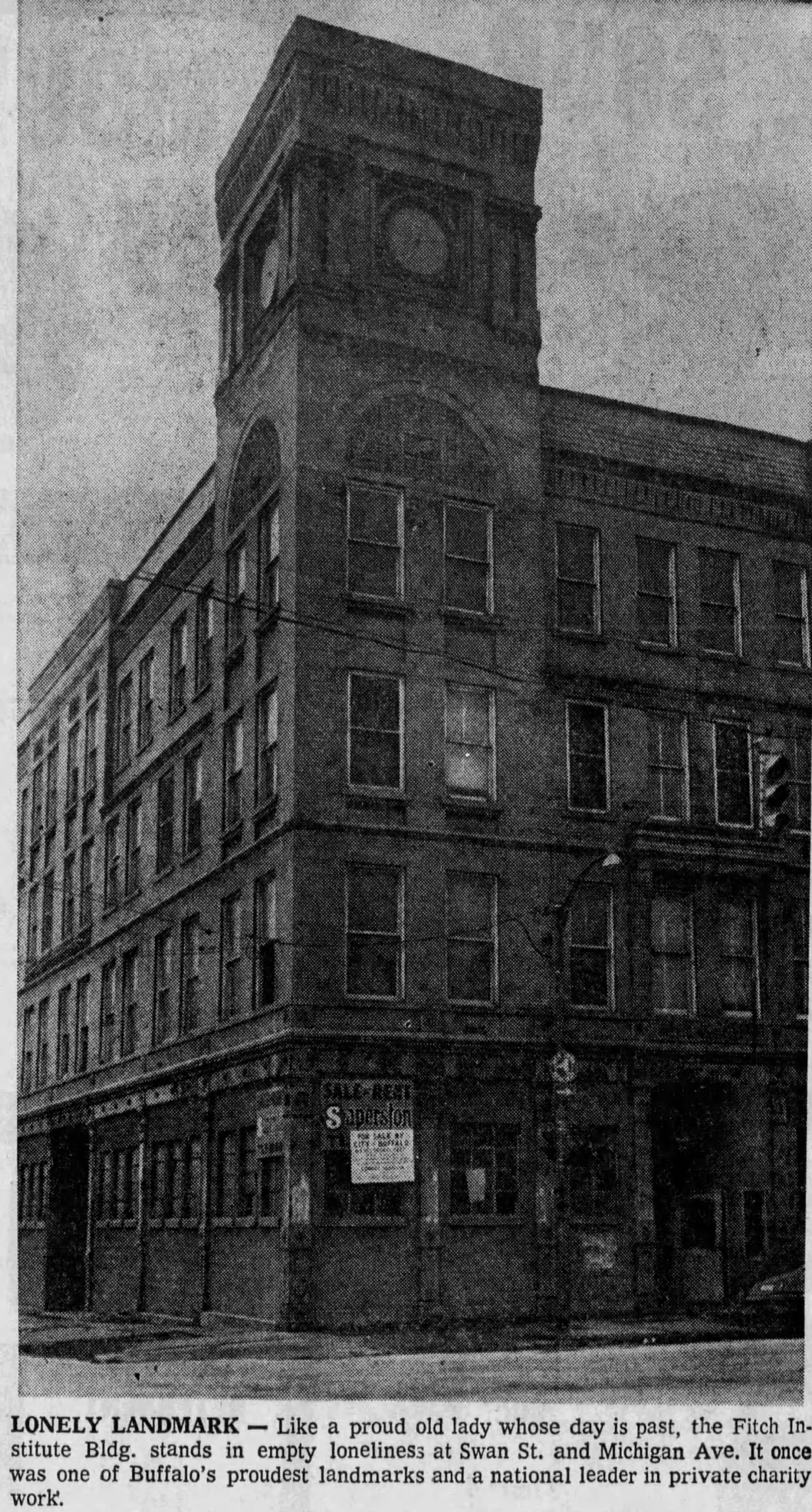
Fitch_institute

Fitch Institute Building as it looked in 1973 when it was listed for sale by the City. Source: Buffalo News.

In 1973, Ralph Dribble of the Buffalo News called the Fitch Institute “a genuine historical landmark.  It is a relic of times when private charity anticipated what politicians of later years would proclaim under such labels as New Deal, Fair Deal and Great Society.  It was a precursor of what would later become known as children’s hospitals, day nurseries, working girls’ homes, soup kitchens and credit unions.  In short, it is the high-water mark of the days when private charity tried to take care of society’s problems.”

In January 1973, the City of Buffalo put the Fitch property on the auction block.  In April 1973, Joseph Nasca, on behalf of Land Reclamation Inc., purchased the property for $5800(about $41,000 today)  with the agreement to demolish the building within 90 days.  In May 1973, the City Planning Division asked the Common Council to rezone the property for commercial.  It had been zoned as industrial when the property was used by Arner.  

Fitch_Building_Fire_1974

Fitch Building under fire in 1974. Source: Buffalo News.

On May 15, 1974, the Fitch Institute Building was burned down by an arsonist.  Several floors of the building had been saturated with combustible liquids and then set aflame.  Fire investigators were unsure of the reason for the fire since the building was supposed to be demolished by Land Reclamation Inc. by February 21st, 1974.  The extinguishing of the fire also caused water damage at the building next door, the former Fitch Creche, which was being used as a warehouse for rugs and floor coverings at the time.  One firefighter was hospitalized after the fire.  Land Reclamation Inc. had purchased the property because they had needed fill, but after the fire, they claimed they had gotten fill elsewhere and held off on demolishing the building.  They held off on demolishing as they were looking at purchasing other properties on the same block and were waiting to secure all of the properties so they could be demolished all at one time.  The fire-damaged ruins of the Fitch Building were demolished at the end of May 1974. 

159Swan1990s

159 Swan Street in the 1990s before demolition. Source: Preservation Ready Sites.

In the 1990s, preservations were working on getting the Fitch Creche building at 159 Swan Street listed on the National Register of Historic Places.  It had severe water damage.  The building was demolished in June of 1998.  Today, the former sites of the Fitch Institute and the Fitch Creche are a part of the parking lot associated with the Apartments at the Hub Property at 149 Swan Streeet.  

Back to Butler Place

Ok, so where were we….oh yes, Butler Place.  

Joseph Butler was born in 1865 in Erie, Pennsylvania, to John Butler and Margaret Collins.  Joseph Butler served as Alderman from 1894 to 1910, first for the Second and Third Wards.  Joseph Butler also operated a tavern with his brother Patrick at 204 Seneca Street, at the northeast corner of Seneca and Butler Place. The saloon was still in business in February 1931 when it was padlocked by an injunction order by the Assistant Federal Attorney.  The business was ordered to be padlocked for one year.  Overall, there was a campaign to close 250 saloons in Buffalo!  

Joseph Butler petitioned the city to get Fitch Alley to be renamed Butler Place, in honor of his father, John.  John Butler was a flagman with the New York Central Railroad.  John was well-known around town because he only had one arm.  Butler Place was officially named on September 23, 1891.  John Butler died in May 1896 of a heart attack.  Joseph Butler died in May 1945 at the age of 80.  Joseph is buried at Mount Olivet Cemetery in Kenmore.  I wasn’t able to determine exactly when their saloon at the corner of Seneca and Butler Place was demolished, but the property has been a parking lot for Seneca Plumbing at 192-196 Seneca Street (at the northwest corner of Seneca and Butler Place – now the Botanist and a law firm) since at least 1962.  

Next time you pass the corner of Michigan and Swan Streets, think of Buffalo’s early social workers, Mr. Fitch’s gift he gave to Buffalo, and the good work that happened at that corner between 1880 and 1933.  (And the next time you walk, bike, or drive down Lexington Avenue, ask yourself if you’re “toney” enough to be on the street, haha!)  

Want to learn about other streets? Check out the Street Index. Don’t forget to subscribe to the page to be notified when new posts are made. You can do so by entering your email address in the box on the upper right-hand side of the home page. You can also follow the blog on Facebook. If you enjoy the blog, please share it with your friends; It really does help!

Sources:

  • Sheehan Closure Plan, August 28, 2012.  NYS Department of Health.  http://www.health.ny.gov/events/public_hearing_reports/sheehan/docs/closure_plan.pdf
  • The History of Germans in Buffalo and Erie County.  Reinecke & Zesch. Buffalo NY, 1898.
  • “Motion, Resolution and Notices.”  Buffalo Express.  March 26, 1855, p3.
  • “What’s in a Name”.  Buffalo Sunday Truth.  March 18, 1888, p1.
  • “A Magnificent Charity:  Benjamin Fitch’s Gift to the Poor of Buffalo.” Buffalo Commercial.  April 13, 1881, p1.
  • “Benjamin Fitch’s Portrait.”  Buffalo Courier Express.  March 14, 1882, p4.
  • “Mr. Fitch Dead:  The Veteran Philanthropist Dies in New York at a Ripe Old Age.”  Buffalo Weekly Express.  November 8, 1883, p5.
  • “Maria M Love Fund Benefit Recalls Work of Founder.”  December 2, 1950, p13.
  • Stuart, Paul.  “Stephen Humphreys Gurteen”  Encylopedia of Social Work:  National Association of Social Workers Press.  June 11, 2013.
  • “Fitch Institute Laying the Corner Stone.”  Buffalo Courier Express, May 11, 1882, p3.
  • “Far-Sighted Liberality:  Darien’s Fitch Founded Nation’s First Veterans Home in 1864.”  Hartford Courant.  July 13, 2014, pB1.
  • “Benjamin Fitch’s Gift:  Buffalo’s Cooper Institute Nearly Completed”.  Buffalo Evening Telegraph.  April 9, 1883, p1.
  • “Formal Opening of the Institution Tomorrow Evening.”  Buffalo Commercial, Janaury 5, 1881.
  • “Fitch Institute’s Properties Sought for Business Use”.  Buffalo News.  June 9, 1953, p28.
  • “Tax Suit Recalls Fitch Gifts to Charity Here in 1870s”.  Buffalo News.  May 27, 1947, p11.
  • Child And Family Services, About Us.  http://www.cfsbny.org/about-us/
  • “Fifty Years of Family Social Work:  1877-1927”.  Charity Organization Society of Buffalo, October 1927.
  • “Mrs. Norman E Mack heads Charity Ball Committee.”  Buffalo News.  November 13, 1933, p10.
  • “Fitch Accident Hospital Abolished.”  Buffalo Times.  January 28, 1901, p1.
  • “Miss Mary Sheldon’s School for Young Ladies and Kindergarten”.  Buffalo Commercial.  August 17, 1867, p3. 
  • “Fitch Sites, in Tax Foreclosure, Bought by City for $41,927”.  Buffalo News.  March 26, 1948, p4.   
  • Brady, Karen.  “The Birth of Day Care”.  Buffalo News.  October 1, 1995, p126. 
  • Ernst, Dave.  “Fire-Ruined Fitch Building Had Been Sold, Should have been Demolished Months Ago.”  Buffalo News.  May 30, 1974, p21.  
  • “Fitch Institute Bldg, Only Shell of Past, Faces Provident Death.”  Dribble, Ralph.  Buffalo News.  April 10, 1973, p28.  
  • “How Buffalo Is Doing Good.”  Buffalo Courier.  Janaury 29, 1897, p2.  
  • Enrst, Dave.  “Investigators Claim Arsonist Started Fitch Blaze; The Question is Why”  Buffalo News.  May 15, 1974, p14.  
  • “Fitch Building is Found Unfit as Men’s Shelter.”  Buffalo News.  October 11, 1967, p77.
  • Anderson, Dale.  “Structure that Housed Nation’s First Day-Care Center for Working Women Razed.”  Buffalo News.  June 30, 1998, p11. 
  • “Joseph Butler, Alderman for 16 years, dies.”  Buffalo Courier Express.  May 21, 1945, p16.  
  • “Padlocks Placed on 6 Saloons Here.”  Buffalo News.  February 3, 1931, p3.  
  • Fitch, Roscoe Conkling.  History of the Fitch Family.  Privately Published by the Fitch Family.  1930. 
  • “Fresh Air Mission.”  Buffalo Commercial.  August 11, 1888, p3.   
Read Full Post »

Screenshot (74)

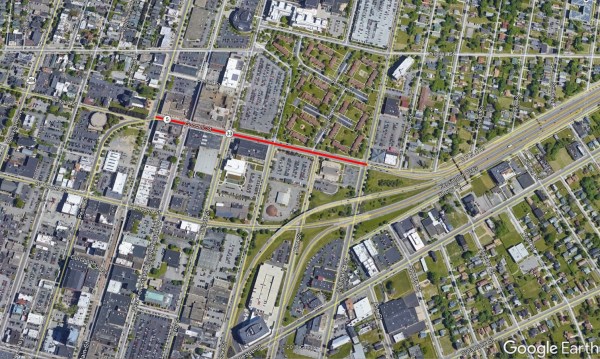
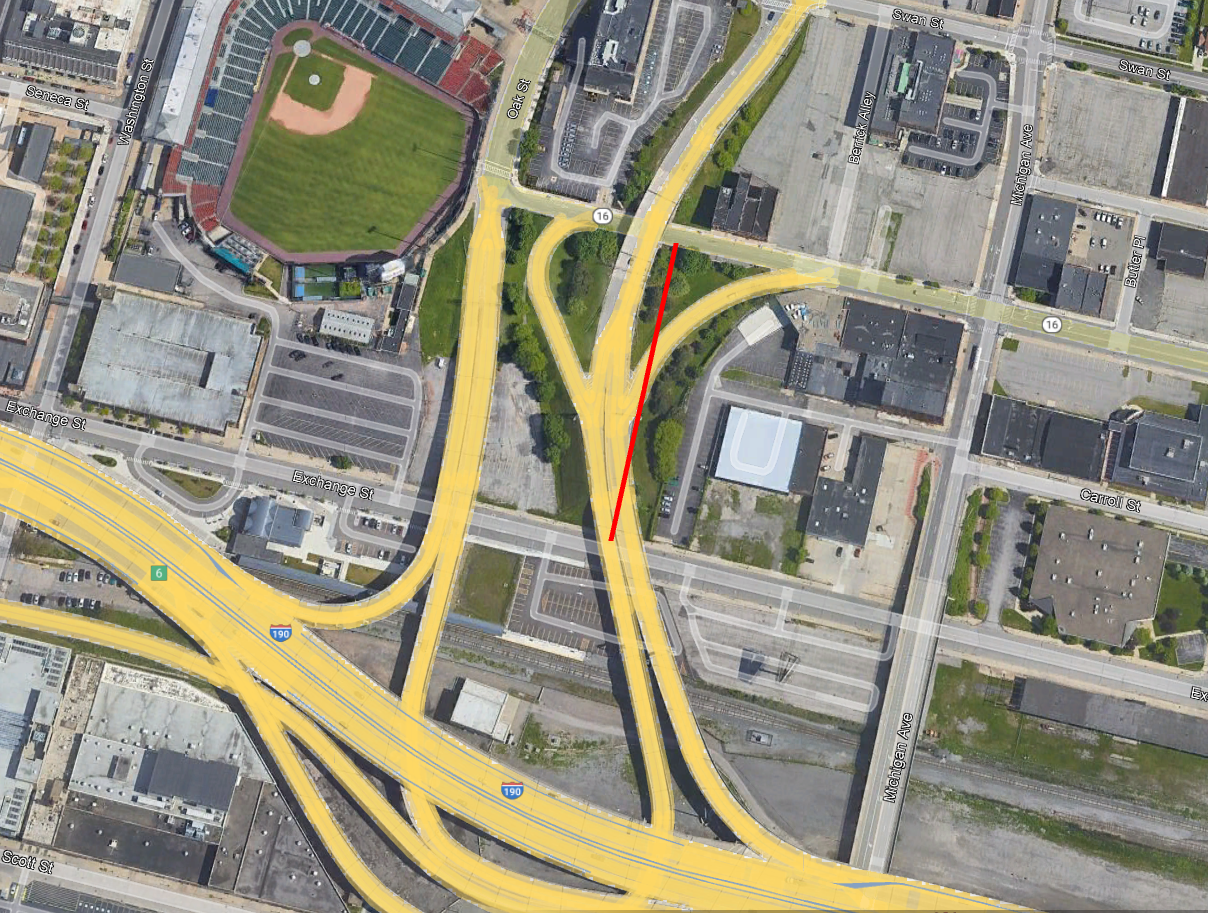
The former location of Wells Street is shown in red.

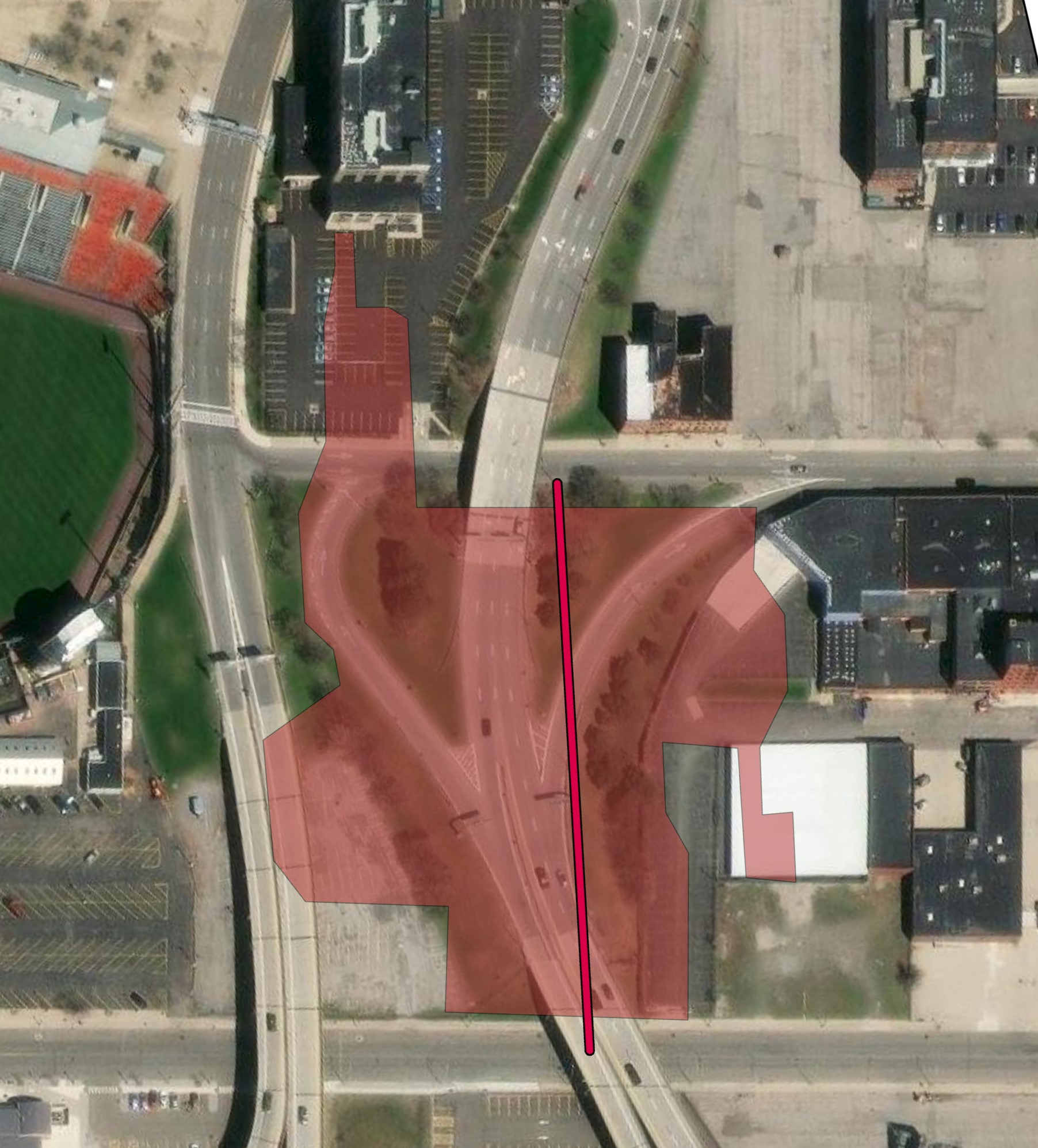
Wells Street is a street that is no longer extant in Downtown Buffalo.  It formerly ran for two blocks between Exchange and Seneca Street.  The former location of Wells Street is now hidden underneath the Elm Street exit ramps from the I-190.  Wells Street was once an important business center in Buffalo, serving both visitors and industry due to its location close to the railroads.

Many often believe that Wells Street is named after Henry Wells.  Henry Wells helped found Wells Fargo alongside William Fargo.  Henry Wells lived in Auhoorora in Cayuga County, New York.  Wells College is named for Henry Wells.  However, Wells Street here in Buffalo is named after Chandler J. Wells.  I could not find any relationship between Henry and Chandler, though they may be related many generations back.

The Early Life of Chandler Wells

The Buffalo Wells family – Joseph Wells and his wife Prudence – came to Buffalo around 1797 from Rhode Island.  There wasn’t much happening here in Buffalo, so they settled in Brantford, Ontario, where Prudence’s sister lived.  They came back to Buffalo around 1802.  Joseph and Prudence had their first son, Aldrich, in 1802 after returning to Buffalo.  Some reports say that Aldrich Wells was the first white male born in Buffalo, but there are several disputed claims to that title.  Joseph and Prudence had eleven children – six sons and five daughters.  Their seventh child, Chandler, is the namesake of the street.

Chandler_J_WellsChandler Joseph Wells was born in Utica, New York, in June 1814.  The Wells family had fled to Utica after the Burning of Buffalo on December 30, 1813.  During the War of 1812, Joseph Wells served as a Captain and later a Major in the militia.  Shortly after Chandler’s birth, the Wells family returned to Buffalo with baby Chandler.  The Wells family lived at 150 Swan Street.  In 1815, Joseph Wells built a tannery on Main Street near Allen Street, where he also operated a farm and made bricks.
Chandler attended private schools when he was young.  At age 17, Chandler became a joiner’s apprentice, finding employment with Benjamin Rathbun.  He later worked for John Drew, who saw potential in Mr. Wells and put him in charge of constructing a building at Pearl and Tupper Streets.

In 1835, Mr. Wells partnered with William Hart as contractors and builders.  The partnership lasted for twenty years, and they were very successful.  At one time, they owned three sawmills and built many buildings around Western New York.  Among their buildings were the State Arsenal on Broadway, built in 1857, and the Dart Mansion at Niagara and Georgia Streets.

Grain Elevator Entrepreuneur

In 1857, Mr. Wells became interested in grain elevators.  His brother William was an elevator foreman.  Mr. Wells felt he could improve Joseph Dart’s elevator design.  The Wells Elevator was built in 1857-1858 and had a storage capacity of 100,000 bushels, double that of the Dart Elevator.  It could transfer nearly six times the amount of grain in an hour.  The elevator, known as the Wells Elevator (later became the Wheeler Elevator in 1884 and was replaced by the concrete Wheeler Elevator, constructed in 1909 and now part of Buffalo Riverworks), was located across the river from the New York Central Railroad freight house on Ohio Street.

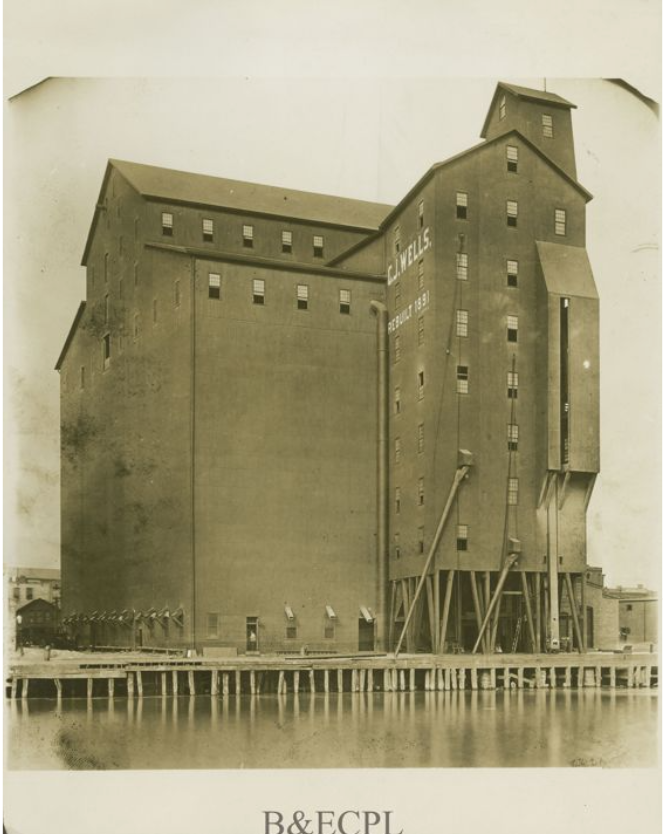
wells

C.J. Wells Elevator, between Ohio and Indiana Streets…now the location of the DL&W Terminal. Source: Buffalo and Erie County Public Library.

In August 1860, Chandler Wells leased what was known as Coburn Square, located at Buffalo Creek, Ohio (now South Park Ave) and Indiana Streets.  He built the Coburn Elevator here.  It was destroyed by fire in 1863.  In September 1860, he built the CJ Wells Elevator to replace the Coburn Elevator on the site with some additional property he purchased.  The CJ Wells Elevator was built with stone, brick and lumber.  It was designed to be a model elevator of its day.  It had a capacity of 350,000 bushels and could elevate 8,000 bushels an hour.  The CJ Wells elevator burned down in 1912, and the DL&W Railroad Station was constructed on the site in 1917 (now the location of the NFTA Shops/Rail Yard).

Political Career of Chandler Wells

In 1854, Mr. Wells was elected Alderman for the 2nd Ward.  He was continuously elected for seven years.  In 1861, Wells was the unanimous Union Republican candidate for Mayor.  He was defeated by William Fargo, 6,431 to 5,986 votes.  In 1865, he was again named the Union Republican candidate, running again against William Fargo, who was looking to win his third term as mayor.  On November 7, 1865, Mr. Wells defeated Mr. Fargo 5,570 to 5,348.  On election night, a group of his supporters went to Mr. Wells’ Swan Street home and saluted him with a small cannon.

Mayor Wells was mayor during the Fenian Uprising in 1866.  Thousands of Fenians gathered in Buffalo, planning to enter Canada and destroy the Welland Canal, which would have crippled the Canadian trade.  Mayor Wells kept the mayors of Hamilton and Toronto informed of the movements of the Fenians.  General Grant arrived on the Battleship Michigan to guard the Niagara River.  The situation lasted for about a week.

In September 1866, General Ulysses S Grant, President Andrew Johnson and other dignitaries were guests at Mayor Wells’ home.  Mayor Wells did not seek a second term in office, deciding instead to retire.  Following his retirement, Mayor Wells served as commissioner of the first Board of Water Commissioners and held the position for six years.  During his time on the Board, the inlet pier and tunnel were built for Buffalo Water Works.  Many people at the time opposed the plan for the waterworks, thinking it impractical.  Mayor Wells threw his time and money into the project and worked hard to get the water system built.  The City later saw the value in the water inlet, and Mr. Wells was reimbursed for his expenses.  He is sometimes referred to as “the father of the waterworks.”
Chandler Wells also served as a founder and director of the Erie County Savings Bank, the Young Men’s Association, the Buffalo Historical Society, the Falconwood and Beaver Island Clubs, and the Buffalo Club.  Mayor Wells was also fond of horses.  He helped found the Buffalo Driving Park, one of the first organizations of its kind (horse-driving, not car-driving, FYI), and served as President for 15 years.  Mr. Wells was a founding member of the Board of the Buffalo Juvenile Asylum in 1856.  In 1862, Mr. Wells helped organize the Buffalo Academy of Fine Arts (now the AKG Museum).
The Wells Family

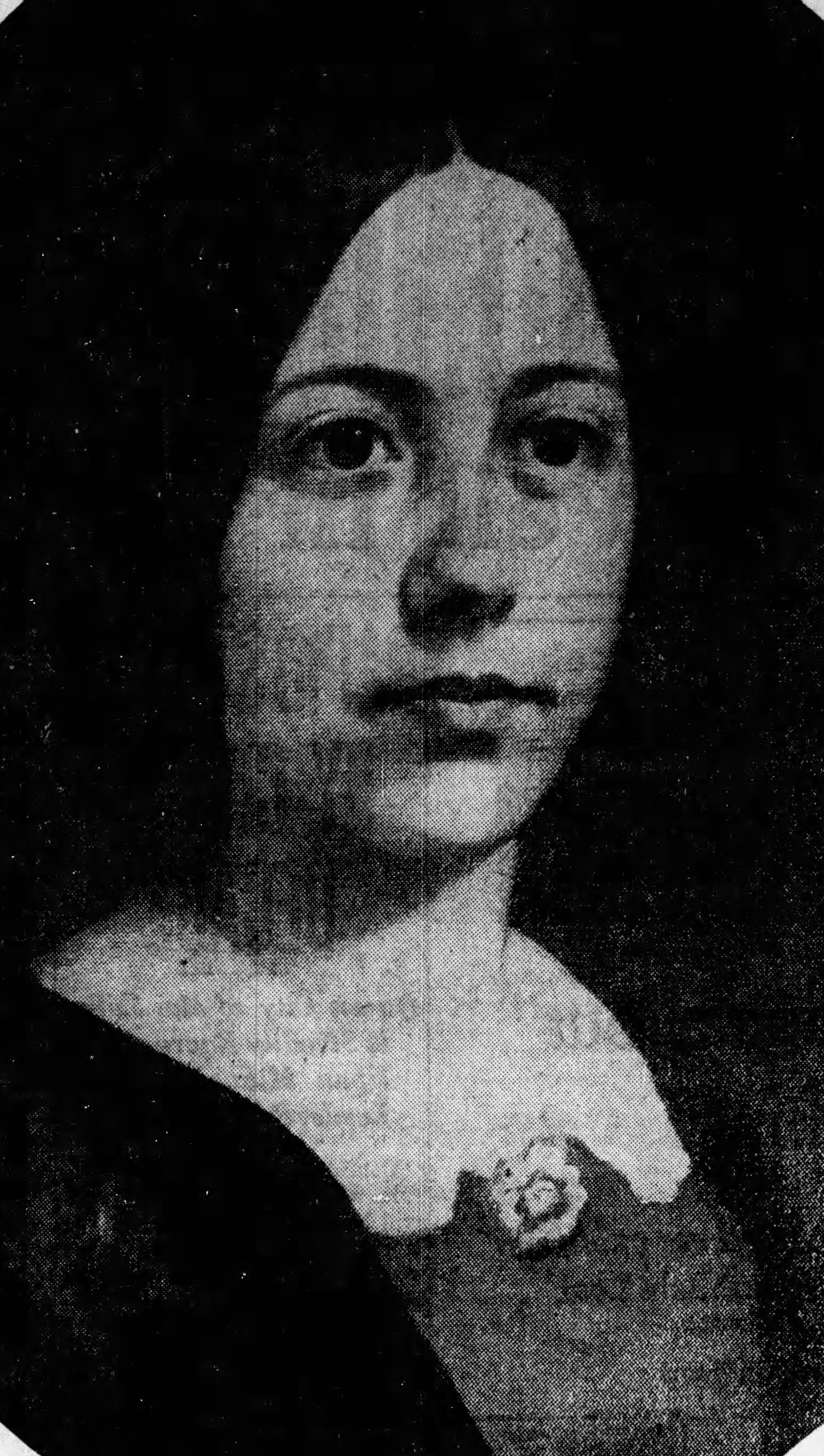
Elizabeth_Wells_daughter_of_Chandler_Wells

Portrait of Elizabeth Wells, daughter of Chandler. Source: Buffalo Times.

Mr. Wells married Susan Wheeler in April 1837.   The Wells had two children.  The first, Theodore, died after just six weeks in 1838.  The second child, daughter Elizabeth, died of Cholera in 1854 at age 16.  Her death was one of the reasons Chandler Wells cared so deeply about clean water and invested in the waterworks.  After the death of their daughter, Susan and Chandler’s niece, Lucy Ann Wells, lived with them.  Lucy was the daughter of Chandler’s brother, John.  Lucy got married in 1847 to Merrit W Green.  Lucy and Merrit had two daughters – Jeannie and Elizabeth.  Jeannie and Elizabeth were Chandler and Susan’s grand-nieces, but they were eventually adopted by Chandler and Susan when their parents moved to Michigan.  Jeannie and Elizabeth took the Wells name and were treated as a part of the Wells family.

In 1858, the Wells family built a red brick house at 77 Swan Street (near Oak Street).  At the time, Swan Street was the fashionable neighborhood of Buffalo, but eventually, the street changed to a business district; many families began to move to places like Delaware Avenue.  In the 1860s, the Wells Family built a house at 685 Main Street.  The house on Main Street is now the location of Town Ballroom.  In 1860, the family lived with servants Mary Ann Higgins, a 12-year-old girl, and Fanny Castillo, a 20-year-old woman who worked as a cook.  In 1870, Fanny was still working for the family as a cook, along with Eliza Killian, a 21-year-old domestic servant.   In 1880, Fanny was still working for the family, along with 30-year-old Margaret O’Brien.

Chandler_Wells_house_Swan_Street

Chandler Wells House on Swan Street. Source: Buffalo Times.


Chandler_Wells_house_on_Main_Street

Chandler Wells House on Main Street near Tupper. Source: Buffalo Times.


45247262_d8855dde-5367-431f-b369-6a1e44ece639

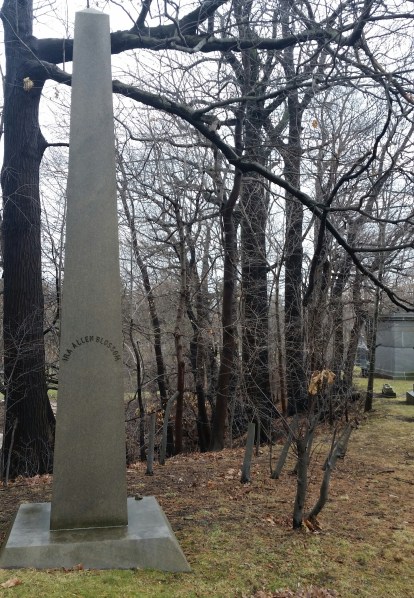
Mayor Wells Grave in Forest Lawn.

Mayor Wells died on February 4, 1887, after suffering from rheumatism of the heart for more than 13 weeks.  His obituary in the Buffalo News called him “a man of quick perceptions, rare judgment and unflinching integrity, with energy and perseverance far beyond the average; a bluff and outspoken manner to strangers, behind which, however, lay a heart good humor and a kindly generous heart.”  He is buried in Forest Lawn Cemetery.  Mrs. Wells died in October 1892.  The house at 685 Main Street was sold in February 1893 to the “Business Mens Investment Association.”  The house was rented out to Dr. L. E. DeCouriander and became the Buffalo Sanitorium/Invalids’ Hotel.  The former house site is now the location of Town Ballroom.

The Great Wells Street Fire of 1889

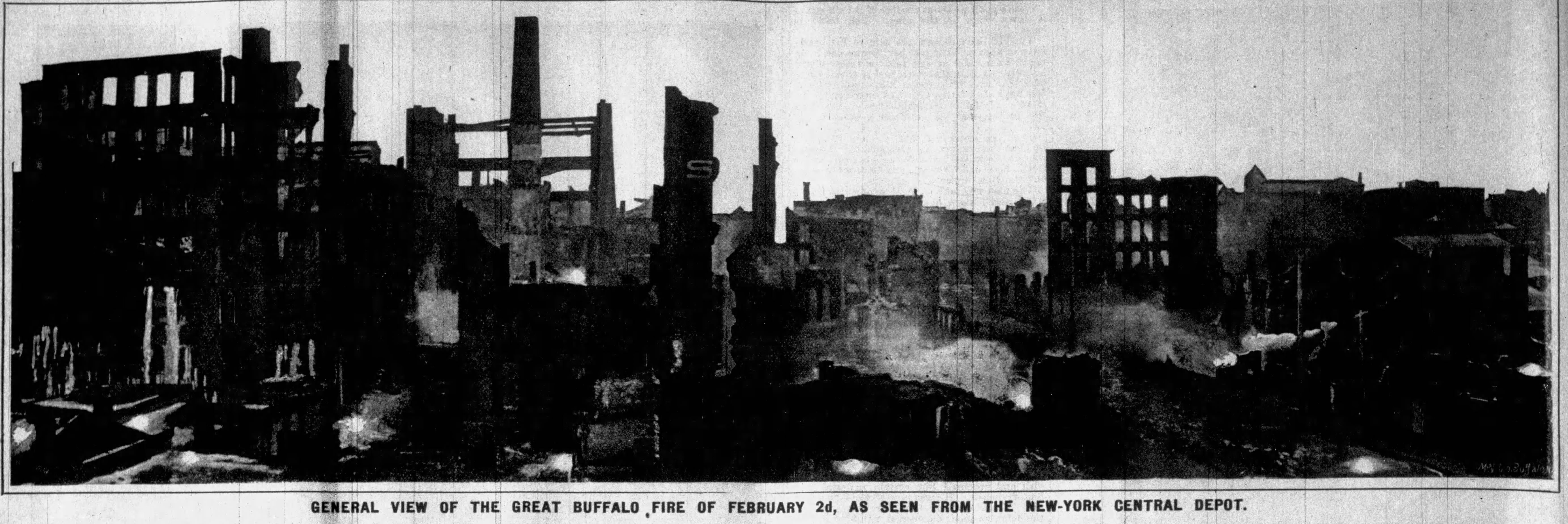
In 1889, Wells Street was the scene of a large fire.  The fire was reported as having “no parallel in the history of the Queen City of the Lakes,” measured in magnitude by the area of the burned district, by monetary loss, and by difficulty in slowing the flames.  Newspapers reported that the only fire worse was when all of Buffalo was burned to the ground during the War of 1812.  The 1889 fire affected Wells Street, Seneca Street, Carroll Street and Exchange Street.  This area was a major business center for Buffalo at the time.  Due to its location close to the railroad stations, it was a location for several well-known hotels and lodging facilities, as well as industry that used the rail, since it was close to the depots.

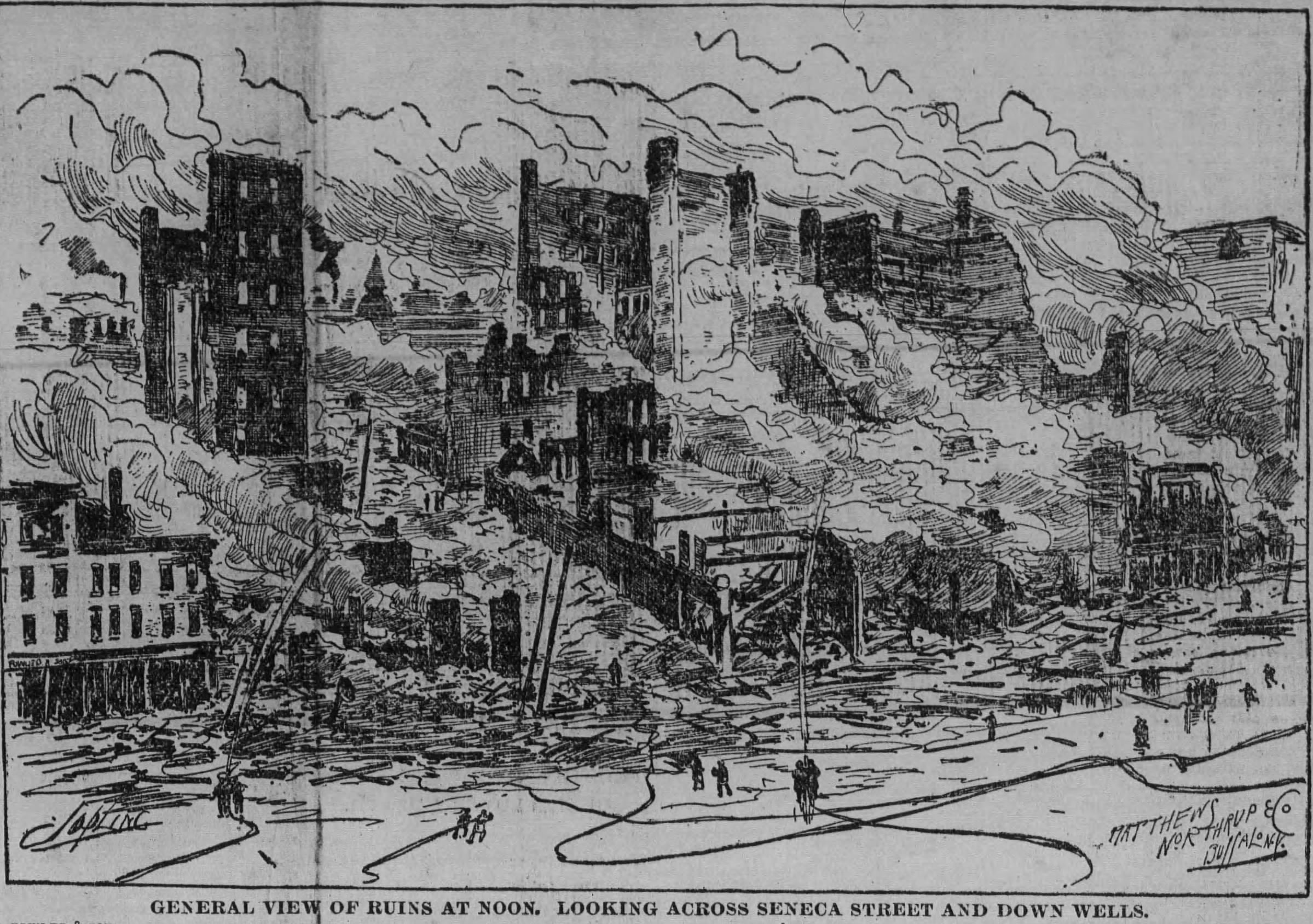
Fire_on_Wells_Street

Sketch of the Wells Street Fire after Burning for more than 12 hours

The fire broke out at 2:45am on February 2nd, 1889.  A night watchman saw flames on the fourth floor of the Root & Keating Building and sounded the alarm.  The wind quickly spread the fire to the surrounding buildings.  The flames were so high they could reportedly be seen as far away as North Street.  Strong winds helped the fire to spread quickly and caused a great deal of destruction.  The fire did an estimated $2.0 to $3.0 Million in damage ($68 Million to $102 Million in today’s dollars).

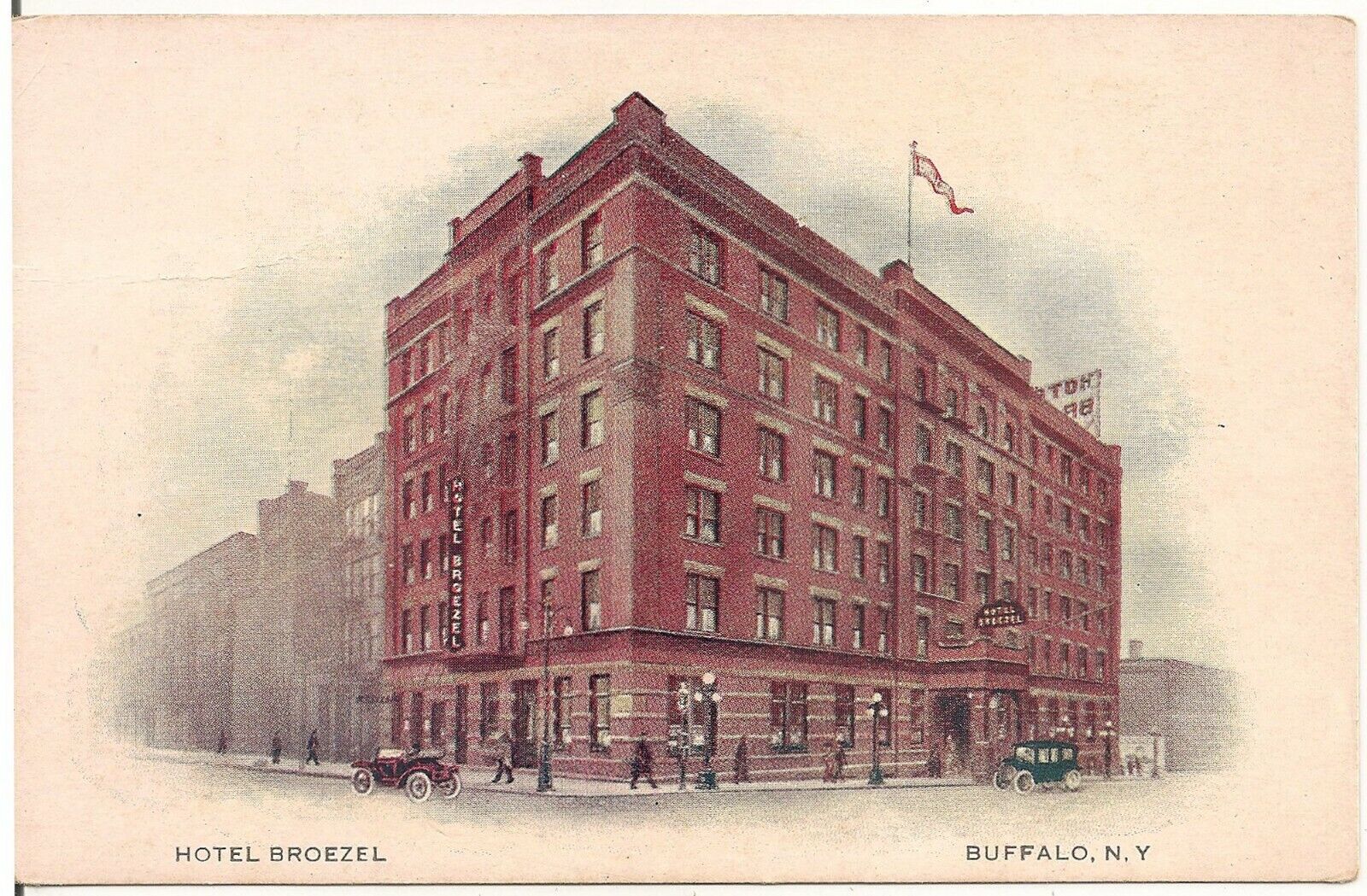
s-l1600

Postcard of Hotel Broezel located at the northeast corner of Wells and Carroll Streets

Guests at the Broezel House and the Arlington, two of the city’s better-known hotels, were able to escape just moments before the hotels went up in flames.  Within an hour, all of Wells Street was a mass of flaming ruins.

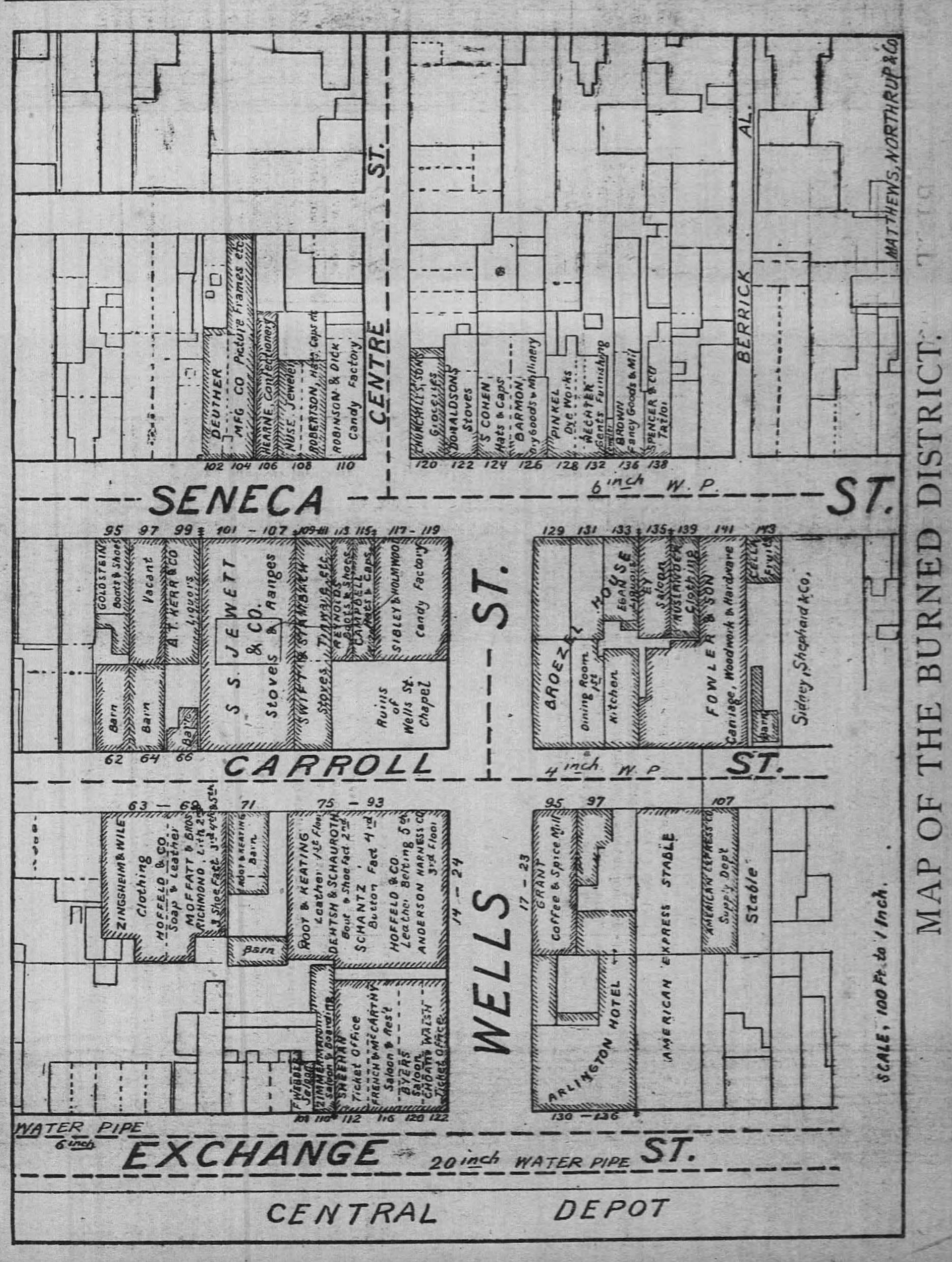
Forty buildings were damaged by the fire, with many destroyed entirely.  The tallest of the burned structures was the seven-story Hoffeld Building on Carroll Street.  Most of the buildings in the area were 4 to 5 stories tall.  Major Buildings/Businesses that burned included Zingsheim & Wile Clothing, Hoffeld & Co Soap and Leather, Moffatt & Bros Shoe Factory, Goldstein Boots & Shoes, A.T. Herr & Co Liquors, SS Jewett & Co Stoves and Ranges, Swift & Stantback Stoves and Tinwares, Reynolds Boots and Shoes, Campbell Hats and Caps, Sibley & Holmwood Candy Factory, Root & Keating Leather, Dentsch & Schauroth Boots and Shoes Factory, Schantz Button Factory, Hoffeld & Co Leather Belting, Anderson Harness Company, Zimmerman Saloon and Boarding House, Sheehan, French & McCarthy Saloon & Restaurant, Byers Saloon, Arlington Hotel, Grant Coffee & Spice Mill, American Express Supply Department, Broezel House Saloon and Boarding House, Egan Liquors, Ruslander Clothing, Fowler & Son Carriage and Woodwork, Churchill & Sons Groceries, Robertson Hats and Caps, Hearne Confectionary, Deuther Picture Frame Manufacturing Company, Donaldsons Stoves, S. Cohen Hats & Caps, Barmon Dry Goods and Millinery, Pinkel Dye Works, Wechter Furnishings, Brown Fancy Goods and MIllinery, Spencer & Co Tailor and the Wells Street Chapel.

map_of_burned_district_wells_street_fire

Map of the Burned District of destroyed buildings after the Wells Street Fire. Source: Buffalo Express.


wells street fire

Modern view of the burned district and Wells Street, both shown in red.

News of the fire was reported in newspapers across the country.  The fire began to be referred to as “the Great Wells Street Fire” or “the Great Seneca Street Fire.”  At least 20 people were injured during the fire – mostly firemen.  One fireman, Richard Marion, was trapped under fallen bricks in the Hotel Arlington when it collapsed and lost his life during the fire.  It took six hours to dig his body out of the debris.  Miraculously, no one else was killed.  Fire Chief Fred Hornung’s arm was nearly severed by a falling plate glass window.  It was estimated that 1,000 people were put out of work by the fire.  It took several weeks to clear the debris and reopen Wells Street after the fire.  Some businesses rebuilt, and some decided not to.  Hotel Broezel was rebuilt; the Hotel Arlington was not.  By August, the Buffalo News reported that the Seneca Street Burnt District was “building up better than ever.”  The Buffalo Sunday Morning News reported the day after the fire, “One beauty about Buffalo’s fires is this: there is a phoenix goes with every one of them.”

view_after_the_fire

View after the fire, Feb 10, 1889. Source: Buffalo Courier Express.

The Buffalo Fire Department referred to the Fire Alarm Box 29 at Wells and Seneca Street as the “Hoodoo Box” because it was believed to be cursed.  Several fires broke out in the area besides the Great Wells Street Fire of 1889.  In 1874, Fireman John D Mitchell was crushed to death by falling bricks at the Red Jacket Hotel fire.  In 1880, a fire occurred at the furniture factory on Carroll Street at Wells. In January 1907, a fire started at the 8-story brick Seneca Building at 103-107 Seneca Street.  Originally built as a hotel, the building had been converted into offices and a pawnshop. While fighting the fire, a collapsing wall trapped more than 20 firemen.  It took hours to rescue them.  Three firemen died – Lt William J. Naughton, Stephen E. Meegan and John R. Henky.  Another fire in 1913 at Box 29 sent two firemen to the hospital with smoke inhalation.  After so many fires at Box 29, the National Board of Fire Underwriters and insurance companies looked into the reason for so many fires in the area.  They concluded the fires were only coincidental that their location was so prevalent, determining it was due to the many factories and hazards in the area.

The area around Exchange, Wells, and Carroll Streets began to decline significantly once the NY Central Station on Exchange Street closed in 1929.  Exchange Street, once one of the most important thoroughfares, lost most of its businesses and became a ghost town after the railroad moved to Central Terminal in the Broadway Fillmore neighborhood.  Despite so many changes to the area by urban renewal projects, the “hoodoo” firebox 29 is still on Seneca Street and can be seen near where the intersection of Wells would have been.  

In 1978, Wells Street was acquired by the State of New York for the construction of the Elm Oak Arterial Highway.  Wells Street disappeared from Buffalo.  The next time you head downtown via Elm Street, you’ll be driving right over where Wells Street once was located.  When you take that ramp, think of Chandler Wells and be thankful that he fought for our water system and gave us clean drinking water.  And remember the commercial district that once existed there, wiped away by fire, urban renewal, and time.

I’ve scheduled some tours for this summer.  You can view the dates at this link: buffalostreets.com/2024/06/27/free-downtown-history-walking-tours-2/

Want to learn about other streets? Check out the Street Index. Don’t forget to subscribe to the page to be notified when new posts are made. You can do so by entering your email address in the box on the upper right-hand side of the home page. You can also follow the blog on Facebook. If you enjoy the blog, please share it with your friends; It really does help!

Sources:

  • Smith, H. Katherine.  “Wells Street a Mayor’s Memorial.”  Buffalo Courier Express.  January 15, 1939, p12.
  • “Buffalo Juvenile Asylum- Meeting Last Evening.”  Buffalo Daily Dispatch.  December 27, 1856, p2.
  • “Married”.  Buffalo Daily Commercial.  April 21, 1837, p2.
  • “Chandler J. Wells:  A Useful Life Ended.”  Buffalo News.  February 4, 1887, p1.
  • “Death of Chandler J. Wells.”  Buffalo Times.  February 4, 1887, p1.
  • Sheldon, Grace Carew.  “Wells Earned Title of Reconstruction Mayor by his Deeds in Office.”  Buffalo Times.  October 5, 1919, p50.
  • Burr, Kate.  “The Mansion that Housed a President.”  Buffalo Times.  June 27, 1926, p14.
  • “Unequaled:  A Great Business Center Burned.”  Buffalo Weekly Express.  February 7, 1889, p1.
  • Ditzel, Paul.  “The Hoodoo Box”.  Buffalo News.  May 15, 1983, p195.
  • “Notice of Appropriation of Property”.  Buffalo News.  June 14, 1978, p67.
  • “Buffalo Has A Big Fire.”  The New York Times.  February 3, 1889, p1.
  • “Extra! Fire! The Worst Buffalo Has Ever Had.”  Buffalo News.  February 2, 1889, p1.
  • “Beginning to Clear Up.”  Buffalo Courier Express.  February 12, 1889, p5.
  • “Well It Was Done.”  Buffalo Commercial.  February 21, 1889, p3.
  • “Where the Ruins Were.”  Buffalo News.  August 13, 1889, p10.
  • “Wells Residence Sold.”  Buffalo News.  February 24, 1893, p13.

Read Full Post »

Screenshot 2023-12-10 200646

Map showing Hersee Alley in Red.

Hersee Alley is an alley that runs between Ellicott Street and Oak Street in Downtown Buffalo.  It was originally Koons Alley until March 1886, when it was renamed.  One of the reasons the street was changed was because there was confusion between Koons Alley and Koons Avenue.  Hersee Alley is named for a business that was located on Ellicott Street adjacent to the alley, Hersee Furniture Company, which was in business for nearly 100 years.

Thompson Hersee was born in Arundel, Sussex, England, on May 13, 1814.  He came to Buffalo in 1834 and engaged in the furniture trade.  Hersee & Co. was established in 1836.  Mr. Hersee was in business for a few years with Benjamin Timmerman, and the company became known as Hersee & Timmerman, but most people reportedly still called it Hersee & Co. during those years.  Mr. Timmerman left the firm in 1866 and the firm name became Hersee & Co once again.  Mr. Hersee’s stores were at 307-309 Main Street for several years.  Main Street has been renumbered; Mr. Hersee’s store was midway between Eagle and Clinton Streets.  The site of his store was later replaced with the J.N. Adam Department Store and then AM&As, which many of you may remember.

Hersee & Co. was known as a business that provided quality, quantity, service, and value.  Thompson Hersee felt that a business should never charge more than an article was worth and refused to mark prices up for some and down for others, a common business practice.

Hersee & Co. was well known throughout Western New York and Northern Pennsylvania but also sold across the country.  Following the Gold Rush in California, they’d send furniture destined for California office buildings around “the Horn” (of South America) by steamship.  They also had vessels that sailed the Mississippi River to deliver chairs and desks made by the Hersee factory.    The firm furnished many homes over the more than three generations they were in business.  They made much of their own furniture at their factory in Buffalo but also dealt with some of the best-known furniture makers in Grand Rapids and other manufacturing centers.

25_Linwood_Ave_Buffalo_NY_Courier_Express_1902

Ad for the sale of 25 Linwood Avenue. Source: Courier Express, April 1902

Mr. Hersee married Annette C. Moses from Attica in September of 1844.  They had six children – Thompson Jr, William, Orton, Walter, Carrie, and Porter (who was called Benny).  The Hersees lived at 371 Washington Street, at the corner of Eagle Street.  They attended Trinity Episcopal Church.  The family later moved to 25 Linwood Avenue.  They then attended the Church of the Ascension on North Street, practically across the street from their house.

Sadly, many of the Hersee children died young.  Son Orton died in 1859 at the age of 9. Son Benny also died in 1859, one day after Orton.  Benny was just one year old.  Orton and Benny’s death notices were published together in the newspaper. The fact that the two boys died so close to each other, I wonder if they died from an illness.  Son Water died tragically at the age of 11 when he was playing on the steps of Trinity Church in 1863.  He tried to jump over the iron fence but slipped and fell onto the fence, which pierced his stomach.  Son Thompson Jr. died in 1875 at the age of 30 of rheumatism.  Son William died in 1891 at the age of 43 of congestion of the brain.

In 1849, Mr. Hersee was nominated by the Democratic Party for Mayor but lost to Henry K. Smith.

Sherwood Pages from The_Picture_Book_of_Earlier_Buffalo

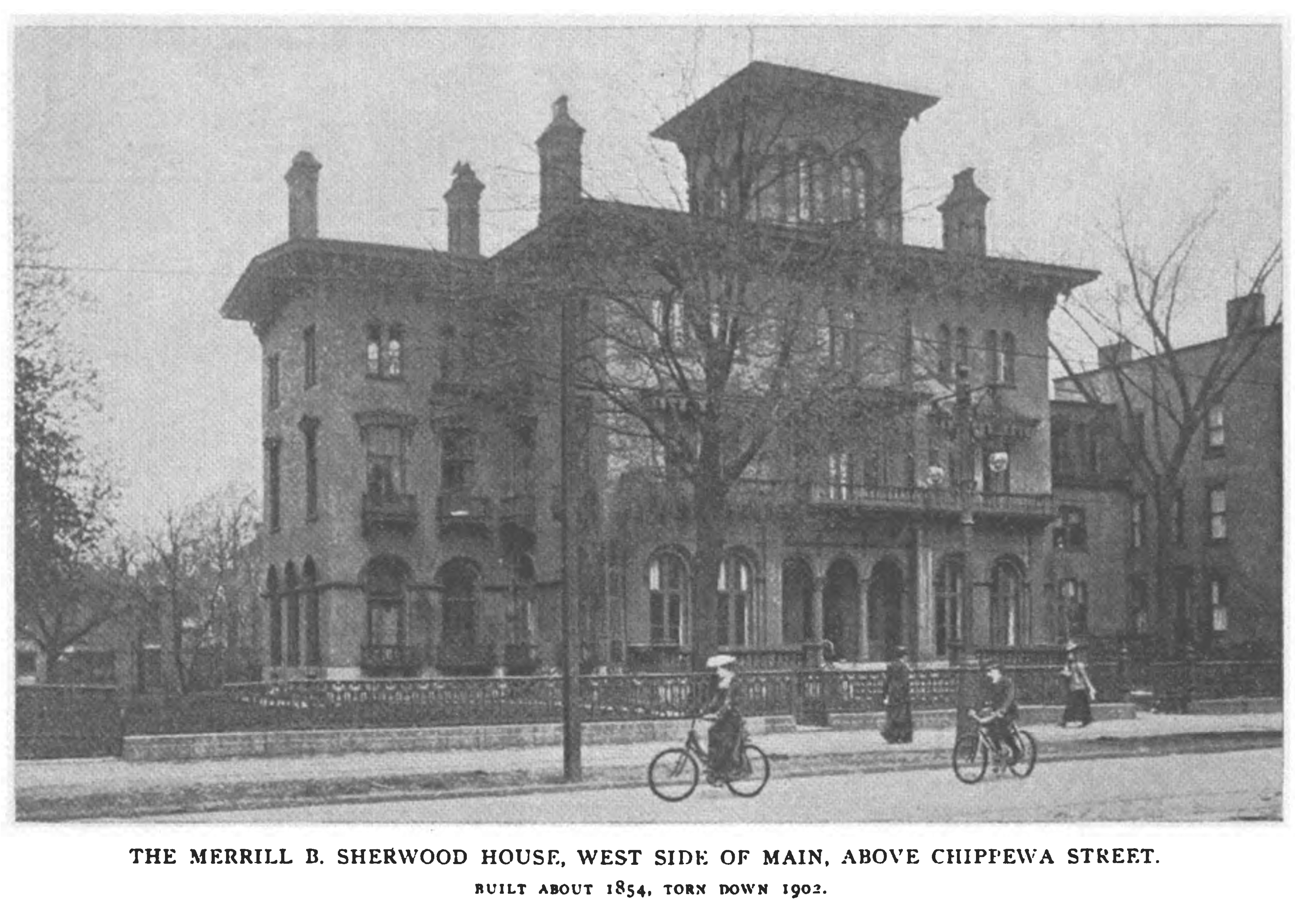
Sherwood Mansion at 652 Main Street, Downtown Buffalo. Source: Picture Book of Earlier Buffalo

Hersee & Co. built a mill on Elm Street.  In 1870, they built a large showroom in what was then the old Sherwood Home at 652 Main Street.  We discussed this house a bit in our last post.  Hersee & Co took over the mansion and decorated the various rooms to showcase furniture – i.e., the parlor, chamber, dining room, and library were all set up as such to show examples of how people could furnish their own homes.  You could view things in the showroom, and then you could make a purchase from the store, just a few blocks away down Main Street.  This was modeled after the example of Mr. Chickering in New York City, who did something similar with a large private dwelling on 14th Street.  They also had a large upholstery department and also manufactured and finished interior fittings such as mantels, doors, wainscotings, etc.  The Sherwood house was a great place for Hersee & Co to do this, as there were 34 rooms in total in the house!

20231105_150553

Hersee Factory on Ellicott Street.  Source:  Buffalo & Erie County Public Library Scrapbook.

In 1872, son William Hersee took over management of the company.  The company closed the Showroom and the store on Main Street company moved to 303-311 Ellicott Street, along what would become Hersee Alley fourteen years later.  The new store included six stories of sales floor and warehouse space.  The company had a staff of 100 skilled cabinetmakers.  The factory was situated between Ellicott Street and Blossom Street, just south of what became Hersee Alley.

Screenshot 2023-12-10 200114

1899 Sanborn Map showing the location of Hersee & Co furniture factory.

The 652 Main Street property remained in the Hersee Family’s hands after the showroom closed.  They turned the Sherwood house into a hotel called the Hersee House.  At the time, the City lacked hotel accommodations, particularly in this part of town.  Mr. Hersee also purchased land on the south and north side of the house.  He worked with Cyrus K. Porter, a well-known architect, to prepare plans for a larger hotel that would incorporate the Sherwood house into its design.  The Sherwood House would form the middle of the structure, with wings on either side, connected to the house via hallways.  The plan was for the Hersee Hotel to have 150 rooms.  Instead of building the larger hotel, the Hersee family turned the house into a boarding house.  The house was referred to as The Sherwood and also as Hersee House.

20231124_144714

Hersee Family Plot at Forest Lawn. Photo by Author.

Mr. Thompson Hersee died on December 1, 1884.  He died on the same day as Cyrenius Bristol of Bristol Sarsaparilla fame! Thompson Hersee is buried in the Hersee family plot in Forest Lawn Cemetery, which is the eternal home of 18 members of the Hersee family.

Son William ran the Hersee business following Thompson’s death, along with his mother Annette.  Annette Hersee also managed the Hersee’s large real estate portfolio.  They owned several properties around Symphony Circle, including the lands where St. John and Orton Places.  Annette Hersee established the grading and paving of those two streets in April 1885.  I have no documentation, but I surmise that Orton Place may have been named for Orton Hersee, who was the first of the children to die.  Annette also managed the estate of Harry Hersee, her brother-in-law, after he died in 1898.

In 1888, William and Annette Hersee submitted a bid to the US Government to build a new post office on the 652 Main Street site.  There were 11 bids received.  Interestingly, none of the sites were selected for the post office building.  The Post Office ended up being built at the corner of Ellicott and South Division Streets in 1897.  The building still stands today and is home to Erie Community College.

Daughter Carrie was the only of the Hersee children to grow old.  Carrie married George Coit in 1877. George Coit was hired and rose up in the ranks at Hersee & Co., becoming Managing Partner and Director of the firm’s business policy in 1887. Carrie and George lived at 33 Linwood, next door to the Hersee home.  George Coit was the third generation of Coits in Buffalo; his grandfather was also George Coit, the one who built the Coit House, which still stands on Virginia Street and is generally believed to be the oldest house still standing in Buffalo.  Coit Street is named after the Grandpa George Coit.

When William Hersee died in 1891, Annette took over the Hersee & Co. business, with George Coit as managing partner of Hersee & Co.  Annette C. Hersee passed away on June 10, 1901.  The newspaper listed the hymns sung at her funeral at the Church of the Ascension as “Lead Kindly Light,” “Abide With Me,” and “Hark, Hark, My Soul.”

When Annette died, the entirety of the estate went to her daughter, Carrie Coit, the last remaining Hersee child.  The estate of Mrs. Hersee was estimated to be around $800,000 (about $28.6 Million in 2023 dollars).  The estate also included some of the best real estate in Buffalo, including the family home on Linwood, the Hersee factory on Ellicott Street, the property on Main Street above Chippewa Street, a building at Chippewa and Main Streets, and other properties.

A cousin of Carrie Hersee Coit, Stanford Whiting, tried to claim that he was supposed to be left a part of the estate since he had lived with the Hersees for several years as a child.  He sued for $200,000 (about $7 Million in 2023 dollars) of the estate.  He lost his fight in April 1904 when the jury voted against his claim for 1/3 of the estate.  Carrie Coit became the sole inheritor of the Hersee estate.  She and George ran the Hersee & Co. business.

650 Main Street

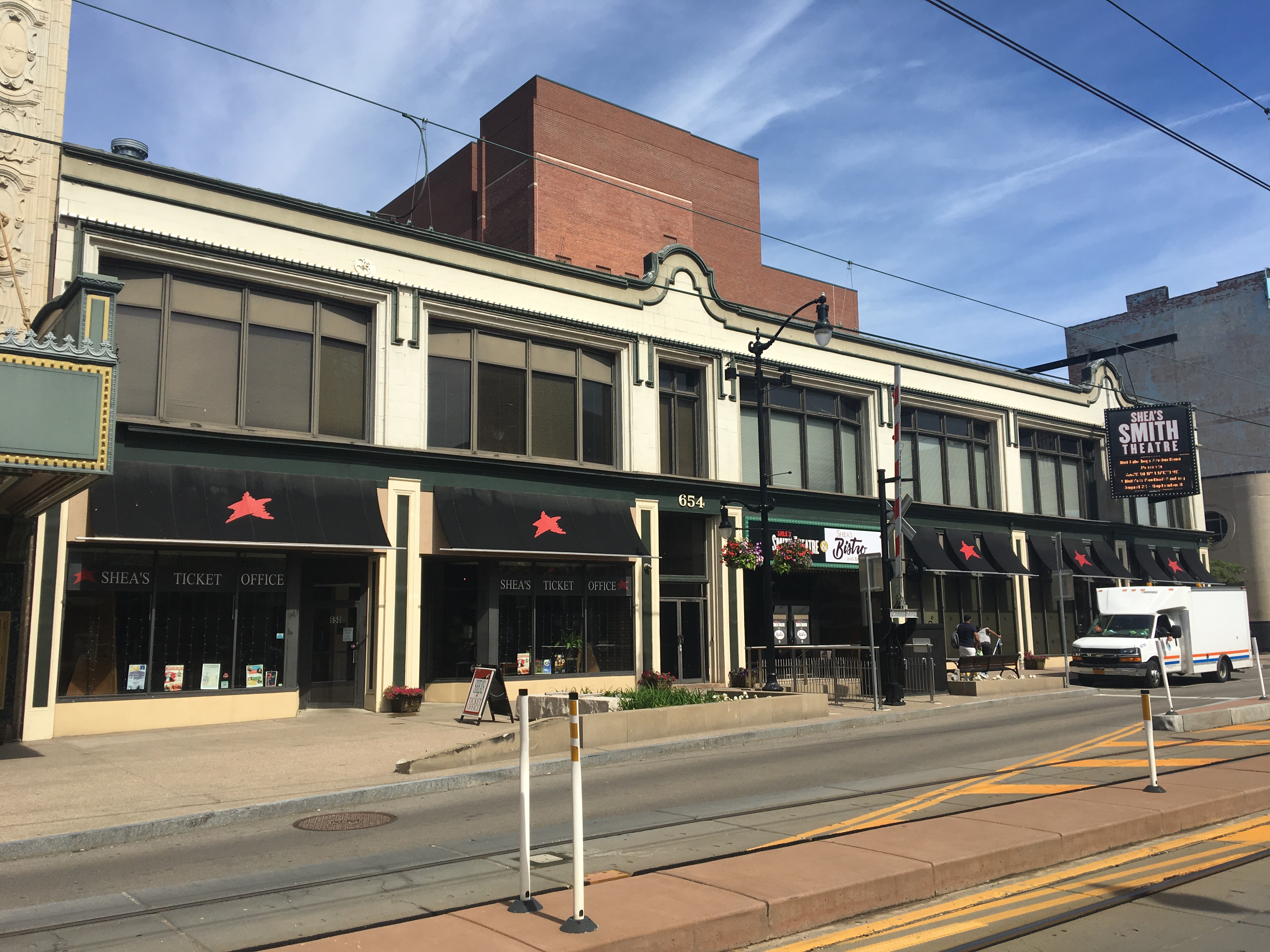
Hersee Building on Main Street.  Photo by author.

In 1902, Carrie and George decided to build a commercial structure on the property where the Sherwood Mansion stood.  The building was designed by Lansing & Beierl and took up the site of two former houses – the Sherwood Mansion and another house.  When it opened, the building was known as the Hersee Building and consisted of 8 storefronts on the first floor and offices on the second floor.  At the time, there was a trend of businesses locating in this portion of “uptown” from the city’s original business district, on Lower Main Street.  Division Street was named such because it divided the business and residential districts.  Around the turn of the century, many other residential properties in what we now call the Theater District were converted into commercial sites – such as the Spaulding Building and the Sidway Building.  The Hersee Building is still standing at 646-662 Main Street.

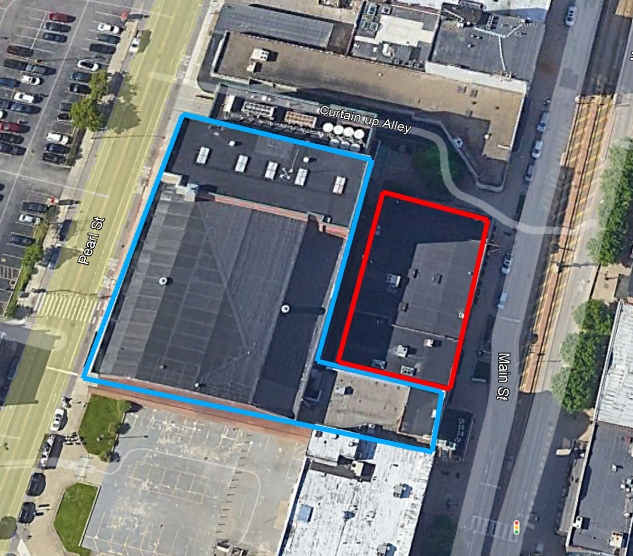
In 1924, the Hersee Building was leased to Shea’s Amusement Company for 60 years at a cost of about $5,000,000 (about $90 Million in 2023 dollars).    Michael Shea, head of Shea’s Amusement Company, constructed his theater with the lobby at 646-648 Main Street, just south of the Hersee Building.  The Shea’s Theater wraps around the west side of the Hersee Building along the Pearl Street frontage on what was the Hersee property.  Shea’s Buffalo opened in January 1926.

Screenshot 2023-12-10 203124

Location of Hersee Building and Shea’s between Main and Pearl Streets. Hersee Building is outlined in red, and Shea’s is outlined in Blue.

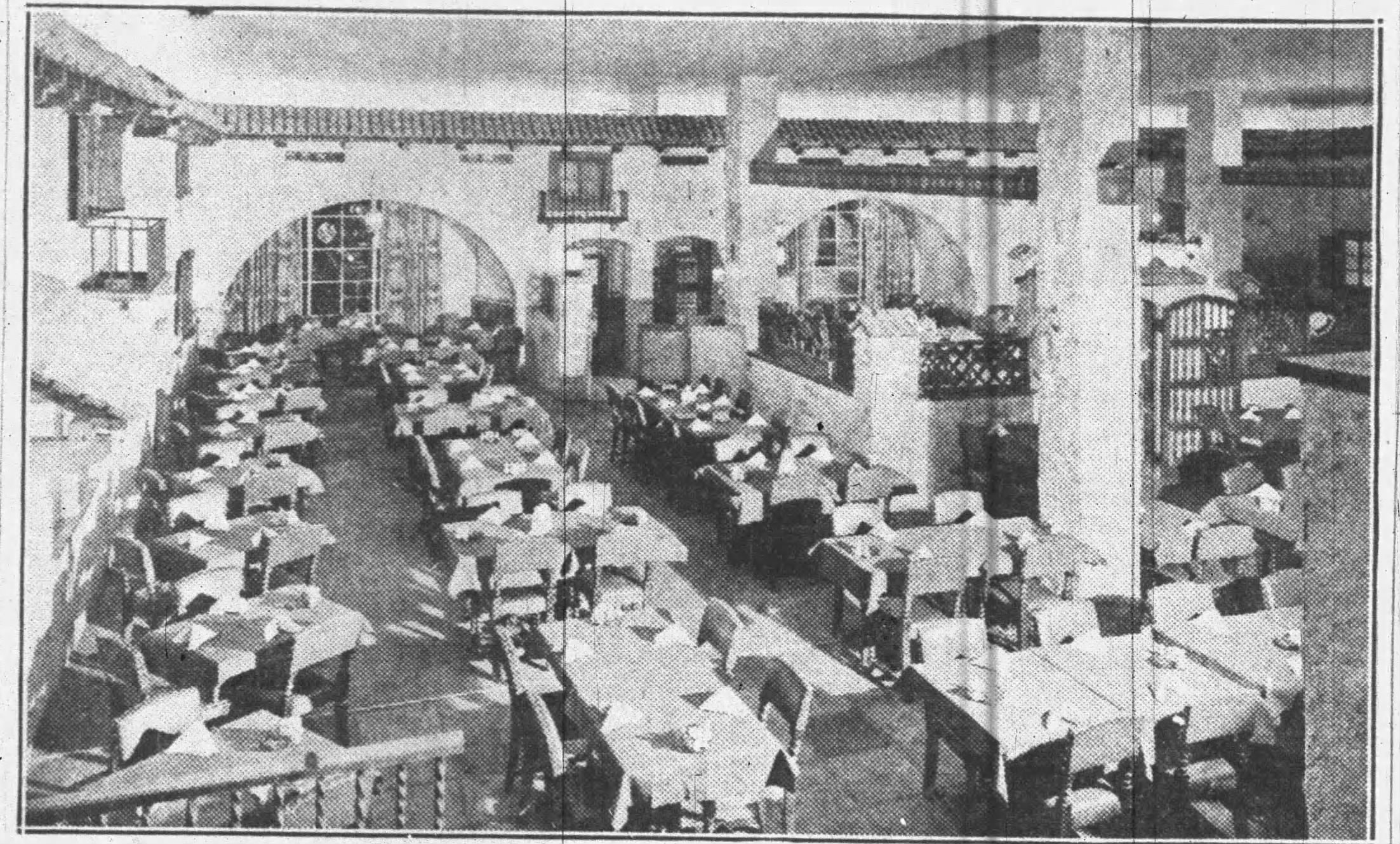
Laub_s_Old_Spain_April_1936_Courier_Express

Interior of Laub’s Old Spain, located in the Hersee Building, as it looked in April 1936. Source: Buffalo Courier Express.

The Hersee building was the long-time home to Laube’s Old Spain restaurant beginning in 1928.  After leasing the Hersee Building in 1924, the building was eventually purchased by Shea Operating Corporation in July 1931.  The upper floor was occupied by the Hippodrome Billiard Academy beginning in 1931.  The City of Buffalo obtained the building through tax foreclosure in 1975, the same year that Shea’s closed.  In 1976, many of the interior fixtures, including leaded and stained glass windows, wrought iron, mirrors, and woodwork, were stolen during a robbery.  After Laub’s closed in 1968, two other restaurants tried to locate in the building but failed and went out of business.

Screenshot 2023-12-03 201717

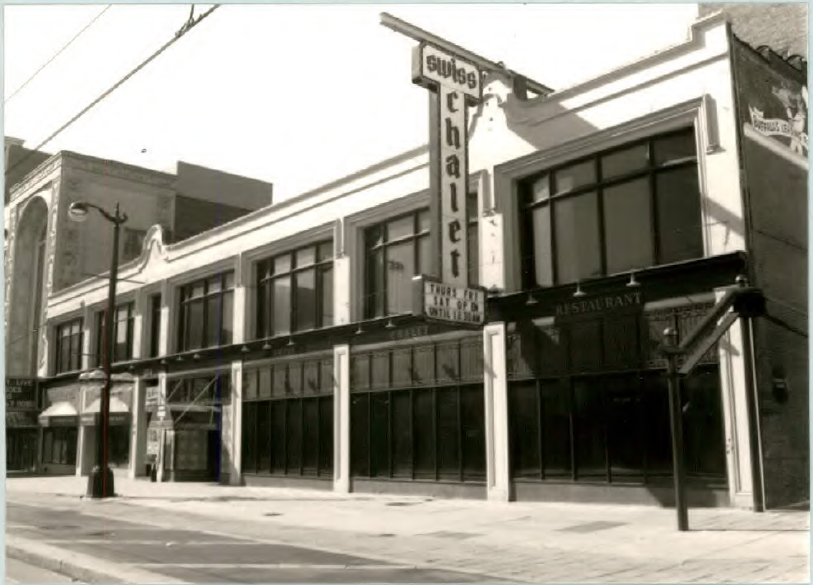
Hersee Building on Main Street 1988. Source: NYS SHPO.

In 1985, the Herseee building was purchased by George Smilanich, owner of George & Co.  The building was partially renovated by Mr. Smilanich and partly by the Swiss Chalet restaurant.  Swiss Chalet was located across the street at 643 Main Street, but their structure was destroyed by a fire in May 1984. Swiss Chalet is a Canadian chain mostly known for its rotisserie chicken.  George & Co. originally began in Buffalo as Buffalo Novelty Bazaar in 1901.  George & Co. was looking for a new space because their space across the street at 615 Main Street was being taken by the City of Buffalo for the Days Inn and Market Arcade Movie Theater project.  George & Co. and Swiss Chalet were located on the first floor of the Hersee Building.  George & Co.’s dice and poker chip manufacturing operation was located on the second floor of the building.

In 2002, George & Co. separated the business and manufacturing sides of the business.  The manufacturing moved to Florida.  George & Co. is in its fourth generation of operation and still operates as “Buffalo’s most unusual store” in Transit Town Plaza at Main and Transit(Note from Angela:  I went to elementary school with a member of the family that runs the store…if you see this, Hi Jill!)  Swiss Chalet left downtown in 1996 and closed all of the WNY restaurants in 2010.  You can still find them in Canada and can often find me there, feasting on rotisserie chicken.

The Hersee Building was purchased by Shea’s O’Connell Preservation Guild LTD in 2000.  They currently use the building for their box office, Shea’s Smith Theatre, and Shea’s Bistro & Bar.   Shea’s Smith Theatre has operated since 2000 and is a 200-seat black box theater.

Back to the Hersee furniture business – After George Coit died in 1920, the Hersee & Co. firm was managed by Carrie Hersee Coit and her son Thompson Hersee Coit.

hersee_ad_1924

Hersee Ad from January 1924.  Source:  Buffalo Courier Express.

20231124_145550

Carrie and George Coit’s graves.  Photo by author.

Carrie Hersee Coit died in 1930.  Carrie’s estate was valued at $1,000,000 (about $18 Million in today’s dollars) and was to be evenly divided between her six children.  The heirs decided to sell several of the properties and close Hersee & Co. to settle the estate.  This is also when the Hersee Building was sold to Michael Shea.  The Hersee heirs listed the Hersee & Co. property for sale in November 1930.  They had a sizeable going-out-of-business sale.  After 94 years in business in Buffalo, Hersee & Co. closed in January 1931.

Fun fact:  Downtown Buffalo used to be home to many furniture companies.  Today, the only remaining furniture business is Scherer Furniture, which actually got its start with Hersee Furniture.  Frederick Scherer began working with Hersee & Co. in the 1890s.  On April 7, 1897, he established his own firm at 156 Genesee Street.  He did business at that site until 1937 when he bought the present location of Scherer Furniture at 124 E Genesee Street.  Scherer is currently run by the fourth generation of the Scherer family.

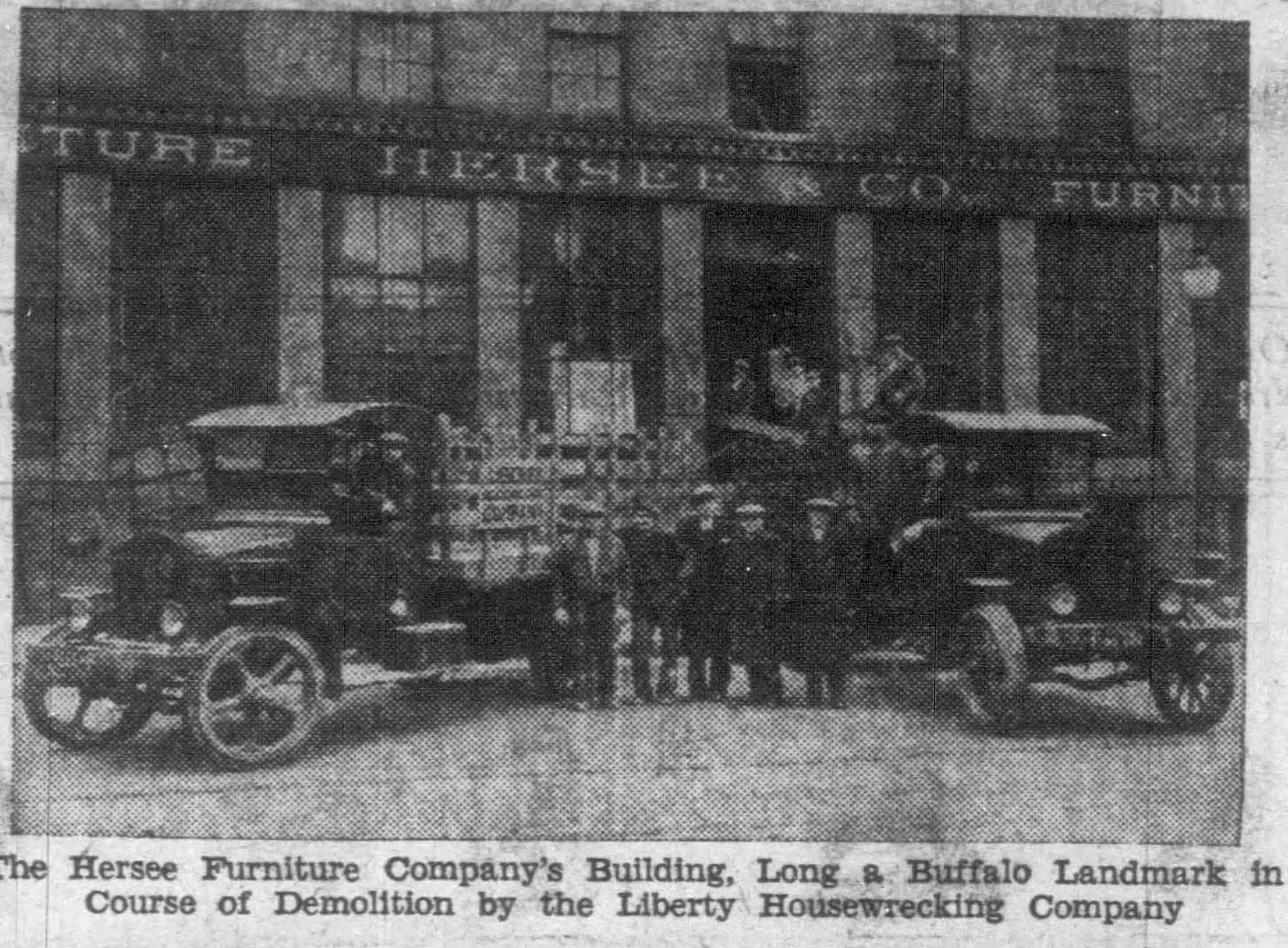
The Hersee & Co. building on Ellicott Street was demolished in 1932 by the Liberty Housewrecking Company.  Many of the building materials from the building were salvaged to be resold by the Liberty Housewrecking Company at their site at the corner of Seneca and Oneida Streets.

Hersee___Co_before_demolition

Hersee Co. on Ellicott Street before demolition.  Source:  Buffalo Times.

A parking lot was established at 303 Ellicott Street in 1933 by James A Watt and Hector MacDonald.  They developed three parking lots in the Ellicott and Oak Streets area.  The lot was later operated by Gusto Mattioli and then his wife, Mary Mattioli.  In 1951, the site was looked at as a possible location for a parking ramp.  The ramp ended up being constructed across Ellicott Street, which is still the site of the Mohawk Ramp today.  The parking lot has been owned since 1968 by Ferguson Electric, which operates its business out of the buildings north of the parking lot.

1702258885068-8cc124fb-0c1f-430c-9a8b-6f07c1b6e5b2_

The only known picture of the Hersee Family’s Main Street Orchard.  The orchard is where Holy Trinity is now. Source: Holy Trinity.

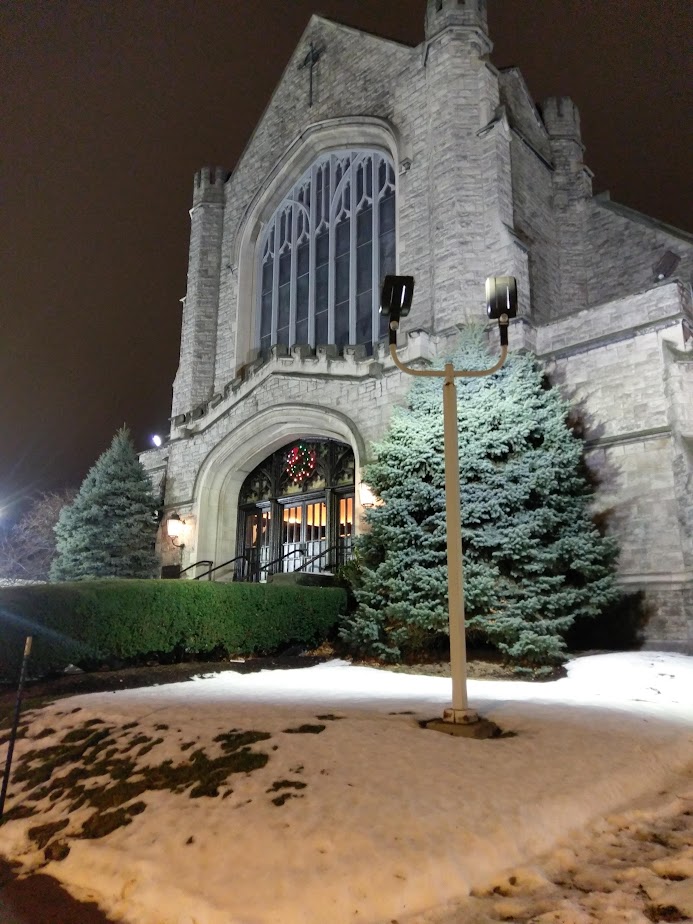
What happened to the Hersee Estate on Linwood?  The Main Street portion of their property was formerly their orchard.  The orchard was a popular place for the Hersees to host parties.  The orchard portion of the property was sold to Holy Trinity Lutheran Church in 1899, which opened its “new” church on the site in April 1905(note from Angela:  this is my church).  Holy Trinity Church was designed by Lansing & Beierl, the same architects who designed the Hersee Building on Main Street.

IMAG1419

Holy Trinity, located at 1080 Main Street, the former location of the Hersee family’s orchard.  Photo by Author

1899Sanborn

The 1899 Sanborn Map shows Hersee Property outlined in red, with the houses along Linwood.  The orchard was located along Main Street.

1951Sanborn

1951 Sanborn Map with the former Hersee Property outlined in red.  Note Holy Trinity Church along Main Street and the two houses still standing along Linwood Avenue.

The Hersee Family house at 25 Linwood was sold in 1911.  The house stood until the early 1960s. The Coit family heirs converted Carrie and George Coit’s house at 33 Linwood into a rooming house.  The 33 Linwood House was purchased by Holy Trinity in 1946.  The house was used as a parish house and as a meeting space for various groups.  I have been trying to find pictures of the house, but I have not yet been able to.  I have contacted a former resident of the house and one of the Hersee-Coit descendants.  If I can find a picture, I will add it to the post and share it on Facebook.  I was, however, able to talk with a long-time member of Holy Trinity, David Hehr, who was able to provide me with this great description of the house:

“A grand shingle style mansion, 3 stories high, and very dark green colored in its last iteration.  It had a protruding three-story side entrance that was circular in shape, and surmounted by a cupola, I recall.  This columnar shaped appendage contained the side stairwell that went all the way up to the third floor.  You ascended a short flight of maybe 6 or 8 rickety wooden steps up to the porch that led to the side entrance door.  Just inside the side entrance door there was a foyer.  Believe it or not, in those Baby Boom years, all of the Sunday School classrooms in the rooms above the church offices were filled to capacity, so 33 Linwood was used for overflow classrooms.  Three rooms on the first floor of the mansion were used.  The front room, along the south and east (possibly the dining room and adjoining kitchen?), was where I had my 5th grade class.  The front room, along the south and west side, was where we had my 6th grade class.  There was also a room in the middle, which led from the foyer off in a northerly direction, and which had no windows.  Each of these three rooms fanned out from the side entrance.  I recall white marble fireplaces in each of the three rooms.  Each room also could be closed in from the foyer by pocket doors containing multiple panel grid-like glass lites.  Directly behind 33 Linwood, between the mansion and the church offices, the Sunday School created the “Garden of Praise,” a nice flower and shrub garden with a picket fence, curving trellis with roses and ivy climbing up it, etc.”

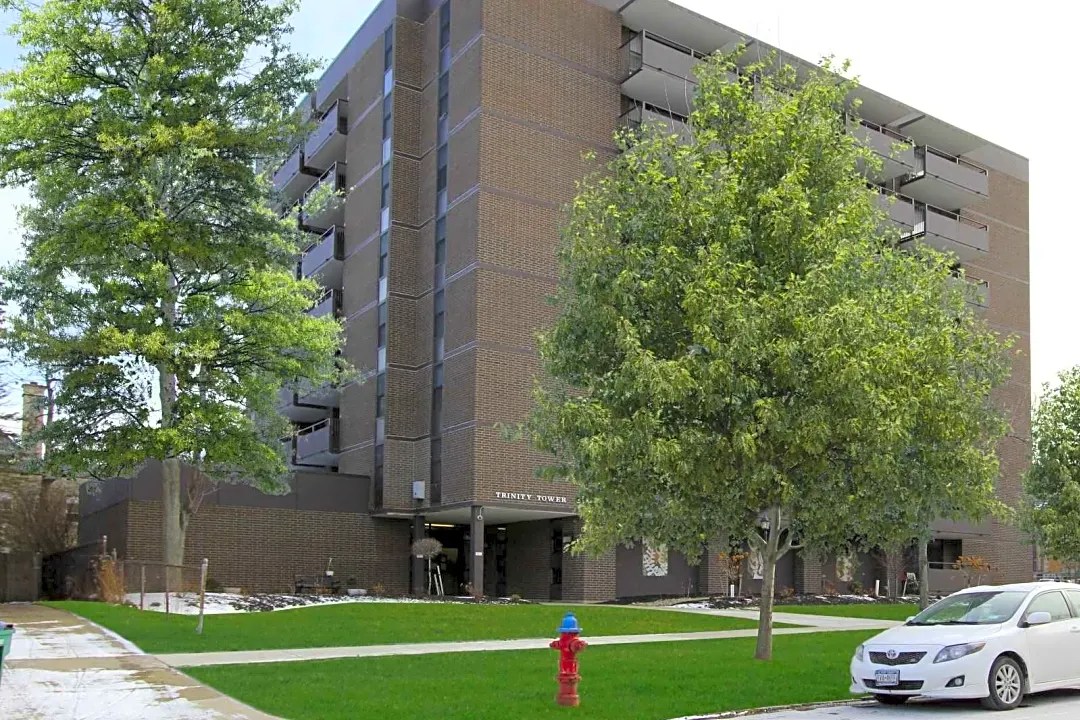
trinitytowers

Trinity Towers at 33 Linwood Avenue

The Coit House at 33 Linwood Avenue was demolished in 1970 to build Trinity Towers, an 83-unit senior housing complex.  The $2 Million apartment building, Trinity Towers, opened in 1971.  It was the first private development in Buffalo in which financing through the New York State Housing and Urban Renewal Commission was combined with federal interest subsidy loans.  Trinity Towers still operates as affordable senior housing today.

modernview

Modern view with Former Hersee property outlined in red. Holy Trinity Church along Main Street and Trinity Towers along Linwood Avenue.

The next time you drive past Hersee Alley, think of the nearly 100 years of a furniture business that operated here in Buffalo.  Check the back of any old furniture pieces; you can still find Hersee pieces occasionally.  If you have a piece, I’d love to see pictures of it!  Here’s a link to an example of one of their pieces:  https://www.chairish.com/product/8404637/early-1900s-hersee-co-furniture-american-empire-period-flame-mahogany-veneer-mirrored-tall-chest-of

Want to learn about other streets? Check out the Street Index. Don’t forget to subscribe to the page to be notified when new posts are made. You can do so by entering your email address in the box on the upper right-hand side of the home page. You can also follow the blog on Facebook. If you enjoy the blog, please share it with your friends; It really does help!  Interested in getting even more content from me?  You can become a Friend of Buffalo Streets on Patreon, where I post unique extra content at least once a month.   You can go to https://www.patreon.com/buffalostreets/ to join.

Sources:

  • “Died.”  The Buffalo Advocate.  July 30, 1863, p3.
  • “Died.”  Buffalo Courier Express.  August 16, 1859, p2.
  • “Death of William M. Hersee.”  Buffalo Courier Express.  October 1, 1891, p5.
  • “George Coit’s Sudden Death a Great Shock”.  Buffalo Times.  January 22, 1920, p1.
  • “85th Birthday of Hersee Co.”  Buffalo Times.  September 30 1931, p4.
  • “Plumbing and Building Supplies at Low Prices.”  Buffalo Times.  February 20, 1932, p14.
  • “Hersee & Co to Close Forever on Wednesday”.  Buffalo Courier.  January 18, 1931.
  • “Hersee & Co Closing up After 94 years in City”.  Buffalo Courier.  October 19, 1930.
  • “Old Established House of Hersee and Co Still Leads for Best Goods in All Grades.”  Buffalo Express.  March 23, 1902.
  • “Thompson Hersee.”  Buffalo Times.  September 3, 1921.
  • “Incorporation Papers Are Filed By Local Concerns.”  Buffalo Courier Express.  April 21, 1932, p22.
  • “New Building On Main Street”.  Buffalo Commercial.  April 29, 1902, p9.
  • “A New Feature.”  Buffalo Commercial.  May 18, 1879, p1.
  • “A Model Establishment – The Furniture Exhibition Rooms of Messrs T. Hersee & Co.” Buffalo Commercial.  April 29, 1870, p3.
  • “New Hotel Enterprises – The Hersee House.”  Buffalo Courier Express.  March 8, 1873, p1.
  • “Corporation Proceedings.”  Buffalo Times.  April 21, 1885, p3.
  • “The Sites Offered for the New Buffalo Post Office.”  Buffalo Commercial.  April 25, 1888, p3.
  • “Notice to Creditors.”  Buffalo News.  May 12, 1888, p25.
  • “Funeral of Mrs. Hersee.”  Buffalo Commercial.  June 12, 1901, p9.
  • “Seeks Part of Hersee Estate.”  Buffalo Enquirer.  April 12, 1904, p6.
  • “Lost His Fight for a Fortune.”  Buffalo News.  April 16, 1904, p1.
  • “Parking Privilege Nearly Upsets Main Street Deal.”  October 12, 1924, p86.
  • “Chippewa and Tupper Streets Fashionable Center When Main Street Was Van Stophorst Avenue.”  Buffalo Courier.  October 26, 1924, p68.
  • “Laube’s Building to Be Renovated.”  Buffalo News.  February 12, 1985, p32.
  • “Old Spain Renovation Has May Target Date.”  Buffalo News.  March 4, 1980, p35.
  • “Mrs. Mary P Mattioli.”  Buffalo Courier Express.  July 23, 1963, p13.
  • “Lux Baffled by Associates on Ramp Votes.”  Buffalo Courier Express.  July 11, 1951, p1.
  • “Furniture Man Reviews his 50 Years in Field.”  Buffalo Courier Express.  November 19, 1944, p39.
  • “Building Permits.”  Buffalo News.  February 28, 1936, p37.
  • “Hersee Home Sold.”  Buffalo Times. March 16, 1911, p13.
  • This Faith Tremendous.  Holy Trinity Lutheran Church, Buffalo, 1979.
  • “Coit Will Disposes of $1,000,000 Estate.”  Buffalo News.  July 9, 1930, p14.
  • “Site Embracing Shea’s Buffalo Changes Hands.”  Buffalo Courier Express.  June 7, 1931, p35.
  • “Linwood Rezoning Asked by Church for Elderly Housing.”  Buffalo News.  June 25, 1970, p38.
  • “Holy Trinity Lutheran Battles City Blight.”  Buffalo News.  October 10, 1970, p5.

Read Full Post »

Screenshot (46)

Fuhrmann Boulevard shown in red on map

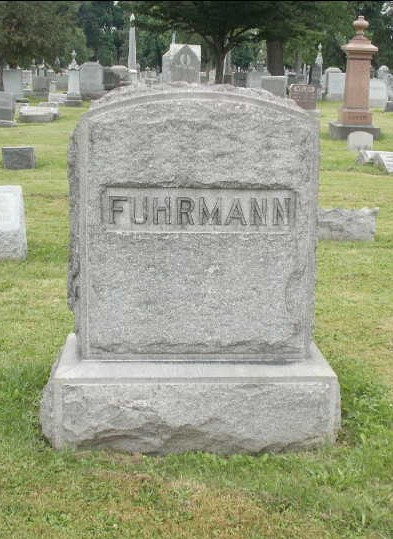
Fuhrmann Boulevard is a street (the main street) on the Outer Harbor of Buffalo.  As we wrap up summer on Labor Day Weekend, perhaps you spent some time on Fuhrmann Blvd as you enjoyed the waterfront this summer. The street has had several configurations over time and exists today as the road that runs to the south of the elevate portion of Route 5 on the Outer Harbor.  The road was first built in 1935 and is named after Mayor Fuhrmann, who was instrumental in getting it built by securing the land on the Outer Harbor.

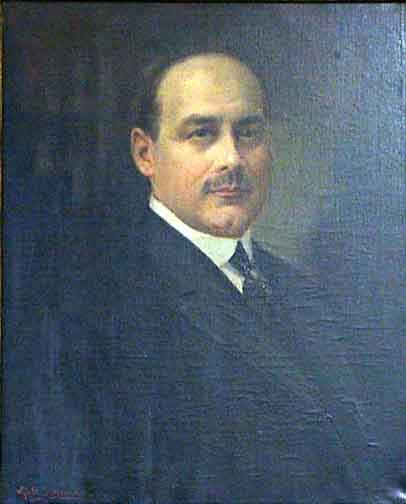
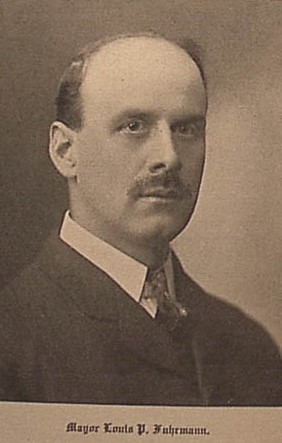
06fuhrmann

Louis Fuhrmann Mayoral Portrait

Louis P. Fuhrmann was born on the East Side on November 7, 1868 to Philip and Elisabeth Fuhrmann, who had emigrated from Bavaria.  The family lived on Clinton Street in the South Ellicott neighborhood of the near East Side, near Bennett Park.  Louis’ father owned and operated a barber shop on Genesee Street near Ellicott Street.  Louis was educated in Buffalo Public Schools – PS 32 on Cedar Street and Central High School.  While he was in school, he worked on weekends in the meat business as a butcher boy for Christian Klinck in the Elk Street Market.  After high school graduation, he was given a full time job and remained in the meat business his whole life.  Since he had so much experience, he was quickly hired to work in the wholesale beef business in the Jacob Dold Packing Company.  He was placed in charge of the Jacob Dold Packing Company’s Kansas City plant at the age of 18 years old.  After six years in Kansas City, he was homesick for his hometown.  He returned to Buffalo in 1892 to open his own business, the Louis P Fuhrmann Packing House, located at 1010 Clinton Street.

Louis Fuhrmann had a reluctant entry into politics. His first bid for public office was in 1905, when he was convinced to run for Alderman in the old Sixth Ward.  He was elected and re-elected two years later.  He quickly grew to be a leader in government.  He was such a popular Alderman that when Mayor J.N. Adam went out of town for month-long trips home to Scotland, he left Mr. Fuhrmann in charge as Acting Mayor for several years in a row.  He was well known around town and well respected for his business savvy and government experience.  He was referred to as “Louis Fuhrmann, the Progressive.”

In 1909, he ran as the Democratic candidate for Mayor.  The election was hotly contested, with Louis Fuhrmann up against a strong Republican candidate Jacob Siegrist.  At first, The Buffalo News published an Extra Edition at 6pm to announce that Siegrist was the next mayor.

Siegrist the Next Mayor

Buffalo Evening News. 6pm Extra Edition. November 2, 1909. Headline declaring Siegrist the Next Mayor.

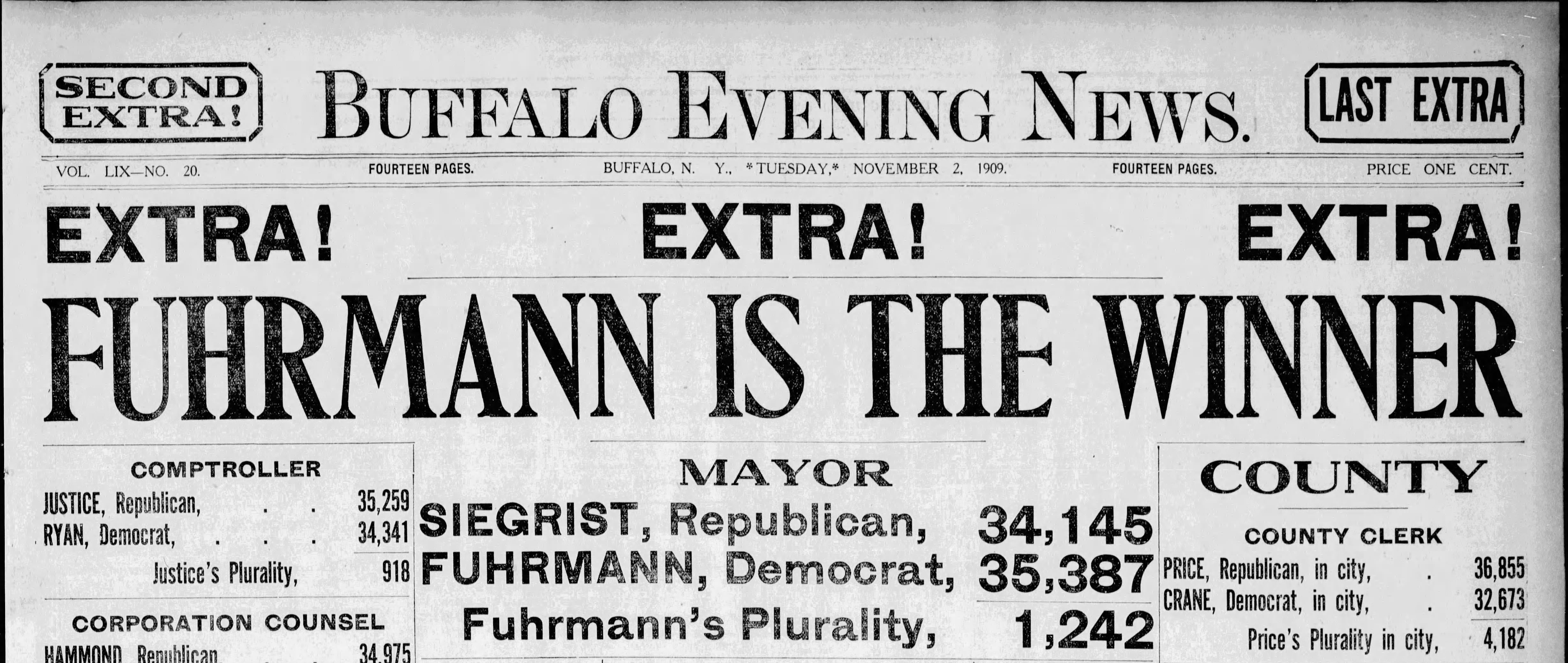
In an episode similar to that famous “Dewey Beats Truman” headlines…. ballots continued to be counted and the Buffalo News had to issue a Second Extra Edition when it became clear that Fuhrmann won!  It was reported, “when Louis Fuhrmann was elected the Mayor of Buffalo no one received a greater shock than he did.”  Republicans had swept all the rest of the seats across the City and County, other than Fuhrmann, a Democrat.  Mayor Fuhrmann was the first Mayor born and raised in Buffalo.  His mayoral office was also the first to be lit by electricity rather than gas.

Fuhrmann is the Winner

Buffalo Evening News. Second Extra Edition, November 2, 1909. Headline declaring Fuhrmann is the winner.

While Mayor Fuhrmann was in office, a major issue in Buffalo was the “Sea Wall Strip”.  This is land along the lakeshore, which today we call “The Outer Harbor”.  The questions surrounding the Strip included who owned the land and what was happening with the Hamburg Turnpike (now Route 5).  For more than 50 years, there had been more questions regarding the Strip than answers.  Shortly after election, Mayor Fuhrmann began working on the issue.  The feeling at the time was that Buffalo needed bigger facilities in order to grow, including harbor improvements – new docks, new slips and a new highway that was planned to connect Buffalo with Cleveland via the Hamburg Turnpike.

seawall strip 1889

View of the Seawall Strip from 1889. You can see how narrow some portions of the Outer Harbor was before much of the fill was added to expand the land. Source:  Buffalo Library via New York Heritage

13-01

Map showing slips and adjuncts of the Erie Canal at Buffalo. Source: History of the Canal System of New York State.

The City of Buffalo’s waterfront has been modified a great deal since the Buffalo was founded.  Building the harbor break walls, the Erie Canal and other canal slips and many other modifications over time would probably make today’s waterfront unrecognizable to those early settlers who first arrived here. Much of the Outer Harbor land has been created over time by landfill.  The “Outer Harbor” essentially was created when the Blackwell Canal was constructed in 1850.  It was built by E.R. Blackwell, who ran out of money to complete it, and so it was renamed the City Ship Canal in 1853. The City Ship Canal allowed ships to have additional areas to dock and opened up more land for waterfront access.  Additional canal slips connected the Buffalo River and the City Ship Canal, further increasing waterfront access.  This also created what is known as Kelly Island, which is technically a peninsula.  The Island is the land where General Mills and Riverworks is now; Ganson Street runs through the middle of Kelly’s Island.  In 1883, the City Ship Canal was extended to allow the Buffalo Creek Railway Company to create a series of canal slips at what we now call Tifft Farms (Lake Kirsty is remnants of those canal slips).  The City Ship Canal was partially filled in during the 1950s when Ohio Street was changed and Fuhrmann Blvd was elevated (more on that later).

The Sea Wall Strip was the land on the Outer Harbor from where Ohio Street meets the Outer Harbor north.  The Sea Wall Strip was permitted by Congress in 1837 and construction began in 1841.  In 1859, the City was authorized to construct a breakwater, but was not given the power to take land.  In 1864, the City was empowered to use condemnation proceedings to take the strip of land known as the Sea Wall Strip.  The Hamburg Turnpike ran along the Outer Harbor from Ohio Street to the City Line.  In 1874, the City acquires the Hamburg Turnpike from the Hamburg Turnpike Company.  By the 1870s, railroads crisscrossed around the waterfront.  In 1899, the Mayor created a harbor commission to investigate the disputed rights and title of who owned the Sea-Wall Strip and the Hamburg Turnpike.  In 1900, the Commission declared that the City owned the Hamburg Turnpike with a width of six rods (99 feet).  The Railroads claimed that they only owned four rods (66 feet).

erie street

1894 shoreline and canals shown overlaid in blue over modern aerial photograph. Map by Author.

Calls for beautifying the Turnpike and Seawall Strip came as early as 1902.  Planning began to build design an elevated highway that was similar to a road along the Potomac River and Anacostia Creek in Washington, DC.  The elevated route in Buffalo was to include a railing along the roadway, with trolley tracks running alongside the road and sidewalks for pedestrians.  Below the roadway would be arches where railroads could cross under the road to access the industrial plants, elevators, etc., along the road.  The road was to be the main connection between the City of Buffalo core and the Stony Point Industries being planned for opening that year.  Stony Point Industries was an early name for the steel plant and affiliated businesses that became Lackawanna Steel and later Bethlehem Steel.  The roadway project never happened because of the ownership issue.

There was a lot of back and forth judgements in court until in April 1911, the railroad agrees to drop the appeals and exchange the rights and the disputed titles, so the City of Buffalo finally owned the Sea-Wall Strip and the Hamburg Turnpike.  This would allow the ability to build a new bridge at Ohio Street for better clearance for vessels.   This also allowed them to relocate Tifft Street and Ganson Street to improve harbor facilities.  They also received 500 feet at the foot of South Michigan Street.

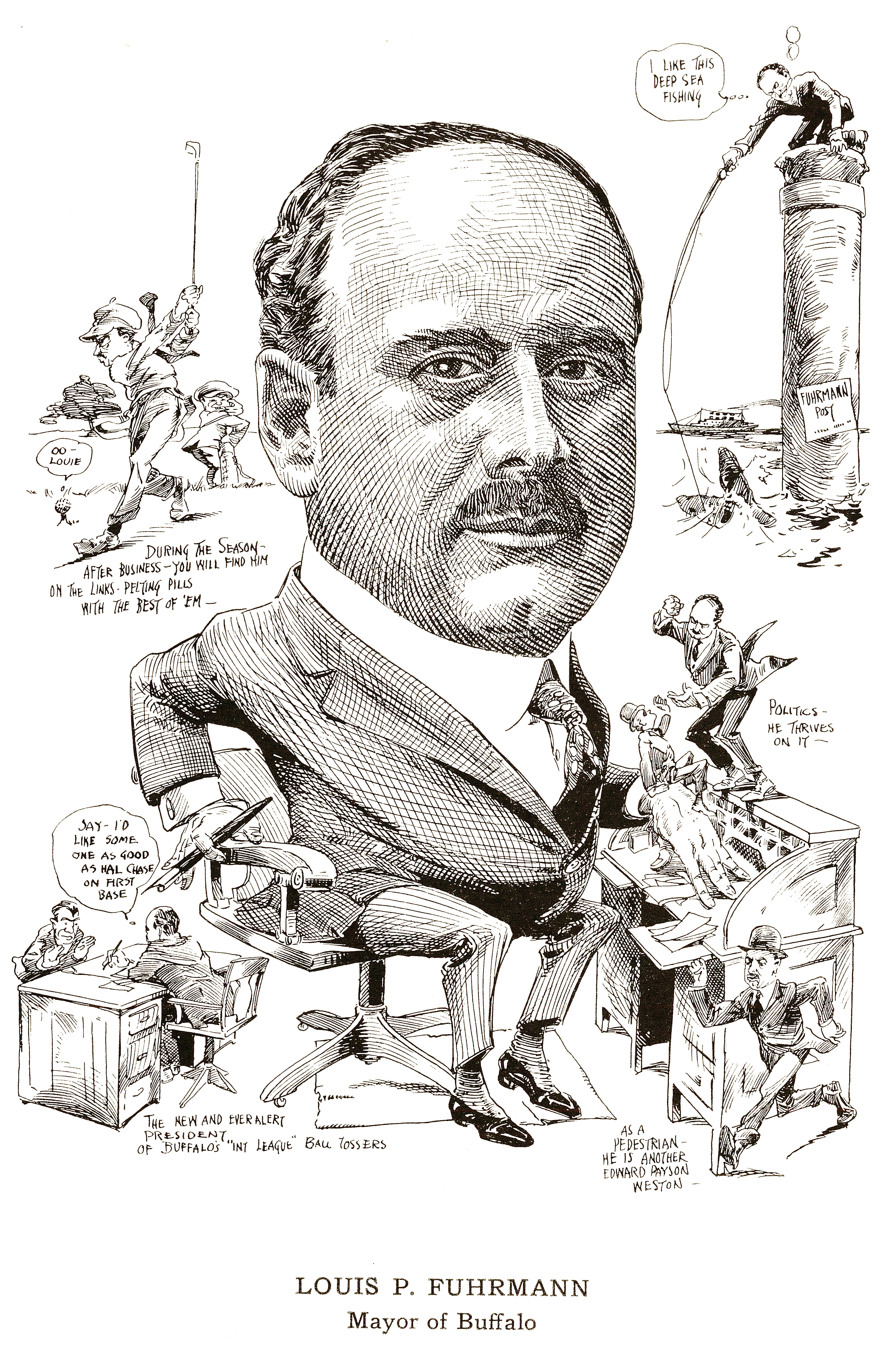
e1e0c476a660c7c1a09d05a2d2542ddf

Associated Buffalo Artists, “Louis P. Fuhrmann: Mayor of Buffalo,” from 1913. Source: Digital Collections – University at Buffalo Libraries, accessed February 13, 2023, https://digital.lib.buffalo.edu/index.php/items/show/78476.

It was reported that Mayor Fuhrmann was successful in winning the Sea Will Strip for the City, because “he is a big man mentally, as well as physically.  He has no petty notions to obscure his vision.  He has imagination and he is fearless and free.”  He was able to settle what had been “juggled, misappropriated, pawned, fought over, blanketed, buried and resurrected for a half century.”

Mayor Fuhrmann ran again for mayor in 1913.  The Democratic Party felt he was too independent and endorsed Edward J Meyer instead.  Meyer’s name may be familiar to you as the name of Erie County Medical Center (ECMC) was Edward J Meyer Memorial Hospital until 1978.  Mayor Fuhrmann won the primary contest overwhelmingly and went on to also beat both Thomas Stoddart from the Citizen’s Party and John Lord O’Brian from the Republican Party in the General Election.  During his second mayoral term, WWI broke out.  Mayor Fuhrmann was active in shaping the city’s contributions in men, money and munitions to the war effort.

Elk_Street_Decorated

Elk Street decorated for St. Patrick’s Day 1915. Source: Buffalo News.

In 1915, Mayor Fuhrmann helped bring a St. Patrick’s Day parade back to Buffalo after 27 years!  Some sources hint that Mayor Fuhrmann was trying to distance himself from the rising anti-German sentiment that was rising in Buffalo as WWI was happening in Europe by supporting the Irish groups efforts for the parade. The parade in the 1880s would march up Main Street from the Liberty Pole at the Terrace to Cold Spring (around Main and Ferry)  and was led by the Hibernians and the Knights of Columbkill.  The 1915 parade started from Chicago and Fulton Streets at 2:30pm on Wednesday March 17th.  The movement for the a parade began with the Gaelic-American Association of the First Ward, an organization that had 600 members that were all born in Ireland.  The Elk Street Businessmen’s Association took charge of the idea and the result became one of the largest St. Patrick Day celebrations Buffalo had ever seen.  The idea had only come about a month before St. Patrick’s Day, and more than 1500 Irish-Americans were involved in the planning of the parade, meeting at St. Bridget’s, at the corner of Fulton and Louisiana Streets, near where the parade started.  More than 30 churches were represented during the planning for the parade, many different organizations and 11 churches marched in the parade – St. Brigid’s, St Stephen’s, Perpetual Help, St. Teresa’s, St. Monica’s, St Patrick’s at Limestone Hill, Nativity, Precious Blood, Holy Family, Our Lady of Lourdes.  More than 3,000 people marched in the parade that year.  March 17th was on a Wednesday that year, so Alderman Sullivan declared the day a half holiday in the First Ward!

st_patricks_day_parade_1915

Photos from 1915 St Patrick’s Day Parade. Source: Buffalo Times

The parade was filmed as “The Great St. Patrick’s Day Parade in Buffalo” and was shown by Michael Shea at the Shea’s Hippodrome Theatre (located on Main Street Downtown where Fountain Plaza is today) beginning on March 22nd.

The 1916 and 1917 parade had a different route, mostly on Main Street downtown.  In 1918, it was announced in January that there would be no St. Patrick’s Day parade that year.  The Gaelic Association came together and held a parade, bringing it once again back to the South Side of the city, starting at Elk and Hayward Streets.  The 1918 parade was held on Saturday March 16th , since March 17th was a Sunday, to allow for festivities not to be marred by church obligations.  The Gaelic Association made arrangements for the Marine Band to lead the parade, and American Flags were more prominent than in previous years, due to WWI.  The Association honored its members who had been called to the draft and held a reception to honor them before they left the following Monday.

In 1919, there was no parade.  The leaders of the Irish organizations met to abandon the parade to concentrate on a united effort for a big demonstration to take place after Easter.  I’m not sure if that happened.  The parade eventually faded away before being revived in 1939 as the St Patrick’s Day Parade along Delaware Avenue.  The 1939 parade went from Niagara Square up Delaware to Tupper, to Main to the Terrace.  The “Old Neighborhood” St Patrick’s Day parade was revived in 1994 to bring back the spirit of the Old First Ward.

mayor fuhrmann

Mayor Fuhrmann. Source: Buffalo and Its German Community.

In 1917, Mayor Fuhrmann was defeated in the mayoral race by George Buck.  It was also a strong year for Republicans across local elections, only one Democrat was elected that day, Councilman John Malone.  Mayor Fuhrmann’s defeat was mainly attributed to the fact that Mayor Fuhrmann opposed the change in governmental structure to a commission form of government.  The proposal eliminated the Common Council, replacing it with a commission with five members, including the Mayor, Public Safety (fire, police and health), Finance and Accounts (comptroller, treasurer, auditor and assessors), Public Affairs (education and poor departments) Public Works (bureau of water, streets, building and engineering), and Parks and Public Buildings.  Mayor Fuhrmann vetoed the proposal, which was overturned by the legislature and the Commission form of Government was created.  The new charter went into effect in January 1916.  It was in effect until 1926 when the Kenefick Commission created a new charter for the City, which separated legislative and executive  powers of the municipal government.  The City’s new charter went into effect in January 1928, vesting the Common Council with legislative powers and the Mayor in charge of executive and administrative functions.

Some sources also reported that Louis Fuhrmann’s loss was partly due to the anti-German sentiment in Buffalo during WWI.  Many parks, hospitals, streets and banks lost their German names.  German newspapers folded. Churches and business which spoke German began speaking English in the name of patriotism.  And the scrappy son of German immigrants Louis Fuhrmann lost to the Yale Law educated Anglo-American George Buck.

After Mayor Fuhrmann left office, he continued to be active in Democratic politics.  He was appointed by Frank Schwab to the School Board in 1922, where he served for five years.  While he was Mayor and while on the School Board, he fought for more high schools and helped to see the schools he fought for constructed.  In 1927, Fuhrmann became Chair of the Erie County Democratic Committee.

fuhrmann grave

Louis Fuhrmann Gravestone, Forest Lawn Cemetery.

Louis Fuhrmann married Alice Meahl in 1900.   They had four children:  Frederick, Dorothea, Philip and Mary Alice.  The family lived at 438 North Oak Street for many years.  They later moved to Jewett Parkway.  Sadly, Mary Alice died from heart problems at just one year old, while Louis was Mayor.  Mayor Fuhrmann was a member of Concordia Lodge, F & A. M, the Buffalo Consistory, the Eagles, the Elks, the Oriels and other social lodges.  Louis Fuhrmann retired from Fuhrmann Packing House in 1927, with son Frederick taking over.

Louis P. Fuhrmann died in 1931 after two years of illness.  Mr. Fuhrmann was so prominent in the local Democratic party that it was published in the paper that all local Democratic leaders from across the county attended his funeral, along with other prominent people from Buffalo’s political, social and civic life.  His funeral was conducted by Reverend John D. Sayles, who had served as Mr. Fuhrmann’s secretary during the 8 years of his mayoral terms.  Rev. Sayles eulogized Mayor Fuhrmann by saying:

“Louis Fuhrmann was unique in his human qualities.  Everybody who knew him loved him because he himself was lovable.  Nobody ever appealed to him for help in vain.  The sick, the poor, the unlucky, the friendless, were blessed by his benefactions.  In early life he leaned that the coin of this realm cannot be legal tender in any other.  He made a fortune during his lifetime and without publicity gave more than half of it away.  Some may say that a man who does that is a fool.  If that be so, he was one of God’s fools and did not die – such fools never die unloved, unwept and unremembered.”

Mayor Fuhrmann is buried in Forest Lawn.

officials opening Fuhrmann

Opening of the Fuhrmann Blvd in 1935. From left: Edward C. Dethloff, Democratic Candidate for Council; Councilman George K Hambleton, sponsor of the boulevard and high-level bridge; Councilman Charles J. Hereth; Francis J. Downing, former ERB Executive Director and WPA Administrator; Martin P. Flemming, secretary to Mayor Zimmerman; and Democratic County Chair Frank J. Carr. Source: Buffalo Times.

Fuhrmann Boulevard opened from South Michigan Avenue to Ohio Street in August 1935.  It was built as an Emergency Relief Bureau project at a cost of $300,000 ($6.7 Million in today’s dollars).  Construction of the boulevard provided work for 1200 men for a year.  Opening this road was important for traffic along the lakeshore, as creation of the road helped traffic to avoid 2 lift bridges and 8 active at-grade railroad crossings.  During summer months at that time, traffic averaged about 20,000 cars a day.  The new Fuhrmann Drive was designed to connect to the proposed high-level bridge which was supposed to be built later that year (spoiler alert:  they had a ribbon cutting and drove the first pilings for the bridge in 1935, but the Skyway wasn’t finished until 1955).

In 1958, Governor Harriman announced an at-grade separation project to create what they referred to as the “Fuhrmann El”.  By creating this limited access highway route, they felt it would “open up the lake shore area to practically unlimited development”.  The elevated highway was considered to be an important piece of the chain of expressways from Niagara Falls to the South and West.  The elevated highway would connect the new Skyway (opened 1955) to the new Father Baker Bridge (over Union Ship Canal, built 1961), and the work that was being completed at the time in Athol Springs (the traffic circle by the Ford Plant).  The road was designed to help workers getting to their jobs at the industrial plants and to enhance the available industrial land along the route.  The road was designed by Elmer G. H. Youngmann, who was the District Engineer for NYSDOT and designed most of WNY Highways.  The Fuhrmann El route was 1.2 miles running from the Buffalo Skyway to just north of the Tifft Street interchange, which was where the approaches for the Father Baker Bridge were located.  The route was designed to be 4 lanes -two northbound, two southbound – and included a complete system of service roads for entrance and exit into the present or planned future plants along the right-of-way.  The original Fuhrmann Boulevard was reduced to just those service roads.  The expressway was 18 to 22 feet above the level of the service roads.  Because the road was so costly to build, instead of being built on an elevated steel structure, it was built on an earth embankment.

Fuhrmann El

Buffalo News sketch of the proposed Fuhrmann ‘El’ Elevated Highway.

fatherbaker-bukaty-4-sept1989_1200xx2644-1489-74-74

Demolition of Father Baker Bridge in 1989. Source: Buffalo Business First.

In 1989, the Fuhrmann Blvd area began to see another major change as the Father Baker Bridge over Union Ship Canal was demolished.  The bridge spanned 100 feet over the canal and helped to make the ride from Downtown Buffalo to Lackawanna feel like a roller coaster with the two high-level bridges.  The demolition of the bridge took two years and was the State’s most costly highway project being completed at the time.

fuhrmann boulevard

Modern View of Fuhrmann Boulevard running between the Outer Harbor and the Elevated Route 5 (on the right of image). Source: Step Out Buffalo

Beginning in the 1990s, there was renewed interest in the waterfront.  The Southtowns Connector Feasibility Study was completed in 1991.  It was included in the Horizons Waterfront Action Plan, prepared in 1992.  The plan would have moved the highway inland to the CSX tracks, opened up more of the Outer Harbor Land for development.  In 2001, the project was refocused based on comments received from agencies and the public.  The concern was that moving the highway would have unacceptable impacts on neighborhoods and the environment, as well as being too costly to be able to be completed in a reasonable amount of time.  So, the decision was made that the elevated Route 5 would remain.  The new plan became focused on changes to the existing road system rather than fully relocating the highway.  This helped to create a project that was actually able to be completed.  Fuhrmann Boulevard was improved and became more of an actual road once again, rather than just an intermittent service road which provided access to properties.  Multi-use trails were placed along the road, with signage celebrating the industrial heritage of the Outer Harbor.

If you’re wondering what happened to Fuhrmann’s Meatpacking business?  Son Frederick Fuhrmann took it over when Louis retired and it was ran by the Fuhrmann family until 1945 when it was purchased by Mr. Teplesky of Tog Packing.  They operated until 1980, when the business was sold to P Brennan Meat Wholesalers.  In 1999, an action was held to sell the equipment.  A building was still standing on the site until 2007, but it has since been demolished.  It is now a vacant lot.

Want to learn about other streets? Check out the Street Index. Don’t forget to subscribe to the page to be notified when new posts are made. You can do so by entering your email address in the box on the upper right-hand side of the home page. You can also follow the blog on facebook. If you enjoy the blog, please be sure to share it with your friends.  Interested in getting even more content from me?  You can become a Friend of Buffalo Streets on patreon.   You can go to https://www.patreon.com/buffalostreets/

Hope to see some of you on my upcoming tours this month!  For more info on tours, click here.

Sources:

  • “Louis P. Fuhrmann”. Buffalo Courier-Express. Feb 24, 1931, p5.
  • “Ex-Mayor Fuhrmann Dead” Buffalo Courier-Express. Feb 24, 1931,p1.
  • Mueller, Jacob.  Buffalo and Its German Community.  German-American Historical and Biographical Society.  1911-12.
  • “Mayor Fuhrmann Was Efficient Executive”.  Buffalo Times.  July 13, 1924.  P45.
  • “Winning the Sea Wall Strip for Buffalo”.  Buffalo Sunday News.  August 27, 1911, p 13.
  • “Parade Details are Settled for St. Patrick’s Day”.  Buffalo Courier.  March 14, 1915, p 74.
  • “Four Thousand in St. Patrick’s Day Parade Wednesday”.  Buffalo Times.  March 14, 1914, p43.
  • Gaelic Association to Parade on St. Pat’s Day”.  Feb 24, 1918, p45.
  • “20,000 Marches Enroll for parade St Patrick’s Day”.  Buffalo Times.  February 25, 1917, p17.
  • “St. Patrick’s Day Parade to Outshine All Affairs of its Kind In History”.  Buffalo Courier.  February 22, 1915, p6.
  • “In the Good Old Days:  St. Patrick’s Day in Years Long Past”.  Catholic Union and Times.  January 14, 1915, p5.
  • Burr, Kate.  “Old St. Patrick’s Day Parades.  Buffalo Times.  March 17, 1932.
  • “Great Legal Contest to Determine Ownership of Hamburg Turnpike”.  Buffalo Times.  October 12, 1902
  • “Beautify the Turnpike”  Buffalo Express.  June 8, 1902.
  • “Boulevard Change Ready for Opening”.  Buffalo Times.  August 22, 1935.
  • “Start of Work on Furhmann El Due in Early 59”.  Buffalo News.  August 6, 1958 p 29.
  • McCarthy, Robert.  “Closing Brings Bridge to Dead End Father Baker Span Was Monument to Industrial Might”.  Buffalo News.  August 22, 1989.
  • Whitford, Noble E.  “Slips and Other Adjuncts of the Erie Canal at Buffalo”. History of the Canal System of New York State.  Brandow Printing Company.  1906.
  • Adam, Thomas.  German and the Americas:  Culture, Politics and History.  ABC-CLIO.  2005.
  • “Sons of Old Erin Honor St. Patrick in Street Pageant”.  Buffalo Times.  March 17, 1917, p1.
  • “No Parade By Irish on South Side Today”.  Buffalo Times.  March 17, 1919, p7.
  • “Baby Daughter of Mayor Dead”  Buffalo Enquirer.  January 7, 1915, p6.
  • “Hundreds Pay Final Tribute to Fuhrmann”  Buffalo News.  February 27, 1931, p1.
  • Roseberry, Jack.  “Fair-ly Long Custom of Camp Aid Ends with His Retirement”.  Buffalo News.  August 13, 1980, p10.

Read Full Post »

Screenshot (71)

Asbury Alley shown in red. The former right of way of the rest of they alley is shown in yellow.

Asbury Alley is a short, narrow alley running parallel to Pearl and Franklin Streets, north of Chippewa Street in Downtown Buffalo.  The alley takes a turn mid-block and runs to Pearl Street.  Asbury Alley is one of the few remaining brick streets in Buffalo; however, much of the brick has been covered as asphalt from the parking lots has encroached into the alley.  Asbury Alley historically ran another block south to Huron Street, but the majority of the alley south of Chippewa has been covered by the Augspurger Parking Ramp since 1983.  The portion of Asbury Alley south of Chippewa which still exists is gated.

asbury alley

Asbury Alley looking north from Chippewa.  Photo by author.

Asbury Alley gets it’s name from a church that used to be located on it.  Asbury Church was first established on March 22, 1847.  At this time, members of the Niagara Street Methodist Church (located at Niagara and Franklin Street) looked to establish a new congregation in the northern part of the expanding downtown core.  They established a church at the northwest corner of Pearl and Chippewa Streets, known as Pearl Street Methodist Church.  The first church on the site was a plain brick two-story structure which was ready for services on June 16, 1848.  In 1850, the church changed it’s name to Asbury Church after Bishop Francis Asbury, though, as we know in Buffalo, we hold on tight to former names of things, and newspapers of the day alternately referred to the church as both Pearl Street Church and Asbury Church.

John_Paradise_-_Francis_Asbury_-_NPG.90.82_-_National_Portrait_Gallery

Portrait of Francis Asbury by John Paradise. Source: National Portrait Gallery.

Francis Asbury was one of the first two bishops of the Methodist Episcopal Church in America.  He was born in England in 1745.  In 1771, he volunteered to come to British North America as a traveling lay preacher. During the Revolutionary War, he was one of only two British Methodist ministers to remain in America.  In 1794, Francis Asbury became Bishop of the Methodist Episcopal Church of the United States.  He preached in various places, wherever a crowd would come to hear him.  He rode an average of 6,000 miles each year, preaching nearly every day.  I do not believe he ever made it to Buffalo, which was still a small fledgling village at the time Bishop Asbury died in March 1816.  Many Methodist churches across the country use the Asbury name in his honor.

Asbury Church was a strong congregation for many years.  The Buffalo Young Men’s Christian Association (YMCA) was organized in the church on April 26, 1852.   The organization was founded by a number of young men from members of various city churches who met at Asbury Church to form an association to improve the spiritual and mental condition of young men.  They adopted the Boston YMCA’s bylaws and thus the second YMCA in the country was born.  By 1870, they had outgrown the building and contemplated joining with Delaware Avenue Methodist Church.  Delaware Ave Church had just opened to meet the needs of the residents of Buffalo who were moving to what was considered “uptown” at the time.  Many of the residents were moving from the Grace Church area, which was located at Michigan and Division Streets.  The merger between Delaware Avenue Church and Asbury Church fell to the wayside when Asbury Church decided to build a new building for themselves instead of merging.

In April 1871, the Asbury Church congregation held their last services in their old church.  While the new church was under construction, they held services a the Chapel of the North Presbyterian Church.  The cornerstone of the new church was placed on July 13, 1871.  The new church was designed by Richard A Waite.  The new church was considered to be the finest Methodist church in the City of Buffalo.

asbury church

Asbury Church. Source: Methodism in Buffalo.

The New Asbury M. E. Church was dedicated in December 22, 1872.  During their dedication service, after the sermon, Rev. B. I. Ives arose to deliver a passionate speech to raise funds needed for the new church.  The church had cost $50,000 ($1.2 Million today) to build and $25,500 had been raised so far.  He asked the congregation to raise the required remainder $24,500 on the spot, calling for pledges of donations of $1,000 then $500, etc…This continued for two hours. They managed to raise $20,000.  The congregation was then dismissed with a benediction to come back for evening services later that day.  During the evening services, the remaining $4,500 was pledged and the church was dedicated.

Asbury Church struggled to pay off it’s debt from the beginning.  While contributions had been made and many additional dollars were pledged, a long time was given to parishioners to make their payments.  This did not account for the interest that was accruing on the debt for building the church.  Several of the members had business misfortunes of their own and were unable to meet their pledges.  After the first six years, little of the debt had even begun to be paid off.  It was discouraging to both the members of the church and the presiding elders of the Methodist Church locally, as Asbury was considered to be the most beautiful church edifice in Buffalo if the property were to be sold due to lack of payment.  The pastor, Dr. Leak, traveled across the city for two months during 1887, raising money for the church.  They managed to pay off their debt and a grand jubilee was held to celebrate.

delaware asbury historic image

Delaware Ave Methodist Church, which became Asbury-Delaware Methodist Church when the two congregations merged. Source: Yale Divinity Library

Asbury Church celebrated it’s 50th anniversary in April 1897 with a two day celebration.  By 1916, membership in the Delaware Avenue Church at Tupper and Delaware had been declining.  Asbury Church was a larger a congregation of 1150 members, with 842 active members, but the Delaware Ave Church had struggled.  The church felt there was no longer a need for two downtown Methodist churches as downtown had shifted to a business center as opposed to a residential neighborhood.  The value of the Asbury property had increased so it was decided it would be better to prepare to sell the Asbury church site for development purposes, as it was the more valuable piece of property.  The decision to merge was made on June 19, 1917, leaving Asbury Church with just a few weeks left in their church.  On July 21, 1917, the congregation from Asbury Church moved one block north and one block west to join the Delaware Ave Church at the southeast corner of Delaware and Tupper.  The church at Delaware and Tupper became known as Asbury-Delaware Church (also referred to as Delaware-Asbury Church), with the pastors from each of the two churches becoming Associate Pastors at the combined church.  Long time readers of the blog may remember that the Delaware Avenue church was designed by architect John Selkirk.

After Asbury Church’s congregation moved out of the property on Asbury Alley, the church building became the first location of the Buffalo City Mission.  The City Mission was incorporated with an inter-denominational board of directors and served the community from the church building for four years.  The City Mission was granted the use of the church rent free so that the church could continue to be tax-free until the property could be sold for development.

City_Mission_Building_On_Broadway

City Mission Building at 85 Broadway. Source: Buffalo Times, March 7, 1931.

In 1922, Mission purchased 85 Broadway and moved to the unique architectural building, which had been Nate Fenton’s Pekin Cabaret, a nightclub.  The building on Broadway contained an auditorium, offices, kitchen and rooms for services.  When the Mission opened in the new building, the Buffalo Courier reported that, “by its purchase of the former cabaret and dance hall and its decision to destroy none of the decorative effects, the City Mission has put into practice its belief that religion is not necessary a dull, drab affair to be practiced in dreary, distasteful surroundings.”  The jazz music changed to Christian hymns, but the Mission took advantage of the bright colored lights and the hand-painted pictures on the walls.  In 1930, the City Mission had provided lodging and food to 11,412 men and to 180 women.  About 300 men were served each day for meals.  In 1940, the City Mission at 85 Broadway was reconstructed with a larger kitchen, dining area, dormitory and new showers.  In 1984, the City Mission moved into a new facility at 100 E Tupper.  In 2021 a new building was constructed next to the former building on Tupper Ave.

Back to Asbury Alley…. In 1922, after the City Mission moved out, the Asbury Church site at Pearl and Chippewa was being prepared for demolition.  The site had been sold to the Peabody Holding Corporation for $250,000 (about $4.5 Million in today’s dollars) to be developed by Harrison Real Estate Corporation.  The sale of the property allowed the church to pay off all of their debts.  The church building was demolished by the American Salvage and Housebreaking Company.  There were plans to building a modern two-story store and office building on the site, with 8 storefronts and a second floor with office suites.  The architect for the new building was Harold J. Cook.

Pearl_and_Chippewa_1922_

Proposed building at Chippewa and Pearl Streets. Source: Buffalo Courier, January 1922.

Peabody_Building_asbury_

Peabody Building as it looked when it opened in 1922. Source: Buffalo Times, May 1922.

When the Peabody Building opened, it was an excellent location, as Chippewa was a major east-west connection through the Central Business District.  The building leased up fast.  There were ten ground floor store units, eight on Chippewa and two on Pearl.  The entrance to the second floor was also on Pearl Street. When the building opened, it created a continuous link of business storefronts along Chippewa Street from Main Street to Delaware Avenue.  Demand for the building was great, so the building was erected very quickly.  The church demolition began February 20, 1922 and was completed on March 4th.  The building was completed on April 29, in just 55 calendar days or 44 working days!

When it opened in 1922, some of the businesses located in the building included C.A. Kremp, Haberdashery; Max F. Drewelow, Cigars and Magazines; Dr. D. J. Walker, Dentist; Dr. Irwin Cohen, Surgeon Chiropodist; The Pennsylvania Locksmith; W. J. Condon, Optometrist; Art Smith Auto Supply Co;  Weinert & Hirsch, Merchant Tailors; The Marcel Hair Shop; Sapouna Brothers, hat cleaning/shoe shining; and The Orchid Shop, millinery, lingerie, corsets, hosiery.

town_shop_sale_b_c_of_smoke_asbury

Ad for Town Shop for sale b/c of stock damaged by the smoke from the fire, July 28.

In July 1954, the Original Pants Store, located at 31 W Chippewa in the building, caught fire.  The fire injured two men and caused $25,000 ($282,000 in 2023 dollars) in damage.  The blaze was confined to the pants store, with some smoke and water damage in neighboring storefronts – The Consolidated Tie Shop at 29 W Chippewa and the Town Shop women’s apparel at 35 W Chippewa.  The manager of the pants store, Marvin Gumins, was treated for first degree burns on his face.  Junior Capitan Charles Weisenburger of Engine 12 cut his hand and was treated at the scene.  The two-alarm fire was likely started by careless smoking.

Fire_at_Pearl_Chippewa_Asbury (1)

Fire and Smoke at the Peabody Building. February 1959. Note, the building on the left in the photo is still standing at 45 Chippewa today. Source: Buffalo News.

A few years later, the building was not so lucky.  On February 19, 1959, a three-alarm fire caused $225,000 damage to the building, which at the time was known as the Nasco Building.  The fire originated on the second floor and spread rapidly throughout the building.  The first call for the fire was at 9:29 am.  The second alarm was at 9:31 am and the third alarm was at 9:32 am.  At the time of the fire, the businesses located in the building included the Town Shop, ladies’ wear; Martin, men’s wear’ a hat cleaning and tailor shop operated by Gust Gavras; and Elliott’s Cigar Store.  The second floor was occupied by Kurt Brychta, violins; a beauty salon operated by Loretta Bitterman; Louis Weyer, furs; signs by Coffas; Eric & Joseph, a beauty shop; and the offices of Dr. Seymour Saries, podiatrist.

The building was owned by Nasco Corp, who also had offices in the building.  More than 80 firefighters battled the fire in temperatures of 5 degrees.  The scene described in the paper of “the pall of heavy black smoke blown across Main Street by a frigid west wind” sounds eerily familiar to the scene just a few months ago when the building at 745 Main Street burned down.  The 1959 fire caused more than $225,000 ($2.6 Million in 2023 dollars) damage to the stores and offices.  It was thought to have been caused by either defective wiring or an overloaded electrical circuit.  Included in the loss were two cellos and six violins in Mr. Brychta’s shop.  Mr. Brychta was also a violinist with the Buffalo Philharmonic Orchestra.  One of the lost violins was a Ruggieri!

fire_at_pearl_chippewa_asbury

Another view of the fire, 1959. Source: Buffalo News.

A few months later, on April 24, 1959, the firefighters were called back to the scene when the rubble in the wrecked Nasco Building caught on fire again.  The two alarm fire was quickly controlled by the fire department.

In March 1960, the City of Buffalo Department of Public Works advertised for bids for the demolition of the fire-damaged building.  The site was owned by the City of Buffalo and the Buffalo Urban Renewal Agency for the next few decades and leased out to various parking operators by the Board of Parking.

In June 1996, The Buffalo Urban Renewal Agency put out a Request for Proposals for a developer to redevelop the parcel.  At the time, they were considering redevelopment of offices, residential, retail, commercial, entertainment, educational, healthcare or a creative combination of any of the above.

Diner_Pearl_and_Chippewa_Asbury

Diner that was going to be located at the lot at Pearl & Chippewa. Source: Buffalo News.

Only one plan was proposed for the site.  Mark Goldman, who owned the Calumet Arts Café at Chippewa and Franklin Streets and is widely regarded as the driving force behind the rebirth of Chippewa Avenue. Mr. Goldman’s plan was to purchase a 70-year old authentic “Pullman Car” style diner, restore the diner and install it in the lot.  The diner had been found in Canoga, in Seneca County, New York.  In addition to the diner, plans included building an adjoining food service building and a handful of small retail outlets resembling sidewalk newsstands along the edges of the property to serve as walk up retail to serve people walking around downtown.  The project did not proceed and in 1998, the City began using the property for parking again.

20230701_172923

Current view of the parking lot at Pearl & Chippewa. Photo by author.

In November 1998, the property was sold to Skydeck Corp for $80,100 ($149,000 in 2023 dollars)  Skydeck Corporation is an entity that was formerly owned by the late Mark Croce.  At the time, he was developing the Brownstone Bistro at 297 Franklin Street and the parking lot would provide the parking he needed for the restaurant.  This was Mr. Croce’s first parking lot purchase, as he saw the purchase of parking lots as strategic to help fuel his downtown entertainment and hospitality projects.  His impacts are seen throughout Downtown Buffalo to this day, dispute his death in January of 2020.  Fun fact:  Downtown’s newest street name just was created last week when a portion of W Genesee Street was renamed Croce Way in honor of Mark Croce.

20230627_121841

Croce Way sign in Downtown Buffalo next to the Statler, which Mark Croce saved from the wrecking ball.

So what happened to the Asbury Church congregation after they merged with Delaware?  Asbury-Delaware Church continued to hold services for more than 70 years until the church finally closed in June 1990.   Like so many of the urban churches, they lost members to the suburbs.  The congregation had dropped from about 2,000 members in the 1950s to just 135 members.  Toward the end, they saw just an average of 40 regular attendees in services, all members of about 18 families.  The church was listed for sale for $400,000 ($867,000 in 2023 dollars).  The proceeds from the sale of the church were planned to be used to support other Methodist churches or programs in the city.  The remaining members of the church transferred to other congregations.  During the 1990s, two churches in Amherst merged and decided to take on the Asbury name, so while the congregation which still worships in Amherst doesn’t take its roots directly from the Downtown Asbury Church, they share the same namesake!

There were several different proposals for the building that were floated around.  The church was then purchased by another church group but sat vacant and neglected.  In 1995, pieces of the steeple fell and West Tupper Street adjoining the church was closed for a year.  The church was almost demolished that year when a judge declared it a public safety hazard.   The City of Buffalo purchased the building in 1999 for $175,000 ($319,000 in 2023 dollars) after a four year legal battle over what was going to happen to the church.  In early 2000s, musician Ani Difranco and Scot Fisher purchased and renovated the Delaware -Asbury Church into Babeville/Asbury Hall, a concert venue and offices of the record label.  The new venue “The Church” opened in 2006.

Next time you’re at a concert at Asbury Hall, or just the next time you pass by the parking lot at Pearl and Chippewa, think about the history that those sites have seen!  Want to learn about other streets? Check out the Street Index. Don’t forget to subscribe to the page to be notified when new posts are made. You can do so by entering your email address in the box on the upper right-hand side of the home page. You can also follow the blog on facebook. If you enjoy the blog, please be sure to share it with your friends.  Interested in getting even more content from me?  You can become a Friend of Buffalo Streets on patreon.   You can go to https://www.patreon.com/buffalostreets/

Sources:

  • Buffalo Christian Advocate.  January 23, 1851, p2.
  • “At Church” Buffalo Christian Advocate.  June 18, 1863, p2.
  • “Church Dedication”.  The Buffalo Commercial.  December 2, 1872, p3.
  • “City Mission Directors See Their Work Growing”  Buffalo Times.  March 7, 1931, p14.
  • “Plans Could Brighten Chippewa”.  Buffalo News.  April 8, 1998, p1.
  • “Goldman is Planning to Open Diner”.  Buffalo News.  June 27, 1997, p8.
  • “Asbury and Delaware Ave to Join Hands.”  Buffalo News.  July 21, 1917, p5.
  • “Semi-Centennial”.  Buffalo Commercial.  April 27, 1897, p10.
  • “Corner-Stone Laying, Today”.  Buffalo Advocate.  July 13, 1871, p3.
  • “Churches Merge”.  Buffalo Commercial.  June 20, 1917, p10.
  • “Business Block to Supersede Asbury Church”.  Buffalo Courier.  January 11, 1922.
  • “Our History”  Buffalo City Mission.  https://www.buffalocitymission.org/who-we-are/history/
  • “City Mission Now in Fenton’s Pekin”.  Buffalo Courier.  June 12, 1922, p14.
  • “Another Famous Landmark Passes Out”.  Buffalo Times.  January 13, 1922, p13.
  • “Advertisement for Bids.”  Buffalo News.  March 8, 1960, p34.
  • “Request for Proposals”.  Buffalo News.  June 16, 1996, p 75.
  • Hunt, Sandford.  Methodism In Buffalo:  From its Origin to the Close of 1892.  HH. Otis and Sons:  Buffalo, 1893.
  • “Pearl-Chippewa Fire Pours Out Pall of Smoke”.  Buffalo News.  February 19, 1959, p1.
  • “Pearl-Chippewa Blaze Quelled by Daring Firemen”.  Buffalo news.  February 19, 1959, p1.
  • “One of two things”.  Buffalo News.  February 21, 1959, p3.
  • “Blaze Dampened in Rubble Left by Big Mid-Winter Fire”.  Buffalo News.  April 24, 1959, p31.
  • “Further Evidence of a Greater Buffalo The Peabody Building”.  Buffalo Times.  May 14, 1922, p 54.
  • “Peabody Block Aids Business”.  Buffalo Times.  May 14, 1922, p54.
  • “Damage is $25,000 in Downtown Blaze, Sixth Big One of Year”.  Buffalo News.  July 10, 1954, p4.
  • Real Estate Transactions.  Buffalo News.  November 23, 1998, p7.
  • Dolan, Thomas.  “New Diner Faces Trip”.  Buffalo News.  September 13, 1996, p21.
  • Dolan, Thomas.  “Rail Car Diner Project is Not Going Forward”.  Buffalo News.  September 15, 1998, p2.
  • Condren, Dave.  “2 Churches Prepare Last Services”.  Buffalo News. May 27,1990, p 17.
  • Stouffer, Rick.  “Realtor Plans Open Church Sundays”.  Buffalo News.  December 14, 1990, p5.

Read Full Post »

A few posts ago, we talked about General Hayes, for whom two streets in Buffalo get their name.  Did you know there’s another General who actually had three streets named after him!?  Unfortunately, two of this General’s streets don’t exist anymore and the third was renamed.  Today, we’re going to talk about Brig. General David Burt, two Burt Avenues and Burt Alley.  

burtave

Approximate Former Location of Burt Ave

Burt Avenue was located between Abby (now Rittling Blvd) and Hopkins Streets near Tifft Street in South Buffalo.  The street appears on maps as early as 1894.  It is unclear if there was ever development on the street.  I was unable to find evidence of development; however, there were some records of sale of properties on Burt Ave.  The street doesn’t appear to ever have been opened, as it’s listed as “not opened” on maps as late as the 1950s.  Burt Ave, along with other streets in this area appear to be paper streets.  Paper streets are streets that only exist on paper, designed for subdivisions that never end up built for whatever reason.  This area of Buffalo was referred to as part of the the Ogden Gore Tract.  The land was originally a part of the Buffalo Creek Reservation.  Between 1838 and 1842, negotiations were in place with the Ogden Company to acquire the Reservation land for white settlement.  The Ogden Company reportedly obtained the land from a Council of Chiefs. The negotiations were later reported to be “a scandalous condition of bribery and corruption, shameful methods of bribery and intoxications seeming to have been used in procuring signatures.”  We’ll discuss this more when we learn about Ogden Street.  Burt Avenue and the streets in this area may have been planned for development, but as South Buffalo developed, other subdivisions were built first and this area never developed the way that was planned.  This area was surrounded by heavy industrial uses.  If anyone lives near here or has family that lived near here, I’d love to know if you know any more about these streets!

burt ave

1894 Atlas of Buffalo map showing Burt Avenue and other streets that were likely never fully developed in this part of South Buffalo.

There was also a Burt Avenue in North Buffalo.  In 1908, the street name was changed to Coburg Street to remove the street duplication of names.  Newspaper reports of the time indicated that there were no houses built on the street at that time, so the name change would not impact anyone.

burtalley

1894 Atlas of Buffalo Map showing Burt Alley. Court Street is the bottom of the photo with Burt Alley above it in the center part of the photo.  Also depicted is Buffalo High School on the former Burt property and the Tucker Building built on the site of the Burt Family’s 2nd house.  Source:  Erie County.


20220131_172808

Remnants of Burt Alley seen between the Convention Center on the left and the Walbridge Building on the right.  Photo by author.

Burt Alley was located between Pearl and Franklin Streets, north of Court Street.  At times, it was also known as Burt Street.  In 1938, the street name was changed from Burt Alley to Omaha Alley.  The name change was the result of a two-year campaign by the Junior Chamber of Commerce to abolish duplicate and confusing names.  Since the Burt name was also used for Burt Ave, the name was changed.  There were 31 street names change at this time, and oddly, this was not the most street names changed by council in one session!  It took a year for the new street signs to go up due to a funding shortage.  Whether you call it Burt or Omaha, the alley is now covered by the Buffalo Convention Center, a portion of its path can still be seen between the Walbridge Building and the Convention Center from Franklin Street.  

davidburt

David Burt. Source: Ancestry.com

David Burt as born in Northampton, Massachusetts in November 1791.  He came to Buffalo in 1815 and opened a general store.  His store was located on the west side of Main Street between Court and Huron opposite the Tifft House

General Burt succeeded General Peter Porter as Brigadier General of the 46th New York State Brigade.  He served on the Village of Buffalo Board of Trustees and was Pension Agent for local veterans of the Revolution and War of 1812. 

In 1825, General Burt accompanied Governor Clinton and other distinguished guests on the inaugural ride on the Seneca Chief to open the Erie Canal.  This event is often referred to as the Wedding of the Waters.  General Burt served in the Assembly from 1827 to 1829.  He served as a Director of the United States Bank, the Commercial Bank and the Buffalo & Niagara Falls Railroad.  

burthouse

Burt House on Niagara Square Source: Picture Book of Earlier Buffalo.

General Burt married Harriet Whiting in September 1830.  They had four children – Harriet, Henry, Maria and David Jr.  The Burt family lived in a mansion on Niagara Square that was built in 1832.  Mr. Burt had purchased the lot from Seth Grosvenor for $7,750 (about $251,000 in today’s dollars) in 1832.  The Burts were members of Trinity Church.   Their property was on the triangle of land at Niagara Square bounded by Court, Franklin and Genesee Streets.  It was one of the largest mansions in the city and considered to be among Buffalo’s grandest homes.  Guests at the Burt home included Henry Clay, John Quincy Adams, and the long time Commanding General of the US Army – Winfield Scott.  

Destruction_of_the_Caroline

The Destruction of the Caroline by George Tattersall. Source: Wikipedia

During the Patriot’s War in 1837, the Canadian Patriot movement took possession of Navy Island.  Led by William Lyon McKenzie, from the town of York (now Toronto), they declared the island The Republic of Canada.  The population of the island grew from about 25 to over 600 men.    Navy Island is a small island on the Ontario side of the Niagara River near Niagara Falls.  The Ship “The Caroline” belonging to William Wells of Buffalo ran between Buffalo and Slocher (Schlosser) opposite Navy Island.  The Canadians thought the steamer was bringing supplies to the Patriots on Navy Island (which it was).  The Canadians boarded the ship, killed the watchman and set the steamer on fire.  They sent the ship over Niagara Falls.  There was outrage in Buffalo over the actions of the Canadians and a fear of going to War again (the memories of the War of 1812 still in many Buffalonians minds).  General David Burt issued orders to the different militia commanders to mobilize in Buffalo for the defense of the frontier in December of 1837.  About 1200 men mobilized – 300 in Buffalo, 100 at Lower Black Rock, 200 in Upper Black Rock, 200 in Tonawanda and the others in Niagara Falls.  The men were discharged from service after the island was vacated by the Patriots.  

burtgraveGeneral Burt died on August 9, 1848.  He was buried with military honors at Forest Lawn.  After General Burt’s death, his widow sold the house to the City of Buffalo in 1853 for $31,000 (about $1.2 Million in today’s dollars).  The City turned the house into a school, Central High School, which opened on the site in 1854.  This was the early days of public education and the need for public schools was still being debated.  At the time, there were no high schools in Buffalo.  The only higher education that students could receive was through what was called a “Third Department” at two other public schools – School 10 on Delaware Avenue and School 7 on Swan Street.  These Third Departments were established in 1848 and taught arithmetic, algebra, geometry, natural philosophy, chemistry, astronomy, botany, grammar, bookkeeping and English composition.  Eventually the Third Departments grew and the city felt they might need to establish a Central school.  

Central High School was made ready for the 100 students with two teachers.  There were considerable opposition from the press and the public.  In 1858, there was a student rebellion and a petition was circulated to abolish the school.  In 1861, a law was passed which put the school under the supervision of the Board of Regents.  This was the only high school in Buffalo until Masten Park High School opened in 1897.  Central High was the alma mater of both the wife of and the daughter of a US President – Abigail M. Fillmore, daughter of President Millard Fillmore was one of the first students at the school; and Frances Folsom, who later married President Grover Cleveland also attended Central.  Many of the who’s who of Buffalo that have been written about on this blog also attended Central.  One of the most well known teachers at Central was Miss Mary Ripley.  

central high 1908 buffalo times

Central High School, 1908. Source: Buffalo Times

Two generations of General Burt’s descendants attended school in the old house.  In 1870, a wing was added that fronted on Franklin Street to expand the school.  In 1885, the Burt Mansion portion of the school was demolished and replaced by a new three-story structure connecting to the the Franklin Street wing.   In 1914, the school moved to Elmwood Avenue on land donated by the Hutchinson family and became Hutchinson-Central High School.  When Hutchinson opened, they had 122 teachers and 2500 students, along with 4 other high schools – Buffalo’s high schools had 7000 students in total.  Quite a growth from 2 teachers and 100 students when Central opened!  General Burt’s Great Granddaughter taught at Hutchinson High.  After Hutchinson opened, the Old Central building was still used for education of students, including ninth graders attending school there to accommodate the disruption in schools as the new Masten Park School (rebuilding after a fire) and new Hutchinson school buildings were being organized and the construction of the new South Buffalo high school (South Park High) was being completed. 

After the education purposes moved out, the Old Central property was sold by the City of Buffalo in 1926 to help finance the construction of Buffalo City Hall.   William J. Connors Senior (Fingy Conners) purchased the property in March 1926 for $500,000 (about $7.8 Million in today’s dollars).  Mr. Connors, owner of the Buffalo Courier had just brought the Courier and the Buffalo Express together in a merger and planned to erect an office building on Niagara Square for the newspaper.  The first Courier-Express issue hit newsstands on June 14, 1926.   The Courier-Express ended up selecting at Main and Goodell for their building instead, and the Courier-Express building at 787 Main opened in 1930 (now the Catholic Diocese Offices.)  In August 1927, the State purchased the former High School property on Niagara Square to build the Mahoney Office Building.  

Douglas Jemal’s Douglas Development purchased the property in 2020 for $4.1 Million.  Crazy to think that Mr. Jemal is only the 6th owner of the property since the Holland Land Purchase in 1793! Douglas Development is working on a plan to remodel the building into a boutique hotel.  

burthouse2

1872 map showing the location of Central School (in the green triangle on the left). The second Burt Mansion is shown on the lower right corner labeled as D. Burt

After selling the Niagara Square house, Mrs. Burt built a house just a few doors down at 37 Court Street, at the corner of Pearl Street.  That’s right, just like the Burts having multiple streets, they also had two mansions!  The house cost $20,000 in 1861(about $633,000 in today’s dollars).  Mrs. Burt’s gardens were noted for their beauty.  Mrs. Burt lived at the home with her son David Jr., daughter Maria, Maria’s husband Edward Reed, and Maria’s three children.  I wasn’t able to find any pictures of this house, but it was said to be a grand mansion.  The Burt family’s neighbor at the corner of Court and Franklin Street was Albert Tracy

tuckerbuilding buffalo express

Sketch of the Tucker Building on the site of . Source: Buffalo Express

Harriet Burt died in December 1885.  Following her death, the house was demolished and replaced by the Tucker Building.  There were fewer and fewer residential homes around downtown as it was shifting towards a the Central Business District.  Newspaper reports of the time stated that “The rapid growth of Buffalo and the imperative demand of business caused this apparent sacrilege, and as usual with such demands there has been erected on the same site a finer, more costly and more durable building than the former”.  The Tucker Building was demolished for the construction of the Buffalo Convention Center.  

One of David Burt’s grandsons was Frederick Northrop Burt.  Frederick was well known in Buffalo as the proprietor of F. N. Burt Company, who made boxes and cartons.  The company started in a small shop at 440 Main Street in 1886.  F.N. Burt developed a machine that could make boxes and they became the world’s largest producer of small paper boxes.  Their main headquarters was in a building on Seneca Street until 1959 when they moved to Cheektowaga.  The Seneca Street building is now known as 500 Seneca and was renovated into a mixed-use complex by Savarino Companies in 2016.  F.N. Burt closed their operations in Cheektowaga in 1999 after 113 years.

The next time you drive around Niagara Square, think about the Burt Family and all the students of Buffalo who attended school there over the years.  Want to learn about other streets? Check out the Street Index. Don’t forget to subscribe to the page to be notified when new posts are made. You can do so by entering your email address in the box on the upper right-hand side of the home page. You can also follow the blog on facebook. If you enjoy the blog, please be sure to share it with your friends.

Sources:

  • “Two Thoroughfares Memorials to Soldier – Banker-Merchant” Courier Express November 13, 1938. Found in Buffalo Streets Scrapbook, Vol 2 P. 130.
  • “Street Changes Due”.  Buffalo Evening News.  February 23, 1938, p3.
  • “A Credit to Buffalo:  The Splendid Seven Story Building Erected by Mr. David Tucker”.  Buffalo Express.  March 18, 1888, p12.
  • “Passing of Central as a High School”.  Buffalo Commercial.  July 11, 1914, p 13.
  • “In the Early Days of the Central High School.”  The Buffalo Illustrated Times.  November 29, 1908, p40.
  • “Central High Soon Mere Memory; Board Prepares to Surrender Structure”.  Buffalo Courier.  February 8, 1925, p79.
  • “Halcyon Days of Burt Mansion Are Recalled”.  The Buffalo Exrpess.  March 28, 1826, sec6,p8.
  • “Buffalo Courier-Express.”  Buffalo:  Lake City in Niagara Land.
  • “Tales of Older Buffalo – A Pioneer Buffalo Merchant”.  Buffalo Evening News.  August 15, 1938, p8.
  • Miller, Esther.  “F.N. Burt Co. Closes 100 Workers Lose Jobs at the 113-year-old firm”.  Buffalo New.  October 16, 1999.
  • “Buffalo’s Central High School and the Free School System”.  Buffalo History Gazette.  https://www.buffalohistorygazette.net/2013/01/buffalo-central-high-school-free-school.html
  • Hill, Henry Wayland.  Municipality of Buffalo, New York:  A History, 1720 -1923.  Lewis Historical Publishing Company, 1923.  

Read Full Post »

carltonCarlton Street runs from Main to Genesee Street in the Medical Campus and Fruit Belt neighborhoods of Buffalo.  Like many streets in this area, it was impacted by the construction of the Kensington Expressway (NYS Route 33), which separates Carlton Street into two, with its final two blocks of the 33, cut off from the rest of the street west of the 33.

Carlton Street is named for Ebenezer Carleton Sprague.  Ebenezer went by the nickname of Eben and was born in Bath, Grafton County, New Hampshire on November 26, 1822.  Eben Sprague was the Great Great Great Grandson of Frances Sprague, who sailed to Plymouth on the ship Anne, and was the First Secretary of the Plymouth Colony.  Eben Sprague came to Buffalo in 1825 with his parents Noah Sprague and Abiah Carleton.  Technically, you could say that Carlton Street was named for Eben’s mom and her family.  The name was spelled interchangeably as Carleton and Carlton, depending on the source.

Noah Sprague worked in the mercantile business in Buffalo and was well known around Early Buffalo.  He was elected County Clerk of Erie County in 1831 and 1840.  He was mostly identified with the lake business and had an office on the docks for many years.

EbenCarletonSpragueEben Sprague attended Phillips Exeter Academy and graduated from Harvard College in 1843.  After graduation, he studied law in the office of Millard Fillmore and Solomon G. Haven, two of the most distinguished lawyers of their day.  Mr. Sprague was admitted to the bar in October 1846.  He was a successful lawyer and was associated with both Millard Fillmore and his son, Millard Powers Fillmore.  Mr. Sprague founded the firm Moot, Sprague, Marcy and Gulick.  He was well respected among the legal community for nearly 50 years.

Mr. Sprague served as the lawyer for the International Railroad Company, the Great Western Railway of Canada, Grand Trunk and Lake Erie & Western Railroads as well as other railroad and manufacturing concerns.  His firm went by several names over the years.  He served as attorney for Erie County Savings Bank for more than 40 years, beginning in 1854.

235 Delaware

Sprague House at Delaware and Chippewa in center of photo. Source: Chippewa Street Development Report

In 1849, Eben Sprague married Elizabeth H. Williams.  They had eight children, but only four lived to adulthood – Henry Ware,  Carlton, Louise and Mary.  The Sprague Family lived in a cottage on High Street and then moved to a home on the northeast corner of Chippewa and Delaware.  The house at 235 Delaware Avenue was originally built by W. S. Gardner in 1836 for Alexander A. Eustaphieve.  The house was a three story, Federal-style brick structure.  The house had a basement kitchen, which was the older style of house popular in the early days of Buffalo, called an English basement house.  The house was demolished in 1930.  The site is currently Starbucks and Bocce’s Pizza.

The Sprague house was a center of culture.  Mr. Sprague studied languages – including French and German which he was fluent in, and Latin and Greek.  He enjoyed poetry, especially Shelley.  He always said if he hadn’t’ been a lawyer, he’d have been a writer.

Mr. Sprague served as President of the Young Men’s Association, which developed into the Buffalo Library; Vice President and Curator of Buffalo Academy of Fine Arts (the Albright Knox Art Gallery); a member of the Buffalo Natural Science Association, the Harvard Club and the Thursday Club.  He was also one of the founders of First Unitarian Church.  In 1890, he was made the third Chancellor of the University of Buffalo.

In 1876, he was nominated to fill a vacancy in the State Senate for a single session.  During his time in the Senate in 1877, he was a member of the Committee on Canals and helped reduce tolls on the Erie Canal.  He also was a member of the Judiciary Committee, and worked to better the new code of civil procedure, which included writing 600 amendments to the code!  His constituents wanted to nominated him the next year, but he declined.  He had no desire for other public positions.

In the 1880s, Mr. Sprague advised wealthy Buffalonians to share their riches, saying, “It was wealth without a conscience that sowed the seeds of the French Revolution and drove its possessors into exile and to the guillotine.”  He was a supporter of many charities, giving of his time, money and attention.  He served as a Secretary of the Buffalo Orphan Asylum and a Trustee of Children’s Aid and Charity Organization Society, and of the Society for the Prevention of Cruelty to Children.

Mr. Sprague wrote a number of essays that he published.  In 1891, Mr. Sprague printed a book titled “Lessons from the Life of Benjamin Franklin” for the young people of Buffalo.  This book is an autobiography of Franklin’s that was edited by Mr. Sprague.  In Mr. Sprague’s introduction he wrote to the boy and girls, hoping they could learn from Franklin’s life and, “while they cannot all be Franklins, they can become respected and prosperous.”  He desired wide circulation of the book, so he sold it at cost.

sprague graveMr. Sprague died on February 14, 1895 at the age of 73.  He suffered fell into a coma while home reading to his wife by the fire.  He died the next day of kidney disease.  His grave says:  Jurisconsultus Insignis – Civis Fidelis Literis Perdoctus- Hominum Amator, which means “Distinguished Lawyer – A Loyal Citizen – Lover of Human Learning.  He left behind an estate valued at $50,000 in real estate and $150,000 in personal property ($1.6 Million and $4.9 Million in today’s dollars).  Eben left his law office to his son Henry, who continued the practice until his death.  The firm then continued under Eben’s grandson!

Want to learn about other streets? Check out the Street Index. Don’t forget to subscribe to the page to be notified when new posts are made. You can do so by entering your email address in the box on the upper right-hand side of the home page. You can also follow the blog on facebook. If you enjoy the blog, please be sure to share it with your friends.

Sources:

  • Smith, H. Katherine.  “Carlton Street Memorial to Outstanding Buffalo Lawyer.”  Buffalo Courier-Express.  April 20, 1941, p 7-3.
  • “E.C. Sprague Dead”.  Buffalo Enquirer.  February 14, 1895.  p1.
  • “Last Will of Late Eben Carlton Sprague”.  Buffalo Enquirer.  June 14, 1895.  p2.
  • “Loved and Mourned:  A Departed Bright Light of the Bar of Buffalo.”  Buffalo Courier.  February 16, 1895, p6.
  • “Mr. E.C. Sprague:  Sudden Death of One of City’s Most Prominent Lawyers at Noon.”  Buffalo Evening News.  February 15, 1895, p6.
  • Patterson, Roger.  “Chippewa Street Development Report.”  Prepared for the Dept of Community Development, Buffalo New York.  February 1980.
  • Franklin, Benjamin.  Lessons from the Life Of Benjamin Franklin.  Ebenezer Carlton Sprague, editor.  P. Paul & Bro Publishers:  Buffalo.  1891.

Read Full Post »

Marvin Street is a short street running between South Park Avenue and Perry Street in the Cobblestone/First Ward neighborhood of Buffalo.  The street is adjacent to the Seneca Buffalo Creek Casino.  The street is named for Asa Marvin, and his family, who used to own a bunch of land in the First Ward of Buffalo.

marvinAsa Marvin was born October 13, 1778 in Norwalk Connecticut.  He grew up in Kirkland, in Oneida County.  He worked as a hatter and invested in property.  Mr. Marvin married Sarah Lockwood. They had two sons, George and LeGrand, and a daughter, Sarah.  Both sons were prominent lawyers in Buffalo during the 1830s-60s.  Asa and Sarah came to Buffalo after LeGrand had established himself here.  The Marvin Family lived at the southeast corner of Court and Franklin Streets.  The elm trees planted in front of the mansion were considered to be the tallest trees in Buffalo before they were chopped down.  Asa Marvin died on December 12, 1849.  He is buried in Forest Lawn Cemetery.
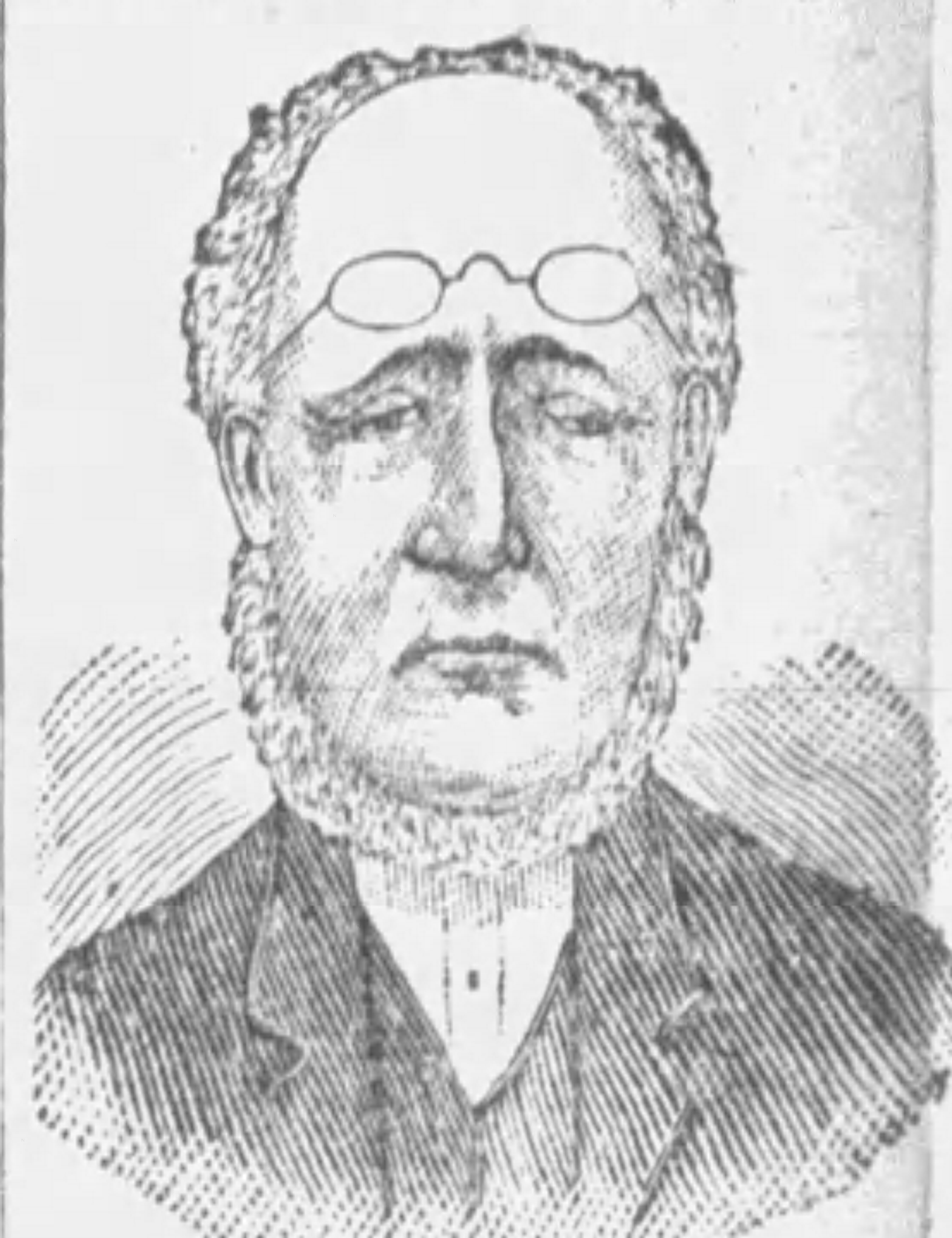
LeGrand Marvin was born in 1807.  He attended Hamilton College and then moved to Baltimore to teach.  He returned to Buffalo to study law with Philander Bennett.  Le Grand was admitted to practice as an attorney in 1833.  George was three years younger and attended Yale.  He returned to Buffalo and studied law under his brother.  George was admitted to the bar in 1836.  George married  lived on West Mohawk Street, the site of his house is now covered by the Statler.  George represented the Ninth Ward in the County Board of Supervisors and served as Chairman of the Board during his time.  The Ninth Ward at this time was the area around Niagara Square and up Niagara Street to Porter.  The brothers formed a partnership and worked together in their law practice.  It was said that the Marvin brothers had the largest law practice in the City of Buffalo.  

Buffalo_Evening_News_Sat__Dec_3__1887_

Sketch of Le Grand Marvin, Buffalo Evening News, December 3, 1887

Around 1831, Le Grand had been given power of attorney to care for his parents large estates.  He purchased real estate in the City for his father and managed it until he formed a partnership with George in 1839.  As a result, the Marvin family owned extensive property in Buffalo, including Marvin Street and all the land bordering it.  Le Grand Marvin divided the streets into building lots shortly before the street was opened in 1841.

In the spring of 1842, LeGrand made some bad endorsements for businesses which failed and as a result, became insolvent.  The law practice’s articles of incorporation were changed so that George was in charge, to help protect LeGrand from investors coming after him and collecting against the business.  

Le Grand married Julia Reynolds, a schoolteacher from Syracuse, in 1854.  They divorced in 1861.  

Following the death of their mother in 1963, the brothers began to argue over their mother’s properties.  The properties had been purchased by Le Grand originally.  Mrs. Marvin obtained title by foreclosure when Le Grand had his financial struggles.  She left the property to Le Grand in her will.  The litigation that follows broke up the firm and the law partnership dissolved in 1864. 

properties

Some of the Marvin-owned Properties along Marvin Street. Note: they are labeled here as owned by both George Marvin and Simon Greenwood. These were the properties that were under disputed ownership for 25 years while the case proceeded Source: 1872 Hopkins Atlas of Buffalo

The court case that proceeded was the longest in City history at that time.  After 22 years, the court case was settled in February 1886, in favor of Le Grand.  George had died in October 1882.  The matter was over real estate that was valued at $80,000 (about $2.2 Million today) and $12,000 (about $335,000 today) cash.   The value of the estate changed often, due to the longevity of the case, so various reports indicated differing amounts.  George’s family continued to appeal the case.

LeGrand became eccentric during his later years, and he was known to travel around Buffalo on the hottest days of summer wearing “artics and a woolen shawl”.  Following his death, the Buffalo Commercial said that:

No man, with his own hands, ever built a taller monument to his own eccentricity, than Le Grand Marvin.  He possessed an irrepressible tendency to rush into print on all matters that concerned him, however remotely….as a rule, his contributions to the press were declined with thanks, as the mere fact of publishing them would lay the medium through which they appeared open to libel suits from the inhabitants of Buffalo, consequently his literary remains are to be found principally in pamphlet form.

Whenever he felt anyone ran afoul of him, he’d jot it down and include it in his next pamphlet.  It was said that he distrusted and condemned all churches, political parties and professions.  He claimed that his marriage was not legal because his wife wore rouge at the wedding, so he felt she had defrauded him.  Despite the failure of his marriage and subsequent divorce, he wrote a pamphlet on “The Joys of Perfect Matrimony”.  He didn’t have any children, but he wrote pamphlets on “The Proper Rearing of Children”.  

While he was eccentric, he was still considered a fine lawyer and was well respected as one of the oldest members of the Buffalo Bar.  The court case continued following Le Grand’s death in 1887, with the case in another round of appeals and the will contested by George’s widow and children.  The properties were mainly located in the First Ward, and was some of the most valuable land in the city at the time.  In addition to the value of the land and buildings, they also brought in considerable rent from businesses operating on the properties.  Holmes Mill, Hamlin’s Grape Sugar Works, De Laney’s Forge and Cook’s Distillery were some of the businesses located on the land.

library bookplate

Old Buffalo Library bookplate showing Le Grand’s name. Source

The suit was decided yet again in favor of Le Grand almost a year after his death.  The bulk of his estate was to be left to the Buffalo Library (one of the predecessors to the Buffalo & Erie County Library).   Le Grand left behind a 37 page will, his final pamphlet.  After accounting for 25 year of legal fees and a few gifts to friends, the Library was expected to received about $35,000 or about $950,000 in today’s dollars.  Le Grand had been one of the founder’s of the library and was a life member.  The estate was contested by George’s family and finally settled in February of 1891.  

When he died, Le Grand also donated his body to University at Buffalo for research and dissection.  His skeleton was mounted in the vestibule of the Medical College on High Street for many years.  Do any of my UB friends know if they still have his skeleton?  

Sadly, George’s family was left without that income they had expected to come into after winning the law suit and the estate.  The loss of that money, plus the legal fees strained the family’s finances.   Son Phillip (Le Grand’s nephew) committed suicide in 1915 by jumping from a sixth floor window at the Buffalo Savings Bank.  Prior to his death, Phillip had visited every lawyer in the building trying to negotiate a loan to tide him over from the family’s financial difficulty and keep their home at 450 Richmond.  

So the next time you’re at the Casino, maybe take a look out the back of the parking ramp onto Marvin Street and pour one out for the Marvin Family.  And seriously, UB, someone let me know about that skeleton!

Want to learn about other streets?  Check out the Street Index.  Don’t forget to subscribe to the page to be notified when new posts are made.  You can do so by entering your email address in the box on the upper right hand side of the home page.  You can also follow the blog on facebook.  If you enjoy the blog, please be sure to share it with your friends.

Sources:

  • Smith, H. Katherine.  “Marvin Street Linked with Pioneer Buffalo”  Buffalo Courier-Express.  June 19, 1938, 4E.
  • “Le Grand Marvin:  A Chapter of Reminiscences Concerning the Great Litigant- Selections from His Own Works”  The Buffalo Commercial, December 10, 1887, pg 3.
  • “Some Old Buffalo Characters:  Recollections of People and Things in Early Buffalo””  Buffalo Commercial, October 14, 1911.
  • “Le Grand Marvin Wins His Law Suit after 22 Years”.  Buffalo Evening News.  February 9, 1886.
  • “Le Grand Marvin:  One of Buffalo’s Most Noted Characters Gone to His Last Rest”.  Buffalo Weekly Express.  December 8, 1887.
  • Percy C Marvin Jumped to Death at Bank Building.  Buffalo Times.  April 19, 1915.
  • “Le Grand Marvin’s Suit:  Wins a Victory in One of His Long Contested Suits”.  Buffalo times.  November 28, 1888.

Read Full Post »

blossomBlossom Street is a street in Downtown Buffalo that runs between East Huron Street and Broadway.  It is cut in half by Hersee Alley.  It functions mainly as an alley for buildings along Ellicott and Oak Streets these days, but it is still designated as a street by the City of Buffalo.  Buildings along the street have windows and doorway entrances that once looked out onto Blossom Street, but are now bricked over.

20200302_173054

20200302_173119

Street sign that has seen better days


20200301_154105It is not named for flowers, but for Ira Allen Blossom.  Mr. Blossom served as right hand man to Joseph Ellicott. Mr. Blossom’s family were pioneers in Monmouth, Maine, where Ira was born in 1789.  In his 20s, Ira moved to Meadville Pennsylvania for work.  When he was 26, he came to Buffalo as Joseph Ellicott’s assistant.

Mr. Blossom started as Joseph Ellicott’saide in 1821 and was later a Subagent for the Holland Land Company following Joseph’s resignation.  Mr. Blossom was connected to the Holland Land Company until the company was sold to the Farmer’s Loan & Trust Company in the 1840s.  He was then appointed receiver of the Buffalo branch of the United States Bank.  He was also made receiver of the Commercial Bank.  While working for the Holland Land Company and the banks, he was known for being lenient with giving credit to promising young men to start their businesses.  A number of businessmen in Buffalo attributed much of their success to Mr. Blossom’s confidence in them and expressing his confidence through credit.


Mr. Blossom partnered with Mr.Lewis Allen to lease what is now the site of the Ellicott Square Building.  In May, 1829, they secured a 63 year lease for the property bounded by Main, North Division, Washington and Swan Streets.  They were able to get the lease at a bargain.  This land had been set aside for Joseph Ellicott by the Holland Land Company in 1816 to build his home, but the Village Trustees interfered and straightened the path of Main Street.  Joseph was disgusted and gave the land to Joseph Ellicott the younger, his nephew.  For the first 21 years, they paid only $700 ($16,000 in today’s dollars) per year, for the second 21 years $850 ($19,000) a year, and for the third 21 years, they paid $1,000 ($23,000) a year.

It was written of Mr. Blossom and Mr. Allen at the time, “the magnitude of their enterprise frightened every conservative in town.” They saw the potential of the site and built a block of fourteen 2-story buildings on the site.  The first legitimate theater in Buffalo was built on the site in 1835.  This theater, William Duffy’s Theater, was on South Division Street between the alley at Washington Street.  It burned down in the 1840s.  The Young Men’s Association (which became the Buffalo Public Library) leased and occupied the upper part of the Theater building.  Reverend Cicero Stevens Hawkins worshiped in the theater in the late 1830s with a group of Episcopalians.  These worshipers later formed Trinity Church, on Delaware Avenue.  Other buildings on the site were filled with businesses as well.

20200301_151957

Buildings located at what is now the Ellicott Square Building

Mr. Blossom and Mr. Allen’s lease on the Ellicott Square ran out in 1892, after both men had died.  On March 1, 1893, the properties were all purchased by the Ellicott Square Company for a fee of $1,080,000 (about $33,583,730 today).   By 1895, when they were planning to construct the Ellicott Square Building, the buildings on this property were described as “the sorriest exhibit of business buildings in the city.”  The planned Ellicott Square Building was expected to cost 2 Million to construct.

Mr. Blossom married Eunice Hubbard.  They lived at the triangle at Franklin, Swan and Erie Streets, across from St. Joseph’s Cathedral.   The famous naturalist Audubon was a guest at their home.  Mr. Audubon was thought to have painted portraits of the Blossoms in 1825, which the family treasured.  The house stood in a garden and was framed by majestic trees of the primeval forest.  The Blossoms had one daughter, Anna.

In 1831, Mr. Blossom, along with John Beals, Samuel Callendar, Elizah Einer, James McKay and Noah Sprague met to organize a parish of the Unitarian church.  The congregation grew and constructed its first building in 1833, at the corner of Franklin and Eagle Street.  The building is still standing today, having been remodeled into a commercial building by the Austin Family. 

In 1832, Mr. Blossom was elected to Buffalo’s first Board of Alderman.  For two terms, he represented the old Third Ward on the board.  He was offered other public offices, but he declined them.  He helped to incorporate the University of Buffalo and was on the university’s first council.

He also was known for giving generously to public projects he believed would benefit Buffalo.  He was known for his hospitality.  He was also known for taking care of the poor, at a time when the indigent were not considered a general public responsibility; his gifts and kindness helped many families.

blossom grave 2He died in 1856.  Mr. Blossom’s tombstone read “a man who never turned his back on his honor, a loyal citizen, a generous friend.”  He is buried in Forest Lawn Cemetery.

After Mr. Blossom died, living across from the Cathedral and hearing it’s carillon inspired Mrs. Blossom to become a Catholic.  She gave the house to the church.  On the site of the house, St. Stephen’s Hall was built.   Mrs. Blossom and Anna moved to New England.  When Mrs. Blossom died in 1875, she was buried along with her husband in Forest Lawn.

Portraits of Mr. Blossom can be found in the collection of the Albright Knox Art Gallery and the Buffalo History Museum, both portraits are the same painting.  The portrait in the Albright Knox Collection was attributed to John James Audubon and was believed to have been painted in 1825. The Albright’s  portrait was donated, along with a portrait of Mrs. Blossom, in 1943 by the grandson of the Blossoms, Ira A.B. Smith.  The second portrait, was donated to the Buffalo Historical Society at a later date by the estate of one of Mr. Blossom’s associates in the Holland Land Company office.  This second portrait was accompanied by Mr. Blossom’s journals.  The 1835 journal reveals that an associate (Mr. Johnson) commissioned the painting, along with a copy, for his colleague in 1835.  The paintings are both believed to have been done by Samuel Bell Waugh and not by Audubon as had been originally thought.  Both museums attribute the painting to Waugh now.  The picture of Mr. Blossom in this article is a newspaper copy clipping of the painting.

To learn about other streets, check out the Street Index.   Be sure to subscribe to the blog so that new posts are sent directly to you – you can do so on the right hand side of the home page.  You can also like my blog page on facebook at facebook.com/buffalostreets.

Sources:

  1. Winner, Julia Hull.  “The Puzzle of Buffalo’s Two Ira Blossom Portraits that Look Just Alike”.  Buffalo Evening News Magazine.  December 1, 1962, p 1.
  2. “Centennial Planned for Unitarian Church”.  Buffalo Evening News.  November 21, 1931.  p 4.
  3. Buffalo Changes:  The Old Buildings Now on Good Business Sites, and the New Structures which are to Replace Them.  Buffalo Express.  Feb 3, 1895.
  4. Audubon Works Are Acquired by Art Gallery.  Courier Express , Nov 19, 1939, sec 5 p3.
  5. Goldberg, Arthur.  The Buffalo Public Library:  Commemorating its first century of service to the citizens of Buffalo – 1836-1936.  Privately Printed, Buffalo New York, MCMXXXVII (1937).
  6. Smith, Katherine.  Named for Ira Blossom. Courier Express Nov 19, 1939, sec. 5, p3.


Read Full Post »

goodellstreetGoodell Street is an east-west street that runs Michigan Avenue to Main Street.  Goodell Street forms the northern boundary of the Central Business District and typically “south of Goodell” is used as a definition for what constitutes “Downtown Buffalo”.  North of Goodell Street is the Medical Campus and the Fruit Belt neighborhood.  Until the 1950s, Goodell Street ran thru to an intersection with Cherry and Locust Streets.  The Kensington Expressway, which ends at Goodell Street, cut through the Fruit Belt.  I am currently working on a multipart series about the streets of the Fruit Belt and the historic development of the neighborhood.  Stay tuned!  Goodell Street is named for Jabez Goodell, one of the early residents of Buffalo.

Jabez Goodell was born in Holland, Massachusetts in 1776.  He was the only son of Icabod Goodell.  Jabez had three sisters – Huldah, Mary, and Persis.  Jabez came to Buffalo in 1806.  At the time, Buffalo had four shops, consistent mostly of Indian goods and a small drug shop, one blacksmith, one shoemaker, one carpenter and a joiner.  He purchased lands at their original price from the Holland Land Company.  His purchases were at the northern edge of the original layout for the Village of Buffalo.  Due to the growth of the city over the next half-century, his lands increased in value to create a substantial estate.

outerlots goodell

Properties owned by Jabez Goodell

Mr. Goodell owned Outer Lots 135, 136, 137 and 145, 146, and 147.  This included properties along Genesee Street and the property where Goodell Street would eventually be laid out.  He also owned lot 33, west of Delaware Avenue near Tupper.

Goodell Street ran through Mr. Goodell’s property.  He operated the Broadwheel Tavern at the corner of Goodell and Main Streets.  The Tavern was located where the Sidway Building now stands.  It was said that his tavern “entertained man and beast”.  His house was burned during the War of 1812, along with the rest of Buffalo.  He rebuilt at Goodell and Oak Street.  His house was later owned by Mayor Solomon Scheu.

st peters

The former St. Peter’s Evangelical Church

Mr. Goodell donated land on Genesee Street at Hickory to the German Evangelical Society of Buffalo in 1834.  The first worshiped on the site in a building that was originally built as the original First Presbyterian Church but was moved to the Genesee Street Site.  Their second church was the original St. Paul’s Episcopal Church, which was moved to their property in 1850.  In 1851, they became St. Peters German United Evangelical Church.  In 1877, they built the current Victorian Gothic church that is located on the site.  The tower on the church was removed in 1991, along with small pinnacles that had been surrounding it.  The congregation moved in 1974 when they merged with Lloyd’s Memorial Church to become New Covenant Church of Christ.

Mr. Jabez was a stockholder in the Batavia Street Plank Road Company and served as President of the company.  Batavia Street became Broadway.   Plank roads were common in New York State during the late 1840s and 1850s.  A plank road is made of wooden planks or logs.  The wooden roads were easier and cheaper to maintain that McAdam roads, another common road type of the time period.  The first plank road in the United States was built in Syracuse.  The Batavia Street Plank Road Company controlled 2.5 miles of the roadway and invested $13,000 ($428,910 in 2019 dollars) of capital improvements into the road in 1850.  These road companies were organized and regulated under New York State law.

6Mr. Goodell died in September 1851 at 75 years old.  In death, he donated 10 acres and $10,000 (about $333,000 in 2019 dollars) to the newly formed Buffalo Female Academy to build a 30,0000 square foot school.  Ten months after he died, Goodell Hall opened at the school, just behind the Evergreen Cottage at the corner of Johnson Park and Delaware.  Classes had been held in Evergreen Cottage (Mayor Ebenezer Johnson’s former home) for the 1851 school year.  In 1852, the school moved into Goodell Hall and the cottage was used as a home for the Principal.  The Academy was renamed Buffalo Seminary in 1889 and they moved to their current location on Bidwell Parkway in 1909.

goodell

Jabez Goodell Grave

Mr. Goodell married Diadamia Day, but they had no children.  After the donation to the school, he left his the remainder of his property and estate to be distributed to different societies as well as to religious, missionary and education associations of the Presbyterian church.  Mr. Goodell had been an elder at First Presbyterian Church.  The Goodell estate at his time of death was worth about $400,000 when he died.  That would be more than $13 Million today.  At the time of his death, he was the largest public benefactor who had lived in Buffalo.  He also left $500 ($16,672 in 2019 dollars) to his hometown of Holland, Massachusetts, to provide perpetual care of the cemetery.  He is buried in Forest Lawn, which opened only two years before he passed away.

The rest of the Goodell family was also prominent in Western New York and the Southern Tier.  The Goodell Family at the time was reportedly considered the way the Kennedy Family is in Massachusetts.  Robert Goodell was born in 1601 and immigrated from Dennington England to Massachusetts with his wife and children in 1634.  Jabez was a sixth generation Goodell in America.  Robert was his great-great-great grandfather.  The NFL commissioner Roger Goodell is a 12th generation Goodell and fourth cousin, six times removed to Jabez Goodell.

It is often said in Buffalo that the road is actually pronounced “GOOD-ul”, but because Roger Goodell’s branch of the family pronounces it as “Good-elle”, the pronunciation has changed as his career has risen in the NFL.  I’d love to hear from some Buffalo old timers, especially those who live in the Fruit Belt…how do you pronounce it?

To learn more about other streets, check out the Street Index.   Stay tuned for my upcoming series about more streets in the Fruit Belt area!  You can subscribe to the site on the homepage and new articles will be emailed to you as soon as they are posted.

Sources:

  1. Boltwood, Robert.  “St. Louis’ Pioneer Catholic Church, Enters 12th Decade”.  Buffalo Courier Express, Sunday August 27, 1939, p L7.
  2. “St. Peter’s to Honor Founding 102 Years Ago”. Buffalo Courier Express.  Feb 6, 1937, p 25.
  3. Graham, Tim.  “The Other Goodell:  How NFL commissioner’s dad ran afoul of Nixon”.  Buffalo News.  February, 3 2018.
  4. Ketchum, William.  An Authentic and Comprehensive History of Buffalo.  Rockwell, Baker & Hill Printers:  Buffalo NY.  1865.
  5. Severance, Frank.  “Jabez Goodell”.  As found in Lovering, Martin. History of the Town of Holland, Massachusetts.  The Tuttle Company:  Rutland, Vermont.  1915.
  6. “Batavia Street Plank Road Co”.  Daily Courier.  January 15, 1850.
  7. Zobel, Michael.  “Letter: Learn the correct pronunciation of Buffalo’s Goodell Street”.  Buffalo News.  April 29, 2019.


Read Full Post »

Older Posts »

Field Notes

Live from Buffalo, NY

Grants.gov Community Blog

Connecting the grant community to #LearnGrants

Dienna Howard

I create, therefore I am.

Hidden Waters blog

Companion blog for the book "Hidden Waters of NYC"

Hoping for a Tail Wind

Because I definitely brought way too much gear.

priorhouse blog

Photos, art, and a little bit of LIT.

Sheepie Niagara

Bleating the Beat Since 2015