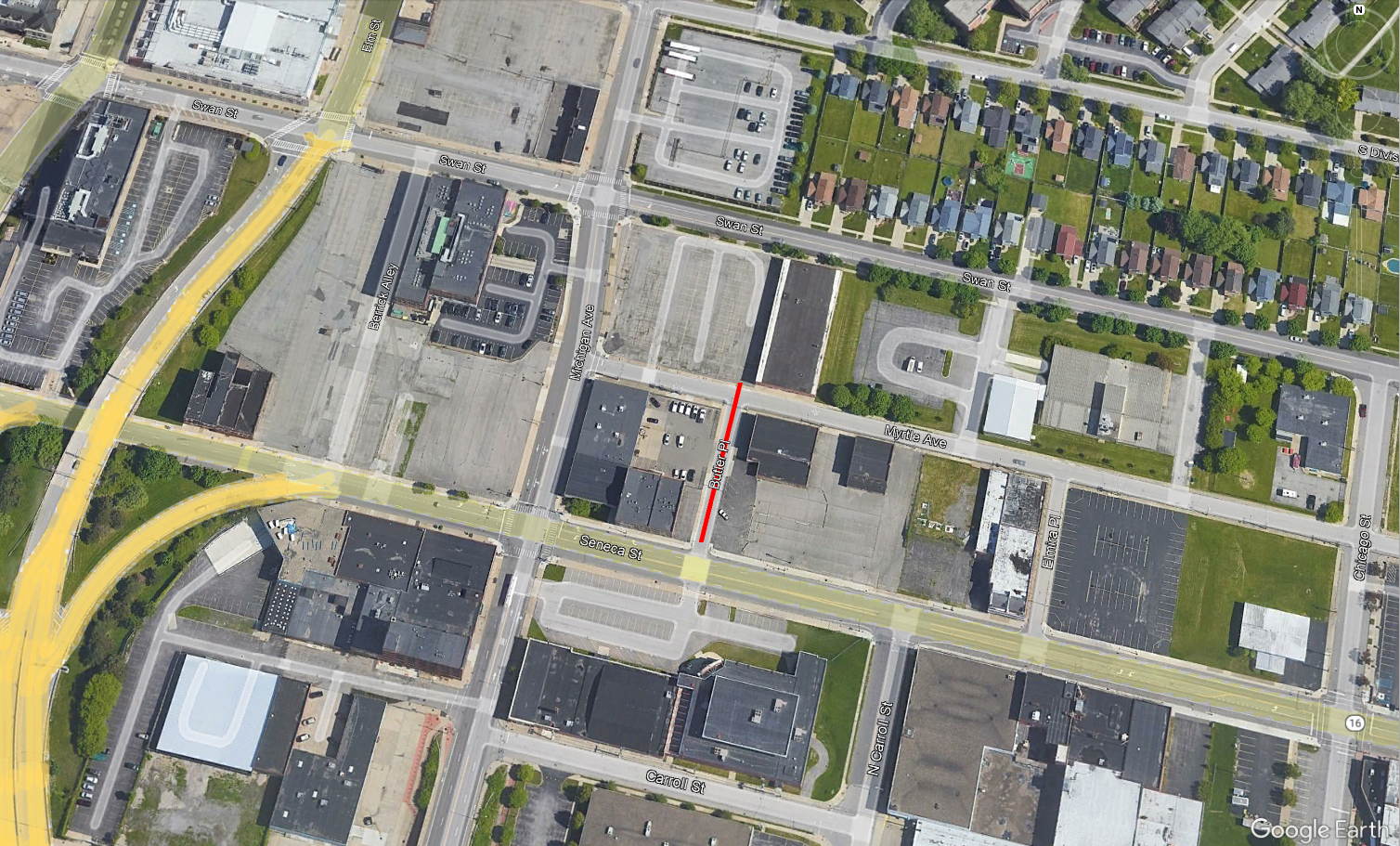
Butler Place is shown on the map in red.
Today we’ll be talking about Butler Place, which was originally Fitch Alley. We’ll be discussing both Mr. Joseph Butler and Mr. Benjamin Fitch in this post….because the Fitch name is very important in Buffalo’s social work history! Normally, I don’t write much about the original namesakes of streets but I don’t know when else I’d be able to tell the story of the Fitch Institute and the Fitch Creche otherwise.
Another Butler – Butler Street
Most of the time, a municipality likes to ensure it doesn’t have duplicated street names, to avoid confusion for things like emergency services and mail delivery. However, Buffalo has two streets called Butler: Butler Place and Butler Avenue. The next post, coming next week, will discuss Butler Avenue and its namesake, the founder of The Buffalo News.

1872 Atlas of Buffalo map showing Butler Street, lined in orange.
There actually used to be a THIRD Butler! Butler Street was laid out in 1855 between Delaware Avenue and the State Reservation Line (near Richmond Avenue). Butler Street is now known as Lexington Avenue. Frank Kraft, an undertaker who lived at what became 53 Lexington Avenue, decided the name of Butler Street was not “toney” enough, meaning “aristocratic or high-toned.” Mr. Kraft convinced his neighbors to petition to become Lexington Avenue, thinking it sounded fancier. The name change was granted in 1888. There was a trend during this era to change street names to seem higher class. At the time, people believed Avenues were nicer than Streets, so residents would petition to change their street names – Delaware and Michigan went from streets to avenues around this time. During the same Streets Committee Meeting where Butler became Lexington, Cleveland Street became Cleveland Avenue. Unfortunately, I could not determine who Butler Street was originally named for when it was laid out in 1855; several Butler families lived in Buffalo around that time. However, neither the Butler Place nor the Butler Avenue namesakes lived in Buffalo in 1855, so it was not named for either of them.
The Original Fitch Alley
So now, back to Butler Place….Butler Place runs for just one block between Swan Street and Myrtle Avenue, just east of Downtown Buffalo. Butler Place was originally named Fitch Alley, after Benjamin Fitch, but was renamed in 1891 to honor Joseph Butler. Mr. Fitch owned the land just west of Fitch Alley.

1872 Atlas of Buffalo image showing some of the properties of Benjamin Fitch outlined in red. Property at the southwest corner of Swan and Michigan became home to the Fitch Creche (in the building located on the site on this map) and Fitch Institute on the vacant portion of that property. Note Fitch Alley’s name on the map. Intersects with Folsom Street, which is now Myrtle Avenue.
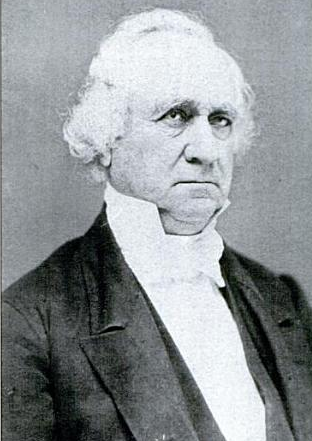
Mr. Benjamin Fitch
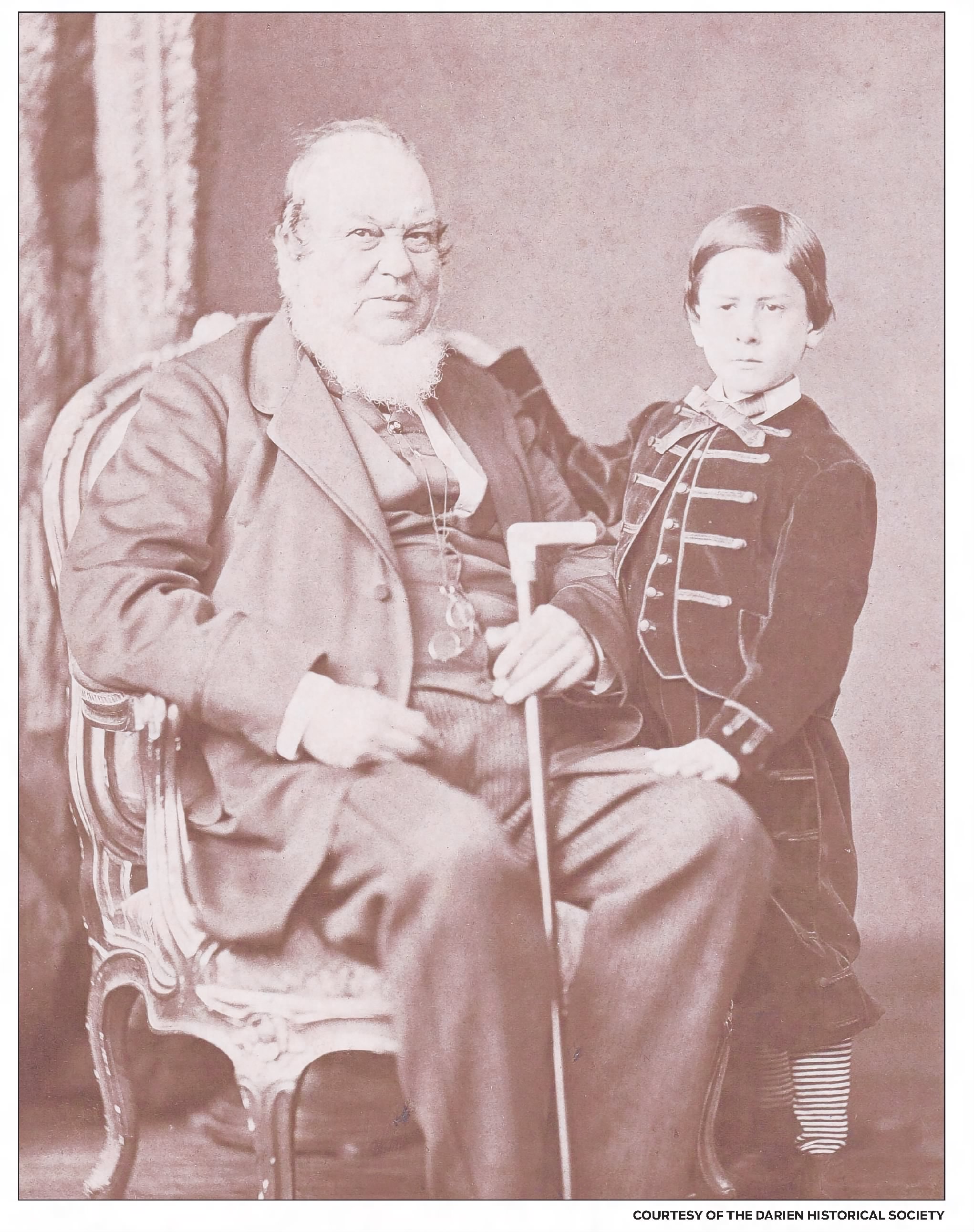
Benjamin Fitch and his grand-nephew Augustus. Source: Hartford Courant.
We’ll start with Mr. Fitch. Benjamin Fitch was born in June 1802 to Charlotte Selleck and Stephen Fitch. His birthplace is disputed among various records. Charlotte petitioned the State of Connecticut for divorce on the grounds of being threatened and beaten by her husband. The divorce was granted in 1808, and Charlotte moved away with two of Benjamin’s siblings. Benjamin and two of his brothers lived with their father. In 1812, at the age of 10, Stephen was working as an Indian Agent, and the family came to Buffalo to see Red Jacket. They were still in Buffalo when it got burned by the British in 1813-1814, and they decided to move to Albany. At that time, Benjamin ran away from his father and made his way back to New York City by working on the Hudson River in a sloop. He reunited with his mother and lived in New York City for a few years, working as a store clerk. He eventually went into business for himself.
In 1824, Benjamin Fitch returned to Buffalo to open a General Store. After a few years of establishing his business, he returned to New York City but maintained a branch office in Buffalo. In 1841, he returned to Buffalo as a member of the firm of Marvin, Bennett & Company. The Bennett in Marvin, Bennett & Co is Mr. Bennett of Bennett Park fame, and the Marvin is Marvin Street’s namesake. The store was originally on the west side of Main Street between Seneca Street and the Terrace (the site is now a part of Seneca One Tower). After a year or two, Benjamin returned back to New York. In 1846, he returned to Buffalo, establishing Benjamin Fitch & Co., with branches in Buffalo and Chicago. He split his time between Buffalo and New York City while his nephew ran the Chicago Branch. Fitch & Co. had three stores in Buffalo at that time. In 1853, he retired to New York City for good but retained many of his Buffalo land holdings. After Mr. Fitch retired, his company eventually became a part of Flint & Kent, which operated until 1956.
During the Civil War, Mr. Fitch contributed to many wartime causes. Mr. Fitch saw many soldiers return wounded or broken by battle, unable to provide for their families. In 1863, Benjamin Fitch founded Fitch’s Home for Soldiers and Orphans in Darien, Connecticut, with the endorsement of President Abraham Lincoln and Secretary of War Edwin Stanton. The Home was formally dedicated on July 4, 1864, as a place for the support of at least 80 disabled soldiers and the support and education of their children. It was the first home of its kind in the United States. Mr. Fitch would take out bank accounts for each of the children there and deposit $5(about $100 today) into the accounts to get them started once they grew up and moved out. Mr. Fitch later added a public hall and art gallery to the home. After Mr. Fitch died, the State of Connecticut took over the facility. Fitch’s Home for Soldiers operated until August 1940, when the 561 residents were moved to Rocky Hill for the State’s new Veterans Home and Hospital. The only remaining building from Fitch’s Home is the chapel, which was moved across the street and is now a VFW Post. Also in Darien, Mr. Fitch built a house for his mother in 1850 and helped endow a local church for her across the street, St. Luke’s Protestant Episcopal.
The Fitch Creche
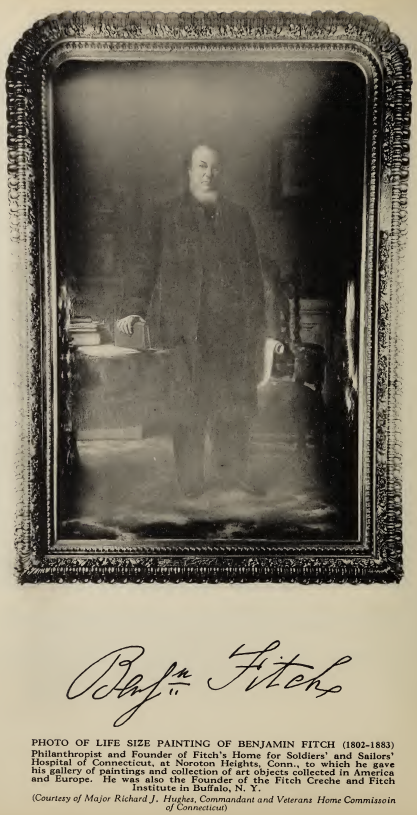
Life Size Portrait of Benjamin Fitch from the Soldiers Home. Source: History of the Fitch Family.
In the 1870s, Buffalo was beginning to look at starting a Charity Organization Society (COS). While working to start COS, Reverand Gurteen and Ms. Maria Love visited Benjamin Fitch at his home in New York. Reverand Gurteen was pastor at St. Paul’s Episcopal Church here in Buffalo, and Maria Love was a wealthy socialite who cared deeply about social work reforms of the time. We’ll learn more about the Love family when I write about Love Alley. Ms. Love had visited many creches in England, France and Italy while traveling with her nephew and thought about founding a model kindergarten and training school in Buffalo. A creche is a nursery where babies and young children are cared for during the working day, what we’d call a daycare today. The COS of Buffalo was incorporated in November 1879 and was the first Charity Organization Society in the United States. The COS asked Mr. Fitch for assistance in leasing a property for the Society to build a creche. While never marrying or having children of his own, Mr. Fitch felt strongly for their mission. The property at 159 Swan Street was deeded to the Society by Mr. Fitch on January 1, 1880. The house at 159 Swan Street was originally built by Lucius Pratt in 1835. After Mr. Pratt’s death, Benjamin Fitch purchased it, and it was operated as a rooming house. Some sources incorrectly state that the house was home to Mr. Fitch’s dry goods store or that Mr. Fitch lived in the house; neither of those statements appear to be correct based on my research. The property was valued at $100,000 at the time(about $3 Million today). The Fitch Creche was established on the property “for the care of infants and small children while their mothers are away from home at their daily labors; without regard to creed.” Maria Love served as Chairman of the Fitch Creche Advisory Board.
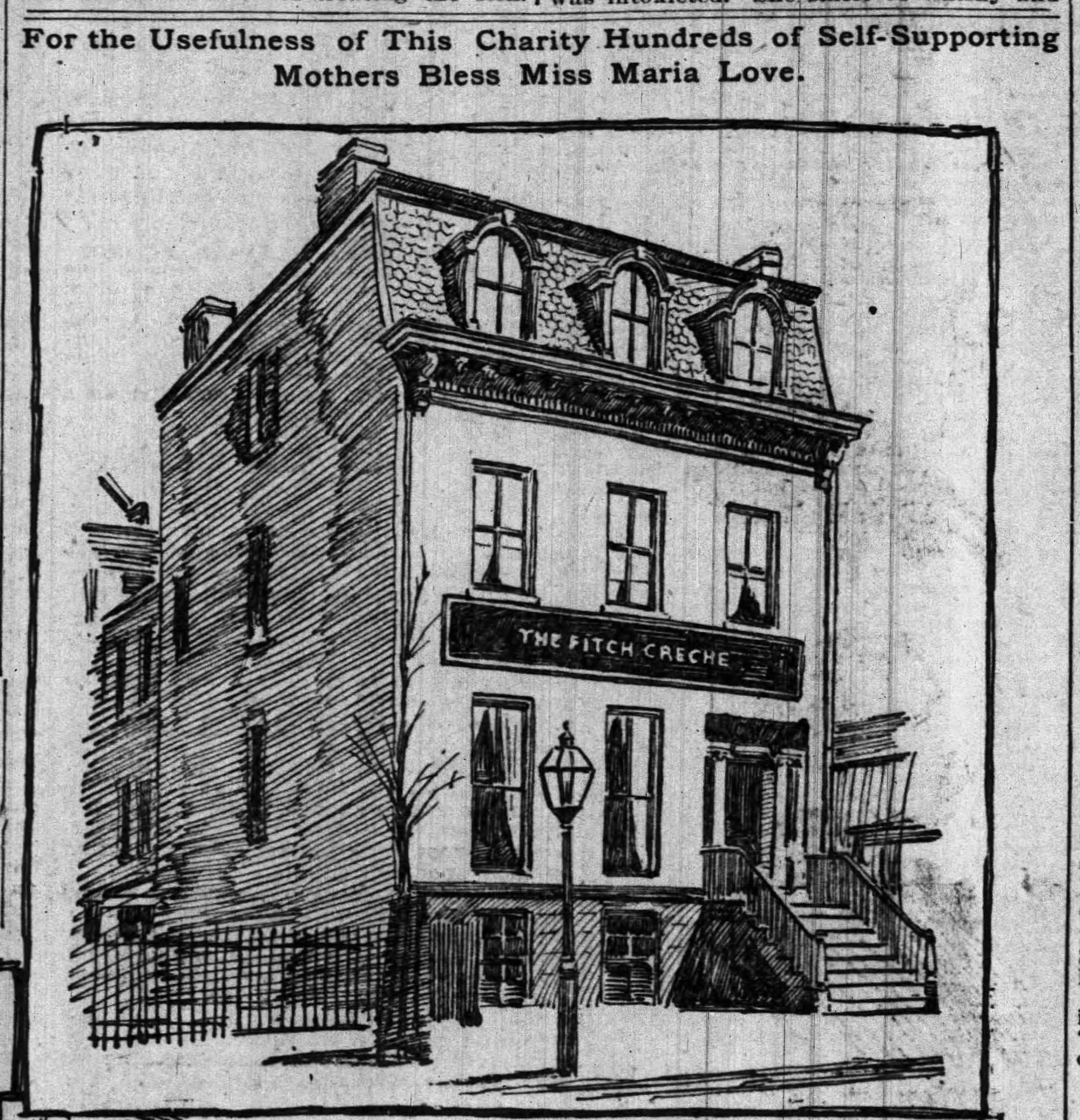
Sketch of Fitch Creche, 1897. Source: Buffalo Courier.
The Fitch Creche was quickly in operation, opening on January 5, 1881. The Creche was funded by working mothers paying 5 cents a day (about $1.54 today). This was the first organization of its kind at the time. While we think of daycare as commonplace today, this was a new thing back then. As the Buffalo Commerical put it at the opening, “The Creche was established to give poor working people’s young children a home to remain in during the day while the parents were seeking a livelihood outside. The design was to keep such children as would otherwise be left in the streets or locked up in the house.”
The Creche served children from 2 months old to 10 years old and operated from 7 am to 6pm daily. The children were provided 3 meals, Creche dresses, baths and shampoos, naps, and physical exams with treatment as needed. There was a staff of 12 nurses, a housekeeper, a dietician, and three cleaning women. Breakfast was at 8am and consisted of oatmeal and milk. Dinner was served at noon, consisting of bread, broth, potatoes, meat, baked apples, rice and milk. For tea at 5pm, they were served bread, applesauce and milk. Children under one-year-old were fed with condensed milk out of a bottle. The Creche had space for 50 children when it first opened.
A kindergarten was established in the Fall of 1884. You sometimes hear that this was the first kindergarten in the country, which is not true. The first kindergarten in America was established by Elizabeth Peabody in Boston in 1860. Buffalo had a kindergarten established as early as 1867, run by Miss Mary Sheldon. The Fitch Creche daycare is, however, believed to be the first daycare for working women in the United States. The Fitch Crech established a training school for nursemaids was established in 1890. This was established as the “Nursery Maids Department of the Training School for Domestics,” and this was also the first program of its kind. Four nursery maids graduated in the first year.

Fitch Creche. Source: History of the Fitch Family.
Over time, COS was able to arrange for some of the children to go away for the summer to Fresh Air Missions. The first Fresh Air Mission was first established in 1888 by the Church of the Messiah, which was located on Main Street between Chippewa and Huron (now Fountain Plaza). The Fresh Air Fund sent children to Corfu, Middleport, Orchard Park, Silver Creek, Evans and other country locations. The idea was that getting kids out of the crowded, dirty city to spend a few weeks in the pure air of the countryside would be good for the children. Cradle Beach Camp got its start as one of the Fresh Air Missions. While the children were at camp, some of the working mothers were also sent away for vacations at homes in the countryside, including in East Aurora and Holland, to allow for them to get a vacation and some rest, too.
Charity Balls were held to add supplemental income for the Creche, with the first ball held in 1880. In 1903, the balls began to be held for the children, because they felt the ballroom was too beautiful to only hold one event a year. Charity Balls stopped from 1917-1919 because of WWI but eventually were picked up again. When the Fitch Creche closed in 1933, the Maria M Love Convalescent Fund was established to continue the mission through the balls. The Children’s Charity Ball is still held to this day, with funds raised still going to people in need. This year’s Charity Ball will be held for Middle School students in November of 2024.
The Fitch Institute

Map of properties donated to COS by Benjamin Fitch. Map by author.
Many people know the Fitch name in relationship to the Fitch Creche, but there were other institutions that bore the Fitch name in Buffalo – the Fitch Institute and the Fitch Accident Hospital! In May 1881, Mr. Fitch donated several other properties to the COS for the “purposes of founding a maintaining in Buffalo a public institution for the physical, moral and intellectual benefit of the worthy poor of the city, without distinction of creed or sex.” The Institute was to run a course of free lectures each year on scientific or other instructive topics, a free reading room, a provident coffee and soup room, a dispensary for supplying medicines and a medical attendant, a training school in domestic work for girls, a hospital for the temporary treatment of injured persons, and a place of deposit of small sums of money for working people to be drawn down as they need. The properties had a value that totaled about $325,000 (about $10 Million today) of property donated to the organization. The donation directed COS to build the public hall at the property on the southwest corner of Swan and Michigan, adjacent to the Fitch Creche. They were able to sell, mortgage or lease the other properties to allow for income to provide for their mission.
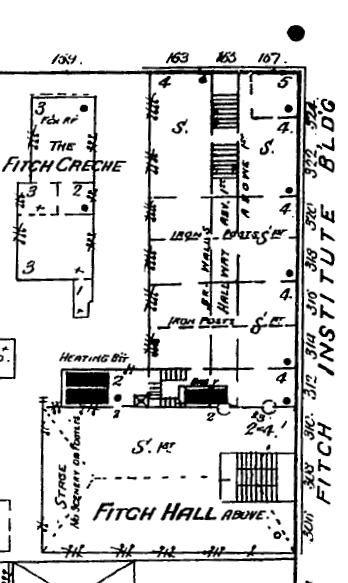
A portion of the 1889 Sanborn Map which shows the corner of Swan Street and Michigan Avenue, depicting the Fitch Creche and Fitch Institute Building.
The public hall was established as the Fitch Institute, located at 163-167 Swan Street and 304-310 Michigan Streets. The Fitch Institute was designed to be similar to the Cooper Institute in New York. The cornerstone was laid for the Fitch Institute on May 10, 1882. The first floor of the building was designed to include a large office for COS where they could also operate the penny bank. They were the only society in New York State to receive a penny bank charter since savings banks opposed penny banks. A penny bank was a bank that allowed for any deposit to be made, no matter how small (even just a penny). The charter for the penny bank allowed each person to deposit up to $50.
The rest of the ground floor was set up as storefronts for the society to rent out for income. The next floor called the ground floor, was set up for a hall for seating 200 people. This was to be the home of the lectures. Additional rooms on the ground floor were set up for surgeons and nurses to be known as the Fitch Accident Hospital. On the next floor, called the second floor, was the reading room, library and coffee room for the Mechanics Institute. On the third floor, half of the building was set up to be a hall for the Knights of Labor with the other half of the floor for housing for older couples. Additional housing was on the fourth floor.

Fitch Institute Building. Source: History of Fitch Family.
Mr. Fitch’s Death

Interment of Benjamin Fitch in St. Luke’s Church.
Mr. Fitch never married or had children, though he was close with his nephews and nieces and grandnephews and grandnieces. Benjamin Fitch died in November 1883 at his house at 61 Fifth Avenue in New York City. He is buried in Darien, Connecticut, in the crypt of the church he built. It was estimated when he died that he had given away more than $500,000 of his wealth to charity (about $15.6 Million today).
The Legacy of the Fitch Institute and Fitch Creche
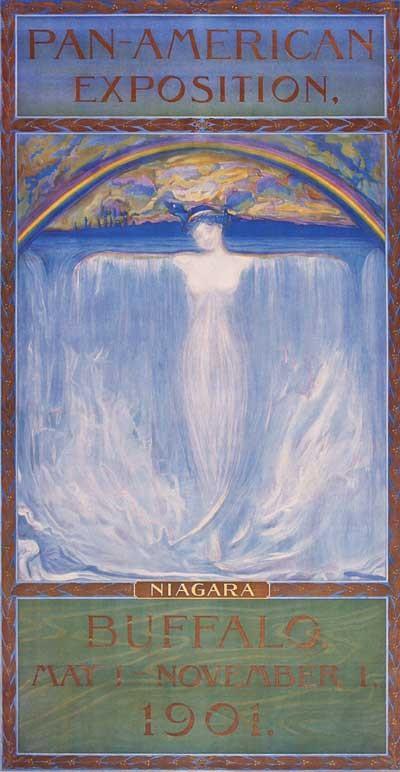
The Fitch Creche displayed a model creche in the Children’s Building at the World’s Fair in Chicago in 1893 and received medals at the New Orleans Exposition in 1885, the Paris Exposition in 1900, and the Pan American Exposition in Buffalo in 1901. The Fitch Creche and the Fitch Institute were considered to be social work pioneers of their time!
The Fitch Institute was host to countless events such as cooking classes, concerts and lectures on a variety of topics. The Women’s Educational Industrial Union got its start in the Fitch Institute before spinning off as its own organization. In October 1885, the Union hosted Julia Ward Howe at the Fitch Institute; she gave a lecture titled “Is Polite Society Polite?” Julia Ward Howe is best known for writing the Battle Hymn of the Republic and founding Mother’s Day.
The Fitch Accident Hospital closed in 1901 because it was felt that it was too costly for the COS to operate such a small hospital (served about 25 patients). They also felt services were going to be duplicated by the nearby Emergency Hospital that was under construction. The Emergency Hospital had begun as a First Aid Station run by the Sisters of Charity in 1884 in a home near the railyards. The new Emergency Hospital opened in January 1902 at the corner of Pine and Eagle Streets and was able to serve 100 patients. The Emergency Hospital was taken over by the Diocese of Buffalo in 1954 and was renamed in 1977 after receiving a donation from Paul V. Sheehan. In 1979, a new 136-bed Sheehan Memorial Emergency Hospital opened on Michigan Avenue, in front of the former Pine Street hospital. The old Emergency Hospital on Pine Street was demolished after the new hospital opened. Sheehan Memorial closed in 2012.
After the hospital closed, the rooms were used as the Hotel Orizaba during the Pan-American Exposition. After the Expo, the hotel space, along with the third and fourth floors of the Fitch Institute building, was turned over to be used as a Railroad YMCA. Called the Union Terminal Railroad Department, it provided overnight shelter for train crews. Railroad Y’s were located throughout Western New York to serve railroad employees.
In 1907, the first tuberculosis dispensary in Buffalo was located in the Fitch Institute, having been established by the TB Committee of the COS.
After the Fitch Institute Closed
The Fitch Institute closed in 1933. They had carried out the purposes of the society for as long as they could, but the character of the neighborhood had changed, and other agencies had taken over some of its functions. The Great Depression was the death knell of many private charities, such as COS as public-operated social services came into existence. The Charity Organization Society became the Family Services Society in 1934. Child and Family Services is the organization that today continues on the work of the COS and Family Services Society.
In 1948, the Fitch Creche and Fitch Institute properties were purchased by the City at a tax foreclosure sale for $41,927 (about $547,000 today). It had been determined that the properties were no longer exempt from taxes after they were no longer being used for charitable purposes. The City listed the property for sale at Auction for $60,000 in June 1953(about $707,000 today).
In 1953, Arner Company, who were manufacturing pharmacists with headquarters across the street at 303 Michigan Avenue, leased the Fitch Institute building. The building was used by Arner Company until 1960.
In 1967, Erie County had considered using the Fitch Institute Building for a Men’s Shelter. At the time, there was a real urgency to find a sufficient building because of the demolitions of Halfway House, Terrace House and the St. Francis Hotel. They inspected the building and determined it would not work because the building had no heating or electrical service, the ceilings were too high, the floor and joists were made of wood, and the staircases were not fireproofed. Due to the imminent need for a new shelter, they wanted something that could very quickly be turned over and passed on using the Fitch Building.
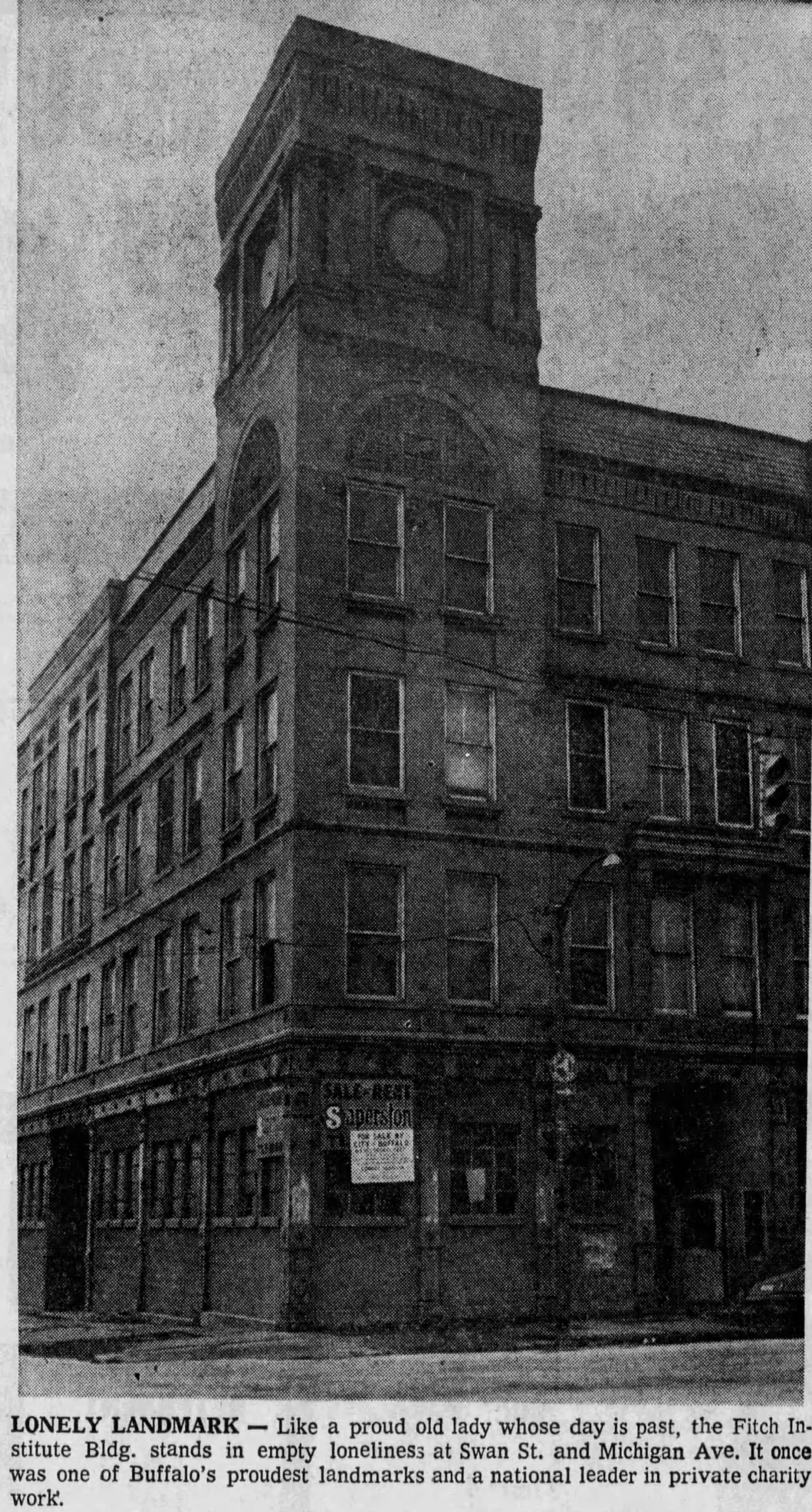
Fitch Institute Building as it looked in 1973 when it was listed for sale by the City. Source: Buffalo News.
In 1973, Ralph Dribble of the Buffalo News called the Fitch Institute “a genuine historical landmark. It is a relic of times when private charity anticipated what politicians of later years would proclaim under such labels as New Deal, Fair Deal and Great Society. It was a precursor of what would later become known as children’s hospitals, day nurseries, working girls’ homes, soup kitchens and credit unions. In short, it is the high-water mark of the days when private charity tried to take care of society’s problems.”
In January 1973, the City of Buffalo put the Fitch property on the auction block. In April 1973, Joseph Nasca, on behalf of Land Reclamation Inc., purchased the property for $5800(about $41,000 today) with the agreement to demolish the building within 90 days. In May 1973, the City Planning Division asked the Common Council to rezone the property for commercial. It had been zoned as industrial when the property was used by Arner.

Fitch Building under fire in 1974. Source: Buffalo News.
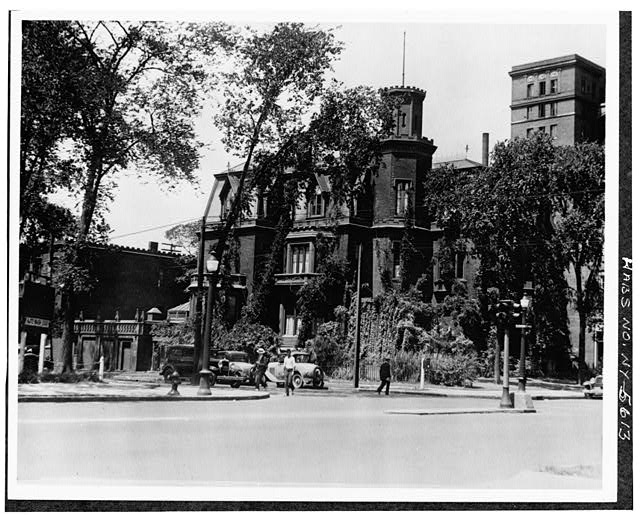
On May 15, 1974, the Fitch Institute Building was burned down by an arsonist. Several floors of the building had been saturated with combustible liquids and then set aflame. Fire investigators were unsure of the reason for the fire since the building was supposed to be demolished by Land Reclamation Inc. by February 21st, 1974. The extinguishing of the fire also caused water damage at the building next door, the former Fitch Creche, which was being used as a warehouse for rugs and floor coverings at the time. One firefighter was hospitalized after the fire. Land Reclamation Inc. had purchased the property because they had needed fill, but after the fire, they claimed they had gotten fill elsewhere and held off on demolishing the building. They held off on demolishing as they were looking at purchasing other properties on the same block and were waiting to secure all of the properties so they could be demolished all at one time. The fire-damaged ruins of the Fitch Building were demolished at the end of May 1974.

159 Swan Street in the 1990s before demolition. Source: Preservation Ready Sites.
In the 1990s, preservations were working on getting the Fitch Creche building at 159 Swan Street listed on the National Register of Historic Places. It had severe water damage. The building was demolished in June of 1998. Today, the former sites of the Fitch Institute and the Fitch Creche are a part of the parking lot associated with the Apartments at the Hub Property at 149 Swan Streeet.
Back to Butler Place
Ok, so where were we….oh yes, Butler Place.
Joseph Butler was born in 1865 in Erie, Pennsylvania, to John Butler and Margaret Collins. Joseph Butler served as Alderman from 1894 to 1910, first for the Second and Third Wards. Joseph Butler also operated a tavern with his brother Patrick at 204 Seneca Street, at the northeast corner of Seneca and Butler Place. The saloon was still in business in February 1931 when it was padlocked by an injunction order by the Assistant Federal Attorney. The business was ordered to be padlocked for one year. Overall, there was a campaign to close 250 saloons in Buffalo!
Joseph Butler petitioned the city to get Fitch Alley to be renamed Butler Place, in honor of his father, John. John Butler was a flagman with the New York Central Railroad. John was well-known around town because he only had one arm. Butler Place was officially named on September 23, 1891. John Butler died in May 1896 of a heart attack. Joseph Butler died in May 1945 at the age of 80. Joseph is buried at Mount Olivet Cemetery in Kenmore. I wasn’t able to determine exactly when their saloon at the corner of Seneca and Butler Place was demolished, but the property has been a parking lot for Seneca Plumbing at 192-196 Seneca Street (at the northwest corner of Seneca and Butler Place – now the Botanist and a law firm) since at least 1962.
Next time you pass the corner of Michigan and Swan Streets, think of Buffalo’s early social workers, Mr. Fitch’s gift he gave to Buffalo, and the good work that happened at that corner between 1880 and 1933. (And the next time you walk, bike, or drive down Lexington Avenue, ask yourself if you’re “toney” enough to be on the street, haha!)
Want to learn about other streets? Check out the Street Index. Don’t forget to subscribe to the page to be notified when new posts are made. You can do so by entering your email address in the box on the upper right-hand side of the home page. You can also follow the blog on Facebook. If you enjoy the blog, please share it with your friends; It really does help!
Sources:
- Sheehan Closure Plan, August 28, 2012. NYS Department of Health. http://www.health.ny.gov/events/public_hearing_reports/sheehan/docs/closure_plan.pdf
- The History of Germans in Buffalo and Erie County. Reinecke & Zesch. Buffalo NY, 1898.
- “Motion, Resolution and Notices.” Buffalo Express. March 26, 1855, p3.
- “What’s in a Name”. Buffalo Sunday Truth. March 18, 1888, p1.
- “A Magnificent Charity: Benjamin Fitch’s Gift to the Poor of Buffalo.” Buffalo Commercial. April 13, 1881, p1.
- “Benjamin Fitch’s Portrait.” Buffalo Courier Express. March 14, 1882, p4.
- “Mr. Fitch Dead: The Veteran Philanthropist Dies in New York at a Ripe Old Age.” Buffalo Weekly Express. November 8, 1883, p5.
- “Maria M Love Fund Benefit Recalls Work of Founder.” December 2, 1950, p13.
- Stuart, Paul. “Stephen Humphreys Gurteen” Encylopedia of Social Work: National Association of Social Workers Press. June 11, 2013.
- “Fitch Institute Laying the Corner Stone.” Buffalo Courier Express, May 11, 1882, p3.
- “Far-Sighted Liberality: Darien’s Fitch Founded Nation’s First Veterans Home in 1864.” Hartford Courant. July 13, 2014, pB1.
- “Benjamin Fitch’s Gift: Buffalo’s Cooper Institute Nearly Completed”. Buffalo Evening Telegraph. April 9, 1883, p1.
- “Formal Opening of the Institution Tomorrow Evening.” Buffalo Commercial, Janaury 5, 1881.
- “Fitch Institute’s Properties Sought for Business Use”. Buffalo News. June 9, 1953, p28.
- “Tax Suit Recalls Fitch Gifts to Charity Here in 1870s”. Buffalo News. May 27, 1947, p11.
- Child And Family Services, About Us. http://www.cfsbny.org/about-us/
- “Fifty Years of Family Social Work: 1877-1927”. Charity Organization Society of Buffalo, October 1927.
- “Mrs. Norman E Mack heads Charity Ball Committee.” Buffalo News. November 13, 1933, p10.
- “Fitch Accident Hospital Abolished.” Buffalo Times. January 28, 1901, p1.
- “Miss Mary Sheldon’s School for Young Ladies and Kindergarten”. Buffalo Commercial. August 17, 1867, p3.
- “Fitch Sites, in Tax Foreclosure, Bought by City for $41,927”. Buffalo News. March 26, 1948, p4.
- Brady, Karen. “The Birth of Day Care”. Buffalo News. October 1, 1995, p126.
- Ernst, Dave. “Fire-Ruined Fitch Building Had Been Sold, Should have been Demolished Months Ago.” Buffalo News. May 30, 1974, p21.
- “Fitch Institute Bldg, Only Shell of Past, Faces Provident Death.” Dribble, Ralph. Buffalo News. April 10, 1973, p28.
- “How Buffalo Is Doing Good.” Buffalo Courier. Janaury 29, 1897, p2.
- Enrst, Dave. “Investigators Claim Arsonist Started Fitch Blaze; The Question is Why” Buffalo News. May 15, 1974, p14.
- “Fitch Building is Found Unfit as Men’s Shelter.” Buffalo News. October 11, 1967, p77.
- Anderson, Dale. “Structure that Housed Nation’s First Day-Care Center for Working Women Razed.” Buffalo News. June 30, 1998, p11.
- “Joseph Butler, Alderman for 16 years, dies.” Buffalo Courier Express. May 21, 1945, p16.
- “Padlocks Placed on 6 Saloons Here.” Buffalo News. February 3, 1931, p3.
- Fitch, Roscoe Conkling. History of the Fitch Family. Privately Published by the Fitch Family. 1930.
- “Fresh Air Mission.” Buffalo Commercial. August 11, 1888, p3.






 Discovering Buffalo, One Street at a Time