Feeds:
Posts
Comments

Archive for the ‘Downtown/Harbor’ Category

Holland Land Purchase

Holland Land Purchase

This is Part Two of a series on Joseph Ellicott, for whom Ellicott Street is named.  If you haven’t read Part 1 yet, you can read it by clicking here.

Following his time surveying in Washington, DC and along the Georgia-Carolina boundary, Joseph Ellicott began to survey some property in Western PA that a group of Dutch investors purchased.  The Dutch Investors had formed the Holland Land Company to invest in land in New York and Pennsylvania.  The Company also purchased a large tract of land in Western New York known as the Holland Purchase.  The Holland Land Purchase consisted of approximately 3,250,000 acres of land, stretching from 12 miles west of the Genesee River to the present western boundary of New York State.  Much of the land had been owned by Robert Morris, who had purchased it from the Senecas.  Between 1798 and 1800, the area was surveyed under the direction of Joseph Ellicott.  Joseph brought a crew of 11 surveyors, each with his own assistants to survey the property.  Joseph himself surveyed the east line of the purchase.   While Joseph laid out the site of Buffalo, there were many who doubted a city would establish there. Interference from the State and Buffalo Creek Reservations was calmed due to Joseph’s skills as a surveyor and diplomat.  He persuaded the Senecas to leave the Village’s location out of the reservation.  At the time, the Buffalo River as we know it was only a simple stream that ended in a marshland.  Joseph foresaw that Buffalo would be important as a port due to the convergence of Buffalo Creek on Lake Erie.  In Spring 1798, Joseph opened the first wagon track in Erie County, improving the trails from East Transit to Buffalo, and from Buffalo to Batavia.

The Holland Land Company had purchased the land, intending to sell large tracts of lands to investors for a profit. The bankers were unable to sell large tracts of land and began to sell directly to settlers looking to build homes.   Holland Land Company bought the land for 35 cents per acre and sold it for $2-2.50 per acre.

Holland Land Office in Batavia (now a museum)

Holland Land Office in Batavia (now a museum)

Joseph Ellicott was appointed Resident Agent of the Holland Land Company and opened an office in Batavia in 1801.    He oversaw the surveying crews to complete the subdividing the land into townships , each six square miles.  The townships were then subdivided into lots.  The officers of the Holland Land Company had an extensive program to build roads, lay out towns and attract settlers to the area by selling small tracts of land on liberal terms and providing loans to help businessmen set up shops.  The typical agreement was a down payment of  5-25 percent to be paid in 4-8 years at 7 percent interest.  During that period, the settlers were required to clear several acres of land, erect a dwelling and fence in a portion of his property.   Pioneers purchasing land here faced the hard task of relocating.  It took weeks or months to navigate over muddy, rugged roads.   The area was primarily a primeval forest.   A typical settler would have to clear about 50 trees to build a modest log cabin.

The first map of Buffalo was made by Joseph in 1804, calling it the Village of New Amsterdam, to honor the Holland Land Company.   The fledgling Village had a population of about 25 at the time, including a blacksmith, a silversmith, and half a dozen houses.  While Ellicott wanted to call it “New Amsterdam”, the residents preferred the name of Buffalo Creek, so their name stuck, which was then later shortened to Buffalo.  He is responsible for the radial street plan of the City of Buffalo.  He named most of the streets after members of the Holland Land Company.

Buffalo Lots in 1805

Buffalo Lots in 1805
(Lot 104 can be seen in the center of the map)

Joseph Ellicott also purchased his own share of Downtown Buffalo, a 100-acre tract of land known as Outer Lot 104, bounded by the current Main Street, Swan Street, Eagle Street and Jefferson Avenue.  There was a half-moon shaped piece of land along the Main Street frontage of Joseph’s property, from which Niagara, Church and Erie Streets radiated.  Joseph planned to build a mansion on this half-moon; however, in 1809, the Village authorities decided to straighten Main Street.  Ellicott abandoned the idea of building on the lot and during his lifetime, no development occurred on Outer Lot 104.   Also, Ellicott changed his will, which had been drawn to leave the tract of land to the City for a public park.   Today, the Ellicott Square Building sits on the Main Street part of the lot, a fitting reminder of Ellicott’s influence in Buffalo.

Many of the settlers were unable to pay back for their land; however, Joseph was lenient with them and allowed them to extend their payments.   After 10 years, the Holland Land Company opened an office in Mayville in Chautauqua County. This allowed them to better serve the pioneers by ridding them of the burden of travelling all the way to Batavia to make payments.

During the War of 1812, the Holland Land Company allowed settlers to make payments in goods instead of cash.  They mostly accepted black salt, which they would then make into pearl ash to sell to Montreal.

In 1833, New York State laws changed, forcing foreign owners to be taxed the same as residents.  The Holland Land Company began to enforce their payment schedules and were no longer as lenient with settlers.
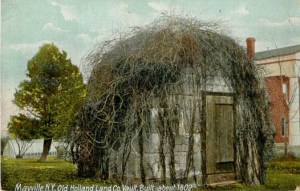
Holland Land Company Vault postcard, Mayville NY

Holland Land Company Vault postcard, Mayville

In 1835, the Holland Land Company sold its remaining holdings in Chautauqua County to Trumbell Cary, George Lay, Jacob LeRoy and Herman Redfield.  They instituted a new policy called the “Genesee Tariff”, forcing those who still owed to pay a penalty of a specific amount per acre in additional to the original price paid for the land.  They also threatened to sell the land to another purchaser if payments were not made.  The settlers fought back against the Genesee Tariff.  In 1836, 500 men gathered in Hartfield, rioted and marched to Mayville to destroy the Land Office.  The building and furniture were destroyed and the company’s books were burned in a bonfire.  The company salvaged what they could and reopened an office in Westfield.   William Seward was made the Land Agent of the new office, and was able to renew peace.  Seward later went on to become Abraham Lincoln’s Secretary of State, and is best known for “Seward’s Folly”, aka the purchase of Alaska.  A stone vault near the present day County Courthouse is the only visible landmark of the Holland Land Company’s presence in Chautauqua County.

In 1839, the Holland Land Office in Batavia closed.  The last holdings of the company were sold in 1846 at little profit.  The building, which was built in 1815 to replace the original log cabins is still standing in Batavia.   The building is listed on the National Register of Historic Places.  The building was saved by a Batavia High School teacher, John Kennedy, and the Class of 1894.  The site currently operates as the Holland Land Office Museum.

For more on Ellicott’s legacy in Western New York, check out Part Three by clicking here.

Sources:

  1. “Joseph Ellicott”  Memorial and Family History of Erie County New York. Volume 1, Biographical and Genealogical
  2. Beers, F.W.  “Our County and It’s People:  A Descriptive Work on Genesee County, New York.”  J.W. Vose & Co Publishers, Syracuse NY 1890.
  3. “Our Street Names:  They Tell Much of Buffalo’s History”.  Buffalo Express, November 14, 1897.
  4. Burns, Rosamond.  “Paving the Way For Settlers:  The Rise and Fall of the Holland Land Co.”  Buffalo News, January 25, 2004.
  5. Houghton, Frederick.  “History of the Buffalo Creek Reservation”.   Buffalo Historical Society Publications, Volume 24:  Buffalo, 1920.

Read Full Post »

ellicottEllicott Street is one of the main north-south thoroughfares in Downtown Buffalo.  As most people know, the street was named for Joseph Ellicott, the surveyor of the Holland Land Company who laid out the City of Buffalo.  Since Ellicott was such a prominent man, instead of making this post too long, I have decided to break it up into three posts.  Part 1 today is about Joseph’s early life.   Part 2 details Joseph’s work with the Holland Land Company.  Part 3 discusses Ellicott’s legacy.
Joseph Ellicott’s father, Joseph Ellicott, Sr. was founder of Ellicott’s Mills, Maryland in 1772 when he and his brothers set up a milling business there.  The elder Joseph Ellicott was instrumental in the farming of the area, by convincing the farmers to plant wheat instead of tobacco.  The farms flourished because he introduced fertilizer (using ground plaster of paris) to the area to help the depleted soil be revitalized.   After the Revolutionary War, they were growing enough wheat to build a mills and the town grew up around the mills.  Joseph Ellicott the elder had nine children.  Two of his sons, Andrew and Joseph Junior became surveyors.

Andrew Ellicott was born in 1754.   In 1784, Andrew was appointed to be a member of the survey group working to extend the survey of the Mason-Dixon line.   He also surveyed the “Ellicott Line” in 1786.  This is the line running north-south that forms the western boundary of Pennsylvania.  During his work, he met Benjamin Franklin.  Based on Franklin’s recommendations, Andrew was appointed by George Washington to survey the lands between Lake Erie and Pennsylvania to determine the border between Western New York and U.S. Territory.  He also made the first topographical study of the Niagara River.

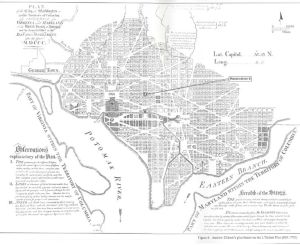
Andrew Ellicott's Plan for Washington, D.C., 1792

Andrew Ellicott’s Plan for Washington, D.C., 1792

In 1791, Thomas Jefferson (then Secretary of State) selected Andrew to survey the boundaries of the Territory of Columbia, which became the District of Columbia (Washington, DC) in 1801.  During this time, he surveyed the future city of Washington, working with Pierre L’Enfant.   When L’Enfant disagreed with some of the commissioners, L’Enfant stepped down and Andrew took over the planning and revised the plans.  Andrew Ellicott’s plans, printed in 1792 were the first Washington city plans to receive wide circulation.

The Erie Triangle, Surveyed by Andrew Ellicott

The Erie Triangle, Surveyed by Andrew Ellicott

In 1794, Andrew plotted the road from Reading, PA to Presque Isle on Lake Erie.  He then laid out the City of Erie, PA and supervised the construction of Fort Erie.

In 1796, George Washington again commissioned Andrew for the commission to survey the border between the Spanish Territories in Florida and the United States.  He traveled via the Ohio and Mississippi Rivers.   He worked for four years on this survey and presented his final report to the government in 1800.  However, political administrations had changed and the Adams administration refused to pay Andrew for the work done on the survey.  He sold many of his possessions to support his family during this time.  When President Thomas Jefferson offered him the post of Surveyor General, Andrew turned it down due to his negative experience with the Adams administration.

Andrew’s brother, Joseph was born in 1760 in Bucks County, PA.   During Andrew’s survey of Washington, D.C., Joseph was Andrew’s chief assistant.  Following the survey of Washington, Joseph went to Georgia to survey the boundary line between Georgia and Carolina.  Following that survey, he returned to Pennsylvania, where he met up the Holland Land Company.

For more on Joseph’s days with the Holland Land Company, click here to read Part Two….

Sources:

  1. “Joseph Ellicott”  Memorial and Family History of Erie County New York. Volume 1, Biographical and Genealogical
  2. Beers, F.W.  “Our County and It’s People:  A descriptive Work on Genesee County, New York.”  J.W. Vose & Co Publishers, Syracuse NY 1890.
  3. “Our Street Names:  They Tell Much of Buffalo’s History”.  Buffalo Express, November 14, 1897.

Read Full Post »

Perkins Drive is a little street coming off of Niagara Square, along the south side of City Hall.  It’s one of the streets in Buffalo that we drive on and most of us don’t realize it actually has a name.  It’s most well-known for showing up in google maps when you have directions starting from Buffalo.  When you list “Buffalo” as the starting point for directions, the first few steps normally get you onto the I-190 via Church Street using these steps:

  1.  Head South toward Perkins Drive
  2. Exit Traffic Circle onto Perkins Drive
  3. Turn Left onto S Elmwood Ave

Perkins Drive is named for Former Councilman Frank. C. Perkins.  He served as President of the Common Council.  He was considered a socialist at the time, but not a radical.  He was elected to the Council several times, but never spent more than $50 on a campaign.

Mr. Perkins was born in 1868 in Dunkirk, New York.  He won a scholarship to Cornell University and paid for the remainder of his education by publishing marketing booklets about the university   After graduating from Cornell, he studied electrical engineering in Germany and other European Countries.  He then opened an office in the Erie County Bank Building.  He conducted night school there to teach streetcar motormen and boys to learn the fundamentals of electricity.  Electrical equipment was still in its infancy at the time.  Mr. Perkins was published in electrical journals in the US, England and Germany.

He was the inventor of the first electric incubator to be patented.  He was well-known in the engineering community.  When he was elected to Council, he closed his consulting business.

Perkins Family House

Mr. Perkins and his wife lived at on Prospect Avenue near The Connecticut Street Armory.  Their house was the first house in Buffalo to be wired for electricity.  Mr. Perkins did all the wiring himself.  The Perkins Family was especially proud of an apple tree in their back yard which was 100 years old when they were living there.  The house is still standing today, I wonder if the apple tree is still there!

Mr. Perkins was a socialist, the type that was of the sort that advocated municipal ownership of electrical power plants to light the streets and asphalt plants to pave the streets.  He left the socialist party in 1920 after one of his appointments was rejected by the rest of the City Council.

For those of you who enjoyed yourselves at Larkin Square this summer might have heard about how the original proposal for Larkin Square was established in the earlier part of the century, but never built.  Here’s a post at the Hydraulics Press that explains a little more about that.

Mr. Perkins was known as “the watchdog of City Government”.  Shortly after his death, his fellow council members named the street after him.


Be sure to check out the Street Index to learn about other streets!

Sources:

  1. “Perkins Drive Memorial to Councilman”  Courier Express Apr 2, 1939, sec 5 p 2
  2. “Perkins Quits, Buffalo Local Socialists Are Not Surprised”  The New York Call, February 13, 1920, p3.

Read Full Post »

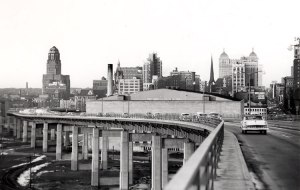
Buffalo Skyway around 1956
(from WNY Heritage Website)

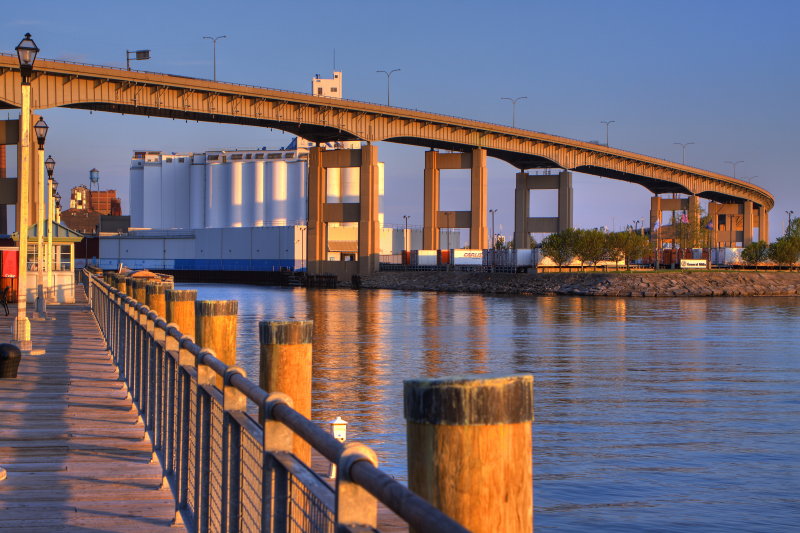
The Buffalo Skyway was originally known as “High Level Bridge”, a description of the function of getting the road over the Buffalo River.  The bridge opened in 1955 and was a marvel of modern engineering.  The bridge is fraught with controversy today, as many people see the skyway as a barrier to development of the waterfront.

The bridge eliminated the waits for railroad and lift bridges that plagued commutes between downtown Buffalo and South Buffalo/Lackawanna.    Plans for a bridge had been discussed amongst the Planning Commission as early as 1922.  Some early traffic planners had fought for a tunnel instead.  The tunnel idea was scrapped because the City would have been responsible for operation and maintenance costs for lighting, ventilating and other maintenance, which the City could not afford.  New York State is responsible for maintenance of the Bridge.

Some planners insisted that construction of either the bridge or a tunnel would be too expensive and not worthwhile.  The Skyway was built despite the fierce opposition and bitter criticism.  It was heralded as a triumph of development and engineering.

The highest piece of the bridge sits 120 feet above the River.  And the viaduct is 5,803 feet in length.  The Steel used to create the skyway was from the Bethlehem Steel plant, just down the road.  The girders were brought to the River via barge.   The Father Baker Bridge, further down the river, was built in similar fashion to cross the Union Slip Canal and opened in November the following year  The two plate girder spans measure 348 feet and at the time were the second longest on any structure in the United States (not sure if they still are).  The bridge was built by the Bates and Rogers Construction Corporation.  Approximately 10,000 cubic yards of concrete was used.  It is supported by 15 massive steel “bents”.  More than 10,000 gallons of paint were used to protect it from the weather.  The bridge incorporated 11,516 tons of structural steel that was fabricated by Bethlehem Steel.

The Street was named The Buffalo Skyway after a contest was held to name the bridge.  Mrs. Wallace E. Easter, of Lackawanna, submitted the name “Skyway”.  Mrs. Easter received a golden key to the City and $100 for her prize.  If you had to name the road, what would you have named it?

Officials on the Skyway
October 4, 1955
From The Buffalo News

The Bridge cost $12,000,000 (1955 dollars) and Opened on Oct 19, 1955.  The Ribbon Cutting Ceremony was held on October 19th and consisted of Mayor Pankow accompanying an inspection party of city and state officials on a tour by car and a ribbon cutting at the north abutment near Delaware and Church Street.  A reception was held following the ceremony at the Hotel Lafayette, which included an address by State Public Works Superintendent John W. Johnson.

The Skyway brought the start to some major transportation investment projects in Buffalo.  The following projects were announced as being funded during the reception (costs in 1955 dollars):

  • Union Slip Canal Bridge (aka the Father Baker Bridge…it has since been demolished) – $13,000,000
  • Kensington Expressway – $6,3,00,000 (for Section 1)
  • Broadway Viaduct Elimination (aka the Z-viaduct of the New York Central) – $2,4,00,000
  • Scajaquada Creek Expressway – $10,000,000.

These investments brought the City of Buffalo into a new time period.  A time where the car was king.   The state officials at the reception called the opening of the Skyway “so magnificent as to be unforgettable”.

Today, many people consider the Skyway to be a barrier to development of our waterfront.   Many public meetings regarding the waterfront, canalside, and other projects result in cries to remove the Skyway.  However, from a traffic perspective, it’s one of the best ways to move traffic.  It’s a key transportation artery in the City of Buffalo, carrying an average of 38,800 vehicles each day (according to 2011 data from GBNRTC).  The New York State Department of Transportation see the Skyway as “a safe, efficient sturdy roadway with another 40,50 years of life in it”.

Yesterday, a new article was published in Next American City which quotes the Congress for the New Urbanism stance that the Skyway as one of the top 12 roads that need to be removed.

Many argue that the accidents on the Skyway is a reason for its removal.  However, the rate of accidents on the Skyway is 0.61 accidents per mile, far below the statewide average for urban, divided four-lane highways, which is 1.52.

Some see the Skyway, with its smooth curves as graceful, while at the same time monumental and graceful.   The ride along the Skyway is unlike any other drive in Buffalo – these people see the climb, the descent, and the view as phenomenal.

So which side of the Skyway Debate do you fall on?

[To learn about other streets, check out the street index. ]

Sources:

  1. “Buffalo Skyway to Open” Oct 19 with a ribbon-cutting, Buffalo News 10-4-1955
  2. “Final River Span Lifted Into Place” , Courier Express 5-5-1955
  3. “Skyway Name Approved by Mayor” Buffalo News 10-6-1955
  4. “Traffic Streaming Over Skyway Heralds New Era For City”,  Buffalo News 10-19-1955
  5. “Skyway Called First Of Big Projects”,  Courier Express 10-20-1955
  6. “Skyway Celebrates 50th Year” Buffalo News, 10-21- 2005

Read Full Post »

« Newer Posts

Field Notes

Live from Buffalo, NY

Grants.gov Community Blog

Connecting the grant community to #LearnGrants

Dienna Howard

I create, therefore I am.

Hidden Waters blog

Companion blog for the book "Hidden Waters of NYC"

Hoping for a Tail Wind

Because I definitely brought way too much gear.

priorhouse blog

Photos, art, and a little bit of LIT.

Sheepie Niagara

Bleating the Beat Since 2015