Feeds:
Posts
Comments

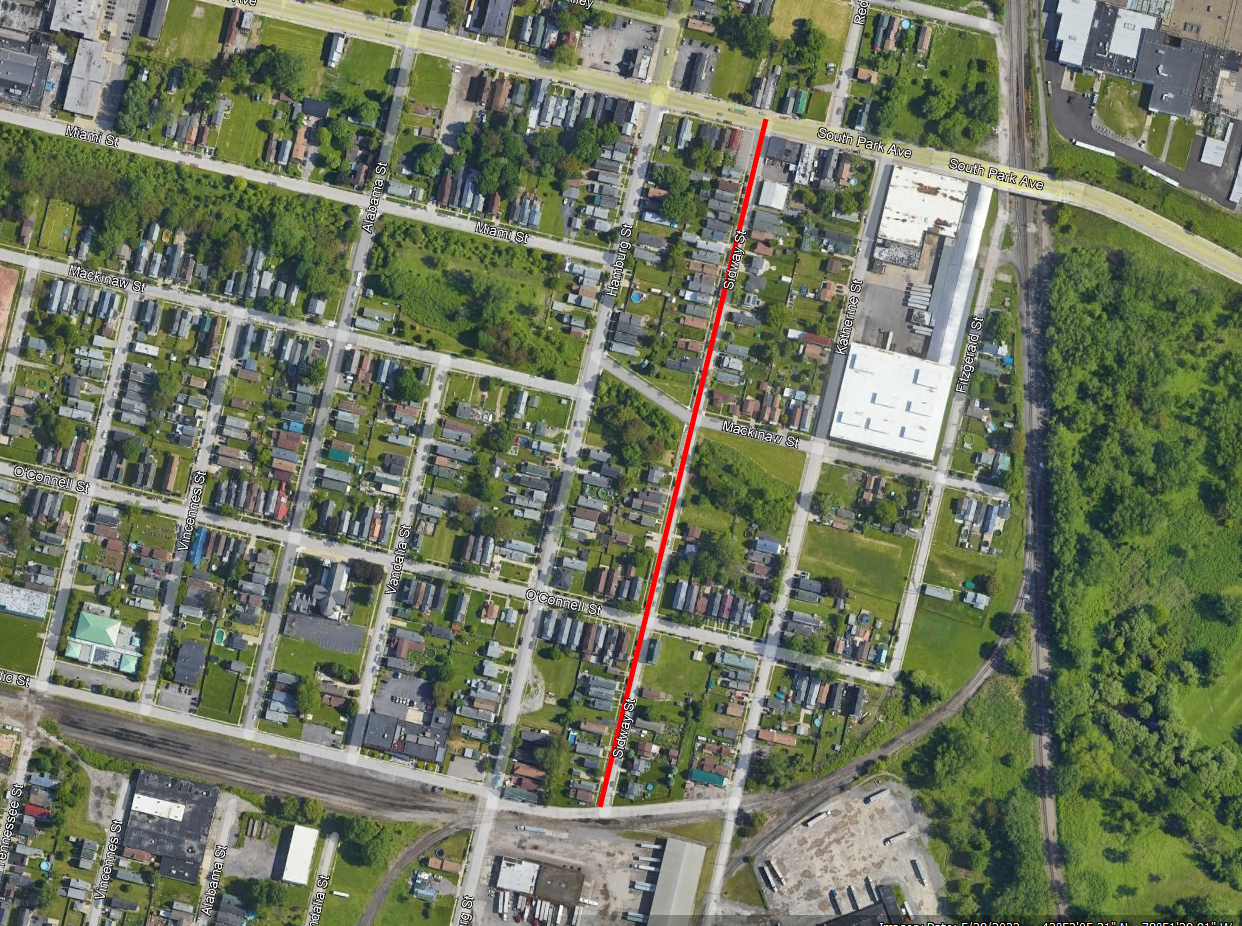
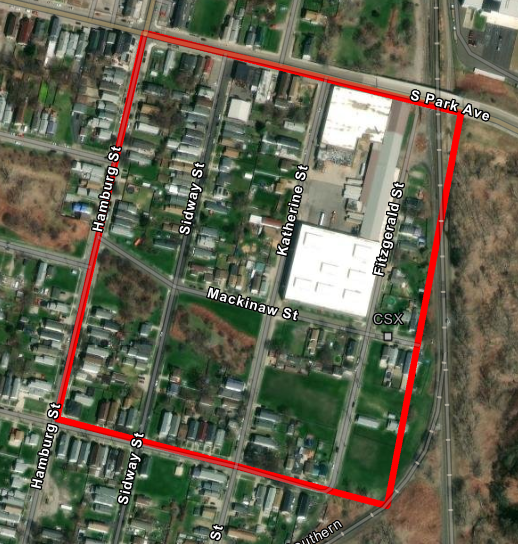
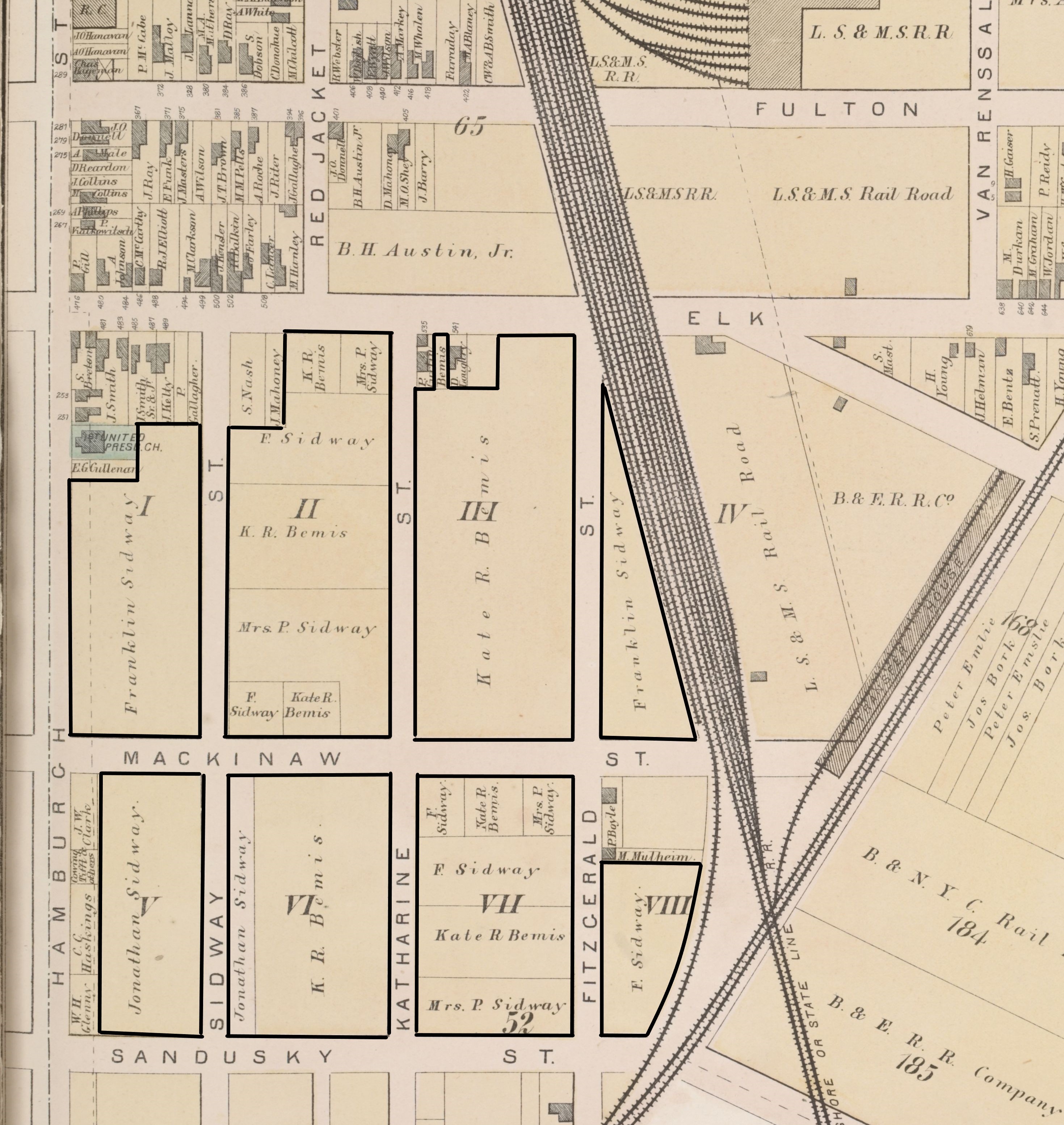
Screenshot (84)Sidway Street runs for three blocks between South Park Avenue and a railroad line property in the First Ward neighborhood of South Buffalo.  The street is named for Jonathan Sidway and runs through land that used to be a farm that was owned by the Sidway family, an influential early Buffalo family.

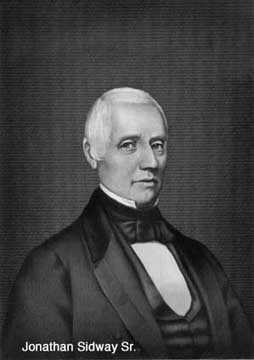
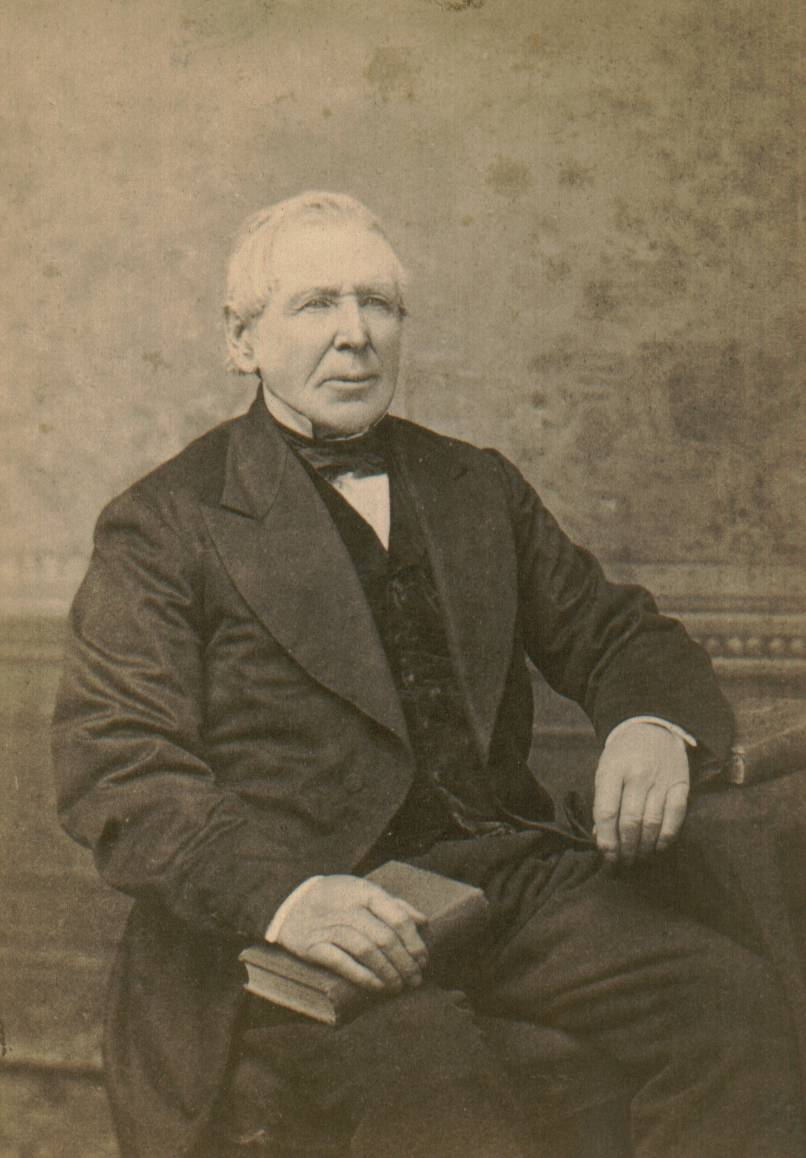
jonathan sidway

Jonathan Sidway. Source: Ancestry.com User lhstjohn1

Jonathan Sidway was born on April 1, 1784 in Goshen, New York in Orange County.  He worked as a farmer in the Goshen area until he came to Buffalo in 1812.  His parents, James and Rebecca Sidway also came to Buffalo around that time.  Jonathan was looking for work in the shipping business when he came to Buffalo.  He became a successful merchant and the owner of the brigs Union and Huron and the Schooner Rachel.  These were some of the first vessels to sail out of the Buffalo Harbor.  Jonathan Sidway was also founder of Buffalo’s first gas company and a director of Farmers and Mechanics National Bank. He was also involved in real estate, including a large farm on Doat Street and the farm where Sidway Street is now located.

Screenshot (82)

Approximate boundary of the former Sidway Farm in the First Ward.

Mr. Sidway married Parnell St. John on January 1, 1826.  Parnell was the daughter of Margaret St. John.  During the Burning of Buffalo during the War of 1812, Margaret St. John’s house was one of only three buildings left standing after Buffalo was burned by the British.  St. John Place is named for the St. John Family.  Jonathan and Parnell Sidway had 9 children – daughters Katherine, Maria, Parnell and Helen, and sons Dewitt, Jonathan, Franklin and James.  Only Katherine, Jonathan, Franklin and James lived to adulthood.  The Sidway family were members at First Presbyterian church.  The Sidway family originally lived on a farmhouse on Elk Street (now South Park Avenue) on the land that became Sidway Street.  When the City of Buffalo was formed in 1832, the Sidway farm was along the eastern boundary of the city of Buffalo, which was considered to be “way out in the countryside.”

Shea_s_Music_Hall_Bethune__Bethune_Fuchs

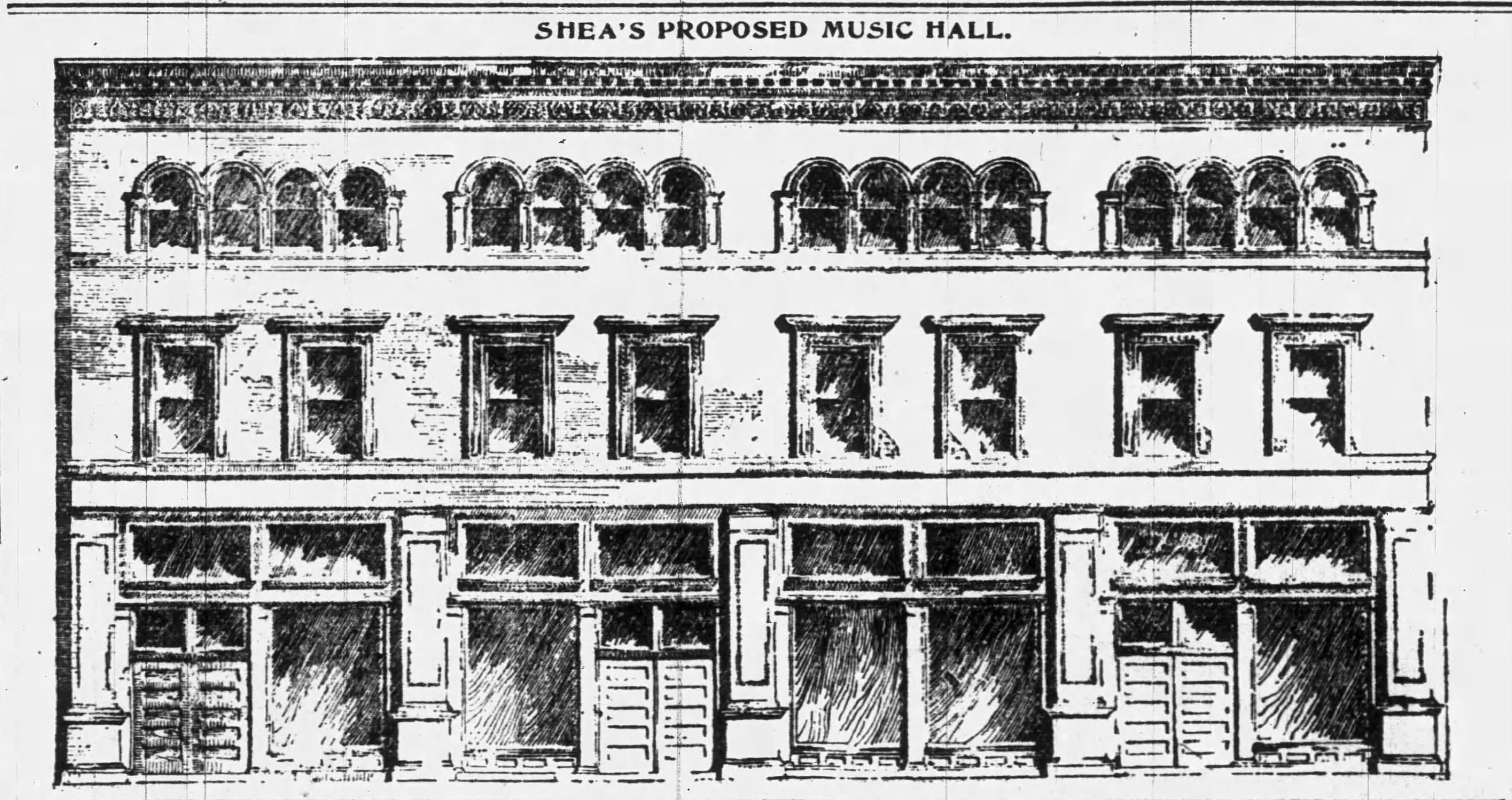
Michael Shea’s Proposed Music Hall to be built on the site of Jonathan Sidway’s former house in 1895. Designed by Bethune, Bethune and Fuchs. Source: Buffalo Courier

On January 3, 1826, Mr. Sidway purchased Holland Land Company Lot 27 – located on the east side of Main Street between Huron and Chippewa Streets (now the location of M&T Center at Fountain Plaza, just north of the Gold Dome bank).  In the mid-1830s, Jonathan Sidway built a two-story frame house on the site.  The house had an orchard and gardens.  Over the years, the block became more commercialized and the family moved north of downtown.  The Sidway house on Washington Street was demolished in the 1895 for Michael Shea to build a concert hall.  The Concert Hall was designed by architects Bethune, Bethune & Fuchs (the firm of Buffalo Gal Extraordinaire – Louise Bethune, the first female architect!  However, newspaper articles of the time indicated that this building was designed by W.L Fuchs, not by Louise.)  The building was to be an Italian Renaissance style building, built of brick with a frontage along Washington Street of a light buff colored brick.  It was to have a grand lobby, fitted with mirrors and onyx trimmings and a mosaic floor.  It was to be one of the largest theatres in the country.  It was to have 24 dressing rooms, which were conveniently located and of sufficient size, which were not found in any other Buffalo theatre at the time.  The main auditorium was to be 91 feet square and have a seating capacity of between 700 and 800, and 55 feet high ceilings.  The building was to be lit by electricity with a large chandelier in the center of the auditorium, 34 feet in diameter.  The theatre was to be funded half by Iroquois Brewery and half by Mr. Shea.  It was expected to cost between $75,000 and $100,000 (between $2.7 and $3.6 Million in today’s dollars).  However, they had difficulty getting loans to build a building on for theatrical purposes, so the plans were abandoned and it was decided that stores would be built on the site instead.  Mr. Shea eventually did build a theater in this area –  the west side of Main Street between Huron and Chippewa was the long time home to the Hippodrome Theatre which opened in 1914.  And of course, Michael Shea eventually got his large, super grand theatre on the next block to the north – now known as Shea’s Performing Arts Center, still a popular theatre today!

1872 atlas sidway

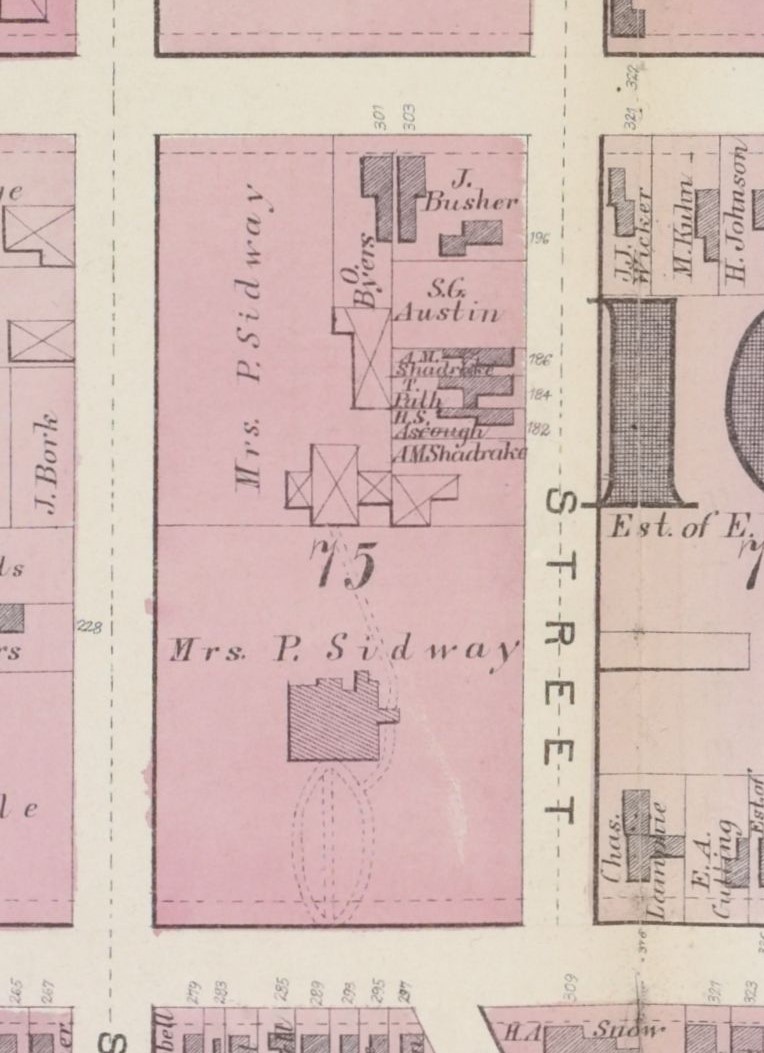
1872 atlas map showing the Sidway Mansion. Hudson Street is located at the bottom of the image. Note the house on the lower part of the block with the circular drive in front of it and the pathway leading to the carriage house in the center of the block. The carriage house was later a part of son Franklin Sidway’s property at 30 Plymouth after the property was subdivided and parts of it are still standing today.

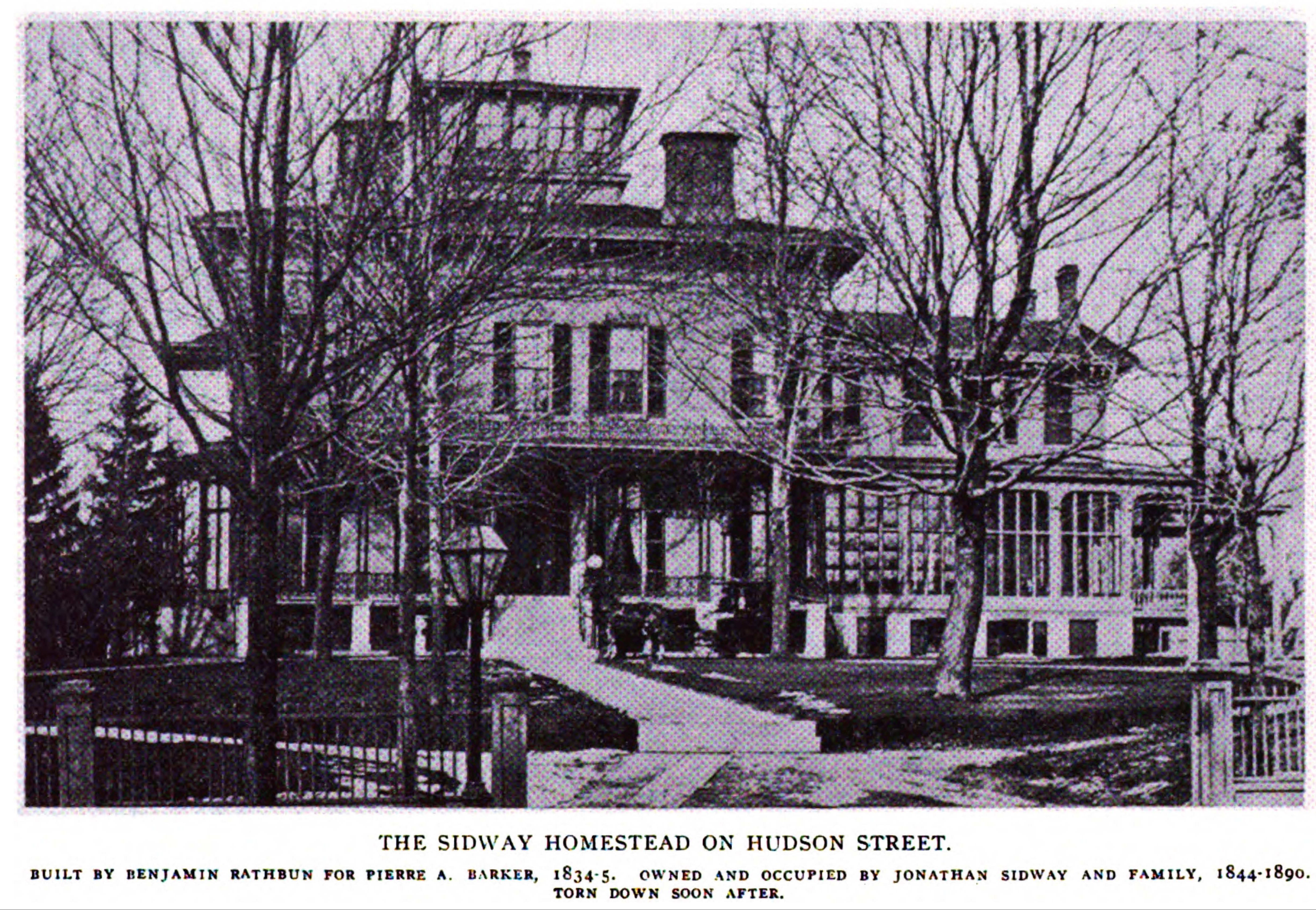
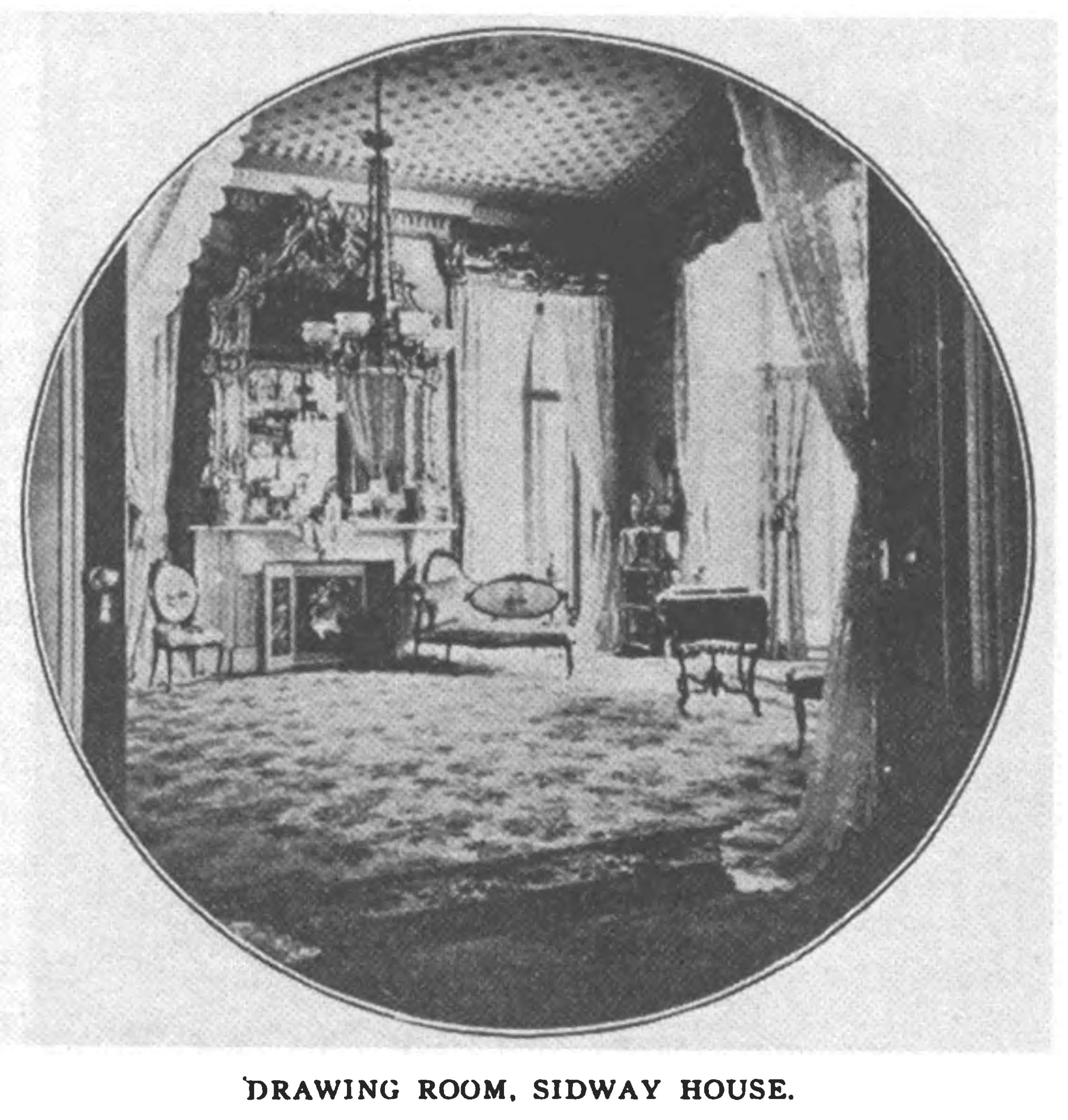
In 1843, the Sidway family moved from Washington Street into a large home at 290 Hudson Street. The house was originally built by Benjamin Rathbun around 1834 for Mayor Pierre Barker and was also considered to be far out in the country at the time.  The house sat on the center of the block, bounded by Plymouth, West, Hudson and Pennsylvania.  The house was surrounded by old trees and flowering shrubs in a park-like setting.  The grounds were laid out in large circles, one directly in front of the house  and another between the house and West Avenue.  The house was considered to be one of the most beautiful in the City.  It had ornate gilt cornices above the doors and windows, exquisite lace curtains hung in the windows.  The house had three drawing rooms on the first floor facing the West Avenue side of the house.  The rooms were furnished with carved rosewood furniture upholstered in satin damask.  On the other side of the main hall was a sitting room with large black marble mantle and a dining room with a glass enclosed piazza in front of it.  The house was so large that in order to be comfortable in it during the winters, the family would close off the upper rooms.  They kept a cow in the backyard barn to provide milk for the family.

SidwayBlock_ from RootNeal website

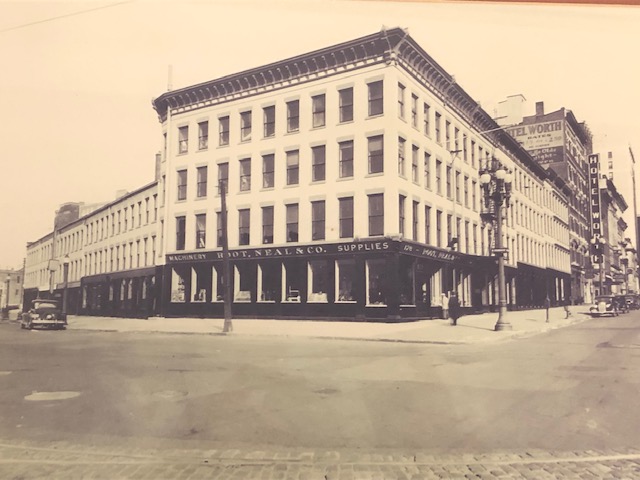
Sidway Block – Main Street is on the right, Upper Terrace is in the foreground. Source: https://www.rootneal.com/

In 1832, Jonathan Sidway built one of Buffalo’s first brick block buildings.   The Sidway Block consisted of 19 stores.  The Sidway Block was located along Main and Upper Terrace at 172-194 Main Street and 7-25 Upper Terrace (now a part of One Seneca Tower).  Mr. Sidway had owned a portion of the property since 1819!  The offices of Jonathan Sidway’s ship chandler firm – Sidway, Skinner & Moore were located on the second floor of the building.  The building stood for more than 130 years before it was torn down.  Starting in 1905, the building was home to Root & Neal, an industrial supply company.  Root & Neal moved to Peabody and Perry Streets in 1960 and they still in business today as a fourth generation Buffalo-business.

city_atlas_2_42

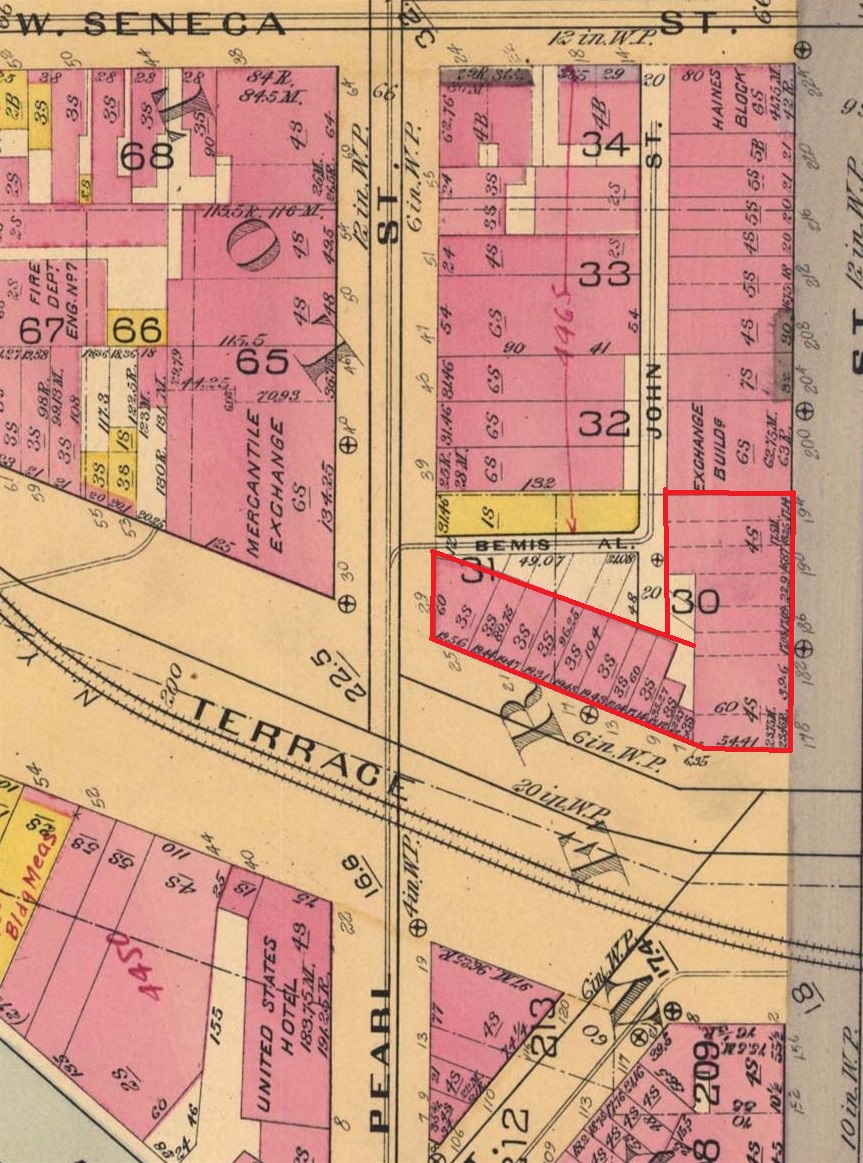
1894 City Atlas. Sidway Block outlined in red. Note Bemis Alley and John Street, two non-extant streets on the same block as the Sidway Block of buildings.

As you can see in the image above, to the rear of the Sidway Block were two additional streets that no longer exist – Bemis Alley and John Street.  Bemis Alley was named for Asaph Bemis, Jr, who married to Jonathan Sidway’s daughter Katherine in 1844.  Asaph Bemis was a grocer and Alderman.  Asaph was the daughter of Asaph Bemis, Sr. and Aurelia St. John.  Aurelia was Parnell St. John Sidway’s sister.  So, Asaph and Katherine were first cousins who married!  I’m not sure who John Street is named for….but I wonder if it were in homage to the St. John family?  St. John Place did not exist in Buffalo until the late 1880s and John Street was named before that.  I wasn’t able to find any information about John Street, so it’s all just conjecture. Bemis Alley and John Street are no longer extant, they are now part of the site of Seneca One Tower.

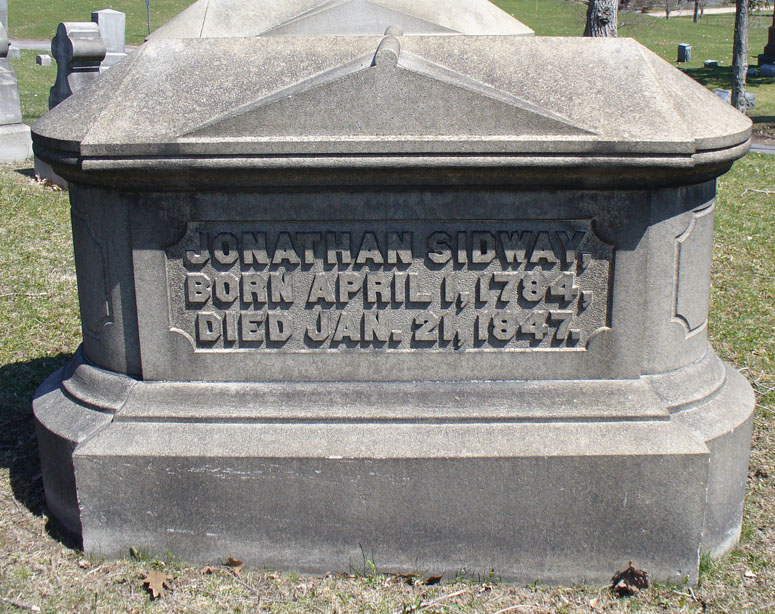
sidway graveJonathan Sidway died in 1847.  His estate was estimated to be worth $1 Million (about $30 Million in today’s dollars).   Sidway street was laid out and named in Jonathan’s honor in January of 1854.  The street was proposed by Alderman Asaph Bemis.  Both Fitzgerald Street and Katherine Street were laid out and named during the same council meeting, so I believe that Katherine Street may have been named for Katherine Sidway Bemis.  Do any First Ward historians know?  I wasn’t able to find any sources indicating any rationale behind the name.

sidway mansion from picture book of earlier buffalo

Sidway Mansion on Hudson Street.  Source:  Picture Book of Earlier Buffalo.

Mrs. Parnell Sidway lived in the Hudson Street house after the death of her husband, until her death in 1879.  After Mr. Sidway’s death, several family members came to live with the family to help Parnell with the kids – who were ages 20, 15, 13, and 8 when Jonathan died.

In 1850, Parnell, Jonathan Jr, Franklin and James lived in the house with Parnell’s sister-in-law Elizabeth Sidway(who had been Jonathan’s sister-in-law technically), along with servants Francis Skinner, Elizabeth Lafever, Mary Bertrand, William McDonald, M Dolan and Anna Page.

drawing room sidway house picture book of earlier buffalo

One of the Drawing Rooms at the Sidway Mansion.  Source:  Picture Book of Earlier Buffalo

In 1860, the house was home to Parnell and her sons, Franklin and James.  Daughter Katherine and her husband, Asaph Bemis also lived with the family, along with Parnell’s brother, Le Grand St. John, and servants John McGinnis, Bridget McGinnis, Margaret Hoag, and Agnes Kearns.

In 1870, Parnell lived with son Jonathan, his wife Caroline and their children Gertrude, Jonathan, William and Kate.  Also living in the house were servants Jane Baudin, Sarah Smith, Elizabeth Jeffcott, Nellie Riley, Ann Singleton and William Smith.

1575879

1872 Atlas showing the Sidway family properties near Sidway Street that were still owned by the Sidway family – Franklin, Jonathan Jr, Mrs. Parnell Sidway and Katherine Bemis.

When Parnell Sidway was close to death in 1879, the Buffalo Times reported that “she has survived her husband thirty years and has managed his big estate with great ability.  She has been a woman of great force of character and was benevolent and generous to a large degree.”  Mrs. Sidway had also been involved with the Old Settler’s Festival, along with Mr. and Mrs. Bristol who we learned about in our last post.

After Parnell’s death, in 1880, the Hudson Street house became home to Parnell’s son Franklin Sidway, his wife Charlotte Spaulding Sidway, and their sons Harold, Franklin, Edith and Clarence.  They were joined by their servants Ann Dewey, Ellen Hanrahan, Mary Dewey, John Beckman, Peter Villikes, Jennie Villikes, and Annie Clark.

The Sidway Mansion was demolished around 1891 and the property was sold off to be developed with houses.  Franklin Sidway built a house on the family property at 30 Plymouth Avenue. The 30 Plymouth Avenue house includes the original brick stable from the Sidway Mansion, both of which are still standing today.  The Sidway property at 30 Plymouth Avenue, was sold by son Frank Sidway in 1907.  It has been subdivided into apartments, but it is still standing.

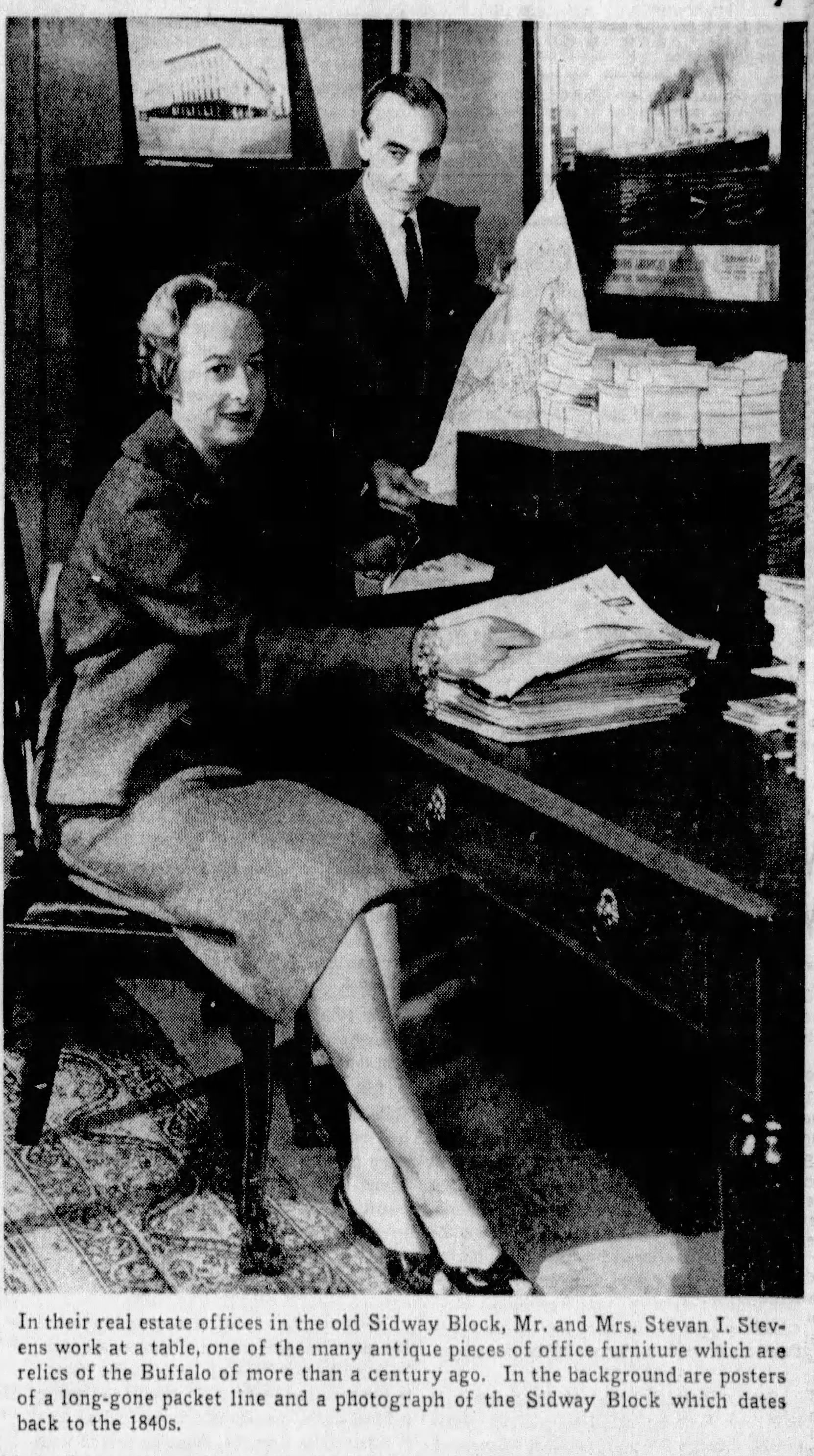
Edith_Sidway_Stevens

Edith Sidway Stevens and her husband Stevan Stevens in their office at the Spaulding Block in 1959. Source: Buffalo News. Note the picture of the Sidway block in the rear, which I believe is the same picture seen earlier in this post.

The Sidway Block building stood for more than 13 decades.  After Jonathan’s death, his wife Parnell took over the firm of Sidway, Skinner & More, which shifted from ship chandlery to real estate over time.  Sons Franklin and Jonathan Jr and daughter Katherine were all involved with the company as well.  Son James became a firefighter, and unfortunately perished at the age of 25 in the fire which destroyed the American Hotel on Main Street near Court Street in 1865.  Franklin married Charlotte Spaulding, whose father was Elbridge Spaulding and had the Spaulding Exchange, a mercantile operation across the Terrace from the Sidway block.  Franklin helped to manage the Spaulding Exchange and the offices of the Spaulding Exchange were located in the Sidway Block.  The Sidway Block stood until the late 1960s.  In later years, only the first floor spaces were occupied, with the exception of the second floor offices of Stevens & Strong, a real estate company run by Steven Stevens, the husband of Edith Sidway – a fifth generation Buffalo Sidway.  Edith worked as a real estate agent and had a desk in the offices, following a long tradition of Sidway women who had offices in that space, starting with her Great Grandmother Parnell St. John Sidway!

The Sidway Block was demolished in 1969 as part of the Waterfront Renewal project undertaken by the City of Buffalo.  The City was looking to take possession of the property to convey the land to Cabot, Cabot & Forbes for the Marine Midland Project to build the tower now known as Seneca One Tower.  In December 1967, exactly 154 years after Margaret St. John refused to let her house burn during the War of 1812, Margaret’s Great-Great Grandaughter, Edith Sidway Stevens was interviewed while sitting in her office, the last occupant in the Sidway Block, watching buildings get demolished all around them.  She was quoted as saying, “We would have stayed indefinitely, we had no interest in going anywhere else.  Oddly, we like the location.”

The Sidway Block property underwent condemnation proceedings in February 1969 and the Supreme Court set a price of $282,750 (about $2.4 Million in today’s dollars) for the property.  City Council appealed the price.  The City of Buffalo had given the owners a low-ball offer of $104,000 for the property (about $850,000 in today’s dollars).  City Counsel met with the Sidway family owners and a compromise price of $250,000 was arrived at for the property, which would have saved the City $32,000 (about $260,000 in today’s dollars).  City Council then refused to accept the compromise price, preferring to go through the Courts.  The Court then affirmed the fair market value at $282,750 and the City had to pay that, as well as the additional costs of the appeal.

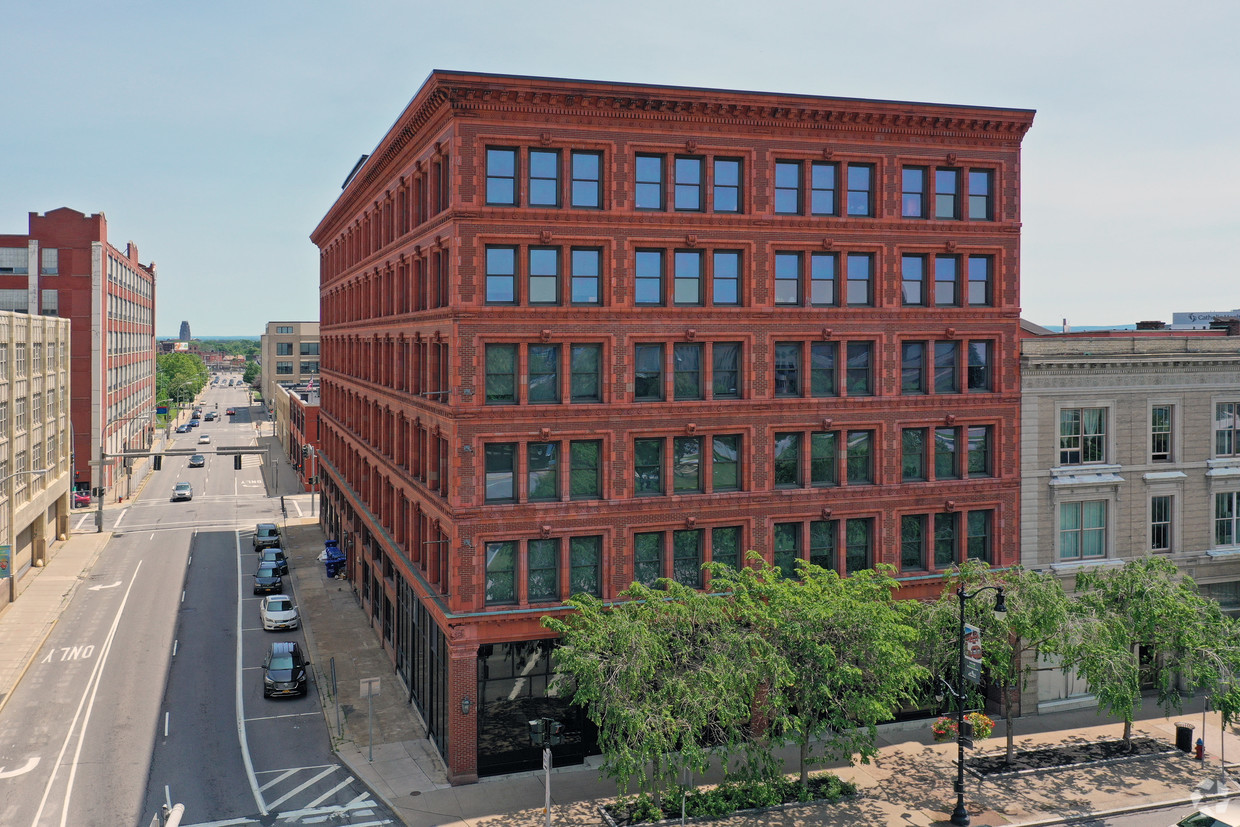
Sidway exterior building

Sidway Building at Main and Goodell. Source: Matthew Friend, Google Maps Images

In 1907, Franklin Sidway erected the Sidway Building, a six-story terra cotta building designed by architects McCreery, Wood and Bradney.  The building was located on the site of the house where Franklin’s wife, Charlotte Spaulding, had grown up.  It must have been confusing when people would refer to the Sidway Building and the Sidway Block, which were two separate buildings on Main Street in either end of the Central Business District!  The building has been renovated into apartments.

Charlotte_Sidway_School,_Grand_Island,_New_York

Sidway School, Grand Island. Source: Wikipedia

Franklin Sidway and Charlotte preferred country life to city life.  Franklin built a home on Grand Island in 1898, called River Lawn, and they moved to River Lawn from their home at 30 Plymouth Avenue.  River Lawn was occupied by Charlotte Spaulding Sidway until 1931 when the 400-acre estate was sold to New York State to become a part of Beaver Island Park.  Charlotte was the daughter of Elbridge Spaulding.  Charlotte Sidway Elementary School on Grand Island is named after Charlotte, who passed away just before the school opened.  You can learn more about the Sidway Building, River Lawn and Charlotte’s family in the post about Spaulding Street here:  https://buffalostreets.com/2022/12/23/spaulding/

So the next time you drive past Sidway Street or the Sidway Building, think of the Sidway family and remember when there were farms in the First Ward and that Hudson Street was way out in the country.  And next time you visit Seneca One, stop for a moment to think about the 135 years of the Sidway Block standing at its location.  Want to learn about other streets? Check out the Street Index. Don’t forget to subscribe to the page to be notified when new posts are made. You can do so by entering your email address in the box on the upper right-hand side of the home page. You can also follow the blog on facebook. If you enjoy the blog, please be sure to share it with your friends, it really does help.  This past week, a reader posted an old post in a facebook group and more than 5,600 people read that post this week!  If you’re coming from Buffalo, A Talk of the Town – welcome new readers!!  Interested in getting even more content from me?  You can become a Friend of Buffalo Streets on patreon.   You can go to https://www.patreon.com/buffalostreets/

Sources:

  • “Sidway Street Honors Memory of Pioneer in Shipping, Realty” Courier June 18, 1939, p16.
  • “Fifty Years Ago.”  Buffalo Times.  April 21, 1929, p16.
  • “One Hundred Years Ago.”  Buffalo Times.  July 16, 1922, p32.
  • “Death of Mrs. Parnell Sidway.”  Buffalo Weekly Courier.  April 30, 1879, p7.
  • Cook, Anna Hoxie.  “When Buffalo Was Young – Sidway Mansion on Hudson Street a Show Place.”  Buffalo News.  March 2, 1936, p13.
  • “Relic of Long Ago: Manager Shea’s New Theatre Will Take Place of the Old Sidway Residence.”  Buffalo Commercial.  February 9, 1895, p10.
  • “Bernard Duffy Buys Home on Linwood Avenue:  JB Healy Buys Last of the Old Sidway Homestead Property on Plymouth Avenue.”  Buffalo News.  June 1, 1907, p22.
  • “Shea’s Proposed Music Hall.”  Buffalo Courier.  March 10, 1895, p11.
  • “Mr. Shea’s Theater:  That Magnificent Variety House Will Not Be Built on Washington Street.”  Buffalo Commercial.  May 14, 1895, p11.
  • “Shea’s New Theatre.”  Buffalo Commercial.  February 23, 1895, p11.
  • Turner, Fred.  “The Old Sidway Block:  A Volume of Buffalo History.”  Buffalo News.  October 31, 1959, p15.
  • Zubler, Bud.  “Council Tries to Dicker-Court Costs Added to Bill”.  Buffalo News.  April 2, 1969, p33
  • Smith, H. Katherine.  “Men Of Vision Built the Sidway Block.”  Buffalo Courier Express.  November 20, 1955, p96.
  • Taussig, Ellen.  “Protection of Its Property is a Sidway Family Tradition.”  BuffalO News.  December 30, 1967, p2.
  • “Root Neal Leaving Main Street Where Its Been 52 Years.”  Buffalo News.  February 6, 1960, p16.
Screenshot (47)

Bristol Street shown in red on the map.  Note the railroad tracks cutting the street into two parts.

Bristol Street is a street in the Emslie neighborhood on the East Side of Buffalo.  The street has two parts, each two blocks long – the first runs from Clare Street to Smith Street.  The road has a dead end where the street is bisected by railroad tracks and then continues from Lord Street to Emslie Street.  Prior to the removal of at-grade railroad crossings the road did cross the railroad tracks, those were removed by 1916.  The street historically was supposed to have continued past Jefferson Street to Spring Street, but only the block between Jefferson and Spring was constructed.  That block of Bristol Street existed until urban renewal removed it in the 1950s.

ny57932893230215394723_map

1899 Sanborn Map key map showing the additional block of Bristol Street between Spring and Jefferson. Bristol Street showing in red

Mr_and_Mrs__Bristol

Mr. and Mrs. Bristol in 1873. Source: Buffalo Courier

The street is named for one of the earliest residents of Buffalo, Daniel Bristol.  Daniel Bristol was born in Milford,  Connecticut in 1782.  Daniel Bristol married Mary Lockwood Reynolds in October 1810.  Mary went by Polly and was from Philadelphia.  The Bristols came to Buffalo in 1811.  Daniel was one of the earliest master builders in Buffalo and erected many of Buffalo’s first structures.  When the Village was burned during the War of 1812, they fled with their neighbors.  Mrs. Bristol gathered their treasured belongings and placed them in a large iron kettle and suspended it in their well.  After the war, they came back to help rebuild Buffalo.  When they returned, they fished the iron kettle and her silver out of the well.

Bristol_Home_Buffalo_Times

Mr. and Mrs. Bristol and their home

In 1816, Mr. Bristol built a home for his family on the southeast corner of Delaware Avenue and Mohawk Street.  Daniel and Polly had six children – Cyrenius, William, Peter, Eliza, Erasmus, and Catherine.  The Bristol family property originally extended on Delaware Avenue to Niagara Square and included most of the entire block.  They had a large garden east of his house on Mohawk Street, which led to a stable.   Over the years, portions of the property were sold off and other houses were built on the block, including the house that was purchased by Millard Fillmore in 1858.  The Bristol family house stood until 1923 when it was demolished to build the Statler Hotel.

On March 17, 1817, the Village of Buffalo established their first volunteer fire company.  Daniel Bristol was one of its members.  These men used old-time fire buckets and had no engine, they were what is referred to as a bucket brigade. In 1824, the first engine company was organized, which became known as Cataract Engine No 1.  In 1831, Pioneer Hook & Ladder No 1 was organized on South Division Street, east of Washington Street with Daniel Bristol as a charter member of the company.  The Buffalo Fire Department Engine 1/Ladder 2 is still located on this site.

Bristol Grave

Daniel, Polly and Peter Bristol Grave, Forest Lawn Cemetery.

Polly and Daniel lived to be among the oldest citizens of Buffalo.  They were a part of the “Old Settler’s Festival”, which brought together the older citizens of Buffalo to reminisce.  The Old Settler’s Festival was held at St. James Hall in 1866.  In 1866, there were just 16 residents of Buffalo remaining who had lived here before the Burning of Buffalo on December 30, 1813.  In addition to Dan and Polly Bristol, the others were George Coit, James Sloan, Commodore Stephen Champlin, Moses Baker, Mrs. R.B. Heacock, Lucius Storrs and his wife, Mrs. Kibbe (Mrs. Grosvenor), Mrs. Alvin Dodge, Mrs. Ebenezer Walden, Lester Brace and wife, and Mrs. William Hodge.

Daniel Bristol died on June 30, 1867 at the age of 85.  Polly died on February 28, 1879 at 92 years old.   They were buried in the North Street Cemetery.  His remains, along with those of Polly Bristol and their son Peter, were moved to Forest Lawn in October 1894.  Peter had died in 1838 at just 23 years old. These three Bristols are buried with one stone.

30584-original-bristolssarsaparillars

Ad for Bristol’s Sarsaparilla after they moved to NYC.  C.C. Bristol’s image is in the center.  Source:  https://www.bottlepickers.com/bottle_articles156.htm

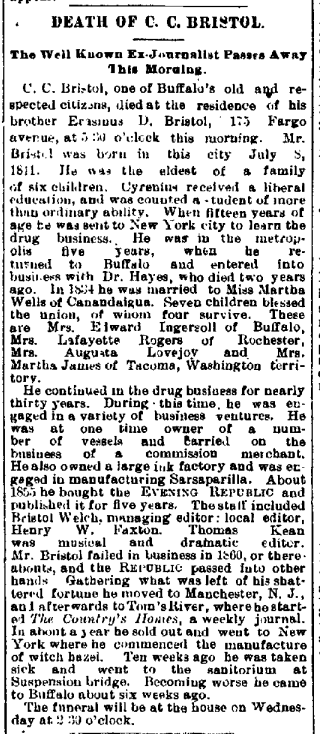
Daniel’s son Cyrenius Chapin Bristol, known as C.C. Bristol was born on July 8, 1811.  Some sources claim that he was the first male child born in Buffalo, but that claim is debatable.  At age 15, he went to New York City to learn the drug business.  He returned to Buffalo five years later to work as a chemist and druggist, with an apothecary near the corner of Washington And Swan Streets (now the location of the Ellicott Square Building).  He was considered one of the most well-known Buffalonians in his time.  He invented Bristol’s Extract of Sarsaparilla.  Bristol’s Sarsaparilla was considered to be the “first great American tonic” and was sold across the country and in Mexico for many years.  These almanacs were considered to be “as familiar to 19th century homes as the Bible”. In 1855 when the formula, the formula for Bristol’s Sarsaparilla was acquired by the Comstock Company of New York.  The Comstock Company remained in business until 1959.

CC_Bristol_Bottle

C.C. Bristol medicine bottle. Note the periods at the top of the C’s and the backwards S. Source: Buffalo News, August 1982.

In 1838, C.C. Bristol published “Bristol’s Gazette and Herald of Health”, a monthly that was discontinued in 1842.  In 1844, C.C. Bristol published the first patent medicine almanac called “Bristol’s Free Almanac”.  C.C. Bristol was said to have made “barrels of money” from the drug business and in 1855 when he sold his formula, he invested his money into The Buffalo Daily Evening Republic one of Buffalo’s early newspapers.  He published the paper for five years.  In 1861, the Republic was absorbed by the Buffalo Courier.

C.C. Bristol married Martha Hayden Wells of Canandaigua, NY in 1835.  He was the only one of his siblings to marry.  C.C. Bristol and Martha had 9 children.  Mary died in February 1866.    C.C. Bristol moved to New Jersey  after Mary’s death but returned to his hometown to end his days in Buffalo.  He died ten weeks later, in December 1884, at the home of his brother Erasmus at 175 Fargo Avenue.  Mary and C.C. were originally buried in the North Street Cemetery, but their remains were moved to Lakeside Cemetery in Hamburg in 1901.

Bristol_Home_sketch

Sketch of the Bristol Home. Source: Buffalo News, March 1957.

There’s another well-known Bristol namesake in Buffalo – the Bristol Home.  The Bristol name comes from a separate family – I was not able to discover a link between the two families, however, they both were long standing families in the New England area so if you go back far enough, they may intersect. Since we’re discussing Bristol today, I figured noone would mind if I included the history of the Bristol Home, since it was a longstanding institution in the City of Buffalo for more than 150 years!

Edward Bristol was born in Buffalo in 1825.  He worked as a merchant.  Edward was a businessman, who owned a furniture store; however, he had a deep interest in religious activities.  He was a charter member of Lafayette Presbyterian Church and the first superintendent of its Sunday School.  He helped conduct religious services at the Erie County Penitentiary.  While he was there, he saw that there were many women at the penitentiary that had nowhere to go.  In 1872, he ended up giving up his business and devoting his life to religious work.  In 1877, he was ordained as a minister and became pastor of Calvary Presbyterian in Rochester.  He lived the rest of his life in the Rochester area.

In May 1867, while still in Buffalo, Mr. Edward Bristol called together a band of women to the home of Mrs. F. H. Root.  The women met to discuss the need for relief and care for women in Buffalo who were alone and in distress, telling the women of the conditions he saw at the penitentiary.  They came up with the idea to start a Home for the Friendless.  The organization consisted of a 41-person Board of Managers.  They were all women, and mainly members of Protestant Churches, as the Roman Catholic church had their own institutions.  Temple Beth Zion was also involved, making the facility not just Christian, but also including Jewish women. The home was non-sectarian, but many of the churches would host Sunday services in the home on a rotating basis.  Some of the churches involved included:  First Presbyterian, Central Presbyterian, North Presbyterian, Lafayette Presbyterian, Westminster Presbyterian, Calvary Presbyterian, St Paul’s, Trinity Church, Church of the Ascension, Grave Episcopal, Church of the Good Shepherd, All Saint’s Church, Delaware Avenue Methodist, Linwood Ave Methodist, Asbury Methodist, Prospect Ave Baptist, First Unitarian Society, First Congregational, Disciples Church of Christ and Temple Beth Zion.  The first president of the Board of Managers was Mrs. Noah Gardner.  Mrs. Gardner died a year later, and Mrs. O. G. Steele became President, a role she held until 1875.  Many of the daughters and granddaughters of the first Board members served as Board members as well, making the Home feel like a true family affair.  Residents of the Home were referred to as inmates by many, but the Home referred to the residents as “The Family”.  This was a home for women, run by women.

The Board of Managers organized and started a quiet campaign amongst their friends to bring about an institution to meet their needs.  It took about six months for them to raise enough money.  They purchased a house at 334 Seventh Street, at the corner of Maryland Streets.  The house was a large, rather plain, old-fashioned house in an unfashionable but respectable part of town.  It was a two and a half story brick house on a lot with 116 feet on both Maryland and Seventh Streets.  The house was often referred to as “the Home on Maryland Street”.   The house was paid for in cash and furnished by donations with items from the houses of the members of the Board.  The Home for the Friendless opened on February 4th, 1868, with space for 12 to 24 women at a time.  Their first residents were four elderly women.  The first year there were 26 residents, and 438 days of board had been provided at the home.  The second year, there were 132 residents who stayed at the home.

The Home was open to all who needed friends – some were impoverished, some bereaved, some sorrowful, some idle, some sinful.  They took in the unfortunates, poor, beaten and abused, women with fatherless babies, respectable girls from the country seeking work and decent women in awkward positions due to home, finance, or travel issues.  Some stayed for two weeks, some for two months – for as long as they needed, but the home was mainly transient in nature.  Children were allowed to stay at the Home as well.  Most of the women were under the age of 21 years.  When they’d leave, some would find respectable homes in Buffalo, some would find jobs, some would return to their friends or family, or some would go on to another city.  The Board of Managers would work with the women to help them find better situations if they could – finding homes or domestic jobs, etc.  Many of the original residents were Civil War widows who were struggling to obtain their husbands pensions.

Each member of the house paid at least $5 to stay there (about $103 in 2023 dollars) as long as they needed up to a year.  Some residents paid more; they paid as they were able.  The policy was not to turn anyone away. Several of the churches contributed to the Home.  The Board of Managers would act as an employment agency, helping people find cooks, nursing aides, laundresses, and seamstresses from among the residents at the house.  They would charge a fee of 50 cents(about $10 in 2023 dollars) to prospective employers.  The institution also raised money each year by hosting a Donation Day.  They would open the doors to the public to come visit the institution and have supper with the residents in exchange for donations of money, clothing, provisions, etc.  Donation Day was the only time of year they would ask the public for money.  They also published a monthly newsletter called “Our Record” which was very successful, both in getting the word out about the Home for the Friendless to the community at large, but also in providing a source of income for the home.  Residents would also sell their needlework, sewing and other crafts to help fund the home.  In the 1980s, the organization boasted that they had never taken on any debt for their entire existence, and they had never had any government funding.

20231007_120602

Ingleside Home on Harvard Place, March 1903. Source: Buffalo Times.

In 1869, they realized that the home was serving two distinct needs – first was for women who were looking for refuge until they could obtain a suitable place and secondly women who were in a more unfortunate situation and may need some help to get on “a better course” for their life.  They referred to these women as those who had been “tempted and fallen”.  The Ingleside Home for Reclaiming the Erring was opened in 1869 at the corner of 13th and Vermont Streets.  They had several locations before settling at 70 Harvard Place near Main Street.  The building pictured here burned down and was replaced with the still extant building in 1929.  The Ingleside name comes from the Scottish word for “a home fireside.”  Ingleside was mainly a home for unwed mothers.  The Ingleside Home operated until 1977.  The home has been renovated into apartments.

Also in 1869, because they couldn’t care for the very sick, the Board of Managers of the Home for the Friendless worked to make arrangements with Buffalo General Hospital, which got its start in 1858.  The part of the hospital devoted to women had become dilapidated and was vacant for some time.  At the time, the Hospital was not doing well financially and had begun to lack the confidence of the community.  The Board of Managers worked to place the female ward of the Hospital under the management of the Home for the Friendless.  The Home for the Friendless raised money and worked to construct partitions, closest and lockers, they kalsomined the walls (a type of white wash), provided beds, bedding, furniture and clothing for the sick.  They quickly determined that running the Home for the Friendless, the Ingleside Home AND the Hospital was too much for the one organization, so a separate organization was spun off of the Home for the Friendless, the Ladies Hospital Association.  The new wards opened on November 1, 1870.  By 1872, the Ladies Hospital Association had successfully managed to get three of their members seats on the Executive Committee of the Board of Buffalo General Hospital.  The Ladies Hospital Association continued to be an important force for the Hospital, raising most of the funds for the Hospital’s maintenance, expansion and growth, and improvement of equipment.

By the late 1870s, older women began looking at the Home for the Friendless as an option when they didn’t want to stay with families, or they didn’t have families.  They had some money, but not enough to live on.  The Home developed a policy that for $250 (about $7,000 in 2023 dollars), women over 60 could stay for life.  This amount gave them a room, food, clothing, medical attention, nursing, and a decent funeral and a grave.  These residents were referred to as “permanent members” of the Home.  Many of the older women who came to the Home were women who had worked for members of the Board of Managers as maids, cooks, laundresses, seamstresses, secretaries and governesses.  Once they were done with their working career, there were few places for them to go, other than the poorhouse.  In 1871, there were 12 permanent residents.  The Home for the Friendless started to become more of a home for older women.  The transient women started going to the Ingleside Home, the Prison Gate Mission and the Young Women’s Christian Association.

home for the friendless marker forest lawn

Home for the Friendless Marker in Forest Lawn Cemetery.

In 1872, the Home for the Friendless purchased a large plot in Forest Lawn Cemetery with a marker placed in 1879.  Many of the women from the home are buried in the Home’s plot.  In 1873, the house was enlarged to add additional space for the permanent residents of the Home, as well as the transients who still passed through.  The family continued to grow, and they began to look for additional space.

The group set their sights on the former estate of Mrs. Sally Van Deventer, whose mansion had sat on Main Street in Cold Spring.  (Note from Angela:  This is another case where the site is often referred to as “Mr. Van Deventer’s property”, but indeed Mr. Van Deventer was dead when Sally Van Deventer purchased the property.)

Peter Van Deventer and his wife Mary came to Erie County in 1803 from New Jersey, settling in the Newstead area.  The first Town Meeting west of the Genesee River was held at Peter Van Deventer’s house in 1804.  He was chosen as first Supervisor of the Town of Willink.   At the time, the Town of Willink consisted of all of Erie and Niagara Counties.

Peter’s son, Christopher Van Deventer, was born on July 30, 1788.  Christopher attended Williams College and graduated from the U.S Military Academy at West Point in 1809.  He was promoted to Major and served with distinction in the War of 1812 until he was captured at the Battle of Stony Creek.  He was held hostage in Quebec.  Christopher later served as Chief Clerk in the War Department.  This position was second to the Secretary of War and Major Van Deventer served as Acting Secretary whenever Secretary Calhoun was absent.  Major Van Deventer held this position for 11 years.

Major Van Deventer was married three times.  First to Marcia Kellogg, with whom he had one daughter, Marcia Van Deventer.  His second wife was Eliza Cooper, who had a son Eugene Winfield Scott Van Deventer.  Christopher married his third wife in Sally Birckhead of Baltimore, Maryland in 1823 and they moved to Buffalo that year.  Sally and Christopher had six children, all born in Western New York – Soloman, Jane, Hugh, James Thayer, Lenox and Susan.  Christopher Van Deventer died in April 1838.
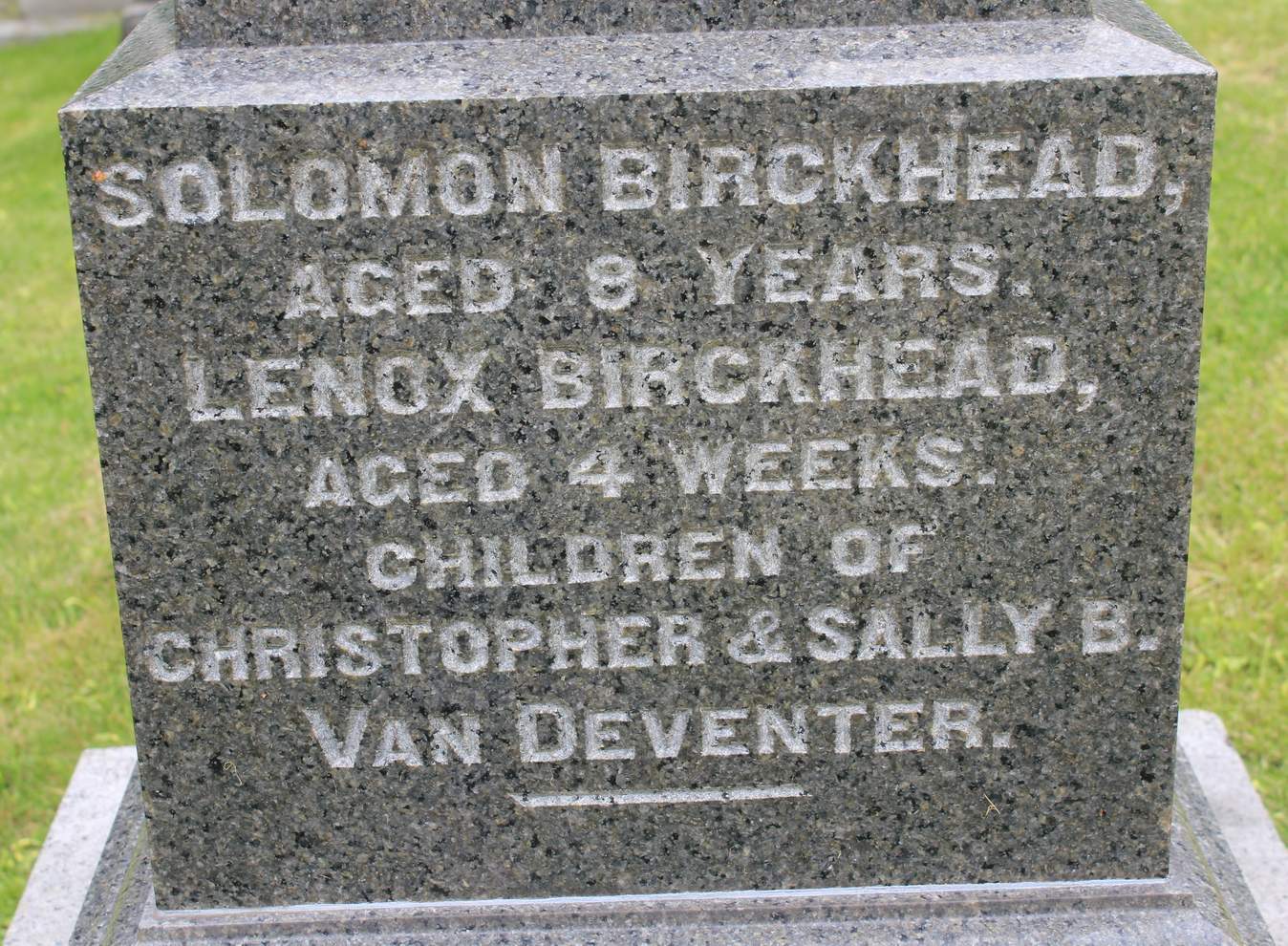
deventer children grave

Van Deventer Children’s grave. Forest Lawn.

In 1841, Sally Van Deventer build a 2-and-a-half-story Italianate home at 1500 Main Street.  The property was two acres, thickly studded with shade trees and laid out with walks and gardens.  Sally exhibited items from her gardens in the first several fairs of the Buffalo Horticultural Society, starting in 1845.  The group eventually became the Erie County Horticultural Society, they are the group that still puts on the Erie County Fair today.  Sally lived at the home with her three children –  Hugh, who became a doctor, John Thayer, who became a lawyer, and Susan, who married lawyer Myron Tyrill.  Unfortunately, the other children did not live to adulthood.  The Van Deventer family also had a staff of three – in 1850, the staff included James Noles, a 25-year-old Irish man, Kate Noles, a 15- year old Irish woman; and Jemima Coleman, a 50-year-old-Black woman.
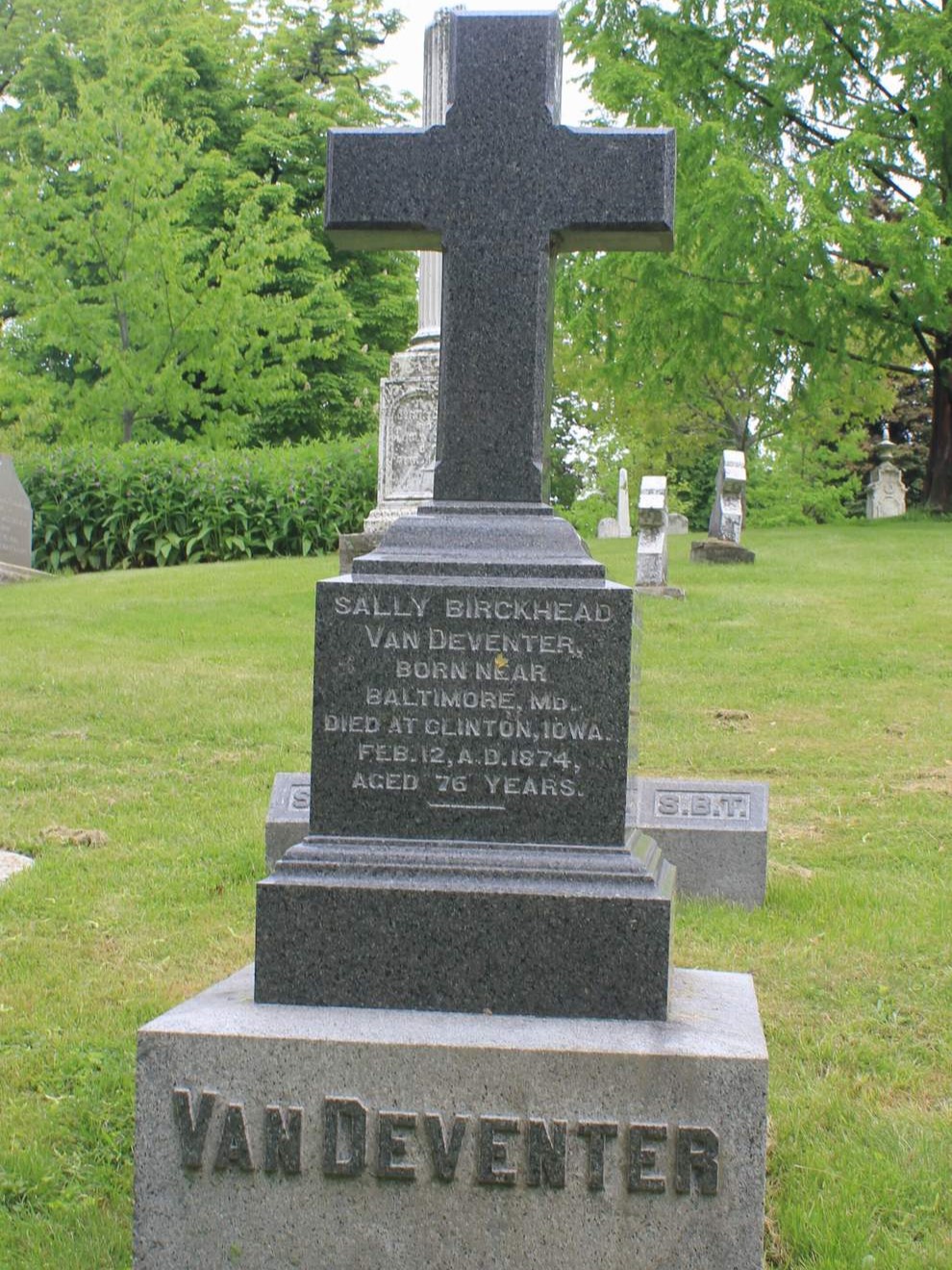
sally vandeventer

Sally Van Deventer Grave. Forest Lawn Cemetery

The Van Deventer property was listed for sale in 1856.  The family dispersed.  Dr. Hugh Van Deventer moved to the New York City Area with his family.  Myron and Susan and her mom Sally moved to Clinton Iowa.  James Thayer Van Deventer and his family also moved to Clinton, Iowa and then moved on to Knoxville, Tennessee.  Susan died in September 1873 of complications from childbirth.  Mother Sally died a few months later in February 1874.  Both Susan and Sally are buried in Forest Lawn Cemetery in Buffalo with the other Van Deventer children.  Their servant, Jemima Coleman, is also buried in Mrs. Van Deventer’s family plot.

The Van Deventer property on Main Street became Spring Abbey, a picnic grove.  Spring Abbey opened for the season in June 1867 by proprietor Adam Clark who renovated the buildings on the property and built a large ballroom for the use of private parties and excursions.  The grounds were open to the public for free.  Spring Abbey also had a beer garden, dance hall, bar and restaurant.  The buildings burnt down in December 1867.  George Weber rebuilt the grounds and constructed the existing building and reopened Spring Abbey in May 1868.  The original building also served as a hotel.  The property continued to be run as a picnic grounds until 1877 when the preparty becomes vacant.

Home for the friendless Buffalo Express

Home for the Friendless as it appeared in 1888. Source: Buffalo Express.

The Home for the Friendless formed a real estate committee consisting of Mr. Pascal P. Pratt, Mr. E. L. Hedstrom, Mr. George Gorham and Mrs. Maria M Welch.  In 1884, the property at 1500 Main Street was purchased by the Home for the Friendless for $25,000 (about $783,000 in 2023 dollars).  The building was altered and remodeled for the purposes of the home.  A three-story building was added to the back of the existing mansion.  The renovations cost $15,287(about $433,000 in 2023 dollars).  The former bar room was turned into the library and chapel used for Sunday services.  The site was dedicated on June 13, 1885.

On March 17, 1886, the family of 34 women moved into their new home on Main Street.  The Home on Seventh Street closed and was sold, having served 2,478 residents during its 20 years of existence.  The building on Seventh Street was used as Buffalo Maternity Hospital for several years before a new Maternity Hospital was built at the corner of Georgia and Seventh Streets.

dining room at home for the friendless courier express

Dining Room at Home for the Friendless. Buffalo Courier.
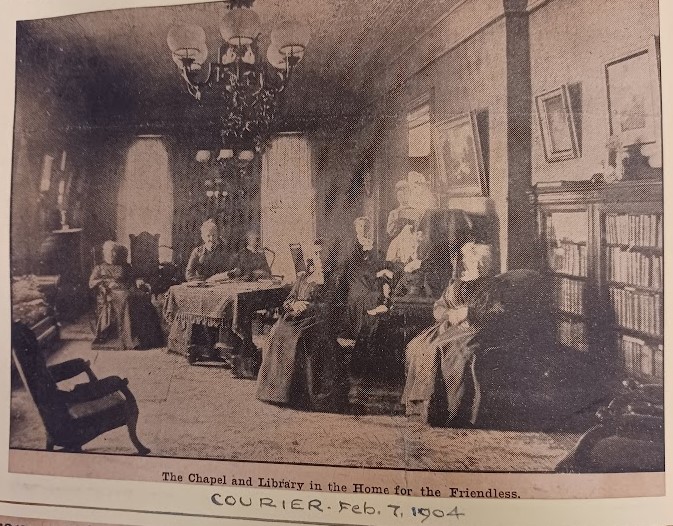
chapel and library home for the friendless

Chapel and Library at Home for the Friendless. Buffalo Courier.
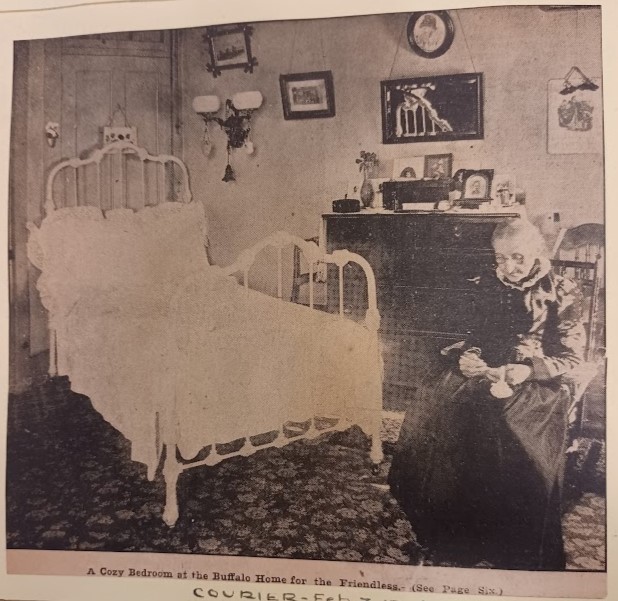
bedroom at home for the friendelss courier express

Bedroom at Home for the Friendless. Buffalo Courier.

In 1893, at the World’s Fair in Chicago, the Home for the Friendless received the Gold Medal for the best managed and most successful charity.  The Home was noted for “its long and extensive career of usefulness and remarkable financial ability shown in the management of its affairs.”

In 1907, William Mills donated money to build the Mills Annex, which added 18 more rooms, which allowed the home to be able to house 50 to 60 permanent residents, staff and transients.  This addition also provided a new kitchen, a veranda, and a sun parlor.  The new wing was built on the rear of the original home.  Until the1920s, the house continued to serve transients, but after that, the house became mostly a house for the aged.  Many of the women who had used the shelter in their youth returned to spend their retirement there.
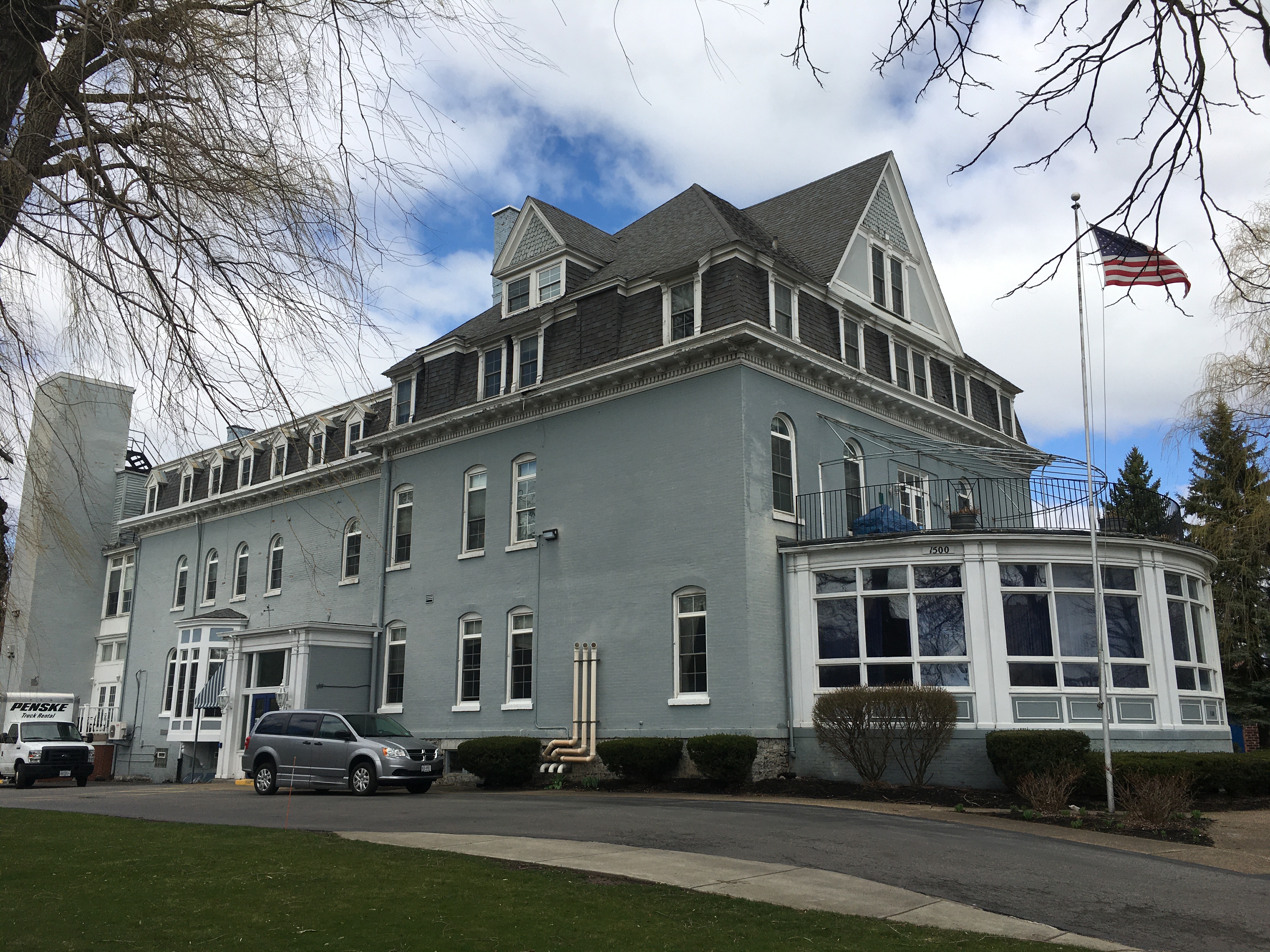
Bristol Home

Bristol Home, 1500 Main Street.

In 1956, the house at 1500 Main Street got a major renovation and remodeling.  Additional staircases were added, allowing the wrought-iron fire escapes to be removed from the property.  The front porch was removed, and a large solarium was added to the front of the house.  Tearing down an old barn allowed for a new driveway, a delivery ramp for the kitchen and increased parking spaces to be built.  After the remodel, the Board and residents finally decided to adopt a new name.  For many years, they had not wanted to change the name of the Home.  Some people felt that Home for the Friendless had a negative connotation, but many of the Board members and residents felt it had a long history.  There were also Homes for the Friendless in other cities and the sense of connection to the history meant the name stuck for a long time.  One of the proposed new names was Springhaven, giving a nod to their location in Cold Spring and their existence as a haven for women.  The name selected was Bristol Home, in honor of Edward Bristol, who had helped to bring the women together to found the Home in 1867.  And so, the Home for the Friendless name faded into history and Bristol Home was born.
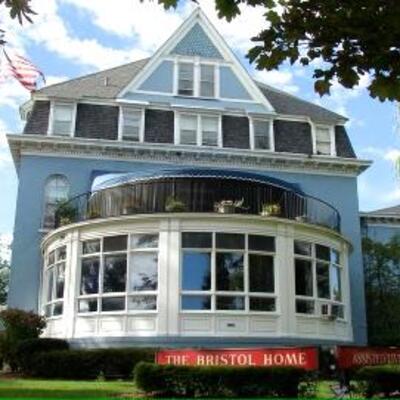
bristol home 3In the late 1970s and 80s while Main Street was under construction for the building of the NFTA Metro Rail, there was some talk of Bristol Home moving out to the suburbs.  Bristol Home stood strong, preferring their location in the City which allowed residents to be more centrally located and able to take advantage of all the amenities that living in an urban area provides.

In 2003, Bristol Villages in Clarence opened, with a facility offering assistive living and memory care.  Things change over time and in February 2021, Bristol Home on Main Street closed.  They found alternate living arrangements for their 40 remaining residents and the 45 employees at the Home.  The decision was related to financing.  The costs to run a facility to serve a poor community proved to be too great.  Bristol Villages still operates as the only freestanding nonprofit assisted living facility in Western New York.

In May 2022, the 1500 Main Street property was purchased by Jericho Road Community Health Center, with plans to move its Vive Shelter program for asylum seekers into the space.  This keeps the house at work in providing a safe place for people, a chance to find a new beginning, a similar mission to why the Home for the Friendless was originally founded. The Main Street property allows Vive to provide a better, safer and more comfortable atmosphere for residents.  Since the original Vive structure on Wyoming Street was originally built as a school, it had dorm style rooms, separating by gender.  Since the Home on Main Street has residential rooms, families will be able to stay together.   You can help them meet their goal by donating at their website here:  https://vive.jrchc.org/

So the next time you drive past Bristol Street, think of Daniel and C.C., and maybe drink some sarsaparilla!  And then next time you drive past the former Bristol Home on Main Street, give a wave and think about the Van Deventers and all the woman who have lived on the property over the last 200 years!  Want to learn about other streets? Check out the Street Index. Don’t forget to subscribe to the page to be notified when new posts are made. You can do so by entering your email address in the box on the upper right-hand side of the home page. You can also follow the blog on facebook. If you enjoy the blog, please be sure to share it with your friends.  Interested in getting even more content from me?  You can become a Friend of Buffalo Streets on patreon.   You can go to https://www.patreon.com/buffalostreets/

PS.  From Angela – thank you for understanding when I had to cancel two of my walking tours last month.  I had COVID and felt really bad about having to cancel.  I am feeling better now and planning some new tours for next summer!

Sources:

  • White, Truman C.  Our County and It’s People:  A Descriptive Work on Erie County, New York.  Boston History Company, 1898.
  • Endres, Matt.  History of the Volunteer Fire Department of Buffalo.  W. Graser, Printer, 1906.
  • Sheldon, Grace Carew.  “Seeing Buffalo of the Olden Time:  The Bristol: Sizer Homestead”.  Buffalo Evening Times.  May 11, 1909, p4.
  • “Founders of Our Holiday Festivities”.  Buffalo Courier.  January 24, 1904, p4.
  • “The Statler Stand:  Most Historic Associations of Buffalo on Site”.  Buffalo Times.  March 25, 1923, p40.
  • Burr, Kate.  “Ingersoll-Bristol Joinder of Old Families”.  Buffalo Times.  November 28, 1926, p14
  • “$6,000 Addition”.  Buffalo Express.  April 9, 1907.
  • Roberts, Katherine.  “Sentimentalist and Insurgents will Seek New Name for institution known as the Home of the Friendless”.  Buffalo Times.  August 18, 1935.
  • “Group Strives to Alter Name of Institution”.  Buffalo Courier.  October 10, 1936.
  • History and By-Laws of the Home for the Friendless in the City of Buffalo.  The Courier Company, Printers.  Buffalo, 1888.
  • Knight, Willard M.  Manual, Catalogue and History of the Lafayette Street Presbyterian Church.  Courier Company, Buffalo NY:  1876.
  • “Spring Abbey Season, 1867”.  Buffalo Courier.  June 4, 1867, p8.
  • “New Home of the Friendless”.  Buffalo Commercial.  June 15, 1885, p3.
  • “All Buffalo to have Share in Befriending Family of 69”.  Buffalo News.  September 30, 1937.
  • Burr, Kate.  “If All God’s Chillun (sic) Had a Home”.  Buffalo Times.  October 1, 1930.
  • Death of C.C. Bristol.  https://images.findagrave.com/photos/2023/76/250848919_268ec091-58ae-4604-a924-8ada8f798eda.png
  • White, David.  “A Historical Recap of Medicine Bottles.”  Buffalo News.  August 28, 1982, p148.
  • “Memory Trip Shows City First with Many Things.”  Buffalo News.  November 7, 1935, p14.
  • “48th Annual Donation Day”.  Buffalo Commercial.  September 25, 1922, p5.
  • “Free Picnic – Spring Abbey”.  Buffalo Evening Post.  June 1, 1866, p2.
  • Harris, John.  “Jericho Road completes $2M purchase for new home of Vive”.  Buffalo News.  May 5, 2022, p17.
  • “Origin of Many Street Names”.  Buffalo Times.  January 16, 1927, p67.
  • “Bristol, Cyrenius C) Papers”.  University of Rochester.  https://rbscp.lib.rochester.edu/files/finding-aids/pdf/AB86.pdf
  • “The Home for the Friendless”.  Buffalo Commercial.  October 9, 1875, p3.
  • “Buffalo Changes”.  Buffalo Express.  February 3, 1895.
  • “Home for the Friendless”.  Buffalo Express.  August 11, 1904.
  • Swift, Pat.  “Women Helping Women Made Bristol Home’s Unique Heritage.”  Buffalo news.  March 2, 1986.
  • “Home for the Friendless Gets Another Name – Bristol”.  Buffalo News.  January 16, 1957, p48.
Screenshot (46)

Fuhrmann Boulevard shown in red on map

Fuhrmann Boulevard is a street (the main street) on the Outer Harbor of Buffalo.  As we wrap up summer on Labor Day Weekend, perhaps you spent some time on Fuhrmann Blvd as you enjoyed the waterfront this summer. The street has had several configurations over time and exists today as the road that runs to the south of the elevate portion of Route 5 on the Outer Harbor.  The road was first built in 1935 and is named after Mayor Fuhrmann, who was instrumental in getting it built by securing the land on the Outer Harbor.

06fuhrmann

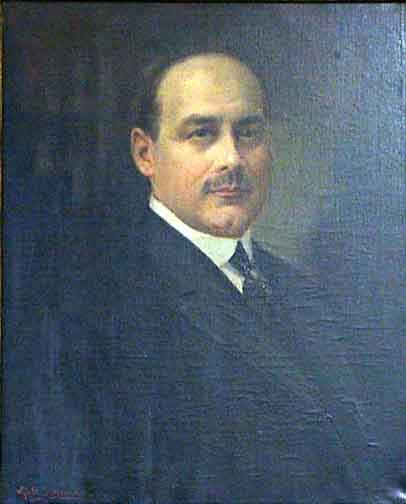
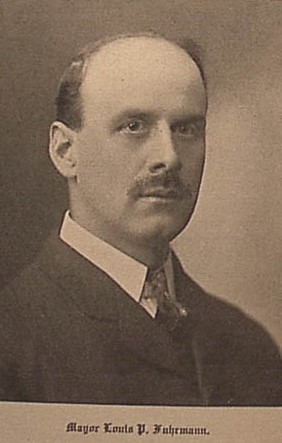
Louis Fuhrmann Mayoral Portrait

Louis P. Fuhrmann was born on the East Side on November 7, 1868 to Philip and Elisabeth Fuhrmann, who had emigrated from Bavaria.  The family lived on Clinton Street in the South Ellicott neighborhood of the near East Side, near Bennett Park.  Louis’ father owned and operated a barber shop on Genesee Street near Ellicott Street.  Louis was educated in Buffalo Public Schools – PS 32 on Cedar Street and Central High School.  While he was in school, he worked on weekends in the meat business as a butcher boy for Christian Klinck in the Elk Street Market.  After high school graduation, he was given a full time job and remained in the meat business his whole life.  Since he had so much experience, he was quickly hired to work in the wholesale beef business in the Jacob Dold Packing Company.  He was placed in charge of the Jacob Dold Packing Company’s Kansas City plant at the age of 18 years old.  After six years in Kansas City, he was homesick for his hometown.  He returned to Buffalo in 1892 to open his own business, the Louis P Fuhrmann Packing House, located at 1010 Clinton Street.

Louis Fuhrmann had a reluctant entry into politics. His first bid for public office was in 1905, when he was convinced to run for Alderman in the old Sixth Ward.  He was elected and re-elected two years later.  He quickly grew to be a leader in government.  He was such a popular Alderman that when Mayor J.N. Adam went out of town for month-long trips home to Scotland, he left Mr. Fuhrmann in charge as Acting Mayor for several years in a row.  He was well known around town and well respected for his business savvy and government experience.  He was referred to as “Louis Fuhrmann, the Progressive.”

In 1909, he ran as the Democratic candidate for Mayor.  The election was hotly contested, with Louis Fuhrmann up against a strong Republican candidate Jacob Siegrist.  At first, The Buffalo News published an Extra Edition at 6pm to announce that Siegrist was the next mayor.

Siegrist the Next Mayor

Buffalo Evening News. 6pm Extra Edition. November 2, 1909. Headline declaring Siegrist the Next Mayor.

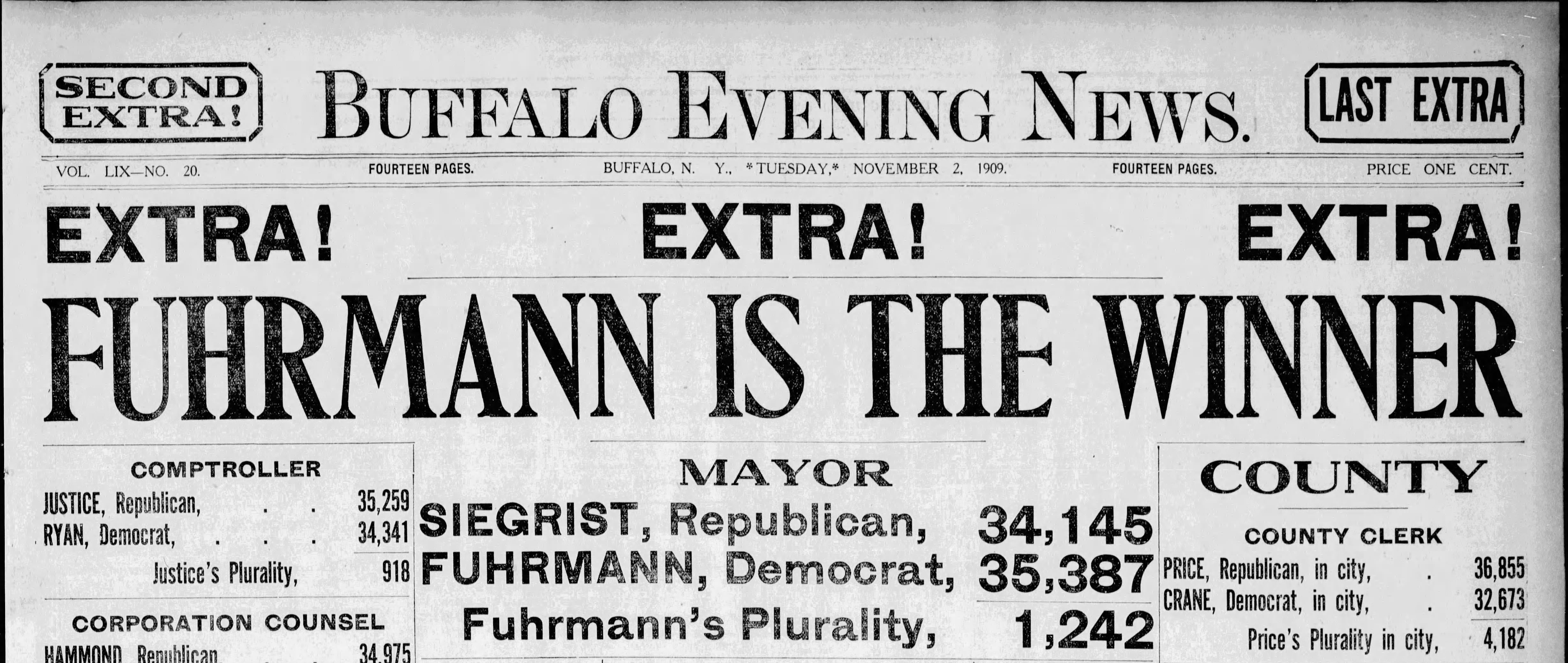
In an episode similar to that famous “Dewey Beats Truman” headlines…. ballots continued to be counted and the Buffalo News had to issue a Second Extra Edition when it became clear that Fuhrmann won!  It was reported, “when Louis Fuhrmann was elected the Mayor of Buffalo no one received a greater shock than he did.”  Republicans had swept all the rest of the seats across the City and County, other than Fuhrmann, a Democrat.  Mayor Fuhrmann was the first Mayor born and raised in Buffalo.  His mayoral office was also the first to be lit by electricity rather than gas.

Fuhrmann is the Winner

Buffalo Evening News. Second Extra Edition, November 2, 1909. Headline declaring Fuhrmann is the winner.

While Mayor Fuhrmann was in office, a major issue in Buffalo was the “Sea Wall Strip”.  This is land along the lakeshore, which today we call “The Outer Harbor”.  The questions surrounding the Strip included who owned the land and what was happening with the Hamburg Turnpike (now Route 5).  For more than 50 years, there had been more questions regarding the Strip than answers.  Shortly after election, Mayor Fuhrmann began working on the issue.  The feeling at the time was that Buffalo needed bigger facilities in order to grow, including harbor improvements – new docks, new slips and a new highway that was planned to connect Buffalo with Cleveland via the Hamburg Turnpike.

seawall strip 1889

View of the Seawall Strip from 1889. You can see how narrow some portions of the Outer Harbor was before much of the fill was added to expand the land. Source:  Buffalo Library via New York Heritage

13-01

Map showing slips and adjuncts of the Erie Canal at Buffalo. Source: History of the Canal System of New York State.

The City of Buffalo’s waterfront has been modified a great deal since the Buffalo was founded.  Building the harbor break walls, the Erie Canal and other canal slips and many other modifications over time would probably make today’s waterfront unrecognizable to those early settlers who first arrived here. Much of the Outer Harbor land has been created over time by landfill.  The “Outer Harbor” essentially was created when the Blackwell Canal was constructed in 1850.  It was built by E.R. Blackwell, who ran out of money to complete it, and so it was renamed the City Ship Canal in 1853. The City Ship Canal allowed ships to have additional areas to dock and opened up more land for waterfront access.  Additional canal slips connected the Buffalo River and the City Ship Canal, further increasing waterfront access.  This also created what is known as Kelly Island, which is technically a peninsula.  The Island is the land where General Mills and Riverworks is now; Ganson Street runs through the middle of Kelly’s Island.  In 1883, the City Ship Canal was extended to allow the Buffalo Creek Railway Company to create a series of canal slips at what we now call Tifft Farms (Lake Kirsty is remnants of those canal slips).  The City Ship Canal was partially filled in during the 1950s when Ohio Street was changed and Fuhrmann Blvd was elevated (more on that later).

The Sea Wall Strip was the land on the Outer Harbor from where Ohio Street meets the Outer Harbor north.  The Sea Wall Strip was permitted by Congress in 1837 and construction began in 1841.  In 1859, the City was authorized to construct a breakwater, but was not given the power to take land.  In 1864, the City was empowered to use condemnation proceedings to take the strip of land known as the Sea Wall Strip.  The Hamburg Turnpike ran along the Outer Harbor from Ohio Street to the City Line.  In 1874, the City acquires the Hamburg Turnpike from the Hamburg Turnpike Company.  By the 1870s, railroads crisscrossed around the waterfront.  In 1899, the Mayor created a harbor commission to investigate the disputed rights and title of who owned the Sea-Wall Strip and the Hamburg Turnpike.  In 1900, the Commission declared that the City owned the Hamburg Turnpike with a width of six rods (99 feet).  The Railroads claimed that they only owned four rods (66 feet).

erie street

1894 shoreline and canals shown overlaid in blue over modern aerial photograph. Map by Author.

Calls for beautifying the Turnpike and Seawall Strip came as early as 1902.  Planning began to build design an elevated highway that was similar to a road along the Potomac River and Anacostia Creek in Washington, DC.  The elevated route in Buffalo was to include a railing along the roadway, with trolley tracks running alongside the road and sidewalks for pedestrians.  Below the roadway would be arches where railroads could cross under the road to access the industrial plants, elevators, etc., along the road.  The road was to be the main connection between the City of Buffalo core and the Stony Point Industries being planned for opening that year.  Stony Point Industries was an early name for the steel plant and affiliated businesses that became Lackawanna Steel and later Bethlehem Steel.  The roadway project never happened because of the ownership issue.

There was a lot of back and forth judgements in court until in April 1911, the railroad agrees to drop the appeals and exchange the rights and the disputed titles, so the City of Buffalo finally owned the Sea-Wall Strip and the Hamburg Turnpike.  This would allow the ability to build a new bridge at Ohio Street for better clearance for vessels.   This also allowed them to relocate Tifft Street and Ganson Street to improve harbor facilities.  They also received 500 feet at the foot of South Michigan Street.

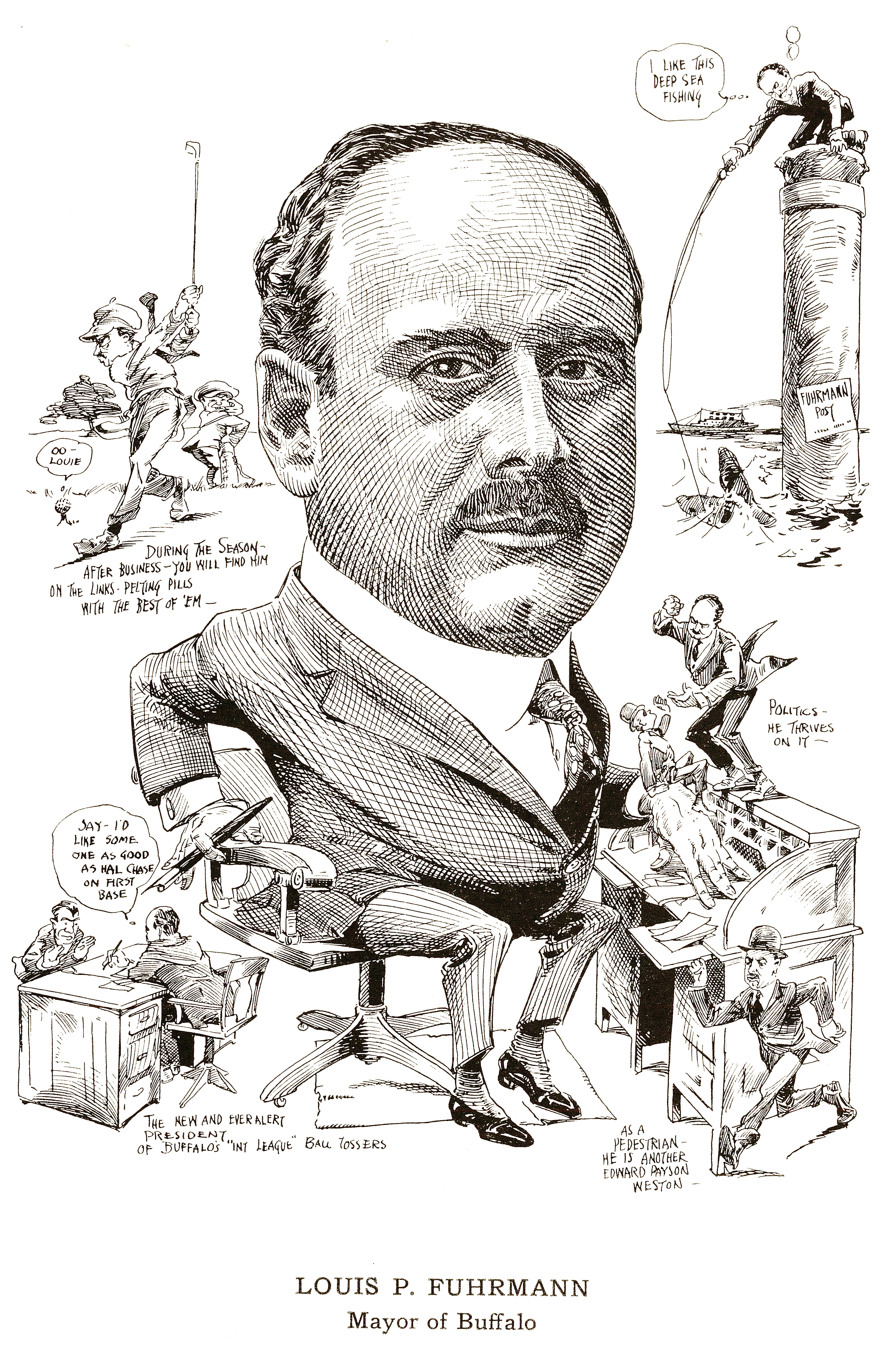
e1e0c476a660c7c1a09d05a2d2542ddf

Associated Buffalo Artists, “Louis P. Fuhrmann: Mayor of Buffalo,” from 1913. Source: Digital Collections – University at Buffalo Libraries, accessed February 13, 2023, https://digital.lib.buffalo.edu/index.php/items/show/78476.

It was reported that Mayor Fuhrmann was successful in winning the Sea Will Strip for the City, because “he is a big man mentally, as well as physically.  He has no petty notions to obscure his vision.  He has imagination and he is fearless and free.”  He was able to settle what had been “juggled, misappropriated, pawned, fought over, blanketed, buried and resurrected for a half century.”

Mayor Fuhrmann ran again for mayor in 1913.  The Democratic Party felt he was too independent and endorsed Edward J Meyer instead.  Meyer’s name may be familiar to you as the name of Erie County Medical Center (ECMC) was Edward J Meyer Memorial Hospital until 1978.  Mayor Fuhrmann won the primary contest overwhelmingly and went on to also beat both Thomas Stoddart from the Citizen’s Party and John Lord O’Brian from the Republican Party in the General Election.  During his second mayoral term, WWI broke out.  Mayor Fuhrmann was active in shaping the city’s contributions in men, money and munitions to the war effort.

Elk_Street_Decorated

Elk Street decorated for St. Patrick’s Day 1915. Source: Buffalo News.

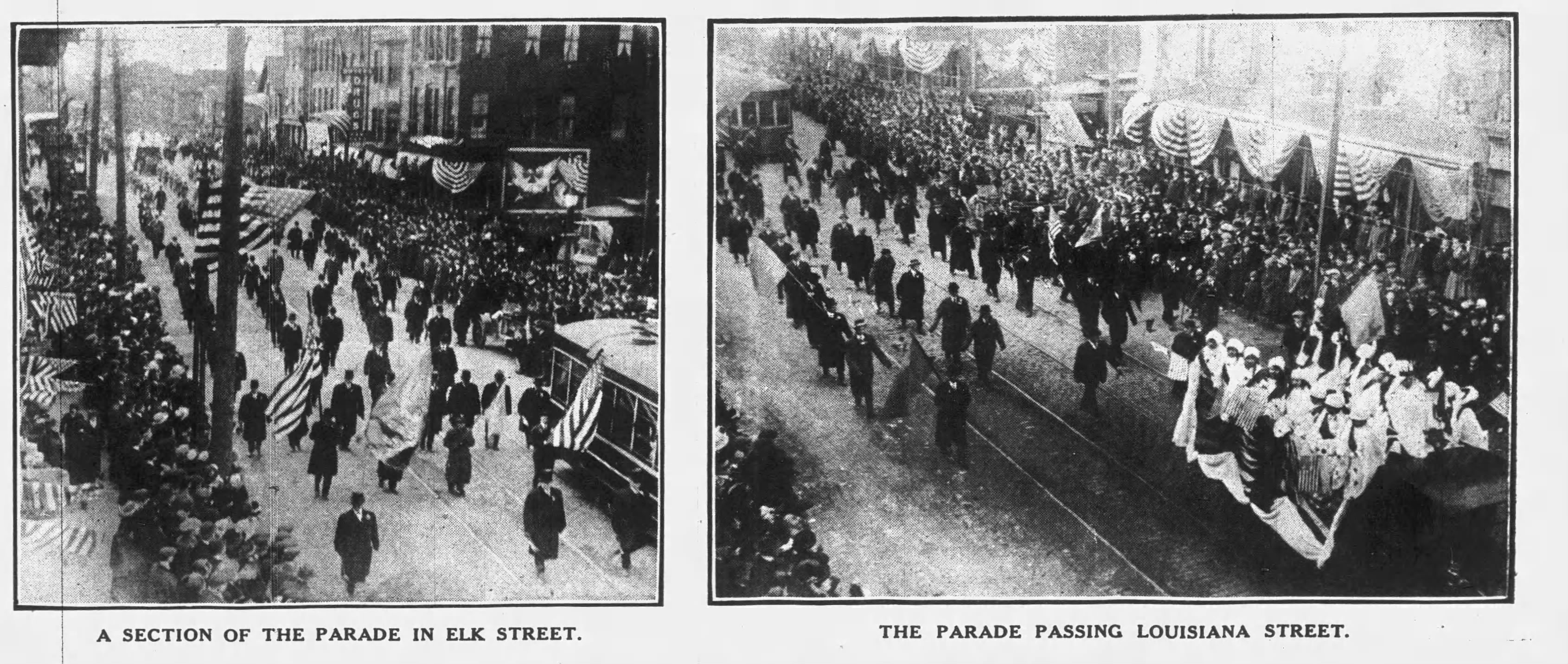
In 1915, Mayor Fuhrmann helped bring a St. Patrick’s Day parade back to Buffalo after 27 years!  Some sources hint that Mayor Fuhrmann was trying to distance himself from the rising anti-German sentiment that was rising in Buffalo as WWI was happening in Europe by supporting the Irish groups efforts for the parade. The parade in the 1880s would march up Main Street from the Liberty Pole at the Terrace to Cold Spring (around Main and Ferry)  and was led by the Hibernians and the Knights of Columbkill.  The 1915 parade started from Chicago and Fulton Streets at 2:30pm on Wednesday March 17th.  The movement for the a parade began with the Gaelic-American Association of the First Ward, an organization that had 600 members that were all born in Ireland.  The Elk Street Businessmen’s Association took charge of the idea and the result became one of the largest St. Patrick Day celebrations Buffalo had ever seen.  The idea had only come about a month before St. Patrick’s Day, and more than 1500 Irish-Americans were involved in the planning of the parade, meeting at St. Bridget’s, at the corner of Fulton and Louisiana Streets, near where the parade started.  More than 30 churches were represented during the planning for the parade, many different organizations and 11 churches marched in the parade – St. Brigid’s, St Stephen’s, Perpetual Help, St. Teresa’s, St. Monica’s, St Patrick’s at Limestone Hill, Nativity, Precious Blood, Holy Family, Our Lady of Lourdes.  More than 3,000 people marched in the parade that year.  March 17th was on a Wednesday that year, so Alderman Sullivan declared the day a half holiday in the First Ward!

st_patricks_day_parade_1915

Photos from 1915 St Patrick’s Day Parade. Source: Buffalo Times

The parade was filmed as “The Great St. Patrick’s Day Parade in Buffalo” and was shown by Michael Shea at the Shea’s Hippodrome Theatre (located on Main Street Downtown where Fountain Plaza is today) beginning on March 22nd.

The 1916 and 1917 parade had a different route, mostly on Main Street downtown.  In 1918, it was announced in January that there would be no St. Patrick’s Day parade that year.  The Gaelic Association came together and held a parade, bringing it once again back to the South Side of the city, starting at Elk and Hayward Streets.  The 1918 parade was held on Saturday March 16th , since March 17th was a Sunday, to allow for festivities not to be marred by church obligations.  The Gaelic Association made arrangements for the Marine Band to lead the parade, and American Flags were more prominent than in previous years, due to WWI.  The Association honored its members who had been called to the draft and held a reception to honor them before they left the following Monday.

In 1919, there was no parade.  The leaders of the Irish organizations met to abandon the parade to concentrate on a united effort for a big demonstration to take place after Easter.  I’m not sure if that happened.  The parade eventually faded away before being revived in 1939 as the St Patrick’s Day Parade along Delaware Avenue.  The 1939 parade went from Niagara Square up Delaware to Tupper, to Main to the Terrace.  The “Old Neighborhood” St Patrick’s Day parade was revived in 1994 to bring back the spirit of the Old First Ward.

mayor fuhrmann

Mayor Fuhrmann. Source: Buffalo and Its German Community.

In 1917, Mayor Fuhrmann was defeated in the mayoral race by George Buck.  It was also a strong year for Republicans across local elections, only one Democrat was elected that day, Councilman John Malone.  Mayor Fuhrmann’s defeat was mainly attributed to the fact that Mayor Fuhrmann opposed the change in governmental structure to a commission form of government.  The proposal eliminated the Common Council, replacing it with a commission with five members, including the Mayor, Public Safety (fire, police and health), Finance and Accounts (comptroller, treasurer, auditor and assessors), Public Affairs (education and poor departments) Public Works (bureau of water, streets, building and engineering), and Parks and Public Buildings.  Mayor Fuhrmann vetoed the proposal, which was overturned by the legislature and the Commission form of Government was created.  The new charter went into effect in January 1916.  It was in effect until 1926 when the Kenefick Commission created a new charter for the City, which separated legislative and executive  powers of the municipal government.  The City’s new charter went into effect in January 1928, vesting the Common Council with legislative powers and the Mayor in charge of executive and administrative functions.

Some sources also reported that Louis Fuhrmann’s loss was partly due to the anti-German sentiment in Buffalo during WWI.  Many parks, hospitals, streets and banks lost their German names.  German newspapers folded. Churches and business which spoke German began speaking English in the name of patriotism.  And the scrappy son of German immigrants Louis Fuhrmann lost to the Yale Law educated Anglo-American George Buck.

After Mayor Fuhrmann left office, he continued to be active in Democratic politics.  He was appointed by Frank Schwab to the School Board in 1922, where he served for five years.  While he was Mayor and while on the School Board, he fought for more high schools and helped to see the schools he fought for constructed.  In 1927, Fuhrmann became Chair of the Erie County Democratic Committee.

fuhrmann grave

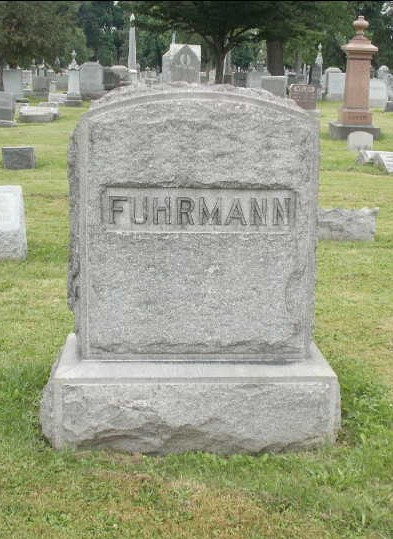
Louis Fuhrmann Gravestone, Forest Lawn Cemetery.

Louis Fuhrmann married Alice Meahl in 1900.   They had four children:  Frederick, Dorothea, Philip and Mary Alice.  The family lived at 438 North Oak Street for many years.  They later moved to Jewett Parkway.  Sadly, Mary Alice died from heart problems at just one year old, while Louis was Mayor.  Mayor Fuhrmann was a member of Concordia Lodge, F & A. M, the Buffalo Consistory, the Eagles, the Elks, the Oriels and other social lodges.  Louis Fuhrmann retired from Fuhrmann Packing House in 1927, with son Frederick taking over.

Louis P. Fuhrmann died in 1931 after two years of illness.  Mr. Fuhrmann was so prominent in the local Democratic party that it was published in the paper that all local Democratic leaders from across the county attended his funeral, along with other prominent people from Buffalo’s political, social and civic life.  His funeral was conducted by Reverend John D. Sayles, who had served as Mr. Fuhrmann’s secretary during the 8 years of his mayoral terms.  Rev. Sayles eulogized Mayor Fuhrmann by saying:

“Louis Fuhrmann was unique in his human qualities.  Everybody who knew him loved him because he himself was lovable.  Nobody ever appealed to him for help in vain.  The sick, the poor, the unlucky, the friendless, were blessed by his benefactions.  In early life he leaned that the coin of this realm cannot be legal tender in any other.  He made a fortune during his lifetime and without publicity gave more than half of it away.  Some may say that a man who does that is a fool.  If that be so, he was one of God’s fools and did not die – such fools never die unloved, unwept and unremembered.”

Mayor Fuhrmann is buried in Forest Lawn.

officials opening Fuhrmann

Opening of the Fuhrmann Blvd in 1935. From left: Edward C. Dethloff, Democratic Candidate for Council; Councilman George K Hambleton, sponsor of the boulevard and high-level bridge; Councilman Charles J. Hereth; Francis J. Downing, former ERB Executive Director and WPA Administrator; Martin P. Flemming, secretary to Mayor Zimmerman; and Democratic County Chair Frank J. Carr. Source: Buffalo Times.

Fuhrmann Boulevard opened from South Michigan Avenue to Ohio Street in August 1935.  It was built as an Emergency Relief Bureau project at a cost of $300,000 ($6.7 Million in today’s dollars).  Construction of the boulevard provided work for 1200 men for a year.  Opening this road was important for traffic along the lakeshore, as creation of the road helped traffic to avoid 2 lift bridges and 8 active at-grade railroad crossings.  During summer months at that time, traffic averaged about 20,000 cars a day.  The new Fuhrmann Drive was designed to connect to the proposed high-level bridge which was supposed to be built later that year (spoiler alert:  they had a ribbon cutting and drove the first pilings for the bridge in 1935, but the Skyway wasn’t finished until 1955).

In 1958, Governor Harriman announced an at-grade separation project to create what they referred to as the “Fuhrmann El”.  By creating this limited access highway route, they felt it would “open up the lake shore area to practically unlimited development”.  The elevated highway was considered to be an important piece of the chain of expressways from Niagara Falls to the South and West.  The elevated highway would connect the new Skyway (opened 1955) to the new Father Baker Bridge (over Union Ship Canal, built 1961), and the work that was being completed at the time in Athol Springs (the traffic circle by the Ford Plant).  The road was designed to help workers getting to their jobs at the industrial plants and to enhance the available industrial land along the route.  The road was designed by Elmer G. H. Youngmann, who was the District Engineer for NYSDOT and designed most of WNY Highways.  The Fuhrmann El route was 1.2 miles running from the Buffalo Skyway to just north of the Tifft Street interchange, which was where the approaches for the Father Baker Bridge were located.  The route was designed to be 4 lanes -two northbound, two southbound – and included a complete system of service roads for entrance and exit into the present or planned future plants along the right-of-way.  The original Fuhrmann Boulevard was reduced to just those service roads.  The expressway was 18 to 22 feet above the level of the service roads.  Because the road was so costly to build, instead of being built on an elevated steel structure, it was built on an earth embankment.

Fuhrmann El

Buffalo News sketch of the proposed Fuhrmann ‘El’ Elevated Highway.

fatherbaker-bukaty-4-sept1989_1200xx2644-1489-74-74

Demolition of Father Baker Bridge in 1989. Source: Buffalo Business First.

In 1989, the Fuhrmann Blvd area began to see another major change as the Father Baker Bridge over Union Ship Canal was demolished.  The bridge spanned 100 feet over the canal and helped to make the ride from Downtown Buffalo to Lackawanna feel like a roller coaster with the two high-level bridges.  The demolition of the bridge took two years and was the State’s most costly highway project being completed at the time.

fuhrmann boulevard

Modern View of Fuhrmann Boulevard running between the Outer Harbor and the Elevated Route 5 (on the right of image). Source: Step Out Buffalo

Beginning in the 1990s, there was renewed interest in the waterfront.  The Southtowns Connector Feasibility Study was completed in 1991.  It was included in the Horizons Waterfront Action Plan, prepared in 1992.  The plan would have moved the highway inland to the CSX tracks, opened up more of the Outer Harbor Land for development.  In 2001, the project was refocused based on comments received from agencies and the public.  The concern was that moving the highway would have unacceptable impacts on neighborhoods and the environment, as well as being too costly to be able to be completed in a reasonable amount of time.  So, the decision was made that the elevated Route 5 would remain.  The new plan became focused on changes to the existing road system rather than fully relocating the highway.  This helped to create a project that was actually able to be completed.  Fuhrmann Boulevard was improved and became more of an actual road once again, rather than just an intermittent service road which provided access to properties.  Multi-use trails were placed along the road, with signage celebrating the industrial heritage of the Outer Harbor.

If you’re wondering what happened to Fuhrmann’s Meatpacking business?  Son Frederick Fuhrmann took it over when Louis retired and it was ran by the Fuhrmann family until 1945 when it was purchased by Mr. Teplesky of Tog Packing.  They operated until 1980, when the business was sold to P Brennan Meat Wholesalers.  In 1999, an action was held to sell the equipment.  A building was still standing on the site until 2007, but it has since been demolished.  It is now a vacant lot.

Want to learn about other streets? Check out the Street Index. Don’t forget to subscribe to the page to be notified when new posts are made. You can do so by entering your email address in the box on the upper right-hand side of the home page. You can also follow the blog on facebook. If you enjoy the blog, please be sure to share it with your friends.  Interested in getting even more content from me?  You can become a Friend of Buffalo Streets on patreon.   You can go to https://www.patreon.com/buffalostreets/

Hope to see some of you on my upcoming tours this month!  For more info on tours, click here.

Sources:

  • “Louis P. Fuhrmann”. Buffalo Courier-Express. Feb 24, 1931, p5.
  • “Ex-Mayor Fuhrmann Dead” Buffalo Courier-Express. Feb 24, 1931,p1.
  • Mueller, Jacob.  Buffalo and Its German Community.  German-American Historical and Biographical Society.  1911-12.
  • “Mayor Fuhrmann Was Efficient Executive”.  Buffalo Times.  July 13, 1924.  P45.
  • “Winning the Sea Wall Strip for Buffalo”.  Buffalo Sunday News.  August 27, 1911, p 13.
  • “Parade Details are Settled for St. Patrick’s Day”.  Buffalo Courier.  March 14, 1915, p 74.
  • “Four Thousand in St. Patrick’s Day Parade Wednesday”.  Buffalo Times.  March 14, 1914, p43.
  • Gaelic Association to Parade on St. Pat’s Day”.  Feb 24, 1918, p45.
  • “20,000 Marches Enroll for parade St Patrick’s Day”.  Buffalo Times.  February 25, 1917, p17.
  • “St. Patrick’s Day Parade to Outshine All Affairs of its Kind In History”.  Buffalo Courier.  February 22, 1915, p6.
  • “In the Good Old Days:  St. Patrick’s Day in Years Long Past”.  Catholic Union and Times.  January 14, 1915, p5.
  • Burr, Kate.  “Old St. Patrick’s Day Parades.  Buffalo Times.  March 17, 1932.
  • “Great Legal Contest to Determine Ownership of Hamburg Turnpike”.  Buffalo Times.  October 12, 1902
  • “Beautify the Turnpike”  Buffalo Express.  June 8, 1902.
  • “Boulevard Change Ready for Opening”.  Buffalo Times.  August 22, 1935.
  • “Start of Work on Furhmann El Due in Early 59”.  Buffalo News.  August 6, 1958 p 29.
  • McCarthy, Robert.  “Closing Brings Bridge to Dead End Father Baker Span Was Monument to Industrial Might”.  Buffalo News.  August 22, 1989.
  • Whitford, Noble E.  “Slips and Other Adjuncts of the Erie Canal at Buffalo”. History of the Canal System of New York State.  Brandow Printing Company.  1906.
  • Adam, Thomas.  German and the Americas:  Culture, Politics and History.  ABC-CLIO.  2005.
  • “Sons of Old Erin Honor St. Patrick in Street Pageant”.  Buffalo Times.  March 17, 1917, p1.
  • “No Parade By Irish on South Side Today”.  Buffalo Times.  March 17, 1919, p7.
  • “Baby Daughter of Mayor Dead”  Buffalo Enquirer.  January 7, 1915, p6.
  • “Hundreds Pay Final Tribute to Fuhrmann”  Buffalo News.  February 27, 1931, p1.
  • Roseberry, Jack.  “Fair-ly Long Custom of Camp Aid Ends with His Retirement”.  Buffalo News.  August 13, 1980, p10.

Update:  Unfortunately, the tours on Saturday September 16th and Monday September 25th have been cancelled.  I apologize for any inconvenience.  I have COVID.    

At long last, I have scheduled some dates for walking tours for this season!  For those who have reached out asking about this years tours, thank you for your patience – this summer has been kind of crazy!

Once again, I’m giving two distinct tours – Discover Downtown – Then and Now and Discover Lower Main Street. These tours will be free, as I want to ensure they are accessible to all, but donations will be graciously accepted. All money received will go directly into continuing to build up Discovering Buffalo, One Street at a Time.

5aDiscover Downtown – Then and Now – we will look at the area around Lafayette and Niagara Squares and the core of Downtown Buffalo.  We’ll talk about the history of the central part of Downtown as the city grew and the buildings in the area.  You’ll also get an up close look at the progress of the Main Street Multi Modal Access and Revitalization Project (Cars Sharing Main Street) which is currently working on replacing the 35 year old metro rail track bed.
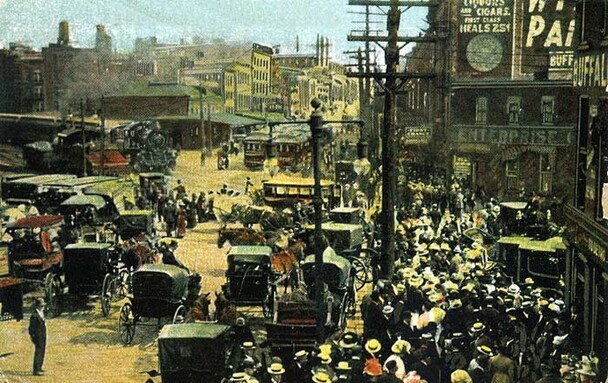
This tour meets outside of Public Espresso in the Hotel Lafayette, 391 Washington Street, at the corner of Washington Street and Clinton Street.  The tour will be about 1.5 miles and will be a loop that ends near the starting point.

This tour will be offered:

(Canceled) Saturday September 16th at 1pm.  More info at link:  https://www.facebook.com/events/318564317283457

Monday October 2nd at 5:30pm.  More info at link:  https://www.facebook.com/events/859451828498834/

foot_2-608wDiscover Lower Main Street – this tour looks the area of Lower Main Street, south of Church Street, portions of the former canal district, and the Erie Street corridor.  We’ll talk about some of the earliest history of Buffalo, how the area has changed over the last 150 years, and you’ll get an view of the construction happening right now at Heritage Point.
This tour will start at the Tim Hortons in Harbor Center, 1 Scott Street, corner of Main and Scott Streets.  The tour will be about 1.5 miles and will be a loop that ends near the start.  This tour does include going down one staircase, and walking up 2 other staircases, each about 15 steps.

This tour will be offered:

Sunday September 10th at 11am.  More info at this link:  https://www.facebook.com/events/1347975509263485

Canceled Monday September 25th at 5:30 pm.  More info at this link:  https://www.facebook.com/events/256819873947207

To RSVP for any of the tools, you can email buffalostreets@gmail.com or feel free to just show up! Tours will be rain or shine. Looking forward to seeing some of you on tours!  I always enjoy getting to talk history with people in person.

I will be on the schedule for University Express again this fall, talking more streets!  The sessions begin in October and schedules for that will come out soon, so keep your eyes out for more info about that as well.  I’ll be at a few locations that are new to me, so I’m looking forward to hopefully meeting some new people!

Hope you’re all enjoying these last few weeks of summer.  You might find me at a couple more Bisons games, trying to soak up the waning days of baseball season!  Go Herd!

Screenshot (44)

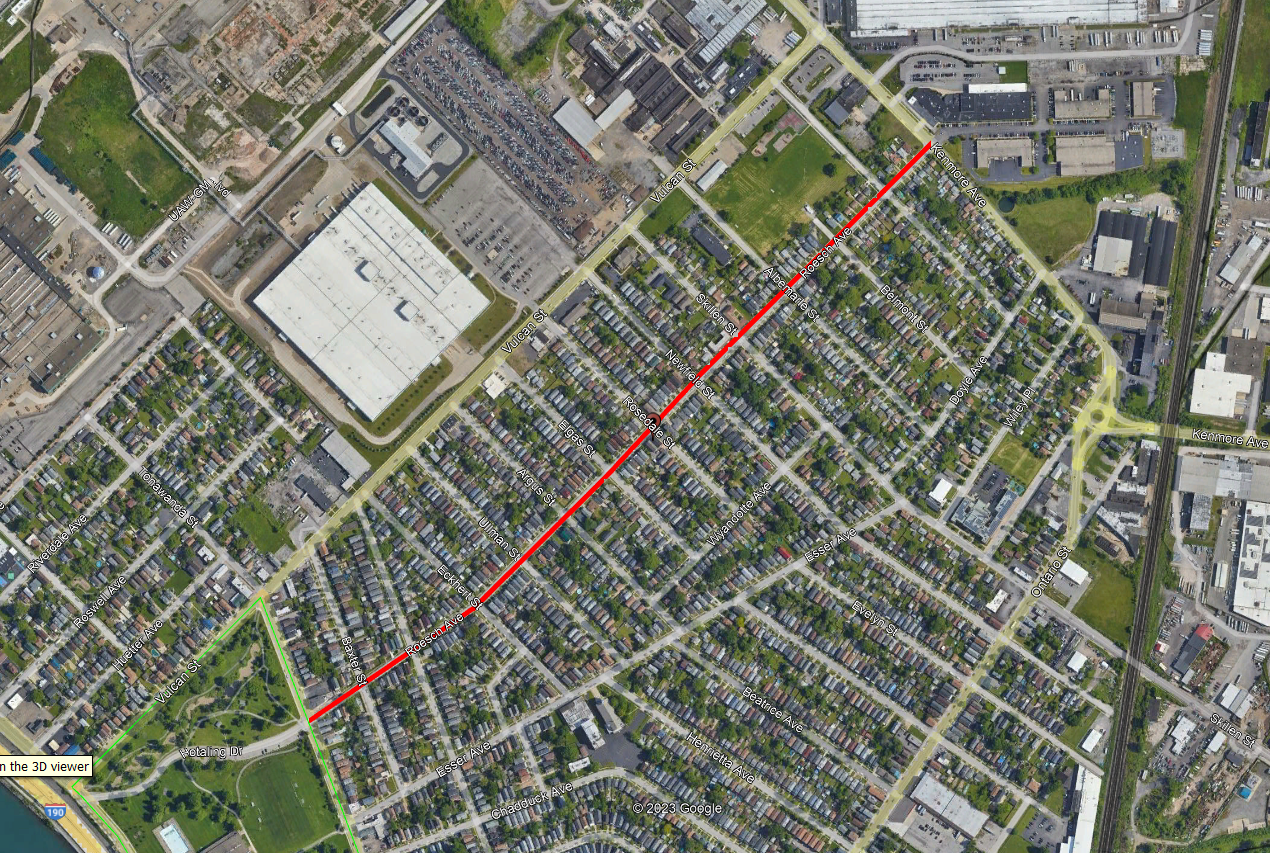
Roesch Ave in Riverside shown with red line on map

Roesch Avenue runs between Tonawanda Street and Kenmore Avenue in the Riverside Neighborhood, near the northwestern edge of the City of Buffalo.  The street is named for Louis Roesch.  The Roesch (pronounced like fresh) family is a family of butchers still known in Buffalo today!

Louis Roesch came from Baden, Germany in 1869 with his brother Jacob.  Louis and Jacob worked as butchers, so Buffalo was a logical pace to come, as we were a center of meat processing.  They quickly got jobs here in Buffalo and lived frugally to save money to establish their own butcher shops.

Louis established his butcher shop at 1923 Niagara Street in Black Rock, with a barn and slaughterhouse at the corner of Hamilton and Dearborn Streets.  Louis was eventually able to take over the North Buffalo Hotel at 1921 Niagara Street (at the corner of Hamilton Street), where he operated a restaurant and continued with his butcher shop.  His slaughterhouse was on the grounds, and he kept a few extra cows to supply fresh milk.

Louis and his family were known for their love of dances.  They hosted regular dances at the North Buffalo Hotel.  They were strict, old-school Germans, so the dances were “decorous and dignified -the sort of dances parents of the neighborhood were pleased to have their sons and daughters attend.”

Louis would return to Germany several times to go back home to visit his family.  On one of the visits, he convinced his brother George Frederich (Fred) to join them in Buffalo.

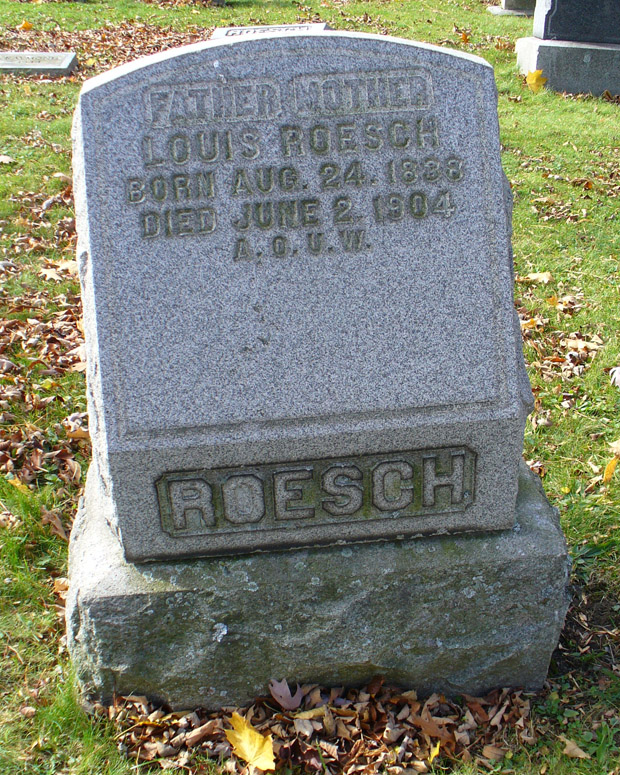
Louis Roesch was a lifelong Democrat and friend of Grover Cleveland.  He was elected Alderman of the old 12th ward in the 1885 and served two terms.  In an article describing the candidates running for Alderman, the Buffalo Express described him as “grey, sparsely built, and is passionately fond of red neckties.”

While Alderman, Louis Roesch had the first asphalt pavement laid in Black Rock, up Niagara Street.  At the time, some of the streets had been paved with cobblestones, but the majority of Black Rock’s streets were dirt roads at the time.  Residents in the area had to have their coal delivered during the summer.  The roads would be muddy in the fall and too snowy/icy in the winter, so the coal trucks were unable to deliver since the roads were impassible. He was also instrumental in the construction of the Hertel Avenue sewer while he was Alderman.

In 1888, the land that would become Roesch Avenue was part of the large tract of land that was purchased by Louis Roesch, John Hertel, John Esser and Frank Argus as the Black Rock Land Company, one of the first development companies in Buffalo.   Streets were named after each of the men.  The land was purchased at the low price of $1/foot.

After buying the land, Mr. Roesch worked in the Real Estate business, while continuing to manage his hotel, butcher shop and slaughterhouse.  He was known for helping young men get a start in life and being generous with his time and money.

Mr. Roesch loved horses and was proud of his ability to pick fast horses.  Once, at an auction, he picked up what was supposedly a washed up race horse for $10.  His neighbor teased him for buying the horse.  Mr. Roesch bet the neighbor $100 that his new horse could beat any of his neighbor’s horses in a race from Niagara and Amherst Street to Niagara and Main Street downtown.  Mr. Roesch’s horse won!

Louis married Rosina Rupp, who lived in Buffalo but had come from the same village in Germany where Louis had lived as a boy.  They had thirteen children.  The family lived at 276 Dearborn Street.   They were members of St. John’s Evangelical Church, at 85 Amherst Street.

roesch louis grave

Louis Roesch Grave, Forest Lawn Cemetery.

Louis died June 3, 1904 at age 65 from Bright’s Disease (kidney disease now called nephritis).  After his wife Rosina’s death in 1920, the five remaining Roesch children – Louis, Edward, Charles, Caroline and Rosina moved to Seattle, Washington with their families.

So remember how Louis Roesch came to Buffalo with his brother Jacob P. Roesch in 1869?  While Louis has the street named after him, Jacob’s side of the family tree is better known in Buffalo these days!  Jacob P. Roesch also worked as a butcher here in Buffalo until 1895, when he went into the confectionary business.

Jacob P. Roesch’s son, Jacob M. Roesch entered the meat business at the age of 13 as a clerk in the meat market of Andrew Rupprecht.  He spent time time in Cleveland, St. Louis, Kansas and Pennsylvania learning the meat business.  Jacob M Roesch returned to Buffalo to opened a stall at the Washington Street Market in 1878.  He also operated a packing house on Oak Street and a meat market at the corner of Ferry and Niagara Streets.  He oversaw a large shipping trade.  In 1895, Jacob M. Roesch was appointed Market Clerk of the Washington Street Market by Mayor Jewett.  The Market Clerk managed the markets, keeping market records and helping the market run efficiently.

Jacob M. Roesch married Julia Fuelhart in 1880.   They had three children – John Jacob, Charles Edward, and Lillian Philipene.  Their family lived at 613 North Oak Street.

Charles and John Roesch took over their dad’s market stand at the Washington Street Market.  The business was named Jacob M Roesch & Sons in 1911.  Their stall was number 2, at the Chippewa end of the Market.

In 1916, Charles and John decided to take separate paths and Charles opened a butcher stall in the Broadway Market as Charles E Roesch & Company.  He also opened a wholesale poultry business behind the home at 613 Oak Street.

Charles_E_Roesch_-_1932_BPDReport

Mayor Charles Roesch. Source: City of Buffalo Annual Report of the Department of Police, 1932.

Charles E. Roesch was elected Mayor of Buffalo in 1929.  He became mayor in 1930, at the time of the Great Depression.  Thousands were unemployed both in Buffalo and across the country.  As a businessman himself, he intended to run City Hall like a business.  He did things differently than previous mayors.  He chose to drive his own car.  He didn’t like attending fancy dinners or giving speeches.  He didn’t want to be considered an exhibit, he wanted to get the work done of city governance rather than parade around. He said “there should be more “we” in the city government and less of “I”.  I don’t believe any one man is big enough to run a city.”

Mayor Roesch oversaw relief programs for the unemployed.  He created a man-a-block system that was later adopted across the country.  Under this system, every street in the City was canvassed and those who were fortunate to have jobs would hire unemployed men to do odd jobs for them.  This program provided employment for almost 2000 jobless at a minimum of $15 a week.  The program soon provided inadequate as the depression worsened, but it continued to keep thousands off the relief rolls long after government work and home relief became available.

As the Great Depression worsened, the Mayors Unemployment Committee was formed.  Alfred Schoellkopf served as chairman.  The Committee was so successful, Mr. Schoellkopf was selected to head the New York State Temporary Emergency Relief Agency, which adopted the same methods used in Buffalo across the State.  At the end of 1931, Buffalo became the first city in the country to embark on a work relief program, with employment given to people coming from the home relief rolls.  It wasn’t until two years later that the federal government, through CWA (Civil Works Administration) created a similar program across the Country.  In 1932, Mayor Roesch served as President of the New York State Conference of Mayors, where he fought to have the State help reimburse communities for welfare expenditures.  Mayor Roesch’s proposal for the State to provide a 40% reimbursement later was included in the Wicks Act, which was realized in 1936.

While Mayor Roesch is best known for being one of Buffalo’s Great Depression Mayors, one of the other major issues during his term was transportation.  Mayor Roesch began planning began for the proposed seaway highway and a new bridge to replace the Michigan Street bridge.  These projects were delayed by the Depression, but eventually turned into Furhmann Boulevard and the Skyway.

Mayor_Reosch_new_office_at_city_hall

Mayor Roesch in his brand new City Hall Office, December 21, 1931. Source: Buffalo Times.

Mayor Roesch was the first Mayor to serve in the newly built City Hall.  When he first became Mayor, his office was in the Liberty Building on the 11th floor while they waited for City Hall to be completed.  The former Mayor’s office was located in the building that we now call Old County Hall on Franklin Street.  Old County Hall had originally been shared by the City and the County, but it had been turned over to Erie County during the construction of City Hall.  In December 1931, the Mayor’s new office on the 2nd floor of City Hall was ready for Mayor Roesch to move in.  Mayor Roesch was the final city official to move into City Hall.  However, Mayor Roesch was known for seldom being found in his actual office.  He could often be found on the 21st floor where Budget Director Albert Preston’s office was located, or on the 11th floor with Charles Feldman, Corporation Counsel.  With his philosophy of leadership by teamwork, he was known for meeting with the department heads in their offices, away from the pretentiousness of the Mayor’s office.

Mayor_Roesch

Jack Moranz profile on Mayor Roesch.  Jack Moranz was an internationally known artist and cartoonist who sketched a number of Buffalonians during the summer of 1930 for special publication buy the Buffalo News.  Mayor Roesch was the first sketch published in June 1930.  Source:  Buffalo News

Mayor Roesch was only mayor for one term, which was how the City Charter was written at the time.  Mayor Roesch felt strongly about the single term concept.  While he was Mayor, Council wanted to amend the charter to allow him to succeed himself and remain Mayor.  Mayor Roesch refused, saying he would veto any legislation that tried to do so.  He felt that his election was under the assumption it would be one term and that it would be unfair to the people of Buffalo for the conditions to change while he was serving.

Mayor_Roesch_as_a_butcher

Mayor Charlie the Butcher, December 1931. Source: Buffalo Times.

While serving as Mayor, Mayor Roesch would still help out as a butcher.  Shown here in 1931 (just two days after he moved into his new office in City Hall) helping the Buffalo Restaurant Men’s Association prepare 2000 Christmas baskets for Buffalo’s needy families.  After his mayoral term, he returned full time to the meat business.  He would often report that his favorite food was roast beef and mashed potatoes.

Charles E. Roesch married Mabel C. Klinck.  Mabel’s mother was Julia Fuhrmann, sister of former Mayor Louis P. Fuhrmann for whom Furhmann Boulevard gets its name.  Charles and Mabel had two sons, William Klinck and Charles Jacob.  The family lived in the upper apartment at 633 North Oak Street, at the corner of Carlton Street, just down the street from where Charles had been born.  Oak Street was well known in Buffalo as being the home of three Buffalo Mayors, before the neighborhood was lost to urban renewal.  When Charles was elected Mayor, Mrs. Roesch reported that she was accosted by realtors looking to help sell them a house that was a “better fit for a Mayor”.  They insisted on staying in the neighborhood they loved dearly.  They knew their neighbors well and would not move.  They also refused to take on a maid as was suggested to them to indicate their status as a “respectable family of means”.  Mrs. Roesch took care of the house on her own.  She felt that housework was not an irksome task, but a source of fun and pleasure, so she preferred to do the work herself.

charles roesch grave

Mayor Charles E Roesch grave in Forest Lawn

Charles E Roesch died on January 15, 1936.  He is buried in Forest Lawn.  The day of his funeral, the current Mayor George Zimmermann declared a full Civic Holiday in Buffalo in honor of the former Mayor.  It was believed by many that if Mayor Roesch had not passed away, he would have ran for a second term in 1937 and won.  He was often referred to as “Buffalo’s Greatest Mayor”.

Charles_J_Roesch_Mayor Roesch’s son, Charles J. Roesch was born in January 1916.  He graduated from University of Buffalo in 1938 and entered the family meat market business with his brother William.  Charles J. Roesch became president of the firm in the mid-1960s.  Charles J. Roesch married Doris Yuhl in 1939.  They had two children, Charles W and Susan.  When Susan was married in November 1963, the wedding was on a Wednesday because that was the day that the Broadway Market was closed so that her dad and uncle could attend the wedding!  Charles J Roesch was also an avid bowler, serving as president of the Buffalo Bowling Association as well as of the State Masonic Bowling Association.  Charles J. Roesch retired from the meat business in the mid-1980s.  He passed away in March 1990.
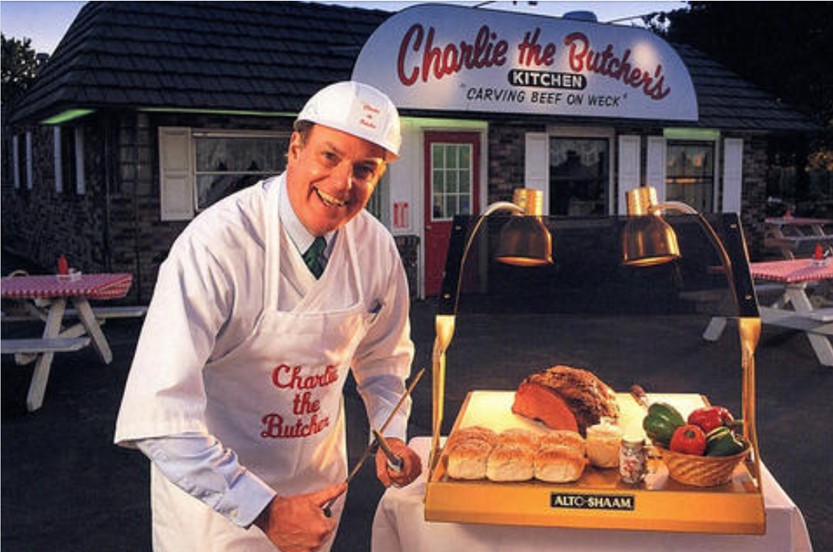

Charlie_carving_

Charlie the Butcher in front of his shop on Wehrle. Source: http://www.charliethebutcher.com

Charles W. Roesch was born in 1949.  He grew up around the meat business but decided to attend the University of Toledo, where he received a chemistry degree.  The pull to return to Buffalo and join the family business was strong.  Charles W. took over the Charles E. Roesch stand in the Broadway Market after his dad’s retirement in the mid-80s.  He realized the butcher model needed to change as supermarkets in the suburbs started to draw traffic away from the butcher shops at markets.

IMG_20230716_161928_221

Beef on Weck at a Bison’s Game.  Because sometimes you don’t want a hot dog (sorry Sahlen’s)  Photo by Author.

Charles W Roesch branded himself as Charlie the Butcher beginning in 1984 at a tradeshow.  With his trademark branded apron, button up shirt, tie, and bumphat (the hardhat that butchers wear), he started by selling sausage on a stick for $1 and began cooking meats to sell sandwiches through catering.  Eventually they started selling their famous hand-carved roast beef on weck.  The sandwich, invented in Buffalo in the 1800s is a quintessential Buffalo food, second only perhaps to the Buffalo wing.  A lot of the popularity of the sandwich is in part to Charlie himself! In 1993, Charlie took over a former hot dog stand on Wehrle Drive at the Amherst/Cheektowaga border, becoming Charlie the Butcher’s Kitchen in 1993.  They opened a downtown “Charlie the Butcher Express” location in the Ellicott Square building a few years later.  Charlie’s reputation and charming personality make him a common presenter on food segments on local news shows like AM Buffalo, helping to market the business.  He’s done appearances across Western New York and across the entire country – New York, Toronto, Washington DC, Orlando, Chicago, Cleveland, Milwaukee, Dallas and San Diego – and even in Europe in Düsseldorf, Germany, and Lyon, France!

Mayor Roesch and Charlie WGRZ

Mayor Charles E Roesch’s portrait and his grandson, Charlie the Butcher, celebrating the 100th anniversary of Charles E Roesch Meats in 2014. Source: WGRZ

rop-charlie-the-butcher-charlie-roesch-bonnie-roesch-trd-bbf7786-07xx23

Charlie and Bonnie Roesch. Source: Buffalo Business First

Charlie the Butcher can now be found at locations throughout Western New York and as Charlie on Location, the catering side of the business.  You can also get Charlie the Butcher cooked roast beef at Dash’s, Market in the Square, and Tops Markets.   The company, led by Charlie and his wife Bonnie, are continuing to grow and evolve.  They’re now working to expand their reach outside of the 716 area code by making roast beef and weck seasoning mixes available to ship anywhere.  That’s right, all of you Buffalo ex-pats who read my blog – you can order your very own make your own beef on weck kit!  Head to charliethebutcher.com to learn more.

So the next time you drive past Roesch Ave, think if Alderman Louis Roesch and thank him for paving Niagara Street or remember his Great-Nephew Mayor Roesch or his Great-Great-Great Nephew Charlie the Butcher.  And the next time you stop for a Charlie the Butcher sandwich, think of the generations of butchering that has led us to that delicious Buffalo food.

Want to learn about other streets? Check out the Street Index. Don’t forget to subscribe to the page to be notified when new posts are made. You can do so by entering your email address in the box on the upper right-hand side of the home page. You can also follow the blog on facebook. If you enjoy the blog, please be sure to share it with your friends.  Interested in getting even more content from me?  You can become a Friend of Buffalo Streets on patreon.   You can go to https://www.patreon.com/buffalostreets/

I’ll be hosting a Buffalo History Chit Chat on Monday August 14th at 7pm EST.  I’ve been busy this summer and haven’t had a chance to host any tours, but I figured we could get together (virtually) and chit chat about Buffalo history! This will be a chance for me to talk with you about some of the current things I’m researching, share some of my favorite history stories, and to answer some of your burning history questions! For more information and tickets, click this link.  I’m particularly excited to be able to connect with some of my readers who no longer live in Buffalo!  I hope you’ll join me.  If this event is successful, it will hopefully be the first of many of these!

Sources:

  • Smith, H. Katherine.  “Roesch Avenue is Memorial to Area Developer and Alderman”.  Buffalo Courier-Express.  June 15, 1941, p7-3.
  • “Louis Roesch Has Passed Away”.  Buffalo Courier.  June 3, 1904, p7.
  • “Jacob Roesch Dead”.  Buffalo Evening News.  February 12, 1903.  P5.
  • White, Truman, editor.  Our County and Its People: A Descriptive Work on Erie County, New York, Volume 2.  Boston History Company.  1898.
  • “Our Story”.  Charlie the Butcher website:  https://www.charliethebutcher.com/index.php/our-story/
  • “John Roesch So Badly Burned That He May Die”.  Buffalo Evening News.  September 30, 1902.  P 18.
  • “These Are Our Rulers:  Aldermen of the Past, Present and Future”.  Buffalo Express.
  • “Louis Roesch has Passed Away”  Buffalo Courier Express.  June 3, 1904, p1.
  • Rizzo, Michael.  “Charles E. Roesch”.  Through the Mayor’s Eyes.  http://www.buffalonian.com/history/industry/mayors/Roesch.htm
  • Violanti, Anthony.  “Days of the East Side Packers”.  Buffalo News.  May 30, 1990, p17.
  • “Charles J. Roesch, businessman, national bowling executive dies”.  Buffalo News.  March 2, 1990, p33.
  • Bermingham, Don.  “Buffalo Emerges From An Era of Disillusionment.”  Buffalo News.  December 30, 1939, p24.
  • Wandell, Walt.  “Roesch, the Man, as He Reveals Himself on Even of Taking Office.”  Buffalo Times.  December 29, 1929.
  • “Kept Promise, Sons’ Respect, Roesch Says”.  Geroge Kennedy.  Buffalo Tmies August 13, 1933.
  • Drury, Tracy.  “With Beef on Weck as Its Calling Card, Charlie the Butcher Continues to Evolve”.  Buffalo Business First.  July 7, 1923.
  • Fiddler-Woite, Julianna and Reverend Jamie Retallack.  Lutherans in Western New York.  Arcadia Publishing, 2015.
  • “Roesch Estate to Be Settled”.  Buffalo News.  July 5, 1938.
Screenshot (71)

Asbury Alley shown in red. The former right of way of the rest of they alley is shown in yellow.

Asbury Alley is a short, narrow alley running parallel to Pearl and Franklin Streets, north of Chippewa Street in Downtown Buffalo.  The alley takes a turn mid-block and runs to Pearl Street.  Asbury Alley is one of the few remaining brick streets in Buffalo; however, much of the brick has been covered as asphalt from the parking lots has encroached into the alley.  Asbury Alley historically ran another block south to Huron Street, but the majority of the alley south of Chippewa has been covered by the Augspurger Parking Ramp since 1983.  The portion of Asbury Alley south of Chippewa which still exists is gated.

asbury alley

Asbury Alley looking north from Chippewa.  Photo by author.

Asbury Alley gets it’s name from a church that used to be located on it.  Asbury Church was first established on March 22, 1847.  At this time, members of the Niagara Street Methodist Church (located at Niagara and Franklin Street) looked to establish a new congregation in the northern part of the expanding downtown core.  They established a church at the northwest corner of Pearl and Chippewa Streets, known as Pearl Street Methodist Church.  The first church on the site was a plain brick two-story structure which was ready for services on June 16, 1848.  In 1850, the church changed it’s name to Asbury Church after Bishop Francis Asbury, though, as we know in Buffalo, we hold on tight to former names of things, and newspapers of the day alternately referred to the church as both Pearl Street Church and Asbury Church.

John_Paradise_-_Francis_Asbury_-_NPG.90.82_-_National_Portrait_Gallery

Portrait of Francis Asbury by John Paradise. Source: National Portrait Gallery.

Francis Asbury was one of the first two bishops of the Methodist Episcopal Church in America.  He was born in England in 1745.  In 1771, he volunteered to come to British North America as a traveling lay preacher. During the Revolutionary War, he was one of only two British Methodist ministers to remain in America.  In 1794, Francis Asbury became Bishop of the Methodist Episcopal Church of the United States.  He preached in various places, wherever a crowd would come to hear him.  He rode an average of 6,000 miles each year, preaching nearly every day.  I do not believe he ever made it to Buffalo, which was still a small fledgling village at the time Bishop Asbury died in March 1816.  Many Methodist churches across the country use the Asbury name in his honor.

Asbury Church was a strong congregation for many years.  The Buffalo Young Men’s Christian Association (YMCA) was organized in the church on April 26, 1852.   The organization was founded by a number of young men from members of various city churches who met at Asbury Church to form an association to improve the spiritual and mental condition of young men.  They adopted the Boston YMCA’s bylaws and thus the second YMCA in the country was born.  By 1870, they had outgrown the building and contemplated joining with Delaware Avenue Methodist Church.  Delaware Ave Church had just opened to meet the needs of the residents of Buffalo who were moving to what was considered “uptown” at the time.  Many of the residents were moving from the Grace Church area, which was located at Michigan and Division Streets.  The merger between Delaware Avenue Church and Asbury Church fell to the wayside when Asbury Church decided to build a new building for themselves instead of merging.

In April 1871, the Asbury Church congregation held their last services in their old church.  While the new church was under construction, they held services a the Chapel of the North Presbyterian Church.  The cornerstone of the new church was placed on July 13, 1871.  The new church was designed by Richard A Waite.  The new church was considered to be the finest Methodist church in the City of Buffalo.

asbury church

Asbury Church. Source: Methodism in Buffalo.

The New Asbury M. E. Church was dedicated in December 22, 1872.  During their dedication service, after the sermon, Rev. B. I. Ives arose to deliver a passionate speech to raise funds needed for the new church.  The church had cost $50,000 ($1.2 Million today) to build and $25,500 had been raised so far.  He asked the congregation to raise the required remainder $24,500 on the spot, calling for pledges of donations of $1,000 then $500, etc…This continued for two hours. They managed to raise $20,000.  The congregation was then dismissed with a benediction to come back for evening services later that day.  During the evening services, the remaining $4,500 was pledged and the church was dedicated.

Asbury Church struggled to pay off it’s debt from the beginning.  While contributions had been made and many additional dollars were pledged, a long time was given to parishioners to make their payments.  This did not account for the interest that was accruing on the debt for building the church.  Several of the members had business misfortunes of their own and were unable to meet their pledges.  After the first six years, little of the debt had even begun to be paid off.  It was discouraging to both the members of the church and the presiding elders of the Methodist Church locally, as Asbury was considered to be the most beautiful church edifice in Buffalo if the property were to be sold due to lack of payment.  The pastor, Dr. Leak, traveled across the city for two months during 1887, raising money for the church.  They managed to pay off their debt and a grand jubilee was held to celebrate.

delaware asbury historic image

Delaware Ave Methodist Church, which became Asbury-Delaware Methodist Church when the two congregations merged. Source: Yale Divinity Library

Asbury Church celebrated it’s 50th anniversary in April 1897 with a two day celebration.  By 1916, membership in the Delaware Avenue Church at Tupper and Delaware had been declining.  Asbury Church was a larger a congregation of 1150 members, with 842 active members, but the Delaware Ave Church had struggled.  The church felt there was no longer a need for two downtown Methodist churches as downtown had shifted to a business center as opposed to a residential neighborhood.  The value of the Asbury property had increased so it was decided it would be better to prepare to sell the Asbury church site for development purposes, as it was the more valuable piece of property.  The decision to merge was made on June 19, 1917, leaving Asbury Church with just a few weeks left in their church.  On July 21, 1917, the congregation from Asbury Church moved one block north and one block west to join the Delaware Ave Church at the southeast corner of Delaware and Tupper.  The church at Delaware and Tupper became known as Asbury-Delaware Church (also referred to as Delaware-Asbury Church), with the pastors from each of the two churches becoming Associate Pastors at the combined church.  Long time readers of the blog may remember that the Delaware Avenue church was designed by architect John Selkirk.

After Asbury Church’s congregation moved out of the property on Asbury Alley, the church building became the first location of the Buffalo City Mission.  The City Mission was incorporated with an inter-denominational board of directors and served the community from the church building for four years.  The City Mission was granted the use of the church rent free so that the church could continue to be tax-free until the property could be sold for development.

City_Mission_Building_On_Broadway

City Mission Building at 85 Broadway. Source: Buffalo Times, March 7, 1931.

In 1922, Mission purchased 85 Broadway and moved to the unique architectural building, which had been Nate Fenton’s Pekin Cabaret, a nightclub.  The building on Broadway contained an auditorium, offices, kitchen and rooms for services.  When the Mission opened in the new building, the Buffalo Courier reported that, “by its purchase of the former cabaret and dance hall and its decision to destroy none of the decorative effects, the City Mission has put into practice its belief that religion is not necessary a dull, drab affair to be practiced in dreary, distasteful surroundings.”  The jazz music changed to Christian hymns, but the Mission took advantage of the bright colored lights and the hand-painted pictures on the walls.  In 1930, the City Mission had provided lodging and food to 11,412 men and to 180 women.  About 300 men were served each day for meals.  In 1940, the City Mission at 85 Broadway was reconstructed with a larger kitchen, dining area, dormitory and new showers.  In 1984, the City Mission moved into a new facility at 100 E Tupper.  In 2021 a new building was constructed next to the former building on Tupper Ave.

Back to Asbury Alley…. In 1922, after the City Mission moved out, the Asbury Church site at Pearl and Chippewa was being prepared for demolition.  The site had been sold to the Peabody Holding Corporation for $250,000 (about $4.5 Million in today’s dollars) to be developed by Harrison Real Estate Corporation.  The sale of the property allowed the church to pay off all of their debts.  The church building was demolished by the American Salvage and Housebreaking Company.  There were plans to building a modern two-story store and office building on the site, with 8 storefronts and a second floor with office suites.  The architect for the new building was Harold J. Cook.

Pearl_and_Chippewa_1922_

Proposed building at Chippewa and Pearl Streets. Source: Buffalo Courier, January 1922.

Peabody_Building_asbury_

Peabody Building as it looked when it opened in 1922. Source: Buffalo Times, May 1922.

When the Peabody Building opened, it was an excellent location, as Chippewa was a major east-west connection through the Central Business District.  The building leased up fast.  There were ten ground floor store units, eight on Chippewa and two on Pearl.  The entrance to the second floor was also on Pearl Street. When the building opened, it created a continuous link of business storefronts along Chippewa Street from Main Street to Delaware Avenue.  Demand for the building was great, so the building was erected very quickly.  The church demolition began February 20, 1922 and was completed on March 4th.  The building was completed on April 29, in just 55 calendar days or 44 working days!

When it opened in 1922, some of the businesses located in the building included C.A. Kremp, Haberdashery; Max F. Drewelow, Cigars and Magazines; Dr. D. J. Walker, Dentist; Dr. Irwin Cohen, Surgeon Chiropodist; The Pennsylvania Locksmith; W. J. Condon, Optometrist; Art Smith Auto Supply Co;  Weinert & Hirsch, Merchant Tailors; The Marcel Hair Shop; Sapouna Brothers, hat cleaning/shoe shining; and The Orchid Shop, millinery, lingerie, corsets, hosiery.

town_shop_sale_b_c_of_smoke_asbury

Ad for Town Shop for sale b/c of stock damaged by the smoke from the fire, July 28.

In July 1954, the Original Pants Store, located at 31 W Chippewa in the building, caught fire.  The fire injured two men and caused $25,000 ($282,000 in 2023 dollars) in damage.  The blaze was confined to the pants store, with some smoke and water damage in neighboring storefronts – The Consolidated Tie Shop at 29 W Chippewa and the Town Shop women’s apparel at 35 W Chippewa.  The manager of the pants store, Marvin Gumins, was treated for first degree burns on his face.  Junior Capitan Charles Weisenburger of Engine 12 cut his hand and was treated at the scene.  The two-alarm fire was likely started by careless smoking.

Fire_at_Pearl_Chippewa_Asbury (1)

Fire and Smoke at the Peabody Building. February 1959. Note, the building on the left in the photo is still standing at 45 Chippewa today. Source: Buffalo News.

A few years later, the building was not so lucky.  On February 19, 1959, a three-alarm fire caused $225,000 damage to the building, which at the time was known as the Nasco Building.  The fire originated on the second floor and spread rapidly throughout the building.  The first call for the fire was at 9:29 am.  The second alarm was at 9:31 am and the third alarm was at 9:32 am.  At the time of the fire, the businesses located in the building included the Town Shop, ladies’ wear; Martin, men’s wear’ a hat cleaning and tailor shop operated by Gust Gavras; and Elliott’s Cigar Store.  The second floor was occupied by Kurt Brychta, violins; a beauty salon operated by Loretta Bitterman; Louis Weyer, furs; signs by Coffas; Eric & Joseph, a beauty shop; and the offices of Dr. Seymour Saries, podiatrist.

The building was owned by Nasco Corp, who also had offices in the building.  More than 80 firefighters battled the fire in temperatures of 5 degrees.  The scene described in the paper of “the pall of heavy black smoke blown across Main Street by a frigid west wind” sounds eerily familiar to the scene just a few months ago when the building at 745 Main Street burned down.  The 1959 fire caused more than $225,000 ($2.6 Million in 2023 dollars) damage to the stores and offices.  It was thought to have been caused by either defective wiring or an overloaded electrical circuit.  Included in the loss were two cellos and six violins in Mr. Brychta’s shop.  Mr. Brychta was also a violinist with the Buffalo Philharmonic Orchestra.  One of the lost violins was a Ruggieri!

fire_at_pearl_chippewa_asbury

Another view of the fire, 1959. Source: Buffalo News.

A few months later, on April 24, 1959, the firefighters were called back to the scene when the rubble in the wrecked Nasco Building caught on fire again.  The two alarm fire was quickly controlled by the fire department.

In March 1960, the City of Buffalo Department of Public Works advertised for bids for the demolition of the fire-damaged building.  The site was owned by the City of Buffalo and the Buffalo Urban Renewal Agency for the next few decades and leased out to various parking operators by the Board of Parking.

In June 1996, The Buffalo Urban Renewal Agency put out a Request for Proposals for a developer to redevelop the parcel.  At the time, they were considering redevelopment of offices, residential, retail, commercial, entertainment, educational, healthcare or a creative combination of any of the above.

Diner_Pearl_and_Chippewa_Asbury

Diner that was going to be located at the lot at Pearl & Chippewa. Source: Buffalo News.

Only one plan was proposed for the site.  Mark Goldman, who owned the Calumet Arts Café at Chippewa and Franklin Streets and is widely regarded as the driving force behind the rebirth of Chippewa Avenue. Mr. Goldman’s plan was to purchase a 70-year old authentic “Pullman Car” style diner, restore the diner and install it in the lot.  The diner had been found in Canoga, in Seneca County, New York.  In addition to the diner, plans included building an adjoining food service building and a handful of small retail outlets resembling sidewalk newsstands along the edges of the property to serve as walk up retail to serve people walking around downtown.  The project did not proceed and in 1998, the City began using the property for parking again.

20230701_172923

Current view of the parking lot at Pearl & Chippewa. Photo by author.

In November 1998, the property was sold to Skydeck Corp for $80,100 ($149,000 in 2023 dollars)  Skydeck Corporation is an entity that was formerly owned by the late Mark Croce.  At the time, he was developing the Brownstone Bistro at 297 Franklin Street and the parking lot would provide the parking he needed for the restaurant.  This was Mr. Croce’s first parking lot purchase, as he saw the purchase of parking lots as strategic to help fuel his downtown entertainment and hospitality projects.  His impacts are seen throughout Downtown Buffalo to this day, dispute his death in January of 2020.  Fun fact:  Downtown’s newest street name just was created last week when a portion of W Genesee Street was renamed Croce Way in honor of Mark Croce.

20230627_121841

Croce Way sign in Downtown Buffalo next to the Statler, which Mark Croce saved from the wrecking ball.

So what happened to the Asbury Church congregation after they merged with Delaware?  Asbury-Delaware Church continued to hold services for more than 70 years until the church finally closed in June 1990.   Like so many of the urban churches, they lost members to the suburbs.  The congregation had dropped from about 2,000 members in the 1950s to just 135 members.  Toward the end, they saw just an average of 40 regular attendees in services, all members of about 18 families.  The church was listed for sale for $400,000 ($867,000 in 2023 dollars).  The proceeds from the sale of the church were planned to be used to support other Methodist churches or programs in the city.  The remaining members of the church transferred to other congregations.  During the 1990s, two churches in Amherst merged and decided to take on the Asbury name, so while the congregation which still worships in Amherst doesn’t take its roots directly from the Downtown Asbury Church, they share the same namesake!

There were several different proposals for the building that were floated around.  The church was then purchased by another church group but sat vacant and neglected.  In 1995, pieces of the steeple fell and West Tupper Street adjoining the church was closed for a year.  The church was almost demolished that year when a judge declared it a public safety hazard.   The City of Buffalo purchased the building in 1999 for $175,000 ($319,000 in 2023 dollars) after a four year legal battle over what was going to happen to the church.  In early 2000s, musician Ani Difranco and Scot Fisher purchased and renovated the Delaware -Asbury Church into Babeville/Asbury Hall, a concert venue and offices of the record label.  The new venue “The Church” opened in 2006.

Next time you’re at a concert at Asbury Hall, or just the next time you pass by the parking lot at Pearl and Chippewa, think about the history that those sites have seen!  Want to learn about other streets? Check out the Street Index. Don’t forget to subscribe to the page to be notified when new posts are made. You can do so by entering your email address in the box on the upper right-hand side of the home page. You can also follow the blog on facebook. If you enjoy the blog, please be sure to share it with your friends.  Interested in getting even more content from me?  You can become a Friend of Buffalo Streets on patreon.   You can go to https://www.patreon.com/buffalostreets/

Sources:

  • Buffalo Christian Advocate.  January 23, 1851, p2.
  • “At Church” Buffalo Christian Advocate.  June 18, 1863, p2.
  • “Church Dedication”.  The Buffalo Commercial.  December 2, 1872, p3.
  • “City Mission Directors See Their Work Growing”  Buffalo Times.  March 7, 1931, p14.
  • “Plans Could Brighten Chippewa”.  Buffalo News.  April 8, 1998, p1.
  • “Goldman is Planning to Open Diner”.  Buffalo News.  June 27, 1997, p8.
  • “Asbury and Delaware Ave to Join Hands.”  Buffalo News.  July 21, 1917, p5.
  • “Semi-Centennial”.  Buffalo Commercial.  April 27, 1897, p10.
  • “Corner-Stone Laying, Today”.  Buffalo Advocate.  July 13, 1871, p3.
  • “Churches Merge”.  Buffalo Commercial.  June 20, 1917, p10.
  • “Business Block to Supersede Asbury Church”.  Buffalo Courier.  January 11, 1922.
  • “Our History”  Buffalo City Mission.  https://www.buffalocitymission.org/who-we-are/history/
  • “City Mission Now in Fenton’s Pekin”.  Buffalo Courier.  June 12, 1922, p14.
  • “Another Famous Landmark Passes Out”.  Buffalo Times.  January 13, 1922, p13.
  • “Advertisement for Bids.”  Buffalo News.  March 8, 1960, p34.
  • “Request for Proposals”.  Buffalo News.  June 16, 1996, p 75.
  • Hunt, Sandford.  Methodism In Buffalo:  From its Origin to the Close of 1892.  HH. Otis and Sons:  Buffalo, 1893.
  • “Pearl-Chippewa Fire Pours Out Pall of Smoke”.  Buffalo News.  February 19, 1959, p1.
  • “Pearl-Chippewa Blaze Quelled by Daring Firemen”.  Buffalo news.  February 19, 1959, p1.
  • “One of two things”.  Buffalo News.  February 21, 1959, p3.
  • “Blaze Dampened in Rubble Left by Big Mid-Winter Fire”.  Buffalo News.  April 24, 1959, p31.
  • “Further Evidence of a Greater Buffalo The Peabody Building”.  Buffalo Times.  May 14, 1922, p 54.
  • “Peabody Block Aids Business”.  Buffalo Times.  May 14, 1922, p54.
  • “Damage is $25,000 in Downtown Blaze, Sixth Big One of Year”.  Buffalo News.  July 10, 1954, p4.
  • Real Estate Transactions.  Buffalo News.  November 23, 1998, p7.
  • Dolan, Thomas.  “New Diner Faces Trip”.  Buffalo News.  September 13, 1996, p21.
  • Dolan, Thomas.  “Rail Car Diner Project is Not Going Forward”.  Buffalo News.  September 15, 1998, p2.
  • Condren, Dave.  “2 Churches Prepare Last Services”.  Buffalo News. May 27,1990, p 17.
  • Stouffer, Rick.  “Realtor Plans Open Church Sundays”.  Buffalo News.  December 14, 1990, p5.
Screenshot (39)

Hager Street shown in red. Approximate boundary of Hager Farm shown outlined in blue/purple color.

Hager Street is a street in the Hamlin Park neighborhood of the East Side of Buffalo.  The street runs for two blocks, between Northland Avenue and East Delavan Avenue.  The street is named for early Hamlin Park resident and developer, August Hager.  Mr. Hager developed Hager Street, along with Viola Park, Pansy Place, Pleasant Place, and Daisy Place.

august hager 2

August John Hager. Source: ancestry user Christine Middleton

August John Hager was born in Bliescastle, Bavaria on June 7, 1830 to John and Theresa Hager.  Mr. Hager came to Buffalo in 1849.   His first job in Buffalo was at a hotel. He worked at the hotel for a year and a half, before he became involved in the business of selling the types of fuel used in oil lamps as a door-to-door salesman.

In 1852, Mr. Hager went into the liquor sales business with Charles Gibbons as Gibbons & Hager. He worked hard and saved his money.  During the Civil War, a war tax was put on liquor.  Mr. Hager anticipated this tax coming and made a large order to have a full stock right before the tax went into effect.  Mr. Hager and Mr. Gibbons each made $20,000 ($370,300 in today’s dollars) more than they would have after the tax.  By 1865, he sold the liquor business and considered retiring at the age of 35, having raised enough money to live comfortably.  That only lasted a short while before he decided to open a small grocery store  in 1870 at the corner of Bennett Street and Batavia Street (now Broadway).  The grocery store was also very successful, so he sold that business and entered the wholesale tobacco business.  His tobacco business was located at 270 Batavia Street (now Broadway), with a large warehouse in the rear.  The business was one of the largest tobacco businesses in the City of Buffalo and dealt with all varieties of tobacco from Connecticut, New York, and Ohio.  In 1880, Mr. Hager’s business was doing approximately $50-60,000($1.5 to 1.8 Million in today’s dollars) of business annually and carried a stock value of about $15,000($443,000 today).

Mr. Hager married Mary Ann Backe on September 21, 1852, at St. Mary’s Church on Broadway.  They had nine children:  John Baptiste, Mary Ann , Otillie, Charles August, Jacob, Frank, Edward August, August John, and Rose.

Mr. Hager served as Alderman of the old Fifth Ward from 1865-1868.  At the time, the Fifth Ward was bounded by Broadway and Eagle Streets, between Michigan Avenue and approximately Fillmore Avenue.  While Mr. Hager was Alderman, one of the issues for the entire country was how to deal with the Civil Rights Amendment passed after the Civil War.  A Black man named Henry Moxley petitioned Buffalo’s Committee on Schools, requesting that his children attend Public School 32.  At the time, the City Charter prohibited the admission of Black children to the Public Schools, but required the City to provide one or more free schools for Black children.  The Common Council was upholding the fact that the Black children could not attend the Public Schools, only the schools provided expressly for them.  There was only one school for Black children, while there were Black children living throughout the school district, so it was difficult for many of the children to travel from their homes to the Black school.  During the discussion about this at the  Common Council meeting, Alderman Hager pointed out that the Civil Rights Bill gave Black children equal rights with white children and questioned if the Common Council of Buffalo or the City Charter was superior to the laws of Congress.  Alderman Hager put forth a resolution that “the superintendent is hereby directed to admit the children of Henry Moxley, a colored citizen and taxpayer, to Public School No 32, and to admit all colored children to the respective public schools in the boundaries of which school districts their parents reside”  The resolution was referred to the Committee on Schools, giving the Committee the power to make recommendations on admittance of Black children.  The Committee refused to put forth a recommendation for three months, stalling in hopes it would be forgotten.  This led to parents across the city, led by Henry Moxley, to withdraw their children from the Black School and send them to District schools beginning on September 1, 1867.  Eighteen Black children entered the district schools.  On September 16th, the Committee on Schools recommended denial of admission for the Black students in district schools.  On September 24th, Superintendent Fosdick (Father of the Fosdick of Fosdick Street) inspected the Black school, determined it to be sufficient and began physically expelling the Black students from the schools.  Althia Dallas, at age 13, insisted on remaining and claimed she had the same right to attend as white kids.  According to Fosdick, he then “took hold of her and led her out of the school”.  Go Althia for standing up to the superintendent!  On October 11, 1867, Fosdick was charged with assault and battery for forcibly ejecting the children from the school in violation of the Civil Rights Act.  On January 10, 1868 the case of Althia Dallas against John S. Fosdick came to trial before State Supreme Court Justice Charles Daniels.  Daniels ruled in favor of Fosdick.  The case was appealed on May 4, 1868.  The judges reaffirmed the earlier judgement.  Buffalo’s Blacks had not yet succeeded in integrating the schools.  After the passage of the 15th Amendment in 1872, Superintendent Thomas Lothrope worked towards integrated schools.  While Mr. Hager was no longer an Alderman, Common Council once again took up the issue and Black children were given the right to attend the District Schools.  By 1880, there were 75 Black children attending 16 different Buffalo Public Schools and only 35 students at the Black School, so the Black School was closed.

hager house

Hager House on East Delavan.  Source:  Ancestry User Christine Middleton

In 1874, Mr. Hager purchased a farm on East Delavan approximately 30 acres in size, near what was then the outskirts of Buffalo.  At the time, East Delavan was still a mud road.  He built a large 3-story, ten room house.  The house was on property bounded by Delavan, Florida, Pleasant Place and Hager Street.  Their property also included a large barn, green house, hennery and fish pond.  The property was surrounded by large shade trees along with cherry, apple and pear trees.  The house stood about 200 feet back from Delavan, with a landscaped lawn and groves of evergreens and willow trees.  The property sloped to the rear to a small pond fed by natural springs and surrounded by old elm trees.  The property was known as Elmwood Park and was sometimes referred to as Hager Park.

Hager_Home (1)

The rear of the Hager Park Property and Pond in 1906. Source: Buffalo Times, February 11, 1906.

He used his business savvy to develop the property around his house and gave houses and land to each of his children as they married.  Mr. Hager formed a land company which developed Viola Park, Daisy Place, Pansy Place, and Pleasant Place.  Pansy, Viola, and Daisy were named after some of Mr. Hager’s favorite flowers.

He was appointed Parks Commissioner in April 1898, a post that he served until his death.  Mr. Hager was described as “an honest, fearless and efficient representative of the public” in his municipal offices.   He was a strong advocate for the improvements of the park system in Buffalo.  Mr. Hager was very interested in flowers, and had a large greenhouse at his home so he could have flowers all winter long.  He took a great interest in helping to select flowers and trees for the parks during his time as Commissioner.

Mr. Hager served as director of the Roman Catholic Cemetery Association at Pine Hill and was one of the first directors of the German Roman Catholic Orphan Asylum.  He was also a member of St. Vincent’s Church (now the Montante Center at Canisius College) and a member of the Catholic Mutual Benefit Association (C.M.B.A.)  He was immensely proud of his American Citizenship.  His brother, Edward, returned home to Germany each summer, but August never returned to his homeland.

hager grave

August Hager’s grave in Cheektowaga

August Hager died on November 14, 1901. He is buried in Pine Hill Cemetery (the United German and French Cemetery, now part of the Mount Calvary group of cemeteries) in Cheektowaga.  After August’s death, the property on Delavan was listed for sale.   August’s wife Mary died a year later in December 1902.

The house was still listed for sale in September 1903.  The children were looking to sell the house to close out their parents estate.  In 1905, J.P. Staderman, husband of the youngest Hager daughter Rose, was using the home as “Home for Pets”.  Mr. Staderman was working with the Humane Society to board animals while their owners went away for summer vacations.  Boarding a cat cost $2/month ($67/month in today’s dollars) or 75 cents a week($25.15 today).  Boarding for dogs varied according to the size of the animals.  They also boarded canaries.  The Home for Pets only lasted one summer.

lutheran_church_home_walden

Lutheran Church Home’s Original Location on Walden Avenue. Source: Buffalo Courier, June 1896.

In February 1906, the Hager Homestead was sold to the Lutheran Church Home for the Aged and Infirm for $13,000($435,985 in today’s dollars).  The Lutheran Church Home was founded in 1896 to provide care for seniors, particularly for those from German, Swedish, and English Lutherans in the City.  Eleven churches – St. Johns, German Trinity, First Church, Lancaster, Holy Trinity, Christ’s, Swedish Trinity, Concordia, Church of the Atonement, German Church of the Redeemer and English Church of the Redeemer – came together to form the Church Home charity.  The Lutheran Church Home’s first location was in a rented home at 390 Walden Avenue near Goodyear Street.  Within a year, the Home had outgrown it’s space and expanded to 388 Walden Avenue as well.  The two houses were connected by a second floor hallway.

Hager_Home

Hager Home on East Delavan. Source: Buffalo Times, February 11, 1906.

In 1906, the Lutheran Church Home purchased the Hager House from the heirs and moved their 25 residents into the Hager family house.  The Lutheran Church Home celebrated their 10th anniversary in Hager Park in June 1906.  The large grounds allowed the property to be used by the Lutheran community for events, particularly fundraising days for the Church Home and large open houses were the public was invited to come visit the Church Home and meet residents and enjoy the property.

A large building to allow them to provide accommodations for an additional 60 residents was constructed along East Delevan in front of the Hager house.  The new building was connected to the Hager House and opened in December 1907.  The Hager House was demolished in the 1950 when an addition was placed on the rear of the Lutheran Church Home Building.

lutheran church home postcard

Lutheran Church Home Postcard, circa 1905

In 1956, the rear portion of the Hager Park property became the location of the Niagara Lutheran Home.  The property was donated by the Lutheran Church Home to the Niagara Lutheran Home.  Niagara Lutheran Home was organized by 59 Lutheran churches in Western New York and provided housing for 99 individuals needing critical care.  In today’s terms – the Lutheran Church Home was an assisted living facility, whereas the Niagara Lutheran Home provided skilled nursing and rehab.  When Niagara Lutheran Home opened in May 1956, it was the first nursing home of its kind in New York State.  It was also the first institution in the United States outside of hospitals in which nurse’s aides and Gray Ladies would serve. Gray Ladies were American Red Cross volunteers who provided friendly, personal, non-medical services to sick, injured and disabled patients.  The facility was not limited to Lutherans, members from all Protestant faiths were admitted.

In the 1990s, Niagara Lutheran Home expanded and added a facility at 1040 Delaware Avenue in addition to their site on Hager Street.  In 1996, the Niagara Lutheran Health System was incorporated and 52 acre of land on Broadway in Lancaster was purchased to become the location of Greenfields Continuing Care Community.  In 1998, the 120 residents of the Niagara Lutheran Home on Delaware Avenue moved to the Lancaster site and the Delaware Ave Home was closed.  In 2001, 92 residential apartments at Greenfield Manor and 49 assisted living apartments at Greenfield Court were opened in Lancaster.  In 2006 the Greenfield Outpatient Rehabilitation Clinic was dedicated in Lancaster.

In 2006, the Lutheran Church Home became a part of the Niagara Lutheran Health System.  In 2013, after 107 years on East Delavan, the residents of the Lutheran Church Home moved to Greenfield Terrace in Lancaster.   When the Lutheran Church Home building closed, the complex included 65 resident rooms, a full commercial kitchen that had been remodeled in the 1990s, a 75-seat dining area, a social hall, a library, a chapel, three elevators, a detached two-level masonry garage and parking for more than 35 vehicles.  In 2014, the Lutheran Church Home sold the property at 217 and 227 East Delevan to 217 Group LLC (an entity of Ellicott Development Company) for $450,000.

20230423_184128

Modern view of 217 Delavan Ave.  Photo by Author

The former Lutheran Church Home building became home to the Community Music School of Buffalo in 2019.  The Community Music School was founded in 1924 and serves more than 500 students each year!  Their mission is to share the gift of music with the diverse communities of WNY and make it affordable for families of all incomes.  Community Music School shares the building with CCNY Inc, PIE Analytics, and Lakeshore Connections.

In 2015, the corporate offices of the Niagara Lutheran Health System moved from 64 Hager Street to a new office building at Greenfields.  The Niagara Lutheran Home was sold at the end of 2015 and the 164 residents were moved to Greenfields, consolidating the care to one site in Lancaster, consolidating the Niagara Lutheran Health system out in Lancaster. The former Niagara Lutheran Home facility on Hager Street operates under new ownership as Humboldt House, a skilled nursing facility.

Screenshot_20211230-123110_Photos~2

Soldiers and Sailors Monument. Designed by Charles Hager.  Photo by Author.

Some of the other members of the Hager family also accomplished some important things in Buffalo.  August Hager’s son Charles Hager owned a contracting company which built the J.N. Adam Memorial Hospital in Perrysburg, many of the grain elevators along the waterfront and the Soldiers and Sailors Monument in Lafayette Square.  August’s son Jacob Hager was a city plumbing inspector.  August’s son Edward August Hager was a dairy farmer.  He had 20 cows on his property on Delavan Avenue.  At the time, the Hager farm part of the city was quickly developing, and as houses came closer to the pasture, Edward A. Hager gave up his cows.  He then was involved with the city parks and streets departments managing the hundreds of city-owned horses.

3973_PlanningMill2020Pic

EM Hager & Sons Planing Mill Building on Elm Street

You may have also heard about the Hager family due to the EM Hager & Sons Company.  August Hager’s brothers Edward M. Hager came to America and lived with August when he ran the grocery store.  Edward worked at the store for awhile, then went to Newark N.J. to learn the carpentry trade.  When he returned to Buffalo, he established the EM Hager & Sons Company in 1868 on Mortimer Street.  The company built many of Buffalo’s early factories, grain elevators and other buildings.  E.M. Hager and Sons moved to 141 Elm Street in 1883.  The company was in operation until the 1980s.  The Elm Street building has recently been renovated and is know referred to as the Planing Mill.  It is a mixed used development with apartments and office space.

Want to learn about other streets? Check out the Street Index. Don’t forget to subscribe to the page to be notified when new posts are made. You can do so by entering your email address in the box on the upper right-hand side of the home page. You can also follow the blog on facebook. If you enjoy the blog, please be sure to share it with your friends.  Interested in getting even more content from me?  You can become a Friend of Buffalo Streets on patreon.   You can go to https://www.patreon.com/buffalostreets/

Sources:

  • “August Hager”  Memorial and Family History of Erie County, New York.  The Genealogical Publishing Company, Buffalo:  1906.
  • Smith, H. Katherine. “Hager Street is Memorial To Former Chief of City Parks”.  Buffalo Courier Express Sept 22, 1940. Sec5, p6.
  • “August Hager, Leaf Tobacco”.  Commerce, Manufactures and Resources of Buffalo and its Environs.  Commercial Publishing Company; Madison, Wisconsin:  1880.
  • “August Hager Appointed Park Commissioner by Mayor Diehl”.  Buffalo Times.  April 30, 1898, p8.
  • “Houses for Sale”.  Buffalo News.  July 5, 1902, p8.
  • “Houses for Sale”.  Buffalo News.  September 15, 1903, p10.
  • “Home for Pets for the Summer”.  Buffalo Commercial.  July 20, 1905,  p13.
  • “A Noble Lutheran Charity”.  Buffalo Commercial.  April 8, 1896, p11.
  • “Hager Homestead Has Been Sold”.  Buffalo Commercial.  February 3, 1906, p12.
  • “New Lutheran Church Home:  Pretty Site for Old Folk”.  Buffalo Morning Express. February 3, 1906.
  • “To Build a Home for Old People.”  Buffalo Morning Express. February 11, 1906, p10.
  • “Dedication of Lutheran Church Home for the Aged”.  Buffalo News.  November 30, 1907, p4.
  • “Ellicott pays $450,000 for Lutheran Church Home”.  Buffalo News.  August 8, 2014, p38.
  • “Lutheran Home is Dedicated as Symbol of Faith”.  Buffalo News.  May 8, 1956, p21.
  • Watson, Stephen T.  “Lutheran Health Selling Facility”.  Buffalo News.  September 11, 2014, p39.
  • White, Arthur O.  “The Black Movement Against Jim Crow Education in Buffalo, New York”.  Phylon, Vol 3, No4.  pp. 375-393.  (accessed via https://sci-hub.ru/10.2307/274041)
Angela Keppel_Hamburg October 22 2019 (1)

Myself speaking to a group

Want to hear me speak in person?  I will be presenting again through Erie County’s University Express program this semester!  I will be giving another Discovering Buffalo, One Street at a Time talk.  I will technically be presenting Part 6 of the talks, but don’t fret, there’s no need to have attended previous talks to come to this one.

Here’s the course description:

“Did you ever wonder how streets get named? Who was Mr. Goodell? What does Cordage Alley have to do with Great  Lakes Shipping? Learn about how our local history is written on our street signs and about some of the people who gave their names to our streets.”

I’ll be giving the talk seven times so you’ll have lots of chances to catch it.  I’ll be at the following times and places:

  • Thursday May 4 at 1pm, Tosh Collins Senior Center
  • Thursday May 18 at 6pm, Amherst senior Center
  • Wednesday June 7 at 12:15pm, Baptist Manor
  • Friday June 16 at 1:30pm, Orchard Park Senior Center
  • Wednesday June 28 at 10:30am, Schiller Park Senior Center
  • Tuesday July 11 at 10am, Clemmon Hodges Sr Community Center
  • Monday July 24 at 1pm, Town of Evans Senior Center

University Express really puts together a great program of classes – everything from “Balancing the Middle East” to “Women in the Civil War” to “Great American Poets” to “Cooking with the Commissioner” and everything in-between.  There’s really something for everyone!  For more information and to learn about the other classes being offered, you can see the entire University Express Catalog here:  https://www4.erie.gov/universityexpress/sites/www4.erie.gov.universityexpress/files/2023-04/final_000003_university_express_spring_2023_catalog_1.pdf

337689159_1526242001112754_5545674992415642265_n

Panel discussion for Buffalo in 50 Maps – Vicky, myself and Jessie

I was recently on a panel with Vicky Johnson-Dahl in celebration of the release of Vicky’s book Buffalo in 50 Maps, hosted by Talking Leaves Books and Hallwalls Contemporary Art Center.  Jessie Fisher and I joined Vicky to talk about maps and Buffalo and more!  The discussion was filmed, so you can watch the panel discussion here:  https://www.youtube.com/watch?v=rQRQS-8WUPM

You can get a copy of the book from Talking Leaves, either in person on Elmwood or ordered via the Talking Leaves website.

tour

Giving a Downtown Walking Tour

Now that it’s finally getting warm again, I’m going to be launching walking tours again this spring/summer!  Tours will likely start next month and run through the fall.  I want to get some feedback about what people are looking for from tours, so I put together a very brief survey (only 4 questions) about what topics people want to learn about and what times are better for tours.  If you’re interested, please click this link to take the survey:  https://forms.gle/xzh64GAqGGEt6mxU7

20230402_142730 (1)

Elfreth’s Alley, Philadelphia

And so you don’t feel deprived, here’s some history factoids for today.  I was in Philadelphia last week for the National Planning Conference.  I stopped by Elfreth’s Alley.  This narrow street dates from 1703!  The houses were developed between 1703 and 1836 along the alley. It’s considered to be the oldest continually residential street in America!  The street is named for Jeremiah Elfreth, a blacksmith and property owner.  As time passed, there were more factories and other development around the Alley.  In 1934, the Elfreth’s Alley Association was founded to preserve the history of the alley.  Part of what they did was to restore the name Elfreth’s Alley (it had been changed to Cherry Street over the years!).  People still live in the homes along the alley (two of the houses are a museum, but the rest are privately owned).  Since it’s a tourist destination, I’m sure it gets crowded and noisy at times, but can you imagine living in a house where people have been living for 320 years?  Pretty amazing if you ask me!

20230403_134618

William Penn’s Plan for Philadelphia in the courtyard of Philly’s City Hall

Did you also know that Philadelphia was the first American city with a planned street grid?  William Penn’s Plan of 1682 laid out the blocks with wide main streets (100 feet wide – wider than any street in London at the time!) and narrow side streets between.  The location he chose was strategic for trade – centered between the two rivers, the Delaware and the Schuylkill.  It’s designed as a two mile by one mile rectangle. It was also the first plan in America to set aside land for public squares and spaces for recreation, as well as to set aside areas for future growth and development.  As other cities were established, many of them were based on the Philadelphia model.  The plan creates a nice compact Center City which is part of Philly’s charm for sure!  Hoorah for street grids!  If you’re wondering, Buffalo’s is from 1804 and was laid out by Joseph Ellicott, but most of you who follow this blog likely already know that! If you don’t, you can read up on it at this link

Interested in getting even more content from me?  You can become a Friend of Buffalo Streets on patreon.   You can go to https://www.patreon.com/buffalostreets/    Patreon is a site where you can help support creators like me.  As you know, I have been telling the story of Buffalo’s streets here for more than a decade!  This blog is my hobby (and my passion).  But it’s something I do, without pay, in my free time.  Becoming a patron can help support the blog and keep it going.  The money will go towards helping to provide for fees for website hosting, as well as memberships to newspapers.com and ancestry.com which help me complete my research. Supporting on patreon will help to keep buffalostreets.com free and accessible to everyone.  If you sign up at the $5/ month tier, you will get monthly newsletters from me with bonus content.  The content will consist of the kinds of interesting tidbits I find while researching that doesn’t quite have a place here on the blog – and observations when I travel, like the info from Philadelphia.  If you’d prefer to make a one time contribution, you can also do that at paypal.me/akepps Thank you to those who have already signed up or who have contributed.  It really does mean the absolute world to me!!

Don’t worry, you don’t have to contribute – I’ll still be posting the same free content you’ve all come to know and love over the years!  Thank you to everyone for your support over the years, it really means a lot to me!

We’ll be back to more regularly scheduled content soon….what street do you want to learn about next?

Screenshot (57)

Map Showing the Block of Little Summer Street

Little Summer Street is a one block street on the West Side.  It is technically the block of Summer Street, between Richmond Avenue and York Street.  Historically, it was named West Summer Street until the late 1890s, when it was renumbered and became a part of Summer Street.  I found references calling it “Little Summer Street” as early as 1883.   Little Summer Street and the adjacent street, Union Place, formerly 16th Street, were originally developed by Edward and Lydia Cox.

edward cox

Edward Perkin Cox. Source: Greg Green on Ancestry.com

Edward Perkins Cox was born in Long Clawson, Leicestershire, England on January 3, 1802.  He was the fifth of seven children of Charles Cox and Anne Perkins Cox.  After attending local schools, he taught in Long Clawson for several years while living at home with his father, who was a gardener.

Edward married Lydia Boyer in 1837.  Lydia Boyer Cox was born in 1816 in Leichestershire, England, the third of ten children of William Boyer and Phoebe Wooten.  After marriage, Lydia and Edward Cox came to America.

Lydia Cox

Lydia Boyer Cox. Source: Greg Green on ancestry.com

The Cox family first settled in Black Rock on the River, where Edward became a gardener.  He became friends with Jesse Ketchum while he was working for him.  In 1840, he bought a large tract of land from Mr. Ketchum – the property which is now crossed by Elmwood, Summer, Richmond, North, Jersey, York and Ketchum Place.  The land was primeval forest and meadow at the time.  Mr. Cox planted a large market garden and built a farm house, near the corner of Jersey and Ketchum.  The farm house was replaced by the brick house at 414 Jersey street around 1842 and at some point, a second house was built in front of the first house.  Mr. and Mrs. Cox lived in the front house at 414 Jersey until both of their deaths in the 1890s.

1872 atlas of buffalo

1872 Atlas of Buffalo. Note the property owned by Edward P Cox in upper right of map. This is the block bounded by York, Richmond, Ketchum and Jersey Streets today

In the 1860s, they began building a number of one-story brick cottages along what became West Summer Street and the end of 16th Street (now Union Place).  The built about 30 houses.  They were referred to jokingly as “Cox’s Plantation” or “Coxtown” or “Cox Settlement” and more commonly as “Shingletown”.   At the time, the city limits were to North Street, so beyond the area was still fields and forest.  Shingletown consists of the area between what is now Symphony Circle and about West Utica Street.  It was a swampy area covered with lots of cedar trees.  Shingles were made from the trees for many Buffalo Houses.  It called Shingletown because “nothing but shingles and lumber could be seen on the roads”.  The Rogers Road section (now Richmond Avenue) was mostly used for cattle grazing and truck gardening.  A truck garden is a garden where fruits and vegetables are raised for sale at markets.  The houses in the area were “ramshackle, out-of-date, ill-repaired dwellings which are offered at low rates” and were surrounded by fields.  By 1888, Shingletown had passed to history, being replaced with a desirable place to live.  The Olmsted Parkways (1868-70) changed the Circle, Richmond Avenue and the neighborhood greatly.  When Richmond Avenue was paved, it was referred to as one of the “finest streets in the city”.  It was called simply “The Avenue” because it was such a grand important street.  The Elmwood Avenue Streetcar line  in 1889 opened up the area to additional development. The shacks were replaced with cottages and homes for the well-to-do and middle classes.  The dwellings in Shingletown shifted from rental properties to owner occupied.  Old time neighbors still referred to the area as Shingletown, with the Rhode Island Businessmen’s Social Club on West Utica still electing a “Little Mayor of Shingletown” up into at least the 1940s.

cottage

Example of one of the cottages on Little Summer Street. Source: buffaloah.com

These cottages built on Little Summer Street and Union Place are famous in Buffalo today, especially on Garden Walk weekend.  The story that is often told about these cottages is that Lydia Cox was homesick wanted to recreate the streets of her hometown in England so they built the cottages.  Both Lydia and Edward came from large families – Lydia had 9 siblings and Edward had 7 siblings!  Many of the family was also in town in Buffalo.  Lydia’s brother William Boyer came to Buffalo and had nine children.  Those 9 children each got married and also had children.  At least two of Edward’s great nephews (his sibling’s grandchildren) also came to live in Buffalo – Edward Cox and Henry W. Kitching.  Most of the cottages were filled with relatives of Lydia and Edward.  I was able to find evidence of at least ten of the houses on Ketchum Place, W Summer Street, and Union Place being occupied with various family members, though it is difficult to trace additional family members due to there being so many nieces who got married and had and name changes.  The family members I was able to find were those remembered in both Edward and Lydia’s wills.

In the 1870s, Mr. Cox began selling off his property as Buffalo was growing around to the area.  Most of the Cox property was sold off by the time he died. As the area began to grow, Mr. Cox and Mr. Ketchum established the first Methodist Episcopal mission house here in Buffalo.  The first chapel stood near where Richmond Avenue and Symphony Circle intersect.  Mr. Cox and Mr. Ketchum then built a larger Methodist Episcopal Mission house on the lot bounded by Thirteenth, Fourteenth, Jersey and York Streets (the land became the State Normal School).  When the congregation disbanded, Mr. Ketchum and Mr. Cox became members of Asbury M. E. Church which had just been re-organized in 1872.

cox hall

Cox Hall postcard at what is now Roberts Wesleyan College. Postmarked 1911.

Mr. Cox served as a Vice President of the Society for the Prevention of Cruelty to Children.  In 1890, he donated $8,000 in to the Chesbrough Seminary in Chili, New York to build an academic building.  The school had been founded in 1866 as Chili Seminary by Benjamin Titus Roberts, a friend of Mr. Cox.  This money was used to build Cox Hall, which was dedicated in 1892.  The building contained a chapel, library, classrooms, science laboratories, cafeteria, administrative offices and dormitory space for the school.  In 1949, Chesbrough Seminary became Roberts Wesleyan College.  Cox Hall is one of two remaining original buildings on campus and is used by the music department for performances, classes and meetings.  In 2017, the Town of Chili officially marked Edward P Cox Memorial Hall as a historic landmark.

little summer 1899

1899 Sanborn Map showing the land formerly owned by Edward Cox. If you look on the lower right, you can see Mr. & Mrs. Cox’s house at 414 Jersey, you can also see the three cottages that are now landlocked down a little lane off of Summer Street. In the empty space along Jersey is where Mr. Cox was trying to cram in additional houses and the neighbors fought back.

In 1892, Edward got into some hot water with his neighbors.  He had applied to get permits to construct two additional frame houses in the block bounded by West Summer, Jersey and Richmond Avenue.  Councilman George Hayward read a document with protest from 18 residents in the area requesting that the building permits be overturned.  It was declared that Edward Cox was trying to fill up the area left in the middle of the block by the sale of short lots, to cram in additional houses.  This was determined to be “flagrant abuse” because the houses that were already there were too close to the neighbors.  The permit was denied, so additional cottages were not built.  You can see on the map how houses were placed onto lots to maximize building potential, leading to houses at odd angles and on triangle lots.  More houses lead to more rental income for the Cox family, so it was their desire to build as many houses as possible to make more money.  The rental houses continued to provide income for the heirs long after Mr. & Mrs. Cox’s deaths.

Edward died December 3, 1893, a month before his 93rd birthday.  He was still active up until right before he died.  His obituary stated that just ten days before he died, he was putting in a sidewalk in front of his property on Ketchum Place.  Mr. Cox is buried in a family plot at Forest Lawn Cemetery along with 34 other family members.

Edward’s will was reported to give bequests to the following:

  • Thomas Boyer, $600
  • Elizabeth Boyer, $800
  • William Boyer, Jr, $100
  • Mary Boyer, $400
  • Clara Upper, $400
  • Hanna Quint, $300
  • Each of the four children of William Boyer, Jr, $50
  • William Cox, $1000
  • Edward Cox, $500
  • Edward Cox, house at 189 York Street
  • Rev. B. T. Roberts for the benefit of the Chesbrough School  [now Roberts Wesleyan College] at North Chili, $300
  • Rev S.K.J. Chesbrough of Chicago, managing editor of the Free Methodist Paper, $300
  • Asbury M.E. Church of Buffalo, $1000 to be used in paying off the mortgage against the parsonage [which was at 270 Georgia Street]
  • Free Methodist Church and Orphanage of Gerry, Chautauqua County, $1,000
  • Elizabeth Cooper of Hungerton, Lincolnshire, England, $12,000 in trust with instructions for how to distribute the trust fund to family overseas
  • Lydia Cox, the use of the residence of the estate of whatever name or nation during the term of her natural life.

Executors of the estate were Lydia, Edward Cox and Walter G Hopkins.  The will stated that after Lydia Cox’s death and the payments of the bequests, the remainder of the estate was to go to Buffalo General Hospital.  The value of the estate that was to be left to Buffalo General was estimated to be about $30,000 (a little over $1 Million in 2023 dollars).  The property was left via three pieces of property – known as the Dempster, the Spayth and the Stengel-Zimmerman mortgages.  Mrs. Cox argued that her husband did not leave the property to the hospital and a lawsuit ensured.  Lydia argued that her husband had sold the property to her and therefore, it was not going to go to the Hospital.  The Court found that the Dempster and Spayth properties, both on Richmond Avenue, were transferred to Lydia Cox.  However, the Stengel-Zimmerman mortgage property was not transferred to her and would come into possession by the Hospital.  The Stengel-Zimmerman mortgage property was on West Summer Street.

Lydia survived Edward for about 3 years before she died in 1897.  Lydia’s will left an estate consisting of real property valued at $45,000 ($1.6 Million today) and personal property valued at $65,000 ($2.4 Million today).  Lydia’s will granted bequests to 48 people, with amounts ranging from $50 to $500($1800 to $18,000 today).  Niece and Nephews Elizabeth, Thomas and William Boyer of Buffalo were named as executors of the estate. They hired William Newbrook to act as lawyer for the estate.  William Newbrook had been Lydia’s lawyer for several years and had created her will.

Mr. Newbrook embezzled some of the funds from Lydia’s estate in two separate instances.  He lost the money in gambling dens.  The first instance in November 1898, his father and father-in-law covered the $5,000 in costs to the estate.  This fact was kept secret, and was only known to William Newbrook, his father George Newbrook and his father-in-law Mr. Brock.  William continued gambling and lost more money.  In the second instance, in August 1889, Mr. Newbrook lost $8,701.90 ($315,000 in today’s dollars) by gambling away the funds deposited with the Empire State Savings Bank and the Fidelity Trust and Guarantee Company.  He asked his father again for help, but this time, his father refused and informed the executors.  The Executors engaged another attorney to examine the books and when they met with Mr. Newbrook, he confessed and admitted he had no money left.  It was found that he had started gambling again just two weeks after his father and father-in-law had bailed him out in the fall.  William Newbrook promised to stay in Buffalo and help them figure things out, however, he quickly fled the country instead.  William’s father George announced that he would make publicly known the names of the men to whom William lost the money, since the gambling dens were operating illegally.  He had hoped that threatening to release the names would convince them to return the funds.  However, George dropped his case, deciding not to fight his son’s battles for him.   At the time, the estate had $42,658 cash in the banks and $50,790 in real estate.  It was determined that Newbrook had forged checks which the bank had cashed.  The estate sued the banks for cashing forged checks.  It took several years of litigation to remove Newbrook from their accounts and for the banks to make good on the shortages.  William Newbrook’s whereabouts was still unknown to his wife when she divorced him in 1905.  I was unable to find information about William after he left Buffalo.  When William’s father George Newbrook died in 1923, his obituary and made no mention of William but includes George’s other children.

While this was all happening, the Lydia Cox Estate also suffered due to the bank failure of the German Bank.  The bank had $26,000 ($942,390 in today’s dollars) on deposit for the estate when the bank failed.  It took another lawsuit to recover the funds, which was partially successful.  Both Mr. & Mrs. Cox’s Estates had so many lawsuits, the newspapers would report them as “another court sensation”!  In 1904, Buffalo General ended up selling the land on West Summer Street back to the Estate for $1.  Other property was divested from the estate over time.  In December 1908, the Cox house at Jersey and Ketchum was purchased by John W. Klauck.  The adjoining property along Jersey street was purchased from the Cox Estate by John D. Larkin.   After more than a decade of lawsuits, the final distribution of the estate was sent to about 20 nephews and nieces living in both England and America in 1909.

greenhouse_summer_street

Ad from 1873 for Thomas Clayton’s Greenhouse at the corner of Rogers (now Richmond) and Summer Street. Source: Buffalo Commercial

The street continued to change over the years.  The last evidence of Shingletons truck farms and gardens was the greenhouse at the corner of Richmond and West Summer Street.  This greenhouse was owned and operated by Thomas Clayton for more than 40 years.  The greenhouse was sold was sold in 1916.  He had operated the greenhouse at the corner of Richmond and West Summer Street for more than 40 years!  The lot was sold to Frank L Kissock to build a residence there.  Supposedly, the final apple tree from the orchards of Shingletown was cut down in 1920 to built the Stuyvesant Arms Hotel on Elmwood.  The orchard had been filled with pear, cherry, plum and apple trees and ran between North and Summer Streets.  The trees had been planted in the 1860s and over time the fruit trees were lost to development.

dodds dairy

1925 Sanborn Map showing Dodds Alderney Dairy at the corner of Summer and York Streets

Around 1909, the former butcher shop at 159 York Street and their barn was sold to Dodd’s Dairy.  Dodds had incorporated in 1904, owned by brothers William, John and David Dodds.  Dodds Dairy was the largest dairy operation in New York State outside of New York City.  The dairy operated on York/Summer Street for many decades.  The building had become vacant by the 1970s and was purchased at the city tax auction in 1975 and converted into apartments.

dodd's milk

Ad for Dodds Dairy from the Buffalo News, 1931.

By the 1920s, the intersection of West Summer and Richmond had become a common spot for car accidents.  A traffic signal was installed to help reduce accidents.  In 1924, the road was made one way, with traffic traveling west only.  In 1944, the Board of Safety restricted traffic on Summer Street to one-way between York and Richmond Avenue (switching the one-way to east bound) and restricted parking to one side of the street.

In 1996, the end of 16th Street between York and Richmond was renamed Union Place.  By the early 2000s, the area started to be referred to as The Cottage District due to the distinct cottages located on the streets.

Want to learn about other streets? Check out the Street Index. Don’t forget to subscribe to the page to be notified when new posts are made. You can do so by entering your email address in the box on the upper right-hand side of the home page. You can also follow the blog on facebook. If you enjoy the blog, please be sure to share it with your friends.

Interested in getting even more content from me?  You can become a Friend of Buffalo Streets on patreon.   You can go to https://www.patreon.com/buffalostreets/    Patreon is a site where you can help support creators like me.  As you know, I have been telling the story of Buffalo’s streets here for more than a decade!  This blog is my hobby (and my passion).  But it’s something I do, without pay, in my free time.  Becoming a patron can help support the blog and keep it going.  The money will go towards helping to provide for fees for website hosting, as well as memberships to newspapers.com and ancestry.com which help me complete my research. Supporting on patreon will help to keep buffalostreets.com free and accessible to everyone.  If you sign up at the $5/ month tier, you will get monthly newsletters from me with bonus content.  The content will consist of the kinds of interesting tidbits I find while researching that doesn’t quite have a place here on the blog.  If you’d prefer to make a one time contribution, you can also do that at paypal.me/akepps Don’t worry, you don’t have to contribute – I’ll still be posting the same free content you’ve all come to know and love over the years!  Thank you to everyone for your support over the years, it really means a lot to me!

We’ll be launching tours again this summer, more information about that will be coming soon.  I’ll also be on the schedule again for this upcoming semester through University Express through Erie County.  I’m scheduled for six classes throughout Western New York!  The schedule comes out in mid-April, so stay tuned for that!

Sources:

  • “Death of An Old Resident”.  Buffalo News.  January 4, 1897, p16.
  • “General Hospital Wins”.  Buffalo News.  July 10, 1896, p4
  • “He Founded “Shingletown”.  The Buffalo Enquirer.  December 9, 1893, p2.
  • “Will of E.P. Cox”  Buffalo Morning Express.  February 22, 1893, p7.
  • “Mrs. Lydia Cox”.  Buffalo Times.  January 4, 1897, p5.
  • “Death of an Old Resident”.  Buffalo News.  January 4, 1897, p8.
  • “Forty-Eight Legatees.”  Buffalo News.  March 3, 1897, p 13.
  • “Left a Large Estate”.  Buffalo Commercial.  March 31, 1897, p2.
  • “Shingletown No More”.  Buffalo Sunday Morning News.  April 8, 1888, p1.
  • “To Ballot Tomorrow”.  Buffalo News.  October 23, 1940, p42.
  • Palazzetti, Agnes.  “The Little Houses on Summer Street”. Buffalo News.  May 1, 1983, p204.
  • “Edward P. Cox’ Will”.  Buffalo Enquirer.  February 22, 1894, p5.
  • “Quarrelsome.  That is, Councilmen Refused to Agree with Alderman.”  Buffalo Courier.  1892.
  • “Not Much Discussion”.  Buffalo Morning Express. June 16, 1892, 5.
  • “Greenhouse Lot Sold”.  Buffalo Enquirer.  April 20, 1904, p10.
  • “Gambling Dens Responsible for “Billy Newbrook’s Downfall”.  Buffalo News.  August 5, 1899, p19.
  • “Defalcation.  Attorney Newbrook Squandered About $8,000 of Lydia Cox Estate.”  Buffalo Commercial.  August 7, 1899.
  • “Lydia Cox Estate to be Distributed:  Since her Death in 1897 There Has Been Much Litigation Against Executors and Others.”  Buffalo News.  March 10, 1909, p6.
  • “Buffalo Hospital:  Important Decision Affecting One of Its Legacies”.  Buffalo Courier.  July 9, 1896.  P5.
  • “Estate of the Late Lydia Cox Say William G Newbrook Stole $8,701.90”.  Buffalo Review.  January 11, 1900, p5.
  • “Did Lawyer Gamble Away His Friend’s Money and Lose His Reputation”.  Buffalo Evening Times.  August 7, 1899, p5.
  • “Newbrook’s Shortage May Be Made Good”.  Buffalo Review.  August 8, 1899, p1.
  • “Executors Ordered to Account:  Estate of Lydia Cox has Developed Another Court Sensation”.  Buffalo News.  December 11, 1899, p1.
  • “One Way Traffic Remains in Part of Summer Street”.  Buffalo News.  November 17, 1944, p8.
  • “Deeds”.  Buffalo Courier.  April 13, 1904, p9.
  • “New Traffic Regulations in Four Thoroughfares”.  Buffalo Courier.  October 2, 1924, p7.
  • “A Traffic Suggestion”.  Buffalo Morning Express.  December 11, 1923, p10.
  • “Old Apple Tree Las of Famous Buffalo Orchard”.  Buffalo Express. September 5, 1920, p44.
  • “Rural Buffalo.”  Buffalo News.  September 5, 1952.
  • “City Briefs”.  Buffalo News.  June 30, 1904, p4.
  • “Three Houses Burned”.  Buffalo News.  September 15, 1883, p1.
Screenshot (33)

Marion Street in Black Rock

What’s the connection between Marion Street in Black Rock and Wade Avenue in the Leroy Neighborhood?  Marion Street runs between Reservation Street and Elmwood Avenue, just north of Amherst Street.  You cannot drive from one end of Marion Street to the other because of the railroad corridor which bisects the street into two halves.  Wade Avenue runs between Fillmore Avenue and Holden Street near Main and Fillmore Avenue.  These two streets are both named after Marion Wade Nicholson!  Marion was the daughter of real estate developer James Nicholson, who built and developed the streets.

Screenshot (34)

Wade Avenue in the Main-Leroy Neighborhood

Today’s post is a partnership with Buffalo Women’s Caucus for Women’s History Month.  Buffalo Women’s Caucus is an organization to empower women in all fields to become leaders and changemakers.  You can follow the Buffalo Women’s Caucus by clicking this link:  https://www.instagram.com/buffalowomenscaucus/  Today (March 8th) is International Women’s Day, a global holiday celebrating the social, economic, cultural and political achievements of women.  I’m glad to feature Marion Wade Nicholson today.  I think when we think of women’s history, we often remember the big changemakers, but I think it’s important to remember all the women who lived fairly regular lives.  Marion was a daughter, a wife, a mother, an insurance saleswoman and a singer.  Unlike most people streets are named for – she never held elected office, own large amounts of real estate or run successful businesses.  She had success in her musical endeavors, but she would probably have considered herself a normal woman of her time.  And I think it’s important to celebrate these women, remembering that our lives today is built on these women.  Behind every man I’ve written about, there was almost always a woman on the sidelines.  Many of those women are forgotten to history, their names written as Mrs. Husband’s Name.  Even more are completely forgotten to the pages of history all together.  So, remember those women as we learn today about Marion.

James W. Nicholson  was born in Buffalo on May 5, 1862.  He attended school in Hamburg and later moved to Buffalo with his family, who lived at 154 Fifteenth Street, near Vermont Street.  He operated a real-estate business in Buffalo from the 1880s until he retired in 1930.  His office was in the Erie County Savings Bank Building.  Besides Marion and Wade, other streets on which he built homes were Woodlawn Avenue, St. Paul Street and Otis Place.

456 ashland

456 Ashland Avenue. Home to the Nicholson Family for more than 50 years!

James William Nicholson married Ella Riley in 1887.  Their first child, a son Wesley Nicholson was born later that year.  The Nicholsons moved into 456 Ashland Avenue in 1890.  Mr. Nicholson was a member of the Richmond Avenue Methodist Church, joining on April 7, 1895.  He also served on Official Board and the Board of Trustees of the Church.  He was active in the Pan American Exposition in 1901.  He was a part owner of the Philippine Village, helping to make arrangements to bring people from the Philippines to the Expo.  (Note from Angela: these types of exhibits with “native” villagers on display, often referred to as human zoos, were common at the time.  News reports from Buffalo in 1901 reported that the Philippine Village was one of the most visited exhibits of the Exposition, considered to be a great hit – people enjoying the way that it matched “amusement with instruction”.  The Philippine Village was set up to be an exhibit in order to showcase the Philippines as America’s newest imperial possession.  The exhibit was guarded by American Soldiers guarding a large, war-torn gate, a model of the fort in Manila Bay which represented a commemoration of war and the American triumph overseas.   Newspapers also reported that the residents of Philippine Village were suffering in the cold Buffalo weather as the summer weather turned to fall.  We do not condone these types of exhibits.)
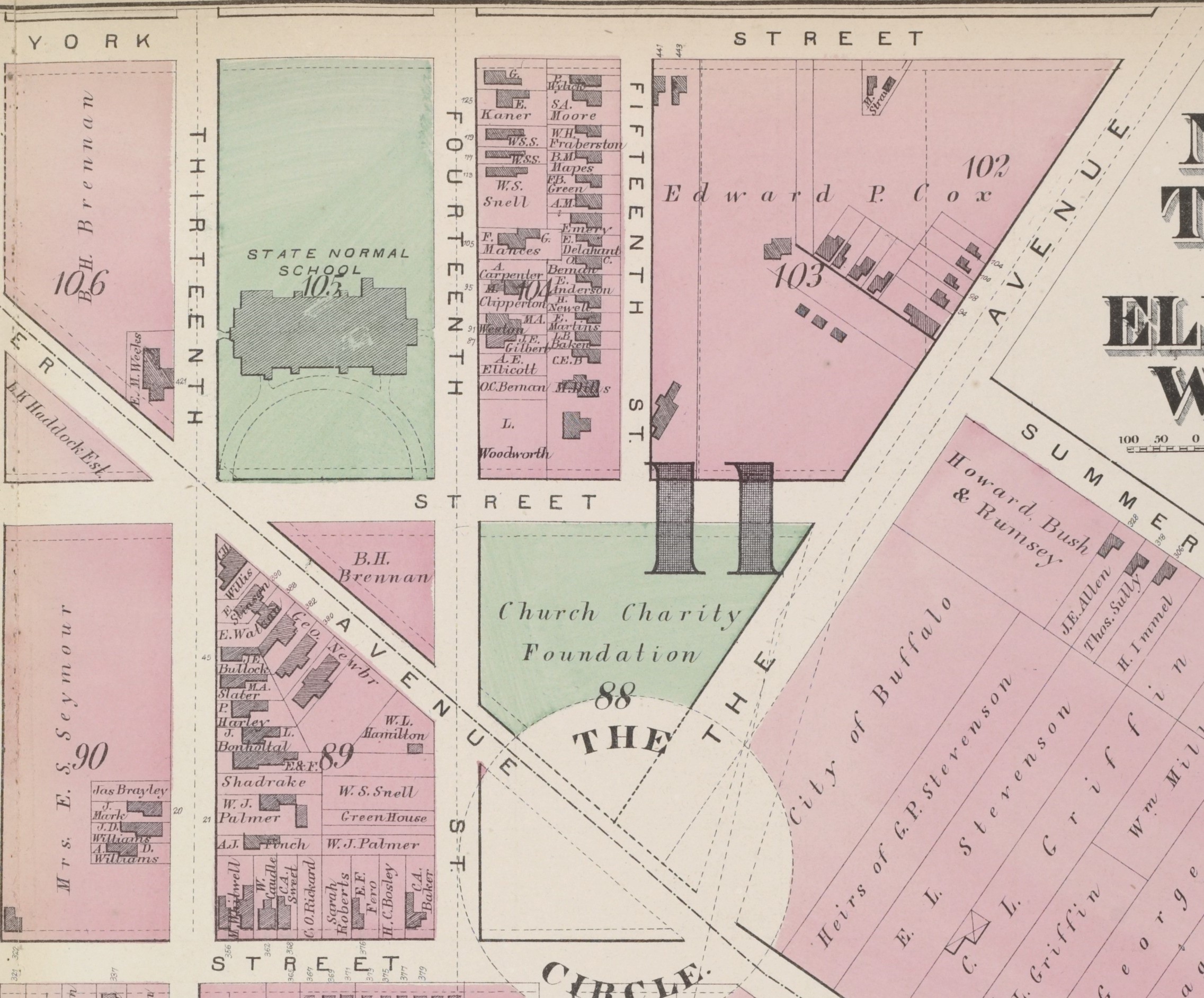
Marion Patterson

1927 Picture of Marion. Source: The Buffalo News.

James and Ella’s second child, Marion Wade Nicholson, was born in April 1895.  She grew up in the house at 456 Ashland.  When she was 4 years old, Marion Street was named for her.  She attended School 56 and Buffalo Seminary.  While she was in high school, Wade Avenue was named in her honor.   When interviewed about her streets, she sad “I was about thirteen when Wade Street was opened, and I told all my schoolmates about it at once.  I still tell people about my streets”.  H. Katherine Smith wrote of her interview that “(Marion) is the only one of more than 100 persons with streets named for them who admitted to me she got a thrill from being so honored”.

Marion was well known in the Buffalo musical circles.  She sang in the choir of Westminster Presbyterian Church and played the piano.  She was associated with Margaret Adsit Barrell’s studio; Mrs. Barrell was a founder of the Community Music School.  Marion also sang on the radio and worked with many welfare organizations in Buffalo, often singing for those groups.

Marion_Nicholson_Concert_November_1926

Marion Nicholson concert announcement in the Buffalo News, November 1926

Marion married Lester Adam Paterson on October 1, 1917 and became Mrs. Lester Paterson.  The wedding was held at the house on Ashland, which was decorated with roses and autumn flowers, ferns and smilax.  Marion wore a gown of white satin with court train and a veil fastened with orange blossoms and carried a bouquet of bride roses, sweetheart roses and gypsophyllium.  Marion’s brother Wesley was the best man.  Marion and Lester took a honeymoon road trip to Boston, New York and Philadelphia before returning to live at the house on Ashland with her parents.  They had two children – Sara (Sally) Wade Paterson, born in 1923 and Jean Marion Paterson, born in 1930.
In June 1935, Marion traveled to Reno to file for divorce from Lester on non-support charges.  At the time, divorce was not as common and was suppressed by state laws that discouraged the dissolution of couples.  In New York, up until 1985, the only way to get a divorce was to prove your spouse had committed adultery!  Reno, Nevada became the Divorce Capital of America in the 1930s.  The grounds for ending marriage had a liberal interpretation there. Women would travel to Nevada for six weeks to establish residency.  During the 1930s, it’s estimated that more than 30,000 people went to Reno to get a divorce.  Hotels and guest ranches were established near the Court House to house the women who came.  Marion’s divorce decree was granted on June 28, 1935.

Marion_Nicholson_Easter_Play_March_1937

Marion Nicholson in costume for an Easter Play at Westminster Church. March 1937. Source: Buffalo News.

After her divorce, Marion worked as a saleswoman for the Phoenix Mutual Life Insurance Company.  She was a member of the Buffalo Life Underwriters’ Association, the Business and Professional Women’s Club, the Wednesday Morning Musical Club, the Junior Musical Club and the Women’s Evening Club of Westminster Church.  She had considered a career in music, but once she got her job, music became her hobby.  It was reported that she played or sang every single day, no matter how busy she was with work or her daughters.  She said “I play or sing every day.  Music still is an important factor in my life.  Playing or singing affords me immediate relaxation.  I can lose myself in music and forget everything else.”  She was one of founding members of the Wednesday Morning Musicale Club, which started in October of 1925.  The group was formed by several women who were interested in making music together on a regular basis.  At the time, there weren’t as many outlets for women.  Women didn’t play in the the Philharmonic at the time, unless the song required a harpist.  Marion was interviewed as a member of the Wednesday Morning Club, 60 years later in 1985, still singing and playing the piano at the age of 90.  The group is still active today, nearly 100 years after it’s founding!

Mrs__Roberts_at_piano_Buffalo_News_August_1967

Marion (seated at piano), from the Buffalo News, August 1967

Marion continued to live in the house on Ashland as an adult. The family had been in Buffalo since the 1830s.  Marion’s Great Grandmother had arrived to the small town of Buffalo via the Erie Canal.  The Great Grandmother brought her belongings in a chest which was still in Marion’s possession more than 100 years later.  The family also had heirloom fiddleback chairs of mahogany, a walnut chest of drawers, a dropleaf table, and the family’s old China place settings which had served the family for generations and had places of honor in Marion’s home.  In 1940, Marion was quoted as saying of the old china:  “It’s beautiful, of course, but so fragile, I feel anxious from the moment it appears on the table until it’s safely back in its place.”

Marion served as a director of the Graduates’ Association of the Buffalo Seminary.  Her daughter Sally also attended the Seminary.  Her other daughter, Jean, attended the School of Practice of the Buffalo State Teacher’s College (aka the State Normal School).

The Nicholson family summered at Shore Meadows in Angola, where they swam and did other outdoor sports.  Shore Meadows was developed by the Lake Shore Real Estate company for business men in Buffalo who couldn’t afford the “fashionable higher priced colonies along the Lake Shore”, but wanted a respectable quality house. In 1946, Mr. Nicholson, Marion and the girls ended up moving from the house on Ashland to their summer house in Shore Meadows on Shore Cliff Road.  Marion married Dr. Carlton Roberts sometime before 1948 and became Mrs. Carlton Roberts.  Dr. Roberts was the first dental consultant to the Erie County Department of Social Welfare.  In 1936, he set up the dental procedures for the guidance of the Department, which was the first of the type in New York State!  Mr. Roberts died in 1965 after three years in the Gowanda State Hospital.

After the death of her second husband, Marion Roberts moved back into the city.  She sold the house in Angola and moved to 515 Ashland Avenue in September 1965.  Her new home was just a block away from her childhood home.  Marion Wade Nicholson died August 14, 1987.  She is buried, along with her family, at Prospect Lawn Cemetery in Hamburg.

Sara_Wesley_Paterson_Wedding_Announcement___Buffalo_News_July_1948

Sara Wesley Paterson’s bridal announcement.  Buffalo News, July 1948.

Marion’s daughter Sara (Sally) Paterson was a 1941 graduate of the Elmwood School and Buffalo Seminary.  She earned a bachelor’s degree in business administration from University of Buffalo in 1945, graduating with honors.  She taught for a few years in Bradford PA and Middleport, NY.  In 1948, she married Raymond W. Garris, a chemical engineer in the oil industry.  She and her husband in many places across the South and Midwest.  They lived in 22 states and 8 countries, including six years living in Saudi Arabia, where he was an advisor to the Minister of Petroleum.  They moved to Daphne, Alabama when he retired in 1985.  She died in 2000.

Jean Paterson

Jean Marion Paterson Yearbook Photo, Millard Fillmore School of Nursing1953.

Daughter Jean Paterson attended the Millard Fillmore School of Nursing.  She married James Elliott Dunning of Los Angeles in August 1961.  They lived in San Diego, California and she worked as a registered nurse in a hospital.  She died in 2007.

Both Marion and her daughters were a well known part of Buffalo society.  Even after Sara and Jean moved away, there were articles in the paper when they’d visit town or come home for Christmas.  In 1955, the Buffalo News reported that Marion was making her special plum pudding for her girls who were coming home for Christmas from Baltimore and the family was looking forward to being together and singing their traditional Christmas carols.

Buffalo_News___August_1978

Marion (third from left) with her daughter Sara (standing) when Sara made a Saudi Arabian lunch on a visit home. Buffalo News. August 1978.

In 1978, Sara came for a visit while living in Saudi Arabia.  She prepared traditional Arabian food while home in Buffalo.  The main course was “Kabsah (the national dish of Saudi Arabia) and homos [sic] with Arab bread and fresh vegetables” and a traditional Saudi dessert which they did not know the official name of.  Here are Sara’s recipes which were printed in the paper:

Kabsah

4 cups rice
4 whole medium tomatoes
1 small can (8 oz) tomato sauce
1/2 teaspoon ground cardamom
1 tsp black pepper
1 tsp ground cumin
2 tablespoon salt (or to taste)
2 medium onions, chopped
4 tablespoons oil
2 to 2 1/2 pounds chicken or lamb, cut up

Brown meat lightly with chopped onions. chop tomatoes;; add to the meat.  Add the spices and tomato sauce; simmer for 10 minutes.  Add 8 cups of water and cook for 20 minutes.  Add rice and more water if needed.  Simmer for 30 minutes.  Serve on a platter with the meat piled in the middle surrounded by rice.  Platter may be decorated with lemon or tomato slices.

Saudi Arabian Dessert

About 2 cups whole wheat berries
Dried figs, cut up, about 1 cup
Dried apricots, cut up, about 1 cup
Dates, cut up, about 1 cup
3/4 cup sugar
Pine Nuts
Walnuts
Cashews

Soak wheat overnight in water to cover.  Drain.  Add clean water, covering wheat by about 5 inches.  Add sugar and simmer slowly until wheat swells and liquid thickens.  Just before it is finished cooking, add dried fruit and continue to simmer for about five minutes.  Mixture should be as thick as pudding.  Remove from pan, place in a dish with cover.  Sprinkle top with a small handful of each time of nut.  Cover and cool.  Particularly delicious with thick whipped cream.

So the next time you drive past Marion St and Wade Ave, think about Marion!  Remember all the women who lived in Buffalo over the years.  Let me know if you try one of the recipes!  To learn about other women with streets named after them check out this post here:  Women’s History Month – Some Buffalo Women You Should Know .  Want to learn about other streets? Check out the Street Index.  Don’t forget to subscribe to the page to be notified when new posts are made. You can do so by entering your email address in the box on the upper right-hand side of the home page. You can also follow the blog on facebook. If you enjoy the blog, please be sure to share it with your friends.

Sources:

  • “Sara P. Garris, former teacher, Buffalo Native”.  Buffalo News.  February 4, 2000.
  • “James W Nicholson, 89; Retired Real Estate Man”.  Buffalo News.  December 20, 1951, p8.
  • “Garris”.  South Florida Sun Sentinel.  October 20, 2014, pB8.
  • “Paterson-Nicholson”.  Buffalo Courier.  October 2, 1917, p9.
  • “Local Woman Asks for Divorce”.  Buffalo News.  June 27, 1935, p21.
  • “Miss Paterson in White Organdy Over Taffeta”.  Buffalo News.  September 18, 1948, p14.
  • “Buffalo  Native Home on a Visit Cooks a Saudi-Arabian Meal”.  Buffalo News.  August 16, 1978, p22.
  • Voell, Paula.  “60-Year Old Musicale Is Outdated in Name But Youthful in Spirit”.  Buffalo News.  November 18, 1985, p28.
  • Smith, H. Katherine.  “Two Buffalo Streets Named For a Musician – Saleswoman”.  Buffalo Courier-Express.  October 6, 1940, p6-9.
  • Marks, Ben.  “Remembering When Reno was the Divorce Capital of America”.  February 14, 2019.  https://www.bitchmedia.org/post/remembering-when-reno-was-the-divorce-capital-of-america
  • “Welcome Back”.  Buffalo News.  September 30, 1965, p4.
  • “Reasonable Country Homes Aim of This Corporation”.  Buffalo Enquirer.  March 25, 1922, p8.
Field Notes

Live from Buffalo, NY

Grants.gov Community Blog

Connecting the grant community to #LearnGrants

Dienna Howard

I create, therefore I am.

Hidden Waters blog

Companion blog for the book "Hidden Waters of NYC"

Hoping for a Tail Wind

Because I definitely brought way too much gear.

priorhouse blog

Photos, art, and a little bit of LIT.

Sheepie Niagara

Bleating the Beat Since 2015