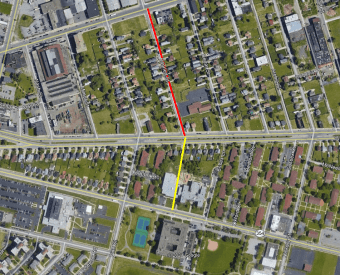
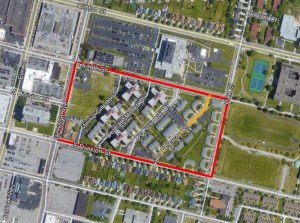
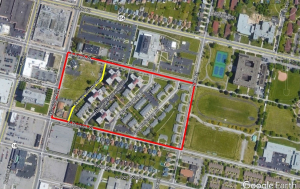
Bennett Street, current alignment shown in red. Former alignment included the portion in yellow
Bennett Street is a short street in the Ellicott Neighborhood of the East Side. The street runs for one block from Broadway to William Street. Historically, the street continued a second block to Clinton Street prior to the urban renewal which demolished much of the neighborhood. You might be thinking, but Angela, didn’t you already write about Lewis Bennett? I did write about him, Lewis Bennett named the Central Park neighborhood, and Bennett High School, but this is a different Bennett and a different school!
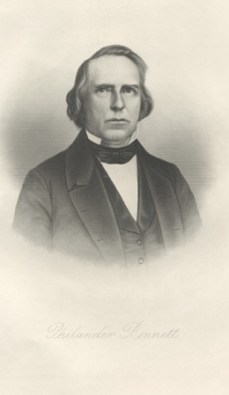 Philander Bennett was born to Nathaniel and Sarah Bennett on April 29, 1795. in Catskill, New York. The family moved to Clinton in Oneida County while Philander was a child. He attended Hamilton College and graduated in 1816. Following his graduation, he went to Delaware, Ohio to try to establish a business. A stock of goods being shipped along Lake Erie had to stop in Buffalo because of a storm. They decided to unload the product in Buffalo and open a business at the corner of Main and Eagle Street, called Scribner & Bennett. Scribner & Bennett quickly became the largest mercantile shop west of Albany.
Mr. Bennett married Henrietta Griffin in December 1817. They had four children: Griffin, who died at sea coming from St. Croix to New York at age 22 in 1841; Charles who left home in 1847 or 48 to attend Hamilton College near Utica and was never heard from again; Mary Henrietta, who married Rollin Germain; and Edward.
In 1820, Philander Bennett left the merchant business to study law in the office of Heman B Potter, who became the District Attorney of Erie County. In October 1822, he was admitted as an attorney of the Supreme Court and in February 1828, he became a counselor in the Court of Chancery. He was appointed a Justice of the Peace in 1822. He was appointed First Judge of the Court of Common Pleas for Erie County in 1829. He held that office until 1837. He also partnered with Le Grand Marvin in the firm Marvin & Bennett.
Mr. Bennett’s father, Nathaniel, moved to Williamsville in 1820 and lived there until 1838 when he relocated to Ohio. Philander and his father were members of the Buffalo Land Company and owned a great deal of real estate in both Toledo and Cleveland.
Philander Bennett served as an Alderman of the City of Buffalo in 1832 and 1833 and again in 1840 and 41. He was appointed by Governor Clinton the Judge Advocate of the 47th brigade of Infantry. For many years he was connected with the “Albany Regency” but in his later years, he became deeply anti-slavery and took up the cause and joined the Republican Party when it was organized in 1854.
Mr. Bennett served as President of the City Bank of Buffalo and was Vice President of the Buffalo & Attica Railroad Company. When President Van Buren came to Buffalo in 1839, Mr. Bennett was chairman of the committee of citizens appointed to receive the president and delivered a speech welcoming the President to the City. He was a member of First Presbyterian Church.

Bennett House on Clinton Street
The Bennett family lived in a house that was constructed in 1831 at the corner of Eagle and Pine Streets. The house contained the first marble mantels to be brought to Buffalo. The house was well known in Buffalo, residents often brought visitors to go see both the Bennett House and the Fargo House, as two examples of the most beautiful houses Buffalo had to offer. The Bennett house was a square house with a cupola and stood in 15 acres of landscaped lawns and gardens.
For the last 16 years of his life, Philander lived in retirement, engaging in some foreign travel but mostly occupied with horticultural pursuits on his property.

Bennett House. Philander is at the bottom of the steps, with family members on the steps. Source: Picture Book of Earlier Buffalo
Philander Bennett died on July 22, 1863. After his death, his widow remained in the home. Following Henrietta’s death in 1885, the house and the grounds were sold by the two remaining children to the City of Buffalo. Edward Bennett was born in 1827 and served as a successful merchant and owned substantial real estate. Edward served as a parks commissioner from 1872 until 1888. Mary Henrietta and her husband Rollin Germain (his name might sound familiar to those familiar with street names…) lived next door to the Bennett House. Mary also owned substantial real estate throughout the city in her own name, which was rare during those times.
The Bennett family house was demolished in 1888 to construct Bennett Place/Bennett Park. Many in town mourned the passing of that landmark which had been a center of luxurious social life and culture for half a century. Some of the furniture and the mantel from the house were owned by their great-grandson Edward Bennett Germain, who lived at Nottingham Terrace in the 1930s. Edward Germain was president of Dunlop Rubber and Tire Corporation.

Source: https://buffaloah.com/
Bennett Park was designed by Frederick Law Olmsted in 1887. Olmsted’s design called for entrances from each corner of the property with flagstone walks circling around a horseshoe-shaped lawn at the center. There was a shelter house constructed in 1888 which faced Eagle Street and a gravel playground adjacent to Clinton Street. The shelter house contained restrooms, a tool room and a large covered space open on three sides. Thick foliage screened the park from the streets and helped conceal the park’s small size. Bennett Park was a popular park, as it was located in a very densely populated neighborhood.

Olmsted Plan for Bennett Park
The park still exists but has been modified from its original design. In 1920, a softball diamond and tennis courts were built and a new shelter house. The gravel playground and many of the plantings were removed. The park has been combined into the JFK Community Center Park and contains only the tennis courts. The trademark Olmsteadian curvilinear paths on the west and south sides of the park still remain.
The part of Bennett Street between Clinton and William Streets was divided into East and West Bennett Streets. The area between the two streets was home to the Clinton Street Market. The market was one of the oldest in Buffalo, established around 1849. The land had been deeded to the City for market purposes by the Bennett family from their property. Because of its location, it was often referred to as Bennett Market, though the city preferred the Clinton Market name. A Liberty Pole was raised and consecrated at the Market on the Fourth of July 1855. The pole was 140 feet high and topped with a gilt eagle with outstretched wings. This Liberty Pole was in addition to the one at the Terrace. In 1856-57, the City graded and paved the Clinton Street Market site, along with the Chippewa Market (at Chippewa and Washington) and the Court Street Market (located where the Buffalo Fire Headquarters is now located). The City also built market buildings on the three sites. The Clinton Street Market and the Chippewa Market buildings were identical at 392 feet long by 36 feet wide, built in the Romanesque style. The market building could accommodate 82 farmers’ wagons under the shelter. Each stall was supplied with gas, water and sewerage. The Court Street Market was built in the form of a Greek Cross, but with similar dimensions as the other market buildings. The Clinton Street Market was a popular meeting site for residents of the 5th Ward for community matters, elections, etc.

1872 Hopkins Atlas. Map shows the location of the Clinton Market, the original location of PS #32 and the location of the Bennett House. Note several other properties owned by Bennett Family members, including Mrs. Mary Germain and Edward Bennett.
In 1925, the City wanted to abandon the Clinton Market to build a community center and public bathhouse. Residents protested the closure of the market. The city argued that the market was not profitable, however, the vendors said it was only not profitable b/c the market was not kept up by the city. It had been ignored and no repairs had been made. At the time, all of the markets in the city operated at a loss to the city. Residents argued that the public markets should be operated for the benefit of the people and not the profiteers. The residents signed petitions with more than 1000 names arguing to keep the market open. The Market at the time had 22 stalls and 17 of the stalls were occupied. The East Side Business Men’s Association put together a proposal to keep the market and establish the bath house at the southern end of the site, but the plan was rejected. The Bath House was originally intended to be for the use of the Blacks in the neighborhood, but members of the Black community fought back and protested against the Bath House saying that it was segregation and discriminatory. The Buffalo American (a Black Newspaper), stated that
“He (the Mayor) is guided solely by the sentiment there expressed, the Free Public Bath House and the Community House will be exclusively for Negroes. If this is the Mayor’s program The American will oppose such a measure as will all of the thoughtful citizens of this section of the city. A Public Bath House and Community Center for all citizens in this section of the city will meet with a hearty welcome from all, but a Bath House and Community Center for Negroes is nothing less than segregation and will not be sanctioned by any thoughtful person. We do not know who the Colored men are who are urging the Mayor to take such steps, but we will not stand by idle and see all of our people segregated for a mere bath.”
Mayor Schwab had to make it clear on several occasions that the Bath House would be for both Black and Whites. Public Bath House No 4 opened in 1927 on William Street on the former location of the Clinton Street Market. A small stub of East Bennett Street was renamed Embassy Street.

1951 Sanborn Map showing the location of the Bath House and the location of Bennett Park School
Despite the protests, the Clinton Market was closed. On Saturday, October 16, 1926, at 10pm, the last of the merchants gathered their wares and left their stalls for the last time. Under the terms establishing the market, the property reverted back to the heirs if it was used for any use other than market purposes. The building was quickly demolished. On the northern portion of the site, Public Bath House No 4 was built. The southern end of the site was to be a gymnasium or a community center, but the empty lot was quickly taken over by students and teachers arriving at Tech High School, across Clinton Street from the former market. The City originally thought that using the site for the Public Bath House and Community Center would be allowed under the agreement, but it was not. Corporation Council and Charles B. Germain (Grandson of Philander Bennett and son of Rollin Germain), representing the heirs of the Bennett family, came to agreement for the City to pay the heirs $10,000 (about $154,000 in 2021 dollars) to abandon the market and receive the property.

Bennett Park School
The Bennett Park name also survives at Public School #32, Bennett Park Montessori School. PS 32 was originally built organized in 1851 with the building originally located on Cedar Street (just behind the school’s current location). In 1872, the school expanded with a second building next to the original building. The current building on the site was built in 1913 and was known as the Bennett Park School, due to its location across the street from the park. In 1969, the building became home to BUILD Academy, the City’s first Community School. BUILD Academy moved to Fougeron Street in 1975. In 1977, the building became home to Bennett Park Montessori Center (BPMC). BPMC is the only public Montessori Program in Western New York and one of the largest Montessori schools in the country. BPMC came about as a result of the desegregation of schools that was happening in the late 1970s and early 1980s. The Arthur vs Nyquist last suit was filed in 1972 by a number of African American parents, including George Arthur, against Ewald Nyquist, the Commissioner of Education, the Board of Education, the Mayor and the Common Council of the City of Buffalo. The case took a long time to be settled, but one of the things to come out of it was the establishment of magnet schools. Magnet schools draw students from the entire school district, as opposed to neighborhood schools which draw from the neighborhood the school is located within. Magnet schools tend to be more diverse, due to students coming from a variety of socioeconomic and racial backgrounds. Parents and teachers from St. Mary of Sorrow’s Montessori preschool program and others worked together to create a public Montessori program. Before BPMC, any parent who wanted their child to have a Montessori education had to pay for the teacher and the program. St Mary’s Montessori program differed from other Montessori programs in the region because it was an integrated preschool.
In September 1977, BMPC opened, along with several other magnet schools. BPMC had received 560 applications for Black students, 320 from white students and 42 from other races. They had a total of 922 applications for 261 spots! They opened on September 7th with 131 minority and 131 majority students. During the 1990 school year, the school expanded to 560 students. An addition constructed in 2009 expanded its capacity to 980 students. The addition received the 2010 Best Education Project in the Brick by Brick Awards by Business First. The school celebrated its 40th Anniversary in 2018.
So the next time you drive by Bennett Street, think about Philander Bennett, his beautiful house, the park that was named after him and the school named after the park.
Want to learn about other streets? Check out the Street Index. Don’t forget to subscribe to the page to be notified when new posts are made. You can do so by entering your email address in the box on the upper right hand side of the home page. You can also follow the blog on facebook. If you enjoy the blog, please be sure to share it with your friends.
Sources:
- Smith, Katherine H. “Bennett Street Memorial to Merchant, First County Judge”. Courier-Express. April 6,1941, sec 5, p5.
- Editorial. The Buffalo American. December 18, 1924.
- Protest Plan to Replace market with Bath House. Buffalo Courier. February 15, 1925. pg 72.
- Mayor to Ask Council to Buy Clinton Market Site. Buffalo Courier. February 11, 1925, p4.
- Citizens Ask Retention of the Clinton Mart. Buffalo Timers. January 10, 1925, p2.
- The Fourth in Buffalo. Buffalo Morning Express. July 6, 1855. p.3.
- Clinton Street Bath House Project May Fall Through. Buffalo Courier. August 10, 1924, p 76.
- Krueger, Pauline. Abolishment of Clinton Market Boon to Tech. Buffalo Times. October 30, 1926.
- Council Defers Action on Clinton Market Petition. Buffalo Courier. January 10, 1925. p3.
- Public Improvements – Markets and Public Buildings. Buffalo Weekly Republic. July 14, 1857, p2.
- Edward Bennett Dead. Buffalo Evening News. May 12, 1898, p 19.
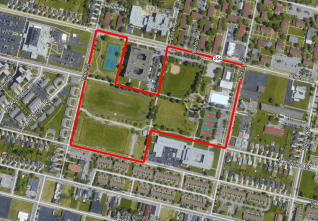 Today’s post is is a little different. We’ll be learning about JFK Park. Unlike most of our posts, we’re not going to look much at the person for whom this was named, but rather the circumstances that created the park. You can google President John Fitzgerald Kennedy if you’d like to learn more about him – there are plenty of books, movies, documentaries about him – see Note 1 for recommendations. JFK Park and the Community Center were created in the 60s, and, like many things built following President Kennedy’s death, named after him.
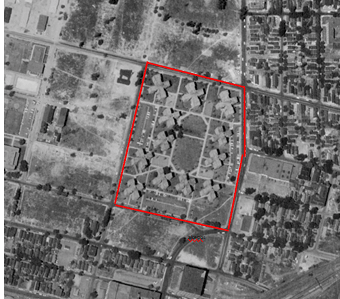
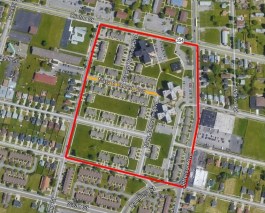
 JFK Park fills most of the space between the Ellicott Mall and the Talbert Mall. This is also my neighborhood park, and I’ve spent a lot of time here the last few months during the pandemic. I walk through the park often during my daily walks. Sometimes, I’ll bring a blanket to sit and read while listening to kids play in the playground and (during non-pandemic times) on the ballfields, basketball court, pool, and tennis court. The photos I’m sharing here lack people out of respect for not wanting to post pictures of children without consent, but even during the pandemic, this is a well used and well-loved park. It also serves as recreation space for the JFK Community Center, Bennett Park Montessori (PS #32), and Buffalo Elementary School of Technology (PS #6).

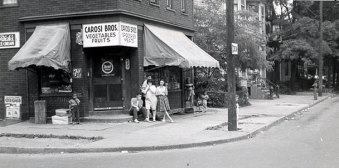

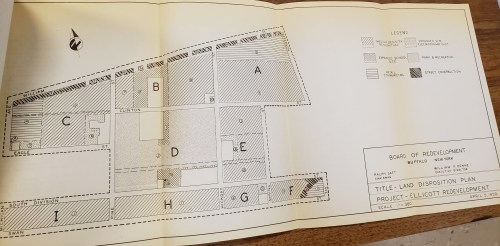 In 1955, Buffalo Common Council designated the 160-acre Ellicott District Redevelopment Project Area to be totally cleared and rebuilt except for religious and education buildings. This was the first Urban Renewal project in New York State – designated with project number NYR-1. In December 1957, a $10 Million Capital Grant (approximately $92 Million in 2020 dollars) was funded to begin to acquire the 1050 parcels and relocated residents and businesses. In 1961, a $600,000 ($5 Million in 2020) addition was added to PS 6 and $450,000 ($4 Million in 2020) in renovations were completed a the Former Technical High School (at the time, it was Clinton Junior High). 25 acres were set aside for the $1.5 Million ($13 Million in 2020) Elliott District Recreation Center, which became JFK Park.
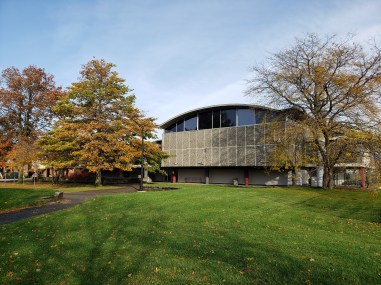 Robert T. Coles, the Buffalo-born architect, wrote his thesis in 1955 at MIT about a plan for Recreational Facilities in the Ellicott Community Renewal Area. In 1960, Robert Coles returned to Buffalo and was placed in charge of programming, design, and construction supervision of the recreation center that became JFK Community Center. The Rec Center building is a great example of Coles’ modern architecture style.
 So the next time you’re walking through JFK Park, or any park or neighborhood, think about what used perhaps used to be there. Neighborhoods change over time, both my forces we can control and by those we cannot. Our cities are built on what came before. There might be more to the story than what you first see. A peaceful park might have been a whole neighborhood that no longer exists. Take a moment and remember.

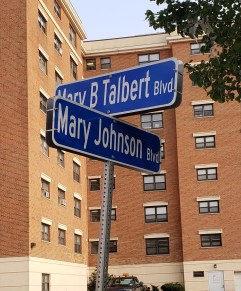 Mary Johnson lived in the Talbert Mall/Douglass towers starting in 1960. Her family had lived in the neighborhood for a long time – she and her parents are listed in the 1930 Census living at 61 Spring Street.
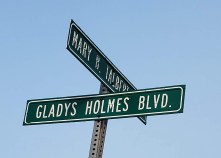 Gladys Holmes was born in 1927 in Macon, Georgia. Gladys married Grady Holmes in 1943. Grady served in the Marine Corps during WWII. After the war, Grady and Gladys moved to Buffalo, arriving in 1952. Grady worked at Bethlehem Steel.
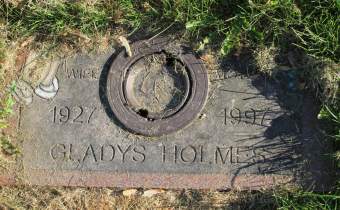 Gladys and Grady lived in the Talbert Mall/Frederick Douglass Towers for 37 years before she died in 1997. When they named the street for her, they called Gladys a “community mom”. In addition to being mother to the community, she had five daughters of her own – Betty Holloway, Jeannette Bishop, Annette Holmes, Graleen Dowell and Barbara Ann Singletary. She is buried in Forest Lawn.
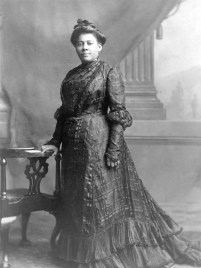

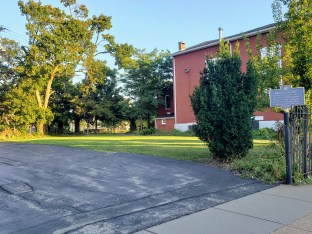



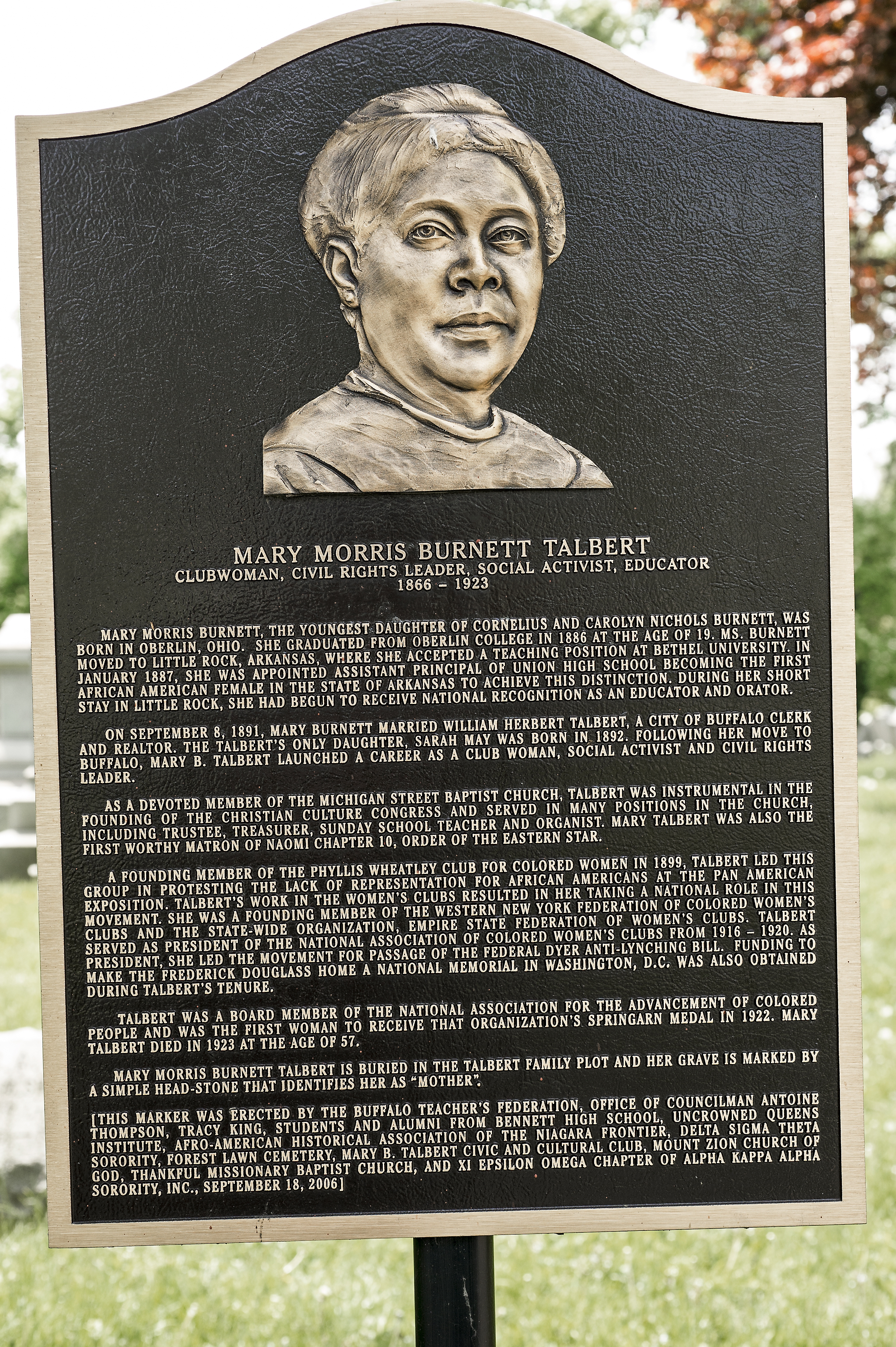





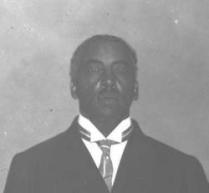



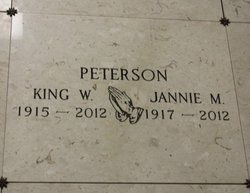 Mr. Peterson was married to the former Jannie McCarley. They were married 72 years and had three children – Kenneth, Lawrence and Lorraine. Jannie was the daughter of Reverend Burnie McCarley, the founder of St. John Baptist Church in Buffalo, and the namesake of the McCarley Gardens apartments. Mr. Peterson died a few months after his wife, on September 23, 2012. His portrait is represented on the Freedom Wall at Michigan and Ferry Streets. Both King and Jannie are buried in Forest Lawn Cemetery.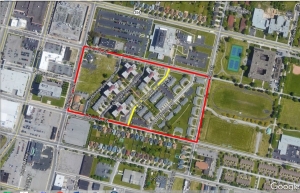
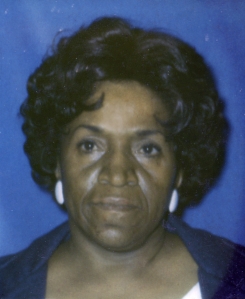 Ora Perry Wrighter was born in December 1920 in Birmingham Alabama, to Owen and Alberta Perry. She came to Buffalo as a child with her family and graduated from the Buffalo Public Schools. She attended Hartwick Seminary. At the time of her death, she was a student at Medaille College.

 Delmar Mitchell was born to Lee and Tobitha Mitchell in February 1918 in Providence, Kentucky. He was raised in Glen Cove, Illinois, outside of Chicago. He attended DuSable High School, the University of Illinois in Champaign and DePaul University. He served in the US Army during WWII, rising to the rank of captain and serving in both the Pacific and European fronts. He earned a Purple Heart for his service. He later worked for the US Department of Justice, in the Intelligence Section.


 Discovering Buffalo, One Street at a Time