Feeds:
Posts
Comments

Archive for the ‘East Side’ Category

hamlin2

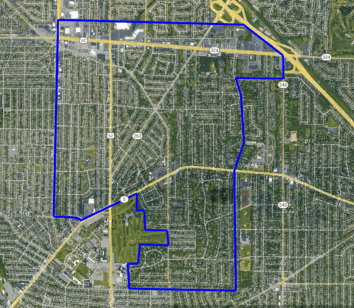
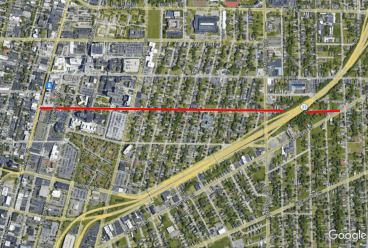
Hamlin Road shown in Red. The former Hamlin Driving Park outlined in Light Blue

Hamlin Road runs between Lonsdale Road and Humboldt Parkway in the Hamlin Park neighborhood of the East Side of Buffalo. The street opened in the early 1920s, running through what used to be the grounds of the Hamlin Driving Park.  The street and neighborhood are named after the Hamlin Family, a prominent family in Buffalo and East Aurora.

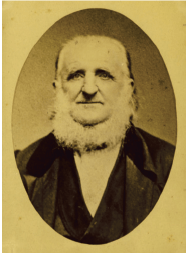
cicero hamlinOn November 7, 1819, Cicero Hamlin was born in Hillsdale in Columbia County, New York. His parents were Reverend Jabez and Esther Stow Hamlin. Cicero Hamlin would say that he started his life as a poor child and that his only heritage was “being of sound health and good digestion.” Cicero was the youngest of a family of ten. Cicero came to East Aurora in 1836 and purchased the general store operated by his brother John W. Hamlin. The store was located on Main Street near what is now Hamlin Avenue in East Aurora.

In 1846, Cicero Hamlin moved to Buffalo, where he entered the dry goods business in the firm Wattles and Hamlin at 252 Main Street. Mr. Wattles left the business in 1847, and Mr. Hamlin continued the business alone until 1852. Then, he joined the firm of Mendsen & Company, a wholesale-retail carpet and house furnishing business. The firm was reorganized as Hamlin & Mendsen. In the 1860s, Mr. Hamlin Built the Hamlin Block on Main Street.  He remained in business there until 1871.  In February 1888, the Hamlin Block was destroyed by a fire. A new Hamlin Black was constructed in its place by the end of 1888.

Hamlin123_buffalohistorygazette

Cicero Hamlin breaking the world’s team’s record.   Source: Buffalo History Gazette

IMG_20220122_205958_944

Gravestone for Mambrino King, East Aurora. Photo By Stacy Grinsfelder, True Tales from Old Houses

In addition to his real estate interests, in May 1855, Cicero Hamlin established Village Farm in East Aurora. The farm began as 55 acres and expanded to 600 acres by the 1890s. The farm had the reputation of some of America’s best trotting horses. The farm was located at the west end of the Village, fronting on the north side of Main Street. His first horses were Little Belle, Mag Addison, and Hamlin Patchem. At its peak, the Village Farm stabled 748 horses. In 1882, Mr. Hamlin purchased “Mambrino King” for $17,000. The horse was judged the most handsome horse in the world. Many people traveled to East Aurora to visit Mambrino King. In one day, Mambrino King was taken out of his stall to be shown to visitors more than 170 times! Mambrino King was put down on December 5, 1899. He is buried in front of a house on North Willow Street, and the grave marker can be seen from the sidewalk.

The Hamlin farm closed in January 1905. The horse line continued at the Ideal Stock Farm, founded in 1905 by Seymour Knox. Cicero Hamlin donated land to the Village of East Aurora to create Hamlin Park. Hamlin Avenue in East Aurora runs through the property that was once the farm.

Before 1873, there were several attempts to manufacture glucose in the United States, but with little success. Cicero Hamlin developed a process that helped form an entire industry; he founded Buffalo Grape Sugar Company in 1874. Buffalo Grape Sugar Company merged with the American Glucose Company in 1888. The works of the American Glucose Company in Buffalo were the largest in the world. Their brands were well known both in domestic and international markets. The Buffalo plant employed 500 men and processed 10,000 bushels of corn per day to create glucose, syrups, grape sugar, and animal food products. American Glucose Company also had factories in Peoria, Illinois; Leavenworth, Kansas; Iowa City, Iowa; and Tippecanoe City, Ohio. Their headquarters were located at 19-23 West Swan Street in Buffalo.

5ef24571ced96

Hamlin Driving Park in 1870. Source: Buffalo News

What became the Hamlin Park Neighborhood in Buffalo was still a rural area in 1868 when Cicero Hamlin established his Driving Park at the corner of East Ferry and Humboldt Parkway. The Driving Park was included in Frederick Law Olmsted’s parks plan for Buffalo. The Driving Park quickly became popular and gained international fame. It had a one-half-mile speedway for trotting and pacing races and training stable for 75 horses. Horse-riding was a gentleman’s sport. Many of Buffalo’s important businessmen were officers of the Buffalo Driving Park Association – Chandler J. Wells, Cicero Hamlin, E.R. Buck, J.H. Metcalfe, Myram P Busch, George Gates, Joseph G. Masten, R.L Howard, and Jewett Richmond. Race days were an important occasion in Buffalo. There was a festive atmosphere, many stores declared them holidays, and the trolley offered half-fare travel to the Driving Park. The Belt Line Railroad opening in 1883 eased access to the track, with a station at Fillmore Avenue near Northland. People traveled from across the country to view the races and to race here. There were railroad car sidings to allow for Pullman cars, day coaches, and special freight cars for the horses.

In 1869, Frederick Law Olmsted looked to integrate the Driving Park into his Parks Plan. Mr. Olmsted looked to put an expanded parkway near the entrance of the race course with a circular or elliptical form for a spot to put a fountain, statue, or other monument. This didn’t happen. The Driving Park grew crowds of up to 40,000 people for special events. After the races, many people would go to the nearby Parade House at The Parade park (aka Humboldt Park, now MLK Park).

buffalo_ny_1896

1895 Map of Buffalo showing the location of the Driving Park/Fairgrounds. Humboldt Parkway is shown in green to the east of the Driving Park site. The Driving Park Station can be shown at the corner of Fillmore and Northland. Source: Rand, McNally & Co Map of Buffalo.

In 1888, Hamlin sold the Driving Park to a group of 120 stockholders who were looking to start up an International Industrial and Agricultural Exposition in Buffalo at Hamlin Park. The largest investor was Cicero Hamlin himself. They planned to create a permanent fairgrounds, similar to the one in St. Louis. He felt Buffalo was a good location between New York and Chicago for fairs. Other stockholders included – Philip Becker, Jacob Schoellkopf, JJ Albright, Daniel N. Lockwood, D.E. Morgan, George Urban Jr, and Jewett Richmond. They constructed several exhibition buildings, including the largest fair building in the world. The Fair opened on September 4, 1888 to great fanfare. However, long-term attendance did not come. The fair lost money and closed within five years. Public transportation made it hard to get to the Fair. A horsecar up Main Street took about an hour from the downtown railroad depots. Passengers actually had to get out and help push the cars up the Main Street hill from North to Virginia Street!

Trolley service finally came to the Park in 1892.  That year, Mr. Hamlin put $25,000 into the Driving Park. He built a new grandstand modeled after the one in Monmouth Park, New Jersey. In addition, Mr. Hamlin offered free admission for that year for those who would take standing room admission. He felt this was a way to increase interest in the Park and allow “regular” folks to come, in addition to the upper class.

In 1895, a grandstand stairway collapsed, and 20 people were injured. In 1896, a fire swept through the grounds and destroyed the buildings, ending the horse races. In January 1898, Mr. Hamlin announced he would divide the Driving Park grounds into residential lots.  Thus began the development of the Hamlin Park Neighborhood.

hamlinhouse

Hamlin House on Franklin Street. Source: Hamlin House Restaurant

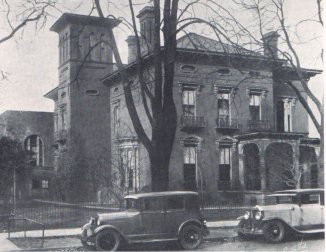
Cicero Hamlin married Susan Jane Ford in September 1842. They had three sons – Frank, William and Harry, and two daughters – Anna and Kate. Sadly, Anna died as a newborn and Kate passed at age 3. The Hamlin Family lived in a house they built at 432 Franklin Street. The Hamlin property consisted of the entire corner of Franklin and Edward Street, where 420, 426, 436 and 440 Franklin now stand. The house is a two-story Italian villa, and is still standing today.  Cicero and Susan moved to 1035 Delaware Ave and sold the property in the 1890s.

The Buffalo Orpheus (a German singing society) used the 432 Franklin Street house as its headquarters starting in 1915. In 1920, the American Legion purchased the Hamlin House, and the house is still the clubhouse for Troop 1 Post 665 of the American Legion. Additions were added to the right side of the building and a gym was added to the rear of the building in 1940. The rear portion of the building has been used as the Legion’s auditorium but used to be the family’s stable.  (Note from Angela:  If you’re looking for a good fish fry – Hamlin House is a great place!)

Cicero Hamlin died February 20, 1905, just three weeks after the sale of Village Farm.  He was considered to be one of Buffalo’s oldest and wealthiest citizens when he died.  He is buried in the Hamlin family plot in Forest Lawn Cemetery.  Cicero’s son Harry Hamlin was born in Buffalo on July 17, 1855. Harry worked with his father in the Village Farm and in the American Glucose Company. Harry married Grace Enos in 1878. Harry and Grace lived on North Pearl Street. Harry was killed in an automobile accident on June 3, 1907 at age 52.

chauncey hamlin

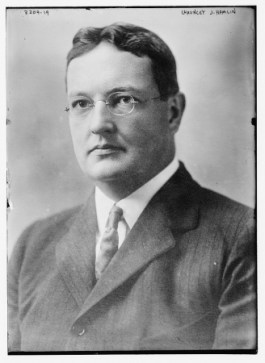
Chauncey J. Hamlin

Grace and Harry had a son named Chauncey Jerome Hamlin, born January 11, 1881. Chauncey attended Miss Hoffman’s School, Heathcote School and Nichols School. Graduating from  Yale in 1903 and from Buffalo Law School in 1905, he was admitted to the bar in February 1909.  Chauncey Hamlin helped to launch the Buffalo Legal Aid Bureau. After serving in WWI, he gave up his active law practice in 1919 to serve the community.

Chauncey married Emily Gray in 1904. The Hamlins lived on West Ferry Street between Delaware and Elmwood Avenues. They had three children – Martha, Mary and Chauncey, Jr.  In 1910, they purchased an estate in Snyder.  The John Schenck House and moved to Snyder.  This estate included the John Schenck House, is a small stone house built in the 1830s on Harlem Road near Main Street.  Between the 1890s and the time the Hamlins purchased it, the house had ceased to be residential.  It was used as oat storage by the farmers who lived on the land.  The house reportedly has a slant due to the weight of the oats.

schenck house harlem

Stone House on Harlem Road, Snyder. Source: NYSHPO

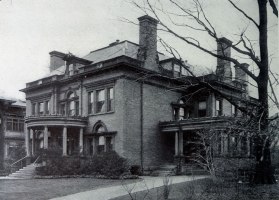
The Hamlin Estate included the Schenck House, the main large mansion house (where the family lived), and two other frame houses. They set up a small museum in the old stone house to display the fossils and other natural objects found in the nearby quarries that the Hamlin children would find. They referred to it as the Snyder Museum of Natural History.

In 1922, the Hamlin Estate was sold to the Park School of Buffalo, a private school founded in Buffalo in 1912. When the school moved to Harlem Road, the grounds were described as:

“large barns in prefect repairs, carriage sheds, and a farmhouse. There were great apple orchard, large trees, fields of grain and a tiny brook winding its way down to two enchanting ponds. Best of all, at the entrance of the estate, a very old, stone house banked with lilacs and forsythias, having in it gardens, flowers and herbs which might have been growing there for a century.”

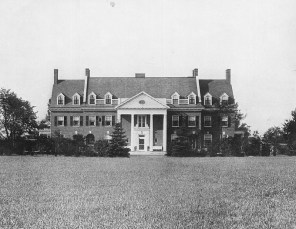
The Hamlin’s home was converted into the main classroom building at Park School, now called Hamlin Hall.

hamlin house snyder

Hamlin House in Snyder. Now Hamlin Hall at Park School.  Source:  Image of America:  Amherst by Joseph Grande.

Chauncey Hamlin would later say that “the little stone house contributed concretely” in his interest in the Buffalo Museum of Science.  Chauncey Hamlin became President of the Museum of Science in 1920. At the time, the Society of Natural Sciences had no permanent building of its own. Some of its collection was housed in a building near the art gallery at the corner of Elmwood Avenue and Penhurst Place, but the major collections were located in borrowed space in the Buffalo Public Library on Lafayette Square.

hamlinhall

Hamlin Hall at the Buffalo Science Museum. Source: Friend of Author

Chauncey Hamlin led a campaign to raise funds to build a permanent building in Humboldt Park (now MLK Park). The Buffalo Museum of Science opened in January 1929. Mr. Hamlin continued on as President until 1948. He worked with other families to finance the creation of and upkeep of exhibits in the halls of the museum including the Schoellkopf, Lark, Knox, Kellogg, Goodyear and Bennett families. Chauncey Hamlin contributed over $241,277 (about $4 Million in today’s dollars) to the museum funds. He served on the American Association of Museums as President. He helped to found the International Council of Museums in 1948 and headed the organization for the first five years of its existence.

Chauncey Hamlin also served as the first President of the Buffalo City Planning Association. He led the site selection committee for the new City Hall, which selected the west side of Niagara Square for the site of the building.  From 1925 to 1947, he was Chairman of the Niagara Frontier Planning Board. While on the Board, he pushed for construction of the Grand Island Bridges and other parkways in Buffalo. He was awarded the Chancellor’s Medal of the University of Buffalo in 1931 and an honorary Doctor of Laws degree from Alfred University in 1954.

harry hamlin

Actor Harry Hamlin, Great Great Grandson of Cicero Hamlin.  Source:  @harryrhamlin Instagram

Chauncey died on September 23, 1963 in Carmel, California.   He is buried in Forest Lawn.

Chauncey’s son, Chauncey Hamlin Jr. was born in March 1905. Chauncey Jr’s son, Harry R Hamlin, was born in 1951. You might recognize this Harry Hamlin as an actor. Harry was People Magazine’s Sexiest Man Alive in 1987.  (Disclaimer:  I am watching Harry in my favorite tv show, Veronica Mars, as I write this.)  Harry is the Great Great Grandson of Cicero Hamlin who the street and neighborhood are named after!

So the next time you drive through Hamlin Park in Buffalo, go to Hamlin Park in East Aurora, stop at the Science Museum, or watch a moving starring Harry Hamlin, think of the Hamlin family.  Want to learn about other streets? Check out the Street Index. Don’t forget to subscribe to the page to be notified when new posts are made. You can do so by entering your email address in the box on the upper right-hand side of the home page. You can also follow the blog on facebook. If you enjoy the blog, please be sure to share it with your friends.

Sources:

  • Askew, Alice.  “Racing Day Marks Era of the Horse.”
  • Keller, Ed.  “Cicero J. Hamlin Village Farm Among Trotting’s Greatest.”  The Harness Horse.  P 50.
  • “Village Farm.”  Pictorial and Historical Review East Aurora and Vicinity.  1940.
  • Fink, Margaret Reid, editor.  “Chauncey Jerome Hamlin”.  Science on the March.  Volume 44, No 2.  December 1963, p1.
  • NYS Office of Parks, Recreation and Historic Preservation.  Building Structure Inventory Form.  The John Schenck House.
  • “C.J. Hamlin Dead”.  The Buffalo Commercial.  February 20, 1905.  p11.
  • Kwiatkowski, Jane and Paula Voell.  “Buffalo’ 20th Century Club: The Far-Sighted Men and Women Who Shaped Our Past and Set a Course for the Future”.  Buffalo News.  November 28, 1999.

Read Full Post »

hayesplace

Hayes Place

Hayes is one of Buffalo’s street names that was used twice! Municipalities typically don’t like having duplicate street names as it leads to difficulty with mail delivery and providing emergency services. Often when street name changes happened throughout Buffalo’s history, it was during times when they were removing duplicate street names. This usually happened when the City boundary was expanded, when Post Offices were consolidated or discontinued, or when confusion occurred due to duplicate names. Hayes Place is a short street off of Seneca Street near the I-190. Place is typically used for streets that don’t have a throughway. In the case of Hayes Place, the road dead-ends at a factory along railroad tracks. Interestingly, the other streets in this area also end at the tracks but are named Street. Buffalo does not have strict naming conventions when it comes to Street versus Avenue versus Road, etc! Hayes Road is also the official name of the ring road that circles UB South Campus, the centerpiece of which is Hayes Hall. All three of these are named for Edmund Hayes.

hayes road

Hayes Road at University of Buffalo

dfc9d2e4-81d5-4e61-8877-08af961c2ed9

Edmund B. Hayes. Source: Ancestry.com

Edmund B Hayes was born in 1849 in Farmington, Maine. He attended public and preparatory schools in Maine and then Dartmouth College. His time at Dartmouth was not continuous. Instead, Mr. Hayes would take time off in-between semesters to earn tuition by working at farms or teaching. After completing two years at Dartmouth, he transferred to MIT, where he graduated in 1873 with a civil engineering degree.

After graduation, he worked for the Passaic Bridge Company in New Jersey and for the engineering division of the Erie Railroad. He came to Buffalo in 1874 to join George S. Field at the Morrison Field Bridge Company. At this time, railroads were expanding across the country, so bridge building was a very profitable business. Mr. Hayes handled the engineering, and Mr. Field dealt with the contracting.

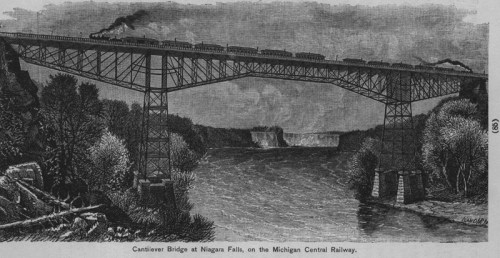
In 1883, Mr. Hayes proposed a cantilever design for the Michigan Railroad bridge across the Niagara River.  The Michigan Central Railway was owned by Cornelius Vanderbuilt, who was looking for a crossing between Canada and the US.  Mr. Hayes proposed the first steel span cantilever bridge across the Niagara River, known as the Niagara Cantilever Bridge.  Previous bridges across the gorge had been a suspension bridge.  This was was the largest steel span bridge in the world at the time.  The train was in operation until 1925 when modern trains became heavier and a new bridge was needed.

NU_RM30_Niagara_Cantilever_Bridge

Cantilever Bridge at Niagara Falls. Rand, McNally & Company.

In 1884, the company became the Union Bridge Company, of which Mr. Hayes was part owner. Mr. Hayes and Mr. Field oversaw an 8-acre manufacturing site at the foot of Hamburg Street that created 15,000 tons of material used to make bridges worldwide! The Union Bridge Company built the Poughkeepsie Bridge over the Hudson River in 1888. This bridge was in service until 1974 and is listed on the National Register of Historic Places and is designated as a National Historic Civil Engineering Landmark.  The bridge reopened in 2009 as a pedestrian walkway as part of the Walkway Over the Hudson Park.

ub_alumni_club1

Edmund Hayes House at 147 North Street, pictured in 1925.  Source: UB Archives

Edmund Hayes married Mary H. Warren in 1878. Mary was a sister-in-law to Edmund’s partner and friend George Fields. In 1892, they moved into a Green & Wicks-designed home at 147 North Street. This house was two doors down from the Metcalfe House. They had no children, but the home was known for entertaining people from the worlds of art, literature, music, and science.

Mr. Hayes served for three years as Chief of the Engineering Division of New York State under Governor Cornell’s administration from 1880 to 1882 and Governor Grover Cleveland’s in 1883.  He was given an honorary military title by his friend Governor Grover Cleveland, who made him an honorary General in the National Guard, and he became General Edmund Hayes.  The title was only honorary.  A story was passed along regarding a time that General and Mrs. Hayes were eating dinner when a down on his luck man rang the doorbell.  The man told the staff “surely General Hayes would want to see a fellow soldier” and that they had served in the same regiment during the war.  General Hayes had the man turned away as they new he was lying as “General” Hayes had never fired a gun.

In 1891, the Union Bridge Company was sold to the US Steel Company, which late became the American Bridge Company.  General Hayes and his wife took a trip overseas to celebrate. They traveled to Europe, Egypt, and Palestine.  General Hayes became a Capitalist and Philanthropist.

In 1897, General Hayes invested with John J. Albright to found the Buffalo Bolt Company in North Tonawanda. They also invested in the Ontario Power Company in Canada. General Hayes was an early automobile user in Buffalo. He funded Hares Motors to manufacture Locomobile, Simplex, and Mercer automobiles.

General Hayes served on the Board of the Buffalo Fine Arts Academy (now Albright Knox Art Gallery). In 1892, he gave $5,000 ($81,271 in 2021 dollars)  to assist them in offering classes. From 1915 until his death, he would give to the organization to cancel out their annual debts.

The Hayes Family attended St. Paul’s Episcopal Church. General Hayes Hayes was the longest-serving vestryman with 34 years of service. In the Episcopal Church, a vestryman is a member of the Church’s leading body. In 1906, St. Paul’s Episcopal Church was in financial distress. He offered $50,000 ($1.5 Million in 2021 dollars) to the church if others in the congregation matched it. The congregation matched the funds, and the church remained in Shelton Square.

In 1913, Dartmouth awarded him an honorary Master of Science degree 40 years after attending the school. He returned the favor with a check for $10,000 ($280,755 in 2021 dollars).

In 1922, Mr. and Mrs. Hayes moved to 198 North Street.  They sold the 147 North Street home to the University of Buffalo Alumni as their first clubhouse.  The Alumni Club was established in 1921, a separate organization from the Alumni Association.  The Alumni Club was established to create a “greater university” through loyalty of the alumni.  The Hayes House was well suited for a clubhouse.  The grounds were shaded by elm trees.  The house contained reception rooms, reading rooms, a library, card rooms, billiard room and an assembly hall.  More than 2,000 meals were served at the Alumni Club each month.  The financial collapse of 1929 affected the Alumni Club and membership was considered a luxury by the members, a luxury they could no longer afford.  The Alumni Club put a portion of the property on the market, but no potential buyers came forward.  They were unsuccessful in obtaining a bank loan and defaulted on the mortgage.  After 1931, the Alumni Club became a group devoted to raising money for scholarships as opposed to a social organization.  The 147 North Street house was then a restaurant for many years, including Tuyn’s Restaurant and Martin’s before the building was demolished.  Like its neighbor, the Metcalfe House, the site of the Hayes House is now the lawns and gardens of UB’s Jacobs Executive Development Center (formerly the Butler Mansion).

hayes grave

Hayes Grave

Edmund Hayes died on October 19, 1923, after suffering a stroke. Mary died a year later, on November 18, 1924. They are buried in Forest Lawn. They left significant amounts of money to various organizations throughout Buffalo:

  • Their artwork was left to the Buffalo Fine Arts Academy, along with $75,000 ($1.2 Million in 2021) for future art purchases.
  • St. Paul’s church received another $50,000 ($812,713 in 2021) for an endowment known as the Edmund Hayes Fund.
  • Buffalo General Hospital received $10,000 ($162,542 in 2021) for an endowment known as the Edmund Hayes Fund.
  • Children’s Hospital received $10,000 ($162,542 in 2021) for the Mary H. Hayes Fund
  • Home for the Friendless, $5,000 ($81,271 in 2021) to be known as the Mary H. Hayes Fund
  • YMCA, $10,000 ($162,542 in 2021) for the Edmund Hayes Funds
  • Farmington, Main Old South Church, $10,000 ($162,542 in 2021) for the Edmund Hayes Fund
  • Farmington Library, $20,000 ($325,085 in 2021) to purchase books and maintain the institution

The remainder of the estate was divided equally between the University of Buffalo and Dartmouth College. The University of Buffalo received $389,000 ($6.3 Million in 2021).  General Hayes had served on the UB Council from 1920 to 1923 – during the years when the University was trying to establish a College of Arts and Sciences. The Erie County Almshouse property was purchased by the University in 1909. The Hayes Estate bequest allowed the University to transform the Almshouse building into classrooms and offices. To remember General Hayes, the University named the building Edmund B. Hayes Hall.  Hayes Hall is a highly visible structure along UB’s Main Street frontage and is often used in images to represent the South Campus.

Hayes Hall was initially built as the Erie County Insane Asylum as part of the Erie County Almshouse and Poor Farm. The building is the only remaining County insane asylum building in Erie County. The first Erie County Almshouse and Asylum was built at Porter and York in 1829. In 1849, the institution moved to Buffalo Plains (University Heights). What we now know as Hayes Hall was built in 1874-79 and was designed by George Metzger. In 1893, the mentally ill became wards of the State. Patients were moved to the State Asylum on Forest Avenue (the Richardson Olmsted Complex today). What is now Hayes Hall and the other buildings were used as a county hospital. The last patients were moved to the Erie County Home and Infirmary in 1926.

Erie County Hospital, University Archives, 1896 call number 20DD:7

Erie County Hospital, 1896.  Source:  University Archives

IMAG0520

Hayes Hall, UB. Photo by Author

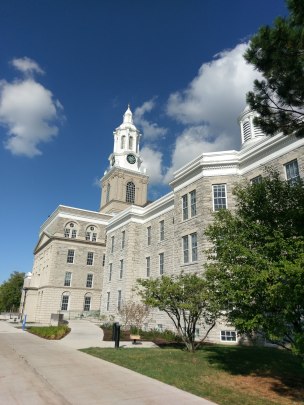
In 1926, Hayes Hall was remodeled in the Georgian Revival Style by Cyrus K. Porter and Sons. This was when the distinctive clock tower was added to the building. The building’s first university use was as an administrative and academic building.  Hayes Hall remodeled again in 1954 by James, Meadows & Howard to expand the building for classroom uses.  The the late 1960s, Hayes Hall was the site of student and faculty protests related to the Vietnam War and the Civil Rights Movement.  Since 1977, the building has been home to the School for Architecture and Planning.  (Note from Angela:  this is where I spent a lot of time while getting my Masters in Planning from 2007-2009).  The building underwent significant renovations from 2010-2015 by Bergmann Associates to modernize the building for a modern architecture and planning school.  The building is listed on the National Register of Historic Places.

Next time you drive past Hayes Place or Want to learn about other streets? Check out the Street Index. Don’t forget to subscribe to the page to be notified when new posts are made. You can do so by entering your email address in the box on the upper right-hand side of the home page. You can also follow the blog on facebook. If you enjoy the blog, please be sure to share it with your friends.

Sources:

  • “General Hayes Noted Bridge Builder Dead”.  Buffalo Commercial.  October 19, 1923, p1.
  • “General Edmund Hayes.”  Buffalo Times.  October 19, 1923, p22.
  • “Arts Academy Benefits By Hayes’ Will”  Buffalo Commercial.  November 7, 1923, p12.
  • Edens, John.  “90 Years Ago, A Club for UB Alumni”.  UB Reporter.  December 22, 2011.
  • “Edmund B. Hayes Hall.”  University at Buffalo University Archives.
  • “Edmund B. Hayes Hall.”  Historic American Buildings Survey.  SHP No 10PRO7210.  Accessed via https://cris.parks.ny.gov/

Read Full Post »

eggertroad

Eggert Road

Eggert Road is one of the longer streets we’ve talked about here.  Eggert is a 6.5-mile, north-south route that runs through four municipalities – Cheektowaga, Buffalo, Amherst, and Tonawanda! The street is named for the first Postmaster of Eggertsville, Christian Eggert.  Eggertsville was also named for Mr. Eggert.  Eggertsville is one of five hamlets in the Town of Amherst. In New York, a hamlet is an unincorporated settlement within a town. A hamlet has no local government or official boundaries. Eggertsville centers around the corner of Main Street and Eggert Road. The western edge of Eggertsville is the City of Buffalo line, but the eastern border is often disputed. Adjacent to Eggertsville, the hamlet of Snyder centers around the corner of Main and Harlem Road. People differ in their opinions of where Eggertsville ends and Snyder begins. Eggertsville and Snyder are often thought of as one unit, such as in the Eggertsville-Snyder Public Library. The Town of Amherst has an Eggertsville Action Plan which uses the following boundary: west to Niagara Fall Boulevard, south to Kenmore Avenue/Main Street, Getzville Road to the east, and Sheridan Drive to the north.

eggertsville

Approximate boundary of Eggertsville

The Eggertsville area was first settled by property owners with large tracts of land. The first building in what became Eggertsville was a general store built on the northeast corner by Abraham Miller in 1811.  Mr. Miller lived behind the store. His property extended north along what became Eggert Road, where he set aside a cemetery to be used by the community. The first burial there was a child named Elizabeth Grobin.  Abraham was buried there in 1845. The cemetery was used until at least 1873. Mr. Miller’s property and the cemetery are now St. Benedicts Roman Catholic Church and School.  A hotel was built at the corner of Main and Eggert in 1816.

The first church in what became Eggertsville, St. Paul’s Lutheran Church was incorporated in 1827 and was granted its present site in 1829 by the Holland Land Company.  St. Paul’s is the oldest Lutheran Church in Erie County.  The church was first called the German Reformed Church. The congregation was established by Reverend Meyerhoffer, an ex-chaplain of the German Army who gathered together German-speaking residents of Buffalo, Black Rock, and Amherst from Alsace Loraine.  The original church on the site was built in 1833 and a new church was built in 1874.  Unfortunately, the church was destroyed by a fire in 1879. The church was rebuilt and dedicated in 1880. (Note from Angela: this is the church I grew up attending – Hi St. Paul’s friends!)

eggert

Christian Eggert III.  Source:  Town of Amherst

Christian Eggert was born in April 1795 in Bethlehem, Pennsylvania. Mr. Eggert was actually Christian Eggert III. His grandfather, Christian Eggert, had come to Pennsylvania from Uckermark, Germany in 1742. Christian III moved from PA to Western New York in 1831, going into business with Hugh Cathcart as “Cathcart & Eggert”. Cathcart & Eggert owned an Iron Foundry and Plough Factory in Williamsville which built ploughs, cast iron turnpike scrapers, sleigh-shoes, wagon boxes, wagon axles, stoves and other cast iron materials.  The partnership was ended in 1832, with Christian Eggert continuing the company himself.  Mr. Eggert also worked as a land surveyor and surveyed many properties across Western New York.

Christian III married Anna Hershey in March 1818. They had ten children. Benjamin, Aaron, Jacob, Melvina, Oliver, Christian, Ann Marie, Esther, Andrew, and Anna. The first six children were born in Pennsylvania. The others were born in Amherst.

In 1836, The Buffalo and Williamsville Macadam Company was incorporated by Christian Eggert, John Hutchinson, and the Hopkins Family. The company operated a paved toll road. Macadam is a form of pavement invented by John McAdam in Scotland in the 18th century. The Buffalo & Williamsville Macadam toll road went from Buffalo to Williamsville along what is now Main Street and opened in 1837. At Humboldt Parkway in Buffalo and at Getzville Road in Amherst, there were toll gates. Everyone who traveled along the road had to pay the toll, including rates for vehicles and bicycles. In addition, farmers taking livestock to market were charged on a per-head basis. The toll gates operated until 1899.

On the southeast corner of Main and Eggert, Christian Eggert built a house in 1832. Mr. Eggert set up the first post office in this house in 1855. At the time, Post Offices moved around based on who Postmaster was, so they were often located in residences and business places. In 1861, when Michael Snyder became Post Master, residents of Eggertsville were angry since this moved the Post Office a mile to the east to Main & Harlem. Since several roads converged at Eggertsville, more business happened at Main & Eggert than at Main & Harlem. They also would have to pass the Toll Gate, which had a charge each way of 5 cents for a single wagon and 8 cents for a double wagon (between $1.50 and $2.56 today). There were 200 residents impacted by this change instead of 40 who were not affected. About 140 residents of Eggertsville banded together to write to Washington to have the old post office reinstated. The Post Office was back in Eggertsville beginning in 1867 when Christian Eggert was reappointed as Postmaster.  Residents of Snyder got their own Snyder Post Office in 1882, with Michael Snyder as Postmaster.

The Eggertsville Post Office was discontinued in 1905, and postal service was transferred to Williamsville.  The Eggertsville Post Office was reestablished in 1914, and discontinued in 1930 when it was absorbed by the Buffalo Post Office.

Christian Eggert III died in August 1879 at the age of 84. He is buried in the Williamsville Cemetery on Main Street in the Village of Williamsville.  Son Christian M. Eggert was one of the first Postmasters of the Tonawanda Post Office.  Son Aaron Eggert was the first lawyer in the town of Amherst establishing a law office in 1868.  Son Oliver Eggert was Sheriff of Erie County from 1865-67.

default

Eggertsville House, circa 1875. Source: A History of the Town of Amherst

In 1859, the Eggert’s house was converted into a tavern by Nicholas Chassin. The Chassin family had a 15-acre plot extending south along Eggert Road. Eggertsville residents will recognize the Chassin name as there is a street named after him, Chassin Avenue, running parallel to Eggert through what was the Chassin property. Many of the settlers in the area at the time were of French origin. When new French immigrants arrived in Buffalo with little to no money, they were told to go out to see Nicholas Chassin. He would take them in, feed them and let them live with him until they found work. The Eggerstville House was demolished in 1960.

At the bend in Main Street, between Ivyhurst and Koster Row, was a little brick church, behind which was a cemetery. In 1866, it was designated as “The Free Church” and in 1880 as “The Union Church .”The church was a small, red brick building with a Pennsylvania Dutch fence and gateway. As members of the congregation passed away or moved, the church was abandoned and demolished. The cemetery was deeded in May 1849. It was known as “The Resting Place” and was dedicated for all denominations.  Two of the Eggerts were buried in The Resting Place: Christian III’s son, Christian M Eggert, who died in 1861 at the age of 31 and Christian M. Eggert’s daughter (Christian III’s granddaughter), Isabell Eggert who died at 19 in 1873.

eggertsville cemetery

Map showing the two Eggertsville Cemeteries – one behind St. Benedict’s Church and one located between Ivyhurst and Koster Row.

58261392_128430179094

Christian M. Eggert and daughter Isabell L. Eggert’s gravestone in Skinnersville Cemetery

In 1950, Henry Juette was looking to build a house on Main Street near Ivyhurst, having purchased the property from Erie County. The property along Main Street was the original church site. Residents of Eggertsville were up in arms as the development of the house would cut the cemetery property off from public access. The house would prevent those who did wish to visit the cemetery from maintaining their relative’s graves. The property had been purchased by John G. Sattler from the church. Mr. Sattler deeded the land to Erie County. Many of the older families had passed away or moved away, so the cemetery was not kept up. Many of those buried in the cemetery were the founders of Eggertsville, including the Frick Family. The Fricks were the first purchaser of land in Eggertsville from the Holland Land Company in 1817. Two of the Eggert children were buried here. The cemetery was abandoned in 1956, and those from this cemetery and the Eggert Road Cemetery (where St. Benedict’s is now) were moved to Skinnersville Road Cemetery in 1956.  Both Christian M. Eggert and Isabell Eggert’s bodies were moved at this time.  The original cemetery was developed with the existing residential subdivision.

crosbymansion

Crosby Mansion, Eggertsville. Source: Beautiful Homes of Buffalo.

In 1893, the Buffalo and Williamsville Railway opened, making Eggertsville more accessible. Large country estates, such as the William H. Crosby Estate, were developed for successful Buffalo businessmen. The Crosby Estate was 243 acres along Main Street, between Bailey Avenue and Eggert Road. William Crosby was a business tycoon.  He owned the Crosby Company, a metal works known for making bicycle frames, founded in 1896 at the corner of Pratt and Broadway.  Crosby Blvd in Eggertsville and Crosby Hall at UB are named for William Crosby.

eggertsville subdivisions

Some of the original subdivisions of Eggertsville – The Crosby Estate in Red, Pomeroy Park in Blue, High Park-Country Club in Green, Amherst Estates in Orange and Hollywood Subdivision in purple

In the early 1900s, these large estates began to be broken up for further residential development. Beginning around 1910, the Amherst Estates were developed by R.W. Goode and G. H. Sickles. They included the streets LeBrun Road, LeBrun Circle, and Keswick Road. They created 180 lots which ranged from one to five acres. The homes in the Amherst Estates were built as expensive homes in various styles for “people of means.”

In 1916, Chas S. Burkhardt developed the High Park-Country Club section adjacent to the Amherst Estates. The development’s name came from the Country Club at Main and Bailey. The Country Club became Grover Cleveland Park and Golf Course in 1926. High Park Boulevard was built and developed with what was considered a “high-class” neighborhood at the time. They restricted the development to single-family homes and required houses to all be setback at least 40 feet from the street and to cost at least $5,000 ($127,500 in 2022 dollars).

The Hollywood Subdivision was established in 1919, built out of John Sattler’s estate. This development includes Westfield, Ivyhurst and Dellwood Roads. While higher-end homes were built earlier, these houses catered to working-class residents looking for inexpensive modest dwellings.

The Crosby Estate was developed in 1926 as Cleveland Park Terrace.  The neighborhood was developed as a “Garden City” style of development. The development had 1300 home sites, 8 miles of streets, 16 miles of sewer and water, and gas, electric, and phone service.

pomeroy

Pomeroy Mansion, Eggertsville. Source: Beautiful Homes of Buffalo.

Pomeroy Park was developed by J. C. Troidl beginning in 1929.  Pomeroy Park was established by Gurney, Overturf & Becker from Robert W. Pomeroy’s estate and advertised as “Buffalo’s finest subdivision.”  Robert Pomeroy was a prominent lawyer in Buffalo.  Pomeroy Park consists of the streets Elham Drive, Bradenham Place, Longleat Park, Audley End and Greenaway Road.  The development consisted of 59 lots and was restricted to “high-class” single family dwellings.  Advertisements of the time indicated that there were other restrictions in place to “assure purchasers of pleasing environments”….not sure what that meant at the time, but it could refer to restrictive covenants which limited people of color from owning homes in certain neighborhoods.

Like much of Western New York and the rest of the country, the growth of Eggertsville slowed during the Great Depression. The boom was replaced by a period of recession and stabilization. The area then began to grow again in the 1950s, when prosperity returned to America, with post-war suburbanization building out much of Eggertsville and Snyder, including sites like the former Hedstrom Estate.

The next time you drive down Eggert Road, think of Christian Eggert and the other early settlers of Eggertsville!  Want to learn about other streets? Check out the Street Index. Don’t forget to subscribe to the page to be notified when new posts are made. You can do so by entering your email address in the box on the upper right-hand side of the home page. You can also follow the blog on facebook. If you enjoy the blog, please be sure to share it with your friends.

Sources:

  • Young, Sue Miller.  A History of the Town of Amherst, 1818-1865.  Town of Amherst, 1965.
  • “Eggertsville Post Office.”  Buffalo Daily Courier.  August 17, 1861.
  • “Obituary – Christian Eggert.”  Buffalo Courier.  August 16, 1879.
  • Fess, Margaret.  “New House Isolating Cemetery Causes Furor”.  Buffalo Courier-Express.  August 20, 1950, p 22-A.
  • “The Amherst Estates.”  Buffalo Evening News.  May 7, 1910.  P53.
  • “Opening High Park”.  Buffalo Commercial.  March 19, 1915, p10.
  • Hubbell, Mark, editor.  Beautiful Homes of Buffalo.  Buffalo Truth Publishing Company, 1915.
  • Petri, Pitt.  The Postal History of Western New York.  copyright 1960, Buffalo NY.

Read Full Post »

lyth

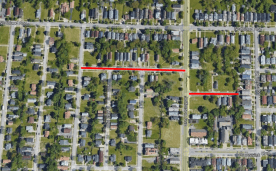
Lyth Avenue on the left, Harwood Place on the right.

Today we are going to talk about two streets on the East Side. Lyth Avenue runs between Purdy Street and Jefferson Avenue in the Cold Spring neighborhood of Buffalo. Harwood Place runs a short distance off, across Jefferson Avenue, near Lyth Ave. Harwood Place is a dead-end street, though historically, it ran through to Lonsdale Road at times. The road was initially a driveway leading to the stables of the Lyth homes at Northland and Jefferson. The horses for the Lyth Tile Company were housed there. The street was deeded to the city around 1886. The family also built two houses and a place of business on the street.

john lyth 3John Lyth was born in Stockton-Upon-Tees in England in September 1820. Mary Ann Harwood Lyth was born in England in 1817. At age 13, Mr. Lyth learned the trade of earthenware manufacturer. John and Mary Ann were married in 1843. They had three children while living in England – Alfred, John, and Mary. They emigrated to Buffalo in 1850 and had two more children – William and Francis- born here in Buffalo.
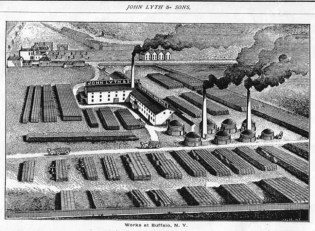
In Buffalo, John Lyth worked for P.A. Balcom, a local brickmaker. He later worked with W. H. Glenny in the crockery business. In 1851, Mr. Lyth’s brother, Francis, invented and introduced the hollow tile arch in York, England. In 1857, Mr. Lyth purchased a plot of land nearly a half-mile square and began to manufacture farm drain-tile. In his first year, he only sold $50 worth of tile. Then, in 1864, he went into business with Mr. Balcom, a partnership that lasted for ten years. They manufactured salt-glazed, citrified sewer pipe and terra cotta goods. Their factory was located at 83 -163 Puffer Street (now Northland Avenue), between Purdy and Jefferson. Lyth Avenue was a driveway to the factory.

lyth works

Lyth Factory. Source: Buffaloah.com

The Lyth family were pioneer residents in the Northland section of the city. Northland Avenue at the time was known as Puffer Street. John Lyth chose the location for the factory because of the abundance of clay in the soil. This clay was the best type for making tiles. The Lyth factory was a landmark of the early neighborhood.

The Lyth home was located at 169 Puffer Street. The house was considered suburban when it was built. In later years, family members would say that they were so far out of town they couldn’t even get a doctor to come, except in gravest illnesses. The large house was surrounded by extensive lawns, gardens, and orchards. The family had a cow, chickens, and vegetable gardens to provide for the family. Mary Ann was devoted to her family. Twice, she refused to return to England on trips b/c she did not want to leave her children.

In 1871, the Great Chicago Fire happened. The demand in construction for fireproof hollow tile and bricks for construction leapt after the fire. In the 80s and 90s, the Lyth Tile Company was the largest of its kind in the country.

lyth grave

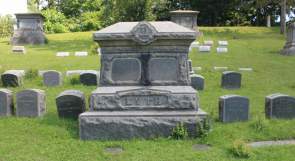
Lyth Family Plot in Forest Lawn

The Lyth Family were members of the Unitarian Church. They were strong advocates of temperance. John Lyth was a member of the Royal Templars of Temperance, serving as Supreme Treasurer of the Order. John Lyth died at his home at 169 Puffer Street in 1889. He is buried in Forest Lawn Cemetery.

Alfred Lyth was born in 1844. One of his earliest memories was traveling from New York to Buffalo along the Erie Canal when the family arrived here. In 1862, Alfred enlisted in the 100th Regiment, New York Volunteers. He served at Fort Sumter, Gloucester Point, the James River Expedition, and Drury’s Bluff. During his time in the regiment, he suffered from typhoid fever and was wounded in action three times. He was also captured by Confederates and held as a prisoner at Andersonville Prison for a year.  After the war, Alfred joined his father’s tile business with his brothers John and William. They formed the firm J. Lyth & Sons.

183 Northland Spree

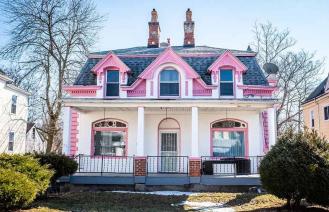
183 Northland.  Source  Buffalo Spree.  

In 1872, the Lyth Mansion at 183 Puffer (now Northland) was built by Alfred Lyth. This house is sometimes listed as being lived in by John Lyth; however, city directory records show that John and Mary Ann lived at 169 Puffer. Son Albert and his wife Kate lived at 183 Puffer.

After his father’s death, Alfred headed the business. He also joined Company F of the 74th Regiment, National Guard, and attained the rank of Major. When the Grand Army of the Republic formed, Major Lyth became a prominent member. For 25 years, he attended every state and national GAR convention as a delegate. In 1897, when the GAR National Encampment was held in Buffalo, Major Lyth was Vice-Commander-In-Chief of the convention.

lyth tile angola

Postcard view of the Tile Works in Angola

In 1872, Major Lyth was Supervisor of the Seventh Ward, and in 1873, he was Chairman of the Board of Supervisors. In 1874, Lyth Avenue was opened and named in Major Lyth’s honor.  In the 1890s, the Lyth Tile Company plant moved to Angola, New York. By 1894, the former factory site was developed for residential purposes.

In 1897, residents of Puffer Street asked for the name to be changed to Northland Avenue. The residents felt that people were getting confused between Puffer Street and Tupper Street, and their mail was getting sent to Tupper Street. Picture the old-timey cursive handwritten envelopes, and it’s easy to imagine the confusion! The name change was granted by Common Council in May 1897 and signed by Mayor Jewett on May 23, 1897.

Alfred’s brother William Lyth inherited the house at 169 Northland after Mr. Lyth’s death. In her later years, mother Mary Ann lived with Alfred at 183 Northland. Sometime between 1916 and 1950, the house at 169 Northland was replaced with a retail store.

Major Alfred Lyth died in 1925 at age 81. Major Lyth’s son, Alfred Lyon Lyth, took over the business. Alfred Lyon had been involved in the industry from a young age. His father had insisted on teaching him all aspects of the company before he retired. Alfred Lyon had been known as the “champion quarterback of Western New York and was offered a scholarship to Syracuse University to play football. Times were hard, so his father convinced him to stay in Buffalo for one year to help with the business before entering college. Alfred Lyon became interested in the work and didn’t leave for college.

In 1922, Alfred Lyon Lyth opened Lyth Chevrolet at 1159 Jefferson Avenue, the first Chevrolet agency in Buffalo. He sold J. Lyth & Sons to Globe Plaster Company three years later. Alfred Lyon Lyth was elected as Erie County Supervisor for the 13th Ward in 1908, 1913 and 1927.

royster northland ave

Royster Family in front of 183 Northland Avenue, 1973.  Source:  Buffalo Courier Express.

Lyth Family members continued living at 183 Northland until the 1950s. From 1956 to 1958, Luke Easter lived in the house. Luke Easter was the first African American to play for the Buffalo Bisons in modern times. As a result, the house is often called “the Luke Easter House.” After Mr. Easter, the house was owned by Clifford Royster, who owned the house until 2002.  The house is within the Hamlin Park Historic District, established in the late 1990s.

Next time you drive by Lyth Ave or Harwood Place, think about the Lyth Family and remember a time when Northland was known as Puffer Street!  Want to learn about other streets? Check out the Street Index. Don’t forget to subscribe to the page to be notified when new posts are made. You can do so by entering your email address in the box on the upper right-hand side of the home page. You can also follow the blog on facebook. If you enjoy the blog, please be sure to share it with your friends.

PS.  I hope you are all having a lovely holiday season and have a very Happy New Year!

Sources:

  • Smith, H. Katherine.  “Harwood Place Memorial to Wife of Area Pioneer.” Buffalo Courier-Express.  December 21, 1941, p7.
  • “Mr. John Lyth”.  Buffalo Commercial.  April 28, 1889, p3.
  • “It is now Northland Avenue.”  Buffalo Courier.  May 23, 1897, p6.
  • “J. Lyh & Sons of Buffalo Coming Here.”  Evans Journal.  September 26, 1957, p4.
  • The Clay Worker, Volume 27-28.  National Brick Manufacturer’s Association of the United States of America:  T.A. Randall & Company, 1897.
  • Nyhuis, Philip.  “Finding Happiness in Hamlin Park.”  Buffalo Spree.  May 15, 2019.
  • Brady, Karen. “Bus Tour of City’s East Side Provides a Trip into the Past”. Buffalo News. August 17, 1992.
  • “Alfred Lyth Will Bequests Total $22,900.”  Buffalo Courier-Express.  May 15, 1953, p19.
  • “It’s Not All Blight”.  Buffalo Courier Express.  July 12, 1973, p18.
  • Smith, Katherine.  Lyth Avenue Honors Family Which Headed First US Tile Plant”.  Buffalo Courier-Express.  September 24, 1939, pL2.

Read Full Post »

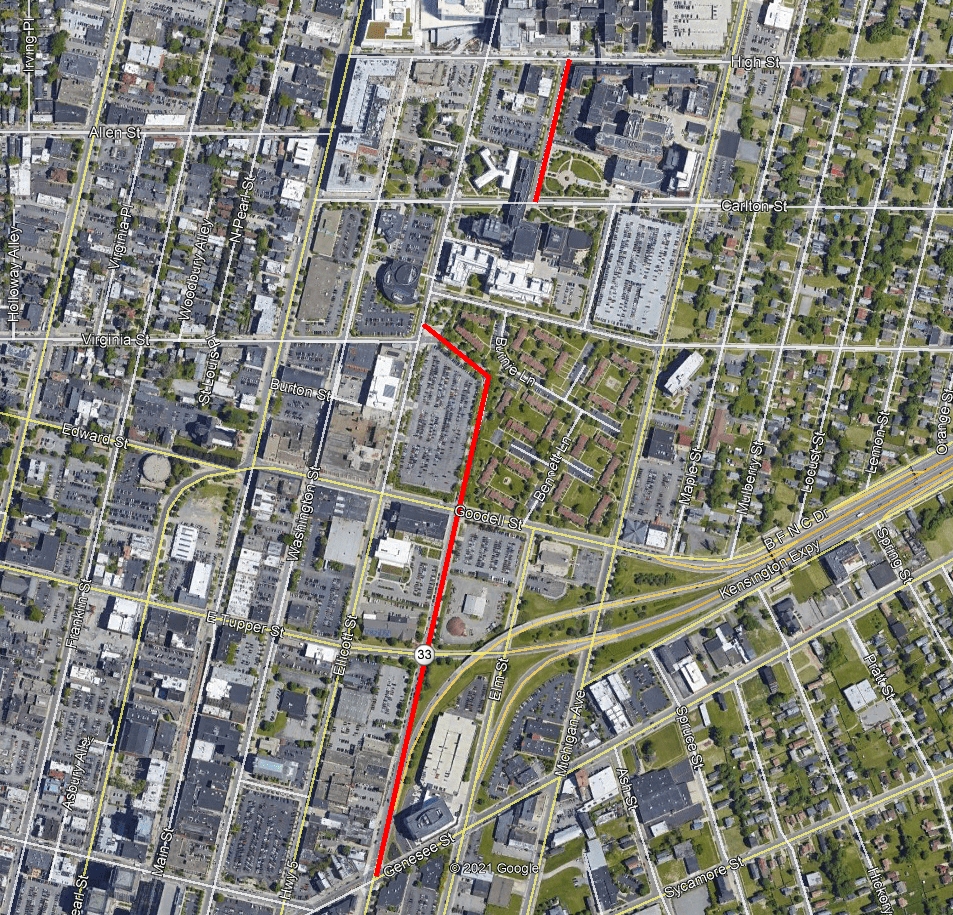
carltonCarlton Street runs from Main to Genesee Street in the Medical Campus and Fruit Belt neighborhoods of Buffalo.  Like many streets in this area, it was impacted by the construction of the Kensington Expressway (NYS Route 33), which separates Carlton Street into two, with its final two blocks of the 33, cut off from the rest of the street west of the 33.

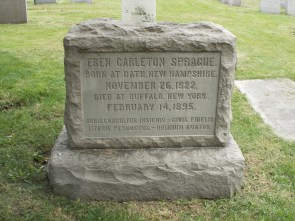
Carlton Street is named for Ebenezer Carleton Sprague.  Ebenezer went by the nickname of Eben and was born in Bath, Grafton County, New Hampshire on November 26, 1822.  Eben Sprague was the Great Great Great Grandson of Frances Sprague, who sailed to Plymouth on the ship Anne, and was the First Secretary of the Plymouth Colony.  Eben Sprague came to Buffalo in 1825 with his parents Noah Sprague and Abiah Carleton.  Technically, you could say that Carlton Street was named for Eben’s mom and her family.  The name was spelled interchangeably as Carleton and Carlton, depending on the source.

Noah Sprague worked in the mercantile business in Buffalo and was well known around Early Buffalo.  He was elected County Clerk of Erie County in 1831 and 1840.  He was mostly identified with the lake business and had an office on the docks for many years.

EbenCarletonSpragueEben Sprague attended Phillips Exeter Academy and graduated from Harvard College in 1843.  After graduation, he studied law in the office of Millard Fillmore and Solomon G. Haven, two of the most distinguished lawyers of their day.  Mr. Sprague was admitted to the bar in October 1846.  He was a successful lawyer and was associated with both Millard Fillmore and his son, Millard Powers Fillmore.  Mr. Sprague founded the firm Moot, Sprague, Marcy and Gulick.  He was well respected among the legal community for nearly 50 years.

Mr. Sprague served as the lawyer for the International Railroad Company, the Great Western Railway of Canada, Grand Trunk and Lake Erie & Western Railroads as well as other railroad and manufacturing concerns.  His firm went by several names over the years.  He served as attorney for Erie County Savings Bank for more than 40 years, beginning in 1854.

235 Delaware

Sprague House at Delaware and Chippewa in center of photo. Source: Chippewa Street Development Report

In 1849, Eben Sprague married Elizabeth H. Williams.  They had eight children, but only four lived to adulthood – Henry Ware,  Carlton, Louise and Mary.  The Sprague Family lived in a cottage on High Street and then moved to a home on the northeast corner of Chippewa and Delaware.  The house at 235 Delaware Avenue was originally built by W. S. Gardner in 1836 for Alexander A. Eustaphieve.  The house was a three story, Federal-style brick structure.  The house had a basement kitchen, which was the older style of house popular in the early days of Buffalo, called an English basement house.  The house was demolished in 1930.  The site is currently Starbucks and Bocce’s Pizza.

The Sprague house was a center of culture.  Mr. Sprague studied languages – including French and German which he was fluent in, and Latin and Greek.  He enjoyed poetry, especially Shelley.  He always said if he hadn’t’ been a lawyer, he’d have been a writer.

Mr. Sprague served as President of the Young Men’s Association, which developed into the Buffalo Library; Vice President and Curator of Buffalo Academy of Fine Arts (the Albright Knox Art Gallery); a member of the Buffalo Natural Science Association, the Harvard Club and the Thursday Club.  He was also one of the founders of First Unitarian Church.  In 1890, he was made the third Chancellor of the University of Buffalo.

In 1876, he was nominated to fill a vacancy in the State Senate for a single session.  During his time in the Senate in 1877, he was a member of the Committee on Canals and helped reduce tolls on the Erie Canal.  He also was a member of the Judiciary Committee, and worked to better the new code of civil procedure, which included writing 600 amendments to the code!  His constituents wanted to nominated him the next year, but he declined.  He had no desire for other public positions.

In the 1880s, Mr. Sprague advised wealthy Buffalonians to share their riches, saying, “It was wealth without a conscience that sowed the seeds of the French Revolution and drove its possessors into exile and to the guillotine.”  He was a supporter of many charities, giving of his time, money and attention.  He served as a Secretary of the Buffalo Orphan Asylum and a Trustee of Children’s Aid and Charity Organization Society, and of the Society for the Prevention of Cruelty to Children.

Mr. Sprague wrote a number of essays that he published.  In 1891, Mr. Sprague printed a book titled “Lessons from the Life of Benjamin Franklin” for the young people of Buffalo.  This book is an autobiography of Franklin’s that was edited by Mr. Sprague.  In Mr. Sprague’s introduction he wrote to the boy and girls, hoping they could learn from Franklin’s life and, “while they cannot all be Franklins, they can become respected and prosperous.”  He desired wide circulation of the book, so he sold it at cost.

sprague graveMr. Sprague died on February 14, 1895 at the age of 73.  He suffered fell into a coma while home reading to his wife by the fire.  He died the next day of kidney disease.  His grave says:  Jurisconsultus Insignis – Civis Fidelis Literis Perdoctus- Hominum Amator, which means “Distinguished Lawyer – A Loyal Citizen – Lover of Human Learning.  He left behind an estate valued at $50,000 in real estate and $150,000 in personal property ($1.6 Million and $4.9 Million in today’s dollars).  Eben left his law office to his son Henry, who continued the practice until his death.  The firm then continued under Eben’s grandson!

Want to learn about other streets? Check out the Street Index. Don’t forget to subscribe to the page to be notified when new posts are made. You can do so by entering your email address in the box on the upper right-hand side of the home page. You can also follow the blog on facebook. If you enjoy the blog, please be sure to share it with your friends.

Sources:

  • Smith, H. Katherine.  “Carlton Street Memorial to Outstanding Buffalo Lawyer.”  Buffalo Courier-Express.  April 20, 1941, p 7-3.
  • “E.C. Sprague Dead”.  Buffalo Enquirer.  February 14, 1895.  p1.
  • “Last Will of Late Eben Carlton Sprague”.  Buffalo Enquirer.  June 14, 1895.  p2.
  • “Loved and Mourned:  A Departed Bright Light of the Bar of Buffalo.”  Buffalo Courier.  February 16, 1895, p6.
  • “Mr. E.C. Sprague:  Sudden Death of One of City’s Most Prominent Lawyers at Noon.”  Buffalo Evening News.  February 15, 1895, p6.
  • Patterson, Roger.  “Chippewa Street Development Report.”  Prepared for the Dept of Community Development, Buffalo New York.  February 1980.
  • Franklin, Benjamin.  Lessons from the Life Of Benjamin Franklin.  Ebenezer Carlton Sprague, editor.  P. Paul & Bro Publishers:  Buffalo.  1891.

Read Full Post »

metcalfeMetcalfe Street runs between Clinton Street and William Street in the Seneca-Babcock neighborhood of the East Side. The street is near the former Buffalo Stockyards and is named for James Metcalfe, a meatpacker.

The Metcalfe family came to America from Yorkshire, England, before the Revolutionary War. James Harvey Metcalfe was born in Bath, New York, in August 1822. James moved to Ellicottville with his parents in the 1840s. James came to Buffalo at the age of 33 in 1855, after the death of his father and a daughter. His first job in Buffalo was as a hotel keeper, operating the Drover’s Home. The Drover’s Home was located on Elk Street, where the Lake Shore and Erie Railroads exchanged freight, at what was known as Elk Street Junction. A drover is someone who drives cattle or sheep. Mr. Metcalfe quickly learned that more money was to be made in livestock in Buffalo rather than the hotel industry. He became a partner in the meatpacking firm of Metcalfe & Cushing, one of the largest local meatpacking houses. He was simultaneously a partner in Metcalfe & Gibbs, meat distributors in New York City.  In 1863, The New York Central and Hudson River Railroad opened the East Buffalo Stock Yards.  Metcalfe & Cushing were in charge of the department of hogs.  The Stock Yards had capacity for up to 35,000 hogs at a time.

Mr. Metcalfe was a strong promoter of the Buffalo, New York & Philadelphia Railroad and served as a Director. He was the largest stockholder in First National Bank, located on the southeast corner of Main and Seneca Street. He served as President of the bank for many years, during which time the bank weathered several financial panics. Mr. Metcalfe was appointed as a parks commissioner in 1876 and contributed to the improvement of the Buffalo Parks System until his death.

158 swan_2

Metcalfe House on Swan Street. Source: New York State Office of Historic Preservation

James Metcalfe married Erzelia Frances Stetson in 1849, and they had six children – Frances, Kate, James Jr, George, Francis, and Guy. The first two daughters were born in Ellicottville. Unfortunately, Kate died as an infant and is buried in Jefferson Street Cemetery in Ellicottville. In Buffalo, the Metcalfes lived in a house on Swan Street, one door from Michigan Avenue. At the time, Swan Street was a fashionable neighborhood. The house was across the street from Benjamin Fitch’s dry good store, which later became the Fitch Creche – the country’s first daycare center. The Metcalfe’s house was listed as a Buffalo Landmark in 1979 but was demolished in 1992 after a wall collapsed.

aaron rumsey

House at 672 Delaware Avenue. Source: Buffaloah.com

Mr. Metcalfe was fond of animals and had a dozen fine horses. In 1871, they moved to Delaware Avenue into a house purchased from Aaron Rumsey at 672 Delaware Avenue. When the Metcalfes moved to Delaware Avenue, he also got a cow, who grazed on the grass outside his gardens. The family had a lot of pets – dogs, cats, a pony, several varieties of pigeons, a raccoon, and a bear cub!  The family noted that the bear cub was well behaved; his only incident was when a popcorn vendor came to the house – the bear stole some popcorn.

The family attended St. John’s Episcopal Church, located at Swan and Washington Streets and later Christ Church. The Metcalfe family often attended plays in box seats at the Academy of Music. The children would enthusiastically stand near the rail of the box seats, blocking their father’s view. Mr. Metcalfe was known for settling into his chair and taking a nap, letting the kids enjoy the show.

Many distinguished guests would visit the Metcalfe Home, including James Blaine. James Blaine was a politician from Maine who served as U.S. Congressman, Senator, and Secretary of State. Mr. Blaine is said to have liked Mr. Metcalfe’s sitting room design so much, he copied it when he designed his own mansion on Dupont Circle in Washington, DC.  The Blaine mansion is still standing today.

71198471_130867945578

Metcalfe Marker in Forest Lawn

Mr. Metcalfe retired from his position as President of First National Bank in June 1879 due to his ill health. Unfortunately, the youngest Metcalfe son, Guy, drowned at age 11 while playing on the canal bridge in August 1879. Mr. Metcalfe, already ill and now heartbroken over the loss of his son, died eight weeks later on October 5, 1879. Both James and his son are buried in the Metcalfe Plot in Forest Lawn Cemetery.

Metcalfe_House,_Buffalo,_NY,_c._1895

Metcalfe House in 1895. Source:  Wikimedia

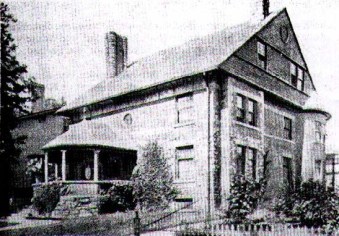
James Metcalfe’s son, James Jr., built a house at 125 North Street from the estate for himself and his mother, Erzelia. The house was built just around the corner from their former house at 672 Delaware on the same property Mr. Metcalfe had purchased from Aaron Rumsey in 1871. The Metcalfe House was commissioned by McKim, Mead, and White architectural firm in July 1882 and was completed in 1884. This was the first house the NYC-based firm designed in Buffalo. The house cost $23,464 to build($636,263 in today’s dollars). The 125 North Street house was described in 1926 as “a charming house that was the scene of many exclusive but brilliant little dinners, for Mrs. Metcalfe had the happy knack of assembling clever people together.” The house was smaller than the grand mansions of the previous generation, with lower ceilings. They required less heat, fewer furnishings, and fewer servants.

After the Metcalfes moved out, the 125 North Street house was occupied by E.R. Thomas and Edward M. Mills. The house was then leased to the Graduates Association and was used as a rooming house. By 1926, the house was “without a tenant and probably will pass, like so many others of its neighbors, into the discard, although it far too artistic a house to meet any such fate.”

jedc3-01009041_1_1

Former Butler Mansion, now Jacobs Executive Center. Source: UB

The former Metcalfe house at 672 Delaware was demolished in 1896 to build two homes for the Williams Brothers at Delaware and North – 672 Delaware for George Williams and 690 Delaware for Charles Williams. Like 125 North Street, these houses were also designed by McKim, Mead, and White. The house at 672 Delaware was the most expensive house of its time in the area, costing George Williams $171,877 (about $5.6 million today). The house was sold to Edward H. Butler, founder of the Buffalo News, in 1905. The Butler family lived in the home for 69 years.

c1905_loc

Metcalfe House on North Street. Pillars from the Butler Mansion can be seen on the right hand side of the photo.  Source: Library of Congress

Sportsystems Corp purchased the 672 Delaware Ave property and 125 North Street in 1979. Sportsystems became Delaware North due to the site’s location at the prominent corner of Delaware Avenue and North Street. The company insisted they could not move their headquarters into the Butler Mansion unless they created a 38 spot parking lot.  They planned to demolish the house to build the parking lot on the Metcalfe House site. The 672 Delaware mansion was meticulously rehabilitated by Delaware North to bring it back to its glory days. The Delaware North headquarters moved into the mansion in 1987.
Preservationists fought to save the Metcalfe House at 125 North, particularly Francis R. Kowsky, Professor of Fine Arts at Buffalo State. Professor Kowsky referred to the architecture of the building as the midway point between HH Richardson and Frank Lloyd Wright. In February 1980, 125 North Street was demolished. The parking lot was determined not to be needed and was removed a few years later.

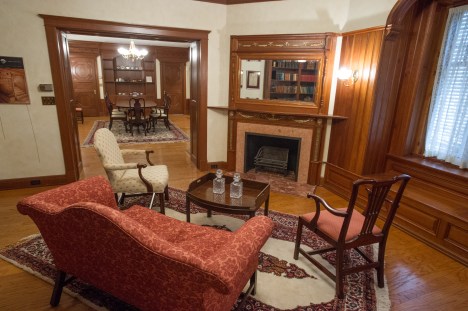
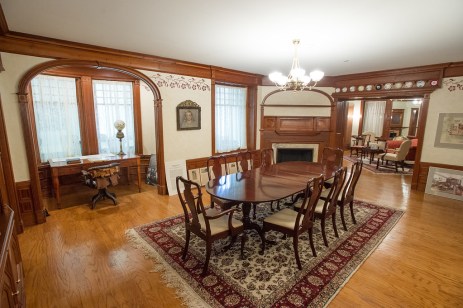
Parts of the Metcalfe House were saved, and you can visit them today! First, the solid cherry dining room and library of 125 North Street were dismantled and stored in boxes. Then, in 1989, the pieces were reassembled on the first floor in Rockwell Hall at Buffalo State College. The Metcalfe Rooms serve as a reception area and conference room. The reconstruction of the rooms cost $220,000 and was financed by private donations, including Delaware North’s donation of $40,000.

Metcalf Room in Rockwell Hall at SUNY Buffalo State College.

Metcalf Room in Rockwell Hall at SUNY Buffalo State College.

Metcalf Room in Rockwell Hall at SUNY Buffalo State College.

Metcalf Room in Rockwell Hall at SUNY Buffalo State College.

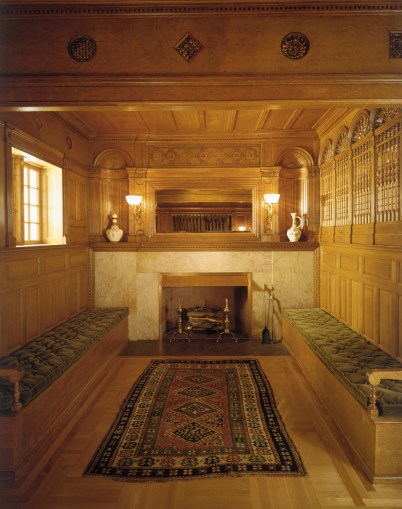
Once it appeared that the preservation battle was lost, the Metropolitan Museum of Art in New York City was also interested in taking the front portions of the interior. The Met received the entrance hall, central staircase, and parlor. The Stair Hall and Entrance were installed between 1990 and 1992 in the Museum’s American Wing. Guests enter through a former doorway and exit through the original colonial-style split (Dutch) door. The room features “a fashionable “inglenook” – a fireplace flanked by built-in benches – and a dramatic staircase with a half-story landing lit by leaded-glass windows.” The parlor has remained in storage.

Parlor_Stairhall_from_the_Metcalfe_House,_Buffalo_MET_ADA2882

Entryway from the Metcalfe House at the Met. Source: Wikimedia

Parlor_Stairhall_from_the_Metcalfe_House,_Buffalo_MET_ADA2881

Stairwell from the Metcalfe House at the Met. Source: Wikimedia

Many architects feel that the wrong house was demolished. The mansions at 690 Delaware and 672 Delaware were big repetitive style houses, whereas 125 North Street was unique and different. The property at 672 Delaware Avenue is currently owned by University at Buffalo. It is known as the Jacobs Executive Development Center. The site of the Metcalfe House is a part of the gardens associated with the Jacobs Center.  The demolition of the Metcalfe house organized the preservation movement in Buffalo. It led to the creation of the Preservation Coalition of Erie County (now a part of Preservation Buffalo Niagara).

So, next time you head down Metcalfe Street, think of the Metcalfe family’s houses that are no longer standing.  And the next time you pass the corner of Delaware and North, imagine someone playing outside with their bear cub!  Want to learn about other streets? Check out the Street Index. Don’t forget to subscribe to the page to be notified when new posts are made. You can do so by entering your email address in the box on the upper right-hand side of the home page. You can also follow the blog on facebook. If you enjoy the blog, please be sure to share it with your friends.

Sources:

  • Smith, H. Katherine. “Metcalfe Street Named for Bank Founder Who Also Built Up Parks.” Buffalo Courier-Express. January 7, 1940, pL5.
  • “The Duchess Strolls: Pomander Walk.” Buffalo Courier. June 5, 1926, p6.
    “First National Bank: Resignation of Mr. Metcalfe as President.” Buffalo Commercial Advertiser. June 9, 1879, p3.
  • “Obituary: Mr. James H. Metcalfe.” Buffalo Courier. October 6, 1879, p2.
  • Cardinale, Anthony. “Rising from the Rubble The Historic Metcalfe House was Razed Ten Years Ago, But Parts of It Can Be Revisited.” Buffalo News. December 24, 1989
  • Bosco, Jim. “At Home in the Office Eight Years and $6 Million Later, A Delaware Avenue Mansion Blossoms as Executive Offices.” Buffalo News. April 23, 1989.
  • Sommer, Mark. “Metcalfe house, preserved in part at Buffalo State, helped launch a movement.” Buffalo News. February 14, 2020.
  • Fairbanks, Phil. “Metcalfe House is a Long Way from Home Remains of Buffalo Landmark Will Go On Display in New York.” Buffalo News. July 7, 1991.
  • “Home of a Thousand Voices: Members of the Metcalfe Family in Ellicottville, New York.” Wisteria. June 29, 2017. http://wisteria-dawn.blogspot.com/ (online November 2021).
  • Larned, JN.  “A History of Buffalo:  Delineating the Evolution of the City.”  Empire State Company, 1911.

Read Full Post »

box-ave.png

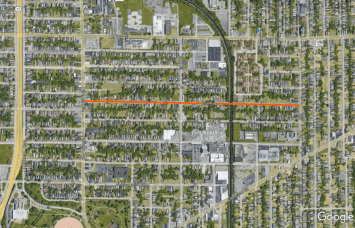
Box Ave

Box Avenue runs between Fillmore Avenue and Moselle Street in the MLK Park neighborhood of the East Side.   I always enjoy finding the origins of streets like Box, where you’d think perhaps there was a box factory near there or something.  Instead, the street is named after Henry Box.

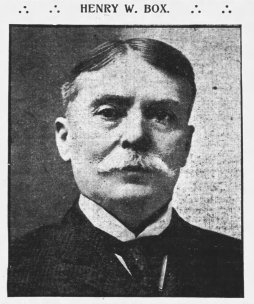
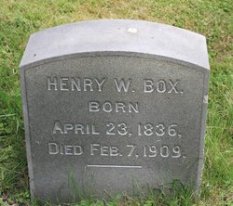
Henry Wellington Box was born in Cornwall, England on April 23, 1836.  His parents died when he was young, so he started working at age six.  He drove sandcarts on a farm.  He worked his way up to making $12.50 (about $440 in today’s dollars) a year.  The sand was necessary in Cornwall to make the soil useful for farming.  At age 13, he came to America.  At the time, the crossing of the Atlantic took 32 days.  When he landed in New York, he had nine English shillings.  He spent three of those shillings on dinner when he arrived.  The rest of his life, he would say that after the weeks of ocean voyage food, the meal tasted better than anything he ever ate after!  His first job in America was working on a farm near Honesdale, PA.  He decided that he finally needed to get an education, and at age 16 enrolled in the rural school while working part-time at the farm.  He became acquainted with a prominent Pennsylvania lawyer who helped him attend Wyoming Seminary in Kingston, PA.  To earn tuition and board, he taught in nearby rural schools.

clip_88393657

Source: Buffalo Times

Mr. Box studied law in the office of Judge Campbell Collins of Wilkes-Barre, PA.  In 1859, Mr. Box was admitted to the Pennsylvania bar.  He came to Buffalo in 1861 and worked as a clerk in the law office of Sherman S. Rogers.  He worked for a salary of $2/week and slept in the office to avoid having to pay rent.  Mr. Box was admitted to the New York State bar in 1862.  He worked his way up in the profession and quickly became recognized.  He was particularly known for his work as a criminal lawyer.  During the 1870s, he started to be in demand as corporation counsel for a variety of companies, so he discontinued his criminal practice.  He served for 31 years as attorney for the Buffalo Street Railway and played an important role in its expansion.  He also served as the attorney for Union Fire Insurance Company, Buffalo Gas Company, Bell Telephone Company and Western Union.

Mr. Box developed an interest in real estate.  He built the subdivisions in the Box Street section; as well as two subdivisions  on Clinton Street – one near the stockyards and the other east of Bailey Avenue; and the Sweet Avenue subdivision.  He named streets for some of his friends – including Warren Street for Orsamus Warren and Sweet Avenue for Charles A Sweet.  He named Selkirk Street after the husband of hiw wife’s sister, John Selkirk.  He built more than 400 houses on the East Side of Buffalo, mainly for railroad employees and mechanics.

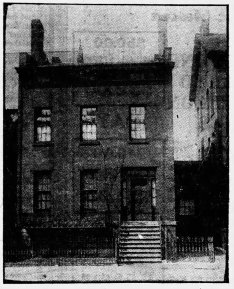
Mr. Box married Mary Mason Peabody in 1865.  Mrs. Box was the daughter of John Peabody, another prominent family.  The Box family lived on Pearl Street and later built a mansion at 638 Delaware Avenue.  They adopted one daughter, Mary Elizabeth Box.  Mary Elizabeth’s coming-out party was held on December 26th 1893 at the Hotel Niagara and had more than 1000 guests.  The family collected paintings and books of immense value.

In 1893, he served as a New York State Commissioner to the Chicago World’s Fair.  He was a member of the Buffalo Club, the Country Club, the Buffalo Library, the Historical Society(Buffalo History Museum), and the Fine Arts Academy (Albright Knox Art Gallery).  He returned to Great Britain several times to visit relatives on London and Edinburgh, Scotland.

henry boxMr. Box retired in 1901.  He passed away in 1909 at Saranac Lake.  He had suffered from tuberculosis for five years before his death.  He spent his last year in the Adirondacks to help with his health.  He is buried in Forest Lawn in the Peabody-Selkirk-Box family plot.

The value of Mr. Box’s estate was determined to be $134,974 in personal property and $150,082 in real property.  It took years to close out Mr. Box’s estate due to his extensive real estate holdings.  This would total about $8.5 Million in today’s dollars.  In 1923, to help close out the estate, the remaining 88 lots on Clinton, Archer, Littell, Seneca, Clemo and other streets were offered for $35,000.  Some of the family’s paintings were donated to the Albright Knox and 850 books were donated to the JN Adam Memorial Hospital to build their library.  Donations were also left to Buffalo General Hospital, Sisters Hospital, Buffalo Orphan Asylum and Children’s Hospital.  Mary Elizabeth never married, in her will she left her remaining money to various organizations including the Tuberculosis Association.

Want to learn about other streets? Check out the Street Index. Don’t forget to subscribe to the page to be notified when new posts are made. You can do so by entering your email address in the box on the upper right-hand side of the home page. You can also follow the blog on facebook. If you enjoy the blog, please be sure to share it with your friends.

Sources:

  • Smith, H. Katherine.  “Box Avenue Memorial to Noted Lawyer.”  Buffalo Courier-Express.  January 21, 1942
  • “Funeral of Henry W. Box.”  The Buffalo Commercial.  February 11, 1909, p10.
  • “Henry W. Box Passes Away”  Buffalo Express.  February 8, 1909, p8.
  • “To Close The Estate of Henry W. Box.”  The Buffalo Enquirer.  June 25, 1923, p5.
  • “Hospital Gets Books as a Henry W Box Memorial.”  Buffalo Courier.  November 3, 1912, p25.
  • “Will of Henry W Box is Filed for Probate.”  Buffalo Courier.  February 16, 190, p7.
  • “Life Story of Henry W Box is History of Distinguished Man.”  Buffalo Courier.  February 14, 1909, p41.

Read Full Post »

shumwayShumway Street is a north-south street running between Broadway and Howard Street in the Emslie Neighborhood on the East Side of Buffalo.

The street is named for Horatio Shumway.  Mr. Shumway was born in Belchertown, Massachusetts in 1788.  Schools were hard to come by at that time in his hometown, so he prepared for college on his own.  He attended Middlebury College in Vermont.  After graduation, he taught school while he trained as a lawyer in Watertown at the office of Luther Bradish.  In 1824, Mr. Shumway decided to go west to St. Louis.  At the time, transportation westward was uncertain, precarious and in some areas, non-existent.  Mr. Shumway arrived around Buffalo during a blizzard.  He intended to leave Buffalo via boat for Chicago, but the lake was icebound.  He was forced to wait until the lake thawed.  While waiting, he decided that he really liked Buffalo and decided to stay.  I guess I could have named this entry “Get Stuck in a Blizzard, Get a Street Named After You!”

In 1831, Mr. Shumway was involved in the incorporation of the City of Buffalo, which occurred in April 1832.  In 1838, he was involved in a series of meetings involving the creation of public school services.  When Buffalo City Water Works was incorporated in 1851, Mr Shumway was also involved.

Elected in 1846, Mr. Shumway represented Buffalo in the New York State Assembly.  Mr. Shumway introduced to the Legislature the first bill to guarantee the protection of a married woman’s property rights.  Mr. Shumway worked tirelessly until it became a law.  Prior to this law, a husband could dispose of his wife’s property anyway he saw fit.   The Married Women’s Property Act of 1848 became an important law as it served as a template for other laws across the country.  While America gets much of its legal precedent from British Common Law, a similar statute was not passed by Parliament until 1882!  This law created an exception to the rule that a man and a woman who were married were considered one single unit.  Women who inherited land from their father’s estates were now allowed to own the property, instead of it going to her husband.  After his time in the legislature, Mr. Shumway decided public life was not for him and continued his private law practice.

clip_87380783

64 Franklin Street Source: Buffalo Times

Mr. Shumway married Mary Haywood, a member of another prominent early Buffalo family.  The Shumway family lived at 64 Franklin Street.  Mary Haywood came to Buffalo after her brother, Russell Heywood, had established himself in a department store at the corner of Pearl and Seneca Street.  The Shumways had one daughter, also named Mary, who was one of the early graduates of Buffalo Female Academy.  Mary Shumway married George F Lee.  Following Mr. Shumway’s death, Mrs. Shumway and Mary moved to 299 Delaware Avenue.  The Franklin Street property was sold to Miss Nardin, principal of St Mary’s Academy.  Ernestine Nardin began the school on Pearl Street and East Seneca in 1857, but moved to the corner of Franklin and Church Streets in 1868.  In 1890, the school moved to Cleveland Avenue. While the school was officially named “St. Mary’s Academy and Industrial Female School”, it was known around town as Miss Nardin’s Academy.  In 1917, the school officially changed its name to The Nardin Academy.  The house at 64 Franklin Street stood between the school and St. Joseph’s Cathedral, which is still standing.  The 64 Franklin Street property was used to house the Italian nuns who taught on Fly Street at Our Lady of Mount Caramel school, just down the street at what is now Canalside.

Mr. Shumway was the first President of First Presbyterian Society, which built First Presbyterian Church.  Through their work with the church, Mr. Shumway was a close friend of Jabez Goodell.  Mr. Shumway was also president of the Buffalo Female Academy, now Buffalo Seminary, and helped persuade Mr. Goodell to donate the land on which Goodell Hall was built for the school.  His life long interest in education was an important factor in helping to found the school.

114653886_1405023043He was also committed to helping Buffalo develop.  He helped many Buffalonians establish their large estates as their lawyer, as he was so well trusted in the community that people felt he would help ensure estates were handled in the appropriate manner.  Horatio Shumway died in July 1871.  He is buried with his wife in Forest Lawn Cemetery.  His tombstone says “faithful to every trust”.

Want to learn about other streets? Check out the Street Index. Don’t forget to subscribe to the page to be notified when new posts are made. You can do so by entering your email address in the box on the upper right-hand side of the home page. You can also follow the blog on facebook. If you enjoy the blog, please be sure to share it with your friends.

Sources:

  • “Death of Horatio Shumway”.  Buffalo Courier.  July 25, 1871, p2.
  • Smith, H. Katherine.  “Street Here Memorial to Legislator”.  Buffalo Courier-Express.  February 1, 1942.
  • “Seeing Buffalo of the Olden Time:  The Horatio Shumway Residence”.  The Buffalo Evening Times.  April 15, 1909, p4.

Read Full Post »

north-oak.png

North Oak Street shown in red.  Source:  Google

Today, we are going to be talking about urban renewal again, specifically what was known as the “Oak Street Redevelopment Project”. The project revolved around the North Oak neighborhood, bounded by Best, Michigan, Goodell, and Main Streets.  This is basically the same boundary as the Buffalo Niagara Medical Campus today.  North Oak formed the central corridor of the neighborhood. It’s ironic that the street they named the project after was pretty much removed from the area, as Oak Street now runs disjointedly through the medical campus.

North Oak Street runs between Genesee Street and High Street.  This is one of the odd street naming conventions in this area. Elm Street and Michigan Avenue remain Elm and Michigan north of Genesee Street, without the north demarcation. There was historically a North Elm Street, running between Northampton and Riley Streets, but it was renamed Holland Place.  Similarly, nearby Pine Street north of Broadway becomes North Pine while the other streets in this area do not change as they continue across Broadway.  I am not sure of the rationale behind these naming conventions, in the case of North Oak, I imagine it could possibly be to differentiate the residential portion of Oak Street from the business section which runs from Genesee Street to Seneca Street.  The southern section of Oak Street has also been changed greatly by urban renewal as well.  In a separate urban renewal project, everything between Elm and Oak Streets in downtown was demolished.

Historically, the North Oak area was referred to as “The Orchard and the Hill”.  The Orchard is what we would refer to today as the Fruit Belt, with the streets named after fruits.  The Fruit Belt term began to be used in the 1950s and 60s.  More to come on the Fruit Belt in future posts.  The Hill was built around the area that is now Buffalo General Hospital, first built on High Street between North Oak and Ellicott Streets.  High Street is the top of the hill, hence its name as the highest street.  Due to the hospital, the area is sometimes called “Hospital Hill”.  When the hospital first opened in 1858, High Street was a rural area, outside of the city.  Keep in mind that when the City limits were set in 1832, North Street and Jefferson Street were set as the outer limits of the City of Buffalo – most of the city was still concentrated between the Terrace and Chippewa Street.  This was the northeastern corner of the city limits.  Up through the 1860s, much of the area between Mulberry Street and Main Street was open fields.  This is where the circus would pitch tents during summers.  

The gentle slope of the hill set the area aside from the rest of the East Side.  As buildings grew on Jefferson, Genesee, and Main Streets, the neighborhood was hidden from view.  The streets had lots of trees and gardens.  There weren’t large mansions or estates in the neighborhood, so there was a street face of small frame houses built close to the street line.  This created a continuous  urban feel to the neighborhood.  The area was mostly residential.  Many of the first residents came in the 1830s when a group of German Lutherans fled the religious persecution they were experiencing and came to Buffalo to settle in this area.  Due to the German’s proclivity towards brewing, the area is also sometimes referred to as “Brewer’s Hill”.  
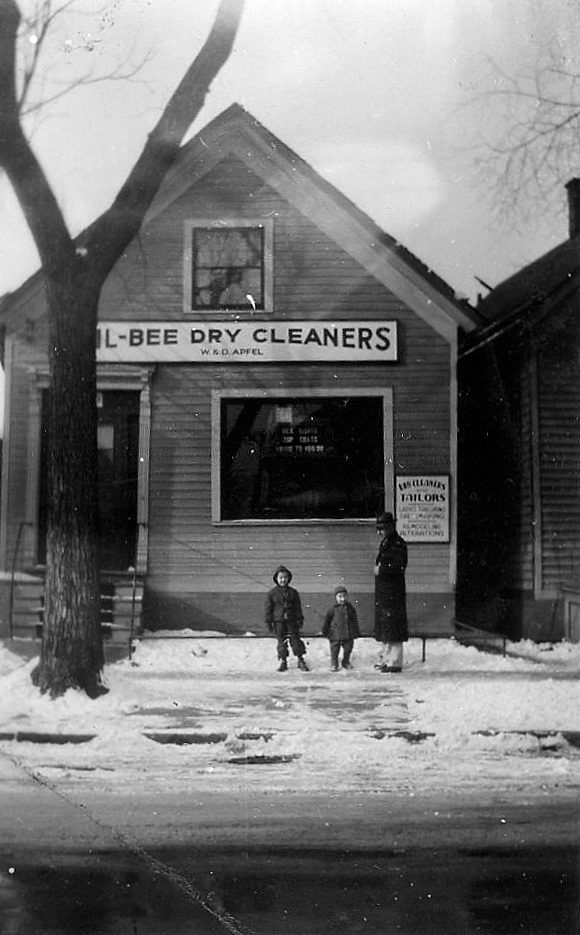
best and ellicott - gta photo

Example of a business in the neighborhood – Wil-Bee Dry Cleaners on Ellicott Street near Best Street, circa 1944. Building was built around 1864. Source: George Apfel, friend of author

The main commercial streets were Virginia, High, and Carlton Streets, which were lined with two and three-story cast iron and brick buildings with stores downstairs and apartments above.  Most of the residents lived and worked in the neighborhood – bakers, confectioners, seamstresses, carpenters, blacksmiths, and coopers.  Taverns were important institutions and social centers where the neighbors would mingle.  There were also many churches in the neighborhood.  One of the jokes in the neighborhood was that if you had a nickel, you could have a pint of beer for four cents and still have a penny left for the church offering plate.

By 1894, the neighborhood was mostly built out – mainly with one and a half-story wood-frame houses and two-story commercial buildings.  By the 1920s, this was one of the densest areas of the city.  Since the area developed as a working-class neighborhood, many of the residents relied on shops and services that were only a short walk away.  This was the horse and buggy era, and at that time, those were typically not within the means of a working-class family.  The Washington Market at Washington and Chippewa allowed many of the residents access to a variety of fresh produce and products just a short walk away. 

North Oak Street was a quiet, tree-lined street.  During the 1880s, North Oak was considered the Delaware Avenue of the East Side.  There were stately homes with tall windows and formal gardens.  Three mayors grew up on the street.  Soloman Scheu, Mayor of Buffalo from 1878-80 lived at North Oak and Goodell Street.  Mayor Scheu was famous in the neighborhood for the dinners hosted at his home and his New Years Parties were the hit of the neighborhood.   After his death, his house was used as the Neighborhood House for many years, one of Buffalo’s earliest settlement houses.  The house was torn down to become the M. Wile Company clothing factory.  Louis Fuhrmann, Mayor from 1910-17, lived at North Oak near Tupper in a big frame house with massive fireplaces.  After he was mayor, he moved to the Wicks House on Jewett Street (across from the Darwin Martin House).  Charles E Roesch, Mayor from 1930-33 lived at 633 North Oak.  He was born and raised on the street and continued to live there while he was Mayor.

oak street school

Oak Street School. Source: Buffalo (N.Y.). Department of Public Works, “School No. 15, Oak Street School,” B&ECPL Digital Collections, accessed May 18, 2021, http://digital.buffalolib.org/document/1765.

Public School No. 15 was located on North Oak Street, at the corner of Burton Street.  The College Crèche, a day nursery was also on North Oak Street.  The Crèche served 40 children whose mothers were widowed or deserted.  Buffalo General Hospital, the first big hospital built in Buffalo was at North Oak and High Street.  In the 1850s and 60s, the Ladies Auxiliary helped fight to get the hospital built.  Nearly every society woman in Buffalo was a part of the auxiliary.  It was a small feat at first to get the hospital built, but it continued to grow and prosper into the entity that we know today.  

There were also many churches in the neighborhood, with two churches on North Oak Street – the Hellenic Eastern Orthodox Church, built like an old Greek Temple was located at 361 North Oak Street.  The Hellenic Church eventually moved into the former North Presbyterian Church at Delaware and Utica in December 1952, having outgrown its Oak Street space.  St. Mark’s United Evangelical Church was also located on North Oak Street near Tupper Street.  In 1929, St. Mark’s merged with St. Paul’s and used their building on Ellicott Street between Tupper and Goodell.  The church was demolished as part of the construction of the Oak Street interchange of the Kensington Expressway in 1970.  

oak streets (1)

Oak Street Renewal Area shown in blue. Extant streets shown in green. Non Extant Streets shown in red. Source:  Author, based on historic maps

ralph street

Houses on Ralph Street.  Source

The North Oak neighborhood was a dense neighborhood.  I often get questions from readers researching their family histories.  They’ll say, “I found the house was at this address, but I can’t seem to find it on a map”.  Usually, it’s because a street name has changed, which we’ve covered a few on this blog.  But sometimes, it’s because the street no longer exists.  Here are some of the forgotten streets of the North Oak Neighborhood:

  • Burton Street- a portion of this still exists, but the road used to reach all the way to Mulberry Street
  • Edwin Alley – between Elm and Michigan, running from Goodell to Tupper
  • Werrick Alley – between Elm and Michigan, running from Goodell to Burton Alley
  • Ralph Alley – between Elm and Michigan, running from Burton to Virginia
  • Hammond Alley – between Elm and Michigan, running from Virginia to Carlton
  • Demond Alley – between Oak and Elm, running from Tupper to Virginia
  • Coolin Alley – between Oak and Elm, running from Virginia to Carlton
  • Morton Alley – between Ellicott and Oak, running from Goodell to Virginia
  • Neptune Alley – between Elm and Michigan, running from Carlton to High

While in many parts of the city, the Alley name is reserved for the rear part of the property, often for service to a carriage house or garage.  However, these alleys in the North Oak Neighborhood were lined with their own rows of houses, due to the density of the neighborhood.  Leading to some of the confusion is that some of these alleys had additional names over the years:

  • Demond was Boston Alley
  • Morton was Weaver Alley
  • Edwin was Goodell Alley
  • Hammond was Swiveler Alley
  • Neptune was Ketchum Alley
  • Coolin Alley was also called Codlin or Collin Alley
oak street houses

Example of the type of housing in the North Oak Street neighborhood.  Source:  New York State Department of Health

The neighborhood continued up through the 1950s when project talks began for the redevelopment of the area.  The city applied for funding from the federal government in the late 1950s.  This was the City’s fourth federal aid renewal project.  The City applied for the funds “with the background of the decade old failure of the Waterfront and Ellicott District renewal projects to materialize and slow pace of developing the Thruway Industrial Park as a renewal project.”  The City was slow to move on the Oak Street project, despite announcing plans, leading to many tenants abandoning the area prematurely.  This furthered the decline and blight of the neighborhood.  

Mayor Frank Sedita signed the contract between the city’s Urban Renewal Agency and the US Department of Housing and Urban Development (HUD) for the 145 acre Oak Street Redevelopment Project Area.  The project to acquire and clear the land and build new housing was expected to take five years and a phased approach.  They planned to do a “tear down-then building” approach which at the time was referred to as a “checker-board” method of demolition and new construction.  The intent was to help minimize the relocation difficulties for residents living in the area.  The long-range plan called for 1500 new housing units built over five years.  Approximately 514 families and 311 more individuals would be relocated as a result of these activities.

The Oak Street Redevelopment Project was to include

  • 1544 low/moderate and elderly housing units
  • Recreation facilities
  • Spot residential rehabilitation
  • Commercial Plazas
  • Hospital and Medical Facility Expansions – a $4 Million Roswell Park Research Studies Center, a $4.3 Million Roswell Park Cancer Drug Center, a $4.5 Million Buffalo General Mental Health Center, and a $1.6 Million Buffalo Medical Group building.
  • Three new parking ramps – one on Michigan between Carlton and Virginia Streets – to serve Roswell Park Memorial Institute, one at the SW corner of Michigan and North to serve Buffalo General Hospital, and one on Goodell between Oak and Ellicott Streets – to serve the Courier News, Trico, Eastman Machine, M. Wile and other industrial businesses in the area. These new parking ramps would have built 4,100 new spaces.  The largest of the three ramps, the 2000 space ramp on Goodell to serve the industrial businesses was never built.

The initial new housing was at the site adjacent to what was then the Fosdick-Masten Vocational School.  They purchased 39 parcels and tore down 29 buildings along Michigan between North and Best Streets.  In April 1968, the Board of Education agreed to release the open space around the school to BURA for these new apartments.  The school had been planning to move to Main and Delevan when their new school was completed.  This never happened and Fosdick-Masten graduated its last class in 1979.  The school was used as a warehouse and the interior was stripped, with plans to be demolished.  Those plans also did not come to fruition.  In 1980, the school became home to City Honors School.   Along the Michigan Avenue side of the site, they built 160 units of townhouses and garden-style apartments there, called Woodson Gardens.  A new street, Fosdick Avenue, was built to serve these apartments.  Woodson Gardens were demolished in 2013 and the school is raising money to rebuild their open space into Fosdick Field.  

St. Philip’s Episcopal Church, which was located at 161 Goodell Street worked with the city to be the nonprofit sponsor of the first phase of construction activities.  St. Philip’s was founded in 1861 in a basement on Elm Street between North and South Division.  At the time, they were one of the seven original African American Episcopal churches in the country!  St. Philip’s expanded in 1921 when they moved to Goodell Street, to the former home of St. Andrew’s Episcopal Church.  The church had been built in 1892.  St. Andrew’s moved to Main Street in University Heights.  St. Philip’s worked with the city to help relocate the residents into new housing.  The church was originally going to be moved to a new site within the neighborhood – to the corner of North and Ellicott Street.  Those plans fell through.  In 1973, St. Philip’s church was razed by the urban renewal project.  The church secretary stated, “We survived as an African American community for more than 150 years.  Now we’ve been through trials and tribulations.  It wasn’t all pretty and sweet.  It’s just the way it was”.  The congregation now calls the Delevan-Grider neighborhood their home.

William Gaiter was interviewed in the early 1970s as a leader in the Black Community and was looking forward to seeing the new housing developed in the area.  Especially the 500 units of low to moderate-income housing for elderly people that was planned for the site.  By 1975, the units had still not been built, due to lack of funds. 

oak street houses 3

Example of some of the run down houses in the North Oak Street neighborhood.  Source:  New York State Department of Health

The project was originally planned to start in 1962 and be completed by 1965.  The Urban Renewal Commissioner, James Kavanaugh, earmarked $599,000 for razing properties before the Common Council and the Federal Government approved the project.  This lead to displacement of residents before the relocation study was completed, so they were not eligible to receive their federal grants and assistance with relocating their families, who were made homeless by the urban renewal project.  The buildings started to be razed in May of 1965 because Roswell Park Memorial Institute was planning to start their expansion project, so they needed the building site to be clear.  Buildings were demolished, even though the federal project wouldn’t be approved until July of that year.  In May 1968, the City of Buffalo went to court to obtain titles to 15 of these parcels near Roswell.  The owners would be paid 75% of the federally established price for their properties while the properties went through the condemnation process.  They had already obtained titled to 20 of the properties in this area.  

605 Oak

605 North Oak Street. Source

I was able to speak to the Salvatore Sisters, Melody and Michelle.  Their family lived at 605 North Oak Street.  The house had been purchased by their parents June and Michael Salvatore in the mid-1950s.  The house had been divided into four apartments, they lived in the upper rear apartment.  They attended 2nd and 3rd grade at School No 15.  They would go to Barone’s corner store at North Oak and Carlton.  Like many property owners in the area, the family depended on the rental income.  Offers were made to purchase the properties in the area by eminent domain.  The City’s offer to buy the house didn’t take into consideration the loss of the rental income in addition to the loss of their property and their home.  June Salvatore hired an attorney and sued the city for fair value.  In the meantime, houses around them were demolished, one by one.  Construction crews would leave debris around their property to intimidate them and block access to their home.  In the end, 605 North Oak was the last house standing on the North Oak and Elm Streets.  June Salvatore refused to be intimidated by this and continued fighting.  The sign went up on their house that said “We would rather fight than submit to legal robbery.”  Eventually, June Salvatore won the battle and was given $35,000 for the house (about $240,000 in 2021 dollars).  The family moved in 1968.  

While June Salvatore won her battle, how many were not so lucky?  


20210501_121255.jpg

Vacant lot in foreground where homes had been demolished. Houses in the rear waiting to be demolished.  Source:  New York State Department of Health

Demolition of this area around Roswell began in January 1968.  There were 126 people living on the block bounded by Oak, Elm, Carlton, and Virginia.  There were also commercial properties – businesses on the site included Joseph A Kozy, Volker Brothers Inc, Inro Inc, Pollack Building Corp, and Kreiss Sign Company.

A second area that began to be cleared in 1968 was the 8 blocks that became McCarley Gardens eventually.  This area was home to more than 530 people.  There were also five commercial properties   – the Good Neighbors Store, Nino’s Entrata, W. Martym Cleaner, Mildred’s Food Store, and T&L Cleaners.  Two other non-residential properties were in this area – St. Philip’s Episcopal on Goodell Street and Neighborhood House Association on Ralph Street.  Neighborhood House was a settlement house founded in 1894.  We discussed St. Philip’s above.  In 1981, Neighborhood House merged with Westminster Community House to form Buffalo Federation of Neighborhood Centers (BFNC).  BFNC Drive, which runs between the Locust Street exit of the Kensington Expressway and Goodell Street, is named after the organization, which provides family focused services for adults and youths living in low income and disadvantaged neighborhoods throughout Buffalo, Niagara Falls and Lockport.  The road was previously North Service Drive was renamed after the organization in 1994 as part of their centennial celebrations.  

Screenshot (7)

North Oak Street “Wasteland”. Source: Buffalo Courier Express, May 1973

By 1972, only 60% of the area had been demolished when President Nixon put a freeze on federal funds to build low-cost housing.  The area was left littered with building debris and rubble.  The City had planned to avoid what had happened in the Ellicott District, where the land laid cleared, vacant and strewn with trash for years.  Instead, the Oak Street project created an eyesore on the edge of Downtown, right where motorists were exiting the new Kensington Expressway.  As motorists drove into Downtown, they were greeted with a view of acres of rubble-strewn land, surrounded by empty, crumbling houses.  The City’s Community Development Commissioner’s solution was to screen the view by erecting a fence.  The fence held a sign explaining that the clearance activities were a “measure of progress toward making Buffalo a more attractive and livable city”.  
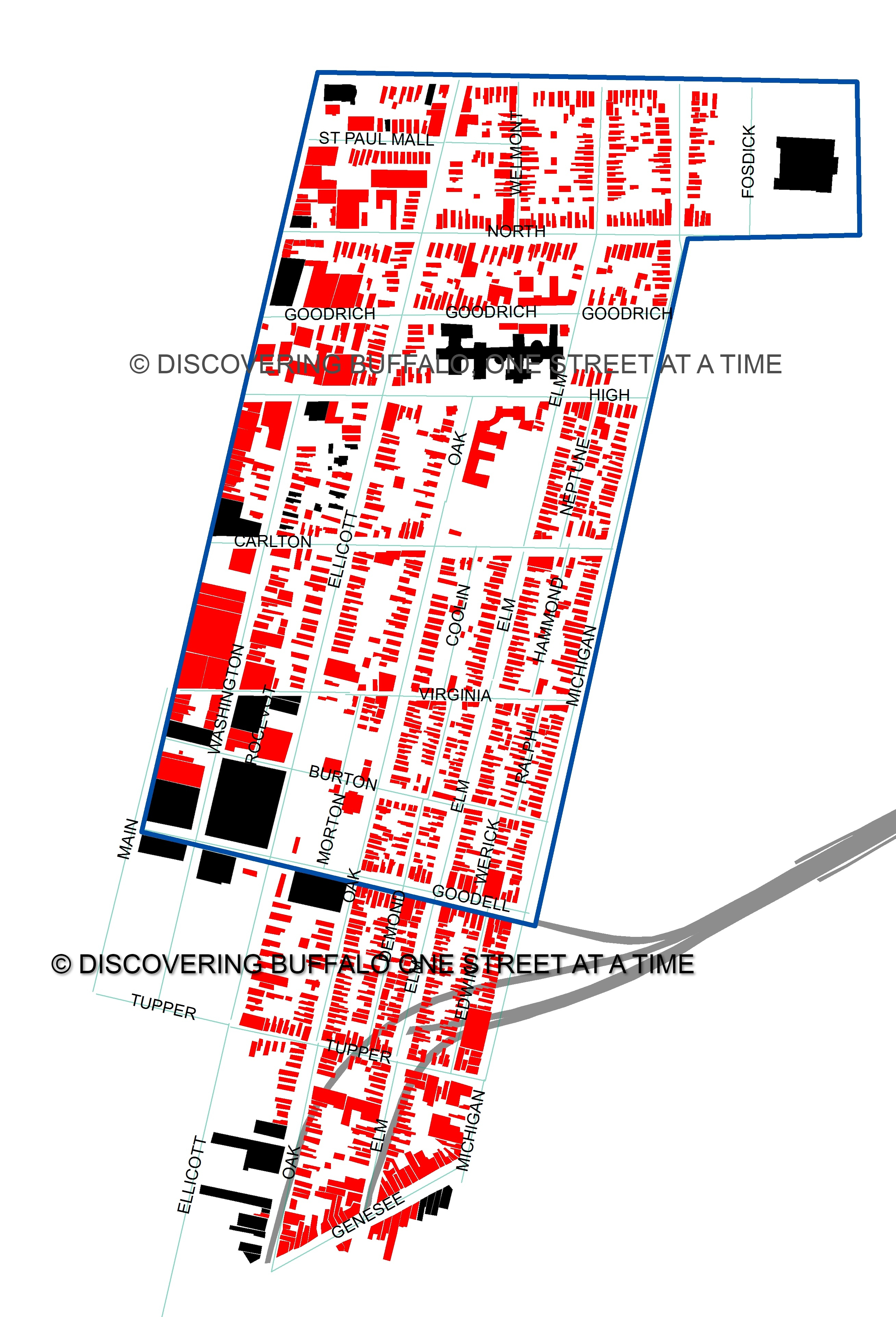
oak_buildings1951 (3)

The Oak Street Redevelopment Area outlined in blue. Buildings shown in black are still standing. Buildings in red have been demolished. Source: Author, based on 1951 Sanborn Maps

In 1951, the Oak Street Redevelopment Area was home to 1308 buildings.  Only 41 of those buildings remain standing today.  Of the 1268 buildings demolished, 461 were residential:  434 frame houses, 1 rooming house, 13 flats (Buffalo upper and lowers), and 13 apartment buildings.  As was the case with the Salvatore home, many of the houses had been subdivided into multiple units.  The average number of people per unit in this neighborhood was 2.93 people.  Conservatively, this neighborhood had been home to at least 2000 people, and likely many more.  The 1500 housing units that were planned for the redevelopment area resulted in only 513 being built….with most of those units built nearly two decades after the residents were kicked out of their homes and the buildings demolished.  
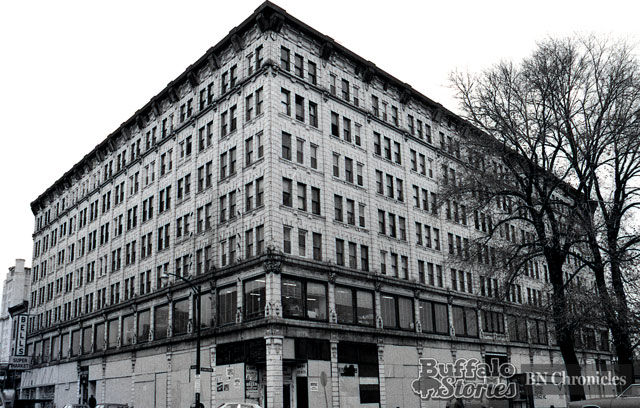
roosevelt apartments

Roosevelt Apartments, 1978Source

In 1971, the City unveiled plans for its first big modernization project.  This was 80 apartments designed for the elderly at the building at 11-23 High Street, the Roosevelt Apartments.  The building is a seven-story Renaissance Revival Style building that was built in 1914.  The city acquired the building as part of the Oak Street Redevelopment.  This was the first project of its kind undertaken by BURA.  The current rents in the building were about $63 and they were expected to go up to $79/month ($520 in 2021 dollars) for one-bedroom and efficiency apartment.  The project never happened and the city turned out all remaining tenants in 1973 because they were losing money on the building.  the building sat vacant, on the brink between demolition and revitalization.  Groups went back and forth trying to figure out a way to renovate the building and find financing.  The building was slated to be torn down if one of the interested groups, Roosevelt Renaissance Group, was unable to obtain financing for their project.  The building sat vacant and abandoned until 1984 when it was converted into 113 apartments subsidized for the elderly.  The apartments are currently managed by MJ Peterson.

After years of sitting vacant and being an eyesore at the edge of Downtown, McCarley Gardens was built.  The complex consists of 150 affordable apartments,  with rents subsidized by HUD.  The groundbreaking for McCarley Gardens was in December 1977.  The site was built by and is still owned by, Oak-Michigan Development Corporation, an affiliate of St. John Baptist Church, located just across Michigan Ave from the complex.  The 15-acre housing site is located between Goodell, Oak, Michigan, and Virginia Streets.  They were the first low to moderate-income housing built in Buffalo in a decade and they received more than 1000 applications for the 150 units before opening.  The first tenants moved into the complex in March 1979 and the site was formally dedicated in July of that year.  McCarley Gardens is named after Burnie McCarley, a pastor of St. John’s.  Burnie’s daughter Jennie married King Peterson, for whom King Peterson Road is named.  

When McCarley Gardens opened, they were touted by the Courier Express as an “outstanding example of what can be accomplished through private initiative” and that St. John Baptist should be “highly commended for pursuing the project over mountains of red tape and craters of bureaucracy to a successful completion”.  The project took nine years to be completed.  The hope was that McCarley Gardens would serve as a rebirth for the neighborhood.    

1515699392225

UB Medical School, Main and Allen Source

In the early 2000s, University of Buffalo proposed removing McCarley Gardens to turn the site into an academic and research facility to support the Buffalo Niagara Medical Campus.  The plan was vehemently opposed by both residents and politicians.  By 2014, UB backed away from those plans, building their new Medical School at Main and Allen Street and using the former M. Wile Company space as the UB Downtown Gateway Building.  Several different plans have been made for rehabilitation of the McCarley Gardens complex in recent years, including a recent plan involving Nick Sinatra to rehab many of the units to bring them up to date.

The other housing built in the Oak Street Redevelopment Area was Pilgrim Village, an 11.3-acre site at the north end of the redevelopment area, bounded by Michigan, Best, North, and Ellicott Streets. The 90-unit affordable housing community was built by former Buffalo City Court Judge Wilbur Trammell in 1980.  In 2002, the site was passed to Trammell’s son, Mark.  Mark Trammell worked with McGuire Development in 2017 on a redevelopment project for the site that was called Campus Square.  At that time, 25 apartments were demolished to prepare for new buildings.  Campus Square was supposed to be the start of redevelopment for the entire site, but construction was delayed, the project stalled and McGuire ended up taking the whole Pilgrim Village site through foreclosure.  

A portion of the Pilgrim Village site, 4.5 acres at the corner of Michigan and Best, was purchased by SAA-EVI, out of Miami.  The group is planning a $50 Million project to build two affordable housing projects –  a four-story building for seniors and a five-story building for families.  The two buildings are planned to have 230 apartments in total.  Plans for the rest of the Pilgrim Village site include new buildings that are a mix of housing, offices, stores, and medical labs.  The blocks have been difficult to redevelop despite many efforts over the years, so it is yet to be seen what will happen at the site.  There are currently 65 townhomes spread across the site.  

20210502_141406

Washington Place Houses that were preserved in the 1980s.  Photo by Author

Four houses that were supposed to be demolished were saved.  In the early 1980s, these four houses on Washington Street were boarded up, vandalized and filled with trash.  They are brick, Italianate houses built before 1872 and are adjacent to four houses on Ellicott Street used by St. Jude Christian Center and the Kevin Guest House.  The City was looking to demolish the Washington Street homes at 923, 929, 933 and 937 Washington Street to clear the land for a future, undetermined development.  These houses were the last of their kind in this area and the only remaining homes on Washington Street.  Austin Fox, a preservationist and architecture buff stood up to the City and argued the case for the houses.  The restoration project that resulted was called Washington Place.  The project restored the exterior of the buildings with public money with the intent of selling them to private developers.  The City spent $330,000 in Community Development Block Grant money to clean the outside brick, repair the masonry and put on new roofs, gutters, downspouts, doors and porches. The street on this block had been cobblestone, but the city repaved the street and built a 40-car parking lot adjacent to the buildings to make them more attractive for tenants.  At the time, this was one of four city-managed projects happening in this neighborhood that were designed to bring new life to the area. The other projects were the Allen Street subway station along with the metro rail, the renovations of the Roosevelt Apartments, the construction of the 14-story building at Ellicott and High Streets to expand Buffalo General Hospital, and construction of an indoor shopping mall at Franklin and Allen Streets – can you imagine, a MALL IN ALLENTOWN???? Thankfully, the mall never happened, though the other projects were completed!  With the hospital just two blocks away from Washington Place, the houses were marketed for medical offices.  As construction was wrapping up in 1981, the City was in negotiations with a medical group to buy the properties.  Since 2005, the houses have been owned by an entity of the Buffalo Niagara Medical Campus.  

be227c4e0853c5464eafe6d7555dc1f7

Anchor Bar. Source: Buffalo & Erie County Public Library

One beloved Buffalo site – the Anchor Bar  – was among buildings planned to be razed as part of the Oak Street Redevelopment project.  The Anchor Bar property was a part of a 3.1 acre parcel that was intended to be redeveloped with housing with St. Philip’s Church located at the NW corner of Ellicott and North Street, as mentioned previously.  Those plans did not come to fruition, and in 1974, BURA then intended to build a new facility for Carlton House Nursing Home on the site.  The Nursing Home began operating at 60 Carlton Street in the late 1960s, but their original site was purchased by the State for Roswell Park Memorial Institute.   Roswell still uses the Carlton House name for the structure. Many in government were angered by the purchase, as the City of Buffalo needed nursing home beds more than they needed the hospital.  The Anchor Bar was left out of the nursing home site at Ellicott and North, under the condition that the restaurant be rehabilitated and that the restaurant purchase 16,000 square feet of adjacent property around their restaurant to allow for off street parking lots.  The nursing home site at Ellicott and North has been the home of Buffalo Hearing and Speech since their building was constructed in 1994.  Can you imagine Buffalo if the Anchor Bar had been demolished just ten years after they “invented” chicken wings?  They may not be everyone’s favorite wings, but they certainly are a Buffalo tradition….if they had gone away, would Buffalo be known for wings today, or would everywhere call them chicken wings instead of Buffalo wings?

So the next time you are on the Medical Campus, think back and remember the North Oak Street neighborhood that used to be there.  To learn more about how urban renewal shaped the near east side’s Ellicott Neighborhood, you can read this post:  JFK Park, A Case Study in Urban Renewal.   Want to learn about other streets?  Check out the Street Index.  Don’t forget to subscribe to the page to be notified when new posts are made.  You can do so by entering your email address in the box on the upper right hand side of the home page.  You can also follow the blog on facebook.  If you enjoy the blog, please be sure to share it with your friends.

Sources:

  • Oak Street Project Contract Signed – Courier Express December, 16, 1970, pg 14
  • Report on Third Acquisitional Area – Health Research Incorporated New York State Department of Health. 
  • Report on Second Acquisitional Area.  Health Research Incorporated New York State Dept of Health.  Roswell Park Memorial Institute.  1968
  • Cichon, Steve.  “Torn Down Tuesday:  Ralph Street has Been Wiped Off the Map”.  Buffalo News.  November 3, 2015.
  • “City Goes to Court over Land Acquisition”.  Buffalo Courier Express March 1, 1968
  • McAvey, Jim.  3 Auto Ramps Planned for Oak Street Area.  Buffalo Courier Express.  June 29, 1967.  
  • Turner, Douglass and Dominick Merle.  Commitment of $599,000 Asked of City.  Courier Express.  September 18, 1961 p1.
  • “Council Votes Cash for Oak Street Project”  Courier Express, May 18, 1966.
  • Locke, Henry.  “A Conversation with William L Gaiter”.  Buffalo Courier-Express, July 14, 1975. P 9
  • Oak Street Area Project Is Backed.  Buffalo Courier Express.  November 22, 1957. P5.
  • Oak St Project Hearing Is Urged – Buffalo Courier Express, Sept 21, 1965, p 4.
  • Turner, Douglass and Dominick Merle.  Commitment of $599,000 Asked of City.  Courier Express.  September 18, 1965. P1.
  • Dearlove, Ray.  McCarley Gardens Keeps Construction on Schedule.  Courier Express.  August 20, 1989, sect H, p1
  • Williams, Michelle.  Church Dedicates Pastor’s Dream.  Buffalo Courier Express, July 16, 1979, p2.
  • City Aides Back Roosevelt Group for Renovation.  Buffalo Courier Express.  October 25, 1973.
  • Epstein, Jonathan.  At Medical Campus’ edge, a taller plan for a hard-to-develop block.  Buffalo News.  July 20, 2020. 
  • Decrease is Reported in Oversized Classes.  Buffalo Courier Express.  April 25, 1968. 
  • “Yes, Mayors Grow on North Oak Street:  Three Sons of Tree Lined Thoroughfare have Answered to ‘His Honor’ as Buffalo’s Chief Executive”.  Buffalo Timers, Sept 3, 1930.
  • Ritz, Joseph.  “Oak St Wasteland Seems Likely to Continue”.  Courier Express.  May 6, 1973, p B1.  
  • “Planning Board Approve Site for Nursing Home” Buffalo Courier Express.  Sept 27, 1974, p 15. 
  • Cardinale, Anthony and Mark Pollio.  “Community Group to Celebrate Centennial Buffalo Federation of Neighborhood Centers Festival Set for Aug 20”.  Buffalo News.  August 8, 1994.  

Read Full Post »

bennett

Bennett Street, current alignment shown in red. Former alignment included the portion in yellow

Bennett Street is a short street in the Ellicott Neighborhood of the East Side.  The street runs for one block from Broadway to William Street. Historically, the street continued a second block to Clinton Street prior to the urban renewal which demolished much of the neighborhood.  You might be thinking, but Angela, didn’t you already write about Lewis Bennett?  I did write about him, Lewis Bennett named the Central Park neighborhood, and Bennett High School, but this is a different Bennett and a different school!

pbennettPhilander Bennett was born to Nathaniel and Sarah Bennett on April 29, 1795. in Catskill, New York.  The family moved to Clinton in Oneida County while Philander was a child.  He attended Hamilton College and graduated in 1816.  Following his graduation, he went to Delaware, Ohio to try to establish a business.  A stock of goods being shipped along Lake Erie had to stop in Buffalo because of a storm.  They decided to unload the product in Buffalo and open a business at the corner of Main and Eagle Street, called Scribner & Bennett.  Scribner & Bennett quickly became the largest mercantile shop west of Albany.
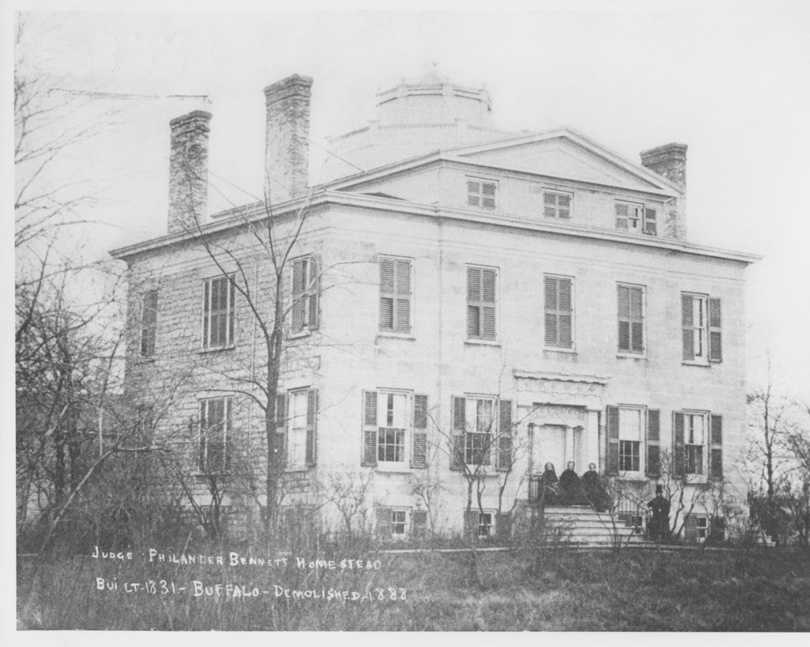
Mr. Bennett married Henrietta Griffin in December 1817.   They had four children:  Griffin, who died at sea coming from St. Croix to New York at age 22 in 1841; Charles who left home in 1847 or 48 to attend Hamilton College near Utica and was never heard from again;  Mary Henrietta, who married Rollin Germain; and Edward.

In 1820, Philander Bennett left the merchant business to study law in the office of Heman B Potter, who became the District Attorney of Erie County.  In October 1822, he was admitted as an attorney of the Supreme Court and in February 1828, he became a counselor in the Court of Chancery.  He was appointed a Justice of the Peace in 1822.  He was appointed First Judge of the Court of Common Pleas for Erie County in 1829.  He held that office until 1837.  He also partnered with Le Grand Marvin in the firm Marvin & Bennett.

Mr. Bennett’s father, Nathaniel, moved to Williamsville in 1820 and lived there until 1838 when he relocated to Ohio.  Philander and his father were members of the Buffalo Land Company and owned a great deal of real estate in both Toledo and Cleveland.

Philander Bennett served as an Alderman of the City of Buffalo in 1832 and 1833 and again in 1840 and 41.  He was appointed by Governor Clinton the Judge Advocate of the 47th brigade of Infantry.  For many years he was connected with the “Albany Regency” but in his later years, he became deeply anti-slavery and took up the cause and joined the Republican Party when it was organized in 1854.

Mr. Bennett served as President of the City Bank of Buffalo and was Vice President of the Buffalo & Attica Railroad Company.  When President Van Buren came to Buffalo in 1839, Mr. Bennett was chairman of the committee of citizens appointed to receive the president and delivered a speech welcoming the President to the City.  He was a member of First Presbyterian Church.

bennett house

Bennett House on Clinton Street

The Bennett family lived in a house that was constructed in 1831 at the corner of Eagle and Pine Streets.  The house contained the first marble mantels to be brought to Buffalo.  The house was well known in Buffalo, residents often brought visitors to go see both the Bennett House and the Fargo House, as two examples of the most beautiful houses Buffalo had to offer.  The Bennett house was a square house with a cupola and stood in 15 acres of landscaped lawns and gardens.

For the last 16 years of his life, Philander lived in retirement, engaging in some foreign travel but mostly occupied with horticultural pursuits on his property.

559717c2-307d-423a-b3c2-150a5d99265a

Bennett House. Philander is at the bottom of the steps, with family members on the steps. Source: Picture Book of Earlier Buffalo

Philander Bennett died on July 22, 1863.  After his death, his widow remained in the home.  Following Henrietta’s death in 1885, the house and the grounds were sold by the two remaining children to the City of Buffalo.  Edward Bennett was born in 1827 and served as a successful merchant and owned substantial real estate.  Edward served as a parks commissioner from 1872 until 1888.  Mary Henrietta and her husband Rollin Germain (his name might sound familiar to those familiar with street names…) lived next door to the Bennett House.  Mary also owned substantial real estate throughout the city in her own name, which was rare during those times.

The Bennett family house was demolished in 1888 to construct Bennett Place/Bennett Park.  Many in town mourned the passing of that landmark which had been a center of luxurious social life and culture for half a century.  Some of the furniture and the mantel from the house were owned by their great-grandson Edward Bennett Germain, who lived at Nottingham Terrace in the 1930s.  Edward Germain was president of Dunlop Rubber and Tire Corporation.

Bennett Park was designed by Frederick Law Olmsted in 1887.  Olmsted’s design called for entrances from each corner of the property with flagstone walks circling around a horseshoe-shaped lawn at the center.  There was  a shelter house constructed in 1888 which faced Eagle Street and a gravel playground adjacent to Clinton Street.  The shelter house contained restrooms, a tool room and a large covered space open on three sides.  Thick foliage screened the park from the streets and helped conceal the park’s small size.  Bennett Park was a popular park, as it was located in a very densely populated neighborhood.

BennettPark

Olmsted Plan for Bennett Park

The park still exists but has been modified from its original design.  In 1920, a softball diamond and tennis courts were built and a new shelter house.  The gravel playground and many of the plantings were removed.  The park has been combined into the JFK Community Center Park and contains only the tennis courts.   The trademark Olmsteadian curvilinear paths on the west and south sides of the park still remain.

The part of Bennett Street between Clinton and William Streets was divided into East and West Bennett Streets.  The area between the two streets was home to the Clinton Street Market.  The market was one of the oldest in Buffalo, established around 1849.  The land had been deeded to the City for market purposes by the Bennett family from their property.  Because of its location, it was often referred to as Bennett Market, though the city preferred the Clinton Market name.  A Liberty Pole was raised and consecrated at the Market on the Fourth of July 1855.  The pole was 140 feet high and topped with a gilt eagle with outstretched wings.  This Liberty Pole was in addition to the one at the Terrace.  In 1856-57, the City graded and paved the Clinton Street Market site, along with the Chippewa Market (at Chippewa and Washington) and the Court Street Market (located where the Buffalo Fire Headquarters is now located).  The City also built market buildings on the three sites.  The Clinton Street Market and the Chippewa Market buildings were identical at 392 feet long by 36 feet wide, built in the Romanesque style.  The market building could accommodate 82 farmers’ wagons under the shelter.  Each stall was supplied with gas, water and sewerage.  The Court Street Market was built in the form of a Greek Cross, but with similar dimensions as the other market buildings.  The Clinton Street Market was a popular meeting site for residents of the 5th Ward for community matters, elections, etc.

atlas 1872 bennett

1872 Hopkins Atlas. Map shows the location of the Clinton Market, the original location of PS #32 and the location of the Bennett House. Note several other properties owned by Bennett Family members, including Mrs. Mary Germain and Edward Bennett.

In 1925, the City wanted to abandon the Clinton Market to build a community center and public bathhouse. Residents protested the closure of the market.  The city argued that the market was not profitable, however, the vendors said it was only not profitable b/c the market was not kept up by the city.  It had been ignored and no repairs had been made.  At the time, all of the markets in the city operated at a loss to the city.  Residents argued that the public markets should be operated for the benefit of the people and not the profiteers.  The residents signed petitions with more than 1000 names arguing to keep the market open.   The Market at the time had 22 stalls and 17 of the stalls were occupied.  The East Side Business Men’s Association put together a proposal to keep the market and establish the bath house at the southern end of the site, but the plan was rejected.   The Bath House was originally intended to be for the use of the Blacks in the neighborhood, but members of the Black community fought back and protested against the Bath House saying that it was segregation and discriminatory.  The Buffalo American (a Black Newspaper), stated that

“He (the Mayor) is guided solely by the sentiment there expressed, the Free Public Bath House and the Community House will be exclusively for Negroes.  If this is the Mayor’s program The American will oppose such a measure as will all of the thoughtful citizens of this section of the city.  A Public Bath House and Community Center for all citizens in this section of the city will meet with a hearty welcome from all, but a Bath House and Community Center for Negroes is nothing less than segregation and will not be sanctioned by any thoughtful person.  We do not know who the Colored men are who are urging the Mayor to take such steps, but we will not stand by idle and see all of our people segregated for a mere bath.”

Mayor Schwab had to make it clear on several occasions that the Bath House would be for both Black and Whites. Public Bath House No 4 opened in 1927 on William Street on the former location of the Clinton Street Market. A small stub of East Bennett Street was renamed Embassy Street.

bennett 1951

1951 Sanborn Map showing the location of the Bath House and the location of Bennett Park School

Despite the protests, the Clinton Market was closed.  On Saturday, October 16, 1926, at 10pm, the last of the merchants gathered their wares and left their stalls for the last time.  Under the terms establishing the market, the property reverted back to the heirs if it was used for any use other than market purposes.  The building was quickly demolished.  On the northern portion of the site, Public Bath House No 4 was built.    The southern end of the site was to be a gymnasium or a community center, but the empty lot was quickly taken over by students and teachers arriving at Tech High School, across Clinton Street from the former market.  The City originally thought that using the site for the Public Bath House and Community Center would be allowed under the agreement, but it was not.  Corporation Council and Charles B. Germain (Grandson of Philander Bennett and son of Rollin Germain), representing the heirs of the Bennett family, came to agreement for the City to pay the heirs $10,000 (about $154,000 in 2021 dollars) to abandon the market and receive the property.

bennett park school

Bennett Park School

The Bennett Park name also survives at Public School #32, Bennett Park Montessori School.  PS 32 was originally built organized in 1851 with the building originally located on Cedar Street (just behind the school’s current location).  In 1872, the school expanded with a second building next to the original building.  The current building on the site was built in 1913 and was known as the Bennett Park School, due to its location across the street from the park.  In 1969, the building became home to BUILD Academy, the City’s first Community School.  BUILD Academy moved to Fougeron Street in 1975.  In 1977, the building became home to Bennett Park Montessori Center (BPMC).  BPMC is the only public Montessori Program in Western New York and one of the largest Montessori schools in the country.  BPMC came about as a result of the desegregation of schools that was happening in the late 1970s and early 1980s.  The Arthur vs Nyquist last suit was filed in 1972 by a number of African American parents, including George Arthur, against Ewald Nyquist, the Commissioner of Education, the Board of Education, the Mayor and the Common Council of the City of Buffalo.  The case took a long time to be settled, but one of the things to come out of it was the establishment of magnet schools.  Magnet schools draw students from the entire school district, as opposed to neighborhood schools which draw from the neighborhood the school is located within.  Magnet schools tend to be more diverse, due to students coming from a variety of socioeconomic and racial backgrounds.  Parents and teachers from St. Mary of Sorrow’s Montessori preschool program and others worked together to create a public Montessori program.  Before BPMC, any parent who wanted their child to have a Montessori education had to pay for the teacher and the program.  St Mary’s Montessori program differed from other Montessori programs in the region because it was an integrated preschool.

In September 1977, BMPC opened, along with several other magnet schools.  BPMC had received 560 applications for Black students, 320 from white students and 42 from other races.  They had a total of 922 applications for 261 spots!  They opened on September 7th with 131 minority and 131 majority students.  During the 1990 school year, the school expanded to 560 students.  An addition constructed in 2009 expanded its capacity to 980 students.  The addition received the 2010 Best Education Project in the Brick by Brick Awards by Business First.  The school celebrated its 40th Anniversary in 2018.

So the next time you drive by Bennett Street, think about Philander Bennett, his beautiful house, the park that was named after him and the school named after the park.

Want to learn about other streets?  Check out the Street Index.  Don’t forget to subscribe to the page to be notified when new posts are made.  You can do so by entering your email address in the box on the upper right hand side of the home page.  You can also follow the blog on facebook.  If you enjoy the blog, please be sure to share it with your friends.

Sources:

  • Smith, Katherine H.  “Bennett Street Memorial to Merchant, First County Judge”.  Courier-Express.  April 6,1941, sec 5, p5.
  • Editorial.  The Buffalo American.  December 18, 1924.
  • Protest Plan to Replace market with Bath House.  Buffalo Courier.  February 15, 1925.  pg 72.
  • Mayor to Ask Council to Buy Clinton Market Site.  Buffalo Courier.  February 11, 1925, p4.
  • Citizens Ask Retention of the Clinton Mart.  Buffalo Timers.  January 10, 1925, p2.
  • The Fourth in Buffalo.  Buffalo Morning Express.  July 6, 1855.  p.3.
  • Clinton Street Bath House Project May Fall Through.  Buffalo Courier.  August 10, 1924, p 76.
  • Krueger, Pauline.  Abolishment of Clinton Market Boon to Tech.  Buffalo Times.  October 30, 1926.
  • Council Defers Action on Clinton Market Petition.  Buffalo Courier.  January 10, 1925.  p3.
  • Public Improvements – Markets and Public Buildings.  Buffalo Weekly Republic.  July 14, 1857, p2.
  • Edward Bennett Dead.  Buffalo Evening News.  May 12, 1898, p 19.

Read Full Post »

« Newer Posts - Older Posts »

Field Notes

Live from Buffalo, NY

Grants.gov Community Blog

Connecting the grant community to #LearnGrants

Dienna Howard

I create, therefore I am.

Hidden Waters blog

Companion blog for the book "Hidden Waters of NYC"

Hoping for a Tail Wind

Because I definitely brought way too much gear.

priorhouse blog

Photos, art, and a little bit of LIT.

Sheepie Niagara

Bleating the Beat Since 2015