Feeds:
Posts
Comments

Archive for the ‘East Side’ Category

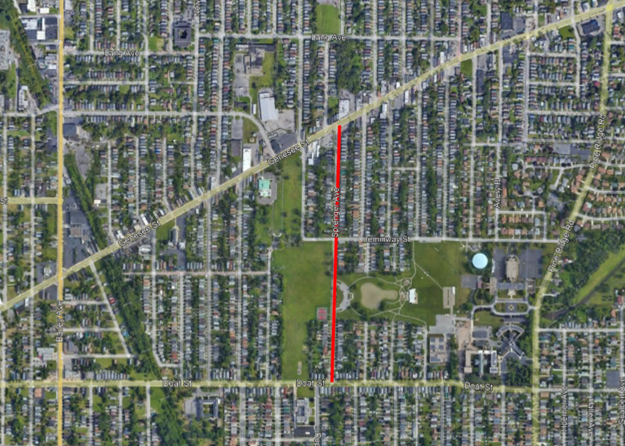
Today, we’re continuing our discussion about the Butlers of Buffalo.  Last post, we discussed Butler Street and Butler Place (and the Fitch Institute/Fitch Creche of Buffalo).  Today, we will discuss the third of the Butlers, Butler Avenue.  Butler Avenue is a street in the Hamlin Park neighborhood of Buffalo, running between Lonsdale Road and Humboldt Parkway.  The street is named for Edward H. Butler, the Founder and Publisher of The Buffalo News.

Screenshot (83)

Butler Avenue is shown in red on the map.

Butler Avenue was laid out in 1915 between Lonsdale and Wohlers Avenue.  The street was developed by the International Home Building Company.  International Home Building Co’s offices were on East Ferry at the corner of Wohlers.  Demand for houses on the street was so high that they decided to open it to Humboldt Parkway after just a few months.  Hamlin Park’s development was centrally located and within easy riding distance of Buffalo’s downtown.  A 1915 article states, “the development that has taken place (on Butler Ave) in the last year or two shows what it means when building operations start in a large city.”  

Buffalo’s first newspaper was the Buffalo Gazette, first published in 1811.  It was published “occasionally” and later became a weekly newspaper.  The first daily newspaper in Buffalo was the Western Star, which began publishing published daily in 1834.  Through a series of purchases and mergers over the years, the Western Star newspaper eventually evolved into the Buffalo Courier-Express in 1926.

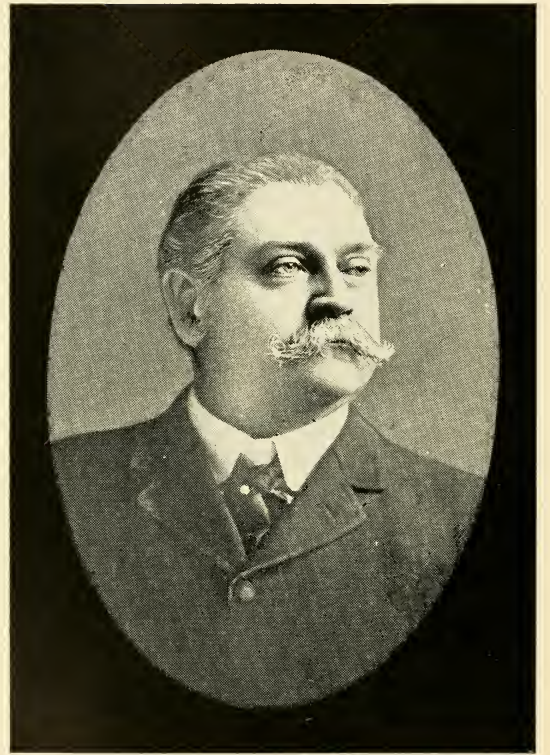
Edward H. Butler, Senior
Screenshot (81)

Edward H Butler, Sr. Source: 20th Century Buffalo

Edward Hubert Butler was born in 1850 in LeRoy in Genesee County, New York, to Irish immigrants Dennis and Lucy Butler.  He attended public schools.  The first newspaper he worked for was the LeRoy Gazette.  He later became connected with the Scranton Times as City Editor and the Scranton Free Press as a Financial Interest Reporter.  

In 1873, just 23 years old, Mr. Butler came to Buffalo to establish The Sunday News.  This venture was regarded by many as reckless, but very quickly, Mr. Butler was able to prove that his judgment was sound.  Other Sunday newspapers had failed to take hold, but The Sunday News was successful.  In 1879, Mr. Butler established the Bradford Sunday News, published for four years before selling it to devote more time to his Buffalo newspapers. The Sunday News was published out of 200 Main Street in Downtown Buffalo.  

Founding of the Buffalo Evening News
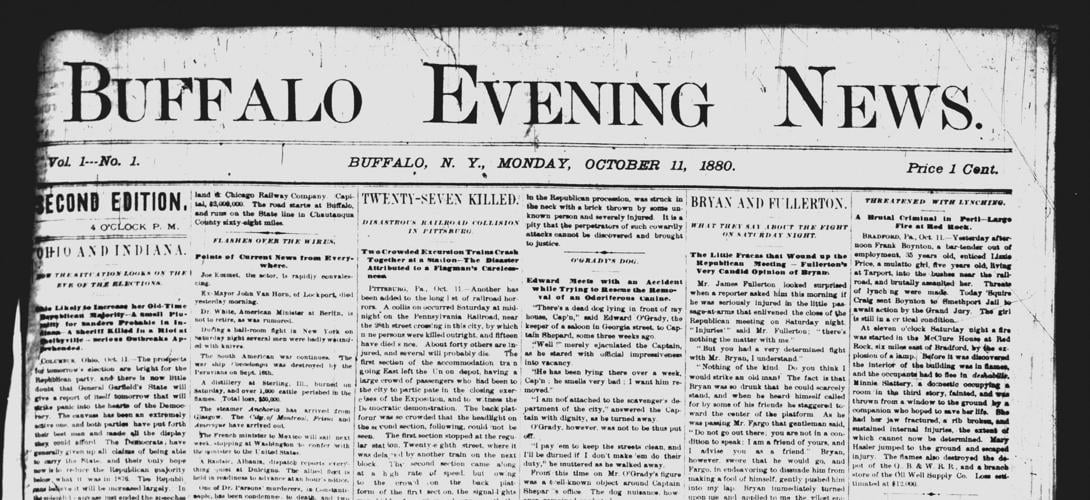
buffalo news second edition

First Issue of the Buffalo Evening News from October 11, 1880. Source: The Buffalo News.

The first copy of the Buffalo Evening News was published by Mr. Butler on October 11, 1880.  You may notice in the picture that the first issue was actually the Section Edition.  The First Edition actually never made it to print.  It was supposed to be off the presses at 2pm.  Due to an elevator incident, the First Edition wound up on the floor, becoming “a tangled mess of handset type.”  They reset the type, and the Second Edition rattled off the presses at 4pm, starting The Buffalo Evening News’ storied history.

With the expansion of The Evening News, The News moved to temporary quarters at 214 Main Street.  The Evening News started as a four-page newspaper that cost 1 cent (about 30 cents today), less than the other daily newspapers of the time, which were 5 cents ($1.54 today).  The first-day circulation was 7,000 newspapers.  By 1882, just two years later, it had risen to 18,000 daily. The News was distributed by Buffalo’s system of horse-drawn streetcars.  The papers were loaded aboard them.  The News had a single horse-drawn, two-wheel cart for areas not reachable by streetcar.  This was the only circulation department for the first several years.  Eventually, a fleet of horse-drawn carriages replaced the streetcars for distribution.  Some of those carriages were used again during the 1940s during WWII gas rationing. 

buffalo news building

Buffalo News Building on Main Street around 1908. Source: A History of the City of Buffalo, Its Men and Institutions.

In 1881, The News moved to 218 Main Street, a 20-foot-wide, four-story building.  The business office (known as the counting room) was on the first floor, and the newsroom was on the second floor.  By 1885, the Buffalo Evening News ran five editions daily, which would continue for a century.  In 1896, the original 218 Main Street and the adjacent 216 Main Street were demolished for a new, larger building, which was used until 1973.  The News building at 216-218 Main Street was described as “one of the finest publishing houses in the State” when it opened in 1898.  

From the start, The Buffalo News differed from other newspapers in Buffalo and in cities other than New York City at the time.  The News sent reporters out on the streets to bring their reports to life.  It also offered something for everyone – news reports, market news, sports, prose and poetry, and advertisements.  One of Mr. Butler’s adages was to “print nothing in The News a child may not read”, to keep The News clean and help it have appeal with everyone.  It was designed to be “the People’s Newspaper” and to hold the public good above all else. 

In 1885, The Buffalo News bought the Buffalo Telegraph.  The Telegraph had been founded on October 30, 1880, just a few weeks after the Buffalo Evening News.  The Telegraph had been run by James and George Scripps and John Sweeney.  It had tried to compete with The News, but not been a financial success, so Mr. Butler took the opportunity and removed his competition.  
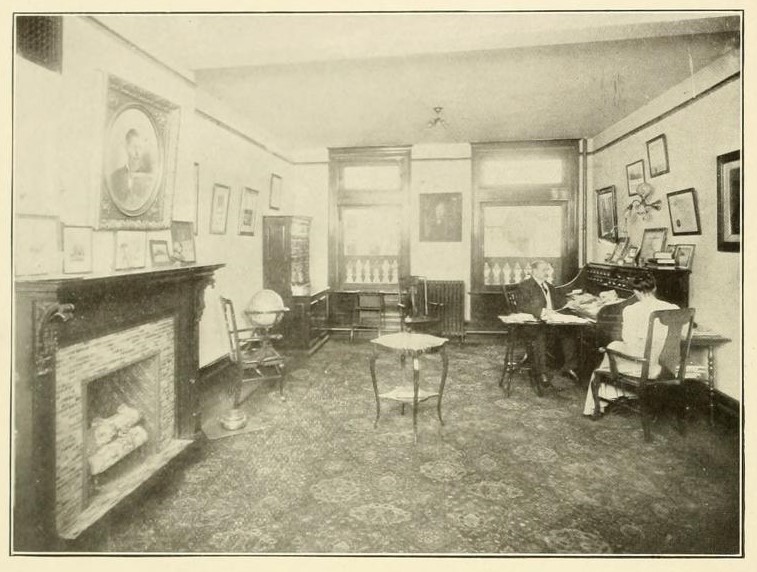
mr butlers private office history of buffalo its men and insitutions

Mr Butler’s Private Office at The Buffalo News, circa 1908. Source: A History of the City of Buffalo, its Men and Institutions

Under Mr. Butler’s ownership, The Buffalo News was very successful. It grew from a four-page daily newspaper into one of the most important newspapers in the country in its first 40 years.   By 1908, The Buffalo News had the largest circulation of any daily paper between New York and Chicago.  It was recognized as one of the best newspapers in the country outside of the two or three largest cities.  It was said that “his success as a journalist is due to his business capacity, his intellectual force and his habit of being in touch with people.”  He kept in touch with every department and paid attention to the operations of his paper.  When he was working on growing the newspapers’ circulation, there were times he was known to ride the train with the newspapers to ensure they made the connection to transfer for delivery of newspapers outside of Buffalo proper, personally ensuring that The News would get to people.  

The Butler Family

Edward Butler married Mary E. Barber of West Pisston in 1871.  They had four children, but only two survived – Ada Deen Butler, born May 31, 1879, and Edward H. Butler Jr, born June 19, 1883.  The other two children were likely named Clara and Ambrose.   [Note:  It was difficult to find the names of the children who died young, as they do not show up in any records I could find.  Special thanks to the staff at Forty Fort Cemetery in Pennsylvania, who took a peak into the Butler Mausoleum and found the crypts for Clara and Ambrose.  There are no dates on their crypts, but many sources mentioned that Mary Butler was buried with her babies, so I will assume that Clara and Ambrose are the two children who died.  Since there are no dates, there’s a possibility they were stillborn or died shortly after birth.]  The Butler family attended Westminster Presbyterian Church.  

In 1875, the Butlers lived at 109 Carolina Street (no longer extant).  Along with Edward and his wife Mary, his brother Ambrose Butler was also living with them while he was working as a clerk in the Canal office.  They also lived with a Domestic Servant – 19-year-old Mary Gorman, and a Housekeeper –  65-year-old Caroline Strong.  

In 1880, the Butlers lived at 377 Prospect Street (still standing).  The house had been the home of Seth Clark before the Butlers.  Along with Edward, Mary and daughter ADA, Edward’s brother Ambrose also lived in the home.  They lived with 20-year-old hosler (keeper of horses) John Collins, and 19-year-old servant Mary Schneck.  

429_Linwood

Image of 429 Linwood Ave as featured in Buffalo News, May 1984.

From 1890 to 1897, the Butlers lived at 429 Linwood Avenue (still standing).  This house is often called the “Lock-Butler House, as it was constructed by William Lock and then was home to the Butlers.  The house is an example of the Romanesque Style in Buffalo.  Mrs. Mary Butler died in August 1893 at the age of just 38 after an illness of three months.  She was buried in Forty Fort Cemetery in Forty Fort, Pennsylvania, in a plot near her two children who had passed away, her father, and her brother.    

In 1905, Mr. Butler lived at 522 Delaware Avenue (no longer extant).   He lived with his son Edward, daughter Ada and niece, 28-year-old Josephine Barber, a niece of the late Mrs. Mary Butler, who served as homemaker for the household.  They had four servants – 38-year-old Catherine Clark, 32-year-old Anna Peterson, 32-year-old Anna Sticht, and 29-year-old Mary Gerhardt.  Rounding out the household was 33-year-old Coachman August Gernoudt and his 32-year-old wife Nellie.  
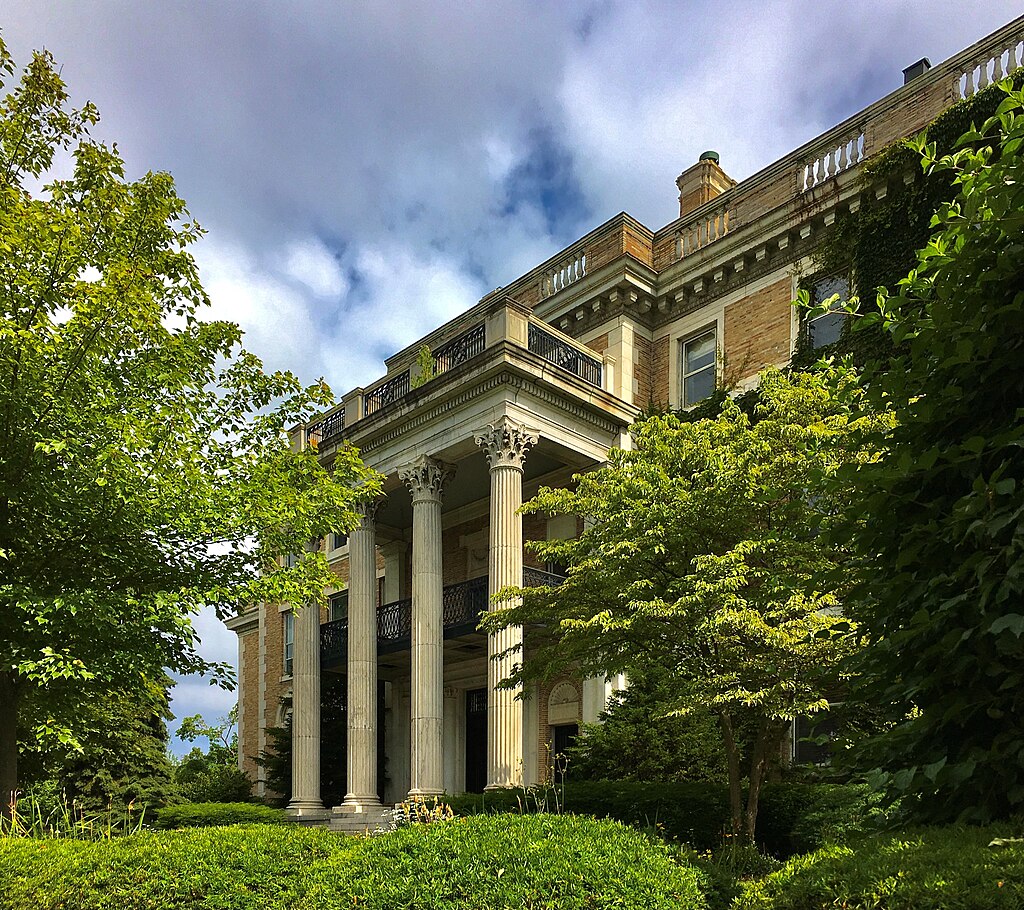
672_Delaware_Ave_-_1

Butler Mansion at 672 Delaware Avenue

In 1909, Edward Butler, Jr. married Kate Maddox Robinson of Atlanta, Georgia.  Also that year, the Butler family (Edward Sr., along with Edward Jr, his new bride Kate, and sister Ada) moved into the house at 672 Delaware Avenue, often called the Butler Mansion (still standing today).  The mansion was originally built for banker and leather manufacturer George Williams.  It is a three-story, Georgian Revival-style mansion with 40 rooms.  It was designed by Mead McKim and White architects, and the two-acre property consists of a 16,000-square-foot mansion and an 8,000-square-foot carriage house.  

In 1910, Mr. Butler lived with his son Edward Jr, daughter-in-law Kate, daughter Ada, and 8 servants:  butler Herman Werne, and servants Pauline Benner,  Caroline Killins, Antoinette Burnod, Emily Schnicklart, Gertrude Beck, Agnes Gambert, and Agnes Kelly.  

Mr. Butler’s Other Involvements

Mr. Butler was very involved with enacting of grade crossing law that created the Grade Crossing Commission and served as a member of the Commission from its founding for its first 20 years.  The Commission erected numerous grade crossing structures within the City of Buffalo city limits.  

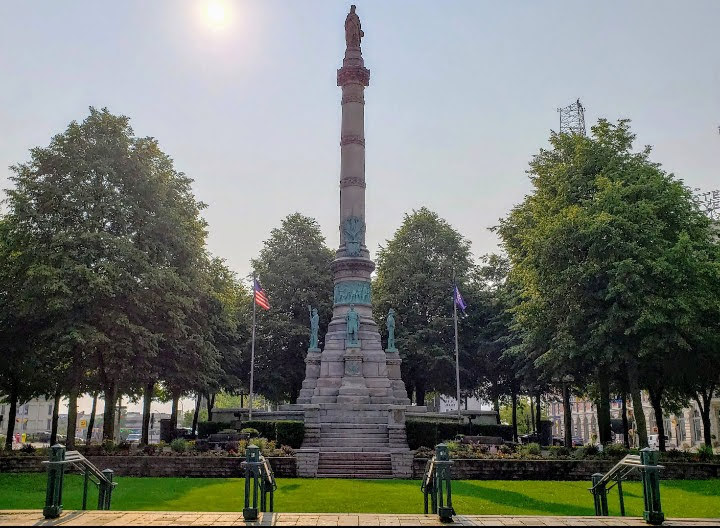
Mr. Butler was also involved in constructing the McKinley Monument in Niagara Square.  The Buffalo News was able to help secure appropriations that made the monument possible.  Mr. Butler was President of the Commission that erected the monument.  Mr. Butler worked closely on the memorial to President McKinley with George E Matthews of the Buffalo Express.   

Mr. Butler served as a member of the Board of Trustees for the State Normal School for many years and was President of the Board for the last three years of his life.  He was President of the Buffalo Daily Newspaper Publishers Association, Vice-President of the United Press, Director of the Associated Press, and President of the State Editorial Association.   He was a member of the Buffalo, Ellicott, Park and Country Clubs in Buffalo; the Lotus and Larchmont Clubs in  New York’s Clover Club in Philadelphia and the Capital City Club in Atlanta.  

According to the book 20th Century Buffalo, in 1902, Buffalo had the following newspapers:  

  • Morning Newspapers:  Buffalo Morning Express (established 1846), Buffalo Courier (established 1842), and Buffalo Review (established 1883).  
  • Evening Papers:  Buffalo Commercial (established 1835), Buffalo Evening News (established 1880), Buffalo Evening Times (established 1883), Buffalo Enquirer (established 1891), Demokkrat (German – established 1837), Freie Presse (German – established 1855), and Polak W’Amervca (Polish – established 1887).
  • Sunday Papers:  The Illustrated Buffalo Express (established 1883), Buffalo Sunday News (established 1873), Buffalo Courier (established 1885), and the Buffalo Sunday Times (established 1879).

The circulation of the Buffalo Evening News at the time was 75,000 daily.  This was much more than the daily circulation of its closest competitors – the Buffalo Courier at 55,000 daily and the Buffalo Evening Times, The Buffalo Enquirer and the Buffalo Morning Express at 30,000 daily.  By 1927, the Buffalo New daily circulation was reportedly at 150,000.  By the mid-70s, the circulation was reportedly 280,000, with 300,000 on weekends.  

The Death of Edward H. Butler
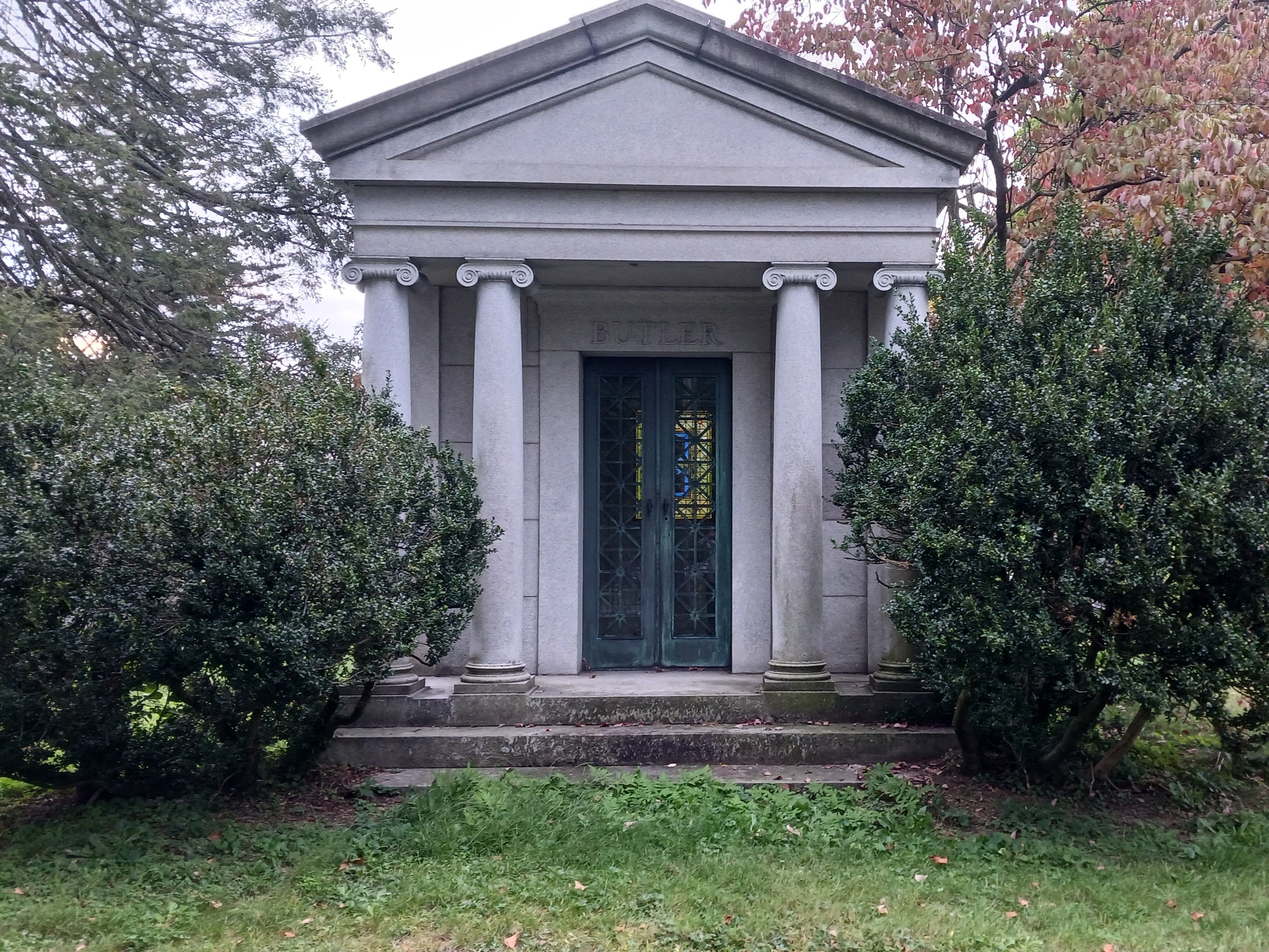
IMG_20240923_075453

Butler Mausoleum in Forty Fort Cemetery in PA

In 1914, Edward H. Butler died at his residence near the corner of North and Delaware.  He had been in poor health for about ten years, mainly due to diabetes.  He had recently had an operation for mastoiditis, an infection of the ear.  He did not recover well from the surgery.  His funeral was held at Westminster Presbyterian Church on Delaware Ave in Buffalo.  He was buried in a mausoleum in Forty Fort Cemetery in Forty Fort, Pennsylvania, next to his wife and the two babies who had passed away. 

IMG_20240923_091356

Interior of Butler Mausoleum showing Mr. Butler’s crypt.

Mr. Butler’s will gave to many charities.  It was believed that Mr. Butler left personal property valuing $25,000(about $787,000 in today’s dollars) and real estate valued at $25,000(about $787,000) or more.  He gave $60,000 (about $1.9 Million) dispersed amongst 40 charities/institutions.  [Note:  For a deep dive into Mr. Butler’s Bequests, we will discuss his will in my next post, going into each organization that received the money, the story of the charities and if they exist anymore.  Stay tuned for that!]

Outside of Buffalo, he donated to the cemetery where he and his wife are buried and to the cemetery in LeRoy where his mother and other relatives were buried.  He distributed approximately $60,000 (another $1.9 Million) to his personal friends, relatives and employees.  Every employee of The Buffalo News who had worked there for at least three years was given $100(about $3,147 today).  

Edward H. Butler, Jr.

edwardbutlerjr

Sketch of Edward Butler Jr. Source: The Fourth Estate.

Following Mr. Butler’s death, son Edward H. Butler, Jr. took over as Editor of The Buffalo News. Edward Jr also inherited the house at Delaware and North Streets, all of the oil paintings, plates, china, rugs and furnishings.    Daughter Ada inherited her house at Delaware and Highland Avenue, which had recently been completed, along with $50,000 to equalize her brother’s more significant inheritance of the larger family home.  

Edward Jr also inherited six-tenths of Mr. Butler’s ownership of the buildings used and occupied by the Buffalo Evening News and the Buffalo Sunday Morning News – 216 and 218 Main Street, the press and composition rooms on Pearl Street south of Seneca Street, the building at West Seneca Street and Lower Terrace that was used as a garage for the news vehicles, and all of the real estate used for the publication of the two newspapers.  The remaining four-tenths of The Buffalo News and Sunday Morning News went to Ada.  

Edward Jr had been well-trained to take his father’s place at The News.  He joined The News after graduating from Yale in 1907.  He took business courses at Bryant & Stratton Business Institute.  He also worked various jobs in all of the newspaper’s departments.  He knew all the people and how they made the newspaper work; the Butlers felt that learning and understanding every part of the business was important.  

In 1914, Buffalo readers had a choice of six English-language daily newspapers.  In the morning – The Courier and the Express.  In the afternoon, The Buffalo News, the Buffalo Times, the Buffalo Enquirer, and the Buffalo Commercial.  

One of Edward Jr.’s first tasks when he took over the newspapers was to close The Sunday News.  The Evening News was doing well, but The Sunday News was operating at a deficit.  Edward Sr had refused to kill The Sunday News as it was his first publishing venture in Buffalo.  Edward Jr quietly killed The Sunday News at the start of 1915.  The Buffalo News Sunday edition began again 63 years later when things shifted following the Butler family’s sale of the newspaper.

Edward Jr and Kate continued to live at 672 Delaware Avenue.  They had two children – first a son, Edward H Butler III, was born in August 1915. Sadly, Edward III passed away in June 1919, just a few months before his fourth birthday, after several days of illness.  According to his obituary, he had been in poor health for the previous year, suffering from “a peculiar glandular malady that had puzzled physicians.”   Daughter Kate Robinson Butler was born in November 1921.  

In the 1920s, Edward Jr became a pioneer in presenting news via radio.  The Radio Commission authorized WBEN to go on the air on September 8, 1930.  The WBEN stands for Buffalo Evening News.  WBEN broadcast from a studio on the 18th floor of the Hotel Statler.  WBEN started broadcasting with all live, local programs, no national programs and no prerecorded music. WBEN was a part of National Broadcasting Co.’s Red Network, which became the NBC Network.  In 1936, Edward Jr bought WEBR, part of the Blue Network that would later become ABC.  WEBR developed a slogan saying that their letters stood for We Extend Buffalo’s Regards. Edward Jr sold WEBR in 1942 to the Courier-Express.  

In 1928, Mrs. Kate Butler gifted the University of Buffalo with the tower clock in Hayes Hall and the four bells accompanying it.  Mrs. Butler was a member of the Council of the University of Buffalo.  The bells and the clock were restored between 2011 and 2015 during the renovations of Hayes Hall and still operate today.  

By the 1930s, the last competing daily newspapers, Buffalo Commercial Advertiser and Buffalo Times ceased publication.  This left Buffalo with just two newspapers – The Buffalo News and the Buffalo Courier Express.  

After WWII, Edward Jr brought The News to television in Buffalo.  WBEN-TV went on the air on May 14, 1948 and for the first five years was Western New York’s only television station.  In 1954, WBEN-TV became a CBS station.  In 1977, WBEN-TV became WIVB-TV, Channel 4 in Buffalo still to this day.      

Edward Jr was involved in many of the same causes as his father.  He was the Chairman of the Board of Buffalo State Teachers College (Now Buffalo State University).  He was involved with the efforts to move the school from his Normal Ave location to its current location on Elmwood Avenue.  He also served as a Trustee of Nichols School.  Edward Jr was a Director of Buffalo Trust Company and American Savings Bank.  He was a member of the Buffalo, Saturn, University, Park, Buffalo Athletic, and Buffalo Country Clubs.

185245182_1510853833

Butler Mausoleum in Forest Lawn Cemetery.

Edward Jr died in February 1956. He is buried in the Butler Mausoleum in Forest Lawn Cemetery.   Also buried there are his son, Edward H Butler III, his wife, Mrs. Kate Butler, daughter Kate Butler Wickham and two of Kate’s husbands – Bruce Wallis and Robert Wickham.  

Ada Butler and her Family

Edward Jr.’s sister, Ada Butler, married Roscoe Mitchell in April 1910.  Mr. Butler, Senior built the house at 1114 Delaware Avenue as a wedding gift for Ada.  The house is a three-story brick mansion designed by Buffalo architect Ulysses G Orr.  

Roscoe Mitchell was a well-known Buffalo attorney.  Ada and Roscoe had a daughter, Marjorie, born in 1911, and a son, Edward Butler Mitchell, born in 1912.  Sadly, both Roscoe Mitchell and Edward Butler Mitchell died in June and July 1932 after a long period of illness.  Roscoe was 49, and Edward was just 19. 
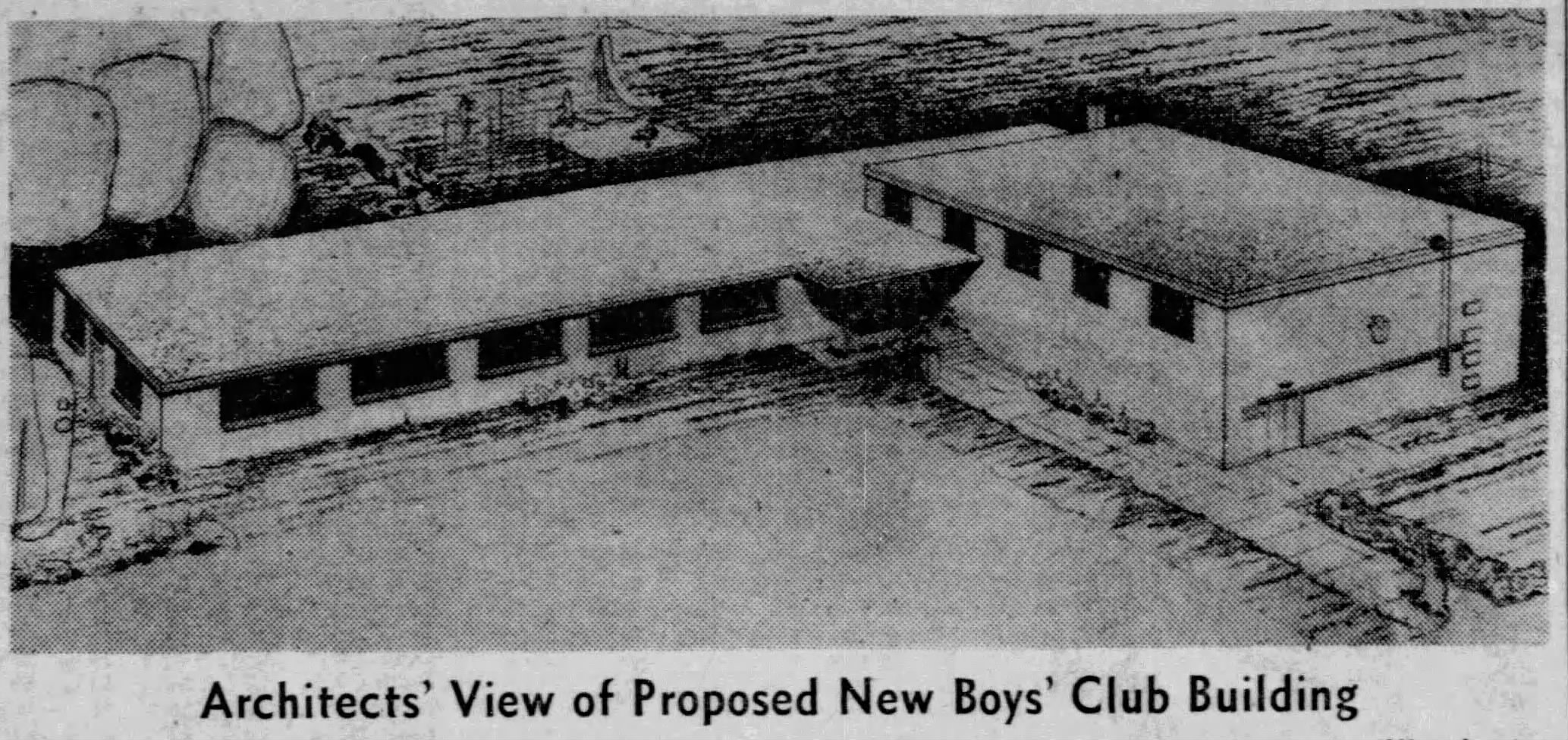
rendering_of_boys_club_building_on_Massachusetts_Ave

Rendering of Boys Club Building on Massachusetts Avenue. Source: Buffalo News, February 1955

The Butler Mitchell Boys Club was founded in the memory of Edward Butler Mitchell in 1933.  The story goes that Ada was driving around the West Side shortly after her son died and saw some young men playing in a makeshift clubhouse and she pulled up to them and talked with them. She decided to buy an old barn on Efner Street to give to the boys of the neighborhood to use.  The Butler Mitchell Club was founded to help the young men of the neighborhood, ages 16 to 24.  The group quickly grew and rented a space in a church at 254 Virginia Street by December of 1933 (this former church is where Hispanics United of Buffalo is located today).  In 1955, the Boys Club of Buffalo and the Boys Club of the Niagara Frontier joined together to erect a new building on the West Side at 370 Massachusetts Avenue, known as the Butler Mitchell Branch.  The Butler Mitchell Boys and Girls Club is still located on this site.  

After their father’s death, Edward Jr and Ada established and perpetually endowed the Edward H Butler Professorship in English Literature within the College of Arts and Science at the University of Buffalo.  This professorship was established in honor of their father and still exists today.

85130819_132955847061

Mitchell Family Plot in Forest Lawn Cemetery

Ada Butler died on April 1, 1934, in New York.  She was buried in Forest Lawn Cemetery with her husband and son.  The Mitchell family plot includes the graves of Roscoe, Edward, Ada, Marjorie and Marjorie’s husband Kent Schuyler McKinley, hence the “Mitchell McKinley” on the plot.  

Ada’s daughter Marjorie was married several times.  First to William Baird in July 1930.  Baird Point at Lake LaSalle on North Campus at UB and Baird Hall are named for the Baird family – William, his brother Cameron, and their father Frank. A street by the Peace Bridge that bisected Front Park, Baird Drive, was also named for them.  The road was removed in 2016 to restore park space to Front Park.  Marjorie and William had one daughter, Barbara Butler Baird, born in August 1931.  

Marjorie helped found the Butler-Mitchell Boys Club with her mother and served as president of the club from 1937 to 1952.  

In 1943, Marjorie Mitchell married Kent Schuyler McKinley.  As Marjorie McKinley, she financed the construction of the Edward H. Butler Auditorium in Samuel P Capen Hall [Note: this Capen Hall was located on South Campus; when North Campus opened, the Capen name moved to North Campus and Capen Hall on South Campus became Farber Hall…I am unsure if the auditorium still exists in Farber Hall – do any of my UB friends know?]

In 1950, Marjorie donated her family house on Delaware to the Episcopal Diocese of Buffalo.  The Diocese used the house as its headquarters, calling it the “Marjorie Mitchell McKinley Diocesan House,” though many called it as “The D’ House.”  The property has been the headquarters of Courier Capital since 2011.  

Marjorie and her husband Kent moved to Sarasota and founded the Sarasota News in 1954.  The Sarasota News was a daily afternoon newspaper.  Talk about a family with deep newspaper ties!  They sold the newspaper in 1962.

Also in 1962, Marjorie sold her 40% shares of The Buffalo News to her Aunt, Kate Butler. 

In 1965, Marjorie was named honorary chancellor of Florida Southern College, the first woman elected to the office.  That year, she also received an honorary doctor of fine arts degree from the college.  She was the main donor for the music building built on campus, the Marjorie M McKinley Music Building, which was named for her. 

Kent McKinley died in 1972.  Marjorie married Ted C Van Antwerp in 1973.  Marjorie passed away in November 1990.  Marjorie and Kent are buried in the Mitchell McKinley plot in Forest Lawn Cemetery.  

Mrs. Kate Butler

Mrs_Butler_August_1974Following Edward Jr’s death, his wife Kate Butler led The News.  She became President of The News in 1956.  She was known around town as “Mrs. Butler”, so I will call her that from here on out.  

The News had purchased additional properties over the years, taking over much of the area at Main and Seneca Streets.  In 1916, The News purchased a building on Pearl Street and remodeled it for use of the mailing department and for stock and file rooms.  In 1924, The News bought a building at Seneca and Pearl Streets; the four-story structure became part of The News’ press room.  In 1929, they purchased 214 Main Street and built an addition to their building.  They continued to need more space.  Mrs. Butler finished the construction of the printing plant, which her husband had begun.  The printing plant on Scott Street opened in 1958 on land that was once part of the Lehigh Valley railroad depot.  The new plant had 35 printing units arranged to operate as five giant presses.  On June 30, 1958, President Dwight D. Eisenhower pressed a button at the White House to start the first production run with the new presses. 

Mrs. Butler also became the Publisher of The News in 1971.  James Righter was publisher from 1956, when Edward Jr died, until 1971.  James Righter was married to Edward and Kate’s daughter Kate.  While the public word was that he took early retirement, reportedly, Mrs. Butler became Publisher because she fired her son-in-law when she found out he was having an affair.  

BN1

Buffalo News Birds Eye View, April 13, 1973. Source: Buffaloah.com

Mrs. Butler also made the tough decision to move The News from 218 Main Street after 75 years to the “new” Buffalo News building at the corner of Washington and Scott Streets.  The Main Street property was going to be a part of the City’s redevelopment program to build Marine Midland Center (now Seneca One Tower).  The new office building was built next door to the printing plant on Scott Street.  One News Plaza, as the new building was known, was designed by NYC Architect Edward Durrell Stone.  The modernist building is unusual because there are no support columns in the middle of the floor plates.  The five-story building also has an atrium that houses a garden with trees and plants.  The News moved into the new building at the corner of Washington and Scott Streets.  Mrs. Butler, unfortunately, was never able to set foot into the new building, as ill health had confined her to her house. 

 Kate Butler died in 1974.  She is buried in the Butler Mausoleum in Forest Lawn Cemetery.  

The Buffalo News After Mrs. Butler’s Death

Mrs. Butler had reportedly been counseled by her attorneys to take steps to minimize the tax consequences that would occur upon her death by gifting off some of her assets, otherwise a “fire sale” would occur.  After Mrs. Butler’s death, the Butler family decided to put The News up for sale.  The newspaper, TV station and radio stations were each sold to different buyers following Mrs. Butler’s death.  The News was officially out of broadcasting at that time.  

The Butler Mansion was donated to Roswell Park Cancer Institute in 1976.  In 1979, Jeremy Jacobs purchased the mansion for use as the headquarters of Delaware North Companies (the mansion is located at Delaware and North Streets, hence the Delaware North name).  In 1991, the mansion was sold to the Variety Corporation.  In 1999, Mr. Jacobs reacquired the mansion for the UB School of Management to use the property for executive training.  In 2001, the mansion was renamed the Jacobs Executive Development Center.  In December 2022, the UB Foundation announced the mansion’s sale to Douglas Development.  

In 1977, after 97 years of being owned by the Butler family, the newspaper was purchased by Warren Buffett for $32.5 Million.  Mr. Buffett became Chairman of The News.  When Mr. Buffett purchased The News, it was an afternoon newspaper published every day except Sunday.  Afternoon newspapers were dying across the country at the time due to the rise of office work over factory jobs and TV news, which made the afternoon edition feel out-of-date at the end of the work day.  The Evening News was different than most; it still sold more than double as many copies as the Courier-Express morning edition.  But it still lacked a Sunday paper.  One of Mr. Buffett’s first decisions was to restart the Sunday edition, which began on November 13, 1977.  There had been a gentleman’s agreement between The News and the Courier-Express that The News would be evening only and the Courier-Express would be morning only.  The Courier-Express fought against the Sunday edition by persuading a local judge to issue rules designed to cripple the distribution of the Sunday News.  In 1979, an appeals court overturned the crippling rules and scolded the judge who imposed them.   Two months later, the Connors family sold the Courier-Express to a Minneapolis newspaper company.  Three years later, on September 19, 1982, the Courier-Express published its last newspaper, leaving Buffalo with just one newspaper.  

After the Courier-Express closed, The Buffalo News became a seven-day newspaper.  In 1989, Buffalo News was the 27th largest newspaper in the United States, with 1100 full-time employees, 200 employees in editorial, and a circulation of 320,000 on weekdays and 390,000 on Sundays.  In 1990, 75% of the newspapers were delivered to homes by 4900 newspaper carriers (4400 youth, 500 adult carriers).   Like so many other Western New Yorkers, I delivered newspapers in middle school. The remaining newspapers were mailed out or found at newsstands/stores.  

The evening edition was abandoned in October 2006, and what had begun as The Buffalo Evening News became a morning-only newspaper.   

In January 2020, after 42 years of being a part of Warren Buffett’s Berkshire Hathaway group, The Buffalo News was sold to Lee Enterprises, just the third owner in the entire history of The News.  Lee Enterprises had ties to Berkshire Hathaway and had managed the Berkshire Hathaway newspapers, except for The Buffalo News, since 2018.   
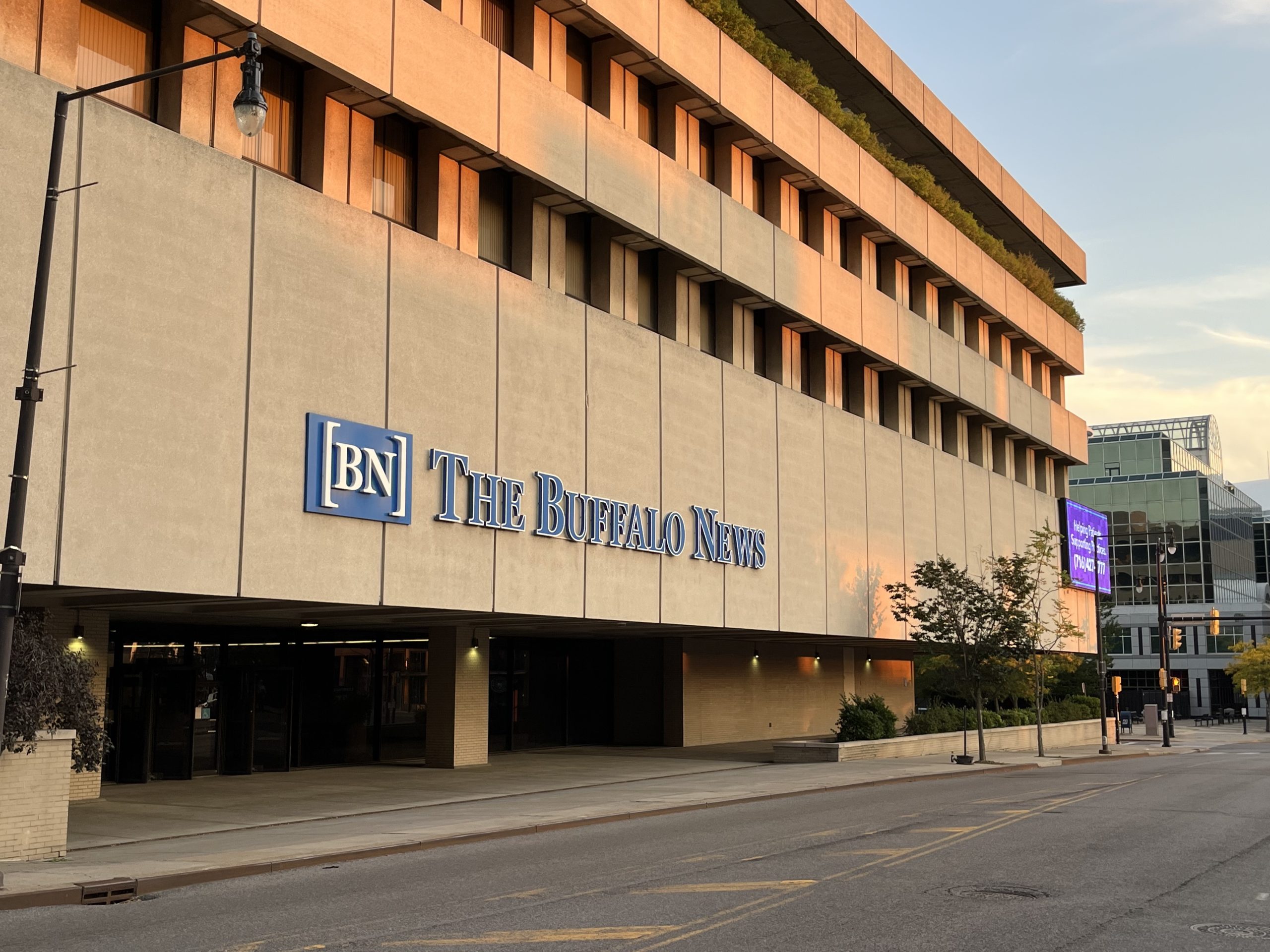
Buffalo-News_Sept.-26-2024-scaled

Former Buffalo News building from Washington Street.  The property is now vacant and fenced off.

In 2022, The Buffalo News announced they were selling their headquarters on Scott Street, moving out of Downtown Buffalo for the first time in almost 150 years. The 175 office employees relocated to 20,000 square feet in the Larkin Exchange Building on Exchange Street in October 2022.  The print production facilities were originally going to remain on Scott Street.  

In February 2023, The Buffalo News announced they were closing the printing production facility on Scott Street and moving print operations to Cleveland, Ohio, to the Plain Dealer printing facility.  About 130 employees across 8 different unions were affected by the closure of the print operations.   The final locally printed edition came off the presses on September 30, 2023.  

In 2024, The Buffalo News announced they would no longer publish a print issue on major holidays, including New Year’s Day, Martin Luther King Jr Day, Presidents Day, Memorial Day, Independence Day, Labor Day, Veterans Day, Thanksgiving and Christmas.  

The Buffalo News building was purchased by Douglas Jemal in July 2024. The sale included the office building, the adjacent production building and a parking lot across the street on Scott Street.  Douglas Jemal also owns the former HSBC Atrium building, just south of The Buffalo News properties, giving the developer control of approximately 14 acres of land in Downtown Buffalo near Canalside and the Arena – I can’t wait to see what he does with the properties!  

So the next time you drive down Butler Ave, or pass by the Former Buffalo News office or the Butler Mansion at Delaware and North, or read The Buffalo News, think of Mr. Edward H Butler and thank him for coming to Buffalo and giving us The Buffalo News and so much more.  What’s your favorite Buffalo News memory?  

Want to learn about other streets? Check out the Street Index. Don’t forget to subscribe to the page to be notified when new posts are made. You can do so by entering your email address in the box on the upper right-hand side of the home page. You can also follow the blog on Facebook. If you enjoy the blog, please share it with your friends; It really does help!

Sources:
  1. “Building is Active in Hamlin Park Now.”  Buffalo News.  November 20, 1915, p21.  
  2. “Butler Ave Just Opened New Street in Hamlin Park.”  Buffalo News.  May 15, 1915, p23.
  3. “Edward H. Butler Died Soon After Serious Operation.”  Buffalo Times.  March 10, 1914, p4.  
  4. “Will of Edward H. Butler is Filed This Afternoon”  Buffalo News.  March 18, 1914, p4.  
  5. “Edward H. Butler Jr and Kate Butler.”  Buffalo News.  November 1, 2015, p84.  
  6. “The News:  A radio and TV Pioneer.”  Buffalo News.  November 15, 2015, p92.
  7. “How the News Grew In Downtown Buffalo.”  Buffalo News.  November 22, 2015, p90. 
  8. “Buffalo’s Last Newspaper War.”  Buffalo News.  December 13, 2015, p94.   
  9. “Death of Mrs. Edward H Butler.”  Buffalo News.  August 21, 1893, p13. 
  10. “Striking Clock Being Installed at University.” Buffalo Times.  June 21, 1928.
  11. “Bennet, A Gordon.  Buffalo Newspapers Since 1870.”  Adventures in Western New York History, Buffalo and Erie County Historical Society, 1974.
  12. Hill, Richmond C.  Twentieth Century Buffalo:  an illustrated compendium of her municipal, financial, industrial, commercial and general public interests.  J.N.Matthews Co, Buffalo, 1902.  
  13. Downs, Winfield Scott.  Municipality of Buffalo:  A History, 1720-1923, Volume 1.  Lewis Historical Publishing Company, 1923.
  14. Kirchhofer, A.H.  “Romance in American Journalism.”  The Fourth Estate.  November 19, 1927.  
  15. “Jacobs Executive Development Center”.  University at Buffalo Archives.  library2.buffalo.edu/archives/campuses/detail.html?ID=118
  16. “Facts About The Buffalo News.” from The Buffalo News.  Updated 9/1990.  Found in the Newspapers Vertical File at the Central Library.  
  17. History of the City of Buffalo, It’s Men and Institutions.  Published by The Buffalo Evening News.  1908.
  18. “Obituary:  Edward H. Butler, Jr.”  Buffalo News.  June 23, 1919, p1.  
  19.  “Station WEBR Transferred; WBEN’s Status Unchanged.”  Buffalo News.  July 12, 1942, p8.  
  20.  Hsu, Charlotte.  “Journey to the Heart of the Hayes Hall Clock.”  UBNow, October 22, 2014.  buffalo.edu/ubnow/stories/2015/10/hayes_clock.html
  21. “Marjorie Van Antwerp Dies; Ex-News Executive”.  Buffalo News.  November 30, 1990, p5.  
  22. Butler Mitchell Alumni Association.  “Our History”.  bmalumni.com/history
  23.  Robinson, David.  “The Buffalo News is Being Sold to Lee Enterprises.”  Buffalo News.  January 20, 2020.
  24. Petro, Michael.  “Buffalo News Plans to Close Downtown Production Facility, Move Printing to Cleveland.”  Buffalo News.  February 20, 2023.  
  25. Glynn, Matt.  “Douglas Jemal agrees to buy Buffalo News complex to expand holdings near Canalside.”  Buffalo News.  March 19, 2024.  
  26. Ashley, Grant.  “Buffalo News no longer publishing print issue on ‘major holidays’.  WBFO.  July 6, 2024.  
  27. Light, Murray B.  From Butler to Buffett:  The Story Behind The Buffalo News.  Prometheus Books. 2011.  
  28. Sullivan, Margaret.  “Historic Change Coming for The News.”  Buffalo News.  October 1, 2006, p81.  

Read Full Post »

Screenshot (93)

Map Showing Sherwood Street on West Side.

Today we are going to talk about two streets – Sherwood and Sidney.  They were both named for members of the same family.   Sherwood Street is a short street, running one block between Hampshire and Arkansas Street on the Lower West Side of Buffalo.  It is named for Merrill Bennett Sherwood, Jr, a soap manufacturer.  

The second street, Sidney Street, runs between Humboldt Parkway and Fillmore Avenue in the MLK Park Neighborhood on the East Side and is named for Merrill Sherwood’s son, Sydney. 

Screenshot (94)

Map showing Sidney Street on the East Side.


20230301_103916

George Washington’s Vault at Mount Vernon which Adiel Sherwood based on his family vault on.  Photo by author.

The first Sherwood family member to live in Buffalo was John Adiel Sherwood, who went by Adiel.  He was born in 1785 in Kingsbury in what is now Washington County, New York.  Adiel’s cousin was General Isaac Sherwood who served with George Washington at Valley Forge.  Adiel arrived in Buffalo in 1815, when it was still a small village.   Adiel Sherwood purchased a farm in what was known as Buffalo Plains.  The farm was in the vicinity of what is now Bennett High School.  Adiel erected a vault on his lot which was an exact replica of the Washington’s Vault at Mount Vernon.  When Forest Lawn opened, a city ordinance was passed that prohibited burials on private property.  All bodies were removed from the burying ground on the Sherwood Farm and moved to the Sherwood family plot at Forest Lawn in 1886.  Adiel Sherwood died in 1839.  

20231119_143553 (1)

Adiel Sherwood Grave. Photo by Author.

Adiel Sherwood invested heavily in Buffalo because he believed in the future of the community.  At one time, he owned 3,000 acres, most of it on Main Street.  He was appointed Commissioner of Deeds by the Governor.  Adiel Sherwood married Anna Woods and they had eight children.  Their son, Merrill Bennett Sherwood, Sr. was born in 1809. 

Merrill Sr came to Buffalo with his family as a child in 1815.  He later purchased oil properties in Pennsylvania and was involved in various Buffalo banks. In 1840, he was President of Erie County Bank.  He was also President of the Farmers’ Joint Stock Company.  Many farmers were lured by Mr. Sherwood to place their savings in the bank, however, there were reports that the bank was a scam.  The story goes that Mr. Sherwood was threatened by the farmers and fled Canada never to return again, but plenty of sources list Mr. Sherwood as still living in Buffalo until his death.  Other reports said that the banknotes were good and were widely used throughout Erie County.  Either way, the bank was affected by the Panic of 1857, so many lost money.  All banks in Buffalo suspended business during the panic, except for White’s Bank down by the Canal.  In 1912, Frank Hayward Severance wrote about the story about the bad bank notes and fleeing to Canada in the Picture Book of Earlier Buffalo that “this, however, is ancient gossip and not history.”  

Merrill Sherwood married Harriet Griffin, daughter of Zachariah Griffin in 1837.  Mr. Griffin, Harriet’s father, had a farm on the site of what is now City Hall.  Merrill and Harriet Sherwood first live in a modest home on Main Street north of Chippewa.  They had five children, Griffin, Merrill Jr, Hiram, Harriet, and Mary. 

Sherwood Pages from The_Picture_Book_of_Earlier_Buffalo

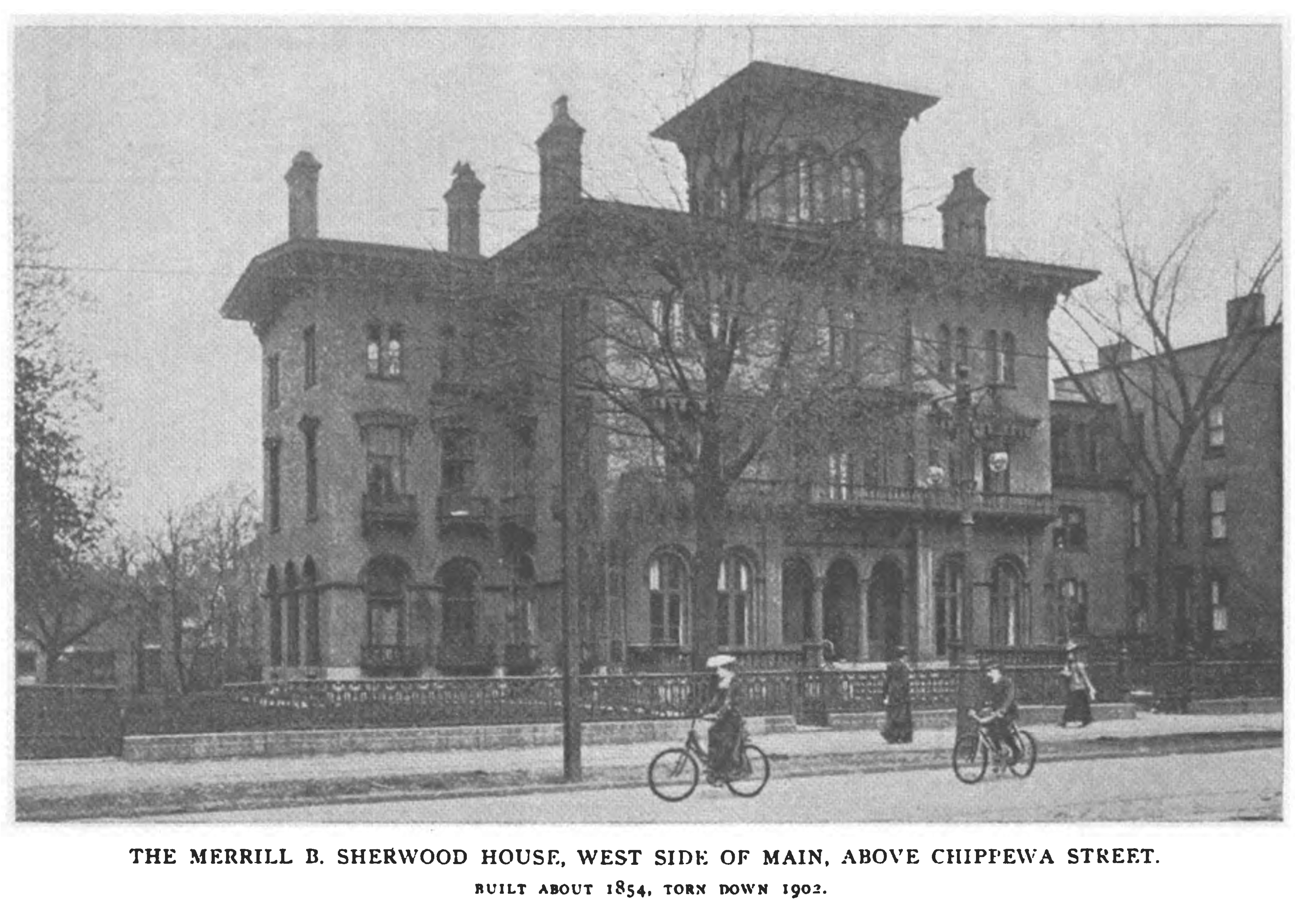
Sherwood Mansion at 652 Main Street, Downtown Buffalo. Source: Picture Book of Earlier Buffalo

In 1854, the Sherwoods built a home which was a three-story brick mansion and a showplace for Buffalo.  The house had 50 rooms and was topped by a massive square observatory.  Nearly everything in the house was brought from France via sailing vessels.  The doors were of solid mahogany.  The lawns and gardens were surrounded by an ornamental handwrought iron fence.  The house was known for its beautiful rose garden.  In 1860, the Sherwood family lived in the house with hostler (a caretaker of horses) James Reed and servants Bridget McGowan, and Rosa Reine.  

The Sherwoods moved out of the house by 1867.  After the Sherwoods moved out, the house had several uses.  It was used as a display house for Hersee Furniture (we’re going to learn more about them in our next post!).  The Sherwood Mansion was then used as an upscale boarding house called The Sherwood.  It was used for visitors to the Pan American Exposition in the last year of its life.  The Sherwood Mansion on Main Street was torn down in 1902 to make way for the growing business district of the City of Buffalo.  The site is now home to Shea’s Performing Arts Center.  

Merrill Sherwood Sr. suffered during the financial panics of the 1870s and 80s and was forced to sell off much of his oil property and real estate in Buffalo.  Mr. Sherwood Sr died in April 1886.  He is buried in Forest Lawn.

Pages from MB Sherwood Patent for curing meat

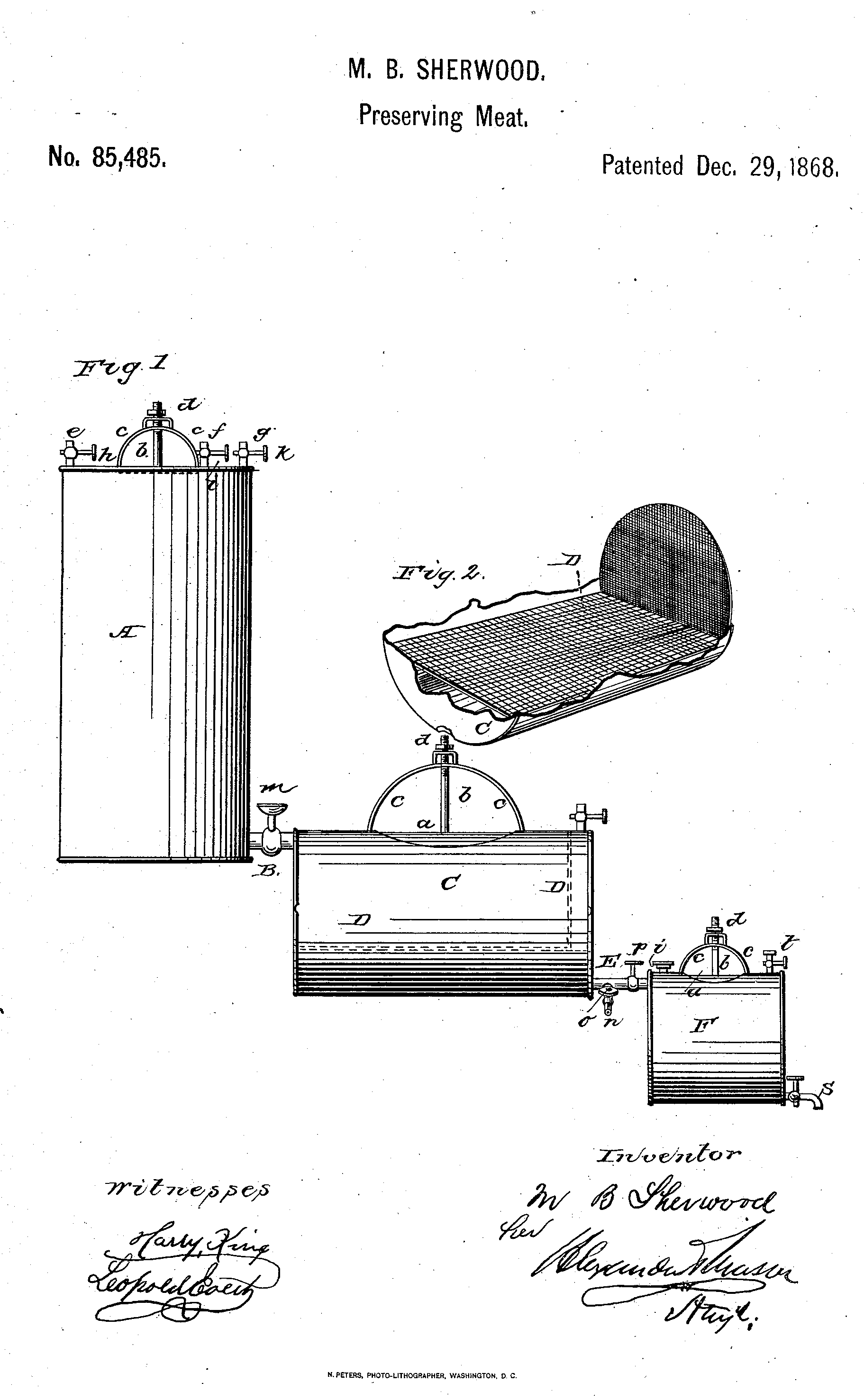
M. B. Sherwood, Jr.’s patent for meat preservation.  Source:  Google Patents.

Merrill Sherwood Jr, for whom the street is named, was born in Buffalo in 1837.  He grew up in the Sherwood Mansion.  Merrill Jr originated a formula for a nationally used toilet soap and operated a soap factory in the City of Buffalo.  The firm was called Sherwood & Hovey and was located at 39 Lloyd Street.  In 1868, he also patented a method for curing and salting meat.  This method was said to be more useful for preserving meat, particularly in warm climates.  

Sources said that Merrill Jr was not as successful in business as his father, but filled his time with his hobbies – music and the study of the Bible.  He was also a pianist.  

Merrill Jr. married Phoebe Cordelia Burt, daughter of George Burt of East Aurora.  They had five sons, Sydney, Charles, Hiram, Edwin, and William.  They lived at 365 Franklin Street, next to the Cyclorama Building.  They later moved to 50 Park Street. 

Merrill Jr also worked as a traveling salesman.  He died in a hotel in Newark, New Jersey in 1888.  His death was determined to be from apoplexy and not to accident.  Mrs. Sherwood, his widow, had to sue the Insurance Company to cover his life insurance costs, claiming that there were bruises on his head, indicating that he had likely fallen and that caused his stroke.  Mrs. Sherwood was successful and received a judgment of $4,918.66 ($166,363 in today’s dollars).  

Sydney_Sherwood

Sydney Sherwood. Source: Buffalo News.

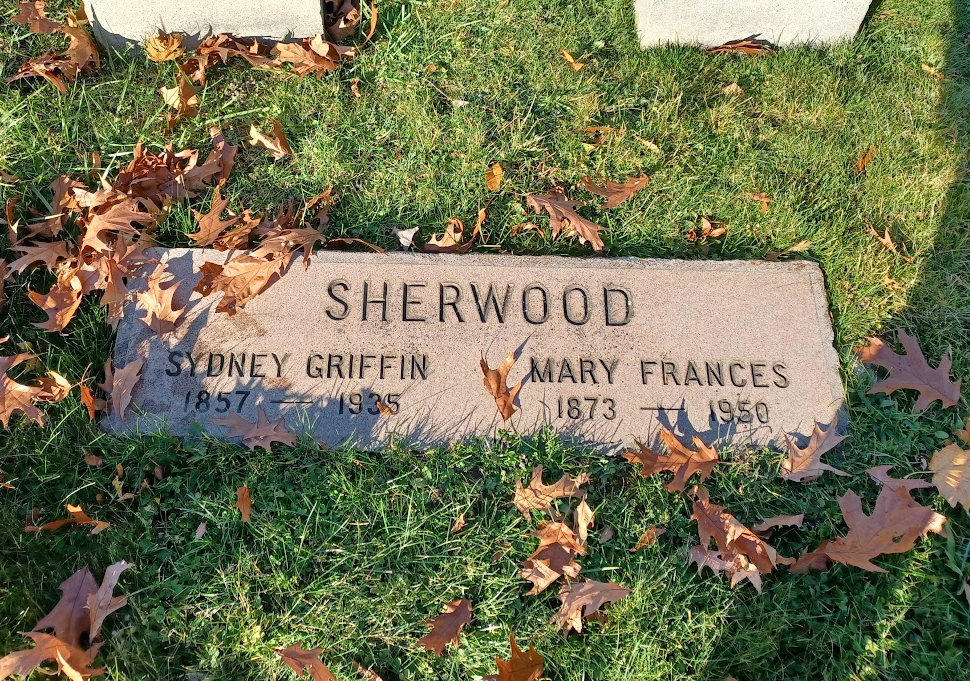
Sherwood Street and Sidney Street were both named by Merrill’s son, Sydney G. Sherwood (in sources, sometimes his first name was spelled Sydney and sometimes Sidney…since his grave says Sydney, I will use that.).  Sydney was born on February 5, 1857.  He attended old Central High School on Niagara Square and at the medical college of the University of Buffalo.  He had a keen interest in people, which is what led him to medicine, but he decided not to continue his studies, instead, he moved his interests to reporting on people.  Sydney Sherwood was a well-known local newspaperman and said that his desire to understand human nature stemmed from the same quest for understanding that had led him to medical school originally, and it helped him as a writer.  Sydney Sherwood started his career in 1879 as a reporter on the Sunday News, a publication of the Buffalo Evening News.  In 1885, Sydney became a railroad editor of the Buffalo Commercial Advertiser.  He founded the Buffalo Real Estate and Building News.  In 1894, he became editor of the Eastern Contractor and also edited the Mercantile Review.  From 1901 to 1905, he was commercial editor of the Buffalo Express and then published the Buffalo Live Stock Record.  In 1912, he became editor of the Co-Operative Magazine.  From 1920 to 1925, he was financial editor of the Buffalo Times.  

Sidney Sherwood grave

Sydney Sherwood Grave. Photo by Author.

Sydney Sherwood was also a partner in the land company that developed the land that became Sherwood Street.  He requested that the street be named after his father, Merrill Sherwood, Jr.  Sydney also developed the tract that includes Sidney Street.  Sydney passed away in 1935.  Like his father, grandfather, and Great Grandfather, he is buried in the Sherwood family plot.  There are 17 Sherwood family members buried in the plot.  Interestingly, both Merrill and Merrill Jr are buried in the lot, but neither had headstones.  There are only headstones for about half of the family members in the plot. 

20231119_144122

Sherwood Family Plot in Forest Lawn includes the headstone in the front, the five headstone stones in the center, and the three ledger (flat to the ground) stones to the right of the center stones. Photo by author.


William Sherwood Pages from The_Picture_Book_of_Earlier_Buffalo-2

William Sherwood House on Niagara Street. Source: Picture Book of Earlier Buffalo.

Merrill Sherwood Senior’s brother, William Sherwood, also had a well-known house in Buffalo.  His house was at the corner of Carolina and Niagara Streets.  It was built in the 1850s.  This house was demolished in 1892 to build the current apartment building which is located at the site.  You sometimes see sources that say that the Sherwood Mansion on Main Street was demolished in 1892, which is incorrect – they are talking about this house on Niagara Street.  It is confusing because newspapers of the time referred to both houses as the “Sherwood Homestead”.  William Sherwood worked as a merchant.  In 1860, he lived in this house with his wife Frances Lord, children William and John, and three Irish servants – Rose Mooney, Isabella Cowan, and James Dow.  Several years before his death, William and his family moved to Kansas City, Missouri.  He died in 1897 in Clinton Missouri.

So, the next time you head to Shea’s, think about the house that was located there before and the family that lived there!  Want to learn about other streets? Check out the Street Index. Don’t forget to subscribe to the page to be notified when new posts are made. You can do so by entering your email address in the box on the upper right-hand side of the home page. You can also follow the blog on Facebook. If you enjoy the blog, please be sure to share it with your friends, it really does help.  Interested in getting even more content from me?  You can become a Friend of Buffalo Streets on Patreon.   You can go to https://www.patreon.com/buffalostreets/ to join.

Sources:

  • Smith, H. Katherine.  “Sherwood Street Carries Name of Local Pioneers’ Descendant.”  Buffalo Courier Express.  July 6, 1941, p19. 
  • “End of the Sherwood House.”  Buffalo Courier Express.  May 18, 1902, p8.
  • “Did He Die By Accident?”  Buffalo Commercial.  May 4, 1892, p9. 
  • “Joint Stock- Public Meeting”.  The Buffalo Daily Republic.  December 11, 1854, p2. 
  • “Recalls Story of the Sherwood House and Others”..  Buffalo Courier Express.  May 6, 1902, p7.
  • Sydney G. Sherwood, Newspaperman Dies.”  Buffalo News.  April 22, 1935, p17.
  • Smith, H. Katherine.  “Sidney Street is Memorial to Newswriter, Developer of Area.”  Buffalo Courier Express.  September 14, 1941, p17.
  • “For Sale”.  Buffalo Courier Express.  March 12, 1867, p3.
  • “Landmark to Go”.  Buffalo Courier Express.  April 29, 1892, p.6.

Read Full Post »

Screenshot (47)

Bristol Street shown in red on the map.  Note the railroad tracks cutting the street into two parts.

Bristol Street is a street in the Emslie neighborhood on the East Side of Buffalo.  The street has two parts, each two blocks long – the first runs from Clare Street to Smith Street.  The road has a dead end where the street is bisected by railroad tracks and then continues from Lord Street to Emslie Street.  Prior to the removal of at-grade railroad crossings the road did cross the railroad tracks, those were removed by 1916.  The street historically was supposed to have continued past Jefferson Street to Spring Street, but only the block between Jefferson and Spring was constructed.  That block of Bristol Street existed until urban renewal removed it in the 1950s.

ny57932893230215394723_map

1899 Sanborn Map key map showing the additional block of Bristol Street between Spring and Jefferson. Bristol Street showing in red

Mr_and_Mrs__Bristol

Mr. and Mrs. Bristol in 1873. Source: Buffalo Courier

The street is named for one of the earliest residents of Buffalo, Daniel Bristol.  Daniel Bristol was born in Milford,  Connecticut in 1782.  Daniel Bristol married Mary Lockwood Reynolds in October 1810.  Mary went by Polly and was from Philadelphia.  The Bristols came to Buffalo in 1811.  Daniel was one of the earliest master builders in Buffalo and erected many of Buffalo’s first structures.  When the Village was burned during the War of 1812, they fled with their neighbors.  Mrs. Bristol gathered their treasured belongings and placed them in a large iron kettle and suspended it in their well.  After the war, they came back to help rebuild Buffalo.  When they returned, they fished the iron kettle and her silver out of the well.

Bristol_Home_Buffalo_Times

Mr. and Mrs. Bristol and their home

In 1816, Mr. Bristol built a home for his family on the southeast corner of Delaware Avenue and Mohawk Street.  Daniel and Polly had six children – Cyrenius, William, Peter, Eliza, Erasmus, and Catherine.  The Bristol family property originally extended on Delaware Avenue to Niagara Square and included most of the entire block.  They had a large garden east of his house on Mohawk Street, which led to a stable.   Over the years, portions of the property were sold off and other houses were built on the block, including the house that was purchased by Millard Fillmore in 1858.  The Bristol family house stood until 1923 when it was demolished to build the Statler Hotel.

On March 17, 1817, the Village of Buffalo established their first volunteer fire company.  Daniel Bristol was one of its members.  These men used old-time fire buckets and had no engine, they were what is referred to as a bucket brigade. In 1824, the first engine company was organized, which became known as Cataract Engine No 1.  In 1831, Pioneer Hook & Ladder No 1 was organized on South Division Street, east of Washington Street with Daniel Bristol as a charter member of the company.  The Buffalo Fire Department Engine 1/Ladder 2 is still located on this site.

Bristol Grave

Daniel, Polly and Peter Bristol Grave, Forest Lawn Cemetery.

Polly and Daniel lived to be among the oldest citizens of Buffalo.  They were a part of the “Old Settler’s Festival”, which brought together the older citizens of Buffalo to reminisce.  The Old Settler’s Festival was held at St. James Hall in 1866.  In 1866, there were just 16 residents of Buffalo remaining who had lived here before the Burning of Buffalo on December 30, 1813.  In addition to Dan and Polly Bristol, the others were George Coit, James Sloan, Commodore Stephen Champlin, Moses Baker, Mrs. R.B. Heacock, Lucius Storrs and his wife, Mrs. Kibbe (Mrs. Grosvenor), Mrs. Alvin Dodge, Mrs. Ebenezer Walden, Lester Brace and wife, and Mrs. William Hodge.

Daniel Bristol died on June 30, 1867 at the age of 85.  Polly died on February 28, 1879 at 92 years old.   They were buried in the North Street Cemetery.  His remains, along with those of Polly Bristol and their son Peter, were moved to Forest Lawn in October 1894.  Peter had died in 1838 at just 23 years old. These three Bristols are buried with one stone.

30584-original-bristolssarsaparillars

Ad for Bristol’s Sarsaparilla after they moved to NYC.  C.C. Bristol’s image is in the center.  Source:  https://www.bottlepickers.com/bottle_articles156.htm

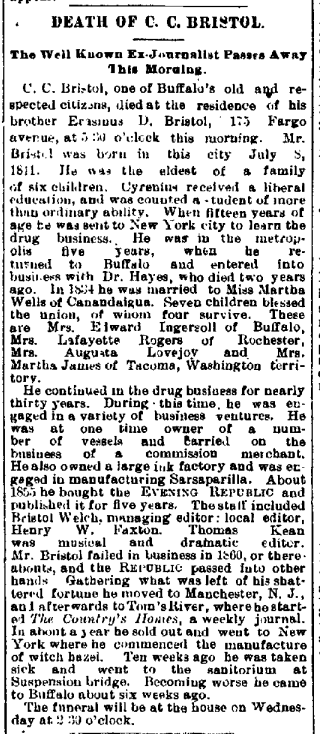
Daniel’s son Cyrenius Chapin Bristol, known as C.C. Bristol was born on July 8, 1811.  Some sources claim that he was the first male child born in Buffalo, but that claim is debatable.  At age 15, he went to New York City to learn the drug business.  He returned to Buffalo five years later to work as a chemist and druggist, with an apothecary near the corner of Washington And Swan Streets (now the location of the Ellicott Square Building).  He was considered one of the most well-known Buffalonians in his time.  He invented Bristol’s Extract of Sarsaparilla.  Bristol’s Sarsaparilla was considered to be the “first great American tonic” and was sold across the country and in Mexico for many years.  These almanacs were considered to be “as familiar to 19th century homes as the Bible”. In 1855 when the formula, the formula for Bristol’s Sarsaparilla was acquired by the Comstock Company of New York.  The Comstock Company remained in business until 1959.

CC_Bristol_Bottle

C.C. Bristol medicine bottle. Note the periods at the top of the C’s and the backwards S. Source: Buffalo News, August 1982.

In 1838, C.C. Bristol published “Bristol’s Gazette and Herald of Health”, a monthly that was discontinued in 1842.  In 1844, C.C. Bristol published the first patent medicine almanac called “Bristol’s Free Almanac”.  C.C. Bristol was said to have made “barrels of money” from the drug business and in 1855 when he sold his formula, he invested his money into The Buffalo Daily Evening Republic one of Buffalo’s early newspapers.  He published the paper for five years.  In 1861, the Republic was absorbed by the Buffalo Courier.

C.C. Bristol married Martha Hayden Wells of Canandaigua, NY in 1835.  He was the only one of his siblings to marry.  C.C. Bristol and Martha had 9 children.  Mary died in February 1866.    C.C. Bristol moved to New Jersey  after Mary’s death but returned to his hometown to end his days in Buffalo.  He died ten weeks later, in December 1884, at the home of his brother Erasmus at 175 Fargo Avenue.  Mary and C.C. were originally buried in the North Street Cemetery, but their remains were moved to Lakeside Cemetery in Hamburg in 1901.

Bristol_Home_sketch

Sketch of the Bristol Home. Source: Buffalo News, March 1957.

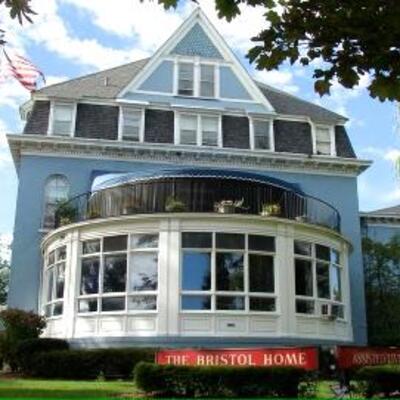
There’s another well-known Bristol namesake in Buffalo – the Bristol Home.  The Bristol name comes from a separate family – I was not able to discover a link between the two families, however, they both were long standing families in the New England area so if you go back far enough, they may intersect. Since we’re discussing Bristol today, I figured noone would mind if I included the history of the Bristol Home, since it was a longstanding institution in the City of Buffalo for more than 150 years!

Edward Bristol was born in Buffalo in 1825.  He worked as a merchant.  Edward was a businessman, who owned a furniture store; however, he had a deep interest in religious activities.  He was a charter member of Lafayette Presbyterian Church and the first superintendent of its Sunday School.  He helped conduct religious services at the Erie County Penitentiary.  While he was there, he saw that there were many women at the penitentiary that had nowhere to go.  In 1872, he ended up giving up his business and devoting his life to religious work.  In 1877, he was ordained as a minister and became pastor of Calvary Presbyterian in Rochester.  He lived the rest of his life in the Rochester area.

In May 1867, while still in Buffalo, Mr. Edward Bristol called together a band of women to the home of Mrs. F. H. Root.  The women met to discuss the need for relief and care for women in Buffalo who were alone and in distress, telling the women of the conditions he saw at the penitentiary.  They came up with the idea to start a Home for the Friendless.  The organization consisted of a 41-person Board of Managers.  They were all women, and mainly members of Protestant Churches, as the Roman Catholic church had their own institutions.  Temple Beth Zion was also involved, making the facility not just Christian, but also including Jewish women. The home was non-sectarian, but many of the churches would host Sunday services in the home on a rotating basis.  Some of the churches involved included:  First Presbyterian, Central Presbyterian, North Presbyterian, Lafayette Presbyterian, Westminster Presbyterian, Calvary Presbyterian, St Paul’s, Trinity Church, Church of the Ascension, Grave Episcopal, Church of the Good Shepherd, All Saint’s Church, Delaware Avenue Methodist, Linwood Ave Methodist, Asbury Methodist, Prospect Ave Baptist, First Unitarian Society, First Congregational, Disciples Church of Christ and Temple Beth Zion.  The first president of the Board of Managers was Mrs. Noah Gardner.  Mrs. Gardner died a year later, and Mrs. O. G. Steele became President, a role she held until 1875.  Many of the daughters and granddaughters of the first Board members served as Board members as well, making the Home feel like a true family affair.  Residents of the Home were referred to as inmates by many, but the Home referred to the residents as “The Family”.  This was a home for women, run by women.

The Board of Managers organized and started a quiet campaign amongst their friends to bring about an institution to meet their needs.  It took about six months for them to raise enough money.  They purchased a house at 334 Seventh Street, at the corner of Maryland Streets.  The house was a large, rather plain, old-fashioned house in an unfashionable but respectable part of town.  It was a two and a half story brick house on a lot with 116 feet on both Maryland and Seventh Streets.  The house was often referred to as “the Home on Maryland Street”.   The house was paid for in cash and furnished by donations with items from the houses of the members of the Board.  The Home for the Friendless opened on February 4th, 1868, with space for 12 to 24 women at a time.  Their first residents were four elderly women.  The first year there were 26 residents, and 438 days of board had been provided at the home.  The second year, there were 132 residents who stayed at the home.

The Home was open to all who needed friends – some were impoverished, some bereaved, some sorrowful, some idle, some sinful.  They took in the unfortunates, poor, beaten and abused, women with fatherless babies, respectable girls from the country seeking work and decent women in awkward positions due to home, finance, or travel issues.  Some stayed for two weeks, some for two months – for as long as they needed, but the home was mainly transient in nature.  Children were allowed to stay at the Home as well.  Most of the women were under the age of 21 years.  When they’d leave, some would find respectable homes in Buffalo, some would find jobs, some would return to their friends or family, or some would go on to another city.  The Board of Managers would work with the women to help them find better situations if they could – finding homes or domestic jobs, etc.  Many of the original residents were Civil War widows who were struggling to obtain their husbands pensions.

Each member of the house paid at least $5 to stay there (about $103 in 2023 dollars) as long as they needed up to a year.  Some residents paid more; they paid as they were able.  The policy was not to turn anyone away. Several of the churches contributed to the Home.  The Board of Managers would act as an employment agency, helping people find cooks, nursing aides, laundresses, and seamstresses from among the residents at the house.  They would charge a fee of 50 cents(about $10 in 2023 dollars) to prospective employers.  The institution also raised money each year by hosting a Donation Day.  They would open the doors to the public to come visit the institution and have supper with the residents in exchange for donations of money, clothing, provisions, etc.  Donation Day was the only time of year they would ask the public for money.  They also published a monthly newsletter called “Our Record” which was very successful, both in getting the word out about the Home for the Friendless to the community at large, but also in providing a source of income for the home.  Residents would also sell their needlework, sewing and other crafts to help fund the home.  In the 1980s, the organization boasted that they had never taken on any debt for their entire existence, and they had never had any government funding.

20231007_120602

Ingleside Home on Harvard Place, March 1903. Source: Buffalo Times.

In 1869, they realized that the home was serving two distinct needs – first was for women who were looking for refuge until they could obtain a suitable place and secondly women who were in a more unfortunate situation and may need some help to get on “a better course” for their life.  They referred to these women as those who had been “tempted and fallen”.  The Ingleside Home for Reclaiming the Erring was opened in 1869 at the corner of 13th and Vermont Streets.  They had several locations before settling at 70 Harvard Place near Main Street.  The building pictured here burned down and was replaced with the still extant building in 1929.  The Ingleside name comes from the Scottish word for “a home fireside.”  Ingleside was mainly a home for unwed mothers.  The Ingleside Home operated until 1977.  The home has been renovated into apartments.

Also in 1869, because they couldn’t care for the very sick, the Board of Managers of the Home for the Friendless worked to make arrangements with Buffalo General Hospital, which got its start in 1858.  The part of the hospital devoted to women had become dilapidated and was vacant for some time.  At the time, the Hospital was not doing well financially and had begun to lack the confidence of the community.  The Board of Managers worked to place the female ward of the Hospital under the management of the Home for the Friendless.  The Home for the Friendless raised money and worked to construct partitions, closest and lockers, they kalsomined the walls (a type of white wash), provided beds, bedding, furniture and clothing for the sick.  They quickly determined that running the Home for the Friendless, the Ingleside Home AND the Hospital was too much for the one organization, so a separate organization was spun off of the Home for the Friendless, the Ladies Hospital Association.  The new wards opened on November 1, 1870.  By 1872, the Ladies Hospital Association had successfully managed to get three of their members seats on the Executive Committee of the Board of Buffalo General Hospital.  The Ladies Hospital Association continued to be an important force for the Hospital, raising most of the funds for the Hospital’s maintenance, expansion and growth, and improvement of equipment.

By the late 1870s, older women began looking at the Home for the Friendless as an option when they didn’t want to stay with families, or they didn’t have families.  They had some money, but not enough to live on.  The Home developed a policy that for $250 (about $7,000 in 2023 dollars), women over 60 could stay for life.  This amount gave them a room, food, clothing, medical attention, nursing, and a decent funeral and a grave.  These residents were referred to as “permanent members” of the Home.  Many of the older women who came to the Home were women who had worked for members of the Board of Managers as maids, cooks, laundresses, seamstresses, secretaries and governesses.  Once they were done with their working career, there were few places for them to go, other than the poorhouse.  In 1871, there were 12 permanent residents.  The Home for the Friendless started to become more of a home for older women.  The transient women started going to the Ingleside Home, the Prison Gate Mission and the Young Women’s Christian Association.

home for the friendless marker forest lawn

Home for the Friendless Marker in Forest Lawn Cemetery.

In 1872, the Home for the Friendless purchased a large plot in Forest Lawn Cemetery with a marker placed in 1879.  Many of the women from the home are buried in the Home’s plot.  In 1873, the house was enlarged to add additional space for the permanent residents of the Home, as well as the transients who still passed through.  The family continued to grow, and they began to look for additional space.

The group set their sights on the former estate of Mrs. Sally Van Deventer, whose mansion had sat on Main Street in Cold Spring.  (Note from Angela:  This is another case where the site is often referred to as “Mr. Van Deventer’s property”, but indeed Mr. Van Deventer was dead when Sally Van Deventer purchased the property.)

Peter Van Deventer and his wife Mary came to Erie County in 1803 from New Jersey, settling in the Newstead area.  The first Town Meeting west of the Genesee River was held at Peter Van Deventer’s house in 1804.  He was chosen as first Supervisor of the Town of Willink.   At the time, the Town of Willink consisted of all of Erie and Niagara Counties.

Peter’s son, Christopher Van Deventer, was born on July 30, 1788.  Christopher attended Williams College and graduated from the U.S Military Academy at West Point in 1809.  He was promoted to Major and served with distinction in the War of 1812 until he was captured at the Battle of Stony Creek.  He was held hostage in Quebec.  Christopher later served as Chief Clerk in the War Department.  This position was second to the Secretary of War and Major Van Deventer served as Acting Secretary whenever Secretary Calhoun was absent.  Major Van Deventer held this position for 11 years.

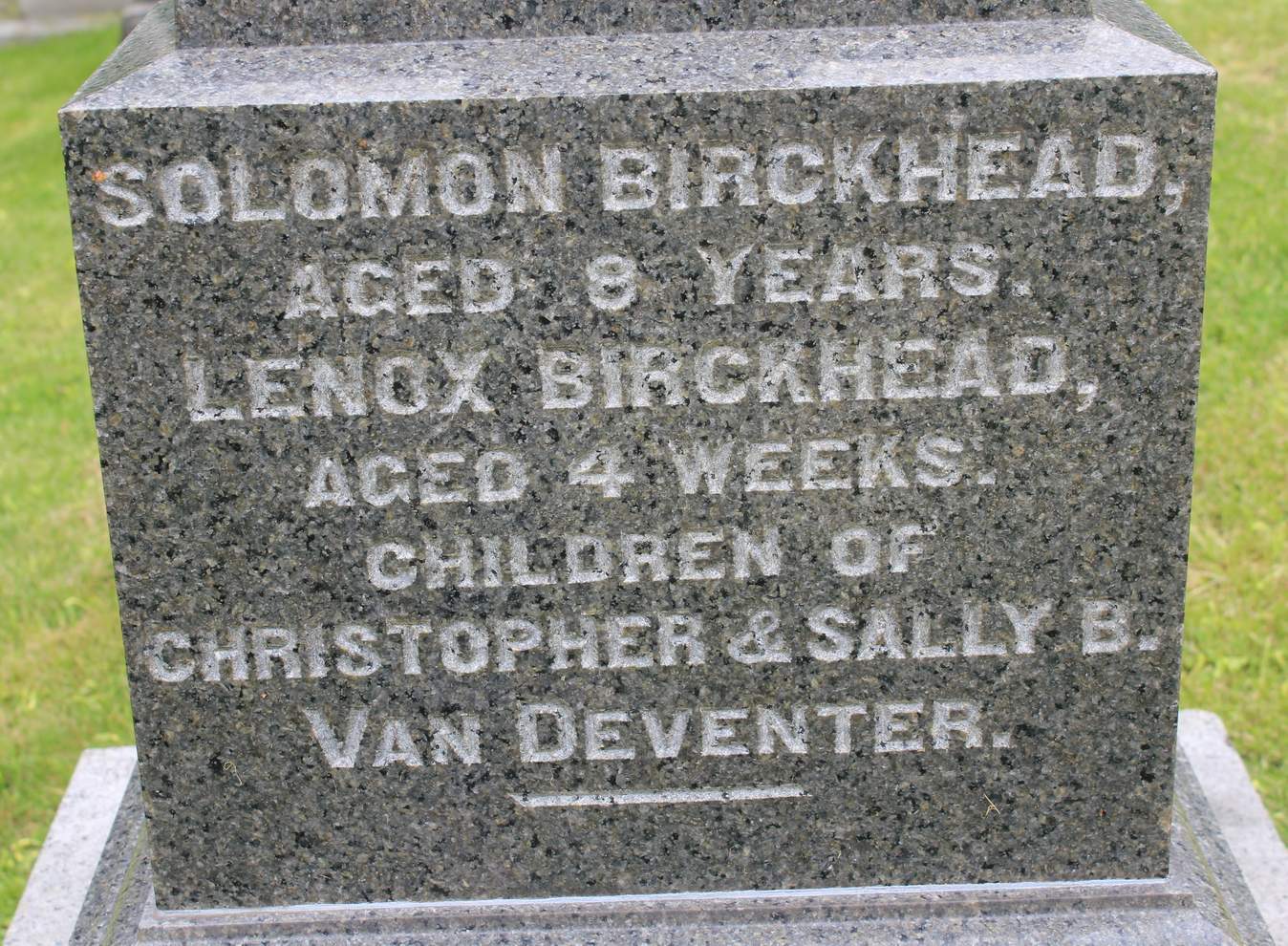
Major Van Deventer was married three times.  First to Marcia Kellogg, with whom he had one daughter, Marcia Van Deventer.  His second wife was Eliza Cooper, who had a son Eugene Winfield Scott Van Deventer.  Christopher married his third wife in Sally Birckhead of Baltimore, Maryland in 1823 and they moved to Buffalo that year.  Sally and Christopher had six children, all born in Western New York – Soloman, Jane, Hugh, James Thayer, Lenox and Susan.  Christopher Van Deventer died in April 1838.

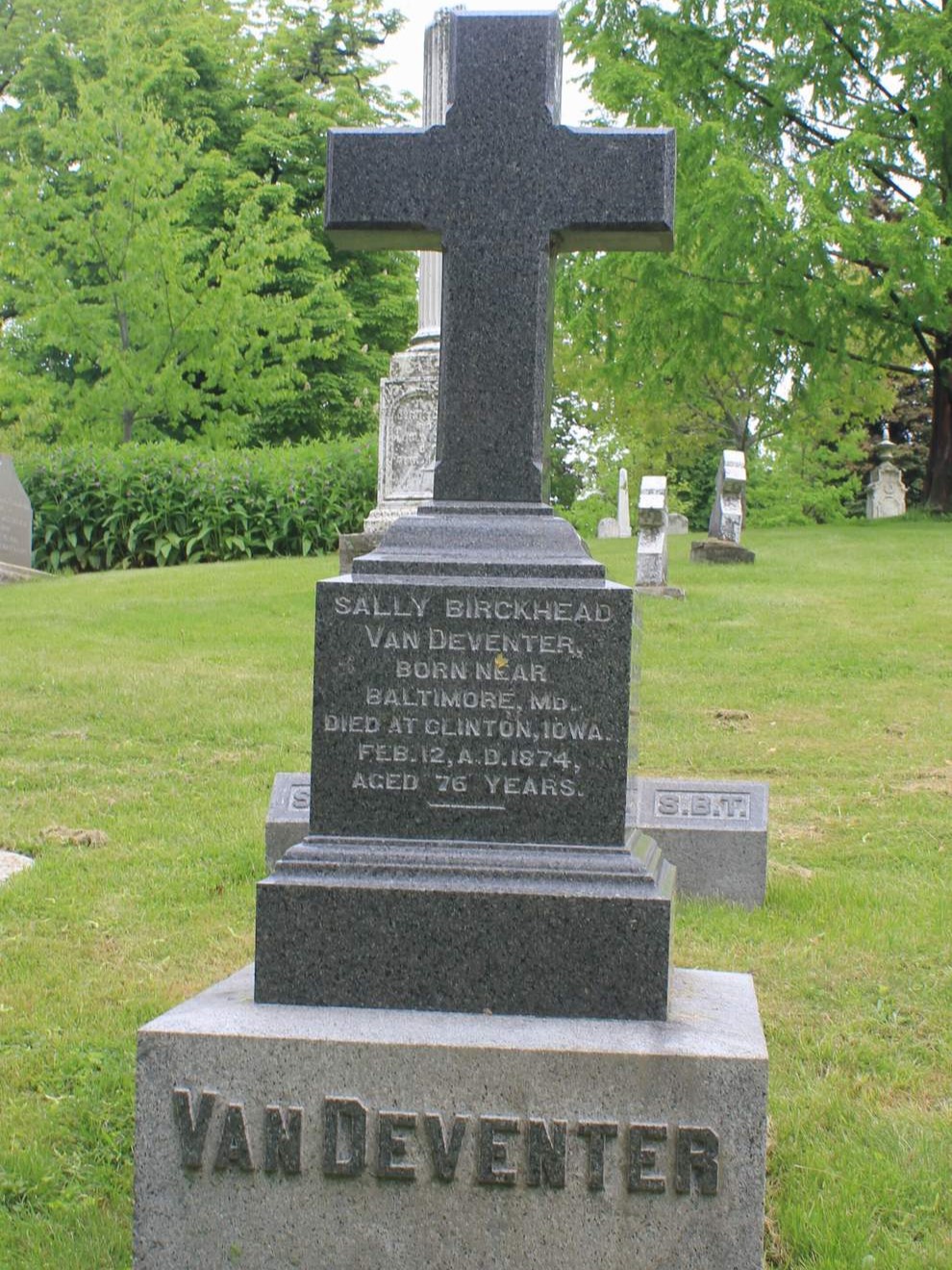
deventer children grave

Van Deventer Children’s grave. Forest Lawn.

In 1841, Sally Van Deventer build a 2-and-a-half-story Italianate home at 1500 Main Street.  The property was two acres, thickly studded with shade trees and laid out with walks and gardens.  Sally exhibited items from her gardens in the first several fairs of the Buffalo Horticultural Society, starting in 1845.  The group eventually became the Erie County Horticultural Society, they are the group that still puts on the Erie County Fair today.  Sally lived at the home with her three children –  Hugh, who became a doctor, John Thayer, who became a lawyer, and Susan, who married lawyer Myron Tyrill.  Unfortunately, the other children did not live to adulthood.  The Van Deventer family also had a staff of three – in 1850, the staff included James Noles, a 25-year-old Irish man, Kate Noles, a 15- year old Irish woman; and Jemima Coleman, a 50-year-old-Black woman.

sally vandeventer

Sally Van Deventer Grave. Forest Lawn Cemetery

The Van Deventer property was listed for sale in 1856.  The family dispersed.  Dr. Hugh Van Deventer moved to the New York City Area with his family.  Myron and Susan and her mom Sally moved to Clinton Iowa.  James Thayer Van Deventer and his family also moved to Clinton, Iowa and then moved on to Knoxville, Tennessee.  Susan died in September 1873 of complications from childbirth.  Mother Sally died a few months later in February 1874.  Both Susan and Sally are buried in Forest Lawn Cemetery in Buffalo with the other Van Deventer children.  Their servant, Jemima Coleman, is also buried in Mrs. Van Deventer’s family plot.

The Van Deventer property on Main Street became Spring Abbey, a picnic grove.  Spring Abbey opened for the season in June 1867 by proprietor Adam Clark who renovated the buildings on the property and built a large ballroom for the use of private parties and excursions.  The grounds were open to the public for free.  Spring Abbey also had a beer garden, dance hall, bar and restaurant.  The buildings burnt down in December 1867.  George Weber rebuilt the grounds and constructed the existing building and reopened Spring Abbey in May 1868.  The original building also served as a hotel.  The property continued to be run as a picnic grounds until 1877 when the preparty becomes vacant.

Home for the friendless Buffalo Express

Home for the Friendless as it appeared in 1888. Source: Buffalo Express.

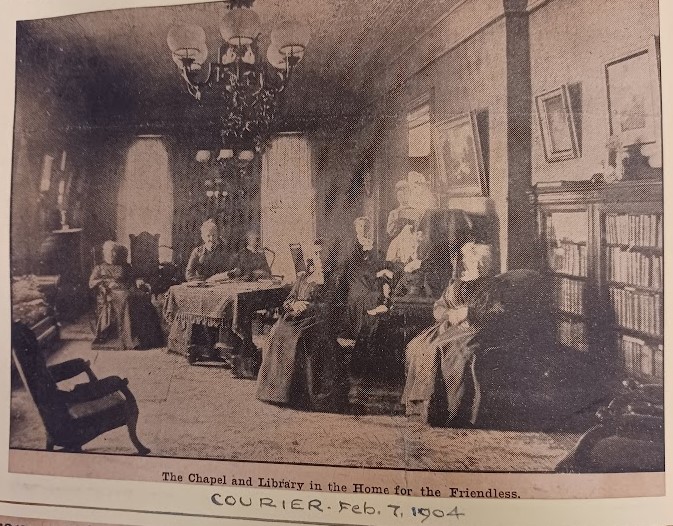
The Home for the Friendless formed a real estate committee consisting of Mr. Pascal P. Pratt, Mr. E. L. Hedstrom, Mr. George Gorham and Mrs. Maria M Welch.  In 1884, the property at 1500 Main Street was purchased by the Home for the Friendless for $25,000 (about $783,000 in 2023 dollars).  The building was altered and remodeled for the purposes of the home.  A three-story building was added to the back of the existing mansion.  The renovations cost $15,287(about $433,000 in 2023 dollars).  The former bar room was turned into the library and chapel used for Sunday services.  The site was dedicated on June 13, 1885.

On March 17, 1886, the family of 34 women moved into their new home on Main Street.  The Home on Seventh Street closed and was sold, having served 2,478 residents during its 20 years of existence.  The building on Seventh Street was used as Buffalo Maternity Hospital for several years before a new Maternity Hospital was built at the corner of Georgia and Seventh Streets.

dining room at home for the friendless courier express

Dining Room at Home for the Friendless. Buffalo Courier.

chapel and library home for the friendless

Chapel and Library at Home for the Friendless. Buffalo Courier.

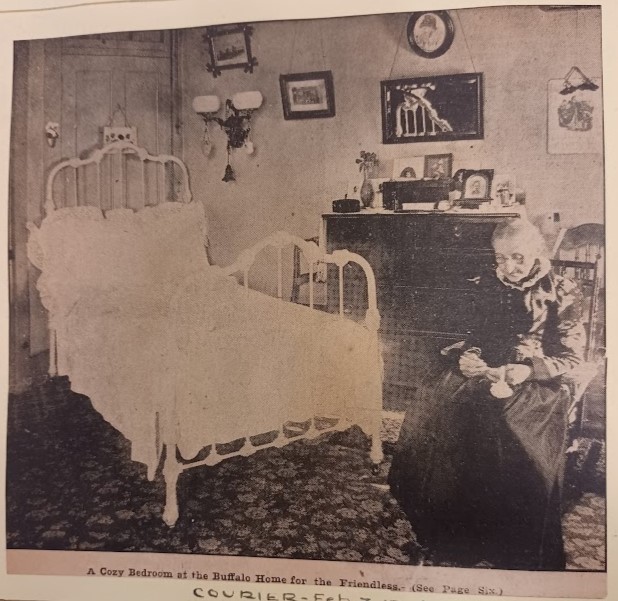
bedroom at home for the friendelss courier express

Bedroom at Home for the Friendless. Buffalo Courier.

In 1893, at the World’s Fair in Chicago, the Home for the Friendless received the Gold Medal for the best managed and most successful charity.  The Home was noted for “its long and extensive career of usefulness and remarkable financial ability shown in the management of its affairs.”

In 1907, William Mills donated money to build the Mills Annex, which added 18 more rooms, which allowed the home to be able to house 50 to 60 permanent residents, staff and transients.  This addition also provided a new kitchen, a veranda, and a sun parlor.  The new wing was built on the rear of the original home.  Until the1920s, the house continued to serve transients, but after that, the house became mostly a house for the aged.  Many of the women who had used the shelter in their youth returned to spend their retirement there.

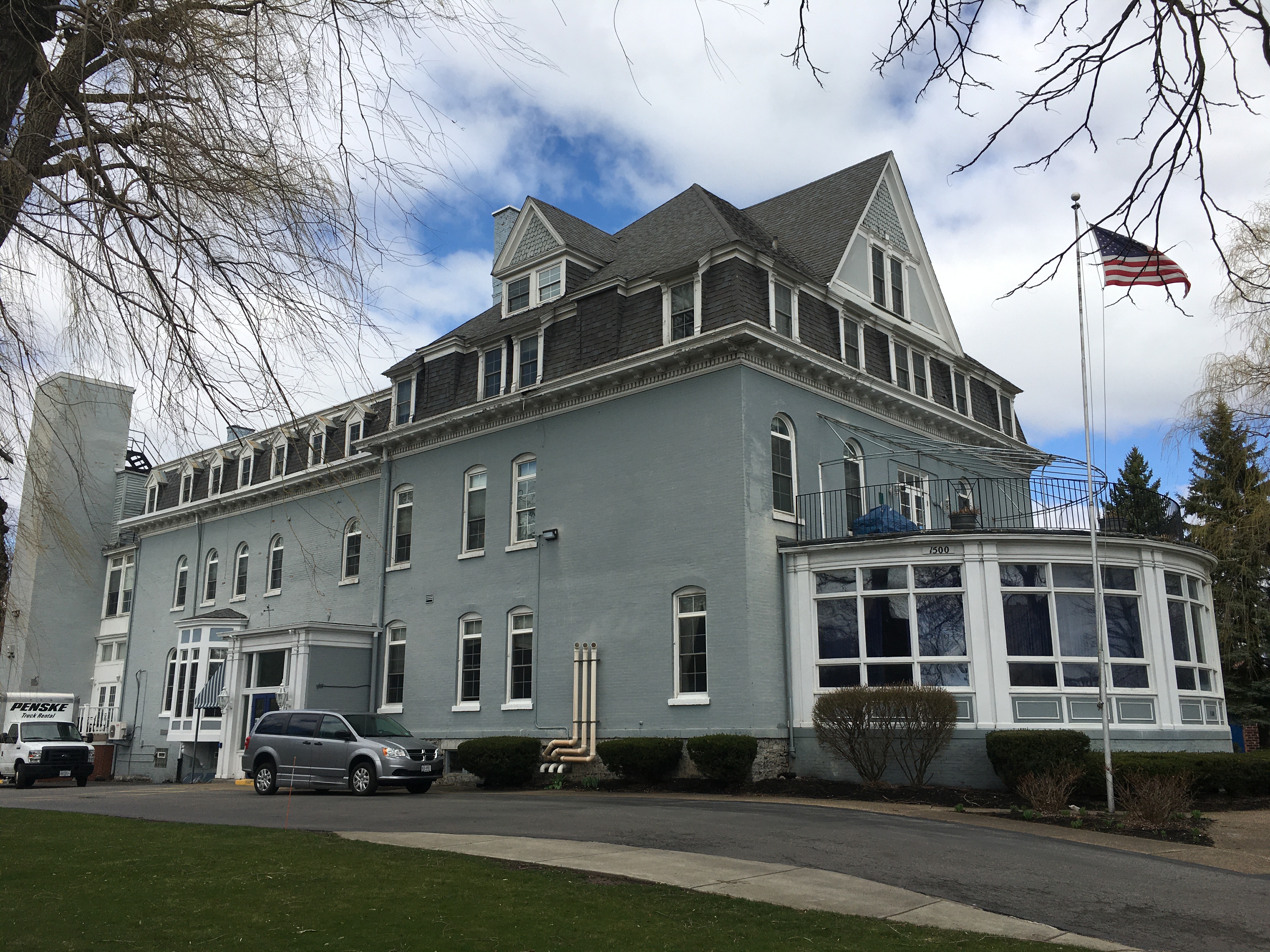
Bristol Home

Bristol Home, 1500 Main Street.

In 1956, the house at 1500 Main Street got a major renovation and remodeling.  Additional staircases were added, allowing the wrought-iron fire escapes to be removed from the property.  The front porch was removed, and a large solarium was added to the front of the house.  Tearing down an old barn allowed for a new driveway, a delivery ramp for the kitchen and increased parking spaces to be built.  After the remodel, the Board and residents finally decided to adopt a new name.  For many years, they had not wanted to change the name of the Home.  Some people felt that Home for the Friendless had a negative connotation, but many of the Board members and residents felt it had a long history.  There were also Homes for the Friendless in other cities and the sense of connection to the history meant the name stuck for a long time.  One of the proposed new names was Springhaven, giving a nod to their location in Cold Spring and their existence as a haven for women.  The name selected was Bristol Home, in honor of Edward Bristol, who had helped to bring the women together to found the Home in 1867.  And so, the Home for the Friendless name faded into history and Bristol Home was born.

bristol home 3In the late 1970s and 80s while Main Street was under construction for the building of the NFTA Metro Rail, there was some talk of Bristol Home moving out to the suburbs.  Bristol Home stood strong, preferring their location in the City which allowed residents to be more centrally located and able to take advantage of all the amenities that living in an urban area provides.

In 2003, Bristol Villages in Clarence opened, with a facility offering assistive living and memory care.  Things change over time and in February 2021, Bristol Home on Main Street closed.  They found alternate living arrangements for their 40 remaining residents and the 45 employees at the Home.  The decision was related to financing.  The costs to run a facility to serve a poor community proved to be too great.  Bristol Villages still operates as the only freestanding nonprofit assisted living facility in Western New York.

In May 2022, the 1500 Main Street property was purchased by Jericho Road Community Health Center, with plans to move its Vive Shelter program for asylum seekers into the space.  This keeps the house at work in providing a safe place for people, a chance to find a new beginning, a similar mission to why the Home for the Friendless was originally founded. The Main Street property allows Vive to provide a better, safer and more comfortable atmosphere for residents.  Since the original Vive structure on Wyoming Street was originally built as a school, it had dorm style rooms, separating by gender.  Since the Home on Main Street has residential rooms, families will be able to stay together.   You can help them meet their goal by donating at their website here:  https://vive.jrchc.org/

So the next time you drive past Bristol Street, think of Daniel and C.C., and maybe drink some sarsaparilla!  And then next time you drive past the former Bristol Home on Main Street, give a wave and think about the Van Deventers and all the woman who have lived on the property over the last 200 years!  Want to learn about other streets? Check out the Street Index. Don’t forget to subscribe to the page to be notified when new posts are made. You can do so by entering your email address in the box on the upper right-hand side of the home page. You can also follow the blog on facebook. If you enjoy the blog, please be sure to share it with your friends.  Interested in getting even more content from me?  You can become a Friend of Buffalo Streets on patreon.   You can go to https://www.patreon.com/buffalostreets/

PS.  From Angela – thank you for understanding when I had to cancel two of my walking tours last month.  I had COVID and felt really bad about having to cancel.  I am feeling better now and planning some new tours for next summer!

Sources:

  • White, Truman C.  Our County and It’s People:  A Descriptive Work on Erie County, New York.  Boston History Company, 1898.
  • Endres, Matt.  History of the Volunteer Fire Department of Buffalo.  W. Graser, Printer, 1906.
  • Sheldon, Grace Carew.  “Seeing Buffalo of the Olden Time:  The Bristol: Sizer Homestead”.  Buffalo Evening Times.  May 11, 1909, p4.
  • “Founders of Our Holiday Festivities”.  Buffalo Courier.  January 24, 1904, p4.
  • “The Statler Stand:  Most Historic Associations of Buffalo on Site”.  Buffalo Times.  March 25, 1923, p40.
  • Burr, Kate.  “Ingersoll-Bristol Joinder of Old Families”.  Buffalo Times.  November 28, 1926, p14
  • “$6,000 Addition”.  Buffalo Express.  April 9, 1907.
  • Roberts, Katherine.  “Sentimentalist and Insurgents will Seek New Name for institution known as the Home of the Friendless”.  Buffalo Times.  August 18, 1935.
  • “Group Strives to Alter Name of Institution”.  Buffalo Courier.  October 10, 1936.
  • History and By-Laws of the Home for the Friendless in the City of Buffalo.  The Courier Company, Printers.  Buffalo, 1888.
  • Knight, Willard M.  Manual, Catalogue and History of the Lafayette Street Presbyterian Church.  Courier Company, Buffalo NY:  1876.
  • “Spring Abbey Season, 1867”.  Buffalo Courier.  June 4, 1867, p8.
  • “New Home of the Friendless”.  Buffalo Commercial.  June 15, 1885, p3.
  • “All Buffalo to have Share in Befriending Family of 69”.  Buffalo News.  September 30, 1937.
  • Burr, Kate.  “If All God’s Chillun (sic) Had a Home”.  Buffalo Times.  October 1, 1930.
  • Death of C.C. Bristol.  https://images.findagrave.com/photos/2023/76/250848919_268ec091-58ae-4604-a924-8ada8f798eda.png
  • White, David.  “A Historical Recap of Medicine Bottles.”  Buffalo News.  August 28, 1982, p148.
  • “Memory Trip Shows City First with Many Things.”  Buffalo News.  November 7, 1935, p14.
  • “48th Annual Donation Day”.  Buffalo Commercial.  September 25, 1922, p5.
  • “Free Picnic – Spring Abbey”.  Buffalo Evening Post.  June 1, 1866, p2.
  • Harris, John.  “Jericho Road completes $2M purchase for new home of Vive”.  Buffalo News.  May 5, 2022, p17.
  • “Origin of Many Street Names”.  Buffalo Times.  January 16, 1927, p67.
  • “Bristol, Cyrenius C) Papers”.  University of Rochester.  https://rbscp.lib.rochester.edu/files/finding-aids/pdf/AB86.pdf
  • “The Home for the Friendless”.  Buffalo Commercial.  October 9, 1875, p3.
  • “Buffalo Changes”.  Buffalo Express.  February 3, 1895.
  • “Home for the Friendless”.  Buffalo Express.  August 11, 1904.
  • Swift, Pat.  “Women Helping Women Made Bristol Home’s Unique Heritage.”  Buffalo news.  March 2, 1986.
  • “Home for the Friendless Gets Another Name – Bristol”.  Buffalo News.  January 16, 1957, p48.

Read Full Post »

Screenshot (39)

Hager Street shown in red. Approximate boundary of Hager Farm shown outlined in blue/purple color.

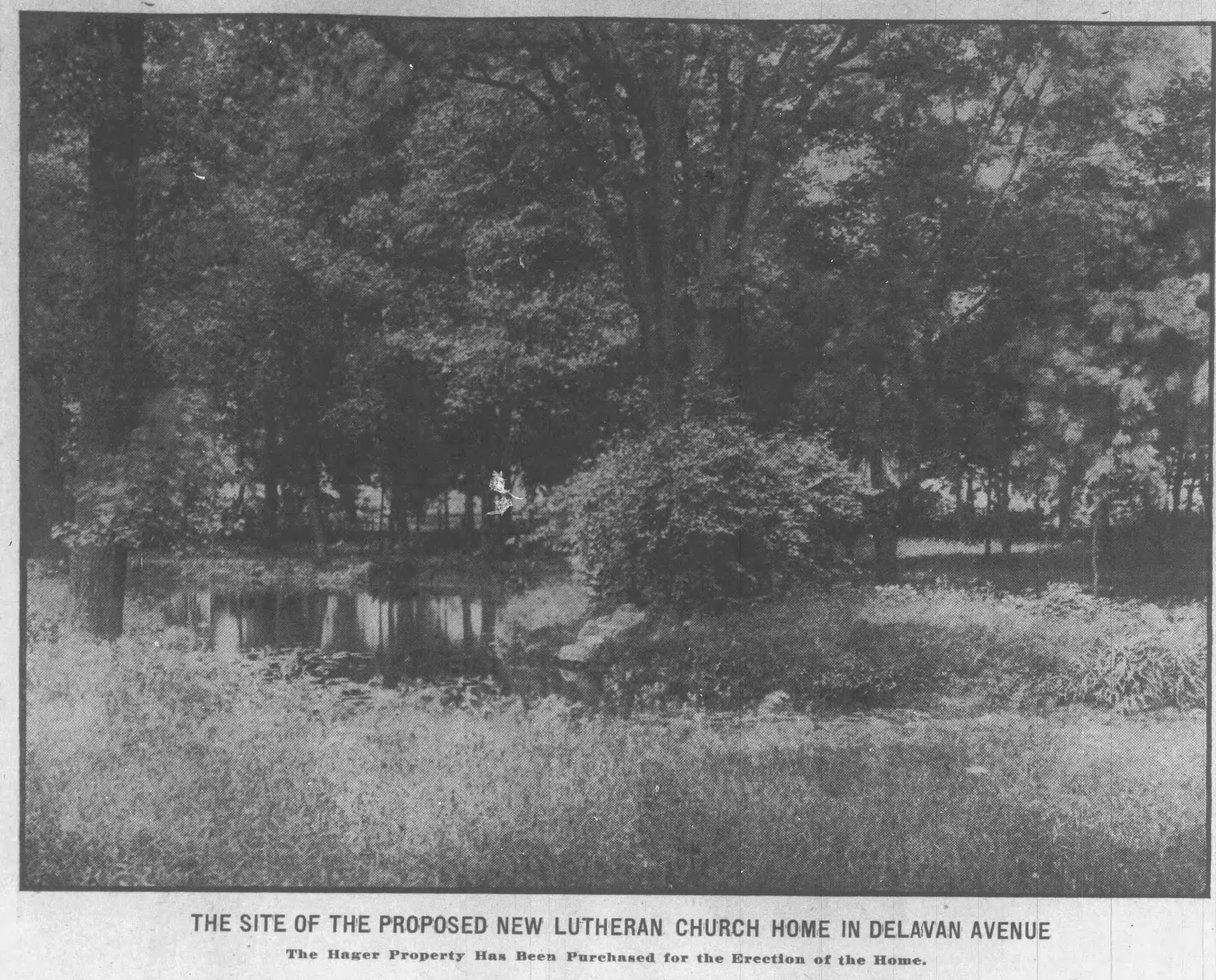
Hager Street is a street in the Hamlin Park neighborhood of the East Side of Buffalo.  The street runs for two blocks, between Northland Avenue and East Delavan Avenue.  The street is named for early Hamlin Park resident and developer, August Hager.  Mr. Hager developed Hager Street, along with Viola Park, Pansy Place, Pleasant Place, and Daisy Place.

august hager 2

August John Hager. Source: ancestry user Christine Middleton

August John Hager was born in Bliescastle, Bavaria on June 7, 1830 to John and Theresa Hager.  Mr. Hager came to Buffalo in 1849.   His first job in Buffalo was at a hotel. He worked at the hotel for a year and a half, before he became involved in the business of selling the types of fuel used in oil lamps as a door-to-door salesman.

In 1852, Mr. Hager went into the liquor sales business with Charles Gibbons as Gibbons & Hager. He worked hard and saved his money.  During the Civil War, a war tax was put on liquor.  Mr. Hager anticipated this tax coming and made a large order to have a full stock right before the tax went into effect.  Mr. Hager and Mr. Gibbons each made $20,000 ($370,300 in today’s dollars) more than they would have after the tax.  By 1865, he sold the liquor business and considered retiring at the age of 35, having raised enough money to live comfortably.  That only lasted a short while before he decided to open a small grocery store  in 1870 at the corner of Bennett Street and Batavia Street (now Broadway).  The grocery store was also very successful, so he sold that business and entered the wholesale tobacco business.  His tobacco business was located at 270 Batavia Street (now Broadway), with a large warehouse in the rear.  The business was one of the largest tobacco businesses in the City of Buffalo and dealt with all varieties of tobacco from Connecticut, New York, and Ohio.  In 1880, Mr. Hager’s business was doing approximately $50-60,000($1.5 to 1.8 Million in today’s dollars) of business annually and carried a stock value of about $15,000($443,000 today).

Mr. Hager married Mary Ann Backe on September 21, 1852, at St. Mary’s Church on Broadway.  They had nine children:  John Baptiste, Mary Ann , Otillie, Charles August, Jacob, Frank, Edward August, August John, and Rose.

Mr. Hager served as Alderman of the old Fifth Ward from 1865-1868.  At the time, the Fifth Ward was bounded by Broadway and Eagle Streets, between Michigan Avenue and approximately Fillmore Avenue.  While Mr. Hager was Alderman, one of the issues for the entire country was how to deal with the Civil Rights Amendment passed after the Civil War.  A Black man named Henry Moxley petitioned Buffalo’s Committee on Schools, requesting that his children attend Public School 32.  At the time, the City Charter prohibited the admission of Black children to the Public Schools, but required the City to provide one or more free schools for Black children.  The Common Council was upholding the fact that the Black children could not attend the Public Schools, only the schools provided expressly for them.  There was only one school for Black children, while there were Black children living throughout the school district, so it was difficult for many of the children to travel from their homes to the Black school.  During the discussion about this at the  Common Council meeting, Alderman Hager pointed out that the Civil Rights Bill gave Black children equal rights with white children and questioned if the Common Council of Buffalo or the City Charter was superior to the laws of Congress.  Alderman Hager put forth a resolution that “the superintendent is hereby directed to admit the children of Henry Moxley, a colored citizen and taxpayer, to Public School No 32, and to admit all colored children to the respective public schools in the boundaries of which school districts their parents reside”  The resolution was referred to the Committee on Schools, giving the Committee the power to make recommendations on admittance of Black children.  The Committee refused to put forth a recommendation for three months, stalling in hopes it would be forgotten.  This led to parents across the city, led by Henry Moxley, to withdraw their children from the Black School and send them to District schools beginning on September 1, 1867.  Eighteen Black children entered the district schools.  On September 16th, the Committee on Schools recommended denial of admission for the Black students in district schools.  On September 24th, Superintendent Fosdick (Father of the Fosdick of Fosdick Street) inspected the Black school, determined it to be sufficient and began physically expelling the Black students from the schools.  Althia Dallas, at age 13, insisted on remaining and claimed she had the same right to attend as white kids.  According to Fosdick, he then “took hold of her and led her out of the school”.  Go Althia for standing up to the superintendent!  On October 11, 1867, Fosdick was charged with assault and battery for forcibly ejecting the children from the school in violation of the Civil Rights Act.  On January 10, 1868 the case of Althia Dallas against John S. Fosdick came to trial before State Supreme Court Justice Charles Daniels.  Daniels ruled in favor of Fosdick.  The case was appealed on May 4, 1868.  The judges reaffirmed the earlier judgement.  Buffalo’s Blacks had not yet succeeded in integrating the schools.  After the passage of the 15th Amendment in 1872, Superintendent Thomas Lothrope worked towards integrated schools.  While Mr. Hager was no longer an Alderman, Common Council once again took up the issue and Black children were given the right to attend the District Schools.  By 1880, there were 75 Black children attending 16 different Buffalo Public Schools and only 35 students at the Black School, so the Black School was closed.

hager house

Hager House on East Delavan.  Source:  Ancestry User Christine Middleton

In 1874, Mr. Hager purchased a farm on East Delavan approximately 30 acres in size, near what was then the outskirts of Buffalo.  At the time, East Delavan was still a mud road.  He built a large 3-story, ten room house.  The house was on property bounded by Delavan, Florida, Pleasant Place and Hager Street.  Their property also included a large barn, green house, hennery and fish pond.  The property was surrounded by large shade trees along with cherry, apple and pear trees.  The house stood about 200 feet back from Delavan, with a landscaped lawn and groves of evergreens and willow trees.  The property sloped to the rear to a small pond fed by natural springs and surrounded by old elm trees.  The property was known as Elmwood Park and was sometimes referred to as Hager Park.

Hager_Home (1)

The rear of the Hager Park Property and Pond in 1906. Source: Buffalo Times, February 11, 1906.

He used his business savvy to develop the property around his house and gave houses and land to each of his children as they married.  Mr. Hager formed a land company which developed Viola Park, Daisy Place, Pansy Place, and Pleasant Place.  Pansy, Viola, and Daisy were named after some of Mr. Hager’s favorite flowers.

He was appointed Parks Commissioner in April 1898, a post that he served until his death.  Mr. Hager was described as “an honest, fearless and efficient representative of the public” in his municipal offices.   He was a strong advocate for the improvements of the park system in Buffalo.  Mr. Hager was very interested in flowers, and had a large greenhouse at his home so he could have flowers all winter long.  He took a great interest in helping to select flowers and trees for the parks during his time as Commissioner.

Mr. Hager served as director of the Roman Catholic Cemetery Association at Pine Hill and was one of the first directors of the German Roman Catholic Orphan Asylum.  He was also a member of St. Vincent’s Church (now the Montante Center at Canisius College) and a member of the Catholic Mutual Benefit Association (C.M.B.A.)  He was immensely proud of his American Citizenship.  His brother, Edward, returned home to Germany each summer, but August never returned to his homeland.

hager grave

August Hager’s grave in Cheektowaga

August Hager died on November 14, 1901. He is buried in Pine Hill Cemetery (the United German and French Cemetery, now part of the Mount Calvary group of cemeteries) in Cheektowaga.  After August’s death, the property on Delavan was listed for sale.   August’s wife Mary died a year later in December 1902.

The house was still listed for sale in September 1903.  The children were looking to sell the house to close out their parents estate.  In 1905, J.P. Staderman, husband of the youngest Hager daughter Rose, was using the home as “Home for Pets”.  Mr. Staderman was working with the Humane Society to board animals while their owners went away for summer vacations.  Boarding a cat cost $2/month ($67/month in today’s dollars) or 75 cents a week($25.15 today).  Boarding for dogs varied according to the size of the animals.  They also boarded canaries.  The Home for Pets only lasted one summer.

lutheran_church_home_walden

Lutheran Church Home’s Original Location on Walden Avenue. Source: Buffalo Courier, June 1896.

In February 1906, the Hager Homestead was sold to the Lutheran Church Home for the Aged and Infirm for $13,000($435,985 in today’s dollars).  The Lutheran Church Home was founded in 1896 to provide care for seniors, particularly for those from German, Swedish, and English Lutherans in the City.  Eleven churches – St. Johns, German Trinity, First Church, Lancaster, Holy Trinity, Christ’s, Swedish Trinity, Concordia, Church of the Atonement, German Church of the Redeemer and English Church of the Redeemer – came together to form the Church Home charity.  The Lutheran Church Home’s first location was in a rented home at 390 Walden Avenue near Goodyear Street.  Within a year, the Home had outgrown it’s space and expanded to 388 Walden Avenue as well.  The two houses were connected by a second floor hallway.

Hager_Home

Hager Home on East Delavan. Source: Buffalo Times, February 11, 1906.

In 1906, the Lutheran Church Home purchased the Hager House from the heirs and moved their 25 residents into the Hager family house.  The Lutheran Church Home celebrated their 10th anniversary in Hager Park in June 1906.  The large grounds allowed the property to be used by the Lutheran community for events, particularly fundraising days for the Church Home and large open houses were the public was invited to come visit the Church Home and meet residents and enjoy the property.

A large building to allow them to provide accommodations for an additional 60 residents was constructed along East Delevan in front of the Hager house.  The new building was connected to the Hager House and opened in December 1907.  The Hager House was demolished in the 1950 when an addition was placed on the rear of the Lutheran Church Home Building.

lutheran church home postcard

Lutheran Church Home Postcard, circa 1905

In 1956, the rear portion of the Hager Park property became the location of the Niagara Lutheran Home.  The property was donated by the Lutheran Church Home to the Niagara Lutheran Home.  Niagara Lutheran Home was organized by 59 Lutheran churches in Western New York and provided housing for 99 individuals needing critical care.  In today’s terms – the Lutheran Church Home was an assisted living facility, whereas the Niagara Lutheran Home provided skilled nursing and rehab.  When Niagara Lutheran Home opened in May 1956, it was the first nursing home of its kind in New York State.  It was also the first institution in the United States outside of hospitals in which nurse’s aides and Gray Ladies would serve. Gray Ladies were American Red Cross volunteers who provided friendly, personal, non-medical services to sick, injured and disabled patients.  The facility was not limited to Lutherans, members from all Protestant faiths were admitted.

In the 1990s, Niagara Lutheran Home expanded and added a facility at 1040 Delaware Avenue in addition to their site on Hager Street.  In 1996, the Niagara Lutheran Health System was incorporated and 52 acre of land on Broadway in Lancaster was purchased to become the location of Greenfields Continuing Care Community.  In 1998, the 120 residents of the Niagara Lutheran Home on Delaware Avenue moved to the Lancaster site and the Delaware Ave Home was closed.  In 2001, 92 residential apartments at Greenfield Manor and 49 assisted living apartments at Greenfield Court were opened in Lancaster.  In 2006 the Greenfield Outpatient Rehabilitation Clinic was dedicated in Lancaster.

In 2006, the Lutheran Church Home became a part of the Niagara Lutheran Health System.  In 2013, after 107 years on East Delavan, the residents of the Lutheran Church Home moved to Greenfield Terrace in Lancaster.   When the Lutheran Church Home building closed, the complex included 65 resident rooms, a full commercial kitchen that had been remodeled in the 1990s, a 75-seat dining area, a social hall, a library, a chapel, three elevators, a detached two-level masonry garage and parking for more than 35 vehicles.  In 2014, the Lutheran Church Home sold the property at 217 and 227 East Delevan to 217 Group LLC (an entity of Ellicott Development Company) for $450,000.

20230423_184128

Modern view of 217 Delavan Ave.  Photo by Author

The former Lutheran Church Home building became home to the Community Music School of Buffalo in 2019.  The Community Music School was founded in 1924 and serves more than 500 students each year!  Their mission is to share the gift of music with the diverse communities of WNY and make it affordable for families of all incomes.  Community Music School shares the building with CCNY Inc, PIE Analytics, and Lakeshore Connections.

In 2015, the corporate offices of the Niagara Lutheran Health System moved from 64 Hager Street to a new office building at Greenfields.  The Niagara Lutheran Home was sold at the end of 2015 and the 164 residents were moved to Greenfields, consolidating the care to one site in Lancaster, consolidating the Niagara Lutheran Health system out in Lancaster. The former Niagara Lutheran Home facility on Hager Street operates under new ownership as Humboldt House, a skilled nursing facility.

Screenshot_20211230-123110_Photos~2

Soldiers and Sailors Monument. Designed by Charles Hager.  Photo by Author.

Some of the other members of the Hager family also accomplished some important things in Buffalo.  August Hager’s son Charles Hager owned a contracting company which built the J.N. Adam Memorial Hospital in Perrysburg, many of the grain elevators along the waterfront and the Soldiers and Sailors Monument in Lafayette Square.  August’s son Jacob Hager was a city plumbing inspector.  August’s son Edward August Hager was a dairy farmer.  He had 20 cows on his property on Delavan Avenue.  At the time, the Hager farm part of the city was quickly developing, and as houses came closer to the pasture, Edward A. Hager gave up his cows.  He then was involved with the city parks and streets departments managing the hundreds of city-owned horses.

3973_PlanningMill2020Pic

EM Hager & Sons Planing Mill Building on Elm Street

You may have also heard about the Hager family due to the EM Hager & Sons Company.  August Hager’s brothers Edward M. Hager came to America and lived with August when he ran the grocery store.  Edward worked at the store for awhile, then went to Newark N.J. to learn the carpentry trade.  When he returned to Buffalo, he established the EM Hager & Sons Company in 1868 on Mortimer Street.  The company built many of Buffalo’s early factories, grain elevators and other buildings.  E.M. Hager and Sons moved to 141 Elm Street in 1883.  The company was in operation until the 1980s.  The Elm Street building has recently been renovated and is know referred to as the Planing Mill.  It is a mixed used development with apartments and office space.

Want to learn about other streets? Check out the Street Index. Don’t forget to subscribe to the page to be notified when new posts are made. You can do so by entering your email address in the box on the upper right-hand side of the home page. You can also follow the blog on facebook. If you enjoy the blog, please be sure to share it with your friends.  Interested in getting even more content from me?  You can become a Friend of Buffalo Streets on patreon.   You can go to https://www.patreon.com/buffalostreets/

Sources:

  • “August Hager”  Memorial and Family History of Erie County, New York.  The Genealogical Publishing Company, Buffalo:  1906.
  • Smith, H. Katherine. “Hager Street is Memorial To Former Chief of City Parks”.  Buffalo Courier Express Sept 22, 1940. Sec5, p6.
  • “August Hager, Leaf Tobacco”.  Commerce, Manufactures and Resources of Buffalo and its Environs.  Commercial Publishing Company; Madison, Wisconsin:  1880.
  • “August Hager Appointed Park Commissioner by Mayor Diehl”.  Buffalo Times.  April 30, 1898, p8.
  • “Houses for Sale”.  Buffalo News.  July 5, 1902, p8.
  • “Houses for Sale”.  Buffalo News.  September 15, 1903, p10.
  • “Home for Pets for the Summer”.  Buffalo Commercial.  July 20, 1905,  p13.
  • “A Noble Lutheran Charity”.  Buffalo Commercial.  April 8, 1896, p11.
  • “Hager Homestead Has Been Sold”.  Buffalo Commercial.  February 3, 1906, p12.
  • “New Lutheran Church Home:  Pretty Site for Old Folk”.  Buffalo Morning Express. February 3, 1906.
  • “To Build a Home for Old People.”  Buffalo Morning Express. February 11, 1906, p10.
  • “Dedication of Lutheran Church Home for the Aged”.  Buffalo News.  November 30, 1907, p4.
  • “Ellicott pays $450,000 for Lutheran Church Home”.  Buffalo News.  August 8, 2014, p38.
  • “Lutheran Home is Dedicated as Symbol of Faith”.  Buffalo News.  May 8, 1956, p21.
  • Watson, Stephen T.  “Lutheran Health Selling Facility”.  Buffalo News.  September 11, 2014, p39.
  • White, Arthur O.  “The Black Movement Against Jim Crow Education in Buffalo, New York”.  Phylon, Vol 3, No4.  pp. 375-393.  (accessed via https://sci-hub.ru/10.2307/274041)

Read Full Post »

Screenshot (33)

Marion Street in Black Rock

What’s the connection between Marion Street in Black Rock and Wade Avenue in the Leroy Neighborhood?  Marion Street runs between Reservation Street and Elmwood Avenue, just north of Amherst Street.  You cannot drive from one end of Marion Street to the other because of the railroad corridor which bisects the street into two halves.  Wade Avenue runs between Fillmore Avenue and Holden Street near Main and Fillmore Avenue.  These two streets are both named after Marion Wade Nicholson!  Marion was the daughter of real estate developer James Nicholson, who built and developed the streets.

Screenshot (34)

Wade Avenue in the Main-Leroy Neighborhood

Today’s post is a partnership with Buffalo Women’s Caucus for Women’s History Month.  Buffalo Women’s Caucus is an organization to empower women in all fields to become leaders and changemakers.  You can follow the Buffalo Women’s Caucus by clicking this link:  https://www.instagram.com/buffalowomenscaucus/  Today (March 8th) is International Women’s Day, a global holiday celebrating the social, economic, cultural and political achievements of women.  I’m glad to feature Marion Wade Nicholson today.  I think when we think of women’s history, we often remember the big changemakers, but I think it’s important to remember all the women who lived fairly regular lives.  Marion was a daughter, a wife, a mother, an insurance saleswoman and a singer.  Unlike most people streets are named for – she never held elected office, own large amounts of real estate or run successful businesses.  She had success in her musical endeavors, but she would probably have considered herself a normal woman of her time.  And I think it’s important to celebrate these women, remembering that our lives today is built on these women.  Behind every man I’ve written about, there was almost always a woman on the sidelines.  Many of those women are forgotten to history, their names written as Mrs. Husband’s Name.  Even more are completely forgotten to the pages of history all together.  So, remember those women as we learn today about Marion.

James W. Nicholson  was born in Buffalo on May 5, 1862.  He attended school in Hamburg and later moved to Buffalo with his family, who lived at 154 Fifteenth Street, near Vermont Street.  He operated a real-estate business in Buffalo from the 1880s until he retired in 1930.  His office was in the Erie County Savings Bank Building.  Besides Marion and Wade, other streets on which he built homes were Woodlawn Avenue, St. Paul Street and Otis Place.

456 ashland

456 Ashland Avenue. Home to the Nicholson Family for more than 50 years!

James William Nicholson married Ella Riley in 1887.  Their first child, a son Wesley Nicholson was born later that year.  The Nicholsons moved into 456 Ashland Avenue in 1890.  Mr. Nicholson was a member of the Richmond Avenue Methodist Church, joining on April 7, 1895.  He also served on Official Board and the Board of Trustees of the Church.  He was active in the Pan American Exposition in 1901.  He was a part owner of the Philippine Village, helping to make arrangements to bring people from the Philippines to the Expo.  (Note from Angela: these types of exhibits with “native” villagers on display, often referred to as human zoos, were common at the time.  News reports from Buffalo in 1901 reported that the Philippine Village was one of the most visited exhibits of the Exposition, considered to be a great hit – people enjoying the way that it matched “amusement with instruction”.  The Philippine Village was set up to be an exhibit in order to showcase the Philippines as America’s newest imperial possession.  The exhibit was guarded by American Soldiers guarding a large, war-torn gate, a model of the fort in Manila Bay which represented a commemoration of war and the American triumph overseas.   Newspapers also reported that the residents of Philippine Village were suffering in the cold Buffalo weather as the summer weather turned to fall.  We do not condone these types of exhibits.)

Marion Patterson

1927 Picture of Marion. Source: The Buffalo News.

James and Ella’s second child, Marion Wade Nicholson, was born in April 1895.  She grew up in the house at 456 Ashland.  When she was 4 years old, Marion Street was named for her.  She attended School 56 and Buffalo Seminary.  While she was in high school, Wade Avenue was named in her honor.   When interviewed about her streets, she sad “I was about thirteen when Wade Street was opened, and I told all my schoolmates about it at once.  I still tell people about my streets”.  H. Katherine Smith wrote of her interview that “(Marion) is the only one of more than 100 persons with streets named for them who admitted to me she got a thrill from being so honored”.

Marion was well known in the Buffalo musical circles.  She sang in the choir of Westminster Presbyterian Church and played the piano.  She was associated with Margaret Adsit Barrell’s studio; Mrs. Barrell was a founder of the Community Music School.  Marion also sang on the radio and worked with many welfare organizations in Buffalo, often singing for those groups.

Marion_Nicholson_Concert_November_1926

Marion Nicholson concert announcement in the Buffalo News, November 1926

Marion married Lester Adam Paterson on October 1, 1917 and became Mrs. Lester Paterson.  The wedding was held at the house on Ashland, which was decorated with roses and autumn flowers, ferns and smilax.  Marion wore a gown of white satin with court train and a veil fastened with orange blossoms and carried a bouquet of bride roses, sweetheart roses and gypsophyllium.  Marion’s brother Wesley was the best man.  Marion and Lester took a honeymoon road trip to Boston, New York and Philadelphia before returning to live at the house on Ashland with her parents.  They had two children – Sara (Sally) Wade Paterson, born in 1923 and Jean Marion Paterson, born in 1930.

In June 1935, Marion traveled to Reno to file for divorce from Lester on non-support charges.  At the time, divorce was not as common and was suppressed by state laws that discouraged the dissolution of couples.  In New York, up until 1985, the only way to get a divorce was to prove your spouse had committed adultery!  Reno, Nevada became the Divorce Capital of America in the 1930s.  The grounds for ending marriage had a liberal interpretation there. Women would travel to Nevada for six weeks to establish residency.  During the 1930s, it’s estimated that more than 30,000 people went to Reno to get a divorce.  Hotels and guest ranches were established near the Court House to house the women who came.  Marion’s divorce decree was granted on June 28, 1935.

Marion_Nicholson_Easter_Play_March_1937

Marion Nicholson in costume for an Easter Play at Westminster Church. March 1937. Source: Buffalo News.

After her divorce, Marion worked as a saleswoman for the Phoenix Mutual Life Insurance Company.  She was a member of the Buffalo Life Underwriters’ Association, the Business and Professional Women’s Club, the Wednesday Morning Musical Club, the Junior Musical Club and the Women’s Evening Club of Westminster Church.  She had considered a career in music, but once she got her job, music became her hobby.  It was reported that she played or sang every single day, no matter how busy she was with work or her daughters.  She said “I play or sing every day.  Music still is an important factor in my life.  Playing or singing affords me immediate relaxation.  I can lose myself in music and forget everything else.”  She was one of founding members of the Wednesday Morning Musicale Club, which started in October of 1925.  The group was formed by several women who were interested in making music together on a regular basis.  At the time, there weren’t as many outlets for women.  Women didn’t play in the the Philharmonic at the time, unless the song required a harpist.  Marion was interviewed as a member of the Wednesday Morning Club, 60 years later in 1985, still singing and playing the piano at the age of 90.  The group is still active today, nearly 100 years after it’s founding!

Mrs__Roberts_at_piano_Buffalo_News_August_1967

Marion (seated at piano), from the Buffalo News, August 1967

Marion continued to live in the house on Ashland as an adult. The family had been in Buffalo since the 1830s.  Marion’s Great Grandmother had arrived to the small town of Buffalo via the Erie Canal.  The Great Grandmother brought her belongings in a chest which was still in Marion’s possession more than 100 years later.  The family also had heirloom fiddleback chairs of mahogany, a walnut chest of drawers, a dropleaf table, and the family’s old China place settings which had served the family for generations and had places of honor in Marion’s home.  In 1940, Marion was quoted as saying of the old china:  “It’s beautiful, of course, but so fragile, I feel anxious from the moment it appears on the table until it’s safely back in its place.”

Marion served as a director of the Graduates’ Association of the Buffalo Seminary.  Her daughter Sally also attended the Seminary.  Her other daughter, Jean, attended the School of Practice of the Buffalo State Teacher’s College (aka the State Normal School).

The Nicholson family summered at Shore Meadows in Angola, where they swam and did other outdoor sports.  Shore Meadows was developed by the Lake Shore Real Estate company for business men in Buffalo who couldn’t afford the “fashionable higher priced colonies along the Lake Shore”, but wanted a respectable quality house. In 1946, Mr. Nicholson, Marion and the girls ended up moving from the house on Ashland to their summer house in Shore Meadows on Shore Cliff Road.  Marion married Dr. Carlton Roberts sometime before 1948 and became Mrs. Carlton Roberts.  Dr. Roberts was the first dental consultant to the Erie County Department of Social Welfare.  In 1936, he set up the dental procedures for the guidance of the Department, which was the first of the type in New York State!  Mr. Roberts died in 1965 after three years in the Gowanda State Hospital.

After the death of her second husband, Marion Roberts moved back into the city.  She sold the house in Angola and moved to 515 Ashland Avenue in September 1965.  Her new home was just a block away from her childhood home.  Marion Wade Nicholson died August 14, 1987.  She is buried, along with her family, at Prospect Lawn Cemetery in Hamburg.

Sara_Wesley_Paterson_Wedding_Announcement___Buffalo_News_July_1948

Sara Wesley Paterson’s bridal announcement.  Buffalo News, July 1948.

Marion’s daughter Sara (Sally) Paterson was a 1941 graduate of the Elmwood School and Buffalo Seminary.  She earned a bachelor’s degree in business administration from University of Buffalo in 1945, graduating with honors.  She taught for a few years in Bradford PA and Middleport, NY.  In 1948, she married Raymond W. Garris, a chemical engineer in the oil industry.  She and her husband in many places across the South and Midwest.  They lived in 22 states and 8 countries, including six years living in Saudi Arabia, where he was an advisor to the Minister of Petroleum.  They moved to Daphne, Alabama when he retired in 1985.  She died in 2000.

Jean Paterson

Jean Marion Paterson Yearbook Photo, Millard Fillmore School of Nursing1953.

Daughter Jean Paterson attended the Millard Fillmore School of Nursing.  She married James Elliott Dunning of Los Angeles in August 1961.  They lived in San Diego, California and she worked as a registered nurse in a hospital.  She died in 2007.

Both Marion and her daughters were a well known part of Buffalo society.  Even after Sara and Jean moved away, there were articles in the paper when they’d visit town or come home for Christmas.  In 1955, the Buffalo News reported that Marion was making her special plum pudding for her girls who were coming home for Christmas from Baltimore and the family was looking forward to being together and singing their traditional Christmas carols.

Buffalo_News___August_1978

Marion (third from left) with her daughter Sara (standing) when Sara made a Saudi Arabian lunch on a visit home. Buffalo News. August 1978.

In 1978, Sara came for a visit while living in Saudi Arabia.  She prepared traditional Arabian food while home in Buffalo.  The main course was “Kabsah (the national dish of Saudi Arabia) and homos [sic] with Arab bread and fresh vegetables” and a traditional Saudi dessert which they did not know the official name of.  Here are Sara’s recipes which were printed in the paper:

Kabsah

4 cups rice
4 whole medium tomatoes
1 small can (8 oz) tomato sauce
1/2 teaspoon ground cardamom
1 tsp black pepper
1 tsp ground cumin
2 tablespoon salt (or to taste)
2 medium onions, chopped
4 tablespoons oil
2 to 2 1/2 pounds chicken or lamb, cut up

Brown meat lightly with chopped onions. chop tomatoes;; add to the meat.  Add the spices and tomato sauce; simmer for 10 minutes.  Add 8 cups of water and cook for 20 minutes.  Add rice and more water if needed.  Simmer for 30 minutes.  Serve on a platter with the meat piled in the middle surrounded by rice.  Platter may be decorated with lemon or tomato slices.

Saudi Arabian Dessert

About 2 cups whole wheat berries
Dried figs, cut up, about 1 cup
Dried apricots, cut up, about 1 cup
Dates, cut up, about 1 cup
3/4 cup sugar
Pine Nuts
Walnuts
Cashews

Soak wheat overnight in water to cover.  Drain.  Add clean water, covering wheat by about 5 inches.  Add sugar and simmer slowly until wheat swells and liquid thickens.  Just before it is finished cooking, add dried fruit and continue to simmer for about five minutes.  Mixture should be as thick as pudding.  Remove from pan, place in a dish with cover.  Sprinkle top with a small handful of each time of nut.  Cover and cool.  Particularly delicious with thick whipped cream.

So the next time you drive past Marion St and Wade Ave, think about Marion!  Remember all the women who lived in Buffalo over the years.  Let me know if you try one of the recipes!  To learn about other women with streets named after them check out this post here:  Women’s History Month – Some Buffalo Women You Should Know .  Want to learn about other streets? Check out the Street Index.  Don’t forget to subscribe to the page to be notified when new posts are made. You can do so by entering your email address in the box on the upper right-hand side of the home page. You can also follow the blog on facebook. If you enjoy the blog, please be sure to share it with your friends.

Sources:

  • “Sara P. Garris, former teacher, Buffalo Native”.  Buffalo News.  February 4, 2000.
  • “James W Nicholson, 89; Retired Real Estate Man”.  Buffalo News.  December 20, 1951, p8.
  • “Garris”.  South Florida Sun Sentinel.  October 20, 2014, pB8.
  • “Paterson-Nicholson”.  Buffalo Courier.  October 2, 1917, p9.
  • “Local Woman Asks for Divorce”.  Buffalo News.  June 27, 1935, p21.
  • “Miss Paterson in White Organdy Over Taffeta”.  Buffalo News.  September 18, 1948, p14.
  • “Buffalo  Native Home on a Visit Cooks a Saudi-Arabian Meal”.  Buffalo News.  August 16, 1978, p22.
  • Voell, Paula.  “60-Year Old Musicale Is Outdated in Name But Youthful in Spirit”.  Buffalo News.  November 18, 1985, p28.
  • Smith, H. Katherine.  “Two Buffalo Streets Named For a Musician – Saleswoman”.  Buffalo Courier-Express.  October 6, 1940, p6-9.
  • Marks, Ben.  “Remembering When Reno was the Divorce Capital of America”.  February 14, 2019.  https://www.bitchmedia.org/post/remembering-when-reno-was-the-divorce-capital-of-america
  • “Welcome Back”.  Buffalo News.  September 30, 1965, p4.
  • “Reasonable Country Homes Aim of This Corporation”.  Buffalo Enquirer.  March 25, 1922, p8.

Read Full Post »

Screenshot (8)Connelly Avenue runs one block between Bailey Avenue and Olympic Avenue in the Kenfield neighborhood on the East Side of Buffalo.  The street is named after John Connelly, from Connelly Brothers Ship Chandlers, a waterfront business in Buffalo for more than a century!
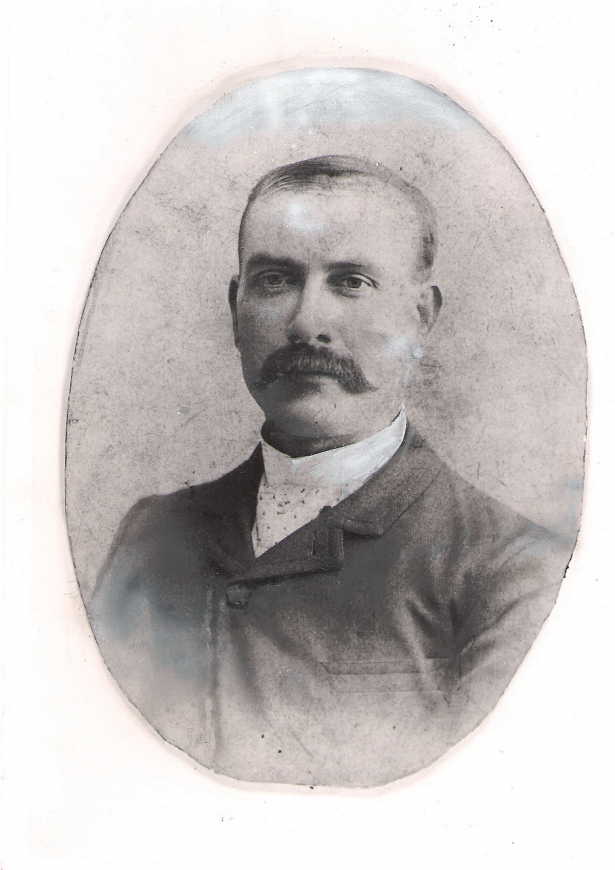
john connolly from ancestry

Portrait of John Connelly. Source: Jennifer Connelly

John Connelly was born in Ireland around 1852.  His father, Michael Connelly as a sailor who visited nearly every port in the world.  On one trip Michael Connelly traveled to the Great Lakes.  He was impressed with Buffalo, which he called “a city of promises”.  In the 1860s, Michael’s two oldest sons, Michael and James sailed to America and came to Buffalo.  In 1866, they brought their brother, John, to the country.  John was about 14 years old and had already been working in the rolling mills in Wales for 50 cents a week since he was 10 years old.  He was excited to come to America, to get away from the cold, hunger and poverty of the old country.  

John and his brothers worked hard to establish a ship chandlery business for themselves here in Buffalo.  Connelly Brothers Ship Chandlers was established in 1870.  Brother James tragically died in 1872, drowning at the foot of Illinois Street. To start their business, John and Michael would take their rowboat to Tonawanda, load it with lumber and tow it to Buffalo, pulling the tugboat from the towpath the horses used along the canal.  It was noted that even as he got older and was successful and could work less, John would still get up early, get dressed, read the newspaper by gas light and get to work right at sunrise.  The ship company was located at the southwest corner of Ohio and Michigan Streets, at a site selected by John Connelly.  They built some of the first steamers built for shipping lumber on the Great Lakes.  In 1896, they built the last steamer that was built to ship lumber on the Lakes.  

download (2)

View of the Buffalo River, between 1900 and 1910. Note Connelly Brothers, the small building in the foreground to the left of the bridge abutment. Source: Library of Congress. Click here to see larger image.


mary sullivan

Mary Connelly. Source: Jennifer Connelly

John Connelly met Mary Sullivan on a trip along the Erie Canal. She was from Ireland and was visiting friends in Oswego, New York.  She returned to Ireland and Mary and John wrote letters to each other for a year.  He then made his only trip back to the old country in 1885 to marry her.  The Connellys lived on Michigan Avenue, which was called Michigan Street at the time.  It was still a quiet, residential street lined with trees.  Today, the site of their house is a parking lot across the street from the Seneca Buffalo Casino.  John and Mary had eleven children, six sons and five daughters.  Unfortunately, five of the children died in childhood.  Five sons and a daughter lived to adulthood – Boetius, William, John Jr, James, Mary and Arthur.  

connolly family ancestry

Connelly Family on the steps of their house. Source: Jennifer Connelly

In 1901, the Connellys moved to 126 Fargo Avenue.  The family lived there for many years.  The house is now a part of the Nickel City Housing Cooperative and is known as Plankton House.  The family also had a servant who lived with the family.  In 1900, their servant was Mary Giritt, a 19-year old woman from Germany.  In 1900, the servant was Annie Snyder, a 20-year old from Germany.  In 1920, their servant was Elizabeth Endres, a 27-year old woman born in New York state to German immigrant parents.  Because John had to leave school to work at a young age, he insisted that all of his children complete high school and offered them all a college education.  John Jr and William were the only two who went to college – both becoming attorneys.  William sailed on the Great Lakes to help finance his education, served in the U.S. Navy and specialized in marine law.  Boetius served in the US Army during WWII.  Mary and James worked for Connelly Bros.  Arthur worked in labor relations. 

clip_112291164

Ad for Connelly Ave Lots for Sale from 1921. Source: Buffalo Times.

Connelly Street was developed in the early 1920s as Buffalo grew.  John Connelly did not see Connelly Street as a source of pride.  The street was named in his honor, which was a sign of his respect and esteem throughout the community.  However, Mr. Connelly could only think of the money he lost when the street was cut through his property!

Despite being eager to grow his fortune, Mr. Connelly was also known as an easy target for those down on their luck.  People would approach him for spare change, and Mr. Connelly would always empty his pockets for them.  Eventually, his family persuaded him to give his change to the bookkeeper every morning, so that he would not have cash on him while walking around town.  Mr. Connelly would then ask his bookkeeper for half a dollar to buy a handkerchief at the store across the street.  He’d buy a hanky and then give the change to the person who asked.  Because of this, he had many, many handkerchiefs!

Mr. Connelly died in 1928.  He is buried in Holy Cross Cemetery in Lackawanna.   After Mr. Connelly’s death, son James and daughter Mary Connelly Keene and Mary’s husband Russell Keene continued the business.  In 1933 Mary Connelly Keene became President of the company. 

Tewksbury Aftermath

Aftermath of the Bridge Collapse. Source: Buffalo News.

On January 21, 1959, the Michigan Avenue Bridge collapsed in what is often referred to as “the Tewksbury Disaster.”  That winter was very cold, with heavy snow and bitter temperatures.  On January 21st, there was an unseasonable thaw.  The 50 degree day combined with a wind storm broke up the sheet of ice along Cazenovia Creek around 6pm, pushing the ice from the creek into the Buffalo River.  The ice jam ran up against the hull of the MacGilvray Shiras, owned by the Kinsman Transit Company in Cleveland.  The Shiras was moored for the winter at Concrete Central Elevator and full of corn.  The Shiras broke free from its mooring around 10:40pm during wind gusts of 48 miles per hour.  A chain-reaction accidental crash when the steamer Shiras broke loose from a dock owned by Continental Grain Company.  The Shiras floated down river, where it struck the steamer Michael K. Tewksbury, which was stationed for the winter at the Standard Elevator and full of wheat.  The boats continued downriver, past the Ohio Street lift bridge which was under construction and out of service.  The story goes that the bridge operators for the Michigan Ave bridge were drinking at the Swannie House and not manning the bridge.  One rumor says that the bridge operator was in bed with his mistress!  William H. Mack testified in Federal Court that he did visit the tavern twice during that evening, from 8:20-8:40pm and from 10:00-10:20pm but that he was back on duty a half hour before the first warning call came in.  Shift change for the bridge came at 11pm.  One of the bridge tenders, Casimir Szumlinski, came on duty at 11.  A call came in at 11:10pm from the watchmen at Standard Elevator alerting the bridge that there was a loose boat coming their way.   It was said an earlier call came in at 10:45pm but the operators were waiting for Mr. Mack and Mr. Szumlnski because they did not know how to raise the bridge.  Mr. Szumlinski recollected to the Buffalo News in 1969, “I saw the boat about 1000 yards away.  It looked like a phantom coming out of the night – no lights, no flares”.  The efforts to raise the bridge came too late, they were only able to partially raise the bridge before they needed to abandon the bridge.  Two of the bridge tenders were injured as the boats slammed into the Michigan Avenue Lift Bridge at 11:17pm.  The bridge plunged into the river, also damaging a water main.  The two ships came to a stop near the wreckage of the bridge, abutting each other and wedged in the River amongst the wreckage of the bridge.  The Shiras had traveled almost 3 miles! 

Screenshot (11)

Approximate path of the MacGilvray Shiras on January 21, 1959

The ice jam created by the ships blocking the river caused intense flooding in the First Ward. The quick thaw and the rain that occurred caused one of  the worst flooding events in Metropolitan Buffalo History.  There was also major flooding that night in Tonawanda and Amherst along Ellicott Creek.  Delaware Park lake (now Hoyt Lake) rose several feet, closing Delaware Avenue.  The New York Central Railroad tracks between Forest and West Delevan were washed out from flooding on Scajaquada Creek.  Smokes Creek flooded an area 2 square miles in size, causing a state of emergency to be declared for Lackawanna. 

At 7:45am the next morning, the north tower of the Michigan Avenue bridge toppled, crushing the roof of the Connelly Bros building and kicking out the sidewall timbers of the Engine 20 (the fireboat) firehouse.  Connelly Bros lost the building, many marine supplies, a pier, and a 40-foot supply ship which sunk under the weight of the twisted bridge girders.  The boat was recovered several months later, found in the rubble in the river.  It took about two weeks for the Shiras and the Tewksbury to be freed from the wreckage, with tug boats and a coast guard ice-breaker cutting thru the ice.  51,000 bushels of wheat were unloaded from the Tewksbury to lighten the load to help free the ship from the wreckage of the bridge.  Suction equipment was used which pumped out the wheat into trucks.  With the Michigan Avenue bridge wrecked and the Ohio Street bridge closed for repairs, the Skyway was the only way to access South Buffalo from Downtown.  The trucks hauled the grain from the wreck site over the Skyway to Connecting Terminal, an 8-mile trip.  A channel was finally cleared on February 3rd preventing the risk of the River flooding again.  The Shiras was damaged and on February 12 was towed to the GLF elevators to be unloaded and then taken to the American Shipbuilding dry dock for repairs.  The Shiras ended up being towed to Hamilton, Ontario and sold for scrap in June 1959.  The Tewksbury continued operations, returning to winter in Buffalo in following years.  In 1962, the Tewksbury was renamed, but the ship saw service until 1975. The Michigan Avenue bridge reopened December 7, 1960.  

Connelly Bros Boat 1946

Connelly Bros Boat at their pier, 1946. Source: Buffalo News.

Connelly Bros Boat

Connelly Bros Boat Recovery in March 1959, after the bridge collapse. Source: Buffalo News.

At that time, Connelly Bros was 89-years old and were the oldest chandlery business in Buffalo.  The company lost an estimated $200,000 ($1.8 Million today).  It took many years for a ruling on how the three parties involved – The Continental Grain Co (owner of the dock), the Kinsman Steamship Co (owner of the steamer MacGilvray Shiras) and the City of Buffalo must share the payment of damages.  The City was held partially liable because it was determined there should have been adequate time to lift the bridge.  The case revolved on whether or not the Shiras was properly moored at Concrete Central elevator.  The lawsuit for the damages was appealed at least six times.  Final settlements for the 28 claimants was decided in 1966, totaling $1.8 Million ($16.5 million today) in damages.  The original damage claims exceeded $3 Million!  Connelly Bros ended up receiving $42,500 ($389,331 today) for business damages and $42,238.17 ($386,932 today) for damages to the building.

mary connelly 1974 ancestry

Mary Connelly Keene, 1974. Source: Jennifer Connelly

After the bridge collapse, the company leased space in a warehouse on Scott Street.  The company suffered another tragedy when the warehouse suffered a fire four years later on March 9, 1963.  Connelly Brothers moved to 43 Illinois Street on March 21, 1963, just 12 days later!  In February 1969, Mrs. Keene was presented a plaque by the Buffalo Propeller Club and the International Shipmasters Association which recognized her contributions to both groups.  Mary Keene was president of the company for more than 40 years!  A rarity for a woman of the time!

Shipping in Buffalo was changing.  The winter of 1974 was the first year since before the Civil War that no freighters spent the winter in Buffalo.  The grain ships, like the Shiras and the Tewksbury, used to spend the winter with storage grain for Buffalo flour mills.  In 1974, it was decided they could move grain in by train as needed.  At the height of grain shipping in Buffalo, there would be more than 100 ships wintering in Buffalo.  In 1973, there were just 12 vessels.  The loss of winter ships impacted the Buffalo economy.  Each ship that stayed in port typically spent about $75,000 (about $500,000 today) in Buffalo before leaving in the spring.  This includes towing, docking fees, shifting fees, shipkeeper pay, and electric and water bills.  Additionally, they’d spend money on food and repairs during the fit-out to prepare the ship for the spring lake season. At the time the entire business of Connelly Bros was built around marine trade.  The company branched out to serve ships across the Great Lakes, not just in Buffalo, trying to survive.  

IMG_7632

43 Illinois Street, the final location of Connelly Bros. Source: Julia Spitz


Connelly Bros 1976

Connelly Bros Ad from 1976.  Source:  Buffalo News

Mary Keene’s son Gilbert Norwalk was president of the company after Mary retired. Mary Keene died in 1978 at age 81.  She is buried in Mt. Olivet Cemetery in Tonawanda.  As the marine business continued to decline, Connelly Bros eventually shifted to including Auto Repairs as part of their business to keep up with the times.  The company closed in 1984, after 114 years in business!  In 2014. the Illinois Street building was listed as part of the Cobblestone District local historic district.  

So the next time you’re down at the waterfront, think about Connelly Bros and the 114 years they spent working on helping ships in the harbor! Special thanks to Jennifer Connelly, Great Granddaughter of John Connelly, for allowing me to use some of her family photos in this post.  

Want to learn about other streets? Check out the Street Index. Don’t forget to subscribe to the page to be notified when new posts are made. You can do so by entering your email address in the box on the upper right-hand side of the home page. You can also follow the blog on facebook. If you enjoy the blog, please be sure to share it with your friends.

Sources:  

  • Smith, H. Katherine.  “Connelly Street a Memorial to Ship Chandlery Founder”.  Buffalo Courier Express.  January 12, 1942, p6.
  • Wood, Jerry.  “Company Crushed in Bridge Collapse”.  Buffalo News.  February 26, 1959, p1.
  • “US Judge Rules on Who Shall Pay in Bridge Disaster.”  Buffalo News.  May 1, 1963, p10.
  • Maserka, Ron.  “Damages in 1959 River Crash Are Set at $1.8 Million”.  Buffalo News.  April 22, 1966, p25.
  • “Mrs. Keene to get Plaque”.  Buffalo News.  February 3, 1969, p2.
  • Buckham, Tom.  “Waterfront’s Economy Hit Hart by Loss of Winter Grain Fleet”.  Buffalo News.  January 25, 1974, p34.
  • “Connelly Bros Leases Building”.  March 21, 1963, p33.
  • “Mary Connelly Keen Dies; Headed Ship Supply Firm”.  Buffalo News.  June 28, 1978.
  • Hariaczyi, Todd.  “January 21, 1959:  The Michael K. Tewksbury topples the Michigan Avenue Bridge”.  Buffalo News.  July 4, 2017.
  • “Mayor Aids Confer in Flood Emergency; Zero Cold Forecast”.  Buffalo News.  January 22, 1959, p1.
  • Kowalewski, Ed.  “1959 Bridge Crash Still Vivid.”  Buffalo News.  Janaury 21, 1969, p29.
  • Maselki, Ron.  “$1.8 Million Damage Found by Investigator of 1959 River Crash”.  Buffalo News.  April 21, 1966, p67.
  • “Crews Start A Task To Cut Away the Bridge.”  Batavia Daily News.  February 2, 1959.  P1.
  • “Conveyors Unloading Grain From Aft Hold of Tewksbury”.  Buffalo News.  January 29, 1959, p31.
  • “Visited Tavern Before Crash, Bridge Operator Tells Court”  Buffalo Courier Express.  May 3, 1961, p64.

Read Full Post »

jones streetJones Street is a street in the Seneca-Babcock neighborhood of the East Side, running between Clinton Street and Lyman Street.  Historically, the street went one block further north to Howard Street and one block south to Seneca Street.  The street is named after a prominent Buffalo family who once had a pork and beef business on the site.
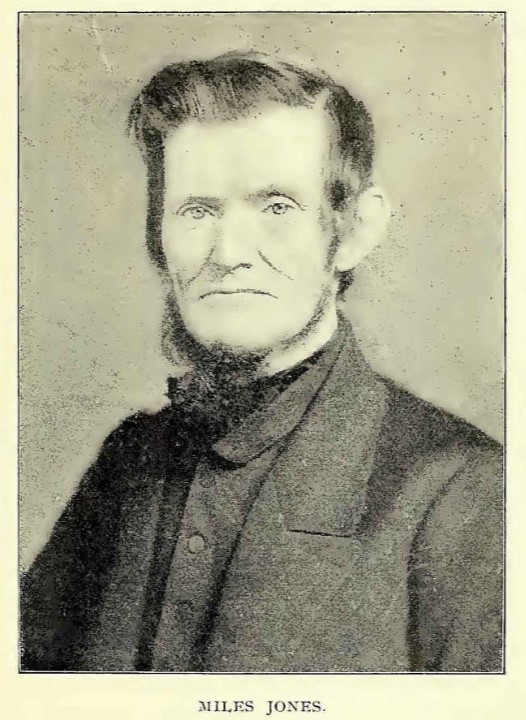
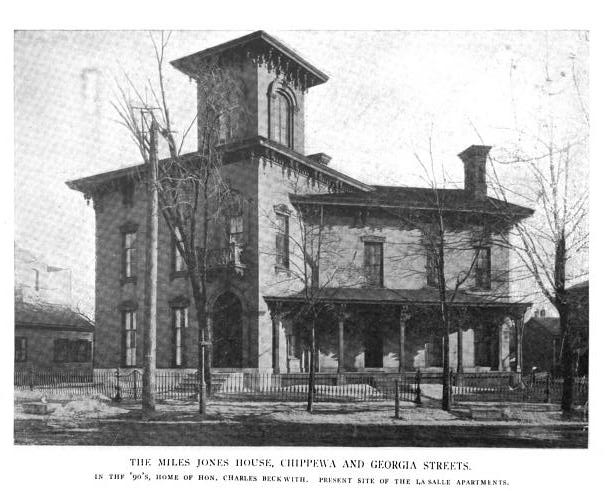
miles jones pb

Source: History and Genealogy of the Ancestors and Descendants of Captain Israel Jones

Miles Jones was born in Park-Hempstead, Connecticut, on May 20, 1804. His parents were Elizabeth Merrill and Marquis Jones. The Jones ancestors had lived in America since the Colonial Times. Miles was apprenticed to a shoemaker in the Village of Fredonia, where he learned the shoemaking trade. Miles came to Buffalo around 1820.

Mr. Jones married Elizabeth Roop in April 1829. Elizabeth was born in Buffalo in January 1810. Her father, John Roop, had come to Buffalo from Germany by way of Pennsylvania. During the Burning of Buffalo in 1813, Mr. Roop was murdered by Native Americans. Elizabeth was orphaned and taken in by Mr. and Mrs. Benjamin Bidwell of Black Rock. I couldn’t find what happened to her mother, but sources list her and her brother as orphans. Once grown, Elizabeth was courted by the Bidwells’ son General Daniel D. Bidwell. However, she preferred Miles Jones, so she became Mrs. Jones.

The Jones family first lived on Delaware Avenue, where the County Jail is now. In 1835, moved to a steamboat (temperance) hotel that they ran on Lloyd Street near Prime Street. This hotel was one of the best known in town for those waiting for transportation on the Canal or Lake. At the time, the Canal area was still a place of upstanding businesses and the heart of the Village of Buffalo. It had not yet become the seedy part of town. The Joneses quickly became a well-respected part of Buffalo society life. Miles was elected First Ward Supervisor in 1839, 1840, 1841, 1851, and 1852.

In 1844, Miles Jones was made an inspector of beef and pork. He established Miles Jones Pork & Beef Wholesale business. The business was located near the canal at the corner of Prime and Hanover Streets. Mr. Jones was a pioneer in the pork packing industry. His pork packing house was looked upon as a marvel of its day. Wondering how pork was sold back then? In 1846, Miles advertised in the paper for sale of “500 pork barrels, 800 smoked hams, 600 smoked shoulders, 2000 pickled hams and shoulders, 100 barrels of Mess Pork, 200 barrels of Prime Pork, and a large quantity of odds and ends.”

The family moved from the canal area to 14 Green Street. Green Street is a small cobblestone street off of Washington Street that is basically just a cobblestone driveway into a parking lot these days. You might think the road was lost because of the construction of the Thruway. However, the street was already consumed by William Fargo’s American Express, which used the land for their shipping sheds.

miles jonesIn 1854, the Jones family built a large house at the corner of Chippewa and Georgia Streets. This was on the location of the Reservation Line, which divided the New York State lands from the Holland Land Company land. The Reservation Line was established in 1786 when the land was reserved for New York State.  At the edge of the reservation was where Peter Porter laid out the original settlement of Black Rock, with the streets named after states and numbers.  When Mr. Jones purchased the property, there was nothing but fields to the west of their home. The Jones Family house was originally numbered 135 but was later changed to 186 West Chippewa. The Jones property also extended to Ninth Street. The Jones family owned two houses on Ninth Street and another house on Cary Street. Their carriage house associated with their Chippewa Street home was also located at the dead-end of Cary Street. In 1869, residents of Ninth Street petitioned Common Council to change the name to Prospect Avenue, which was granted by June of 1870.

The Jones family lived with their twelve children, two domestic servants, and a carriage driver. The children attended Buffalo Public Schools. Unfortunately, two of the Jones children died in childhood. The Jones family owned much of the block, so they’d subdivide their property to build homes for their many children as they grew up.

  • Helen M. was born in January 1830 and married Oliver Bruce in 1848. She had four children – Isabella, Helen, Miles, and Oliver. Her husband died in 1855, and Helen married David F. Day. The family lived at the Day Mansion at 69 Cottage Street. She died in May 1890. The mansion was later used by the Salvation Army as a Home for Young Women but was later demolished.
  • Marshall N was born in September 1831. Marshall was married three times – to Harriet A Beach, Rosanna Quinn, and Hulda Smith. Marshall had six children – Miles, William, Freddie, Richard, Eva, and Hulda. Marshall and his family lived for several years in the family homestead on Chippewa Street. In 1880, he moved to Main Street near Bryant.
  • Chapin William (sometimes went by William) was born in October 1833. He married Caroline (Carrie) Cox in August 1859. They had 5 children – Kate, Marshall, Roop, Allen, and Elizabeth. Chapin and his family lived near the rest of the family, at the corner of Cary Street and Morgan (now South Elmwood).
  • Sarah Stanard was born in November 1835. She married Lafayette E. Mulford in June 1865. They had one child, Henry Jones Mulford, and lived at 90 Bryant Street.
  • Miles was born in October 1838. He died at age 6 in 1844.
  • Elizabeth Roop was born in April 1840. She married Allen M Adams in June 1863. They had 7 children – Allen, James, Frank, Elizabeth, Miles, Helen, and Jay. Their family lived at 1211 Seneca Street.
  • Dencie was born in 1842. She died just before her second birthday in 1844.
  • Henry Roop was born in March 1844. Henry and his wife lived at 13 Ninth Street (which became 25 Prospect when the street name changed). They had two children. In 1874, they moved into 267 Georgia Street, where they lived for 14 years before moving up Niagara Street near the corner of Rhode Island.
  • Elsie Louise was born in January 1847 and married Charles H. White in 1868. They had two children. She and her family lived at the family homestead on Chippewa. After the house was old, they moved up to Allen Street. She died in June 1908.
  • Isabella Clara Jones was born in May 1848 and married Frank H. Ransom in December 1869. They had two children. She died suddenly in Rome, Italy, on vacation with her family in 1885.
  • Ida Francis was born in April 1850 and married John Siver in July 1870. Mr. Siver worked at the Lackawanna steel plant (which became Bethlehem Steel). They had eight children – John, Burton, Eva, Ida, Leroy, William, George, and Elsie. The family lived at 82 Fields in South Buffalo.
  • Eva Imogen was born in Sept 1853 and married George M. Trefts in February 1876. They had three children – George, John, and Chilion. They lived at 25 Prospect when her brother moved out. She died in October 1899.

The youngest brother of Miles Jones, Merlin Willard Jones, also came to Buffalo to work with Miles in the pork business. Merlin lived across Prospect from the rest of the family at 28 Prospect.

church of the messiah main street

Church of the Messiah Alter on Main Street. Source: Picture Book of Earlier Buffalo.

The Jones family were universalists. They attended the Church of Messiah which was located on Washington Street near Swan. In 1866, the church moved to a new building on Main between Chippewa and Huron.  The Jones family donated money for the new church for a pulpit made by the Thompson Hersee factory of Buffalo. Miles Jones was a member of the Hiram Lodge, Free and Accepted Masons. Mr. Jones died in 1869 at age 64 after being confined to his house due to his ill health. Despite this, he insisted on going to the polls to vote on election day, his final outing. He is buried in Forest Lawn

Miles and Elizabeth’s sons Henry and Marshall had entered the pork packing business. When Miles retired, the business was continued by Henry and Marshall under the name Miles Jones’ Sons. The Jones property near the canal was sold to the DL&W Railroad. At that time, the plant moved to Clinton Street near the corner of Metcalfe Street. This area was near the Buffalo stockyards on William Street, so it was a popular area for meatpacking.  Buffalo’s meatpacking industry was second only to Chicago.  When Miles Jones’ Sons business closed, Jones Street was opened through the property in 1882.

georgia apartments

Lasalle Apartments. Source: Author.

The Jones family house on Chippewa was listed for sale in 1878. It was listed for sale again in 1885 as “a large 2.5 story house with lot, 152 feet frontage on Chippewa and Georgia Streets, will be sold at a bargain.” Similar to the case with the Fargo Mansion, just six blocks away, there was little demand for such a large house. The area of the West Village was shifting towards multi-family uses. In 1889, it was used as a boarding house with furnished rooms for let. It was listed for sale again in 1891 and 1892. The last owner of the house, Charles Beckwith, had listed the house for sale but died in the home in 1895. Following Mr. Beckwith’s death, it was demolished to build the LaSalle Apartments. The LaSalle apartments opened on the site in 1898.

Over time, the West Village neighborhood changed. Old housing began to be demolished. Single-family residential structures made way for commercial buildings such as the Lasalle Apartments which replaced the Jones family home or the Roanoke Hotel at Elmwood and Chippewa, built in 1901 for the Pan American Exposition. The building is now home to Evergreen Health Services. The Hutchinson Homestead was replaced with Hutchinson Technical Central High School (Hutch-Tech) in 1913.

The area’s property tax base declined, partly because of the demolition of houses and an increase in privately developed parking lots. In particular, parking demand increased significantly from the Federal Office Building, which opened at 200 Delaware Avenue in 1971. The Thaddeus J. Dulski Federal Office Building houses 50 federal agencies and a workforce of 1,200 people. Much of the parking was on illegal, unlicensed lots.  These illegal lots provided free parking for federal government employees. The government emptied the building in 2005. It was sold to private developers and renovated into The Avant, a mixed-use building with a hotel and condos.

In 1974, the West Village Community Association organized to bring awareness to the neighborhood’s historic value and help to revitalize and rehabilitate properties in the area. During the 1970s, 62 of the West Village’s 166 residential structures had been renovated. These renovated structures provided 265 improved housing units in the neighborhood. In addition, the Association held workshops on recycling older houses to help homeowners improve their buildings and offer suggestions and resources.

The Association saw the detrimental impact of the parking lots in the Georgia-Prospect Street area and wanted to turn the area into a robust residential neighborhood. In the summer and fall of 1979, the Lower West Side Resource & Development Corporation conducted a preliminary planning study. One of the recommendations included infill housing for the vacant lots, particularly those in the Georgia-Prospect area. Improvements to traffic patterns were another measure to improve the neighborhood conditions. Georgia Street would be made two-way; West Chippewa between South Elmwood and Whitney Place would be made one-way eastbound; Prospect Avenue between Huron and Georgia would be one-way toward the southeast; Huron Street between Niagara and Elmwood would be two-way. This was to be designed as a calming traffic measure to lessen the intrusion of downtown traffic using the neighborhood streets to zoom up to get to the highway. Today, West Chippewa and Georgia Street are one-way heading west and southwest; Huron is one-way heading east; Prospect (now Rabin Terrace) is now two-way.

west village

Map of West Village. Red Boundary shows the National Historic District. Orange Boundary shows the Local Preservation District. Blue boundary shows the Georgia- Prospect Urban Renewal Area.

In 1979, the West Village Historic District became a City of Buffalo Local Historic District. The local district is bounded by South Elmwood, Tracy, Carolina, Niagara, and Huron Street. In addition, properties on the north side of Carolina Street between Tracy and Niagara were included in the local district.

In July 1983, the West Village Historic District was listed on the National Register of Historic Places. The boundary for the National Historic District is slightly smaller than that of the local district. The properties being looked at for the Georgia-Prospect Urban Renewal Project were left out of the National Historic District.

In February 1982, the City of Buffalo adopted an Urban Renewal Plan for the Lower West Side (Georgia-Prospect) area. Cannon Planning & Development was retained to establish a formal planning and development framework for the West Village. The plan attempted to provide community growth by assembling vacant and underutilized land to convert into productive residential uses. The program included two areas: the first Virginia-Carolina – the area between Carolina, Virginia, West, and Fell Alley. The second area was Georgia-Prospect – the two-block area bounded by Chippewa, Georgia, Huron, and South Elmwood. We will concern ourselves with the Georgia-Prospect area as this is the former land of Miles Jones.

Properties within the urban renewal area were surveyed by the Lower West Side Resource & Development Corporation. A second survey was independently completed by Cannon Design. Surveys were exterior only, with interior inspections only made on sample properties. The results of the survey indicated that 55.9% of parcels in the area were open or dilapidated. Most of the land slated for acquisition consisted of vacant land (with parking on it). The plan included demolition of all structures and improvement on properties except 241, 245, 247, and 267 Georgia Street, if rehab proved feasible for those structures(which it was).

As part of the urban renewal project, the following properties were demolished. Each of these buildings was listed as contributing to the West Village Local Historic District.  Photos show what the buildings looked like in the late 1970s/early 80s before demolition:

  1. 193 West Huron Street – a one-story residence constructed in 1872 with a front addition built in 1910. The building was constructed in a Second Empire motif with a false Mansard roof with rounded dormer windows. The property had a weird shape due to its frontages on both Huron and Prospect.

    193 Huron

    193 Huron. Source: NYSHPO

  2. 11 Prospect – a 1 and a half story brick Italianate foreman’s cottage built in 1854. It was initially constructed for Robert Denton, a piano turner who became a partner in Denton, Cottier, and Daniels. This Buffalo music store is still in business today. This property had an unusual orientation due to its location on the Reservation Line and the angle of Prospect Street. The house was built oriented towards Huron Street. The building’s last use was as a rooming house.

    11 prospect

    11 Prospect. Source: NYSHPO

  3. 17 Prospect – a two 1/2 story Shingle Style cottage built around 1910. This house had a unique orientation due to its location along the Reservation Line and the street angle. The building was built askew, with no distinct orientation. It faced neither Huron Street nor Prospect Ave.

    17 prospect

    17 Prospect

  4. 28 Prospect – a two-story Italianate-style house built in 1866. The house’s original owner was Miles Jones, and the house was occupied by Merlin, his brother.

    28 prospect

    28 Prospect. Source: NYSHPO

  5. 32 Prospect – a 1 and a half story wood Frame Italianate cottage built in 1861.

    32 Prospect

    32 Prospect. Source: NYSHPO

  6. 53 Cary Street – a 2 and a half story brick carriage house with gable roof built in 1852. The property had a Cary Street address, but the building faced Chippewa Street. It was originally built as a part of Eliza Abell’s house at 166 W Chippewa. The main house was demolished in the 1960s to build Dewey’s Diner, which was also demolished. The carriage house was vacant before it was purchased by the city.

    53 Cary Street

    53 Cary. Source: NYSHPO

  7. 55 Cary Street – a two-story wood-frame Italianate cottage built in 1854. It was typical of the working-class homes that were built in the 1850s in this part of Buffalo.

    55 Cary

    55 Cary. Source: NYSHPO

  8. 67 Cary Street – a two-and-a-half-story brick Italianate residence built in 1854. Its last use was as apartments.

    67 Cary

    67 Cary. Source: NYSHPO

  9. 69-71 Cary Street – a two-story carriage house built in 1854 at the dead-end of Cary Street. This building served as the carriage house for the Jones family home. It was later converted into apartments.

    69-71 Cary

    69-71 Cary. Source: NYSHPO

  10. 166 South Elmwood – a two-and-a-half-story brick Italianate residence built in 1865. The house was later converted to apartments and had a concrete block addition for tavern use. The original owner of the house was John R. Hazard, a coal dealer. The original address for the site was 144 Morgan Street before Morgan Street was changed to South Elmwood.

    166 S Elmwood

    166 S. Elmwood. Source: NYSHPO

  11. 192 South Elmwood – a two-and-a-half-story brick Italianate-style cottage built in 1854. The original owner was Milton Randall, a steamboat agent. A front addition was constructed in the front of the house for tavern use. The rear was converted into apartments.

    192 South Elmwood

    192 S. Elmwood. Source: NYSHPO

Five houses within the urban renewal area were saved and are still extant.  The following properties within the area have been rehabilitated, with the black and white photos showing the buildings in the late 70s/early 80s, and the colored photos showing conditions today:

  1. 241 Georgia Street – a two-story Italianate-style house built in 1869. The house was initially built by Rueben Sparks. The house is divided into four apartment units.

    241 Georgia

    241 Georgia (Source: NYSHPO)

  2. 245 Georgia Street – a three-story Second Empire style house built in 1870. Originally built by L.A. Hamilton. The house is currently divided into three apartment units.

    245 Georgia2

      246 Georgia (Source: NYSHPO)

  3. 247 Georgia St – a two-story Italianate-style house built in 1866. The house was originally built for Robert E Skillings, a livery operator. The porch collapsed in 1977. The building is currently divided into two apartment units.

    247 Georgia

    247 Georgia before. Source: NYSHPO 

    247 Georgia_now

    247 Georgia today. Source: Author

  4. 267 Georgia Street – a three-story Second Empire style house with a mansard roof built in 1874. The building was home to Miles Jones’ son. The building is currently divided into five apartment units.

    267 Georgia

    267 Georgia Before.  Source: NYSHPO

    267 Georgia

    267 Georgia Street today. Source: Author.

  5. 3 Prospect Avenue – a two-and-a-half-story Queen Anne Style residence built in the 1890s. The house is oriented towards Huron Street and has been subdivided into three apartment units.

    3 prospect

    3 Prospect (now 3 Rabin Terrace) before.  Source:  NYSHPO

    3 prospect now

    3 Rabin Terrace today

infill houses 2

Infill Houses along Rabin Terrace

As part of the urban renewal project, infill housing was built. The city paid for land assembly and infrastructure. Thirty-two new housing units were constructed in the Georgia-Prospect area by Marrano Homes. These were the first new homes to be built in the area in 30 years. The houses were sold at market rates and ranged in price from $45,000 to $60,000 ($133,800 – $178,500 in today’s dollars). Similar houses in the suburbs at the time were going for $85,000 ($252,800). The houses are small, charming, and have a design reminiscent of the Italianate houses in the area. This differed from other new housing built in the city that mostly resembled suburban ranch-style homes. These houses are generally looked at as a successful infill project.

infill houses

Examples of Infill houses in this area

rabin terrace

Rabin terrace Dedication. Source: Buffalo News.

In 1996 Lower Prospect Avenue was renamed Rabin Terrace in honor of Israeli Premier Yitzhak Rabin. He was assassinated on November 4, 1995. Prime Minister Rabin had been working towards Israeli-Palestinian peace, and signed several historic agreements with Palestinian leadership as part of the Oslo Accords.  He won the Nobel Peace Prize in 1994, along with Yasser Arafat.  He was assassinated following a rally in support of the Oslo Accords by an extremist Yigal Amir, who opposed the terms of the accords.  The square in Tel Aviv where he was assassinated was renamed Rabin Square in his honor.  There is also a walkway named after Rabin in the America-Israel Friendship Grove in Flushing Meadows-Corona Park in Queens, New York(note from Angela, this is my favorite park!).
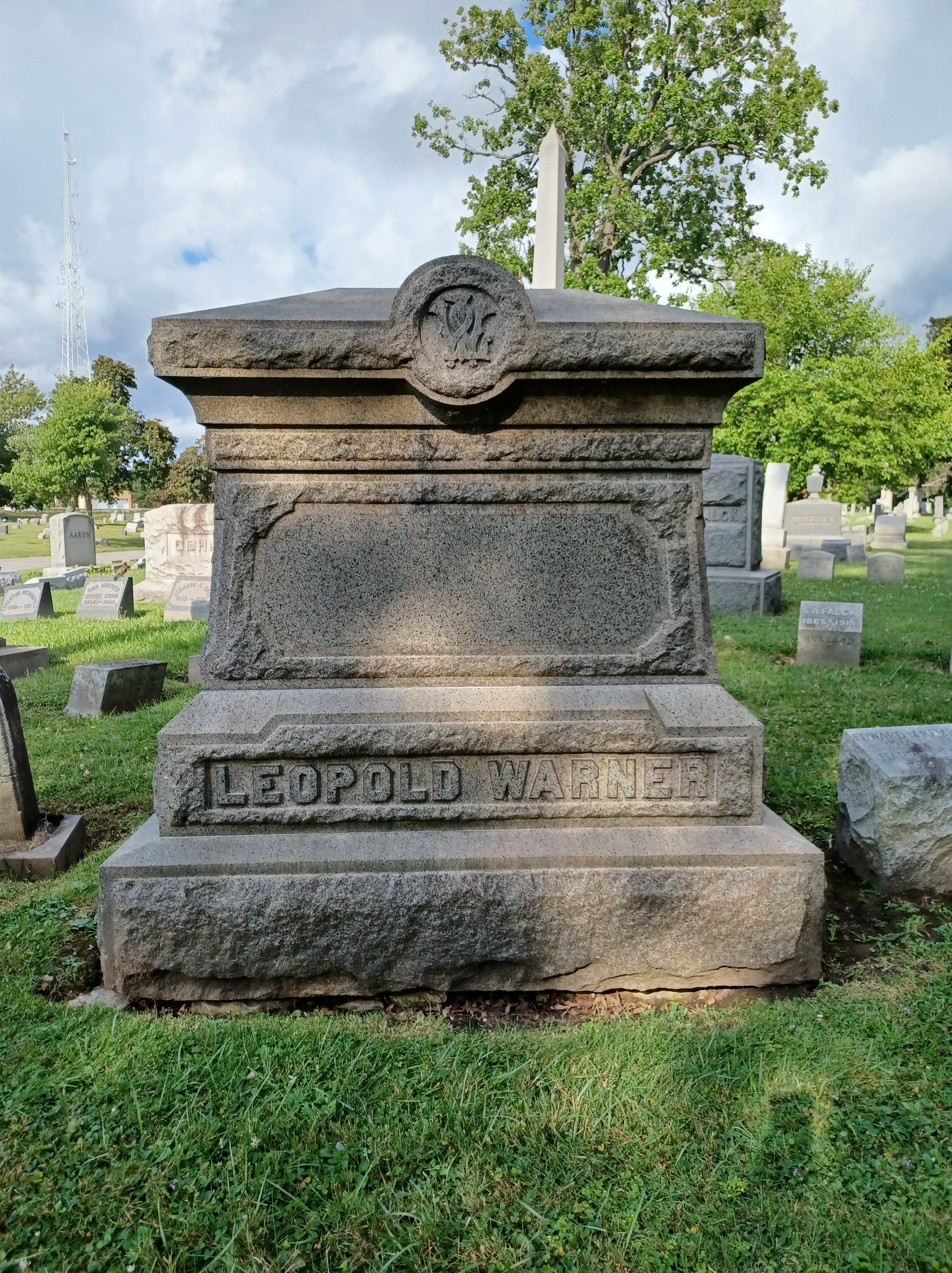
20211031_151918

Recent Image of Rabin Terrace sign.

The Rabin Terrace street signs in Buffalo went up on the first anniversary of his death.  Today, these infill houses sell for $380,000-$400,000.  Many of the residents have fantastic gardens, and this is a popular area for Garden Walk each year.

Want to learn about other streets? Check out the Street Index. Don’t forget to subscribe to the page to be notified when new posts are made. You can do so by entering your email address in the box on the upper right-hand side of the home page. You can also follow the blog on facebook. If you enjoy the blog, please be sure to share it with your friends.

Sources:

  • “Monument to a Peacemaker.” Buffalo News November 5, 1996, p.B-4.
  • “Death of Miles Joes, Esq.” Buffalo Commercial. January 4, 1869. P2.
  • Sheldon, Grace Carew. “Buffalo Of the Olden Time: Henry Roop Jones.” The Buffalo Times.
  • Sheldon, Grace Carew. “Buffalo of the Olden Time: Miles Jones.” The Buffalo Times. Series: December 12, 1910, p11, December 11, 1910. P 40, December 9, 1910, p 15.
  • City of Buffalo Community Development Department. “Lower West Side (Georgia-Prospect) Urban Renewal Plan. February 23, 1982.
  • National Parks Service. Certification Report. West Village Historic District. July 1983.
  • “Buffalo Common Council: Name of Streets” Buffalo Courier. December 7, 1869. p2.
  • Langdon, Philip. “Replace Some Illegal Parking Lots With Homes, W. Side Group Urges.” Buffalo Courier-Express. 1979.
  • Buffalo Courier-Express, April 11, 1982. p 13
  • Haddad, Charles. “38 New West Side Houses Planned”. Buffalo Courier-Express. July 17, 1982. p1.
  • Jones, Asahel Wellington.  History and Genealogy of the Ancestors and Descendants of Captain Israel Jones.  Laning Company:  Madison, Wisconsin. 1902

Read Full Post »

sprenger

Sprenger Avenue shown in red.

Sprenger Avenue runs between Doat Street and Genesee Street in the Schiller Park neighborhood of the East Side.  The Schiller Park neighborhood developed around picnic groves developed by German immigrants at Braun’s Grove (later Genesee Park) and Schiller Park.  Braun’s Grove (Genesee Park) is now the location of the George K Arthur Community Center.  Across Genesee Street, Schiller Park is 36 acres in size and officially became a park in 1912.  The park is named for German poet, historian and philosopher Johann Christoph Friedrich von Schiller. During the New Deal, the Works Progress Administration built the Schiller Parks Pools and Locker House.  The Locker house still stands.  While the pools have been filled in, Schiller Park is home to one of Buffalo’s splash pads. Schiller Park is also home to the Schiller Park Senior Center.  Sprenger Avenue divides Schiller Park into two parts.    

Sprenger Avenue is named for Magdalena Sprenger Warner.  Mrs. Warner went by Laney/Lena and was the wife of Leopold Warner. When the street was coming through land that Leopold owned, they decided that since there were other Warner families in town, it would be more special to name it after Laney’s maiden name, Sprenger.
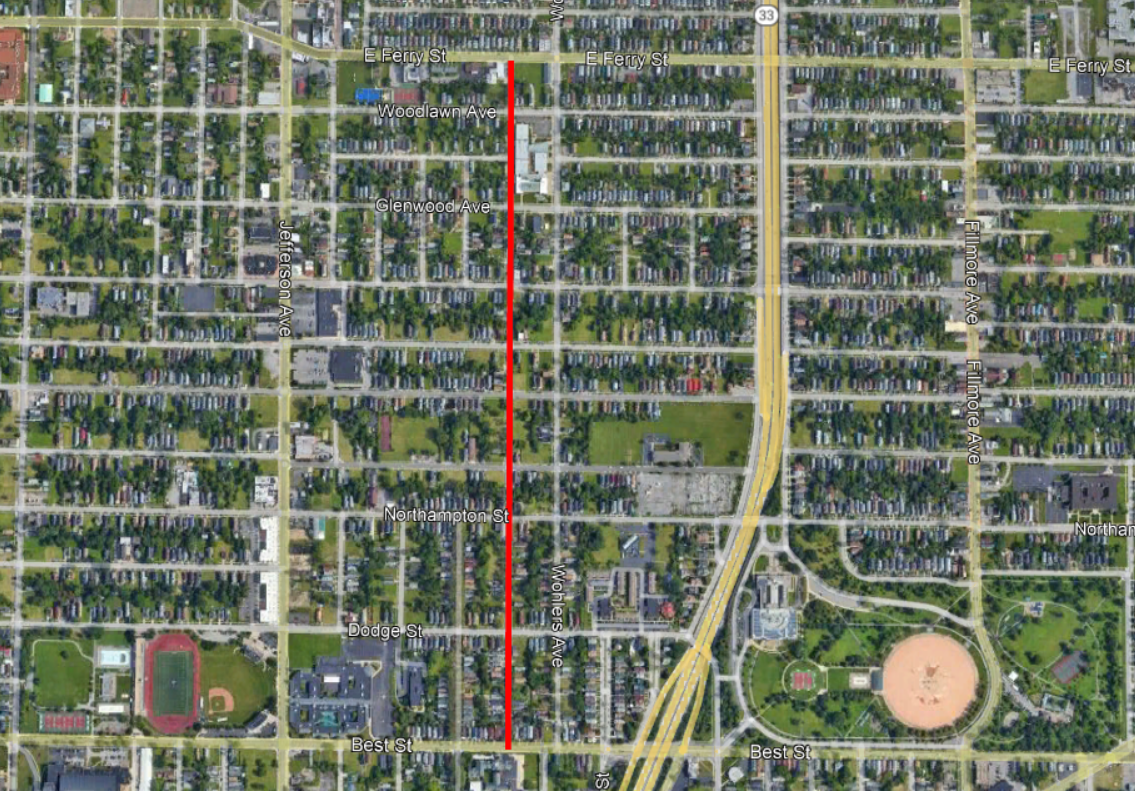
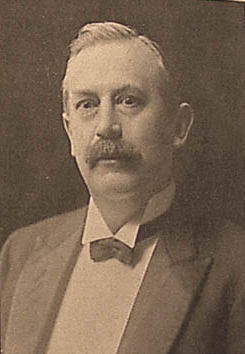
clip_106736320

Leopold Warner. Source: Buffalo Evening News.

Laney was born in Vienna, Austria in May 1822, daughter of Abraham and Lena Sprenger.  Leopold Warner was born in Bzenec in 1818.  Bzenec was part of the Austrian Empire at the time but is now part of the Czech Republic.  Laney and Leopold married on April 10,1842.  After the revolution of 1848, the Warners left Austria and settled in Utica, NY.  Their trip to America from Vienna took three months. They soon learned that Buffalo had greater promise than Utica and moved here in 1854.

Once in Buffalo, Laney helped her husband get his start in clothing.  She made men’s and boys caps which Leopold sold door to door in a reed basket.  Years later, at their 50th wedding anniversary in 1892, the basket was displayed, full of flowers instead of caps!

clip_106739680

Rendering of the Warner Bros Building on the Terrace. Source: Buffalo Morning Express.

In 1855, Leopold established Warner Brothers & Co. men’s clothing with his brothers Joseph and John.  They were one of the first clothing manufacturers in Buffalo.  They were first located at 41-43 Main, then expanded to Exchange Street and then to Pearl Street at the Terrace.  This area was a hub of clothing firms – in addition to Warner Brothers & Co, there were the firms of Henry J. Brock & Co, M. Wile & Co and Rothschilds Brothers. The business was successful and became the second largest wholesale clothing house in the city of Buffalo.  They sold products across the Northeast and also into some of the Southern states.  The firm had more than 1,200 employees.  

clip_106738931

Sketch of Fire at Warner Brothers Building on the Terrace. Source: Buffalo Courier.

The Warner Brothers building at Pearl and Terrace had a fire and in 1878 and another in 1891.  Both fires caused significant damage to the building and inventory.  Two fireman died in the blaze in 1891.  Warner Bros & Co started a relief fund for the benefit of the families of the fireman.  Warner Bros & Co was so large, it also operated at 72 – 76 Pearl Street, now better known as Pearl Street Grill and Brewery.   Leopold retired from the firm in 1878.  The business continued to be run by the Warner family and was renamed Kempner & Warner in 1895. 

warner brothers 1888

Warner Brothers & Co Clothing at 72 Pearl Street.  Now Pearl Street Grill and Brewery. Source: 1888 City Directory

The Warners lived on Scott Street through the 1850s and 60s.  Scott Street was a desirable residential area at the time due to its proximity to the lake.  The Warners had five sons and eight daughters.  Their daughter, Liddie, remembered running out of the house to see President Lincoln’s funeral procession pass down Perry Street.  She called it the saddest day of her childhood and recalled neighbors crying in the streets.  The Warner family later moved to 413 Michigan Street, now the location of the parking lot for the former Sheehan Memorial Hospital.  They lived on Michigan Street when the street was paved for the first time. Unfortunately, five of the children died in childhood.  Another son, Louis, died of typhoid fever a few weeks before he was to be married.  Louis Warner’s fiancée, Josephine Jellinek, died a few weeks later, on August 31, 1889, reportedly of a broken heart.  She was buried in the Warner family plot next to Louis on September 3rd, 1889, the day which they were to be married.  So heartbreaking!  

20220802_173320_2

Louis and Josephine’s graves in Forest Lawn.

In July 1885, the Warners moved to 132 Morgan (now South Elmwood).  The house was at the southwest corner of Huron and was originally built for Charles H Williams.  Mr. Williams was a banker and you may be familiar with Mr. Williams later house, still located at 690 Delaware Avenue (near Delaware and North). 

tbz

Temple Beth Zion at 599 Delaware Avenue. Source: “Buffalo and Its Points of Interest – Illustrated”, NY Commercial Publishing Co, 1896.

The Warners were charter members of Temple Beth Zion.  Temple Beth Zion began as the Orthodox congregation of Beth Zion in 1850.  In 1864, the congregation embraced Reform Judaism and a new constitution was initiated, keeping the name.  The congregation worshiped in several former church spaces until they decided to construct a new temple.  The new Temple Beth Zion was designed by Edward Kent in the Byzantine style and opened located at 599 Delaware Avenue in 1890.  Delaware Avenue at this time was considered Millionaire’s Row.  The choice of a property along Delaware Avenue and the use of society architect Kent was a way for the members of Temple Beth Zion to take their place in Buffalo society.  Most of the members had been Central European immigrants the generation before.  During the dedication of the new Temple, Leopold lit the perpetual lamp, known as ner tamid in Hebrew, a fixture in nearly all Jewish places of worship.  The lamp was dedicated by the Warners in remembrance of their son, Louis, who had passed away shortly before the temple dedication.  It is reported that the lamp is still hanging in the Temple.  Leopold was a charter member and Vice President of Temple Beth Zion for 25 years.  

Temple_Beth_Zion_2

Current Temple Beth Zion, 805 Delaware

After 70 years in their temple, Temple Beth Zion suffered a devastating fire in 1961 that gutted their building.  There was debate about whether to move from the city into the suburbs.  Many other other religious communities were doing so at the time, as Western New York suburbanized.  In 1963, the congregation voted overwhelmingly to remain a city-based congregation and remain in the city.  The new Temple Beth Zion at 805 Delaware was completed in 1967, designed by Max Abramovitz.  The modern, brutalist architecture of the Temple creates an open and light-filled sanctuary.  The ten sides of the building represent the ten commandments.  There is a large amount of symbolism throughout the building and it is considered to be a midcentury architectural treasure of Buffalo.  Temple Beth Zion remains one of the oldest and largest Reform congregations in the country, and the largest Jewish Congregation in Western New York.

After retiring from Warner Brothers & Co, Leopold was involved with real estate throughout the city.  Mr. Warner was one of the largest land holders in the city of Buffalo.On July 29, 1885, the Evening Telegraph reported in a Town Talk column that “Leopold Warner is gradually buying up the whole town.”  

Laney Warner spoke English, but enjoyed reading German authors.  The family were active in many organizations in early Buffalo, such as the Young Men’s Association, the predecessor of Buffalo Public Library.  They attended many plays at the Academy Theatre, which was located on Main Street between Seneca and Swan Streets.  

20220802_173250

Warner Grave in Forest Lawn.

The Warners were considered to be generous and charitable.  Mr. Warner refused to foreclose on a mortgage on a house he owned on Sprenger Avenue because the owner had a family and Leopold refused to leave them homeless.  Leopold was president of the Jewish Benevolent Association and founded the Jewish Orphanage in Rochester in 1878.  The Orphanage served children of Buffalo, Rochester and Syracuse.  In 1892, he left an endowment of $5,025 (approximately $159,650 in today’s dollars) to the orphanage to provide $150 ($4,765 today) to each girl in the orphanage to serve as a marriage dowry for the orphan girls. 

20220802_173306

Laney Warner’s Grave in Forest Lawn.

Mr. Warner died in March 1900.  He is buried in the family plot at Forest Lawn Cemetery.  Laney Warner died on May 13, 1910 and is buried next to her husband.  

Want to learn about other streets? Check out the Street Index. Don’t forget to subscribe to the page to be notified when new posts are made. You can do so by entering your email address in the box on the upper right-hand side of the home page. You can also follow the blog on facebook. If you enjoy the blog, please be sure to share it with your friends.

Don’t forget there are still tours coming this season!  The next tour will be Discover Lower Main on Sunday August 14th at 1pm, meeting outside of Tim Hortons at Main & Scott Street (near Canalside).  Feel free to just show up!  For more info and additional dates, click here.  Hope to see some of you soon!


Sources:

“Sprenger Avenue Given Name to Honor Wife of Area Owner”.  Buffalo Courier-Express.  June 9, 1940, p.8W.

“Death of Leopold Warner”.  Buffalo Evening News.  March 21, 1900, p16.

“The Late Leopold Warner”.  Buffalo Morning Express.  March 25, 1900, p6.

“Synagogues/Temple Beth Zio”.  Jewish Buffalo History Center.  https://jewishbuffalohistory.org/synagogues/temple-beth-zion/

“Thrice Married, Thrice Blessed – Golden Wedding at Concert Hall”.  Buffalo Courier.  April 11, 1892, p5.

“Another Good Block.  The Fine Business Structure Which Warner Bros & Co Are Erecting”.  Buffalo Morning Express.  October 14, 1888, p12.  


Read Full Post »

roehrer

Roehrer Avenue

Roehrer Avenue runs between Best and East Ferry Streets in the Kingsley Neighborhood of the East Side of Buffalo.  The land where the street is now was once owned by John Roehrer.  He owned most of the land between Jefferson, Best, Humboldt Parkway and Ferry Streets.  In addition to Roehrer Avenue, he also developed Wohlers Avenue, Portage Street and Celtic Place.  Peter Wohlers (sometimes spelled Wahlers) was also a part of the Best Street Land Company, hence the name of Wohlers Avenue.

roehrer

John Roehrer.  Source:  Buffalo and the German Community

John Roehrer was born in Buffalo on October 27, 1855.  His father, Johann Georg Roehrer, was a Bavarian immigrant and his mother, Margarethe Herbst, was American-born.  Mr. Roehrer attended local public schools, the German Evangelical Lutheran parish school, and the Bryant & Stratton Business College.  Johann owned and operated a brewery on Best Street.  John’s first job was at the brewery.  Because of business panics, the company made little money and there was no inheritance left for John.

Mr. Roehrer married Mary Louise Beckman in 1880.  John worked at the Schoellkopf Tannery, where he made $6 a week.  After he got married, he asked for a raise.  The tannery was unable to meet his demands so he left and went into business for himself.  He took over an inn and restaurant, which he ran for 8 years.  In 1884, he organized the Broadway Belt Line Land Company, leaving the hospitality business and entered the real estate business.  He also organized the Best Street Land Company and later the Glenwood Land Company.  The associations purchased and subdivided properties on the East Side of the City.  Mr. Roehrer oversaw the building of the first houses on East Utica Street, Glenwood Avenue and other cross streets.

In 1889, he partnered with Mr. Albert Ziegele, Jr, a brewery owner, to establish the firm of Roehrer & Company Insurance Brokers.  Mr. Roehrer was said to be successful in his business dealings because he was always fair and honest.  He worked with craftsmen and laborers to build the homes they would sell.  Mr. Roehrer would then helped his workers be able to build and own houses of their own as well.  This was unique at the time, as many laborers could not afford to own a home.

roehrer house

Roehrer House to the left of image, with the commercial building in front of the house. The entrance of the house is through what used to be a side door. The house has been subdivided into multiple units.

The Roehrer family originally lived on Maple Street.  In 1891, he built a large home at 454 East Utica, at the corner of Roehrer Street.  The house is still standing, but was moved to the rear of the lot in 1920 so a commercial building could be built on Utica.  The house now has a Roehrer Street address.  The Roehrers had one daughter, Grace.

roehrer graveMr. Roehrer was a 32nd Degree Mason, a member of the Modestia Lodge No 343, Order of the Free Masons and the Zuleika Grotto No. 10.  He was a prominent member of the Buffalo Sangerbund (a singing society), and served as treasurer of their association.   He was also a member of Central Presbyterian Church.  Mr. Roehrer died in 1928.  He is buried in Forest Lawn Cemetery.

Want to learn about other streets? Check out the Street Index. Don’t forget to subscribe to the page to be notified when new posts are made. You can do so by entering your email address in the box on the upper right-hand side of the home page. You can also follow the blog on facebook. If you enjoy the blog, please be sure to share it with your friends.

Don’t forget, tours are coming up!  This coming Saturday, May 14th is the first of the season.  1pm meeting outside of Public Espresso at the Hotel Lafayette, 391 Washington Street Buffalo 14203.  Rain or shine!  Feel free to just show up!  For more info and additional dates, click here.  Hope to see some of you soon!

Sources:

  • Smith, H. Katherine.  “Roehrer Avenue Honors Area Owner’s Memory”.  Buffalo Courier-Express.  May 28, 1939, pg L8.
  • Mueller, Jacob.  Buffalo and Its German Community.  German-American Historical and Biographical Society.  1911-12.

Read Full Post »

greene.jpg

Greene Street in Lovejoy

Buffalo only has a few streets whose names could be colors – Pink, Brown, Grey. One of them, Greene Street, runs from Broadway to William in the Lovejoy Neighborhood on the East Side of Buffalo.  The street is named for two brothers who were physicians in Buffalo – Joseph C. Greene and Walter D. Greene.

The Greene brothers came to Buffalo from Vermont.  The Greene family is an old New England family descending from Henry Greene.  Henry Greene sailed from Ipswich, England to Newberry Port, Massachusetts in 1643.  They are related to General Nathaniel Greene of Revolutionary War Fame.  Joseph and Walter’s brother, Stephen, was a naval surgeon in the Civil War and also practiced medicine in Buffalo with his brothers.  There were five Greene Brothers in Buffalo – the Doctors Joseph, Stephen, and Walter mentioned above; Insurance Agent Simon and U.S. Customs Officer George.  I wasn’t able to find out why the street is only named after the two of them!  In addition to those five, there were two other brothers – Edson and William; and 7 sisters – Naomi, Elizabeth, Almira, Elizabeth II, Mary Anne, Caroline, and Cynthia.  Various members of the family spelled their last name as Green without the e.

greene brothers

The five Greene Brothers in Buffalo; Back row: Walter and Stephen; Front row: George, Joseph and Simon. Source: Cindy Davis, via Ancestry.com

joseph greene

Dr. Joseph Chase Greene. Source: Cindy Davis, via Ancestry.com

Joseph Chase Greene was born in Lincoln, Vermont, on July 31,1829, the oldest of the fourteen Greene siblings.  He attended Barry Academy in Vermont and Albany Medical College, receiving his MD in 1855.  He then studied in the clinics in New York Hospital in New York City and came to Buffalo in 1863.

Joseph Greene married Julia Taggart of Vermont in 1856.  They had three children – Dr. Dewitt Clinton Greene, Anna Adelaide, and Julia Delphine.  Joseph and Julia’s first home (and Dr. Greene’s office) in Buffalo was at 444 Elk Street (now South Park Avenue).  When brother Stephen moved to town in 1875, Joseph moved to 124 Swan Street and gave the Elk Street house to Stephen.  Julia Greene died in 1882, and Joseph then married Mary Burrows Smith.  In his later years, Joseph lived and practiced at 1125 Main Street, near Best.

walt_with_mummy_buffalohistorymuseum

Museum Director of Collections, Walt Mayer preparing the mummies on exhibit in 2019. Source: Buffalo History Museum

In the 1890s, Joseph Greene made a trip around the world.  He collected valuable relics of ancient Egypt, Assyria and Syria; Sixteenth Century armor from England and other mementos from the age of chivalry; prized Oriental trinkets, and beautiful canes from every country in the world.  These specimens are part of the Joseph C. Greene Collection at the Buffalo History Museum.  A few years ago, the mummies from the Greene Collection traveled with the exhibit “Mummies of the World”, along with the Museum Director of Collections, Walt Mayer.

OLYMPUS DIGITAL CAMERA

Joseph C. Greene gravestone in Forest Lawn

Joseph Greene was associated with the City of Buffalo Health Department.  He served as an alderman in 1885 and was president of the fourth branch of the New York State Medical Society, the Erie County Medical Society, and the Buffalo Historical Society.  Joseph was a Knight Templar, 32nd Degree Mason and member of the Buffalo Consistory and Shrine.  He died at age 70 from complications from diabetes in 1899.  He is buried in Forest Lawn.  

In addition to the street, Joseph Greene also has what is known as the Bristol Rock.  Wanting to find a way to celebrate his childhood in the Bristol, Vermont area, he paid a carver to engrave the Lord’s Prayer on the slab and his own name.  Some people say that Greene was upset by the cursing and swearing of the loggers traveling along the road, so he put the prayer to make them think twice about their language.

green_bristol rock

Bristol Rock with the Lord’s Prayer carved into it by Joseph C. Greene MD, Buffalo New York. Source: RoadsideAmerica.com

walter greene 2Walter David Greene was born in Starkboro, Vermont, in 1853, the youngest son and second youngest child of the Greene family.  He went to local schools and the Friends’ School on the Hudson.  He joined his brothers in Buffalo and entered Buffalo Medical School in 1873.  At the time, Buffalo Medical School was located at Main and Virginia Streets.
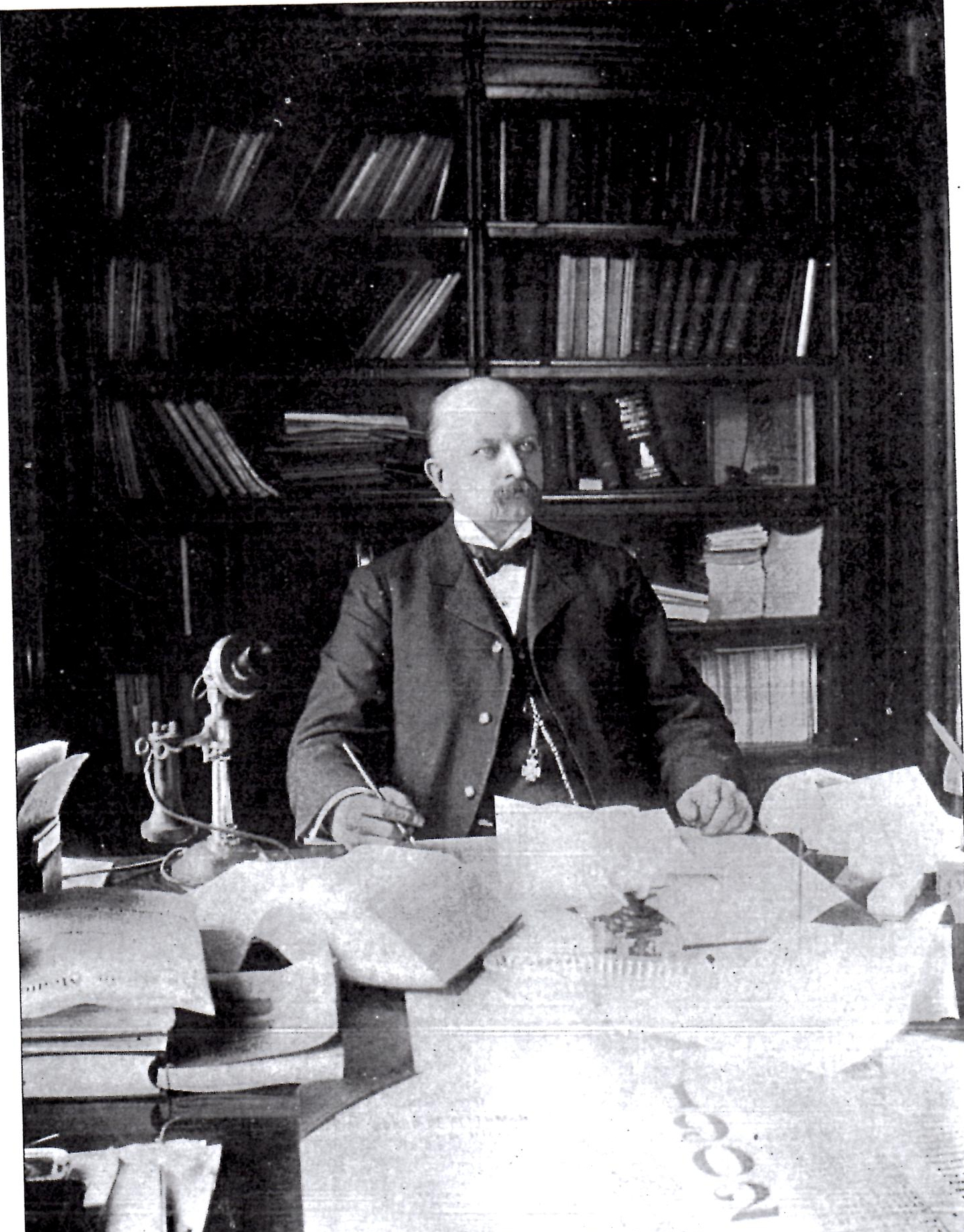
In medical school, Walter Greene was a member of the University Quiz Club, known by U.Q.C.  The U.Q.C. was born out of a society called “The Skulls”.  They rivaled with another society called “The Scalpels”.  Because of the initials, outsiders called the U.Q.C. “You Queer Cusses”.

After two years working in Rochester, Walter Greene practiced medicine in Buffalo for 37 years.  In 1882, Walter Greene was appointed district physician of the City of Buffalo Health Department.  He served for eight years, becoming head of the department.  From 1897 to 1902, he served as assistant health commissioner.  He became Health Commissioner in 1907.

Walter Greene married Mary Pursel of Buffalo in 1878.  They had two children – Frank, who died in infancy, and Clayton.  They lived at 385 Jersey Street, which was also Dr. Greene’s office.  They were members of Plymouth Methodist Church, which is now Porter Hall – The Karpeles Manuscript Library Museum.

    walter greeneDr. Walter D. Greene. Source: Twentieth Century Buffalo, 1902-1903.

Walter Greene was a past potentate of Ismailia Temple, Ancient Arabic Order, Nobles of the Mystic Shrine, a 33rd degree mason, thrice potent master of the Lodge of Perfection.  He was Lieutenant Commander of DeMolay Lodge 498, buffalo chapter Lake Erie Commandery.  He was also president of the New York State Medical Society, member of the American Public Health Association the Erie County Medical Society, Buffalo historical Society, Buffalo Club, and Society of Vermonters.

He died on August 3, 1917 while traveling to West Falls, NY for a family reunion.  He slipped on a rock while walking alongside a creek, landing on his back.  He got up quickly and said he felt fine, but after a few moments was stricken with terrific pain in his back and trouble breathing.  He died just a few moments later.  He is also buried in Forest Lawn Cemetery.

Want to learn about other streets? Check out the Street Index. Don’t forget to subscribe to the page to be notified when new posts are made. You can do so by entering your email address in the box on the upper right-hand side of the home page. You can also follow the blog on facebook. If you enjoy the blog, please be sure to share it with your friends.

Sources:

  • “Kin of Old King Tut and Mummied Pets Are On View Here”.  Buffalo Courier.  March 4 1923, p87.
  • “Dr. Joseph C. Greene Dead”.  Buffalo Evening News.  January 4, 1899, p5.
  • “Greene Street Honors Brothers, Physicians”.  Buffalo Courier Express, April 21, 1940.  Pg. L4.
  • “Masonic Order Pays High Tribute to Dr. Greene”.  Buffalo Courier.  August 7, 1917. p5.
  • “Dr. Greene, Once Commissioner of Health, Stricken”.  Buffalo Courier.  August 4, 1917, p4.

Read Full Post »

Older Posts »

Field Notes

Live from Buffalo, NY

Grants.gov Community Blog

Connecting the grant community to #LearnGrants

Dienna Howard

I create, therefore I am.

Hidden Waters blog

Companion blog for the book "Hidden Waters of NYC"

Hoping for a Tail Wind

Because I definitely brought way too much gear.

priorhouse blog

Photos, art, and a little bit of LIT.

Sheepie Niagara

Bleating the Beat Since 2015