Oh hi. Is anyone out there? It’s me, Angela, posting on my blog again for the first time in more than a year! Sorry for the lack of updates. Things have been crazy; a lot of life has happened. I have missed you all, and I have missed writing. In my last post about Mr. Edward Butler, I even teased the promise of a new post about the bequests in his will. I apologize for the teasing and then falling off the face of the earth for a year! I will get back into that post as I ease back into my research routine. Thanks for your patience. That post will be coming eventually. For today, I figured for my tiptoe back into the swing of things, we’d start with a small, one-block street. Rand Avenue may be a short street, but this story packs a punch – multiple beautiful houses, banks, landmarked downtown buildings, and more!
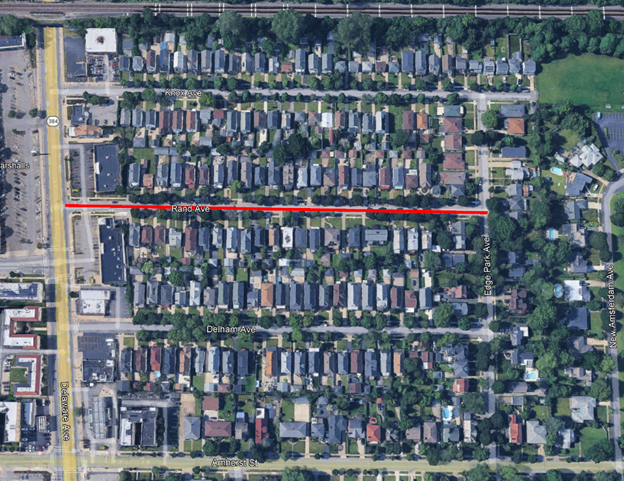
Rand Avenue is highlighted in red.
Rand Avenue is a one-block-long street between Delaware Avenue and Edge Park Avenue in the Park Meadow neighborhood of North Buffalo. Rand Ave is unique in Buffalo in that it was named for someone who was still alive at the time. It is named for George Franklin Rand, a banker. After the street was built, Mr. Rand and Seymour H Knox, for whom the adjacent Knox Avenue was named, would drive around the streets, trying to determine whose street was better. I would love to have been in the car with them while they talked up their streets; each would insist that their street was the superior street! Mr. Rand would say that he was amused that the street was named after him. The area was developed by The George B. Ricaby Company as the Park Edge Acres subdivision.
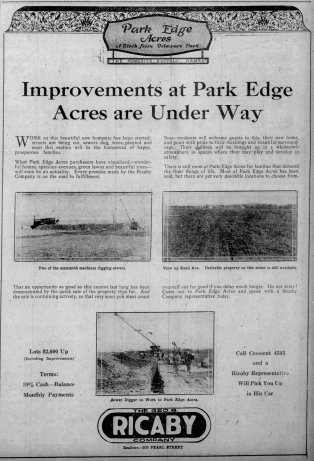
Newspaper Ad From the Ricaby Company for the Park Edge Acres Development, 1923. Source: Buffalo Courier.
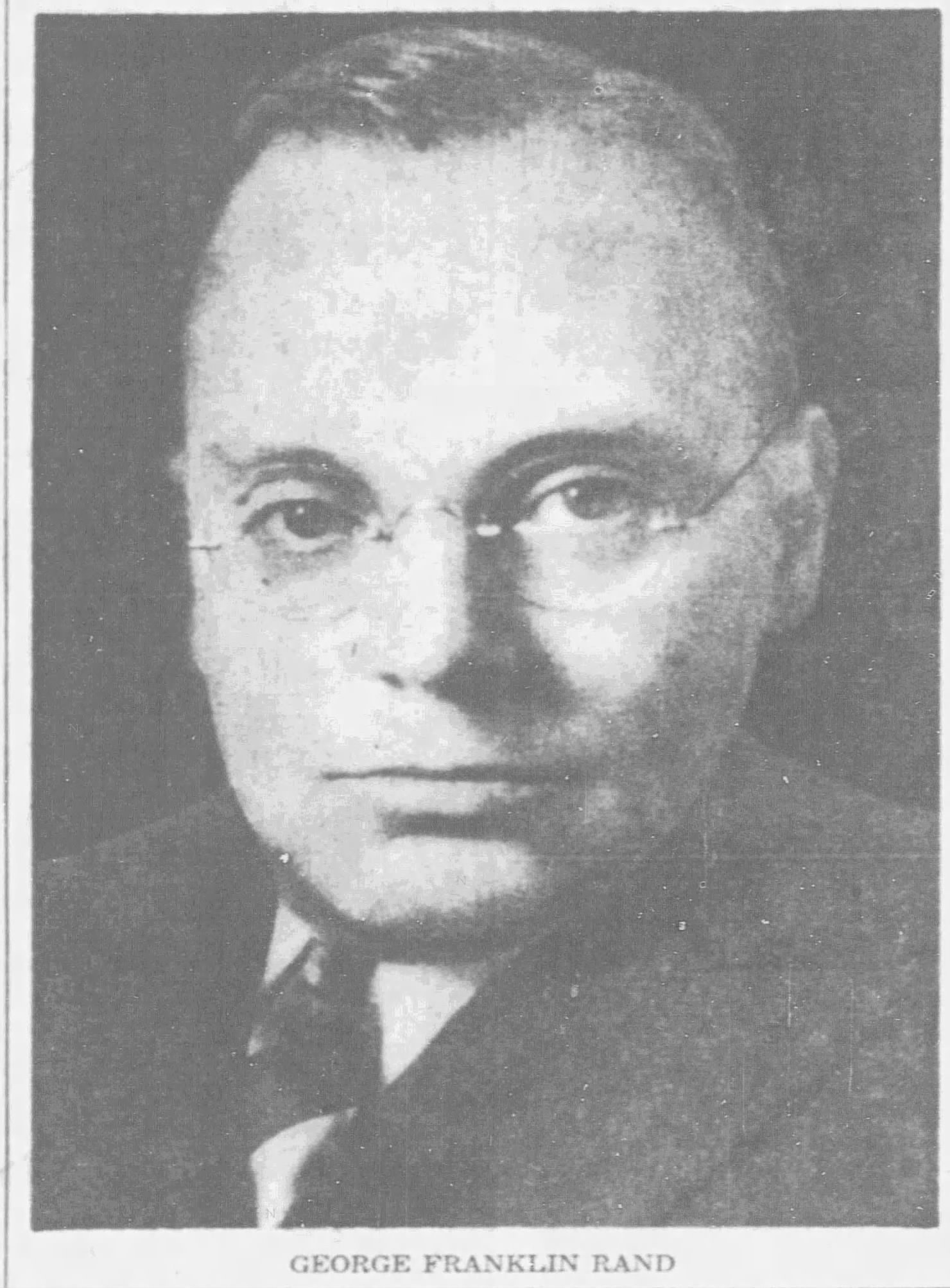
George Franklin Rand.
Source: Buffalo News.
George Franklin Rand was born in North Tonawanda in December 1892. He was the son of George Franklin Rand Sr. and Vina Rand. George Sr was a native of Niagara County and took up banking as President of the Columbia National Bank, then the Marine National Bank (which later became the Marine Trust Company). George Jr, the son and our subject today, attended School 16 of Buffalo, Lafayette High School and the University of Pennsylvania. George Jr graduated from the Wharton School of Finance in 1916.
Mr. Rand began working for his father at the Marine Trust Company after his graduation in 1916. By August 1920, he was made a Vice President of the bank. He served as President and Director of Marine Trust Company and the Marine Midland Corporation, Chairman of the Board of Directors of the Marine Midland Group, Inc., and a Director of the Marine Midland Trust Company of New York. He also served as Director of the Buffalo branch of the Federal Reserve Bank of New York, Remington Rand, Inc., Forest Petroleum Corporation, Garlock Packing Company, Durez Plastics and Chemicals and Dunlop Tire and Rubber Company.
George Rand Sr, the father, was killed in an airplane crash in 1919. While in France in 1919, Mr. Rand Sr had proposed a monument on the battlefield of Verdun as a symbol of the heroism of the French defenses. Mr. Rand Sr and offered to place 500,000 francs at the disposal of the American ambassador to France to build the monument, but he was killed in a plane crash before the details were carried out. Mr. Rand Jr and his siblings took up the cause and proceeded with the erection of the monument.
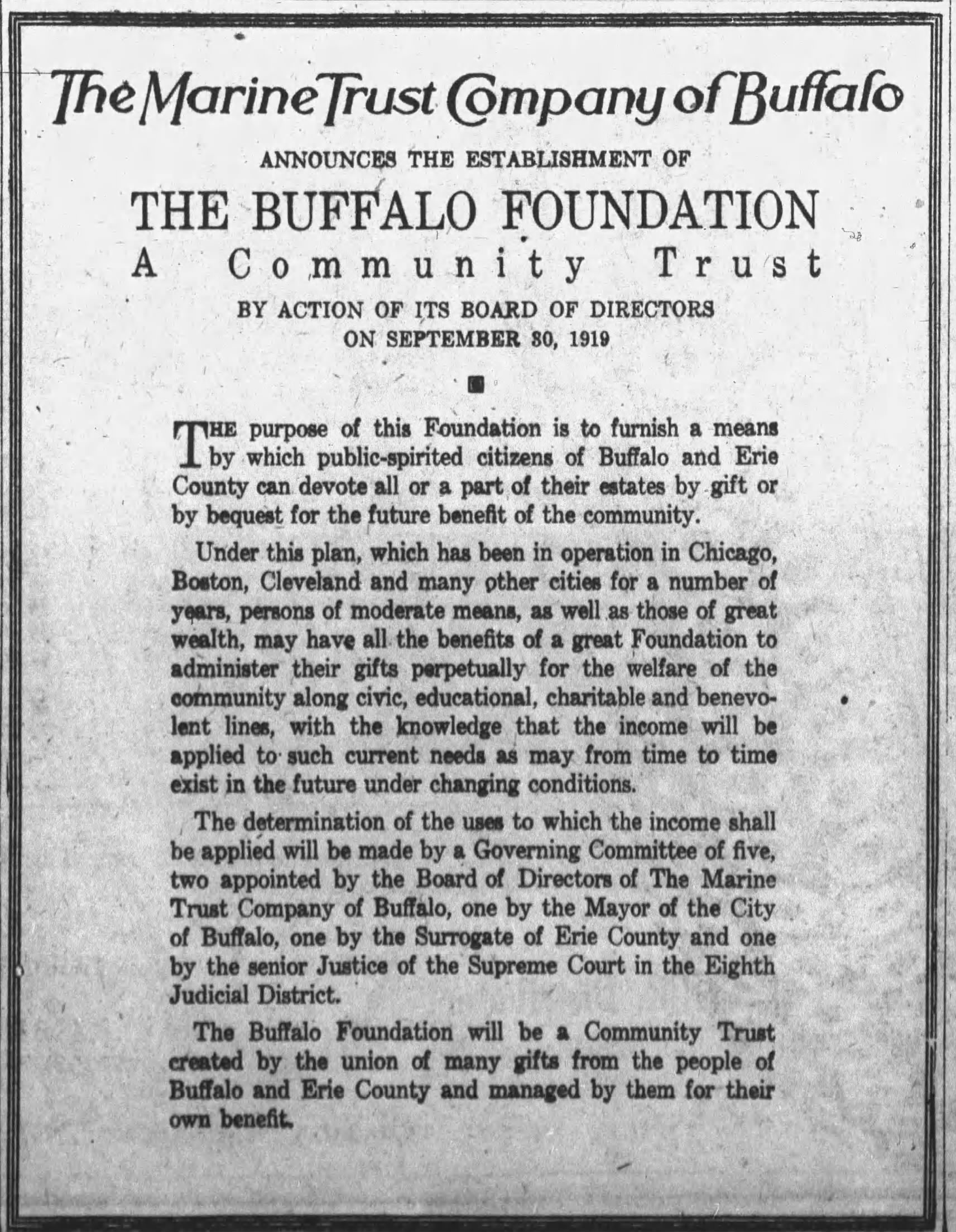
Announcement of the creation of the Buffalo Foundation, October 1919, in the Buffalo News.
Before his death, George Sr had begun work to start to create a community foundation after visiting the first community foundation in Cleveland, Ohio. Following Mr. Rand Sr’s death, George Jr, worked with the Board of Directors of the Marine Trust Company to establish the Buffalo Foundation as a means of administering gifts and bequests to local charities. George and his siblings created the Mr. and Mrs. George F. Rand Memorial Fund as the foundation’s first endowment. The fund was designed to support the changing needs of the community. The Buffalo Foundation changed its name in 1998 to the Community Foundation for Greater Buffalo, due to its work throughout the WNY Region. The Community Foundation is still around today and has done a lot of great work over the past 107 year. You can learn more about their work over the years on their website here: https://www.cfgb.org/about/history/
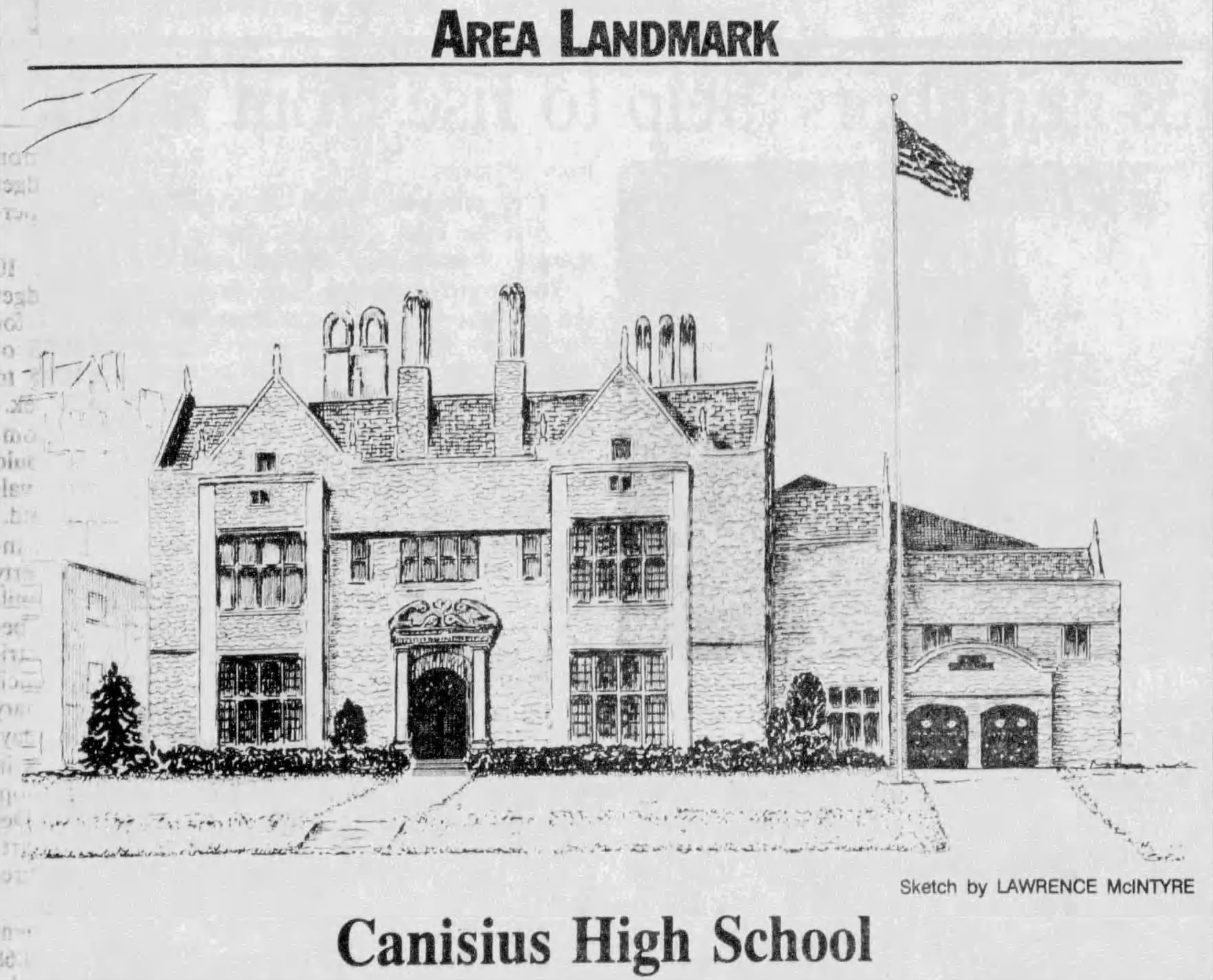
Canisius High School, formerly Rand Mansion on Delaware. Source: Buffalo News, Jan 1994
Mr. Rand Sr had been building a large mansion on Delaware Avenue when he died. The house was designed by William and Franklyn Kidd. Following Mr. Rand Sr’s death, George Rand Jr, at the age of 27, became caregiver and guardian for his younger siblings, Evelyn (19), Gretchen(17) and Calvin(13). The mansion was completed in 1921, and the Rand siblings moved in. They lived in the mansion only until 1923, when they sold it to the Freemasons, who converted it into the Buffalo Consistory. In the 1940s, the building became part of Canisius High School and is currently known as the Koessler Academic Center.
George Rand Jr. was described in his obituary as being “mild-mannered, affable and exceedingly human”, far from the attributes commonly attributed to a powerful banker. He was instrumental in bringing the merger that formed the Marine Trust Company and the Marine Midland group of banks in 1929. This came about because branch banking was not permitted outside Buffalo’s city limits. Mr. Rand saw the advantages of a branch-banking system because it brought banking services closer to business centers. Mr. Rand conceived the idea of a group banking project in which the controlling interest in a statewide group of banks would be acquired by a holding company. This became the Marine Midland Corporation, with Mr. Rand at the head. The project was launched just shortly before the stock market crash in 1929. Mr. Rand continued through the difficult period with confidence and optimism, not letting the Great Depression dampen his enthusiasm for his idea, and kept adding banks to the group while banking was going through very dark days.
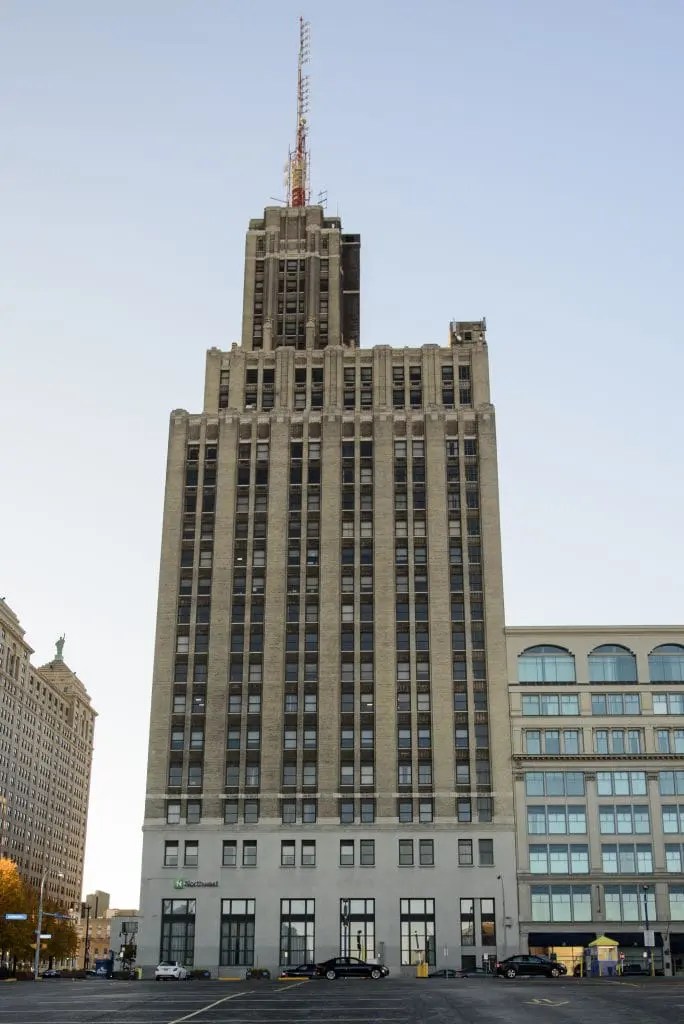
Rand Building on Lafayette Square
Mr. Rand also oversaw the construction of the Rand Building, which opened on Lafayette Square on May 1, 1929. The building is dedicated to and named for his father, George Sr. The lobby has a plaque which reads: “The directors of the Marine Trust Company of Buffalo dedicated this building as a memorial to the late George F. Rand (Sr). in appreciation of his worth as a citizen, and the outstanding services rendered by him to the Marine Trust Company of Buffalo and its predecessors, the Marine National Bank , Bankers Trust Company of Buffalo, Central National bank and Columbia National Bank as chief executive during the period from 1901 until his death in 1919.”
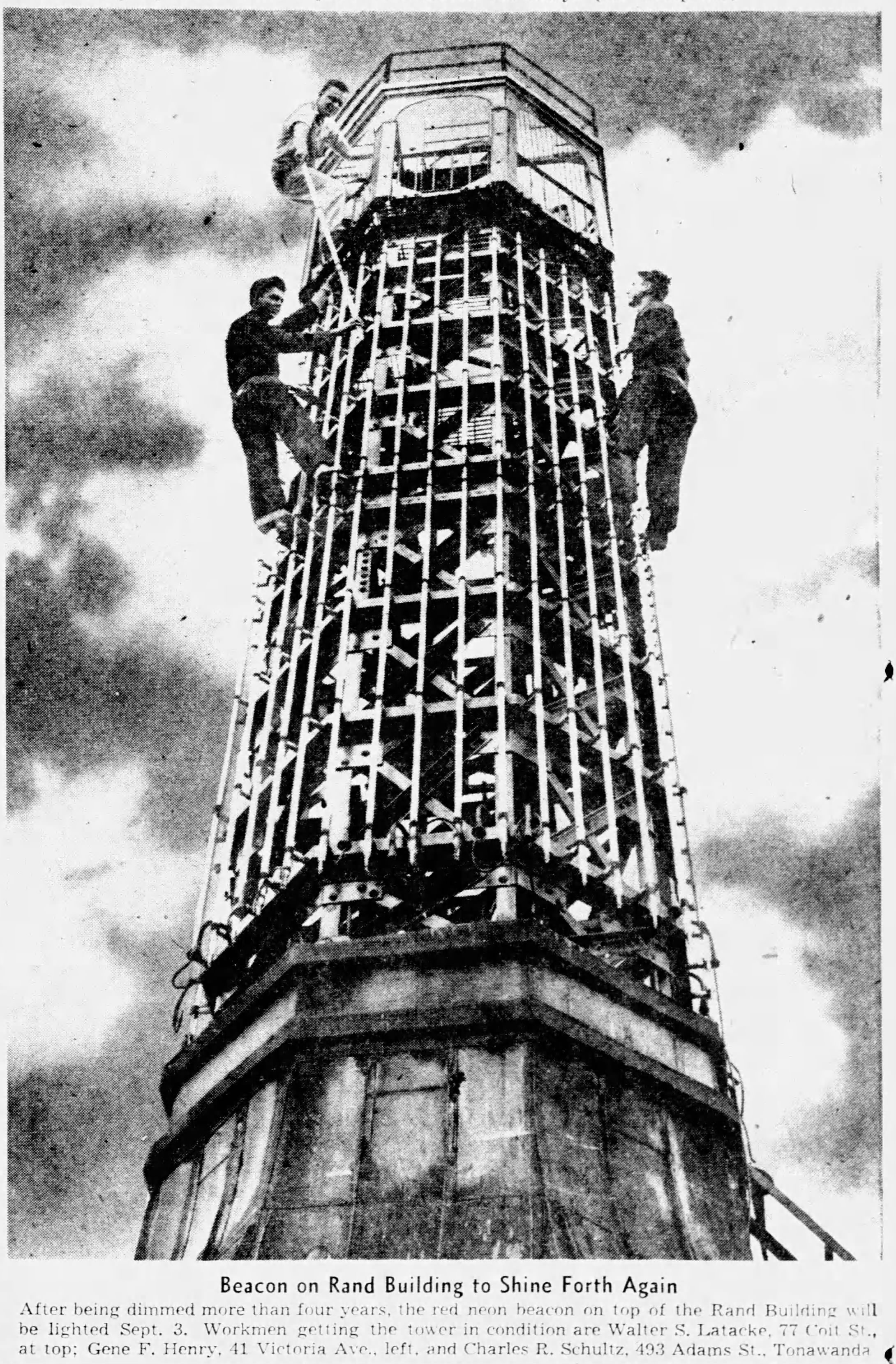
Workers fixing the beacon lights on the Rand Building, August 1929. Source: Buffalo News
The Rand Building is a 26-story Art Deco skyscraper. It was the tallest building when it was completed, until the completion of what was originally Marine Midland Tower. It was also home to an airport beacon light when it opened. George Rand III, at age 6, was the one who turned on the beacon light on May 2, 1929. The beacon had two searchlights: one stationary, directed towards the airport, and the other a revolving light. The revolving light rotated twice a minute. The airport directional light was white, and the revolving light was red. The searchlights were placed at the very top of the tower, which was covered with neon tubes that glowed red. The lights were blacked out starting in May 1942 due to wartime restrictions. The lights were relit on September 4, 1946. When they went to relight it, the airport beacon came on, but the rotating light did not, due to technical difficulties. I was unable to determine if the rotating light was ever fixed or when the beacon ceased to be lit. In 2022, building owner Paul Kolkmeyer relit the top portion of the building after a long period of darkness.
One of the first tenants in the Rand Building was Buffalo Broadcasting Company, who broadcasted their affiliated stations – WGR, WMAK and WKBW out of the Rand Building. Because of WGR’s location in the Rand Building, an oft-repeated rumour persists that the GR in WGR stands for George Rand. The call letters were likely assigned at random, but I think it’s a very fitting coincidence indeed! I’m still going to think George Rand every time I hear WGR! Today, Townsquare Media operates out of the Rand Building – including WBLK, WBUF, WTSS and WYRK.
The Rand Building is also still home to a bank space, which was Marine Midland until 1999 when it became HSBC Bank. In 2011, it became a First Niagara Bank and is now operated by Northwest Bank. This is my bank. My first bank account from when I was seven was at the Marine Midland at Main and Harlem in Snyder, so when I moved downtown, I started using the HSBC here and have continued through the various changes. The bank is one of my favorite interior spaces ever! If you ever stop into this bank, look up at the ceiling; it is a real treat!
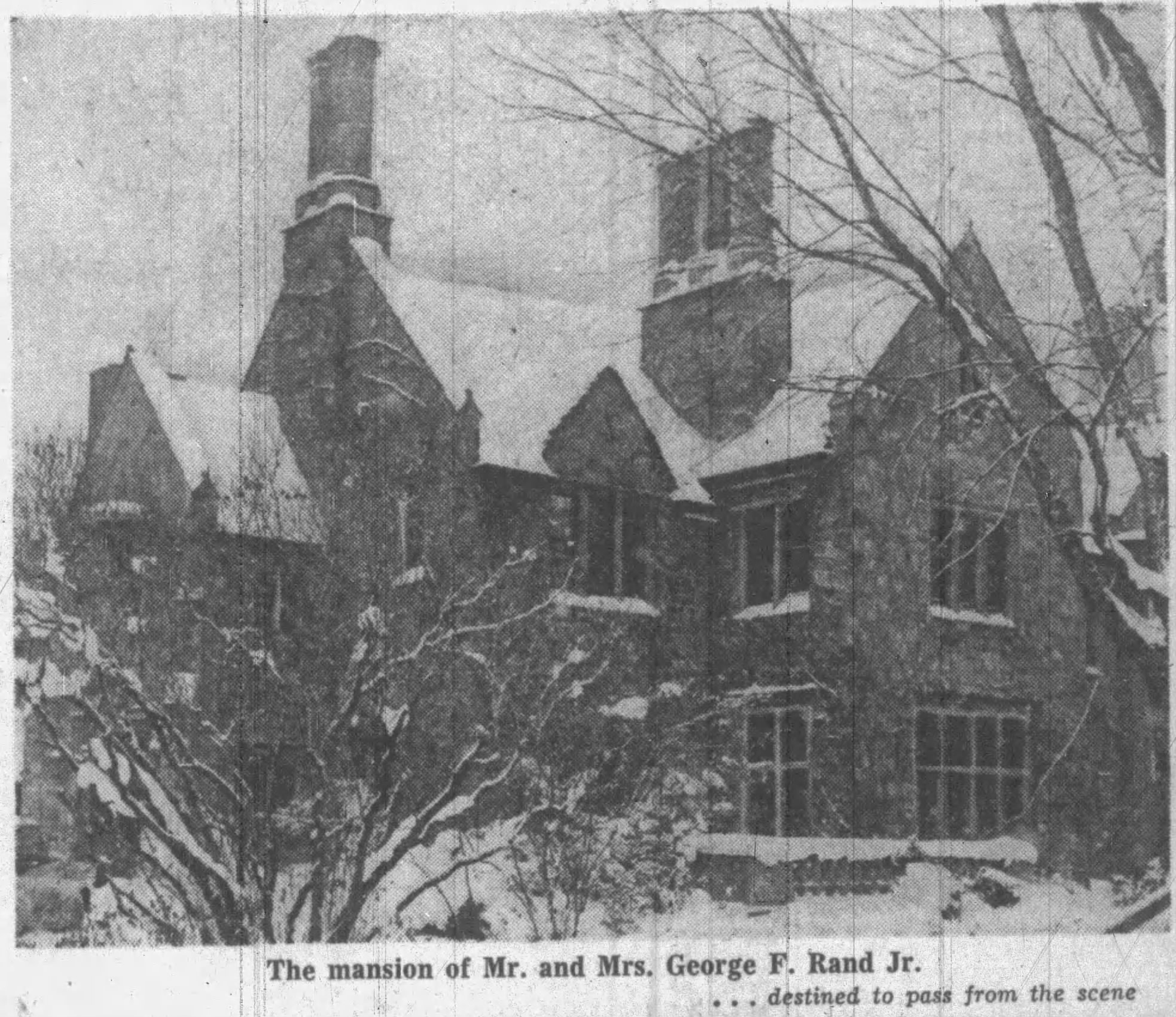
Rand Family Home, Nottingham. Source: Buffalo Courier Express, December 1955.
Mr. Rand married Isabel Hadley Williams in 1922. Mr. and Mrs. Rand moved into the house on Delaware Ave with George and his siblings. They had five children – George F III, Calvin Gordon, Isabel Hadley, David, and Nancy. Sadly, David died after just six days in 1934, and Nancy died after just two days in 1936, leaving just the older three siblings who lived to adulthood. The family lived in a house they built in 1928 at 161 Nottingham Drive. The house cost $500,000 to build at the time(about $9.5 Million in today’s dollars). When the house was built, the Rand family had a model of the house built, four feet high by six feet wide, complete with electricity. The architect designed it for Mrs. Rand so she could better visualize the house. The house was built out of grey stone and had 44 rooms. It was said to resemble a castle. There were 44 switches for station calls to servants, 12 large bathrooms, a private telephone system, three furnaces, an elevator and a loudspeaker system. The entrance door was a square of wrought metal set within carved oak paneling. One of the most impressive rooms in the house was the main dining room, which had an imported marble fireplace mantel and frame, and a huge chandelier with myriad prisms. The floors were made of parqueted oak and oak planks. In the breakfast room, the floor was made of squares of white Italian marble and black Belgian marble. There were two kitchens and a butler’s pantry. Upstairs was a maze of bedrooms and bathrooms. Mrs. Rand’s bathroom was decorated all in a delicate blue, with a cloud effect on the ceiling and silver stars. Behind one of the walls in Mrs. Rand’s bathroom was a secret wall safe with an electrified panel that would open to reveal the safe. The lights throughout the house could be controlled from switches in Mr. and Mrs. Rand’s primary bedroom. In 1940, the staff at the house included 55-year-old cook Ella Mathewson, 51-year-old nurse Dora Ellis, 49-year-old maid Margaret Anderson, and 50-year-old chauffeur William Petrie and his wife, Lydia.
Mr. Rand was involved with several local philanthropic and cultural groups. He was a Chairman of the Board of the Buffalo Foundation, he led YMCA drives, and was a member of the Board of Buffalo General Hospital, the University at Buffalo and the Ingleside Home. He was also Secretary of Children’s Hospital. Mr. Rand was involved in the erection of Kleinhans Music Hall.
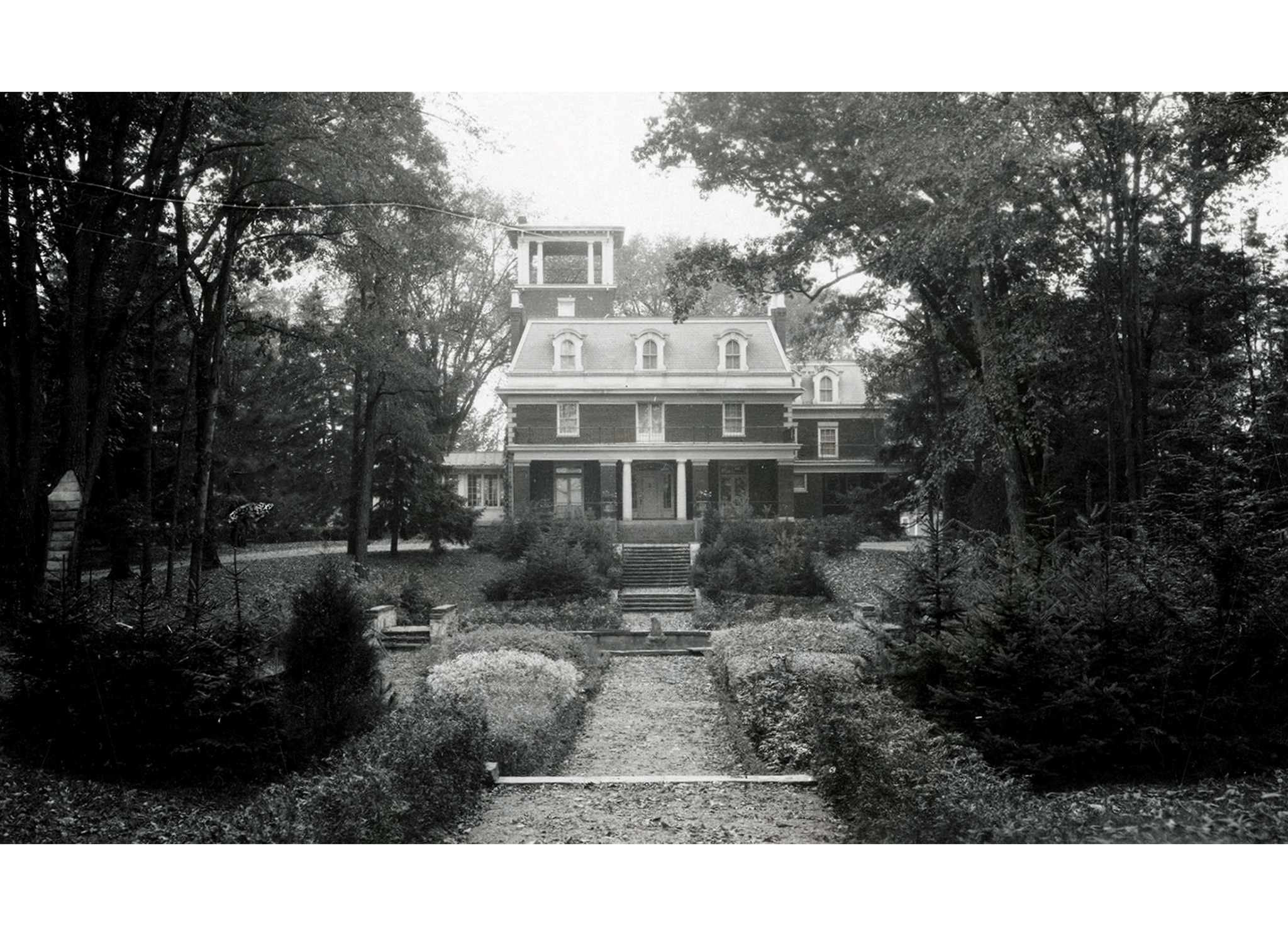
Historic Image of Randwood from the 1920s. Source: ERA Architecture
Mr. Rand also enjoyed swimming and tennis. He was also known for taking his friends on buggy rides along Niagara-On-The-Lake. Their summer estate in Niagara-on-the-Lake was known as “Randwood”. Randwood comprises about 35 acres with a stone wall. The property and the house, called Woodlawn, were purchased by George Rand Sr in October 1910. George Sr added porches to the front and western sides of the house and added a solarium to the east, and renamed it Randwood.
George Rand’s sorrel bobtail horse was named Random. He also collected books on the history of the Niagara Frontier. He was a member of the Buffalo Club, Buffalo Country Club, Saturn Club, Buffalo Athletic Club, Niagara Falls Country Club, University Club, Tennis & Squash, and the Saddle & Bridle Club; however, it was said that he didn’t spend much time at the clubs. He had a private dining room on the top floor of the Marine Trust Company and would dine there with his friends and business associates. The Rand family were members of North Presbyterian Church (which was located at the corner of Delaware and Utica, now the Hellenic Orthodox Church of the Annunciation). Mr. Rand was a trustee at Nichols School. There is a room and Nichols given in memory of his younger brother, Calvin, which was dedicated by Mr. Rand and his sisters. Calvin Rand died suddenly as a 17-year-old Nichols student in 1923 after being stricken with diphtheria.
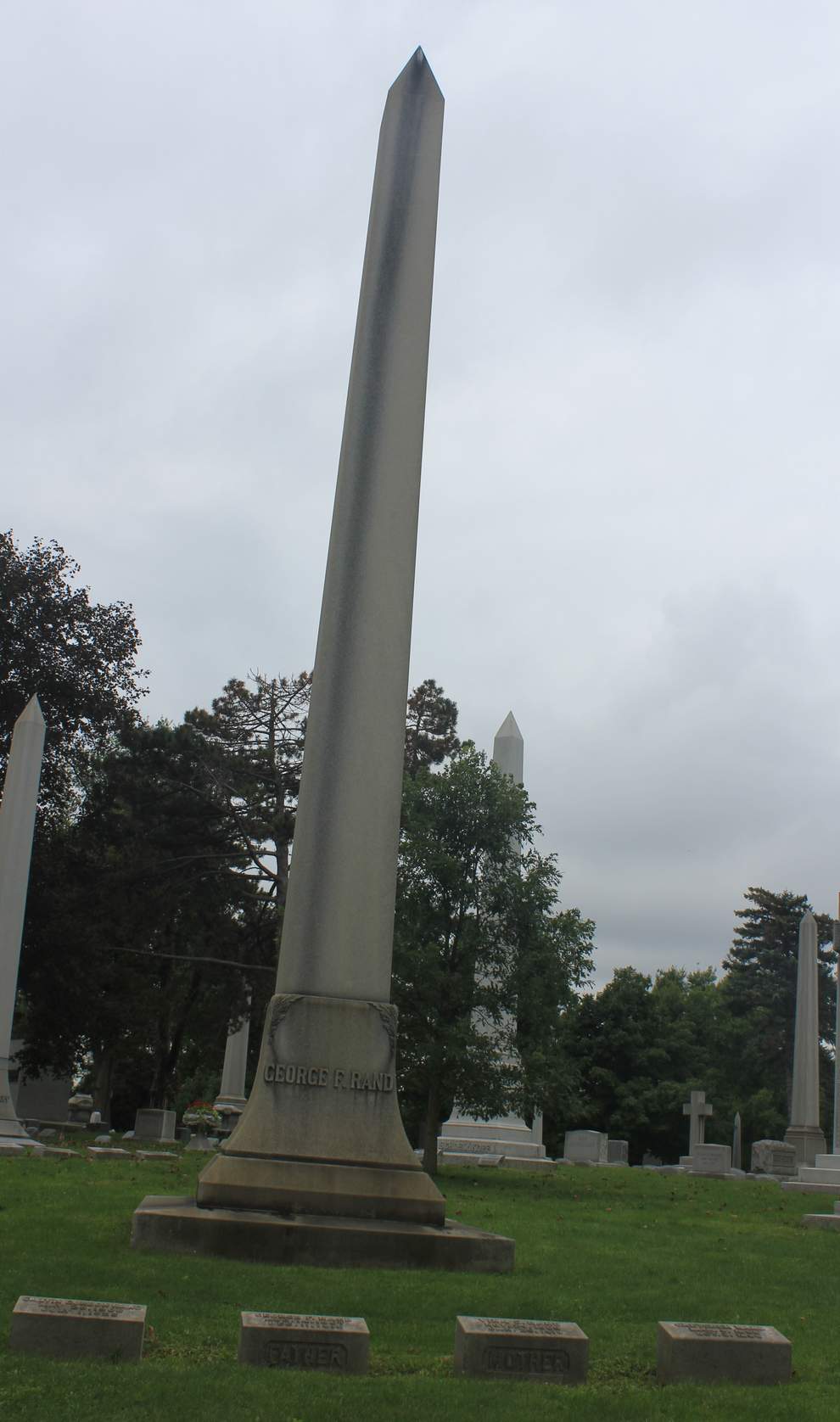
Rand Family plot in Forest Lawn Cemetery
George F Rand Jr died in November 1942. He is buried in the Rand family plot at Forest Lawn Cemetery. Following his death, his will left money to the University of Pennsylvania, the Buffalo Foundation of the Marine Trust Company, Children’s Hospital, Buffalo General Hospital, and North Presbyterian Church.
Mrs. Rand died in 1951. She had been very involved in Children’s Hospital and was a member of the board of the Ingleside Home. When Mrs. Rand died, her estate was listed at $1,615,147(about $19.7 Million in today’s dollars). The Estate was divided between the three children, with bequests made to their servants and employees, as well as to Children’s Hospital, North Presbyterian Church, Westminster Presbyterian Church and the Buffalo Foundation of Marine Trust Company.
Following Mrs. Rand’s death, the family looked at possible uses for their large home. Lady of the Rosary School looked at the school as a possible location. Lady of the Rosary School was located at 745 Washington Street in Downtown Buffalo (also known as Stella Niagara School). They determined that the site was not suitable for the school as there wasn’t room for a gymnasium and auditorium facilities as well as residence facilities for the sisters who would teach there. There was also talk of Westminster Presbyterian Church obtaining the house for use as a Home for the Aged.
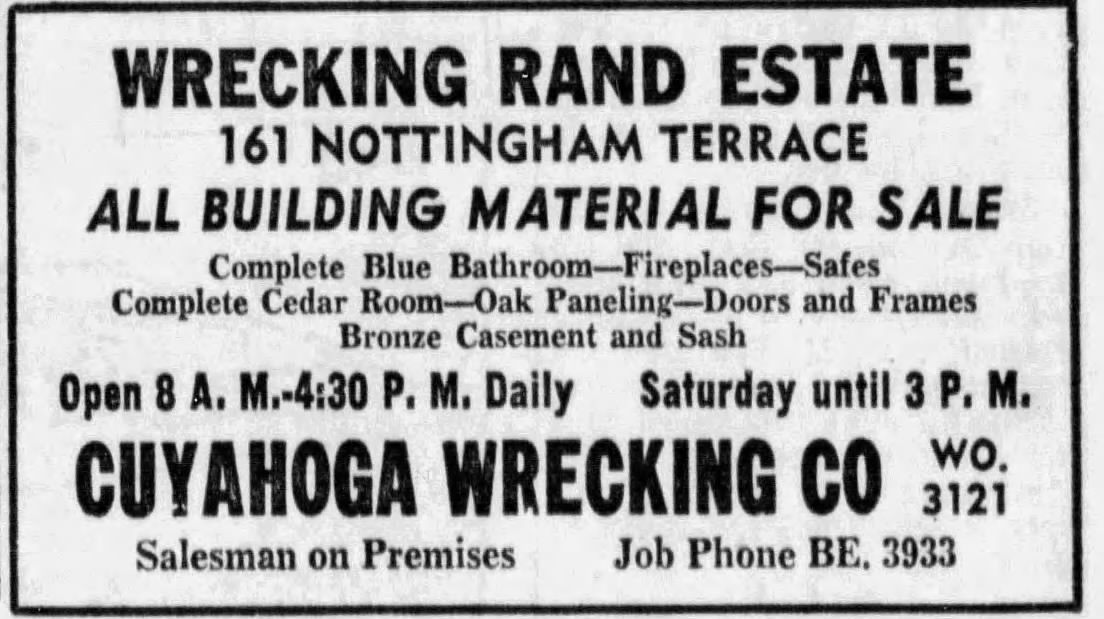
Ad for the Building Materials for Sale during the demo of the Rand Estate. Source: Buffalo News, 1955.
The Rand Mansion could have become Buffalo’s Gracie Mansion! The Rand family offered the house to the City of Buffalo for $50,000 to serve as the official mayor’s residence, but the City declined the offer. In 1955, the Rand family home and property on Nottingham were acquired by Buffalo Attorney Samuel B Darlich, who demolished the house. During the demolition of the home, building materials were made for sale, which included a complete blue bathroom, fireplaces, safes, complete cedar room, oak paneling, doors and frames, bronze casement, and sash. The house took two months to demolish.
After the house was demolished, the property was purchased by Joseph Troidl, a contractor and developer. Four luxury homes were to be constructed on the site of the house, with the apartment-garage building from the property converted into a fifth single-family home. Only three of the new homes were built on the site, with the remaining lot still empty to this day. A new cul-de-sac was constructed to access the homes, named Randwood Lane, in honor of the history of the site and their summer home. So Mr. Rand actually has two streets named after him; he would probably find that doubly amusing!
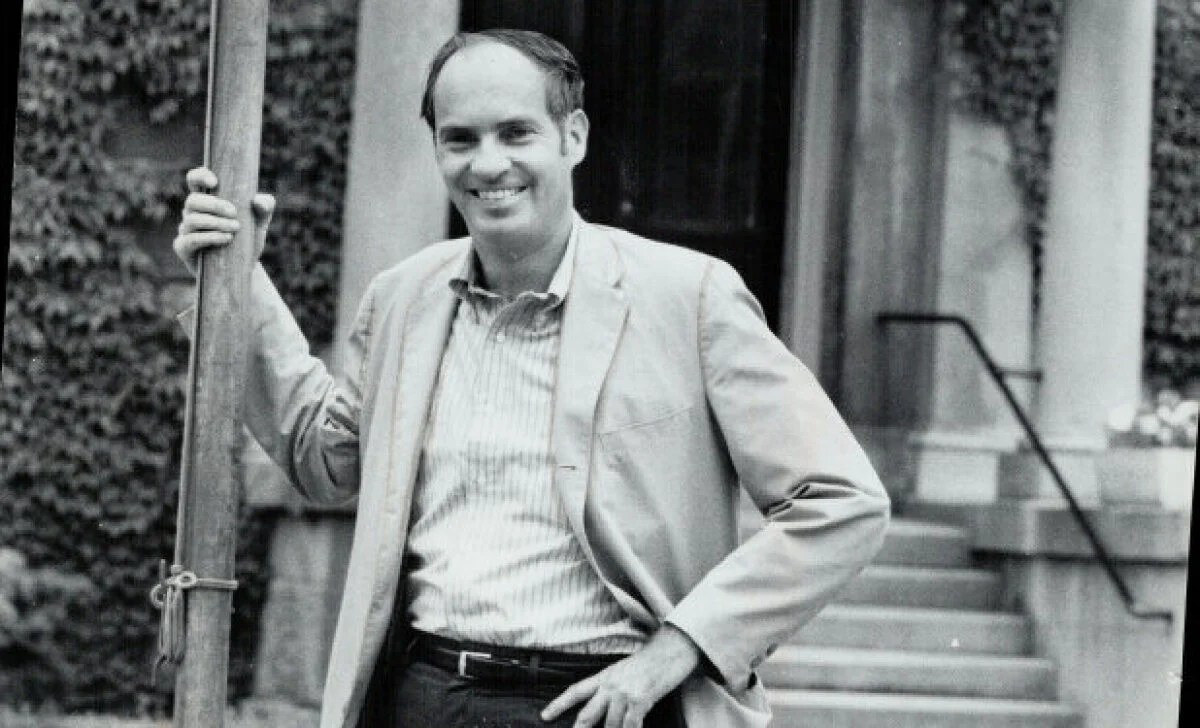
Calvin Rand, founder of the Shaw Festival. Source: Toronto Star
George Jr’s children inherited Randwood in Niagara on the Lake after his death. Son Calvin Rand spent the most time there. In 1962, Brian Doherty was living in the gatehouse at Randwood when he and Calvin founded the Shaw Festival. Calvin was President of the Board of Directors of the Shaw Festival until 1979 and remained on the board until his death in 2016. The Shaw Festival still runs today and is the second-largest repertory theater company in North America.
So, the next time you pass Rand Avenue, the Rand Building or Canisius High School, think of the Rand Family and their impact on Western New York and beyond!
Want to learn about other streets? Check out the Street Index. Don’t forget to subscribe to the page to be notified when new posts are made. You can do so by entering your email address in the box on the upper right-hand side of the home page. You can also follow the blog on Facebook. If you enjoy the blog, please share it with your friends; It really does help!
Sources:
- Smith, H. Katherine. “Banker Rand Finds It Amusing to Have a Street Named After Him”. Buffalo Courier Express. July 13, 1941, s7-p6.
- “George F Rand, Banker, Dies in Home After a Brief Illness”. Buffalo News. November 19, 1942, p1.
- “Reflections in the Social Mirror.” Buffalo Evening News. July 7, 1956, p5.
- “Nottingham Mansion Now Unsuitable for Use as a School”. Buffalo News. May 10, 1955, p11.
- “Rand Mansion is Proposed as Mayor’s Official Home.” Buffalo News. May 28, 1955, p16.
- “Mrs. George F Rand’s Estate is Appraised at $1,615,147 Gross.” Buffalo News. September 19, 1953, p20.
- “Mrs. Rand’s Will Divides Estate Among Children.” Buffalo Evening News, November 21, 1951, p13.
- “Presbyterians May Establish Home for Aged.” Buffalo News. July 29, 1952, p8.
- “Fabulous Rand Mansion Being Torn Down: A Castle Passes From its Nottingham Terrace Site”. Buffalo Courier Express. December 4, 1955, p33.
- Facilities. Canisius High School. https://www.canisiushigh.org/about/facilities
- “BBC Installs Technical Equipments in Duplicate.” Buffalo Courier Express. May 5, 1929, p22.
- “Rand Building Aglow in Colored Lights.” Buffalo Courier Express. May 2, 1929, p15.
- “Lights Go On Again Atop Rand Building.” Buffalo Courier Express. September 4, 1946, p20.
- “Calvin G Rand Dies Suddenly.” Buffalo Times. July 2, 1923, p3.
- Masson, Elizabeth. Randwood: Triumph and Tragedy for the Rand Family. Niagara Now. https://niagaranow.com/news.phtml/4840-randwood-triumph-and-tragedy-for-rand-family/
- Masson, Elizabeth. Randwood Part 4: Calvin Rand and the Modern Era. Niagara Now. https://niagaranow.com/news.phtml/4842-randwood-part-4-calvin-rand-and-the-modern-era/
 Discovering Buffalo, One Street at a Time
I love these historical stories! I’m going to check out your Knox Ave piece.
Great to have you back! Hope you’re planning some walking tours this summer!
I am hoping to do tours!
Interesting! Glad your back. Mom
Wonderful as always and delighted you’re back! Keep ’em coming!
Sarah G Kinney
You have been missed!!!
Get Outlook for iOShttps://aka.ms/o0ukef
Great to have you back. Your articles are always interesting with plenty of family history. Hope you can do one about any of the streets in Sloan. I used to live on Rutland.
Mike Ponichtera – in Oregon since 1975.
I actually have a post I have started with to explain why Lackawanna street is in Sloan! Also, I just went to Kiebzaks for a fish fry last week. 🙂
Angela,
WOW – what an awesome article .. thank you for sharing this information –
xo, mary
Thanks Mary!!
Love your stories, Angela! I worked in the Butler Mansion and after that, the carriage house of it, for several years when I was Legal Administrator for Delaware North. I know that mansion like the back of my hand if you need any info on it (or it’s secret room!)
Judy Tucker
Angela,
Loved this history…..it had everything…mansions, marriages, three generations of goings on. The best part was learning about the Niagara on the Lake and Shaw Theater connection. Reading all of it was like watching a movie in my head !
Thanks so much.
Sheila Marie Long