
Roesch Ave in Riverside shown with red line on map
Roesch Avenue runs between Tonawanda Street and Kenmore Avenue in the Riverside Neighborhood, near the northwestern edge of the City of Buffalo. The street is named for Louis Roesch. The Roesch (pronounced like fresh) family is a family of butchers still known in Buffalo today!
Louis Roesch came from Baden, Germany in 1869 with his brother Jacob. Louis and Jacob worked as butchers, so Buffalo was a logical pace to come, as we were a center of meat processing. They quickly got jobs here in Buffalo and lived frugally to save money to establish their own butcher shops.
Louis established his butcher shop at 1923 Niagara Street in Black Rock, with a barn and slaughterhouse at the corner of Hamilton and Dearborn Streets. Louis was eventually able to take over the North Buffalo Hotel at 1921 Niagara Street (at the corner of Hamilton Street), where he operated a restaurant and continued with his butcher shop. His slaughterhouse was on the grounds, and he kept a few extra cows to supply fresh milk.
Louis and his family were known for their love of dances. They hosted regular dances at the North Buffalo Hotel. They were strict, old-school Germans, so the dances were “decorous and dignified -the sort of dances parents of the neighborhood were pleased to have their sons and daughters attend.”
Louis would return to Germany several times to go back home to visit his family. On one of the visits, he convinced his brother George Frederich (Fred) to join them in Buffalo.
Louis Roesch was a lifelong Democrat and friend of Grover Cleveland. He was elected Alderman of the old 12th ward in the 1885 and served two terms. In an article describing the candidates running for Alderman, the Buffalo Express described him as “grey, sparsely built, and is passionately fond of red neckties.”
While Alderman, Louis Roesch had the first asphalt pavement laid in Black Rock, up Niagara Street. At the time, some of the streets had been paved with cobblestones, but the majority of Black Rock’s streets were dirt roads at the time. Residents in the area had to have their coal delivered during the summer. The roads would be muddy in the fall and too snowy/icy in the winter, so the coal trucks were unable to deliver since the roads were impassible. He was also instrumental in the construction of the Hertel Avenue sewer while he was Alderman.
In 1888, the land that would become Roesch Avenue was part of the large tract of land that was purchased by Louis Roesch, John Hertel, John Esser and Frank Argus as the Black Rock Land Company, one of the first development companies in Buffalo. Streets were named after each of the men. The land was purchased at the low price of $1/foot.
After buying the land, Mr. Roesch worked in the Real Estate business, while continuing to manage his hotel, butcher shop and slaughterhouse. He was known for helping young men get a start in life and being generous with his time and money.
Mr. Roesch loved horses and was proud of his ability to pick fast horses. Once, at an auction, he picked up what was supposedly a washed up race horse for $10. His neighbor teased him for buying the horse. Mr. Roesch bet the neighbor $100 that his new horse could beat any of his neighbor’s horses in a race from Niagara and Amherst Street to Niagara and Main Street downtown. Mr. Roesch’s horse won!
Louis married Rosina Rupp, who lived in Buffalo but had come from the same village in Germany where Louis had lived as a boy. They had thirteen children. The family lived at 276 Dearborn Street. They were members of St. John’s Evangelical Church, at 85 Amherst Street.
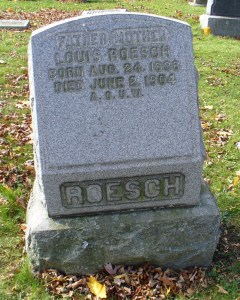
Louis Roesch Grave, Forest Lawn Cemetery.
Louis died June 3, 1904 at age 65 from Bright’s Disease (kidney disease now called nephritis). After his wife Rosina’s death in 1920, the five remaining Roesch children – Louis, Edward, Charles, Caroline and Rosina moved to Seattle, Washington with their families.
So remember how Louis Roesch came to Buffalo with his brother Jacob P. Roesch in 1869? While Louis has the street named after him, Jacob’s side of the family tree is better known in Buffalo these days! Jacob P. Roesch also worked as a butcher here in Buffalo until 1895, when he went into the confectionary business.
Jacob P. Roesch’s son, Jacob M. Roesch entered the meat business at the age of 13 as a clerk in the meat market of Andrew Rupprecht. He spent time time in Cleveland, St. Louis, Kansas and Pennsylvania learning the meat business. Jacob M Roesch returned to Buffalo to opened a stall at the Washington Street Market in 1878. He also operated a packing house on Oak Street and a meat market at the corner of Ferry and Niagara Streets. He oversaw a large shipping trade. In 1895, Jacob M. Roesch was appointed Market Clerk of the Washington Street Market by Mayor Jewett. The Market Clerk managed the markets, keeping market records and helping the market run efficiently.
Jacob M. Roesch married Julia Fuelhart in 1880. They had three children – John Jacob, Charles Edward, and Lillian Philipene. Their family lived at 613 North Oak Street.
Charles and John Roesch took over their dad’s market stand at the Washington Street Market. The business was named Jacob M Roesch & Sons in 1911. Their stall was number 2, at the Chippewa end of the Market.
In 1916, Charles and John decided to take separate paths and Charles opened a butcher stall in the Broadway Market as Charles E Roesch & Company. He also opened a wholesale poultry business behind the home at 613 Oak Street.

Mayor Charles Roesch. Source: City of Buffalo Annual Report of the Department of Police, 1932.
Charles E. Roesch was elected Mayor of Buffalo in 1929. He became mayor in 1930, at the time of the Great Depression. Thousands were unemployed both in Buffalo and across the country. As a businessman himself, he intended to run City Hall like a business. He did things differently than previous mayors. He chose to drive his own car. He didn’t like attending fancy dinners or giving speeches. He didn’t want to be considered an exhibit, he wanted to get the work done of city governance rather than parade around. He said “there should be more “we” in the city government and less of “I”. I don’t believe any one man is big enough to run a city.”
Mayor Roesch oversaw relief programs for the unemployed. He created a man-a-block system that was later adopted across the country. Under this system, every street in the City was canvassed and those who were fortunate to have jobs would hire unemployed men to do odd jobs for them. This program provided employment for almost 2000 jobless at a minimum of $15 a week. The program soon provided inadequate as the depression worsened, but it continued to keep thousands off the relief rolls long after government work and home relief became available.
As the Great Depression worsened, the Mayors Unemployment Committee was formed. Alfred Schoellkopf served as chairman. The Committee was so successful, Mr. Schoellkopf was selected to head the New York State Temporary Emergency Relief Agency, which adopted the same methods used in Buffalo across the State. At the end of 1931, Buffalo became the first city in the country to embark on a work relief program, with employment given to people coming from the home relief rolls. It wasn’t until two years later that the federal government, through CWA (Civil Works Administration) created a similar program across the Country. In 1932, Mayor Roesch served as President of the New York State Conference of Mayors, where he fought to have the State help reimburse communities for welfare expenditures. Mayor Roesch’s proposal for the State to provide a 40% reimbursement later was included in the Wicks Act, which was realized in 1936.
While Mayor Roesch is best known for being one of Buffalo’s Great Depression Mayors, one of the other major issues during his term was transportation. Mayor Roesch began planning began for the proposed seaway highway and a new bridge to replace the Michigan Street bridge. These projects were delayed by the Depression, but eventually turned into Furhmann Boulevard and the Skyway.

Mayor Roesch in his brand new City Hall Office, December 21, 1931. Source: Buffalo Times.
Mayor Roesch was the first Mayor to serve in the newly built City Hall. When he first became Mayor, his office was in the Liberty Building on the 11th floor while they waited for City Hall to be completed. The former Mayor’s office was located in the building that we now call Old County Hall on Franklin Street. Old County Hall had originally been shared by the City and the County, but it had been turned over to Erie County during the construction of City Hall. In December 1931, the Mayor’s new office on the 2nd floor of City Hall was ready for Mayor Roesch to move in. Mayor Roesch was the final city official to move into City Hall. However, Mayor Roesch was known for seldom being found in his actual office. He could often be found on the 21st floor where Budget Director Albert Preston’s office was located, or on the 11th floor with Charles Feldman, Corporation Counsel. With his philosophy of leadership by teamwork, he was known for meeting with the department heads in their offices, away from the pretentiousness of the Mayor’s office.
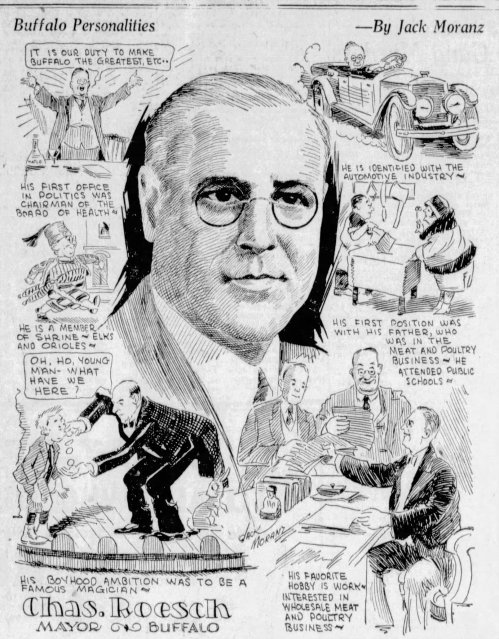
Jack Moranz profile on Mayor Roesch. Jack Moranz was an internationally known artist and cartoonist who sketched a number of Buffalonians during the summer of 1930 for special publication buy the Buffalo News. Mayor Roesch was the first sketch published in June 1930. Source: Buffalo News
Mayor Roesch was only mayor for one term, which was how the City Charter was written at the time. Mayor Roesch felt strongly about the single term concept. While he was Mayor, Council wanted to amend the charter to allow him to succeed himself and remain Mayor. Mayor Roesch refused, saying he would veto any legislation that tried to do so. He felt that his election was under the assumption it would be one term and that it would be unfair to the people of Buffalo for the conditions to change while he was serving.

Mayor Charlie the Butcher, December 1931. Source: Buffalo Times.
While serving as Mayor, Mayor Roesch would still help out as a butcher. Shown here in 1931 (just two days after he moved into his new office in City Hall) helping the Buffalo Restaurant Men’s Association prepare 2000 Christmas baskets for Buffalo’s needy families. After his mayoral term, he returned full time to the meat business. He would often report that his favorite food was roast beef and mashed potatoes.
Charles E. Roesch married Mabel C. Klinck. Mabel’s mother was Julia Fuhrmann, sister of former Mayor Louis P. Fuhrmann for whom Furhmann Boulevard gets its name. Charles and Mabel had two sons, William Klinck and Charles Jacob. The family lived in the upper apartment at 633 North Oak Street, at the corner of Carlton Street, just down the street from where Charles had been born. Oak Street was well known in Buffalo as being the home of three Buffalo Mayors, before the neighborhood was lost to urban renewal. When Charles was elected Mayor, Mrs. Roesch reported that she was accosted by realtors looking to help sell them a house that was a “better fit for a Mayor”. They insisted on staying in the neighborhood they loved dearly. They knew their neighbors well and would not move. They also refused to take on a maid as was suggested to them to indicate their status as a “respectable family of means”. Mrs. Roesch took care of the house on her own. She felt that housework was not an irksome task, but a source of fun and pleasure, so she preferred to do the work herself.

Mayor Charles E Roesch grave in Forest Lawn
Charles E Roesch died on January 15, 1936. He is buried in Forest Lawn. The day of his funeral, the current Mayor George Zimmermann declared a full Civic Holiday in Buffalo in honor of the former Mayor. It was believed by many that if Mayor Roesch had not passed away, he would have ran for a second term in 1937 and won. He was often referred to as “Buffalo’s Greatest Mayor”.
 Mayor Roesch’s son, Charles J. Roesch was born in January 1916. He graduated from University of Buffalo in 1938 and entered the family meat market business with his brother William. Charles J. Roesch became president of the firm in the mid-1960s. Charles J. Roesch married Doris Yuhl in 1939. They had two children, Charles W and Susan. When Susan was married in November 1963, the wedding was on a Wednesday because that was the day that the Broadway Market was closed so that her dad and uncle could attend the wedding! Charles J Roesch was also an avid bowler, serving as president of the Buffalo Bowling Association as well as of the State Masonic Bowling Association. Charles J. Roesch retired from the meat business in the mid-1980s. He passed away in March 1990.

Charlie the Butcher in front of his shop on Wehrle. Source: http://www.charliethebutcher.com
Charles W. Roesch was born in 1949. He grew up around the meat business but decided to attend the University of Toledo, where he received a chemistry degree. The pull to return to Buffalo and join the family business was strong. Charles W. took over the Charles E. Roesch stand in the Broadway Market after his dad’s retirement in the mid-80s. He realized the butcher model needed to change as supermarkets in the suburbs started to draw traffic away from the butcher shops at markets.

Beef on Weck at a Bison’s Game. Because sometimes you don’t want a hot dog (sorry Sahlen’s) Photo by Author.
Charles W Roesch branded himself as Charlie the Butcher beginning in 1984 at a tradeshow. With his trademark branded apron, button up shirt, tie, and bumphat (the hardhat that butchers wear), he started by selling sausage on a stick for $1 and began cooking meats to sell sandwiches through catering. Eventually they started selling their famous hand-carved roast beef on weck. The sandwich, invented in Buffalo in the 1800s is a quintessential Buffalo food, second only perhaps to the Buffalo wing. A lot of the popularity of the sandwich is in part to Charlie himself! In 1993, Charlie took over a former hot dog stand on Wehrle Drive at the Amherst/Cheektowaga border, becoming Charlie the Butcher’s Kitchen in 1993. They opened a downtown “Charlie the Butcher Express” location in the Ellicott Square building a few years later. Charlie’s reputation and charming personality make him a common presenter on food segments on local news shows like AM Buffalo, helping to market the business. He’s done appearances across Western New York and across the entire country – New York, Toronto, Washington DC, Orlando, Chicago, Cleveland, Milwaukee, Dallas and San Diego – and even in Europe in Düsseldorf, Germany, and Lyon, France!
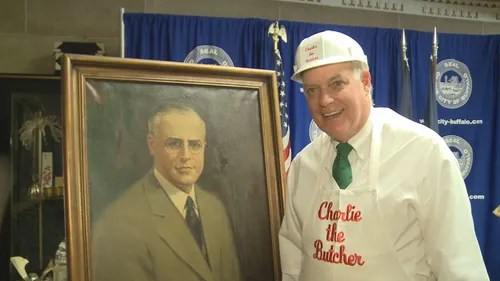
Mayor Charles E Roesch’s portrait and his grandson, Charlie the Butcher, celebrating the 100th anniversary of Charles E Roesch Meats in 2014. Source: WGRZ

Charlie and Bonnie Roesch. Source: Buffalo Business First
Charlie the Butcher can now be found at locations throughout Western New York and as Charlie on Location, the catering side of the business. You can also get Charlie the Butcher cooked roast beef at Dash’s, Market in the Square, and Tops Markets. The company, led by Charlie and his wife Bonnie, are continuing to grow and evolve. They’re now working to expand their reach outside of the 716 area code by making roast beef and weck seasoning mixes available to ship anywhere. That’s right, all of you Buffalo ex-pats who read my blog – you can order your very own make your own beef on weck kit! Head to charliethebutcher.com to learn more.
So the next time you drive past Roesch Ave, think if Alderman Louis Roesch and thank him for paving Niagara Street or remember his Great-Nephew Mayor Roesch or his Great-Great-Great Nephew Charlie the Butcher. And the next time you stop for a Charlie the Butcher sandwich, think of the generations of butchering that has led us to that delicious Buffalo food.
Want to learn about other streets? Check out the Street Index. Don’t forget to subscribe to the page to be notified when new posts are made. You can do so by entering your email address in the box on the upper right-hand side of the home page. You can also follow the blog on facebook. If you enjoy the blog, please be sure to share it with your friends. Interested in getting even more content from me? You can become a Friend of Buffalo Streets on patreon. You can go to https://www.patreon.com/buffalostreets/
I’ll be hosting a Buffalo History Chit Chat on Monday August 14th at 7pm EST. I’ve been busy this summer and haven’t had a chance to host any tours, but I figured we could get together (virtually) and chit chat about Buffalo history! This will be a chance for me to talk with you about some of the current things I’m researching, share some of my favorite history stories, and to answer some of your burning history questions! For more information and tickets, click this link. I’m particularly excited to be able to connect with some of my readers who no longer live in Buffalo! I hope you’ll join me. If this event is successful, it will hopefully be the first of many of these!
Sources:
- Smith, H. Katherine. “Roesch Avenue is Memorial to Area Developer and Alderman”. Buffalo Courier-Express. June 15, 1941, p7-3.
- “Louis Roesch Has Passed Away”. Buffalo Courier. June 3, 1904, p7.
- “Jacob Roesch Dead”. Buffalo Evening News. February 12, 1903. P5.
- White, Truman, editor. Our County and Its People: A Descriptive Work on Erie County, New York, Volume 2. Boston History Company. 1898.
- “Our Story”. Charlie the Butcher website: https://www.charliethebutcher.com/index.php/our-story/
- “John Roesch So Badly Burned That He May Die”. Buffalo Evening News. September 30, 1902. P 18.
- “These Are Our Rulers: Aldermen of the Past, Present and Future”. Buffalo Express.
- “Louis Roesch has Passed Away” Buffalo Courier Express. June 3, 1904, p1.
- Rizzo, Michael. “Charles E. Roesch”. Through the Mayor’s Eyes. http://www.buffalonian.com/history/industry/mayors/Roesch.htm
- Violanti, Anthony. “Days of the East Side Packers”. Buffalo News. May 30, 1990, p17.
- “Charles J. Roesch, businessman, national bowling executive dies”. Buffalo News. March 2, 1990, p33.
- Bermingham, Don. “Buffalo Emerges From An Era of Disillusionment.” Buffalo News. December 30, 1939, p24.
- Wandell, Walt. “Roesch, the Man, as He Reveals Himself on Even of Taking Office.” Buffalo Times. December 29, 1929.
- “Kept Promise, Sons’ Respect, Roesch Says”. Geroge Kennedy. Buffalo Tmies August 13, 1933.
- Drury, Tracy. “With Beef on Weck as Its Calling Card, Charlie the Butcher Continues to Evolve”. Buffalo Business First. July 7, 1923.
- Fiddler-Woite, Julianna and Reverend Jamie Retallack. Lutherans in Western New York. Arcadia Publishing, 2015.
- “Roesch Estate to Be Settled”. Buffalo News. July 5, 1938.
 Discovering Buffalo, One Street at a Time