Feeds:
Posts
Comments

Archive for July, 2023

Screenshot (44)

Roesch Ave in Riverside shown with red line on map

Roesch Avenue runs between Tonawanda Street and Kenmore Avenue in the Riverside Neighborhood, near the northwestern edge of the City of Buffalo.  The street is named for Louis Roesch.  The Roesch (pronounced like fresh) family is a family of butchers still known in Buffalo today!

Louis Roesch came from Baden, Germany in 1869 with his brother Jacob.  Louis and Jacob worked as butchers, so Buffalo was a logical pace to come, as we were a center of meat processing.  They quickly got jobs here in Buffalo and lived frugally to save money to establish their own butcher shops.

Louis established his butcher shop at 1923 Niagara Street in Black Rock, with a barn and slaughterhouse at the corner of Hamilton and Dearborn Streets.  Louis was eventually able to take over the North Buffalo Hotel at 1921 Niagara Street (at the corner of Hamilton Street), where he operated a restaurant and continued with his butcher shop.  His slaughterhouse was on the grounds, and he kept a few extra cows to supply fresh milk.

Louis and his family were known for their love of dances.  They hosted regular dances at the North Buffalo Hotel.  They were strict, old-school Germans, so the dances were “decorous and dignified -the sort of dances parents of the neighborhood were pleased to have their sons and daughters attend.”

Louis would return to Germany several times to go back home to visit his family.  On one of the visits, he convinced his brother George Frederich (Fred) to join them in Buffalo.

Louis Roesch was a lifelong Democrat and friend of Grover Cleveland.  He was elected Alderman of the old 12th ward in the 1885 and served two terms.  In an article describing the candidates running for Alderman, the Buffalo Express described him as “grey, sparsely built, and is passionately fond of red neckties.”

While Alderman, Louis Roesch had the first asphalt pavement laid in Black Rock, up Niagara Street.  At the time, some of the streets had been paved with cobblestones, but the majority of Black Rock’s streets were dirt roads at the time.  Residents in the area had to have their coal delivered during the summer.  The roads would be muddy in the fall and too snowy/icy in the winter, so the coal trucks were unable to deliver since the roads were impassible. He was also instrumental in the construction of the Hertel Avenue sewer while he was Alderman.

In 1888, the land that would become Roesch Avenue was part of the large tract of land that was purchased by Louis Roesch, John Hertel, John Esser and Frank Argus as the Black Rock Land Company, one of the first development companies in Buffalo.   Streets were named after each of the men.  The land was purchased at the low price of $1/foot.

After buying the land, Mr. Roesch worked in the Real Estate business, while continuing to manage his hotel, butcher shop and slaughterhouse.  He was known for helping young men get a start in life and being generous with his time and money.

Mr. Roesch loved horses and was proud of his ability to pick fast horses.  Once, at an auction, he picked up what was supposedly a washed up race horse for $10.  His neighbor teased him for buying the horse.  Mr. Roesch bet the neighbor $100 that his new horse could beat any of his neighbor’s horses in a race from Niagara and Amherst Street to Niagara and Main Street downtown.  Mr. Roesch’s horse won!

Louis married Rosina Rupp, who lived in Buffalo but had come from the same village in Germany where Louis had lived as a boy.  They had thirteen children.  The family lived at 276 Dearborn Street.   They were members of St. John’s Evangelical Church, at 85 Amherst Street.
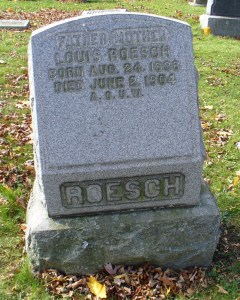
roesch louis grave

Louis Roesch Grave, Forest Lawn Cemetery.

Louis died June 3, 1904 at age 65 from Bright’s Disease (kidney disease now called nephritis).  After his wife Rosina’s death in 1920, the five remaining Roesch children – Louis, Edward, Charles, Caroline and Rosina moved to Seattle, Washington with their families.

So remember how Louis Roesch came to Buffalo with his brother Jacob P. Roesch in 1869?  While Louis has the street named after him, Jacob’s side of the family tree is better known in Buffalo these days!  Jacob P. Roesch also worked as a butcher here in Buffalo until 1895, when he went into the confectionary business.

Jacob P. Roesch’s son, Jacob M. Roesch entered the meat business at the age of 13 as a clerk in the meat market of Andrew Rupprecht.  He spent time time in Cleveland, St. Louis, Kansas and Pennsylvania learning the meat business.  Jacob M Roesch returned to Buffalo to opened a stall at the Washington Street Market in 1878.  He also operated a packing house on Oak Street and a meat market at the corner of Ferry and Niagara Streets.  He oversaw a large shipping trade.  In 1895, Jacob M. Roesch was appointed Market Clerk of the Washington Street Market by Mayor Jewett.  The Market Clerk managed the markets, keeping market records and helping the market run efficiently.

Jacob M. Roesch married Julia Fuelhart in 1880.   They had three children – John Jacob, Charles Edward, and Lillian Philipene.  Their family lived at 613 North Oak Street.

Charles and John Roesch took over their dad’s market stand at the Washington Street Market.  The business was named Jacob M Roesch & Sons in 1911.  Their stall was number 2, at the Chippewa end of the Market.

In 1916, Charles and John decided to take separate paths and Charles opened a butcher stall in the Broadway Market as Charles E Roesch & Company.  He also opened a wholesale poultry business behind the home at 613 Oak Street.

Charles_E_Roesch_-_1932_BPDReport

Mayor Charles Roesch. Source: City of Buffalo Annual Report of the Department of Police, 1932.

Charles E. Roesch was elected Mayor of Buffalo in 1929.  He became mayor in 1930, at the time of the Great Depression.  Thousands were unemployed both in Buffalo and across the country.  As a businessman himself, he intended to run City Hall like a business.  He did things differently than previous mayors.  He chose to drive his own car.  He didn’t like attending fancy dinners or giving speeches.  He didn’t want to be considered an exhibit, he wanted to get the work done of city governance rather than parade around. He said “there should be more “we” in the city government and less of “I”.  I don’t believe any one man is big enough to run a city.”

Mayor Roesch oversaw relief programs for the unemployed.  He created a man-a-block system that was later adopted across the country.  Under this system, every street in the City was canvassed and those who were fortunate to have jobs would hire unemployed men to do odd jobs for them.  This program provided employment for almost 2000 jobless at a minimum of $15 a week.  The program soon provided inadequate as the depression worsened, but it continued to keep thousands off the relief rolls long after government work and home relief became available.

As the Great Depression worsened, the Mayors Unemployment Committee was formed.  Alfred Schoellkopf served as chairman.  The Committee was so successful, Mr. Schoellkopf was selected to head the New York State Temporary Emergency Relief Agency, which adopted the same methods used in Buffalo across the State.  At the end of 1931, Buffalo became the first city in the country to embark on a work relief program, with employment given to people coming from the home relief rolls.  It wasn’t until two years later that the federal government, through CWA (Civil Works Administration) created a similar program across the Country.  In 1932, Mayor Roesch served as President of the New York State Conference of Mayors, where he fought to have the State help reimburse communities for welfare expenditures.  Mayor Roesch’s proposal for the State to provide a 40% reimbursement later was included in the Wicks Act, which was realized in 1936.

While Mayor Roesch is best known for being one of Buffalo’s Great Depression Mayors, one of the other major issues during his term was transportation.  Mayor Roesch began planning began for the proposed seaway highway and a new bridge to replace the Michigan Street bridge.  These projects were delayed by the Depression, but eventually turned into Furhmann Boulevard and the Skyway.

Mayor_Reosch_new_office_at_city_hall

Mayor Roesch in his brand new City Hall Office, December 21, 1931. Source: Buffalo Times.

Mayor Roesch was the first Mayor to serve in the newly built City Hall.  When he first became Mayor, his office was in the Liberty Building on the 11th floor while they waited for City Hall to be completed.  The former Mayor’s office was located in the building that we now call Old County Hall on Franklin Street.  Old County Hall had originally been shared by the City and the County, but it had been turned over to Erie County during the construction of City Hall.  In December 1931, the Mayor’s new office on the 2nd floor of City Hall was ready for Mayor Roesch to move in.  Mayor Roesch was the final city official to move into City Hall.  However, Mayor Roesch was known for seldom being found in his actual office.  He could often be found on the 21st floor where Budget Director Albert Preston’s office was located, or on the 11th floor with Charles Feldman, Corporation Counsel.  With his philosophy of leadership by teamwork, he was known for meeting with the department heads in their offices, away from the pretentiousness of the Mayor’s office.
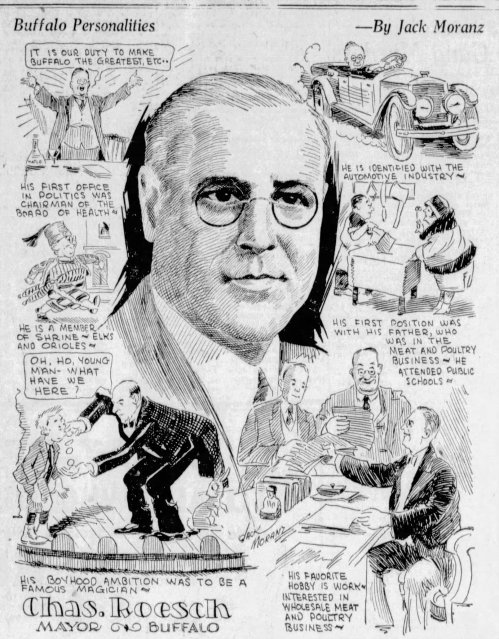
Mayor_Roesch

Jack Moranz profile on Mayor Roesch.  Jack Moranz was an internationally known artist and cartoonist who sketched a number of Buffalonians during the summer of 1930 for special publication buy the Buffalo News.  Mayor Roesch was the first sketch published in June 1930.  Source:  Buffalo News

Mayor Roesch was only mayor for one term, which was how the City Charter was written at the time.  Mayor Roesch felt strongly about the single term concept.  While he was Mayor, Council wanted to amend the charter to allow him to succeed himself and remain Mayor.  Mayor Roesch refused, saying he would veto any legislation that tried to do so.  He felt that his election was under the assumption it would be one term and that it would be unfair to the people of Buffalo for the conditions to change while he was serving.

Mayor_Roesch_as_a_butcher

Mayor Charlie the Butcher, December 1931. Source: Buffalo Times.

While serving as Mayor, Mayor Roesch would still help out as a butcher.  Shown here in 1931 (just two days after he moved into his new office in City Hall) helping the Buffalo Restaurant Men’s Association prepare 2000 Christmas baskets for Buffalo’s needy families.  After his mayoral term, he returned full time to the meat business.  He would often report that his favorite food was roast beef and mashed potatoes.

Charles E. Roesch married Mabel C. Klinck.  Mabel’s mother was Julia Fuhrmann, sister of former Mayor Louis P. Fuhrmann for whom Furhmann Boulevard gets its name.  Charles and Mabel had two sons, William Klinck and Charles Jacob.  The family lived in the upper apartment at 633 North Oak Street, at the corner of Carlton Street, just down the street from where Charles had been born.  Oak Street was well known in Buffalo as being the home of three Buffalo Mayors, before the neighborhood was lost to urban renewal.  When Charles was elected Mayor, Mrs. Roesch reported that she was accosted by realtors looking to help sell them a house that was a “better fit for a Mayor”.  They insisted on staying in the neighborhood they loved dearly.  They knew their neighbors well and would not move.  They also refused to take on a maid as was suggested to them to indicate their status as a “respectable family of means”.  Mrs. Roesch took care of the house on her own.  She felt that housework was not an irksome task, but a source of fun and pleasure, so she preferred to do the work herself.

charles roesch grave

Mayor Charles E Roesch grave in Forest Lawn

Charles E Roesch died on January 15, 1936.  He is buried in Forest Lawn.  The day of his funeral, the current Mayor George Zimmermann declared a full Civic Holiday in Buffalo in honor of the former Mayor.  It was believed by many that if Mayor Roesch had not passed away, he would have ran for a second term in 1937 and won.  He was often referred to as “Buffalo’s Greatest Mayor”.

Charles_J_Roesch_Mayor Roesch’s son, Charles J. Roesch was born in January 1916.  He graduated from University of Buffalo in 1938 and entered the family meat market business with his brother William.  Charles J. Roesch became president of the firm in the mid-1960s.  Charles J. Roesch married Doris Yuhl in 1939.  They had two children, Charles W and Susan.  When Susan was married in November 1963, the wedding was on a Wednesday because that was the day that the Broadway Market was closed so that her dad and uncle could attend the wedding!  Charles J Roesch was also an avid bowler, serving as president of the Buffalo Bowling Association as well as of the State Masonic Bowling Association.  Charles J. Roesch retired from the meat business in the mid-1980s.  He passed away in March 1990.

Charlie_carving_

Charlie the Butcher in front of his shop on Wehrle. Source: http://www.charliethebutcher.com

Charles W. Roesch was born in 1949.  He grew up around the meat business but decided to attend the University of Toledo, where he received a chemistry degree.  The pull to return to Buffalo and join the family business was strong.  Charles W. took over the Charles E. Roesch stand in the Broadway Market after his dad’s retirement in the mid-80s.  He realized the butcher model needed to change as supermarkets in the suburbs started to draw traffic away from the butcher shops at markets.

IMG_20230716_161928_221

Beef on Weck at a Bison’s Game.  Because sometimes you don’t want a hot dog (sorry Sahlen’s)  Photo by Author.

Charles W Roesch branded himself as Charlie the Butcher beginning in 1984 at a tradeshow.  With his trademark branded apron, button up shirt, tie, and bumphat (the hardhat that butchers wear), he started by selling sausage on a stick for $1 and began cooking meats to sell sandwiches through catering.  Eventually they started selling their famous hand-carved roast beef on weck.  The sandwich, invented in Buffalo in the 1800s is a quintessential Buffalo food, second only perhaps to the Buffalo wing.  A lot of the popularity of the sandwich is in part to Charlie himself! In 1993, Charlie took over a former hot dog stand on Wehrle Drive at the Amherst/Cheektowaga border, becoming Charlie the Butcher’s Kitchen in 1993.  They opened a downtown “Charlie the Butcher Express” location in the Ellicott Square building a few years later.  Charlie’s reputation and charming personality make him a common presenter on food segments on local news shows like AM Buffalo, helping to market the business.  He’s done appearances across Western New York and across the entire country – New York, Toronto, Washington DC, Orlando, Chicago, Cleveland, Milwaukee, Dallas and San Diego – and even in Europe in Düsseldorf, Germany, and Lyon, France!
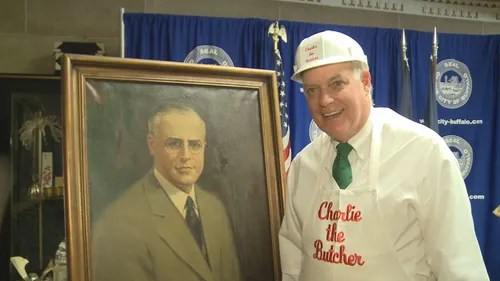
Mayor Roesch and Charlie WGRZ

Mayor Charles E Roesch’s portrait and his grandson, Charlie the Butcher, celebrating the 100th anniversary of Charles E Roesch Meats in 2014. Source: WGRZ

rop-charlie-the-butcher-charlie-roesch-bonnie-roesch-trd-bbf7786-07xx23

Charlie and Bonnie Roesch. Source: Buffalo Business First

Charlie the Butcher can now be found at locations throughout Western New York and as Charlie on Location, the catering side of the business.  You can also get Charlie the Butcher cooked roast beef at Dash’s, Market in the Square, and Tops Markets.   The company, led by Charlie and his wife Bonnie, are continuing to grow and evolve.  They’re now working to expand their reach outside of the 716 area code by making roast beef and weck seasoning mixes available to ship anywhere.  That’s right, all of you Buffalo ex-pats who read my blog – you can order your very own make your own beef on weck kit!  Head to charliethebutcher.com to learn more.

So the next time you drive past Roesch Ave, think if Alderman Louis Roesch and thank him for paving Niagara Street or remember his Great-Nephew Mayor Roesch or his Great-Great-Great Nephew Charlie the Butcher.  And the next time you stop for a Charlie the Butcher sandwich, think of the generations of butchering that has led us to that delicious Buffalo food.

Want to learn about other streets? Check out the Street Index. Don’t forget to subscribe to the page to be notified when new posts are made. You can do so by entering your email address in the box on the upper right-hand side of the home page. You can also follow the blog on facebook. If you enjoy the blog, please be sure to share it with your friends.  Interested in getting even more content from me?  You can become a Friend of Buffalo Streets on patreon.   You can go to https://www.patreon.com/buffalostreets/

I’ll be hosting a Buffalo History Chit Chat on Monday August 14th at 7pm EST.  I’ve been busy this summer and haven’t had a chance to host any tours, but I figured we could get together (virtually) and chit chat about Buffalo history! This will be a chance for me to talk with you about some of the current things I’m researching, share some of my favorite history stories, and to answer some of your burning history questions! For more information and tickets, click this link.  I’m particularly excited to be able to connect with some of my readers who no longer live in Buffalo!  I hope you’ll join me.  If this event is successful, it will hopefully be the first of many of these!

Sources:

  • Smith, H. Katherine.  “Roesch Avenue is Memorial to Area Developer and Alderman”.  Buffalo Courier-Express.  June 15, 1941, p7-3.
  • “Louis Roesch Has Passed Away”.  Buffalo Courier.  June 3, 1904, p7.
  • “Jacob Roesch Dead”.  Buffalo Evening News.  February 12, 1903.  P5.
  • White, Truman, editor.  Our County and Its People: A Descriptive Work on Erie County, New York, Volume 2.  Boston History Company.  1898.
  • “Our Story”.  Charlie the Butcher website:  https://www.charliethebutcher.com/index.php/our-story/
  • “John Roesch So Badly Burned That He May Die”.  Buffalo Evening News.  September 30, 1902.  P 18.
  • “These Are Our Rulers:  Aldermen of the Past, Present and Future”.  Buffalo Express.
  • “Louis Roesch has Passed Away”  Buffalo Courier Express.  June 3, 1904, p1.
  • Rizzo, Michael.  “Charles E. Roesch”.  Through the Mayor’s Eyes.  http://www.buffalonian.com/history/industry/mayors/Roesch.htm
  • Violanti, Anthony.  “Days of the East Side Packers”.  Buffalo News.  May 30, 1990, p17.
  • “Charles J. Roesch, businessman, national bowling executive dies”.  Buffalo News.  March 2, 1990, p33.
  • Bermingham, Don.  “Buffalo Emerges From An Era of Disillusionment.”  Buffalo News.  December 30, 1939, p24.
  • Wandell, Walt.  “Roesch, the Man, as He Reveals Himself on Even of Taking Office.”  Buffalo Times.  December 29, 1929.
  • “Kept Promise, Sons’ Respect, Roesch Says”.  Geroge Kennedy.  Buffalo Tmies August 13, 1933.
  • Drury, Tracy.  “With Beef on Weck as Its Calling Card, Charlie the Butcher Continues to Evolve”.  Buffalo Business First.  July 7, 1923.
  • Fiddler-Woite, Julianna and Reverend Jamie Retallack.  Lutherans in Western New York.  Arcadia Publishing, 2015.
  • “Roesch Estate to Be Settled”.  Buffalo News.  July 5, 1938.

Read Full Post »

Screenshot (71)

Asbury Alley shown in red. The former right of way of the rest of they alley is shown in yellow.

Asbury Alley is a short, narrow alley running parallel to Pearl and Franklin Streets, north of Chippewa Street in Downtown Buffalo.  The alley takes a turn mid-block and runs to Pearl Street.  Asbury Alley is one of the few remaining brick streets in Buffalo; however, much of the brick has been covered as asphalt from the parking lots has encroached into the alley.  Asbury Alley historically ran another block south to Huron Street, but the majority of the alley south of Chippewa has been covered by the Augspurger Parking Ramp since 1983.  The portion of Asbury Alley south of Chippewa which still exists is gated.

asbury alley

Asbury Alley looking north from Chippewa.  Photo by author.

Asbury Alley gets it’s name from a church that used to be located on it.  Asbury Church was first established on March 22, 1847.  At this time, members of the Niagara Street Methodist Church (located at Niagara and Franklin Street) looked to establish a new congregation in the northern part of the expanding downtown core.  They established a church at the northwest corner of Pearl and Chippewa Streets, known as Pearl Street Methodist Church.  The first church on the site was a plain brick two-story structure which was ready for services on June 16, 1848.  In 1850, the church changed it’s name to Asbury Church after Bishop Francis Asbury, though, as we know in Buffalo, we hold on tight to former names of things, and newspapers of the day alternately referred to the church as both Pearl Street Church and Asbury Church.

John_Paradise_-_Francis_Asbury_-_NPG.90.82_-_National_Portrait_Gallery

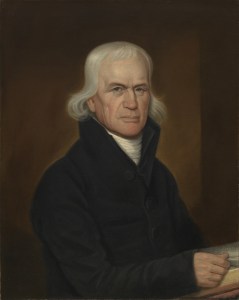
Portrait of Francis Asbury by John Paradise. Source: National Portrait Gallery.

Francis Asbury was one of the first two bishops of the Methodist Episcopal Church in America.  He was born in England in 1745.  In 1771, he volunteered to come to British North America as a traveling lay preacher. During the Revolutionary War, he was one of only two British Methodist ministers to remain in America.  In 1794, Francis Asbury became Bishop of the Methodist Episcopal Church of the United States.  He preached in various places, wherever a crowd would come to hear him.  He rode an average of 6,000 miles each year, preaching nearly every day.  I do not believe he ever made it to Buffalo, which was still a small fledgling village at the time Bishop Asbury died in March 1816.  Many Methodist churches across the country use the Asbury name in his honor.

Asbury Church was a strong congregation for many years.  The Buffalo Young Men’s Christian Association (YMCA) was organized in the church on April 26, 1852.   The organization was founded by a number of young men from members of various city churches who met at Asbury Church to form an association to improve the spiritual and mental condition of young men.  They adopted the Boston YMCA’s bylaws and thus the second YMCA in the country was born.  By 1870, they had outgrown the building and contemplated joining with Delaware Avenue Methodist Church.  Delaware Ave Church had just opened to meet the needs of the residents of Buffalo who were moving to what was considered “uptown” at the time.  Many of the residents were moving from the Grace Church area, which was located at Michigan and Division Streets.  The merger between Delaware Avenue Church and Asbury Church fell to the wayside when Asbury Church decided to build a new building for themselves instead of merging.

In April 1871, the Asbury Church congregation held their last services in their old church.  While the new church was under construction, they held services a the Chapel of the North Presbyterian Church.  The cornerstone of the new church was placed on July 13, 1871.  The new church was designed by Richard A Waite.  The new church was considered to be the finest Methodist church in the City of Buffalo.

asbury church

Asbury Church. Source: Methodism in Buffalo.

The New Asbury M. E. Church was dedicated in December 22, 1872.  During their dedication service, after the sermon, Rev. B. I. Ives arose to deliver a passionate speech to raise funds needed for the new church.  The church had cost $50,000 ($1.2 Million today) to build and $25,500 had been raised so far.  He asked the congregation to raise the required remainder $24,500 on the spot, calling for pledges of donations of $1,000 then $500, etc…This continued for two hours. They managed to raise $20,000.  The congregation was then dismissed with a benediction to come back for evening services later that day.  During the evening services, the remaining $4,500 was pledged and the church was dedicated.

Asbury Church struggled to pay off it’s debt from the beginning.  While contributions had been made and many additional dollars were pledged, a long time was given to parishioners to make their payments.  This did not account for the interest that was accruing on the debt for building the church.  Several of the members had business misfortunes of their own and were unable to meet their pledges.  After the first six years, little of the debt had even begun to be paid off.  It was discouraging to both the members of the church and the presiding elders of the Methodist Church locally, as Asbury was considered to be the most beautiful church edifice in Buffalo if the property were to be sold due to lack of payment.  The pastor, Dr. Leak, traveled across the city for two months during 1887, raising money for the church.  They managed to pay off their debt and a grand jubilee was held to celebrate.

delaware asbury historic image

Delaware Ave Methodist Church, which became Asbury-Delaware Methodist Church when the two congregations merged. Source: Yale Divinity Library

Asbury Church celebrated it’s 50th anniversary in April 1897 with a two day celebration.  By 1916, membership in the Delaware Avenue Church at Tupper and Delaware had been declining.  Asbury Church was a larger a congregation of 1150 members, with 842 active members, but the Delaware Ave Church had struggled.  The church felt there was no longer a need for two downtown Methodist churches as downtown had shifted to a business center as opposed to a residential neighborhood.  The value of the Asbury property had increased so it was decided it would be better to prepare to sell the Asbury church site for development purposes, as it was the more valuable piece of property.  The decision to merge was made on June 19, 1917, leaving Asbury Church with just a few weeks left in their church.  On July 21, 1917, the congregation from Asbury Church moved one block north and one block west to join the Delaware Ave Church at the southeast corner of Delaware and Tupper.  The church at Delaware and Tupper became known as Asbury-Delaware Church (also referred to as Delaware-Asbury Church), with the pastors from each of the two churches becoming Associate Pastors at the combined church.  Long time readers of the blog may remember that the Delaware Avenue church was designed by architect John Selkirk.

After Asbury Church’s congregation moved out of the property on Asbury Alley, the church building became the first location of the Buffalo City Mission.  The City Mission was incorporated with an inter-denominational board of directors and served the community from the church building for four years.  The City Mission was granted the use of the church rent free so that the church could continue to be tax-free until the property could be sold for development.

City_Mission_Building_On_Broadway

City Mission Building at 85 Broadway. Source: Buffalo Times, March 7, 1931.

In 1922, Mission purchased 85 Broadway and moved to the unique architectural building, which had been Nate Fenton’s Pekin Cabaret, a nightclub.  The building on Broadway contained an auditorium, offices, kitchen and rooms for services.  When the Mission opened in the new building, the Buffalo Courier reported that, “by its purchase of the former cabaret and dance hall and its decision to destroy none of the decorative effects, the City Mission has put into practice its belief that religion is not necessary a dull, drab affair to be practiced in dreary, distasteful surroundings.”  The jazz music changed to Christian hymns, but the Mission took advantage of the bright colored lights and the hand-painted pictures on the walls.  In 1930, the City Mission had provided lodging and food to 11,412 men and to 180 women.  About 300 men were served each day for meals.  In 1940, the City Mission at 85 Broadway was reconstructed with a larger kitchen, dining area, dormitory and new showers.  In 1984, the City Mission moved into a new facility at 100 E Tupper.  In 2021 a new building was constructed next to the former building on Tupper Ave.

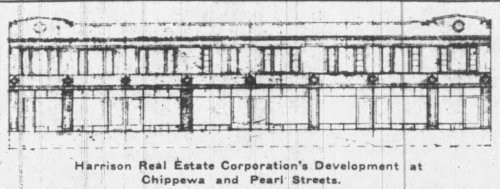
Back to Asbury Alley…. In 1922, after the City Mission moved out, the Asbury Church site at Pearl and Chippewa was being prepared for demolition.  The site had been sold to the Peabody Holding Corporation for $250,000 (about $4.5 Million in today’s dollars) to be developed by Harrison Real Estate Corporation.  The sale of the property allowed the church to pay off all of their debts.  The church building was demolished by the American Salvage and Housebreaking Company.  There were plans to building a modern two-story store and office building on the site, with 8 storefronts and a second floor with office suites.  The architect for the new building was Harold J. Cook.

Pearl_and_Chippewa_1922_

Proposed building at Chippewa and Pearl Streets. Source: Buffalo Courier, January 1922.

Peabody_Building_asbury_

Peabody Building as it looked when it opened in 1922. Source: Buffalo Times, May 1922.

When the Peabody Building opened, it was an excellent location, as Chippewa was a major east-west connection through the Central Business District.  The building leased up fast.  There were ten ground floor store units, eight on Chippewa and two on Pearl.  The entrance to the second floor was also on Pearl Street. When the building opened, it created a continuous link of business storefronts along Chippewa Street from Main Street to Delaware Avenue.  Demand for the building was great, so the building was erected very quickly.  The church demolition began February 20, 1922 and was completed on March 4th.  The building was completed on April 29, in just 55 calendar days or 44 working days!

When it opened in 1922, some of the businesses located in the building included C.A. Kremp, Haberdashery; Max F. Drewelow, Cigars and Magazines; Dr. D. J. Walker, Dentist; Dr. Irwin Cohen, Surgeon Chiropodist; The Pennsylvania Locksmith; W. J. Condon, Optometrist; Art Smith Auto Supply Co;  Weinert & Hirsch, Merchant Tailors; The Marcel Hair Shop; Sapouna Brothers, hat cleaning/shoe shining; and The Orchid Shop, millinery, lingerie, corsets, hosiery.

town_shop_sale_b_c_of_smoke_asbury

Ad for Town Shop for sale b/c of stock damaged by the smoke from the fire, July 28.

In July 1954, the Original Pants Store, located at 31 W Chippewa in the building, caught fire.  The fire injured two men and caused $25,000 ($282,000 in 2023 dollars) in damage.  The blaze was confined to the pants store, with some smoke and water damage in neighboring storefronts – The Consolidated Tie Shop at 29 W Chippewa and the Town Shop women’s apparel at 35 W Chippewa.  The manager of the pants store, Marvin Gumins, was treated for first degree burns on his face.  Junior Capitan Charles Weisenburger of Engine 12 cut his hand and was treated at the scene.  The two-alarm fire was likely started by careless smoking.

Fire_at_Pearl_Chippewa_Asbury (1)

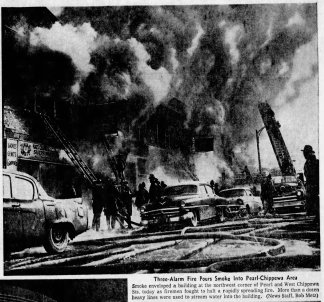
Fire and Smoke at the Peabody Building. February 1959. Note, the building on the left in the photo is still standing at 45 Chippewa today. Source: Buffalo News.

A few years later, the building was not so lucky.  On February 19, 1959, a three-alarm fire caused $225,000 damage to the building, which at the time was known as the Nasco Building.  The fire originated on the second floor and spread rapidly throughout the building.  The first call for the fire was at 9:29 am.  The second alarm was at 9:31 am and the third alarm was at 9:32 am.  At the time of the fire, the businesses located in the building included the Town Shop, ladies’ wear; Martin, men’s wear’ a hat cleaning and tailor shop operated by Gust Gavras; and Elliott’s Cigar Store.  The second floor was occupied by Kurt Brychta, violins; a beauty salon operated by Loretta Bitterman; Louis Weyer, furs; signs by Coffas; Eric & Joseph, a beauty shop; and the offices of Dr. Seymour Saries, podiatrist.

The building was owned by Nasco Corp, who also had offices in the building.  More than 80 firefighters battled the fire in temperatures of 5 degrees.  The scene described in the paper of “the pall of heavy black smoke blown across Main Street by a frigid west wind” sounds eerily familiar to the scene just a few months ago when the building at 745 Main Street burned down.  The 1959 fire caused more than $225,000 ($2.6 Million in 2023 dollars) damage to the stores and offices.  It was thought to have been caused by either defective wiring or an overloaded electrical circuit.  Included in the loss were two cellos and six violins in Mr. Brychta’s shop.  Mr. Brychta was also a violinist with the Buffalo Philharmonic Orchestra.  One of the lost violins was a Ruggieri!

fire_at_pearl_chippewa_asbury

Another view of the fire, 1959. Source: Buffalo News.

A few months later, on April 24, 1959, the firefighters were called back to the scene when the rubble in the wrecked Nasco Building caught on fire again.  The two alarm fire was quickly controlled by the fire department.

In March 1960, the City of Buffalo Department of Public Works advertised for bids for the demolition of the fire-damaged building.  The site was owned by the City of Buffalo and the Buffalo Urban Renewal Agency for the next few decades and leased out to various parking operators by the Board of Parking.

In June 1996, The Buffalo Urban Renewal Agency put out a Request for Proposals for a developer to redevelop the parcel.  At the time, they were considering redevelopment of offices, residential, retail, commercial, entertainment, educational, healthcare or a creative combination of any of the above.

Diner_Pearl_and_Chippewa_Asbury

Diner that was going to be located at the lot at Pearl & Chippewa. Source: Buffalo News.

Only one plan was proposed for the site.  Mark Goldman, who owned the Calumet Arts Café at Chippewa and Franklin Streets and is widely regarded as the driving force behind the rebirth of Chippewa Avenue. Mr. Goldman’s plan was to purchase a 70-year old authentic “Pullman Car” style diner, restore the diner and install it in the lot.  The diner had been found in Canoga, in Seneca County, New York.  In addition to the diner, plans included building an adjoining food service building and a handful of small retail outlets resembling sidewalk newsstands along the edges of the property to serve as walk up retail to serve people walking around downtown.  The project did not proceed and in 1998, the City began using the property for parking again.

20230701_172923

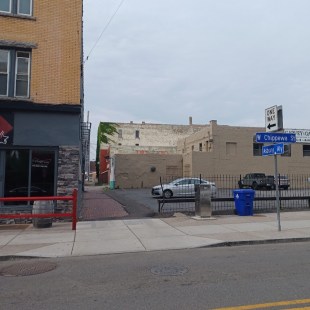
Current view of the parking lot at Pearl & Chippewa. Photo by author.

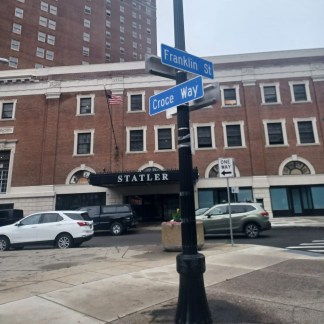
In November 1998, the property was sold to Skydeck Corp for $80,100 ($149,000 in 2023 dollars)  Skydeck Corporation is an entity that was formerly owned by the late Mark Croce.  At the time, he was developing the Brownstone Bistro at 297 Franklin Street and the parking lot would provide the parking he needed for the restaurant.  This was Mr. Croce’s first parking lot purchase, as he saw the purchase of parking lots as strategic to help fuel his downtown entertainment and hospitality projects.  His impacts are seen throughout Downtown Buffalo to this day, dispute his death in January of 2020.  Fun fact:  Downtown’s newest street name just was created last week when a portion of W Genesee Street was renamed Croce Way in honor of Mark Croce.

20230627_121841

Croce Way sign in Downtown Buffalo next to the Statler, which Mark Croce saved from the wrecking ball.

So what happened to the Asbury Church congregation after they merged with Delaware?  Asbury-Delaware Church continued to hold services for more than 70 years until the church finally closed in June 1990.   Like so many of the urban churches, they lost members to the suburbs.  The congregation had dropped from about 2,000 members in the 1950s to just 135 members.  Toward the end, they saw just an average of 40 regular attendees in services, all members of about 18 families.  The church was listed for sale for $400,000 ($867,000 in 2023 dollars).  The proceeds from the sale of the church were planned to be used to support other Methodist churches or programs in the city.  The remaining members of the church transferred to other congregations.  During the 1990s, two churches in Amherst merged and decided to take on the Asbury name, so while the congregation which still worships in Amherst doesn’t take its roots directly from the Downtown Asbury Church, they share the same namesake!

There were several different proposals for the building that were floated around.  The church was then purchased by another church group but sat vacant and neglected.  In 1995, pieces of the steeple fell and West Tupper Street adjoining the church was closed for a year.  The church was almost demolished that year when a judge declared it a public safety hazard.   The City of Buffalo purchased the building in 1999 for $175,000 ($319,000 in 2023 dollars) after a four year legal battle over what was going to happen to the church.  In early 2000s, musician Ani Difranco and Scot Fisher purchased and renovated the Delaware -Asbury Church into Babeville/Asbury Hall, a concert venue and offices of the record label.  The new venue “The Church” opened in 2006.

Next time you’re at a concert at Asbury Hall, or just the next time you pass by the parking lot at Pearl and Chippewa, think about the history that those sites have seen!  Want to learn about other streets? Check out the Street Index. Don’t forget to subscribe to the page to be notified when new posts are made. You can do so by entering your email address in the box on the upper right-hand side of the home page. You can also follow the blog on facebook. If you enjoy the blog, please be sure to share it with your friends.  Interested in getting even more content from me?  You can become a Friend of Buffalo Streets on patreon.   You can go to https://www.patreon.com/buffalostreets/

Sources:

  • Buffalo Christian Advocate.  January 23, 1851, p2.
  • “At Church” Buffalo Christian Advocate.  June 18, 1863, p2.
  • “Church Dedication”.  The Buffalo Commercial.  December 2, 1872, p3.
  • “City Mission Directors See Their Work Growing”  Buffalo Times.  March 7, 1931, p14.
  • “Plans Could Brighten Chippewa”.  Buffalo News.  April 8, 1998, p1.
  • “Goldman is Planning to Open Diner”.  Buffalo News.  June 27, 1997, p8.
  • “Asbury and Delaware Ave to Join Hands.”  Buffalo News.  July 21, 1917, p5.
  • “Semi-Centennial”.  Buffalo Commercial.  April 27, 1897, p10.
  • “Corner-Stone Laying, Today”.  Buffalo Advocate.  July 13, 1871, p3.
  • “Churches Merge”.  Buffalo Commercial.  June 20, 1917, p10.
  • “Business Block to Supersede Asbury Church”.  Buffalo Courier.  January 11, 1922.
  • “Our History”  Buffalo City Mission.  https://www.buffalocitymission.org/who-we-are/history/
  • “City Mission Now in Fenton’s Pekin”.  Buffalo Courier.  June 12, 1922, p14.
  • “Another Famous Landmark Passes Out”.  Buffalo Times.  January 13, 1922, p13.
  • “Advertisement for Bids.”  Buffalo News.  March 8, 1960, p34.
  • “Request for Proposals”.  Buffalo News.  June 16, 1996, p 75.
  • Hunt, Sandford.  Methodism In Buffalo:  From its Origin to the Close of 1892.  HH. Otis and Sons:  Buffalo, 1893.
  • “Pearl-Chippewa Fire Pours Out Pall of Smoke”.  Buffalo News.  February 19, 1959, p1.
  • “Pearl-Chippewa Blaze Quelled by Daring Firemen”.  Buffalo news.  February 19, 1959, p1.
  • “One of two things”.  Buffalo News.  February 21, 1959, p3.
  • “Blaze Dampened in Rubble Left by Big Mid-Winter Fire”.  Buffalo News.  April 24, 1959, p31.
  • “Further Evidence of a Greater Buffalo The Peabody Building”.  Buffalo Times.  May 14, 1922, p 54.
  • “Peabody Block Aids Business”.  Buffalo Times.  May 14, 1922, p54.
  • “Damage is $25,000 in Downtown Blaze, Sixth Big One of Year”.  Buffalo News.  July 10, 1954, p4.
  • Real Estate Transactions.  Buffalo News.  November 23, 1998, p7.
  • Dolan, Thomas.  “New Diner Faces Trip”.  Buffalo News.  September 13, 1996, p21.
  • Dolan, Thomas.  “Rail Car Diner Project is Not Going Forward”.  Buffalo News.  September 15, 1998, p2.
  • Condren, Dave.  “2 Churches Prepare Last Services”.  Buffalo News. May 27,1990, p 17.
  • Stouffer, Rick.  “Realtor Plans Open Church Sundays”.  Buffalo News.  December 14, 1990, p5.

Read Full Post »

Field Notes

Live from Buffalo, NY

Grants.gov Community Blog

Connecting the grant community to #LearnGrants

Dienna Howard

I create, therefore I am.

Hidden Waters blog

Companion blog for the book "Hidden Waters of NYC"

Hoping for a Tail Wind

Because I definitely brought way too much gear.

priorhouse blog

Photos, art, and a little bit of LIT.

Sheepie Niagara

Bleating the Beat Since 2015