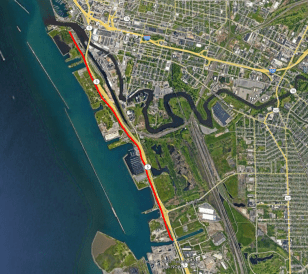
Fuhrmann Boulevard shown in red on map
Fuhrmann Boulevard is a street (the main street) on the Outer Harbor of Buffalo. As we wrap up summer on Labor Day Weekend, perhaps you spent some time on Fuhrmann Blvd as you enjoyed the waterfront this summer. The street has had several configurations over time and exists today as the road that runs to the south of the elevate portion of Route 5 on the Outer Harbor. The road was first built in 1935 and is named after Mayor Fuhrmann, who was instrumental in getting it built by securing the land on the Outer Harbor.
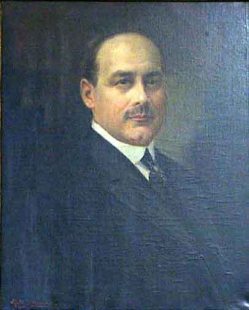
Louis Fuhrmann Mayoral Portrait
Louis P. Fuhrmann was born on the East Side on November 7, 1868 to Philip and Elisabeth Fuhrmann, who had emigrated from Bavaria. The family lived on Clinton Street in the South Ellicott neighborhood of the near East Side, near Bennett Park. Louis’ father owned and operated a barber shop on Genesee Street near Ellicott Street. Louis was educated in Buffalo Public Schools – PS 32 on Cedar Street and Central High School. While he was in school, he worked on weekends in the meat business as a butcher boy for Christian Klinck in the Elk Street Market. After high school graduation, he was given a full time job and remained in the meat business his whole life. Since he had so much experience, he was quickly hired to work in the wholesale beef business in the Jacob Dold Packing Company. He was placed in charge of the Jacob Dold Packing Company’s Kansas City plant at the age of 18 years old. After six years in Kansas City, he was homesick for his hometown. He returned to Buffalo in 1892 to open his own business, the Louis P Fuhrmann Packing House, located at 1010 Clinton Street.
Louis Fuhrmann had a reluctant entry into politics. His first bid for public office was in 1905, when he was convinced to run for Alderman in the old Sixth Ward. He was elected and re-elected two years later. He quickly grew to be a leader in government. He was such a popular Alderman that when Mayor J.N. Adam went out of town for month-long trips home to Scotland, he left Mr. Fuhrmann in charge as Acting Mayor for several years in a row. He was well known around town and well respected for his business savvy and government experience. He was referred to as “Louis Fuhrmann, the Progressive.”
In 1909, he ran as the Democratic candidate for Mayor. The election was hotly contested, with Louis Fuhrmann up against a strong Republican candidate Jacob Siegrist. At first, The Buffalo News published an Extra Edition at 6pm to announce that Siegrist was the next mayor.
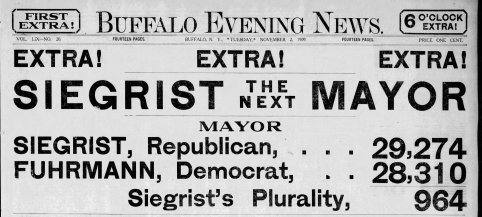
Buffalo Evening News. 6pm Extra Edition. November 2, 1909. Headline declaring Siegrist the Next Mayor.
In an episode similar to that famous “Dewey Beats Truman” headlines…. ballots continued to be counted and the Buffalo News had to issue a Second Extra Edition when it became clear that Fuhrmann won! It was reported, “when Louis Fuhrmann was elected the Mayor of Buffalo no one received a greater shock than he did.” Republicans had swept all the rest of the seats across the City and County, other than Fuhrmann, a Democrat. Mayor Fuhrmann was the first Mayor born and raised in Buffalo. His mayoral office was also the first to be lit by electricity rather than gas.
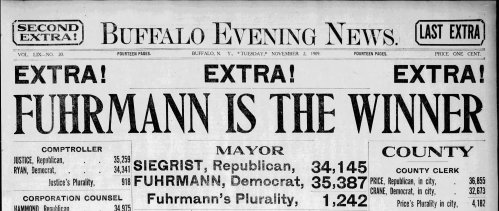
Buffalo Evening News. Second Extra Edition, November 2, 1909. Headline declaring Fuhrmann is the winner.
While Mayor Fuhrmann was in office, a major issue in Buffalo was the “Sea Wall Strip”. This is land along the lakeshore, which today we call “The Outer Harbor”. The questions surrounding the Strip included who owned the land and what was happening with the Hamburg Turnpike (now Route 5). For more than 50 years, there had been more questions regarding the Strip than answers. Shortly after election, Mayor Fuhrmann began working on the issue. The feeling at the time was that Buffalo needed bigger facilities in order to grow, including harbor improvements – new docks, new slips and a new highway that was planned to connect Buffalo with Cleveland via the Hamburg Turnpike.
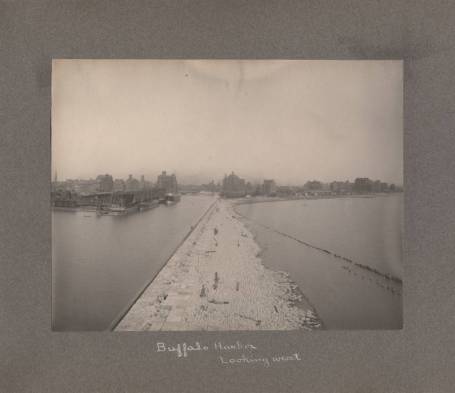
View of the Seawall Strip from 1889. You can see how narrow some portions of the Outer Harbor was before much of the fill was added to expand the land. Source: Buffalo Library via New York Heritage
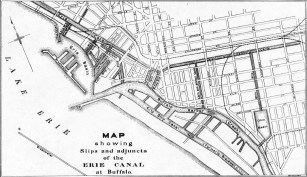
Map showing slips and adjuncts of the Erie Canal at Buffalo. Source: History of the Canal System of New York State.
The City of Buffalo’s waterfront has been modified a great deal since the Buffalo was founded. Building the harbor break walls, the Erie Canal and other canal slips and many other modifications over time would probably make today’s waterfront unrecognizable to those early settlers who first arrived here. Much of the Outer Harbor land has been created over time by landfill. The “Outer Harbor” essentially was created when the Blackwell Canal was constructed in 1850. It was built by E.R. Blackwell, who ran out of money to complete it, and so it was renamed the City Ship Canal in 1853. The City Ship Canal allowed ships to have additional areas to dock and opened up more land for waterfront access. Additional canal slips connected the Buffalo River and the City Ship Canal, further increasing waterfront access. This also created what is known as Kelly Island, which is technically a peninsula. The Island is the land where General Mills and Riverworks is now; Ganson Street runs through the middle of Kelly’s Island. In 1883, the City Ship Canal was extended to allow the Buffalo Creek Railway Company to create a series of canal slips at what we now call Tifft Farms (Lake Kirsty is remnants of those canal slips). The City Ship Canal was partially filled in during the 1950s when Ohio Street was changed and Fuhrmann Blvd was elevated (more on that later).
The Sea Wall Strip was the land on the Outer Harbor from where Ohio Street meets the Outer Harbor north. The Sea Wall Strip was permitted by Congress in 1837 and construction began in 1841. In 1859, the City was authorized to construct a breakwater, but was not given the power to take land. In 1864, the City was empowered to use condemnation proceedings to take the strip of land known as the Sea Wall Strip. The Hamburg Turnpike ran along the Outer Harbor from Ohio Street to the City Line. In 1874, the City acquires the Hamburg Turnpike from the Hamburg Turnpike Company. By the 1870s, railroads crisscrossed around the waterfront. In 1899, the Mayor created a harbor commission to investigate the disputed rights and title of who owned the Sea-Wall Strip and the Hamburg Turnpike. In 1900, the Commission declared that the City owned the Hamburg Turnpike with a width of six rods (99 feet). The Railroads claimed that they only owned four rods (66 feet).
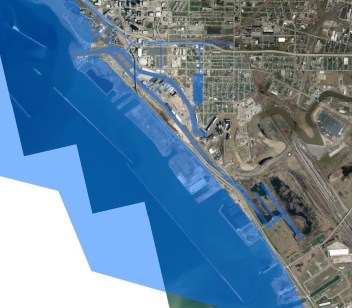
1894 shoreline and canals shown overlaid in blue over modern aerial photograph. Map by Author.
Calls for beautifying the Turnpike and Seawall Strip came as early as 1902. Planning began to build design an elevated highway that was similar to a road along the Potomac River and Anacostia Creek in Washington, DC. The elevated route in Buffalo was to include a railing along the roadway, with trolley tracks running alongside the road and sidewalks for pedestrians. Below the roadway would be arches where railroads could cross under the road to access the industrial plants, elevators, etc., along the road. The road was to be the main connection between the City of Buffalo core and the Stony Point Industries being planned for opening that year. Stony Point Industries was an early name for the steel plant and affiliated businesses that became Lackawanna Steel and later Bethlehem Steel. The roadway project never happened because of the ownership issue.
There was a lot of back and forth judgements in court until in April 1911, the railroad agrees to drop the appeals and exchange the rights and the disputed titles, so the City of Buffalo finally owned the Sea-Wall Strip and the Hamburg Turnpike. This would allow the ability to build a new bridge at Ohio Street for better clearance for vessels. This also allowed them to relocate Tifft Street and Ganson Street to improve harbor facilities. They also received 500 feet at the foot of South Michigan Street.
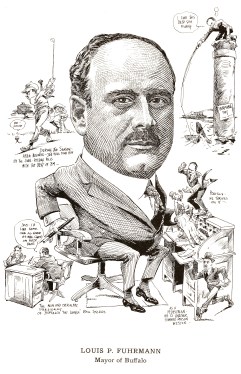
Associated Buffalo Artists, “Louis P. Fuhrmann: Mayor of Buffalo,” from 1913. Source: Digital Collections – University at Buffalo Libraries, accessed February 13, 2023, https://digital.lib.buffalo.edu/index.php/items/show/78476.
It was reported that Mayor Fuhrmann was successful in winning the Sea Will Strip for the City, because “he is a big man mentally, as well as physically. He has no petty notions to obscure his vision. He has imagination and he is fearless and free.” He was able to settle what had been “juggled, misappropriated, pawned, fought over, blanketed, buried and resurrected for a half century.”
Mayor Fuhrmann ran again for mayor in 1913. The Democratic Party felt he was too independent and endorsed Edward J Meyer instead. Meyer’s name may be familiar to you as the name of Erie County Medical Center (ECMC) was Edward J Meyer Memorial Hospital until 1978. Mayor Fuhrmann won the primary contest overwhelmingly and went on to also beat both Thomas Stoddart from the Citizen’s Party and John Lord O’Brian from the Republican Party in the General Election. During his second mayoral term, WWI broke out. Mayor Fuhrmann was active in shaping the city’s contributions in men, money and munitions to the war effort.
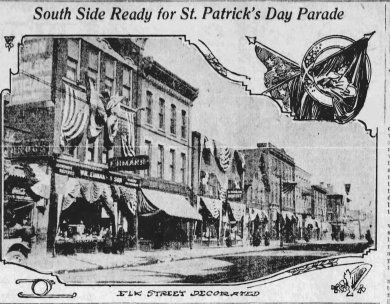
Elk Street decorated for St. Patrick’s Day 1915. Source: Buffalo News.
In 1915, Mayor Fuhrmann helped bring a St. Patrick’s Day parade back to Buffalo after 27 years! Some sources hint that Mayor Fuhrmann was trying to distance himself from the rising anti-German sentiment that was rising in Buffalo as WWI was happening in Europe by supporting the Irish groups efforts for the parade. The parade in the 1880s would march up Main Street from the Liberty Pole at the Terrace to Cold Spring (around Main and Ferry) and was led by the Hibernians and the Knights of Columbkill. The 1915 parade started from Chicago and Fulton Streets at 2:30pm on Wednesday March 17th. The movement for the a parade began with the Gaelic-American Association of the First Ward, an organization that had 600 members that were all born in Ireland. The Elk Street Businessmen’s Association took charge of the idea and the result became one of the largest St. Patrick Day celebrations Buffalo had ever seen. The idea had only come about a month before St. Patrick’s Day, and more than 1500 Irish-Americans were involved in the planning of the parade, meeting at St. Bridget’s, at the corner of Fulton and Louisiana Streets, near where the parade started. More than 30 churches were represented during the planning for the parade, many different organizations and 11 churches marched in the parade – St. Brigid’s, St Stephen’s, Perpetual Help, St. Teresa’s, St. Monica’s, St Patrick’s at Limestone Hill, Nativity, Precious Blood, Holy Family, Our Lady of Lourdes. More than 3,000 people marched in the parade that year. March 17th was on a Wednesday that year, so Alderman Sullivan declared the day a half holiday in the First Ward!
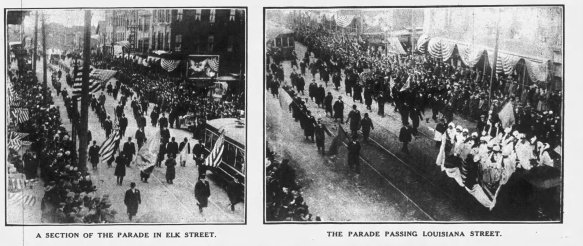
Photos from 1915 St Patrick’s Day Parade. Source: Buffalo Times
The parade was filmed as “The Great St. Patrick’s Day Parade in Buffalo” and was shown by Michael Shea at the Shea’s Hippodrome Theatre (located on Main Street Downtown where Fountain Plaza is today) beginning on March 22nd.
The 1916 and 1917 parade had a different route, mostly on Main Street downtown. In 1918, it was announced in January that there would be no St. Patrick’s Day parade that year. The Gaelic Association came together and held a parade, bringing it once again back to the South Side of the city, starting at Elk and Hayward Streets. The 1918 parade was held on Saturday March 16th , since March 17th was a Sunday, to allow for festivities not to be marred by church obligations. The Gaelic Association made arrangements for the Marine Band to lead the parade, and American Flags were more prominent than in previous years, due to WWI. The Association honored its members who had been called to the draft and held a reception to honor them before they left the following Monday.
In 1919, there was no parade. The leaders of the Irish organizations met to abandon the parade to concentrate on a united effort for a big demonstration to take place after Easter. I’m not sure if that happened. The parade eventually faded away before being revived in 1939 as the St Patrick’s Day Parade along Delaware Avenue. The 1939 parade went from Niagara Square up Delaware to Tupper, to Main to the Terrace. The “Old Neighborhood” St Patrick’s Day parade was revived in 1994 to bring back the spirit of the Old First Ward.
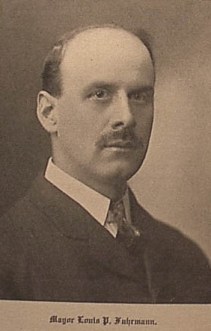
Mayor Fuhrmann. Source: Buffalo and Its German Community.
In 1917, Mayor Fuhrmann was defeated in the mayoral race by George Buck. It was also a strong year for Republicans across local elections, only one Democrat was elected that day, Councilman John Malone. Mayor Fuhrmann’s defeat was mainly attributed to the fact that Mayor Fuhrmann opposed the change in governmental structure to a commission form of government. The proposal eliminated the Common Council, replacing it with a commission with five members, including the Mayor, Public Safety (fire, police and health), Finance and Accounts (comptroller, treasurer, auditor and assessors), Public Affairs (education and poor departments) Public Works (bureau of water, streets, building and engineering), and Parks and Public Buildings. Mayor Fuhrmann vetoed the proposal, which was overturned by the legislature and the Commission form of Government was created. The new charter went into effect in January 1916. It was in effect until 1926 when the Kenefick Commission created a new charter for the City, which separated legislative and executive powers of the municipal government. The City’s new charter went into effect in January 1928, vesting the Common Council with legislative powers and the Mayor in charge of executive and administrative functions.
Some sources also reported that Louis Fuhrmann’s loss was partly due to the anti-German sentiment in Buffalo during WWI. Many parks, hospitals, streets and banks lost their German names. German newspapers folded. Churches and business which spoke German began speaking English in the name of patriotism. And the scrappy son of German immigrants Louis Fuhrmann lost to the Yale Law educated Anglo-American George Buck.
After Mayor Fuhrmann left office, he continued to be active in Democratic politics. He was appointed by Frank Schwab to the School Board in 1922, where he served for five years. While he was Mayor and while on the School Board, he fought for more high schools and helped to see the schools he fought for constructed. In 1927, Fuhrmann became Chair of the Erie County Democratic Committee.
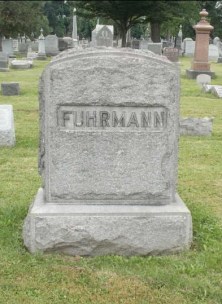
Louis Fuhrmann Gravestone, Forest Lawn Cemetery.
Louis Fuhrmann married Alice Meahl in 1900. They had four children: Frederick, Dorothea, Philip and Mary Alice. The family lived at 438 North Oak Street for many years. They later moved to Jewett Parkway. Sadly, Mary Alice died from heart problems at just one year old, while Louis was Mayor. Mayor Fuhrmann was a member of Concordia Lodge, F & A. M, the Buffalo Consistory, the Eagles, the Elks, the Oriels and other social lodges. Louis Fuhrmann retired from Fuhrmann Packing House in 1927, with son Frederick taking over.
Louis P. Fuhrmann died in 1931 after two years of illness. Mr. Fuhrmann was so prominent in the local Democratic party that it was published in the paper that all local Democratic leaders from across the county attended his funeral, along with other prominent people from Buffalo’s political, social and civic life. His funeral was conducted by Reverend John D. Sayles, who had served as Mr. Fuhrmann’s secretary during the 8 years of his mayoral terms. Rev. Sayles eulogized Mayor Fuhrmann by saying:
“Louis Fuhrmann was unique in his human qualities. Everybody who knew him loved him because he himself was lovable. Nobody ever appealed to him for help in vain. The sick, the poor, the unlucky, the friendless, were blessed by his benefactions. In early life he leaned that the coin of this realm cannot be legal tender in any other. He made a fortune during his lifetime and without publicity gave more than half of it away. Some may say that a man who does that is a fool. If that be so, he was one of God’s fools and did not die – such fools never die unloved, unwept and unremembered.”
Mayor Fuhrmann is buried in Forest Lawn.
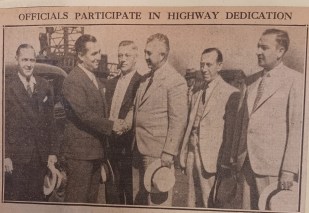
Opening of the Fuhrmann Blvd in 1935. From left: Edward C. Dethloff, Democratic Candidate for Council; Councilman George K Hambleton, sponsor of the boulevard and high-level bridge; Councilman Charles J. Hereth; Francis J. Downing, former ERB Executive Director and WPA Administrator; Martin P. Flemming, secretary to Mayor Zimmerman; and Democratic County Chair Frank J. Carr. Source: Buffalo Times.
Fuhrmann Boulevard opened from South Michigan Avenue to Ohio Street in August 1935. It was built as an Emergency Relief Bureau project at a cost of $300,000 ($6.7 Million in today’s dollars). Construction of the boulevard provided work for 1200 men for a year. Opening this road was important for traffic along the lakeshore, as creation of the road helped traffic to avoid 2 lift bridges and 8 active at-grade railroad crossings. During summer months at that time, traffic averaged about 20,000 cars a day. The new Fuhrmann Drive was designed to connect to the proposed high-level bridge which was supposed to be built later that year (spoiler alert: they had a ribbon cutting and drove the first pilings for the bridge in 1935, but the Skyway wasn’t finished until 1955).
In 1958, Governor Harriman announced an at-grade separation project to create what they referred to as the “Fuhrmann El”. By creating this limited access highway route, they felt it would “open up the lake shore area to practically unlimited development”. The elevated highway was considered to be an important piece of the chain of expressways from Niagara Falls to the South and West. The elevated highway would connect the new Skyway (opened 1955) to the new Father Baker Bridge (over Union Ship Canal, built 1961), and the work that was being completed at the time in Athol Springs (the traffic circle by the Ford Plant). The road was designed to help workers getting to their jobs at the industrial plants and to enhance the available industrial land along the route. The road was designed by Elmer G. H. Youngmann, who was the District Engineer for NYSDOT and designed most of WNY Highways. The Fuhrmann El route was 1.2 miles running from the Buffalo Skyway to just north of the Tifft Street interchange, which was where the approaches for the Father Baker Bridge were located. The route was designed to be 4 lanes -two northbound, two southbound – and included a complete system of service roads for entrance and exit into the present or planned future plants along the right-of-way. The original Fuhrmann Boulevard was reduced to just those service roads. The expressway was 18 to 22 feet above the level of the service roads. Because the road was so costly to build, instead of being built on an elevated steel structure, it was built on an earth embankment.
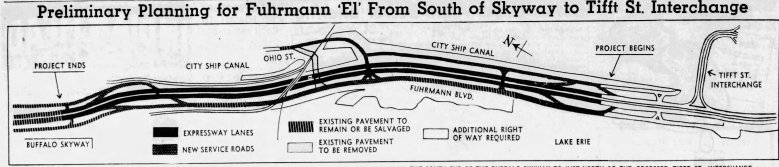
Buffalo News sketch of the proposed Fuhrmann ‘El’ Elevated Highway.
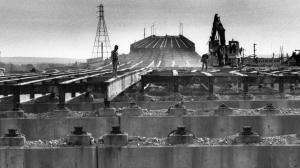
Demolition of Father Baker Bridge in 1989. Source: Buffalo Business First.
In 1989, the Fuhrmann Blvd area began to see another major change as the Father Baker Bridge over Union Ship Canal was demolished. The bridge spanned 100 feet over the canal and helped to make the ride from Downtown Buffalo to Lackawanna feel like a roller coaster with the two high-level bridges. The demolition of the bridge took two years and was the State’s most costly highway project being completed at the time.
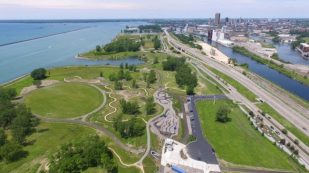
Modern View of Fuhrmann Boulevard running between the Outer Harbor and the Elevated Route 5 (on the right of image). Source: Step Out Buffalo
Beginning in the 1990s, there was renewed interest in the waterfront. The Southtowns Connector Feasibility Study was completed in 1991. It was included in the Horizons Waterfront Action Plan, prepared in 1992. The plan would have moved the highway inland to the CSX tracks, opened up more of the Outer Harbor Land for development. In 2001, the project was refocused based on comments received from agencies and the public. The concern was that moving the highway would have unacceptable impacts on neighborhoods and the environment, as well as being too costly to be able to be completed in a reasonable amount of time. So, the decision was made that the elevated Route 5 would remain. The new plan became focused on changes to the existing road system rather than fully relocating the highway. This helped to create a project that was actually able to be completed. Fuhrmann Boulevard was improved and became more of an actual road once again, rather than just an intermittent service road which provided access to properties. Multi-use trails were placed along the road, with signage celebrating the industrial heritage of the Outer Harbor.
If you’re wondering what happened to Fuhrmann’s Meatpacking business? Son Frederick Fuhrmann took it over when Louis retired and it was ran by the Fuhrmann family until 1945 when it was purchased by Mr. Teplesky of Tog Packing. They operated until 1980, when the business was sold to P Brennan Meat Wholesalers. In 1999, an action was held to sell the equipment. A building was still standing on the site until 2007, but it has since been demolished. It is now a vacant lot.
Want to learn about other streets? Check out the Street Index. Don’t forget to subscribe to the page to be notified when new posts are made. You can do so by entering your email address in the box on the upper right-hand side of the home page. You can also follow the blog on facebook. If you enjoy the blog, please be sure to share it with your friends. Interested in getting even more content from me? You can become a Friend of Buffalo Streets on patreon. You can go to https://www.patreon.com/buffalostreets/
Hope to see some of you on my upcoming tours this month! For more info on tours, click here.
Sources:
- “Louis P. Fuhrmann”. Buffalo Courier-Express. Feb 24, 1931, p5.
- “Ex-Mayor Fuhrmann Dead” Buffalo Courier-Express. Feb 24, 1931,p1.
- Mueller, Jacob. Buffalo and Its German Community. German-American Historical and Biographical Society. 1911-12.
- “Mayor Fuhrmann Was Efficient Executive”. Buffalo Times. July 13, 1924. P45.
- “Winning the Sea Wall Strip for Buffalo”. Buffalo Sunday News. August 27, 1911, p 13.
- “Parade Details are Settled for St. Patrick’s Day”. Buffalo Courier. March 14, 1915, p 74.
- “Four Thousand in St. Patrick’s Day Parade Wednesday”. Buffalo Times. March 14, 1914, p43.
- Gaelic Association to Parade on St. Pat’s Day”. Feb 24, 1918, p45.
- “20,000 Marches Enroll for parade St Patrick’s Day”. Buffalo Times. February 25, 1917, p17.
- “St. Patrick’s Day Parade to Outshine All Affairs of its Kind In History”. Buffalo Courier. February 22, 1915, p6.
- “In the Good Old Days: St. Patrick’s Day in Years Long Past”. Catholic Union and Times. January 14, 1915, p5.
- Burr, Kate. “Old St. Patrick’s Day Parades. Buffalo Times. March 17, 1932.
- “Great Legal Contest to Determine Ownership of Hamburg Turnpike”. Buffalo Times. October 12, 1902
- “Beautify the Turnpike” Buffalo Express. June 8, 1902.
- “Boulevard Change Ready for Opening”. Buffalo Times. August 22, 1935.
- “Start of Work on Furhmann El Due in Early 59”. Buffalo News. August 6, 1958 p 29.
- McCarthy, Robert. “Closing Brings Bridge to Dead End Father Baker Span Was Monument to Industrial Might”. Buffalo News. August 22, 1989.
- Whitford, Noble E. “Slips and Other Adjuncts of the Erie Canal at Buffalo”. History of the Canal System of New York State. Brandow Printing Company. 1906.
- Adam, Thomas. German and the Americas: Culture, Politics and History. ABC-CLIO. 2005.
- “Sons of Old Erin Honor St. Patrick in Street Pageant”. Buffalo Times. March 17, 1917, p1.
- “No Parade By Irish on South Side Today”. Buffalo Times. March 17, 1919, p7.
- “Baby Daughter of Mayor Dead” Buffalo Enquirer. January 7, 1915, p6.
- “Hundreds Pay Final Tribute to Fuhrmann” Buffalo News. February 27, 1931, p1.
- Roseberry, Jack. “Fair-ly Long Custom of Camp Aid Ends with His Retirement”. Buffalo News. August 13, 1980, p10.
 Discovering Buffalo, One Street at a Time