
Map showing Hersee Alley in Red.
Hersee Alley is an alley that runs between Ellicott Street and Oak Street in Downtown Buffalo. It was originally Koons Alley until March 1886, when it was renamed. One of the reasons the street was changed was because there was confusion between Koons Alley and Koons Avenue. Hersee Alley is named for a business that was located on Ellicott Street adjacent to the alley, Hersee Furniture Company, which was in business for nearly 100 years.
Thompson Hersee was born in Arundel, Sussex, England, on May 13, 1814. He came to Buffalo in 1834 and engaged in the furniture trade. Hersee & Co. was established in 1836. Mr. Hersee was in business for a few years with Benjamin Timmerman, and the company became known as Hersee & Timmerman, but most people reportedly still called it Hersee & Co. during those years. Mr. Timmerman left the firm in 1866 and the firm name became Hersee & Co once again. Mr. Hersee’s stores were at 307-309 Main Street for several years. Main Street has been renumbered; Mr. Hersee’s store was midway between Eagle and Clinton Streets. The site of his store was later replaced with the J.N. Adam Department Store and then AM&As, which many of you may remember.
Hersee & Co. was known as a business that provided quality, quantity, service, and value. Thompson Hersee felt that a business should never charge more than an article was worth and refused to mark prices up for some and down for others, a common business practice.
Hersee & Co. was well known throughout Western New York and Northern Pennsylvania but also sold across the country. Following the Gold Rush in California, they’d send furniture destined for California office buildings around “the Horn” (of South America) by steamship. They also had vessels that sailed the Mississippi River to deliver chairs and desks made by the Hersee factory. The firm furnished many homes over the more than three generations they were in business. They made much of their own furniture at their factory in Buffalo but also dealt with some of the best-known furniture makers in Grand Rapids and other manufacturing centers.
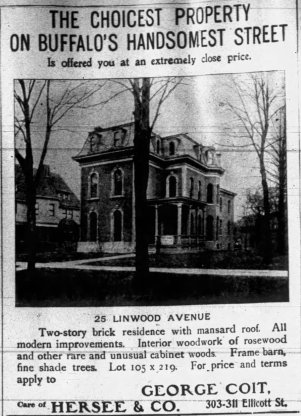
Ad for the sale of 25 Linwood Avenue. Source: Courier Express, April 1902
Mr. Hersee married Annette C. Moses from Attica in September of 1844. They had six children – Thompson Jr, William, Orton, Walter, Carrie, and Porter (who was called Benny). The Hersees lived at 371 Washington Street, at the corner of Eagle Street. They attended Trinity Episcopal Church. The family later moved to 25 Linwood Avenue. They then attended the Church of the Ascension on North Street, practically across the street from their house.
Sadly, many of the Hersee children died young. Son Orton died in 1859 at the age of 9. Son Benny also died in 1859, one day after Orton. Benny was just one year old. Orton and Benny’s death notices were published together in the newspaper. The fact that the two boys died so close to each other, I wonder if they died from an illness. Son Water died tragically at the age of 11 when he was playing on the steps of Trinity Church in 1863. He tried to jump over the iron fence but slipped and fell onto the fence, which pierced his stomach. Son Thompson Jr. died in 1875 at the age of 30 of rheumatism. Son William died in 1891 at the age of 43 of congestion of the brain.
In 1849, Mr. Hersee was nominated by the Democratic Party for Mayor but lost to Henry K. Smith.
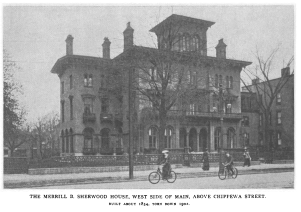
Sherwood Mansion at 652 Main Street, Downtown Buffalo. Source: Picture Book of Earlier Buffalo
Hersee & Co. built a mill on Elm Street. In 1870, they built a large showroom in what was then the old Sherwood Home at 652 Main Street. We discussed this house a bit in our last post. Hersee & Co took over the mansion and decorated the various rooms to showcase furniture – i.e., the parlor, chamber, dining room, and library were all set up as such to show examples of how people could furnish their own homes. You could view things in the showroom, and then you could make a purchase from the store, just a few blocks away down Main Street. This was modeled after the example of Mr. Chickering in New York City, who did something similar with a large private dwelling on 14th Street. They also had a large upholstery department and also manufactured and finished interior fittings such as mantels, doors, wainscotings, etc. The Sherwood house was a great place for Hersee & Co to do this, as there were 34 rooms in total in the house!

Hersee Factory on Ellicott Street. Source: Buffalo & Erie County Public Library Scrapbook.
In 1872, son William Hersee took over management of the company. The company closed the Showroom and the store on Main Street company moved to 303-311 Ellicott Street, along what would become Hersee Alley fourteen years later. The new store included six stories of sales floor and warehouse space. The company had a staff of 100 skilled cabinetmakers. The factory was situated between Ellicott Street and Blossom Street, just south of what became Hersee Alley.
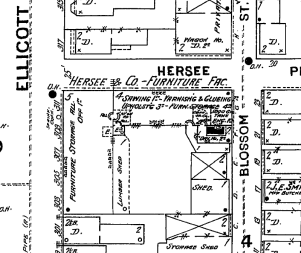
1899 Sanborn Map showing the location of Hersee & Co furniture factory.
The 652 Main Street property remained in the Hersee Family’s hands after the showroom closed. They turned the Sherwood house into a hotel called the Hersee House. At the time, the City lacked hotel accommodations, particularly in this part of town. Mr. Hersee also purchased land on the south and north side of the house. He worked with Cyrus K. Porter, a well-known architect, to prepare plans for a larger hotel that would incorporate the Sherwood house into its design. The Sherwood House would form the middle of the structure, with wings on either side, connected to the house via hallways. The plan was for the Hersee Hotel to have 150 rooms. Instead of building the larger hotel, the Hersee family turned the house into a boarding house. The house was referred to as The Sherwood and also as Hersee House.

Hersee Family Plot at Forest Lawn. Photo by Author.
Mr. Thompson Hersee died on December 1, 1884. He died on the same day as Cyrenius Bristol of Bristol Sarsaparilla fame! Thompson Hersee is buried in the Hersee family plot in Forest Lawn Cemetery, which is the eternal home of 18 members of the Hersee family.
Son William ran the Hersee business following Thompson’s death, along with his mother Annette. Annette Hersee also managed the Hersee’s large real estate portfolio. They owned several properties around Symphony Circle, including the lands where St. John and Orton Places. Annette Hersee established the grading and paving of those two streets in April 1885. I have no documentation, but I surmise that Orton Place may have been named for Orton Hersee, who was the first of the children to die. Annette also managed the estate of Harry Hersee, her brother-in-law, after he died in 1898.
In 1888, William and Annette Hersee submitted a bid to the US Government to build a new post office on the 652 Main Street site. There were 11 bids received. Interestingly, none of the sites were selected for the post office building. The Post Office ended up being built at the corner of Ellicott and South Division Streets in 1897. The building still stands today and is home to Erie Community College.
Daughter Carrie was the only of the Hersee children to grow old. Carrie married George Coit in 1877. George Coit was hired and rose up in the ranks at Hersee & Co., becoming Managing Partner and Director of the firm’s business policy in 1887. Carrie and George lived at 33 Linwood, next door to the Hersee home. George Coit was the third generation of Coits in Buffalo; his grandfather was also George Coit, the one who built the Coit House, which still stands on Virginia Street and is generally believed to be the oldest house still standing in Buffalo. Coit Street is named after the Grandpa George Coit.
When William Hersee died in 1891, Annette took over the Hersee & Co. business, with George Coit as managing partner of Hersee & Co. Annette C. Hersee passed away on June 10, 1901. The newspaper listed the hymns sung at her funeral at the Church of the Ascension as “Lead Kindly Light,” “Abide With Me,” and “Hark, Hark, My Soul.”
When Annette died, the entirety of the estate went to her daughter, Carrie Coit, the last remaining Hersee child. The estate of Mrs. Hersee was estimated to be around $800,000 (about $28.6 Million in 2023 dollars). The estate also included some of the best real estate in Buffalo, including the family home on Linwood, the Hersee factory on Ellicott Street, the property on Main Street above Chippewa Street, a building at Chippewa and Main Streets, and other properties.
A cousin of Carrie Hersee Coit, Stanford Whiting, tried to claim that he was supposed to be left a part of the estate since he had lived with the Hersees for several years as a child. He sued for $200,000 (about $7 Million in 2023 dollars) of the estate. He lost his fight in April 1904 when the jury voted against his claim for 1/3 of the estate. Carrie Coit became the sole inheritor of the Hersee estate. She and George ran the Hersee & Co. business.
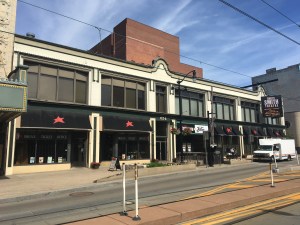
Hersee Building on Main Street. Photo by author.
In 1902, Carrie and George decided to build a commercial structure on the property where the Sherwood Mansion stood. The building was designed by Lansing & Beierl and took up the site of two former houses – the Sherwood Mansion and another house. When it opened, the building was known as the Hersee Building and consisted of 8 storefronts on the first floor and offices on the second floor. At the time, there was a trend of businesses locating in this portion of “uptown” from the city’s original business district, on Lower Main Street. Division Street was named such because it divided the business and residential districts. Around the turn of the century, many other residential properties in what we now call the Theater District were converted into commercial sites – such as the Spaulding Building and the Sidway Building. The Hersee Building is still standing at 646-662 Main Street.
In 1924, the Hersee Building was leased to Shea’s Amusement Company for 60 years at a cost of about $5,000,000 (about $90 Million in 2023 dollars). Michael Shea, head of Shea’s Amusement Company, constructed his theater with the lobby at 646-648 Main Street, just south of the Hersee Building. The Shea’s Theater wraps around the west side of the Hersee Building along the Pearl Street frontage on what was the Hersee property. Shea’s Buffalo opened in January 1926.

Location of Hersee Building and Shea’s between Main and Pearl Streets. Hersee Building is outlined in red, and Shea’s is outlined in Blue.
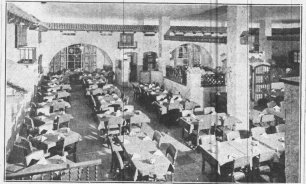
Interior of Laub’s Old Spain, located in the Hersee Building, as it looked in April 1936. Source: Buffalo Courier Express.
The Hersee building was the long-time home to Laube’s Old Spain restaurant beginning in 1928. After leasing the Hersee Building in 1924, the building was eventually purchased by Shea Operating Corporation in July 1931. The upper floor was occupied by the Hippodrome Billiard Academy beginning in 1931. The City of Buffalo obtained the building through tax foreclosure in 1975, the same year that Shea’s closed. In 1976, many of the interior fixtures, including leaded and stained glass windows, wrought iron, mirrors, and woodwork, were stolen during a robbery. After Laub’s closed in 1968, two other restaurants tried to locate in the building but failed and went out of business.

Hersee Building on Main Street 1988. Source: NYS SHPO.
In 1985, the Herseee building was purchased by George Smilanich, owner of George & Co. The building was partially renovated by Mr. Smilanich and partly by the Swiss Chalet restaurant. Swiss Chalet was located across the street at 643 Main Street, but their structure was destroyed by a fire in May 1984. Swiss Chalet is a Canadian chain mostly known for its rotisserie chicken. George & Co. originally began in Buffalo as Buffalo Novelty Bazaar in 1901. George & Co. was looking for a new space because their space across the street at 615 Main Street was being taken by the City of Buffalo for the Days Inn and Market Arcade Movie Theater project. George & Co. and Swiss Chalet were located on the first floor of the Hersee Building. George & Co.’s dice and poker chip manufacturing operation was located on the second floor of the building.
In 2002, George & Co. separated the business and manufacturing sides of the business. The manufacturing moved to Florida. George & Co. is in its fourth generation of operation and still operates as “Buffalo’s most unusual store” in Transit Town Plaza at Main and Transit(Note from Angela: I went to elementary school with a member of the family that runs the store…if you see this, Hi Jill!) Swiss Chalet left downtown in 1996 and closed all of the WNY restaurants in 2010. You can still find them in Canada and can often find me there, feasting on rotisserie chicken.
The Hersee Building was purchased by Shea’s O’Connell Preservation Guild LTD in 2000. They currently use the building for their box office, Shea’s Smith Theatre, and Shea’s Bistro & Bar. Shea’s Smith Theatre has operated since 2000 and is a 200-seat black box theater.
Back to the Hersee furniture business – After George Coit died in 1920, the Hersee & Co. firm was managed by Carrie Hersee Coit and her son Thompson Hersee Coit.
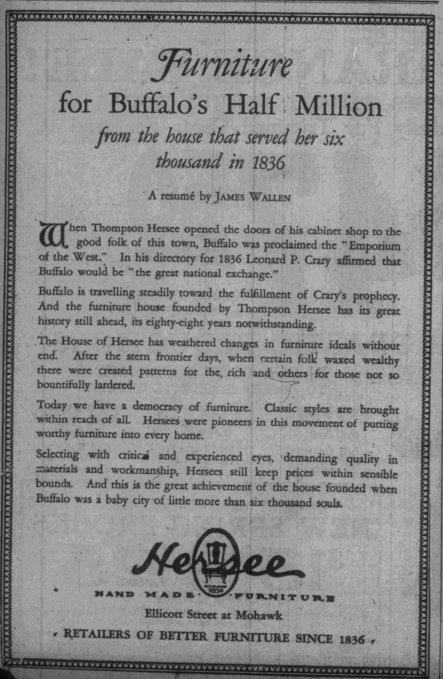
Hersee Ad from January 1924. Source: Buffalo Courier Express.
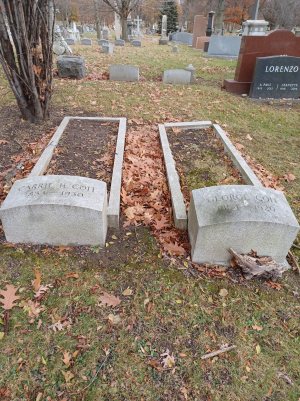
Carrie and George Coit’s graves. Photo by author.
Carrie Hersee Coit died in 1930. Carrie’s estate was valued at $1,000,000 (about $18 Million in today’s dollars) and was to be evenly divided between her six children. The heirs decided to sell several of the properties and close Hersee & Co. to settle the estate. This is also when the Hersee Building was sold to Michael Shea. The Hersee heirs listed the Hersee & Co. property for sale in November 1930. They had a sizeable going-out-of-business sale. After 94 years in business in Buffalo, Hersee & Co. closed in January 1931.
Fun fact: Downtown Buffalo used to be home to many furniture companies. Today, the only remaining furniture business is Scherer Furniture, which actually got its start with Hersee Furniture. Frederick Scherer began working with Hersee & Co. in the 1890s. On April 7, 1897, he established his own firm at 156 Genesee Street. He did business at that site until 1937 when he bought the present location of Scherer Furniture at 124 E Genesee Street. Scherer is currently run by the fourth generation of the Scherer family.
The Hersee & Co. building on Ellicott Street was demolished in 1932 by the Liberty Housewrecking Company. Many of the building materials from the building were salvaged to be resold by the Liberty Housewrecking Company at their site at the corner of Seneca and Oneida Streets.

Hersee Co. on Ellicott Street before demolition. Source: Buffalo Times.
A parking lot was established at 303 Ellicott Street in 1933 by James A Watt and Hector MacDonald. They developed three parking lots in the Ellicott and Oak Streets area. The lot was later operated by Gusto Mattioli and then his wife, Mary Mattioli. In 1951, the site was looked at as a possible location for a parking ramp. The ramp ended up being constructed across Ellicott Street, which is still the site of the Mohawk Ramp today. The parking lot has been owned since 1968 by Ferguson Electric, which operates its business out of the buildings north of the parking lot.

The only known picture of the Hersee Family’s Main Street Orchard. The orchard is where Holy Trinity is now. Source: Holy Trinity.
What happened to the Hersee Estate on Linwood? The Main Street portion of their property was formerly their orchard. The orchard was a popular place for the Hersees to host parties. The orchard portion of the property was sold to Holy Trinity Lutheran Church in 1899, which opened its “new” church on the site in April 1905(note from Angela: this is my church). Holy Trinity Church was designed by Lansing & Beierl, the same architects who designed the Hersee Building on Main Street.
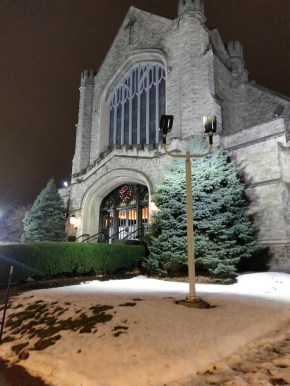
Holy Trinity, located at 1080 Main Street, the former location of the Hersee family’s orchard. Photo by Author

The 1899 Sanborn Map shows Hersee Property outlined in red, with the houses along Linwood. The orchard was located along Main Street.
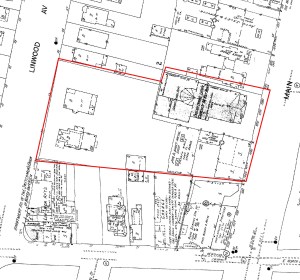
1951 Sanborn Map with the former Hersee Property outlined in red. Note Holy Trinity Church along Main Street and the two houses still standing along Linwood Avenue.
The Hersee Family house at 25 Linwood was sold in 1911. The house stood until the early 1960s. The Coit family heirs converted Carrie and George Coit’s house at 33 Linwood into a rooming house. The 33 Linwood House was purchased by Holy Trinity in 1946. The house was used as a parish house and as a meeting space for various groups. I have been trying to find pictures of the house, but I have not yet been able to. I have contacted a former resident of the house and one of the Hersee-Coit descendants. If I can find a picture, I will add it to the post and share it on Facebook. I was, however, able to talk with a long-time member of Holy Trinity, David Hehr, who was able to provide me with this great description of the house:
“A grand shingle style mansion, 3 stories high, and very dark green colored in its last iteration. It had a protruding three-story side entrance that was circular in shape, and surmounted by a cupola, I recall. This columnar shaped appendage contained the side stairwell that went all the way up to the third floor. You ascended a short flight of maybe 6 or 8 rickety wooden steps up to the porch that led to the side entrance door. Just inside the side entrance door there was a foyer. Believe it or not, in those Baby Boom years, all of the Sunday School classrooms in the rooms above the church offices were filled to capacity, so 33 Linwood was used for overflow classrooms. Three rooms on the first floor of the mansion were used. The front room, along the south and east (possibly the dining room and adjoining kitchen?), was where I had my 5th grade class. The front room, along the south and west side, was where we had my 6th grade class. There was also a room in the middle, which led from the foyer off in a northerly direction, and which had no windows. Each of these three rooms fanned out from the side entrance. I recall white marble fireplaces in each of the three rooms. Each room also could be closed in from the foyer by pocket doors containing multiple panel grid-like glass lites. Directly behind 33 Linwood, between the mansion and the church offices, the Sunday School created the “Garden of Praise,” a nice flower and shrub garden with a picket fence, curving trellis with roses and ivy climbing up it, etc.”
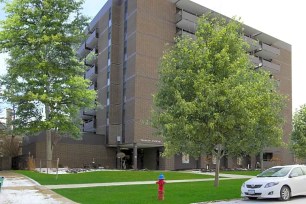
Trinity Towers at 33 Linwood Avenue
The Coit House at 33 Linwood Avenue was demolished in 1970 to build Trinity Towers, an 83-unit senior housing complex. The $2 Million apartment building, Trinity Towers, opened in 1971. It was the first private development in Buffalo in which financing through the New York State Housing and Urban Renewal Commission was combined with federal interest subsidy loans. Trinity Towers still operates as affordable senior housing today.

Modern view with Former Hersee property outlined in red. Holy Trinity Church along Main Street and Trinity Towers along Linwood Avenue.
The next time you drive past Hersee Alley, think of the nearly 100 years of a furniture business that operated here in Buffalo. Check the back of any old furniture pieces; you can still find Hersee pieces occasionally. If you have a piece, I’d love to see pictures of it! Here’s a link to an example of one of their pieces: https://www.chairish.com/product/8404637/early-1900s-hersee-co-furniture-american-empire-period-flame-mahogany-veneer-mirrored-tall-chest-of
Want to learn about other streets? Check out the Street Index. Don’t forget to subscribe to the page to be notified when new posts are made. You can do so by entering your email address in the box on the upper right-hand side of the home page. You can also follow the blog on Facebook. If you enjoy the blog, please share it with your friends; It really does help! Interested in getting even more content from me? You can become a Friend of Buffalo Streets on Patreon, where I post unique extra content at least once a month. You can go to https://www.patreon.com/buffalostreets/ to join.
Sources:
- “Died.” The Buffalo Advocate. July 30, 1863, p3.
- “Died.” Buffalo Courier Express. August 16, 1859, p2.
- “Death of William M. Hersee.” Buffalo Courier Express. October 1, 1891, p5.
- “George Coit’s Sudden Death a Great Shock”. Buffalo Times. January 22, 1920, p1.
- “85th Birthday of Hersee Co.” Buffalo Times. September 30 1931, p4.
- “Plumbing and Building Supplies at Low Prices.” Buffalo Times. February 20, 1932, p14.
- “Hersee & Co to Close Forever on Wednesday”. Buffalo Courier. January 18, 1931.
- “Hersee & Co Closing up After 94 years in City”. Buffalo Courier. October 19, 1930.
- “Old Established House of Hersee and Co Still Leads for Best Goods in All Grades.” Buffalo Express. March 23, 1902.
- “Thompson Hersee.” Buffalo Times. September 3, 1921.
- “Incorporation Papers Are Filed By Local Concerns.” Buffalo Courier Express. April 21, 1932, p22.
- “New Building On Main Street”. Buffalo Commercial. April 29, 1902, p9.
- “A New Feature.” Buffalo Commercial. May 18, 1879, p1.
- “A Model Establishment – The Furniture Exhibition Rooms of Messrs T. Hersee & Co.” Buffalo Commercial. April 29, 1870, p3.
- “New Hotel Enterprises – The Hersee House.” Buffalo Courier Express. March 8, 1873, p1.
- “Corporation Proceedings.” Buffalo Times. April 21, 1885, p3.
- “The Sites Offered for the New Buffalo Post Office.” Buffalo Commercial. April 25, 1888, p3.
- “Notice to Creditors.” Buffalo News. May 12, 1888, p25.
- “Funeral of Mrs. Hersee.” Buffalo Commercial. June 12, 1901, p9.
- “Seeks Part of Hersee Estate.” Buffalo Enquirer. April 12, 1904, p6.
- “Lost His Fight for a Fortune.” Buffalo News. April 16, 1904, p1.
- “Parking Privilege Nearly Upsets Main Street Deal.” October 12, 1924, p86.
- “Chippewa and Tupper Streets Fashionable Center When Main Street Was Van Stophorst Avenue.” Buffalo Courier. October 26, 1924, p68.
- “Laube’s Building to Be Renovated.” Buffalo News. February 12, 1985, p32.
- “Old Spain Renovation Has May Target Date.” Buffalo News. March 4, 1980, p35.
- “Mrs. Mary P Mattioli.” Buffalo Courier Express. July 23, 1963, p13.
- “Lux Baffled by Associates on Ramp Votes.” Buffalo Courier Express. July 11, 1951, p1.
- “Furniture Man Reviews his 50 Years in Field.” Buffalo Courier Express. November 19, 1944, p39.
- “Building Permits.” Buffalo News. February 28, 1936, p37.
- “Hersee Home Sold.” Buffalo Times. March 16, 1911, p13.
- This Faith Tremendous. Holy Trinity Lutheran Church, Buffalo, 1979.
- “Coit Will Disposes of $1,000,000 Estate.” Buffalo News. July 9, 1930, p14.
- “Site Embracing Shea’s Buffalo Changes Hands.” Buffalo Courier Express. June 7, 1931, p35.
- “Linwood Rezoning Asked by Church for Elderly Housing.” Buffalo News. June 25, 1970, p38.
- “Holy Trinity Lutheran Battles City Blight.” Buffalo News. October 10, 1970, p5.
 Discovering Buffalo, One Street at a Time