 Sidway Street runs for three blocks between South Park Avenue and a railroad line property in the First Ward neighborhood of South Buffalo. The street is named for Jonathan Sidway and runs through land that used to be a farm that was owned by the Sidway family, an influential early Buffalo family.

Jonathan Sidway. Source: Ancestry.com User lhstjohn1
Jonathan Sidway was born on April 1, 1784 in Goshen, New York in Orange County. He worked as a farmer in the Goshen area until he came to Buffalo in 1812. His parents, James and Rebecca Sidway also came to Buffalo around that time. Jonathan was looking for work in the shipping business when he came to Buffalo. He became a successful merchant and the owner of the brigs Union and Huron and the Schooner Rachel. These were some of the first vessels to sail out of the Buffalo Harbor. Jonathan Sidway was also founder of Buffalo’s first gas company and a director of Farmers and Mechanics National Bank. He was also involved in real estate, including a large farm on Doat Street and the farm where Sidway Street is now located.

Approximate boundary of the former Sidway Farm in the First Ward.
Mr. Sidway married Parnell St. John on January 1, 1826. Parnell was the daughter of Margaret St. John. During the Burning of Buffalo during the War of 1812, Margaret St. John’s house was one of only three buildings left standing after Buffalo was burned by the British. St. John Place is named for the St. John Family. Jonathan and Parnell Sidway had 9 children – daughters Katherine, Maria, Parnell and Helen, and sons Dewitt, Jonathan, Franklin and James. Only Katherine, Jonathan, Franklin and James lived to adulthood. The Sidway family were members at First Presbyterian church. The Sidway family originally lived on a farmhouse on Elk Street (now South Park Avenue) on the land that became Sidway Street. When the City of Buffalo was formed in 1832, the Sidway farm was along the eastern boundary of the city of Buffalo, which was considered to be “way out in the countryside.”

Michael Shea’s Proposed Music Hall to be built on the site of Jonathan Sidway’s former house in 1895. Designed by Bethune, Bethune and Fuchs. Source: Buffalo Courier
On January 3, 1826, Mr. Sidway purchased Holland Land Company Lot 27 – located on the east side of Main Street between Huron and Chippewa Streets (now the location of M&T Center at Fountain Plaza, just north of the Gold Dome bank). In the mid-1830s, Jonathan Sidway built a two-story frame house on the site. The house had an orchard and gardens. Over the years, the block became more commercialized and the family moved north of downtown. The Sidway house on Washington Street was demolished in the 1895 for Michael Shea to build a concert hall. The Concert Hall was designed by architects Bethune, Bethune & Fuchs (the firm of Buffalo Gal Extraordinaire – Louise Bethune, the first female architect! However, newspaper articles of the time indicated that this building was designed by W.L Fuchs, not by Louise.) The building was to be an Italian Renaissance style building, built of brick with a frontage along Washington Street of a light buff colored brick. It was to have a grand lobby, fitted with mirrors and onyx trimmings and a mosaic floor. It was to be one of the largest theatres in the country. It was to have 24 dressing rooms, which were conveniently located and of sufficient size, which were not found in any other Buffalo theatre at the time. The main auditorium was to be 91 feet square and have a seating capacity of between 700 and 800, and 55 feet high ceilings. The building was to be lit by electricity with a large chandelier in the center of the auditorium, 34 feet in diameter. The theatre was to be funded half by Iroquois Brewery and half by Mr. Shea. It was expected to cost between $75,000 and $100,000 (between $2.7 and $3.6 Million in today’s dollars). However, they had difficulty getting loans to build a building on for theatrical purposes, so the plans were abandoned and it was decided that stores would be built on the site instead. Mr. Shea eventually did build a theater in this area – the west side of Main Street between Huron and Chippewa was the long time home to the Hippodrome Theatre which opened in 1914. And of course, Michael Shea eventually got his large, super grand theatre on the next block to the north – now known as Shea’s Performing Arts Center, still a popular theatre today!

1872 atlas map showing the Sidway Mansion. Hudson Street is located at the bottom of the image. Note the house on the lower part of the block with the circular drive in front of it and the pathway leading to the carriage house in the center of the block. The carriage house was later a part of son Franklin Sidway’s property at 30 Plymouth after the property was subdivided and parts of it are still standing today.
In 1843, the Sidway family moved from Washington Street into a large home at 290 Hudson Street. The house was originally built by Benjamin Rathbun around 1834 for Mayor Pierre Barker and was also considered to be far out in the country at the time. The house sat on the center of the block, bounded by Plymouth, West, Hudson and Pennsylvania. The house was surrounded by old trees and flowering shrubs in a park-like setting. The grounds were laid out in large circles, one directly in front of the house and another between the house and West Avenue. The house was considered to be one of the most beautiful in the City. It had ornate gilt cornices above the doors and windows, exquisite lace curtains hung in the windows. The house had three drawing rooms on the first floor facing the West Avenue side of the house. The rooms were furnished with carved rosewood furniture upholstered in satin damask. On the other side of the main hall was a sitting room with large black marble mantle and a dining room with a glass enclosed piazza in front of it. The house was so large that in order to be comfortable in it during the winters, the family would close off the upper rooms. They kept a cow in the backyard barn to provide milk for the family.

Sidway Block – Main Street is on the right, Upper Terrace is in the foreground. Source: https://www.rootneal.com/
In 1832, Jonathan Sidway built one of Buffalo’s first brick block buildings. The Sidway Block consisted of 19 stores. The Sidway Block was located along Main and Upper Terrace at 172-194 Main Street and 7-25 Upper Terrace (now a part of One Seneca Tower). Mr. Sidway had owned a portion of the property since 1819! The offices of Jonathan Sidway’s ship chandler firm – Sidway, Skinner & Moore were located on the second floor of the building. The building stood for more than 130 years before it was torn down. Starting in 1905, the building was home to Root & Neal, an industrial supply company. Root & Neal moved to Peabody and Perry Streets in 1960 and they still in business today as a fourth generation Buffalo-business.

1894 City Atlas. Sidway Block outlined in red. Note Bemis Alley and John Street, two non-extant streets on the same block as the Sidway Block of buildings.
As you can see in the image above, to the rear of the Sidway Block were two additional streets that no longer exist – Bemis Alley and John Street. Bemis Alley was named for Asaph Bemis, Jr, who married to Jonathan Sidway’s daughter Katherine in 1844. Asaph Bemis was a grocer and Alderman. Asaph was the daughter of Asaph Bemis, Sr. and Aurelia St. John. Aurelia was Parnell St. John Sidway’s sister. So, Asaph and Katherine were first cousins who married! I’m not sure who John Street is named for….but I wonder if it were in homage to the St. John family? St. John Place did not exist in Buffalo until the late 1880s and John Street was named before that. I wasn’t able to find any information about John Street, so it’s all just conjecture. Bemis Alley and John Street are no longer extant, they are now part of the site of Seneca One Tower.
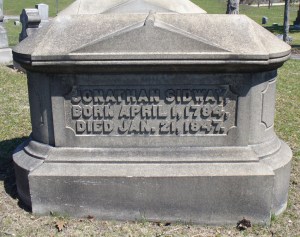 Jonathan Sidway died in 1847. His estate was estimated to be worth $1 Million (about $30 Million in today’s dollars). Sidway street was laid out and named in Jonathan’s honor in January of 1854. The street was proposed by Alderman Asaph Bemis. Both Fitzgerald Street and Katherine Street were laid out and named during the same council meeting, so I believe that Katherine Street may have been named for Katherine Sidway Bemis. Do any First Ward historians know? I wasn’t able to find any sources indicating any rationale behind the name.
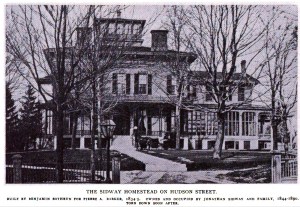
Sidway Mansion on Hudson Street. Source: Picture Book of Earlier Buffalo.
Mrs. Parnell Sidway lived in the Hudson Street house after the death of her husband, until her death in 1879. After Mr. Sidway’s death, several family members came to live with the family to help Parnell with the kids – who were ages 20, 15, 13, and 8 when Jonathan died.
In 1850, Parnell, Jonathan Jr, Franklin and James lived in the house with Parnell’s sister-in-law Elizabeth Sidway(who had been Jonathan’s sister-in-law technically), along with servants Francis Skinner, Elizabeth Lafever, Mary Bertrand, William McDonald, M Dolan and Anna Page.

One of the Drawing Rooms at the Sidway Mansion. Source: Picture Book of Earlier Buffalo
In 1860, the house was home to Parnell and her sons, Franklin and James. Daughter Katherine and her husband, Asaph Bemis also lived with the family, along with Parnell’s brother, Le Grand St. John, and servants John McGinnis, Bridget McGinnis, Margaret Hoag, and Agnes Kearns.
In 1870, Parnell lived with son Jonathan, his wife Caroline and their children Gertrude, Jonathan, William and Kate. Also living in the house were servants Jane Baudin, Sarah Smith, Elizabeth Jeffcott, Nellie Riley, Ann Singleton and William Smith.

1872 Atlas showing the Sidway family properties near Sidway Street that were still owned by the Sidway family – Franklin, Jonathan Jr, Mrs. Parnell Sidway and Katherine Bemis.
When Parnell Sidway was close to death in 1879, the Buffalo Times reported that “she has survived her husband thirty years and has managed his big estate with great ability. She has been a woman of great force of character and was benevolent and generous to a large degree.” Mrs. Sidway had also been involved with the Old Settler’s Festival, along with Mr. and Mrs. Bristol who we learned about in our last post.
After Parnell’s death, in 1880, the Hudson Street house became home to Parnell’s son Franklin Sidway, his wife Charlotte Spaulding Sidway, and their sons Harold, Franklin, Edith and Clarence. They were joined by their servants Ann Dewey, Ellen Hanrahan, Mary Dewey, John Beckman, Peter Villikes, Jennie Villikes, and Annie Clark.
The Sidway Mansion was demolished around 1891 and the property was sold off to be developed with houses. Franklin Sidway built a house on the family property at 30 Plymouth Avenue. The 30 Plymouth Avenue house includes the original brick stable from the Sidway Mansion, both of which are still standing today. The Sidway property at 30 Plymouth Avenue, was sold by son Frank Sidway in 1907. It has been subdivided into apartments, but it is still standing.

Edith Sidway Stevens and her husband Stevan Stevens in their office at the Spaulding Block in 1959. Source: Buffalo News. Note the picture of the Sidway block in the rear, which I believe is the same picture seen earlier in this post.
The Sidway Block building stood for more than 13 decades. After Jonathan’s death, his wife Parnell took over the firm of Sidway, Skinner & More, which shifted from ship chandlery to real estate over time. Sons Franklin and Jonathan Jr and daughter Katherine were all involved with the company as well. Son James became a firefighter, and unfortunately perished at the age of 25 in the fire which destroyed the American Hotel on Main Street near Court Street in 1865. Franklin married Charlotte Spaulding, whose father was Elbridge Spaulding and had the Spaulding Exchange, a mercantile operation across the Terrace from the Sidway block. Franklin helped to manage the Spaulding Exchange and the offices of the Spaulding Exchange were located in the Sidway Block. The Sidway Block stood until the late 1960s. In later years, only the first floor spaces were occupied, with the exception of the second floor offices of Stevens & Strong, a real estate company run by Steven Stevens, the husband of Edith Sidway – a fifth generation Buffalo Sidway. Edith worked as a real estate agent and had a desk in the offices, following a long tradition of Sidway women who had offices in that space, starting with her Great Grandmother Parnell St. John Sidway!
The Sidway Block was demolished in 1969 as part of the Waterfront Renewal project undertaken by the City of Buffalo. The City was looking to take possession of the property to convey the land to Cabot, Cabot & Forbes for the Marine Midland Project to build the tower now known as Seneca One Tower. In December 1967, exactly 154 years after Margaret St. John refused to let her house burn during the War of 1812, Margaret’s Great-Great Grandaughter, Edith Sidway Stevens was interviewed while sitting in her office, the last occupant in the Sidway Block, watching buildings get demolished all around them. She was quoted as saying, “We would have stayed indefinitely, we had no interest in going anywhere else. Oddly, we like the location.”
The Sidway Block property underwent condemnation proceedings in February 1969 and the Supreme Court set a price of $282,750 (about $2.4 Million in today’s dollars) for the property. City Council appealed the price. The City of Buffalo had given the owners a low-ball offer of $104,000 for the property (about $850,000 in today’s dollars). City Counsel met with the Sidway family owners and a compromise price of $250,000 was arrived at for the property, which would have saved the City $32,000 (about $260,000 in today’s dollars). City Council then refused to accept the compromise price, preferring to go through the Courts. The Court then affirmed the fair market value at $282,750 and the City had to pay that, as well as the additional costs of the appeal.
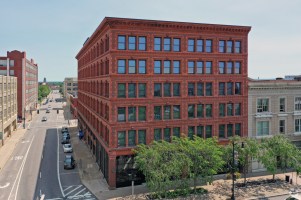
Sidway Building at Main and Goodell. Source: Matthew Friend, Google Maps Images
In 1907, Franklin Sidway erected the Sidway Building, a six-story terra cotta building designed by architects McCreery, Wood and Bradney. The building was located on the site of the house where Franklin’s wife, Charlotte Spaulding, had grown up. It must have been confusing when people would refer to the Sidway Building and the Sidway Block, which were two separate buildings on Main Street in either end of the Central Business District! The building has been renovated into apartments.
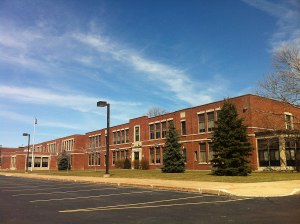
Sidway School, Grand Island. Source: Wikipedia
Franklin Sidway and Charlotte preferred country life to city life. Franklin built a home on Grand Island in 1898, called River Lawn, and they moved to River Lawn from their home at 30 Plymouth Avenue. River Lawn was occupied by Charlotte Spaulding Sidway until 1931 when the 400-acre estate was sold to New York State to become a part of Beaver Island Park. Charlotte was the daughter of Elbridge Spaulding. Charlotte Sidway Elementary School on Grand Island is named after Charlotte, who passed away just before the school opened. You can learn more about the Sidway Building, River Lawn and Charlotte’s family in the post about Spaulding Street here: https://buffalostreets.com/2022/12/23/spaulding/
So the next time you drive past Sidway Street or the Sidway Building, think of the Sidway family and remember when there were farms in the First Ward and that Hudson Street was way out in the country. And next time you visit Seneca One, stop for a moment to think about the 135 years of the Sidway Block standing at its location. Want to learn about other streets? Check out the Street Index. Don’t forget to subscribe to the page to be notified when new posts are made. You can do so by entering your email address in the box on the upper right-hand side of the home page. You can also follow the blog on facebook. If you enjoy the blog, please be sure to share it with your friends, it really does help. This past week, a reader posted an old post in a facebook group and more than 5,600 people read that post this week! If you’re coming from Buffalo, A Talk of the Town – welcome new readers!! Interested in getting even more content from me? You can become a Friend of Buffalo Streets on patreon. You can go to https://www.patreon.com/buffalostreets/
Sources:
- “Sidway Street Honors Memory of Pioneer in Shipping, Realty” Courier June 18, 1939, p16.
- “Fifty Years Ago.” Buffalo Times. April 21, 1929, p16.
- “One Hundred Years Ago.” Buffalo Times. July 16, 1922, p32.
- “Death of Mrs. Parnell Sidway.” Buffalo Weekly Courier. April 30, 1879, p7.
- Cook, Anna Hoxie. “When Buffalo Was Young – Sidway Mansion on Hudson Street a Show Place.” Buffalo News. March 2, 1936, p13.
- “Relic of Long Ago: Manager Shea’s New Theatre Will Take Place of the Old Sidway Residence.” Buffalo Commercial. February 9, 1895, p10.
- “Bernard Duffy Buys Home on Linwood Avenue: JB Healy Buys Last of the Old Sidway Homestead Property on Plymouth Avenue.” Buffalo News. June 1, 1907, p22.
- “Shea’s Proposed Music Hall.” Buffalo Courier. March 10, 1895, p11.
- “Mr. Shea’s Theater: That Magnificent Variety House Will Not Be Built on Washington Street.” Buffalo Commercial. May 14, 1895, p11.
- “Shea’s New Theatre.” Buffalo Commercial. February 23, 1895, p11.
- Turner, Fred. “The Old Sidway Block: A Volume of Buffalo History.” Buffalo News. October 31, 1959, p15.
- Zubler, Bud. “Council Tries to Dicker-Court Costs Added to Bill”. Buffalo News. April 2, 1969, p33
- Smith, H. Katherine. “Men Of Vision Built the Sidway Block.” Buffalo Courier Express. November 20, 1955, p96.
- Taussig, Ellen. “Protection of Its Property is a Sidway Family Tradition.” BuffalO News. December 30, 1967, p2.
- “Root Neal Leaving Main Street Where Its Been 52 Years.” Buffalo News. February 6, 1960, p16.
 Discovering Buffalo, One Street at a Time
Thank you. I truly enjoy each edition you produce.
Ron Smith
Amherst
I find your writing so interesting even though I know none of those family names. Thank You.
This is amazing!
My favorite part is the picture where you note that in the background, a picture you had previously shared is on display. Like art imitating life. It tickled me.
Also, Stevan Stevens? Mean parents to name him that. LOL.
Sharing this on Sidways channels now.
[…] District were converted into commercial sites – such as the Spaulding Building and the Sidway Building. The Hersee Building is still standing at 646-662 Main […]